New integrated impact assessment method
This graduation study contains two reports and a loose supplement. The main report is titled “Strategic Impact Assessment; a new impact assessment method using value
engineering and system engineering elements.” The main report can be found from page 2 through to 64. An appendix to this report is the case study, titled “Strategic impact
Strategic Impact Assessment
A new impact assessment method using value engineering and system engineering elements.
By: ing. R.S.Versluys
University of Twente June 2006
Graduation committee:
Preface
Large construction projects can potentially change the lives of many people. Due to the nature of these projects they are usually irreversible and not suited to be constructed temporarily to determine their impact. This means decision makers and stakeholders alike want to have reliable information about the impact of a project before any irreversible decisions are made. An impact assessment is a document that aims to give a prediction of the impact that a project will have. There are several forms of impact assessments, for example the environmental impact assessment, the social impact assessment and the economic impact assessment. Currently each of these impact assessment fields generates their own report, which contains information about one impact aspect only. Questions are raised whether the current method of impact assessment delivers the information that is required to make well-informed decisions. As indicated the impact assessments are currently following an aspect-by-aspect approach, delivering detailed information on the specific fields, but neglecting cross links between the aspects. The resulting separate impact assessment reports may be contradicting or review different alternatives of the same project.
This report develops a method for impact assessment based on the construction management methods of value- and system engineering. Using these methods the aim is to develop an integrated impact assessment method that reviews all impacts in a single document, allowing the review of links between the impact fields. This study is performed as part of achieving a master degree for Civil Engineering and Management at the University of Twente in the Netherlands.
Using the developed integrated impact assessment method a case study was performed. The case study is available as a separate document, titled ‘Strategic impact assessment golf resort St. Eustatius’. It reviews the economic, social and environmental impact of a planned golf resort on the island of St. Eustatius.
The case study was performed on the island of St. Eustatius on request of the St. Eustatius Business Association (STEBA). The impact assessment is partially based on an earlier feasibility study performed by Rob Blokvoort and Tom Tiggeloven, both students of the University of Twente. I wish to express my thanks to the STEBA for providing me with the opportunity to perform this impact assessment and especially for the hospitality and warm welcome by STEBA president Mr. Koos Sneek and Mrs. Nora Sneek-Gibbs.
An impact assessment is not possible without information from the stakeholders. During the time on the island I have therefore discussed the impact with a large number of local
businesses, (public) organisations and (government) agencies. I wish to thank these persons for the time they spend answering my questions and for the information they have provided. Furthermore I want to thank my graduation committee, Ir. K.Th. Veenvliet, Dr.Ir. S.J. de Boer and Dr. Ir. M.J. Kolkman for their support and (constructive) criticism, which together
Table of contents
Executive summary __________________________________________________________ 5
1 Research plan __________________________________________________________ 7
1.1 Background and objective ___________________________________________ 7 1.2 Problem formulation________________________________________________ 9 1.3 Research questions ________________________________________________ 11 1.4 Research approach ________________________________________________ 12
2 Methodology __________________________________________________________ 13
2.1 Theory __________________________________________________________ 13
2.1.1 Requirements and theory for the Integrated Impact Assessment ____________ 13
2.1.2 Environmental Impact Assessment___________________________________ 15
2.1.3 Value engineering________________________________________________ 16
2.2 Framework ______________________________________________________ 23
2.2.1 Screening ______________________________________________________ 24
2.2.2 Scoping ________________________________________________________ 24
2.2.3 Requirements analysis ____________________________________________ 24
2.2.4 Function allocation _______________________________________________ 25
2.2.5 Synthesis _______________________________________________________ 25
2.2.6 Impact analysis __________________________________________________ 26
2.2.7 System analysis and control ________________________________________ 27
2.2.8 Mitigation ______________________________________________________ 28
2.2.9 Evaluate and report _______________________________________________ 29
3 Case study ____________________________________________________________ 30
3.1 Screening ________________________________________________________ 30 3.2 Scoping __________________________________________________________ 30
3.2.1 Stakeholders ____________________________________________________ 30
3.2.2 Stakeholder requirements __________________________________________ 31
3.2.3 Legislation _____________________________________________________ 32
3.2.4 Local situation __________________________________________________ 32
3.2.5 Conclusion _____________________________________________________ 33
3.3 Requirement analysis ______________________________________________ 34
3.3.1 Functions ______________________________________________________ 34
3.3.2 Attributes ______________________________________________________ 34
3.3.3 Constraints _____________________________________________________ 35
3.4 Function Allocation________________________________________________ 37 3.5 Synthesis_________________________________________________________ 38
3.5.1 Conclusion _____________________________________________________ 39
3.6 Impact analysis ___________________________________________________ 40
3.6.1 Impact analysis of the provisional design______________________________ 40
3.6.2 Conclusion _____________________________________________________ 42
3.8 Evaluate _________________________________________________________ 44
3.8.1 Conclusions ____________________________________________________ 44
4 Conclusions and recommendations ________________________________________ 45
4.1 Conclusions ______________________________________________________ 45 4.2 Reflection ________________________________________________________ 46
4.2.1 Relevance of the thesis ____________________________________________ 46
4.2.2 Making of the thesis ______________________________________________ 46
4.2.3 Usefulness of the integrated approach ________________________________ 47
4.3 Recommendations _________________________________________________ 49
5 Literature_____________________________________________________________ 50
Executive summary
Impact assessment is an important tool to inform decision makers and stakeholders in advance about the impact their decisions will have. Within the field of impact assessment an aspect-by-aspect approach is currently used. For each impact, economic, social and environmental, a different team will write their own report. Links between the impact fields can therefore not be taken into account. The different reports often review different alternatives and may be contradicting. Based on the incomplete, inconsistent and sometimes contradicting information, decision makers currently have to draw their own conclusion about the overall impact of the project.
From the impact assessment community there are calls for a new ‘integrated impact assessment’ method. This method should deliver a single document, which reviews all the impact fields. The method should offer traceability, assuring that decisions made during the impact assessment process are made explicit and traceable. It should make second order effects visible, which are effects caused by the impact of the main project. Finally it should provide the links between the impact fields, making trade-offs between the impacts on different impact fields possible.
Based on the observed problems in the impact assessment community, this report asks the
question: How can the methods of system engineering and value engineering be integrated with
the environmental impact assessment and can the resulting integrated impact assessment method be used to find and solve or mitigate the environmental, social and economic impact of
a planned golf resort on St. Eustatius? The question contains two phases. The first is a theory
developing study, which develops the integrated impact assessment (IIA) method. The second phase is a case study, which applies the created method to find benefits and limitations. It was found that the current impact assessment procedure has a large resemblance with a design process. Based on stakeholder requirements different alternative designs are created, which are reviewed for their impact. Within the field of construction management the design process also plays a prominent role. The methods of system engineering and value engineering are used to combine the expertise of different experts and work with the stakeholders to reach a design solution. It is therefore expected that the construction management methods can offer a new framework for the integrated impact assessment process.
Using the IIA method a case study was performed on the island of St. Eustatius. The case study reviews the economic, social and environmental impact of a planned golf resort. By reviewing the process of creating the case study and reviewing the result it is possible to, at least based on this case, find the benefits and limitations of the method.
Report
Evaluate
- remaning impact
Scoping
-stakeholder requirements - verification criteria
Function Allocation
- Generate lower level functions
Screening
Requirements Analysis
- Functions - Attributes
-Constraints attributes/ add
constraints to new functions
Synthesis
- Functions to physical solutions - Alternative project solution
development - Select most appropriate product /
process solution
Missing functions?
Impact Analysis
- review impact per system- and between
system components
Mitigation
- establish measures that are necessary to avoid or minimize
adverse impact
Verification loop
System analysis and control
- Tradeoff studies - Data management - Configuration management
Most appropriate? / Missing system
solutions
Figure 0.1 – new Integrated Impact Assessment method.
The results of the case study indicate that the IIA method is indeed able to provide traceability,
can show links between impact fields, make 2nd order effects visible and can present all impacts
in a single report.
The specific situation of the case study is that the project is located on a small island. This simplified the case study, as the golf resort affects the whole island and the available resources are relatively easy to determine. It was not possible to use a workshop approach on the island, whereby multiple team meetings would be planned. Instead, an interview approach was used, with a single workshop at the end of the study to review the results with the stakeholders.
1 Research plan
1.1 Background and objective
Within the field of the Environmental Impact Assessment (EIA) there are calls for a more integrated approach to impact assessment [MER-Commission, 2001]. Currently there is segmentation within the impact assessment field, whereby different teams of experts work on impact reports aimed at different impacts (social, economical, historical, environmental, etc). Decision makers will therefore receive several reports, whereby each report may come to different conclusions. The different reports do not show links between the impacts either. This means that decision makers now have to make decisions by reading between the lines to find links between impacts. They then have to draw conclusions from several separately performed studies which may very well contain conflicting information. An integrated approach should enable decision makers to make a decision based on a single document, that reviews the impact on all fields and also shows links between these impact fields.
The impact assessment process appears to be one where first, a preliminary design of the project is created after which this design is reviewed for its impact. Within the field of
construction management, the methods System Engineering (SE) and Value Engineering (VE) are two methods that are used to determine the full set of functions of a project and
systematically turn those functions into solutions. By using these two methods it should be possible to create a preliminary design that includes all impact fields and their links. The hypothesis is that reviewing this preliminary design for its social, environmental and economic impacts will give a good overview of the complete impact of a project.
Based on this background, the objective of this study is to develop an integrated impact assessment method by combining the above-mentioned methods. This integrated impact assessment method will then be used to execute an impact study on the island of St. Eustatius, in the Netherlands Antilles.
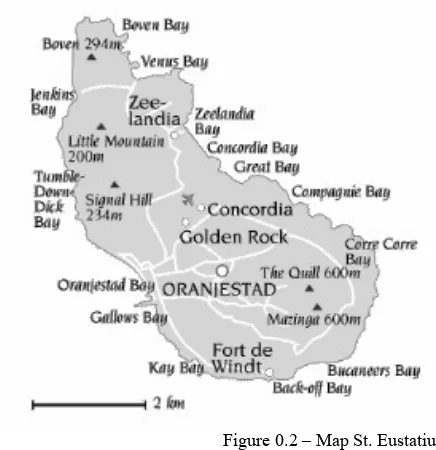
With a landmass of 21km2, St. Eustatius is one of the smaller islands of the windward island
group located in the northeastern Caribbean. The Quill, a dormant volcano, covers a large portion of the island. Even though in 2003 the BNP was the highest of the smaller islands, unemployment is at 6 – 10% and increasing [Staten Generaal 2003]. A large employer on the island is Statia Terminals B.V., which operates a large crude oil transshipment facility. Along with this facility, tourism and a medical school play important roles in the economy of the island.
The island promotes itself as an eco-tourism delight. The main attractions are the two national parks with rare flora and fauna as well as the good diving conditions due to the ample marine life and historic shipwrecks around the island.
The objective of the research therefore is: Objective:
To combine the (strategic) environmental impact assessment with the construction management methods of value engineering and system engineering, testing the resulting method by applying it to a planned golf resort on the island of St. Eustatius.
The methods of value engineering and system engineering are combined with the
environmental impact assessment method. This results in the new integrated impact assessment method. The word integrated in this context means that, instead of looking at only one field at a time, this method will review all impacts. The expected advantages of this integration are:
• The decision maker gets a single report which draws conclusions based on all information.
• The method will show links between the different impact fields.
• Recognising links makes it possible to solve negative impacts more effectively and
1.2 Problem formulation
The problem formulation determines, amongst other things, the scope of the research. In search of an appropriate project formulation the following has been taken into account:
Theory developing and case study
The research can be split up in two phases. The first phase is a theory developing study, which will develop a new impact assessment methodology, based on an evaluation of the problems with the current EIA method and relevant literature on VE and SE. When the theory has been developed, the research will switch to a case study, to test the method in a case situation. The characteristics of a case study [Doodewaard et al., 2000] are a small number of research objects, a labour intensive approach, more depth than width, qualitative data and research methods and research on location.
Integrated Environmental Impact Assessment
As indicated in the previous section, the environmental impact assessment community is looking for a more integrated approach to the impact assessment methodology. What is the current procedure and what is wrong with it that causes the call for an integrated approach? Currently an Environmental Impact Assessment is a procedure that is individually performed. According to the best practice procedure [IAIA, 1999] it should be applied as early in the decision making process as possible.
Environmental Impact Assessment follows an ‘aspect by aspect’ approach [MER-Commission, 1998], which means that for every field of impact assessment, a different report is written. This results in an Environmental impact report, a Social impact report, an Economic impact report, etc. The lack of integration in this approach causes cross-links between different impact assessment aspects not to be taken into account. The approach therefore delivers an incomplete view of the impacts.
From two subsequent reports by the MER-Commission [1998, 2001], which will be discussed in detail in paragraph 2.1, it can be concluded that indeed there are problems with the current EIA procedure. The solution to this problem is mostly sought in integrating the various impact assessment studies and by getting the different experts to communicate with each other. The integrated assessment is thought to lead to a better-informed decision making process, which will lead to more fitting solutions regarding the mitigation of negative impacts.
Construction management methods
Environmental effects
Throughout the report the term “environmental effects” will be used. This term is intended in the wide sense of the word, as the effects something has on its surrounding. Environmental effects therefore include the biological, social and other relative effects that a project has. Based on the previous considerations, the problem formulation for the project can be defined as follows:
Problem formulation:
How can the methods of system engineering and value engineering be integrated with the environmental impact assessment and can the resulting integrated impact assessment method be used to find, solve or mitigate the environmental, social and economic impact of a planned golf resort on St. Eustatius?
The first step will be combining the value engineering and system engineering methods with the environmental impact assessment. It is expected that using value- and system engineering methods will structure the process of an impact assessment. The assumption made is that this impact assessment method makes it possible to combine or integrate impact assessments on several fields (environmental, social and economical) into one study.
Integration
A possible definition of integration is ‘The activity of combining data from multiple data
sources to present a single collection of data’ [IL1]. The word integrated within this report is used in this meaning. The multiple data sources are the three fields of impact (economic, social and environmental) which are combined ‘integrated’ in a single method and thus a single report. This makes it possible to review links between the data that are now lost because the data is presented individually.
1.3 Research questions
The main research question is the problem formulation. This is the question that is ultimately to be answered. However, because this is a much too complex question to answer directly it has been divided into several research questions. When these questions have been answered, the problem formulation has also been answered. The research and thus also the research questions can be divided in two stages. Question one is a theory-generating question. Questions two through to five are questions that follow a design-oriented approach. This is appropriate for the research, as the research first aims to develop an integrated impact assessment method. Using this method a design problem will be solved.
1. What does the integrated environmental impact assessment method look like?
a. What are the requirements for an integrated impact assessment method and is there a theory to support it?
b. What are the basic characteristics of an Environmental Impact Assessment? c. What is Value Engineering and how does it improve integration?
d. What is System Engineering and how does it improve integration? e. What should the procedure for the integrated assessment method be? 2. What are the requirements regarding the golf resort project?
a. Who are the stakeholders?
b. What requirements/ wishes do the stakeholders hold about the golf resort? c. What legislation is relevant?
d. What is the situation at the proposed site(s) of the golf resort? 3. What does the provisional design of the golf resort look like?
4. What is the result of the impact analysis of the provisional design?
5. Which improvements can be made regarding the negative impact of the golf resort and what are the remaining effects?
a. Which improvements can be made to reduce or solve the negative impact of system elements?
1.4 Research approach
The research consists of two parts. First an integrated impact assessment method will be created. This part can be described as a theory developing research. The integrated impact method will be based on the current methods of EIA, VE and SE. To test this new method a case study is performed. In this project the case is a golf resort on the island of St. Eustatius. Using the integrated impact assessment method the impact of the golf resort will be reviewed and where possible negative effects will be solved or mitigated. Based on the case study the integrated impact assessment method will be reviewed for its benefits and limitations. A diagram containing an overview of the research approach is included in appendix I.
Chapter two will develop the integrated impact assessment method, which is the framework for the case study executed in chapter 3.
Chapter 2.1 will answer research question 1a through to 1c. It will establish the theory required to answer research question 1d, which is answered in chapter 2.2. Chapter 2.2 develops the framework for answering the case research questions (question 2, 3, 4 and 5).
Chapter 3.2 will answer research question 2. By interviewing the stakeholders and reviewing the legislation and situation on the site(s) of the planed golf resort the requirements and verification criteria are gathered.
Chapter 3.3 through to 3.5 will answer research question 3 and will go into the transformation from requirements to functions, attributes and constraints. Using function analysis, alternative solutions will be generated. Using system syntheses a system solutions will be found, resulting in a preliminary design.
Chapter 3.6 will review the impact of the preliminary design. Both the impact per system solution and the overall impact of the project will be reviewed. By doing this research question 4 will be answered.
Chapter 3.7 will determine which adverse impacts need to be mitigated or solved. This will require interviews or conversations with the people who will have the ultimate decision power in approving the project.
Chapter 3.8 will review the remaining impact and the significance of the remaining impact. Together with chapter 3.7 this will answer research question 5.
2 Methodology
1. What does the integrated environmental impact assessment method look like?
a. What are the requirements for an integrated impact assessment and is there a theory to support it?
b. What are the basic characteristics of an Environmental Impact Assessment?
c. What is System Engineering and how does it improve integration? d. What is Value Engineering and how does it improve integration? e. What should the procedure for the integrated assessment method be?
This chapter will answer research question one. Chapter 2.1.1 will review literature from the impact assessment field to determine the problems with the current method and the
requirements for the new integrated impact assessment method. Chapter 2.1.2 will review the procedures of the current environmental impact assessment method. Chapter 2.1.3 and 2.1.4 will respectively review the system engineering and value engineering methods and determine the way in which they can improve integration. Chapter 2.2 provides the framework for the new integrated impact assessment method.
2.1 Theory
2.1.1 Requirements and theory for the Integrated Impact Assessment
As indicated in the previous chapter, the environmental impact assessment community is looking for a more integrated approach to the impact assessment methodology. What is the current procedure and what is wrong with it that causes the call for an integrated approach? Currently an Environmental Impact Assessment is a procedure that is not linked to other impact assessment fields. A team of experts develops each impact report individually. The best
practice procedure [IAIA, 1999] indicates an EIA should be applied as early in the decision making process as possible.
The Dutch commission for environmental impact assessment has delivered two articles about a
more integral approach to Impact Assessment. The first article was written in their report new
experiences on EIA in the Netherlands [MER-Commission, 1998]. In this report it is written
that:
“Until now, appraisers have largely used an aspect by aspect approach to the various
specialistic topics and usually invite specialists to advise on the aspects. The product of this approach is a number of sectoral reports, often prepared at different moments in time, with conclusions and recommendations that must be interpreted and combined by the appraisers
into a consistent project proposal of acceptable quality on all aspects.” (page 27)
different experts get together and communicate. The second proposal is to generate a procedure to integrate the different sectoral studies. This, according to the paper, can be done at two levels. At a lower level the sectoral studies can be asked to review the same alternatives. This way the decision makers have a single set of alternatives with the impact they have on each sector. Still the aspects that are cross-linked between different studies are not included though. The higher-level integration would be a single study and report, which covers all the sectors and can thus also look at the relationships between them.
An update on the integration of impact studies was given in the report further experiences on
EIA in the Netherlands [MER-Commission, 2001] by the commission for environmental impact
assessment.
In this report it is still found that “separate studies often use different principles and timetables
and investigate different alternatives. The recommendations which emerge from these studies are far from consistent with each other, which saddles the project coordinator with the
daunting task of drawing up a coherent and acceptable proposal for making decisions”. (page
19) It also notes that “second order effects such as the environmental effects of social changes
caused by the projects, as well as other crosscutting issues are not studied. Which means that
the quality of the resulting project proposal cannot be guaranteed” (page 19).
With increasing attention for the impact of a project on a constantly growing number of fields, there is also the potential of an ever-growing number of experts and reports. This will only increase the problems for decision makers, as they will now have to come to a conclusion based on even more reports.
The report states there is ample reasons to believe that developing an integrated approach to
impact assessment is desirable for the following reason: “Decision makers are now confronted
with sectoral impact studies for the environment, economics, safety and social aspects, especially in large infrastructure projects. The lack of sufficient rapport between these aspects can hamper decision makers, who need an integrated, coherent relationship between the
various disciplines” (page 21).
According to the report, “more economic and environmental profit can be gained if the multiple
objectives can be maintained flexibly while developing alternatives” (page 21). An integrated
Environmental Impact Assessment should therefore promote the evaluation of a project as a whole and prevent fragmented decision making about component aspects.
A mentioned added advantage of the Integrated Environmental Impact Analysis is that “it
contributes to an explicit discussion about the purpose of and need for a project.” (page 22)
The integrated approach thereby also enters the field of the strategic environmental assessment.
“By naming the various interests to be weighed against each other, expressing them in numbers
and connection them with each other at an early stage it will be prevented that the purpose and need of a project and the economic feasibility of solutions are repeatedly brought up for
discussion in the decision making process”.
The 2001 report also goes into the subject of the method of development of an integrated
This approach delivers several impact reports but fails to show the links between the aspects in the reports. Decision makers therefore have to come to a conclusion based on incomplete or even inconsistent information. Within these reports implicit decision are usually made, which limit the options for the decision makers.
This means that a new integrated impact assessment is needed which will look at the impact of
a project as a whole and take 2nd order effects and links into account. The goal is to provide the
decision makers with a single document, which will give them a clear and consistent overview of the project impact. Decisions should be made explicit and traceable.
According to the MER committee [EIA, 1998] the theoretical framework for the integrated assessment should be based upon the system analytical model by Dalal [1992] to define sustainability. The model views the world in three subsystems:
• Economical; system of production, delivery and consumption of goods and services.
• Social; human society. Cultural characteristics, knowledge, norms and values and their
expressions in laws, regulations, standards of social behaviour and institutional bodies.
• Natural system; biotic and a biotic renewable and non-renewable resources.
Overall sustainability, according to this model, cannot be determined. However by increasing the sustainability of each of the subsystems, an acceptable level of sustainability of the overall project can be provided.
An interesting statement in the objective of a Social Impact Analysis [IAIA, 2003] is that a social impact analysis is aiming for a situation where “development maximises its benefits and minimises its cost”. If seen in the light of the integrated Impact Analysis, cost can mean the economic cost, but it can also mean disappearing cultural values or a reduction of plant or animal species. Maximizing the benefits while minimizing the cost is also the very basis of value engineering, for example Thomas [2003] describes value in a formula: value = worth / cost. In other words, the objective of a Social Impact analysis is to maximise the worth and minimize the cost to create the highest value solution.
The above observation brings impact assessment in the domain of construction management and the methods of system engineering and value engineering. Using these methods, which will be described in section 2.1.3 and 2.14, the aim should be to maximize the value of the
economic, social and environmental sustainability, to achieve a high value sustainable solution to the problem.
2.1.2 Environmental Impact Assessment
In January 1999 the International Association for Impact Assessment (IAIA) together with the institute of environmental impact assessment published the “best practice” principles for environmental impact assessment [IAIA, 1999]. The best practice principals are used as a guideline for the current method to execute an Environmental Impact Assessment. The EIA procedure should provide, according to this document, for:
Determining alternatives; to establish the preferred or most environmentally sound and benign option for achieving the project objectives.
Impact analysis; to identify and predict the likely environmental, social and other related effects of the proposal
Mitigation and impact management; establish the measures that are necessary to avoid, minimize or offset predicted adverse impacts and, where appropriate, to incorporate these into an environmental management plan or system
Evaluation of significance; to determine the relative importance and acceptability of residual impacts that cannot be mitigated.
Environmental impact report; document clearly and impartially the impacts of the project, the proposed measures for mitigation and the significance of effects to and concerns from the affected public.
The EIA procedure is shown graphically in diagram 2.1. It follows what is called a linear “waterfall” model. A waterfall model takes one step at a time, but does not look back at previous steps. Such a model is best suited in an environment that does not change, or in other words where input, throughput and output are non-variable. While executing an impact assessment, it is not inconceivable that certain outcomes may cause rethinking of the requirements, or mitigation measures can require additional impact assessment. A waterfall model does not seem to be flexible enough to handle the changes in the environment.
2.1.3 Value engineering
Since not all readers are familiar with value engineering a short history and the basics of functions and the technical FAST and customer FAST diagram are discussed in appendix II.
According to a definition by the Defence Authorisation Act, value engineering is “an analysis
of the functions of a program, project, product, item of equipment, building, facility, service or supply of an executive agency or contractor personnel, directed at improving performance,
reliability, quality, safety and life cycle costs.” [Kelly et al., 1998]
The aim of VE is both to get a better understanding of the problem and to achieve consensus amongst the stakeholders over a common view of the problem. This is important, because when the problem is well known and understood, a more effective solution can be found. The main question value engineering asks is therefore “what does it have to do?” VE can also give an insight in which parts of the problem are easily solvable and where a solution is difficult to
reach. The next two paragraphs will describe some of the value engineering techniques.
Screening Scoping Determine alternative
Impact
assessment Mitigation
List remaining impact and finish report
2.1.3.1 Job plan
The job plan is a framework for undertaking value engineering projects. Male and Kelly [Kelly et al., 1998] determined the generic procedure that is followed world wide in a value
engineering project. Their generic procedure follows eight steps, which are shown in figure 2.2.
In short the job plan starts with pinpointing the problem. Pre-Workshop the information is gathered, during the information phase the exact (perceived) problem is specified. In a creative session solutions are generated. These solutions are reduced/ eliminated in the following steps, whereby each step delivers fewer, but more detailed solutions. During the action planning phase the most appropriate solution is selected. Below the eight steps of the job plan are described in more detail.
1. Pre-Workshop
Information is gathered and an agenda is produced to determine the objectives and
deliverables of the upcoming workshop. The workshop consists of the phases 2 through to 6.
2. Information phase
During the information phase, participants of the workshop determine the needs of the client (whereby a distinction is made between actual needs, or ‘wishes’ that are not required but the client likes to have), the project constraints, the budgetary limits, time limits and the expected quality. Function Analysis plays an important role in this phase, including the Function Analysis System Technique “FAST”.
The FAST technique uses diagrams. The idea of a FAST diagram is to force a group to consider the functions and function interrelationships in such a way that creativity is focused. The Classic, Technical and Customer FAST are three types of FAST diagrams that exist. The technical FAST is most suited to review and improve elements of a design. An example of that could be a review of the irrigation system of golf resort. The Classic and Customer FAST are most suited to review the system as a whole. The Technical and Classic fast are mainly suited to determine what is to be done, while the Customer fast tries to establish a common understanding of what outcome is to be achieved. [Woodhead, 2001].
The FAST diagram has the following functions:
• It helps in describing the wishes, demands and needs in regard to the problem/ project
• Classification and ordering increases understanding of the problem/ project
• Shows the whole product/ design in a single diagram
• Reduces uncertainty, so the product can be viewed upon in the correct way.
3. Creativity phase
Brainstorm sessions are used to determine solutions.
4. Evaluation phase
Pre-workshop Information Creativity Evaluation Development Action planning Workshop report Implementation
rejected. Male and Kelly [Kelly et al., 1998] mention a range of tools that can be used for the evaluation phase. These tools include determining if the solution is economically viable, technically feasible, functionally acceptable and acceptable to the client. Several methods are described to help answer the above questions, these methods include; silence means no, coloured dots, championing, big issues and decision matrices.
5. Development phase
The accepted ideas from the previous phase are reviewed in detail, for their technical feasibility and economic viability.
6. Action planning phase
The promising ideas developed in phase 5 are presented to the decision makers. Plans for implementing the solutions are generated and a document is signed which includes measures to be taken and responsibilities of persons in the process.
7. Workshop report phase
The final report containing findings and actions is prepared and is validated by the participants.
8. Implementation
Implementation of the agreed solutions.
The core of the job plan is the value management workshop. During point two through to six this method relies on a multidisciplinary team of specialists and stakeholders. Working together they first agree on the problem, they brainstorm solutions and work those into a final solution. The solution is reached in consensus, it is not necessarily ‘the best’ solution, but a solution that all parties agree to. By signing a document at the end of the process by the participating parties they all state to agree with the outcome, which can reduce arguments about the solution at a later point.
2.1.3.2 Requirements engineering
Gause and Weinberg published a book [Gause et al., 1989] containing techniques and methods to assess what people desire from a project. A part of this book contains techniques to
determine the functions of a design and how to progress from functions, via attributes, constraints, preferences and expectations to a solution.
Team
Functions
The team will search for the functions of the project. For retrieving functions the following heuristic is advised:
• Generate an initial list of potential functions
• Classify each function as evident (E), hidden (H) or frill (F).
• Using the classification, it should be tried to uncover unmentioned hidden functions.
• Functions with wording that implies constraints on solutions should be reworded to
become problem instead of solution statements.
• Frill functions should be put on a “Get if you can list”
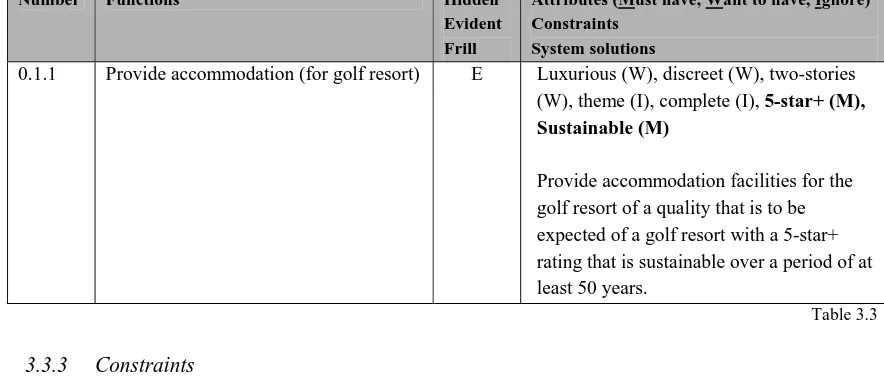
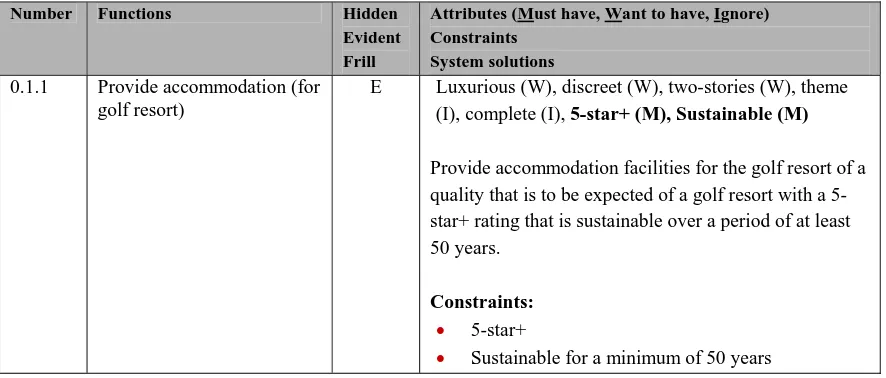
Frills are functions that are ‘nice to have’, but cannot cost anything. Evident functions have to be as visible as possible and hidden functions are to be as invisible as possible. An example of a function can be ‘provide water’. This will probably be a hidden function, as it is not important to show how water is provided. Provide accommodation is another function, which will most likely be evident as the accommodation is an important part of a resort. A frill could be ‘improve airport’. While it may be nice to have a state-of-the-art airport, it is not necessarily required. An example of a constraint function could be ‘develop golf-resort’. In this function it is already clear that the resort has to be a golf resort. This can be intentional, since another resort is not acceptable, but obviously limits the solution space. To make the functions traceable in the process, as promoted by system engineering, each function will be assigned a number.
Attributes
According to Gause and Weinberg (1989);
“Attributes are characteristics of a product that are desired by the client, they can be seen as adjectives or adverbs”
The procedure for finding attributes is as follows: (According to Gause and Weinberg)
• Brainstorming a list of possible attributes
• Sort attributes from attribute details. Fill in the list with attributes for all details, and with
the details suggested by all attributes.
• Assign each attribute to the appropriate function of functions
• Classify the attributes in Must (M), Want (W) and Ignore (I)
• Document the M and W attributes for further processing
Constraints
Gause and Weinberg [Gause et al., 1989] argue that constraints can be seen as borders. Within these borders there is the solution space. Constraints are derived from attributes classified as a Must. An example of a constraint would be 95% reliability. This means the reliability of the supply of irrigation water has to be between 100% and 95%. Another attribute could be ‘multi powered’. The constraint in that case would be that at least one backup power source is required. The solution space would therefore be any solution that provides one or more backup power solutions and reliability between 95 and 100%. A graphic of the solution space is shown in figure 2.3. A similar solution space will be created for all ‘Must have’-attributes. In their method it is possible that no solution space exists. For example if the attributes of the
holes state that they have to be at least 400 times 30m in size (216.000m2 in total for 18 holes),
but the total available space of the location is limited to 150.000m2, there will not be a solution
within the solution space. In this case the constraints may have to be renegotiated with one or more stakeholders(s), resulting in moving or lifting (some of) the constraints to create a solution space.
Preferences
According to Gauss and Weinberg any final design solution that satisfies every constraint is an acceptable solution. Some solutions may be more preferable then others though. This is why preferences should also be looked at. The methods that are used to determine the preferred solution should be made measurable, so designers can determine to what degree the preference has been satisfied. To determine the preferred solutions the method recommends so called ‘what’s it worth’ and ‘trade-off charts’. This means that in a graph the attributes are set out against their value.
In the search for alternative solutions and finding the most appropriate solution from within the solution space, two other tools can also be used. These are the technical FAST diagram and the SMART method. Both methods will be described below.
A technical FAST diagram is most suitable for reviewing and improving parts of a design. The technical FAST is explained in detail in Appendix II. The diagram reviews the functions of the particular part. Knowing all functions the part has to perform, it is possible to find alternative solutions, which cover the same functions. The goal is to find an alternative with a lower impact.
The technical FAST diagram consists out of the following parts [Veenvliet, 2004]:
• Scope
• Basic function
• Critical path functions
• Logic How/Why-question cycle
• Secondary required functions
• Causal function
• Supporting functions
2 or
more SOLUTION
1
0 – 95 % 95 – 100 %
Nu
m
b
er
o
f p
o
we
r
so
u
rc
es
Reliability
of the attributes. The highest scoring alternative is considered to be the most appropriate option for the case. Because of the bounded rationality concept, Green [1992] argues, the most appropriate solution is not necessarily the best. The bounded rationality concept describes that only so many options can be considered; as it is impossible to explore all options it is not possible to find the “optimal solution”.
The SMART method starts with creating an objective tree; this is basically the same process as creating a task oriented FAST diagram, however it uses design objectives instead of functions. An example of the value tree is given in figure 2.4. A design objective in this stage of the project could be a “good” irrigation system. The value tree exists out of “ends” and “means to an end”. One of the means for the “good” irrigation system could be an ‘environmentally friendly water pump’. The lowest order objectives are the attributes against which the design options should be evaluated. In case of the given example these are low energy consumption and a shield to prevent fish entering the pump.
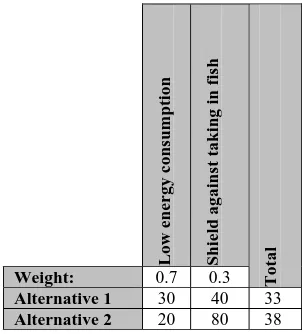
These attributes are equipped with a weight to take into account their relative importance against the other functions. For example if the low energy consumption is found to be more important then the shield, it could get a weight of 0.7 against 0.3 for the shield. As said, the highest scoring alternative on the attributes is the alternative that is the most appropriate one for the project. By involving all stakeholders in the process of determining the weights of attributes, they will more easily accept the resulting alternative. The same applies for determining the score of an alternative, where these have to be determined
subjectively. The score or value of an alternative on a certain attribute is between 0 and 100. Table 2.5 shows an example of the decision analysis matrix. In this example alternative 2 would be favoured above alternative 1.
Lo
w
en
er
g
y
co
n
su
m
p
ti
o
n
Shield
against takin
g
in fis
h
Weight: 0.7 0.3 Total
Alternative 1 30 40 33
Alternative 2 20 80 38
Table 2.5 – Decision analysis matrix "good" irrigation system
environmentally friendly water pump
Low energy consumption
Shield against taking in fish
System engineering
Definition System Engineering (SE):
Systems engineering is an interdisciplinary engineering management process that evolves and verifies an integrated, life cycle balanced set of system solutions that satisfy costumer needs.
System engineering fundamentals, system management college US department of defence, reader 854, University of Twente, page 3.
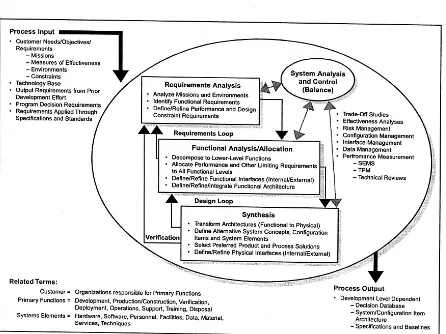
The system engineering process is shown graphically in appendix IV. The goal of System engineering, as can be deduced from the definition, is to create a solution (design) that satisfies the customer. The SE procedure starts with a requirements analysis, to find what the customer wants. The requirements are the input for function analysis and allocation. The function analysis is then used as input for the design synthesis. The process is iterative, in that steps made later in the process can influence earlier decisions.
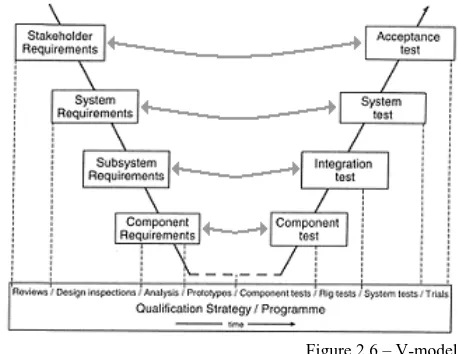
SE is a layered process, which uses baselines. A baseline means that a certain part of the design should be known and will be frozen before the next stage begins. The Baselines follow the left part of the V-Model, as shown in figure 2.1. [Hull et al. 2002] At a certain stage the
requirements of one level are frozen and will be used to determine the requirement in the next level. Each subsequent baseline, or step down in the left side of the V-model, freezes the previous steps and allows the work at a more detailed level. The right side of the V-model shows the
testing procedure, where (a part of) the design is tested to verify it meats its requirements. A method to verify each requirement must be established and recorded during requirements analysis. It must always be possible to verify the requirement; otherwise the requirement is not a legitimate one [system engineering fundamentals, 2001].
SE requires all decisions to be taken visibly and traceable, this is done by assigning numbers to requirements, solutions resulting from the requirements and the verification procedures. Logging relations between requirements, solutions and verification in tables assures traceability.
So in short, system engineering can aid the integrated impact analysis by providing a method that will take into account the whole system and will provide traceability of the transformation of requirements into solutions and the verification procedures belonging to the solution.
2.2 Framework
During the review of the problems with the current impact assessment method (chapter 2.1.1) it was noted that integrated impact assessment should:
• Offer a single document which clearly and consistently states the project impact
• Trace the transformation from requirements to solutions, when decisions are made, they
should be made explicitly.
• Take into account the 2nd order effects, which are the impacts resulting from changes
caused by the project.
• Include the links between the different impact fields, which make trade-offs possible
between for example environmental and economic effects.
How can value engineering and system engineering contribute to reaching these goals? In the theory section it was shown that System engineering delivers a full framework for design projects. Key point of System engineering seems to be traceability, making clear how and why decision were made.
Value engineering has its prime focus in the original question of ‘what it has to do’. It is a good technique to discover the functions a design has to perform. The main tool, which is used in this method, is the FAST diagram (Function Analysis System Technique). The work of Gause and Weinberg can form a link between the methods. It can convert the functions found by the Value Engineering method to solutions, which can then be further processed in the system engineering method. The job plan, which is the main value engineering method, would also be able to convert functions to solutions. This method however relies primarily on a team
approach and workshops. While the method by Gause and Weinberg also prefers a team approach, they do not exclude the option of interviews. Since a workshop approach is not feasible for this research project, the approach of Gause and Weinberg seems to be a more suitable one. There is however a negative side to the use of interviews instead of a team
approach. In a team approach people can respond to and be stimulated by the other parties. This can promote creative solutions. The use of an interview approach will not facilitate this creative process. The effect of the choice for an interview approach will be discussed in more detail in the reflection.
The value engineering approach of the technical FAST diagram and the SMART approach by Green are methods that can be used to determine the most preferred solution where one is not immediately clear.
The current method for impact assessment was shown in the previous chapter and is repeated above in figure 2.7. In the next sections a new integrated impact assessment will be introduced. It is based on the current method, but the given theories will be introduced into this method.
Screening Scoping Determine alternative
Impact
assessment Mitigation
List remaining impact and finish report
2.2.1 Screening
Screening
The need for screening remains, it will still be required to check whether an impact assessment is required and at what detail level. For larger civil engineering project it is expected an impact assessment will almost always be required though. An impact assessment can give an insight in the effects of a project, both positive and negative. If a larger project is not expected to have significant impacts on the economic, social or environmental field, it may not be worth executing the project at all.
2.2.2 Scoping
Scoping
-stakeholder requirements - verification criteria
Screening
When it is determined an impact assessment is required, scoping should establish a list of stakeholders. Stakeholders are those people who are (expected to be) affected by the project. It should also be determined what the requirements and the verification criteria of the
stakeholders regarding the project are. This is still more or less similar to the original impact assessment, with the exception that the likely impacts are not an issue yet. Reviewing the likely impacts is not required as the impact assessment process is already aimed at finding all impacts. It should be noted that the scoping phase can also be found in the value engineering job plan (the information phase) and is considered process input to the system engineering process.
2.2.3 Requirements analysis
Scoping
-stakeholder requirements - verification criteria
Requirements Analysis
- Functions - Attributes -Constraints
After the scoping phase, the current impact assessment starts with determining alternatives. It tries to establish possible solutions to meet the requirements that were given in the scoping phase. This is where the System engineering approach starts to become apparent. This method was created for the purpose of moving from requirements to design solutions. Value
engineering, as indicated, is a method that can very well be used in combination with System engineering to determine the functions that the project has to accomplish. The requirements analysis therefore should convert the stakeholder requirements to functions. Using the methods of Gause and Weinberg, Attributes and Constraints are attached to functions, together
2.2.4 Function allocation
Function Allocation
- Generate lower level functions
Requirements Analysis
- Functions - Attributes
-Constraints attributes/ add
constraints to new functions
Using the FAST-method, which was explained in more detailed in chapter 2.1.3.1, the functions are grouped. Asking ‘how’ a function can be performed will generate lower level functions. When a lower level function is added, attributes and constraints should be attached, which requires an iterative process with requirements analysis.
2.2.5 Synthesis
Function Allocation
- Generate lower level functions
Synthesis
- Functions to physical solutions - Alternative project solution
development - Select most appropriate product /
process solution
Missing functions?
Function allocation delivers a list of functions that the design has to fulfil to satisfy the requirements of the project. Coupled to these functions are attributes and constraints. This makes it possible to determine the solutions space and find physical design solutions. There may be several solutions possible, alternative solutions can therefore be developed.
2.2.6 Impact analysis
Synthesis
- Functions to physical solutions - Alternative project solution
development - Select most appropriate product /
process solution
Impact Analysis
- review impact per system- and between
system components
Most appropriate? / Missing system
solutions
The previous phase has delivered a physical design. The design consists out of many system solutions, which together form the complete project. These system solutions can individually be reviewed for their impact. To review the impact, the input and output of a system solution should be reviewed.
To explain the impact assessment by looking at in- and outputs, consider the system solution is photosynthesis. Photosynthesis is an important biologic/ chemical process within a plant, which
provides energy for the plant. The chemical formula for photosynthesis is: 12 H2O + 6 CO2 +
sunlight = C6H12O6 + 6 O2 + 6 H2O. For the system solution photosynthesis to function it
therefore requires an input of sunlight, carbon dioxide and water. The output of the system solution will be sugar, oxygen and water. Since water is both an input and output, the output can be kept within the system solution and reduce the need for water on the input side. In other words, because photosynthesis produces half of the water it needs, the required amount from its environment is reduced. By reviewing the input and output of the system solution the impact it has is now clear, it uses water, carbon dioxide and sunlight and produces sugar and oxygen. The produced sugar will for a large part be used elsewhere in the higher system solution ‘plant’. A plant may therefore not have the effect that it produces ‘sugar’, since the sugar the
photosynthesis process produces will be used as input in another system solution within the plant.
The input of a system solution can be diverse things as labour, raw materials as petrol, gas, electricity, but also a thing as space. Examples of the output are money, waste, noise, etc. While in the example given above there is an exact formula that describes the required
amounts, the in- and output may not always be measurable in a quantity. A qualitative output of a golf resort can for example be that it alters the appearance of a unique landscape.
It may be found that the impact analysis needs to review lower level system solutions that are not yet included in the provisional design. There should be a link back to synthesis to be able to add system solutions to be reviewed during the impact analysis.
2.2.7 System analysis and control
Function Allocation
- Generate lower level functions
Requirements Analysis
- Functions - Attributes
-Constraints add
attributes/ constraints to new functions
Synthesis
- Functions to physical solutions - Alternative project solution
development - Select most appropriate product /
process solution
Missing functions?
Impact Analysis
- review impact per system- and between
system components
System analysis and control
- Tradeoff studies - Data management - Configuration management
Most appropriate? / Missing system
solutions
2.2.8 Mitigation
Requirements Analysis
- Functions - Attributes -Constraints
Impact Analysis
- review impact per system- and between
system components
Mitigation
- establish measures that are necessary to avoid or minimize adverse impact
Verification loop
When the impact has been established, the impact assessment procedure indicates that measures should be established that are necessary to avoid, minimize or offset predicted adverse impacts and, where appropriate, to incorporate these into an environmental management plan or system. Next to this somewhat negative perspective of ‘fixing the bad’ it may also become apparent that during mitigation opportunities exist to improve already positive impacts. Mitigation of the negative impacts is a must, optimizing the positive effects can however deliver additional value for the stakeholders.
When the mitigation measures have been determined, the impact assessment is in fact
2.2.9 Evaluate and report
Report
Evaluate
- remaning impact
Scoping
-stakeholder requirements - verification criteria
Function Allocation
- Generate lower level functions
Screening
Requirements Analysis
- Functions - Attributes
-Constraints add
attributes/ constraints to new functions
Synthesis
- Functions to physical solutions - Alternative project solution
development - Select most appropriate product /
process solution
Missing functions?
Impact Analysis
- review impact per system- and between
system components
Mitigation
- establish measures that are necessary to avoid or minimize
adverse impact
Verification loop
System analysis and control
- Tradeoff studies - Data management - Configuration management
Most appropriate? / Missing system
solutions
3 Case study
The full impact assessment report for the case study is included as a separate document. This chapter will examine the experience acquired during the research and explain how the method was used in this research.
The new integrated impact assessment method was used to determine the impact of a planned golf resort on the island of St. Eustatius, in the Netherlands Antilles. The project is intended to
have an economic and social impact on the island. St. Eustatius is a small island (21km2) in the
northeastern Caribbean. For its income it is currently dependant mostly on an oil transshipment facility and tourism. There is however a yearly budget deficit of around US$6.1 million. The unemployment is also increasing, coupled with the fact that many young Statians who have to go abroad to study, will stay abroad since no jobs are available for them on the island. The golf resort is intended to solve (a large part of) the budget deficit and create jobs for Statians living on and off the island. The main goal of the golf resort project can be described as making the island self-sustainable.
This chapter will follow the steps of the integrated impact assessment method and answer research question 2, 3, 4 and 5.
3.1 Screening
Screening was not made a part of the research question, even though it is the first phase of the integrated impact investigation. To be able to do this research project, the case study project would have to meet the criteria that it is fit for an impact assessment. The need for an impact assessment was therefore established at the start of the research project and hence screening was not included as research question.
The golf resort project is situated on a small island. At first glance it is clear it will use a significant portion of the available land surface. A number of questions existed on the island, for example what the impact would be on to the Sea turtles, the Iguana’s, on housing, etc. Next to these environmental and social worries another aim of the golf resort is to improve the financial position of the island, which is an economic impact. From this quick screening it is obvious that economic, social and environmental impacts can all be expected in the project. 3.2 Scoping
3.2.1 Stakeholders
2. Scoping of the impact assessment a. Who are the stakeholders
Scoping is about finding requirements and verification criteria. The requirements are used to determine what the customer wants, the verification criteria to verify whether those
show up later in the process. At that time it may be hard to include their requirements. Due to the specific situation of St. Eustatius the resort will affect most of the people on the island. A distinction can be made between stakeholders that have taken the initiative for the project and stakeholders that will be impacted by the project. The first should be heard first to determine what the project is, or in other words to determine the scope of the project. It is possible to isolate some parties, or stakeholders, that have taken the initiative in the project. These stakeholders are the St. Eustatius Business Association (STEBA), the tourism development foundation and the St. Eustatius government. These parties have taken the initiative for social and economic development and can determine the scope of the golf resort. Because it was considered important to have representatives from all three impact fields (social, environmental and economical) from the start of the impact study, the main stakeholder on the field of the environment, the St. Eustatius National Parks Association (STENAPA), was also included in determining the scope of the project.
3.2.2 Stakeholder requirements
b. What requirements/ wishes do the stakeholders hold about the golf resort?
Since it was not feasible to organise a workshop with the stakeholders, an interview approach was selected to retrieve the requirements. Gause and Weinberg [Gause et al., 1989] distinguish between four elements that are important in exploring the requirements. These are the
functions, attributes, constraints and preferences. As much as possible the interviews focussed on retrieving these four elements. The interviewed were stimulated to word their requirements in terms of functions.
Since the impact assessment is a continuation of the economic viability study, the requirements contained in this document were verified during the interviews with the stakeholders. During the interview the question “Who else is affected/ stakeholder” can create a “snowball effect” whereby via one stakeholder, others can be found.
In the initial requirements gathering phase three interviews took place. An interview with the Tourism Development Organization, the St Eustatius Business Association (STEBA) and with the main stakeholder regarding the environmental impact; St Eustatius National Parks
Foundations (STENAPA). The government, a third party taking the initiative for the development of the project, is working closely together with the two other parties, for this reason an interview with the government was expected to deliver no additional information in this initial phase. Before interviewing other stakeholders it was first important to get
information from these ‘key-stakeholders’ about what kind of project they want. Without, for example, an idea about the number of additional students that can be expected, talking to the schools is not very useful. The same applies to talking to the electricity company in regards to the amount of electricity that is required. In fact, without really knowing for sure that additional children will come to the island, the schools may initially not even be a stakeholder?
‘protect coral’, originates from the requirement that the coral should be protected because it is protected by law and important for tourism.
Next to finding the requirements for the project itself, another important item during the interview was the question what such a project has to accomplish, which goes above project level and ultimately showed the program goal that the project is to accomplish. The program goal for the island of St. Eustatius is to become self-sustainable. It was decided to use the constraints developed in the next phase as the verification requirements. When the final result of the impact assessment meets the constraints, it meets the requirements.
3.2.3 Legislation
c. What legislation is relevant?
The relevant legislation is the legislation that affects the project, usually by putting constraints on the solution space. Both by use of a literature study (reviewing the environmental and building laws) and by touching this subject during the interviews information was obtained. St. Eustatius is part of the country of the Netherlands Antilles. Even though this country is a part of the Kingdom of the Netherlands it is not part of the European Union. This means European law is not a factor on the island.
The main relevant legislation for the development of a resort is the environmental legislation. By law, each island of the Netherlands Antilles has to have a national park, which is an environmental protection area. On St. Eustatius the government has appointed the STENAPA to manage the parks (more then one) for them.
From an interview with STENAPA it became clear that a part of the area where the golf resort is envisaged is protected. If the golf resort is to be constructed, the legislation will have to be changed, which requires the government to be informed over the consequences of such an action.
3.2.4 Local situation
d. What is the situation at the proposed site(s) of the golf resort
By visiting the site(s) of the golf resort, relevant information can be obtained about possible environmental worries. Stakeholders may be determined, as well as site specific constraints. These could be matters as the available space, the proximity of the ocean, etc.
3.2.5 Conclusion
The results of the scoping process can be found in chapter II of the Strategic impact assessment, which is a separate supplement to this report.
The scoping phase is aimed at finding the requirements for the project. During the execution of the study it became apparent that there are two kinds of stakeholders. There are initiating parties, who can give the requirements for the project and explain what they want the project to become. The remaining parties are stakeholders because the project has an effect (impact) on them. To be able to determine which parties are affected by the project, it first has to be determined what the project is.
The requirements of the main stakeholders and requirements resulting from legislation and the local situation were determined by an interview method. The interview method in comparison with a team approach reduces the chance for innovative solutions. It was decided to use the constraints developed in the next phase as the verification requirements. When the final result of the impact assessment meets the constraints, it meets the requirements.
The requirements and their resulting functions were placed in a table (table 3.1), to provide traceability. A number is assigned to the function; this number will be used in the FAST diagram. The table also shows the stakeholder that brought in the requirement. The full list of requirements and functions is incl
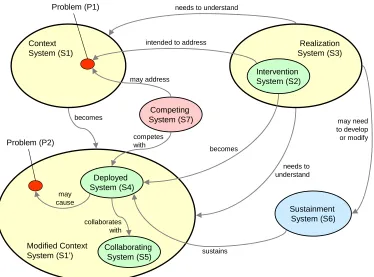
![Figure II.1 Customer FAST [Veenvliet, 2004]](https://thumb-us.123doks.com/thumbv2/123dok_us/1166119.1146746/56.595.299.538.234.535/figure-ii-customer-fast-veenvliet.webp)