M
ichellel
aP
ointeS
tePhenD
aviSc
arolc
ohenc
aSe
S
tuDy
S
erieS
: P
rinciPal
P
reParation
at
D
elta
S
tate
u
niverSity
— a B
olD
S
trategy
to
i
MProve
P
ractice
School Leadership Study
c
oMMiSSioneDByt
heW
allaceF
ounDationS
tanForDe
Ducationall
eaDerShiPi
nStituteSchool Leadership Study — Delta State University
This report was commissioned by The Wallace Foundation and produced by the Stanford Educational Leadership Institute in conjunction with The Finance Project.
© 007 Stanford Educational Leadership Institute (SELI). All rights reserved. Principals play a vital role in setting the direction for successful schools, but exist-ing knowledge on the best ways to prepare and develop highly qualified candidates is sparse. What are the essential elements of good leadership? How are successful lead-ership development programs designed? What program structures provide the best learning environments? What governing and financial policies are needed to sustain good programming? “School Leadership Study: Developing Successful Principals” is a major research effort that seeks to answer these questions. Commissioned by The Wallace Foundation and undertaken by the Stanford Educational Leadership Institute in conjunction with The Finance Project, the study examines eight highly developed pre- and inservice program models that address key issues in developing strong leaders. Once effective processes have been identified they can be replicated, ensuring that more and more schools become vibrant learning communities under the direction of outstanding leaders.
Citation: LaPointe, M., Davis, S., & Cohen, C. (007). School leadership study:
Developing successful principals (Case study series: Principal preparation at Delta State
University — A bold strategy to improve practice). Stanford, CA: Stanford University, Stanford Educational Leadership Institute.
Table of Contents
Overview... 1
Need and Support for Redesigned Educational Leadership Program... 8
The Educational Leadership Program at Delta State University... 14
Program Outcomes... 7
Conclusions: Innovation in the Delta... 40
References...
Appendix A: Methodology...
Appendix B: Key Resources Used in Delta State University Principal Preparation Program...
46
47
53 SELI
Stanford University School of Education 505 Lasuen Mall
Stanford, CA 94305-3084
Phone: 650.73.8639 Fax: 650.736.7160
1
Overview
ne hundred miles south of Memphis, TN, and 100 miles north of Vicksburg, MS, Delta State University (DSU) sits at the epicenter of one of the poorest regions in the United States. Historically a white teachers’ col-lege, Delta State has become increasingly aware of its responsibility to leverage change in the Mississippi Delta Region and the ability of its graduates to make a difference in the lives of children in area schools.
A small public university located in Cleveland, MS, Delta State may seem an unlikely candidate for recognition as one of the country’s exemplary principal preparation programs. Other schools’ programs offered important components such as internships, cohort structures, close partnerships with local school districts, and integrated cur-ricula. However, few that we examined put these pieces together as comprehensively or as consistently well as the Educational Leadership Program at Delta State University. Delta State provides a full-time internship experience, financial support so teachers can leave the class-room to spend a year preparing to be a principal, and a passion for developing school leaders capable of transforming the poor, mostly rural, schools in the region. The program benefits from deep support from both local districts and the state of Mississippi, which provides unprecedented financial support through the Mississippi Sabbati-cal Leave Program. This program pays teachers’ salaries for one year while they complete their administrative credential. Local districts recruit candidates, provide mentors, open their schools to interns, and enthusiastically hire program graduates. The Educational Leadership Program is tailored to develop the skills needed to reform schools in a region with few economic opportunities for many of its citizens.
c
onDitionS in theD
eltar
egionThe Delta Region is known as the cradle of blues music, and many of its residents have good reason to sing the blues. The Delta is more disadvantaged than the rest of Mississippi, and statewide statistics are alarming. According to the Annie E. Casey Foundation, Mississippi ranks last in the nation in the well-being of children. One quarter of its children live in poverty, and nearly one third live in a household where no adult is employed fulltime (Casey, 000). In 003, over half
O
School Leadership Study — Delta State University Overview 3
t
aBle2: e
conoMici
nDicatorSDelta MS U.S.
High school graduate n/a 7.9% 80.4%
Bachelor’s degree or higher n/a 16.9% 4.4%
Median household income* $3,45 $9,611 $38,76
Unemployment rate 10.% 5.7% n/a
Population below poverty level** 4.9% 17.6% 1.7%
Source: US Census Data, 000
*1997 median household income for the Delta **1999 data
The 18 counties of Mississippi’s Delta region are characterized by a sluggish economy, high unemployment, and persistent barriers from the legacy of segregation. Roughly half a million people live in the region. The population is 49.9% African American and 48.3% white. In contrast, the state as a whole is 61.4% white (see Table 3).
t
aBle3: D
eMograPhicSDelta MS U.S.
White 48.3% 61.4% 75.1%
African American 49.9% 36.3% 1.3%
Native American/Pacific Islander <1% 0.4% 10.0%
Asian <1% 0.7% 3.6%
Persons reporting some other race <1% 0.5% 5.5% Persons reporting two or more
races <1% 0.7% .4%
Latino <1% 1.4% 1.5%
Home language not English <1% <1% 17.9%
Source: US Census Data, 000
More than 50 years after Brown vs. Board of Education, de facto segregation is common in the Delta: Public schools are typically 90% (or higher) African American, and many white students attend private academies (Sharpe, 001). Table 4 lists the percentages of African American and white students in the Delta region schools and communities.
of Mississippi’s fourth graders scored below the basic reading level on the state assessment, and over half of eighth graders scored below the basic level in math. In addition, the state assessment reveals a persistent achievement gap between minority and white students (Kersen, 00).
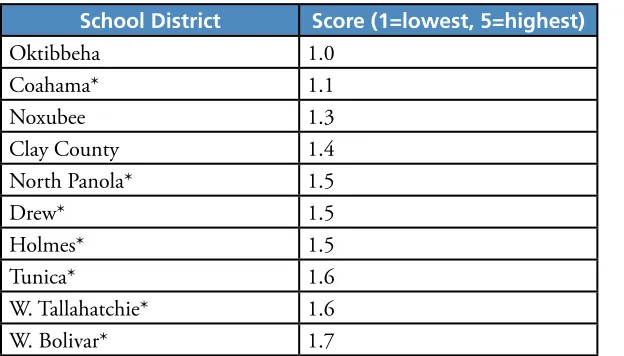
Another achievement gap exists between the Delta and the rest of Mississippi. Of the ten lowest performing schools in Mississippi, seven are in the Delta region (see Table 1) (Sharpe, 001). Low levels of achievement are a barrier for adults in the region as well. U.S. Census data from 000 show that 75% of the residents of Mississippi aged twenty-five and older have a high school diploma and only 17% have a college degree (see Table ) (U.S. Census, 000).
t
aBle1: l
oWeStP
erForMingD
iStrictSinM
iSSiSSiPPiSchool District Score (1=lowest, 5=highest)
Oktibbeha 1.0
Coahama* 1.1
Noxubee 1.3
Clay County 1.4
North Panola* 1.5
Drew* 1.5
Holmes* 1.5
Tunica* 1.6
W. Tallahatchie* 1.6
W. Bolivar* 1.7
Source: State of Mississippi, Department of Education, Office of Accountability Reporting, Missis-sippi Report Card ‘95
*Delta school district Delta StateProviDeSa
4 School Leadership Study — Delta State University Overview 5
P
art oF the SolutionWell aware of the dismal economic and educational conditions in Mississippi and the Delta region, a group of educators in the region decided that a bold strategy was needed to improve opportunities for school children. E. E. Caston (former Delta State University School of Education Dean) had deep concerns that the administrative credentialing program then in place did not produce the kind of practice-ready, change-oriented school leaders needed to transform regional public schools into places that would provide powerful teaching that would, in turn, ensure learning for all children. Caston believed that at the heart of every success-ful school was an effective instructional leader. Unfortunately, such leaders were in short supply in the Delta Region.
In the early 1990s, Caston began working with a consortium of local school district leaders to define the challenge of training administrators equipped with the knowledge, skills, and dispositions needed to reform schools. According to Caston:
We went to [the DSU] administration and said, ‘We are part of the problem when it comes to K-1 leadership.’ We found ourselves lament-ing that the trainlament-ing program for administrators created an insurmount-able stretch from the classroom here [at DSU] to the work environment there [in Delta schools]. It left too much for [the candidate alone] to build that bridge, close the gap, and make the connection from training to actual job performance.
We came to realize that we didn’t want what we had—a traditional program [that was] predominantly part-time, where. . .people [were] stretching course content over a period of years so that the impact of any given course was lost over that period of time.
Under Caston’s direction and with support from the DSU administration, the School of Education faculty engaged in a deep and thorough process that com-pletely redesigned the administrator credential program. To facilitate this effort, the school brought in national education experts such as Joe Murphy and Paul Hershey, reviewed the literature on principal preparation, and visited programs in other parts of the country. The faculty pledged to focus on designing a high-qual-ity program and to address any obstacles that might surface once the design was ready for implementation.
Early in the program’s development, the faculty concluded that a traditional, part-time program spread over several years was not the most effective way to prepare principals. Developers also understood the importance of providing prospec-tive administrators with practice in real-world settings. As a result, DSU faculty decided that the program would require full-time enrollment and an intensive, site-based internship. However, full-time study (particularly for educators) can be
WeFounDourSelveS laMentingthatthe trainingPrograMFor aDMiniStratorScreateD aninSurMountaBle StretchFroMthe claSSrooMhere [at DSu] totheWork environMentthere [in DeltaSchoolS]. itleFt tooMuchFor [the canDiDatealone] to BuilDthatBriDge, cloSe thegaP, anDMakethe connectionFroM trainingtoactualjoB PerForMance.
t
aBle4: D
eF
actoS
egregationintheD
eltar
egionDistrict population School population Delta School
Districts White Black White Black
West Bolivar 3.9% 75.6% 5.1% 94.1%
North Bolivar 18.7% 80.5% 1.9% 98.6%
Coahoma County 30.0% 69.% .7% 96.0%
Holmes County 1.9% 77.9% 0 .1% 99.9%
Humphreys 31.8% 68.1% 3.3% 96.6%
Leflore 34.8% 64.9% 4.7% 95.%
Quitman County 40.5% 58.5% 4.% 95.7%
Sunflower 3.3% 67.1% .6% 97.5%
Clarksdale Separate 37.6% 6.1% 1.% 78.%
Cleveland County 49.7% 49.3% 7.5% 71.6%
Indianola 34.7% 64.6% 6.5% 93.3%
East Tallahatchie 51.0% 48.8% 33.3% 66.7%
West Tallahatchie 7.9% 71.4% 6.3% 99.7%
Tunica 4.4% 75.4% 1.4% 98.6%
Greenville Public 36.0% 63.4% 7.5% 9.3%
Western Line 67.0% 3.1% 44.1% 54.9%
Yazoo County 59.7% 40.0% 30.6% 69.3%
Yazoo City Municipal 35.% 64.4% 13.8% 86.1%
South Delta 36.3% 63.4% 6.% 93.8%
Drew 41.3% 58.4% 16.7% 83.3%
Shaw 3.7% 67.3% 5.1% 94.8%
Benoit 31.5% 68.5% 1.5% 96.6%
Mound Bayou 0.8% 99.% 0.% 99.8%
Source: State of Mississippi, Department of Education, Office of Accountability Reporting, Mississippi Report Card ‘95. Note: Numbers may not add up to 100%, reflecting other races.
6 School Leadership Study — Delta State University Overview 7 During its first five years in operation, the program appeared to be addressing administrator shortages in the region and gained a reputation for producing high-quality, practice-ready administrators. According to Dr. Sue Jolly, program coordinator from 000-005, graduates of the program are:
Leaders [who are]in charge of a place that is pleasant to [visit] and who have a vision of both what they want to accomplish this year, and what they want their school to be like years down the road. They are people who are very hard working to the point of exhaustion, and, in many cases, [are] radi-cally changing the atmosphere [of their schools].
prohibitively expensive. It became clear that resolving this issue would require the support of the state.
During the 1990s, when the program was being redesigned, State Superintendent of Education Tom Burn-ham (himself a Delta State alumnus), followed the development of the program with interest. BurnBurn-ham worked with the State Department of Education to create a supportive political environment for the program.
Meanwhile, Dean Caston successfully lobbied the Delta region’s representative in the Mississippi State Leg-islature, Charlie Capps, for the financial resources necessary to implement the full-time internship program. Capps eagerly supported the proposal as a way to prepare administrators for not only the Delta region but the entire state. As chair of the appropriations committee, he subsequently sponsored legislation that would allow a carefully selected group of teachers from across the state one year of fully paid release time to pursue an ad-ministrative credential. The Mississippi State Sabbatical Program was implemented in 1999, just as Delta State was ready to work with its first cohort of candidates.
Since 1999, Delta State University has prepared, on average, 15 aspiring principals each year. Candidates begin the 14-month program in June, and spend the summer months taking courses at the university. The program is capped by a second summer session designed to wrap up and frame the internship experiences and to provide continuity between outgtoing and incoming cohorts.
During the school year, candidates are immersed in full-time internships that expose them to the day-to-day roles and responsibilities of school administrators. For example, interns participate in teacher evaluations, student discipline, parent conferences, student activities planning and supervision, budget management, and facilities operations. Importantly, the internships are integrated with coursework through weekly seminars. Instead of teaching academic content in separate courses, critical theories and concepts of administration are presented in an interdisciplinary fashion and framed around the issues, events, and problems experienced dur-ing the internship. To illustrate, a candidate’s experience handldur-ing a student discipline problem might be used to stimulate an in-class examination of the principles of school law, Individuals with Disabilities Education Act (IDEA), conflict resolution, problem solving, time management, and school-community communica-tions.
Upon completion of the program, candidates receive a M.Ed. in educational leadership, and after passing the School Leaders Licensure Assessment exam (SLLA), receive certification as a public school administrator in Mississippi. In order to repay their districts and the state, graduates are required to return to work in their districts for five years after completing the program. Candidates who are not nominated by their districts, and therefore are not eligible to participate in the state sabbatical program, receive assistance from the university through a federal grant program. In return, those candidates must work as administrators in Mississippi for three years. Most program graduates return to their school districts and are placed as assistant principals. In Spring 005, the program held its first reunion/celebration when the first cohort completed its five-year service requirement. The timeline for DSU’s program reform activities is illustrated in Exhibit 1.
early 1990S
DSu Faculty realize neeD to reForM eD leaDerShiP PrograM
e
xhiBit1: r
eForMt
iMeline1990
1995
2000
2005
1994
aDMiniStrator PreParation anD certiFication taSk Force rePort: iMProving the PrePa-ration oF MiSSiSSiPPi School leaDerS
1999
State SaBBatical PrograM BeginS
FirStcohortBeginSPrograMat DSu
2005
8 School Leadership Study — Delta State University Need and Support 9 gram. It also proved to be a unique and exemplary example of state support for principal preparation. With-out such support, the depth and rigor of the internship would have been significantly compromised. And, given the centrality of the full-time internship, all other facets of the program would have been similarly compromised. Engendering broad-based political support at the state level required the deep commitment and focused persistence by Dean Caston. He described the process this way:
The state superintendent picked up on our initiative, and he wanted to carry that state-wide. His en-thusiasm spilled over to the state board, so we had its support. It fell for us beautifully, as all the key leaders in the state [also bought in to the concept]. They thought that we should have the opportu-nity to improve the quality of educational leadership in the state.
At the heart of the new program was an outcome-based instructional philosophy that emphasized the develop-ment of highly skilled, self-reflective, and self-actualized administrative candidates who could take the reins of leadership in complex and diverse school environments immediately upon graduation (e.g., “practice-ready” administrators and “consumers of research”). To accomplish this, the program was developmentally sequenced, beginning with activities designed to reorient candidates from thinking like classroom teachers to thinking like school leaders. The development of administrative dispositions was done through targeted efforts to help candidates understand the organizational complexities of schools; the disparate activities of schools as parts of an integrated and coordinated system; and the role of the school within the larger political and policy contexts of the school district, community, and state. According to Dr. Jolly, “They see that a decision affects the whole school rather than one room. They see that decisions can be complex as opposed to cut and dried.” Other learning activities were designed to promote higher order critical thinking and problem solving, as well as the application of empirical research to school improvement efforts.
t
heS
tate oFM
iSSiSSiPPi’
Se
FFortS toS
uPPorte
Ducationall
eaDerShiPWhile Delta State was reforming its educational leadership program, Mississippi was reforming its policies to better support educational leadership. In 1994, Mississippi’s superintendent of education convened an Ad-ministrator Preparation and Certification Task Force to develop strategies for providing the state with leaders for its schools. The task force’s report, Improving the Preparation of Mississippi School Leaders, outlined 11 recommendations that charted the course for new policies that continue to shape the professional develop-ment experiences of principals throughout the state today. (See Exhibit .) The proposed reform components included a more rigorous process to identify and recruit a high-quality principal applicant pool; tuition remis-sion and stipends for full-time study; collaboration between districts, colleges, and the state education agency; and a rigorous set of assessments for both candidates and programs. Although three of the recommendations were not implemented (#1, #, and #7), most of them were. State education leaders believe that their success in implementing many of these recommendations has had a lasting, positive effect on the development of school leaders in Mississippi.
rior to its redesign, the educational leadership program at Delta State, like many others across the country, was framed around a set of traditional academic courses in school management. These courses were taught in combination with a loosely structured, part-time field experience, with little effort made to connect theory with practice or to immerse candidates in problem-based and authentic learning environments. As Dr. Jolly described it:
There was little connection between what we were teaching (which was theory-based), best practice, and what actually happened. And so that was the real impetus [for change]: How can we connect theory with practice and how can we make what we do meaningful?
Complicating matters was the fact that program admission standards were not very rigorous or comprehensive and were based almost entirely on a candidate’s academic record. As a result, the quality of candidates and their level of commitment to school leadership were uneven. According to former dean Caston:
Some students were attempting to use ed leadership as an escape from teaching classrooms, and that attempt was motivated by their low performance. So we had numerous concerns about the state of the ed leadership tradition, i.e., that academic admission to graduate school was not sufficiently screened, and that we had people in leadership positions who were not exemplary in their current teaching positions.
The passage of the Mississippi Sabbatical Leave Program by the state legislature was crucial to the new
pro-NEED AND SUPPORT FOR REDESIGNED
EDUCATIONAL LEADERSHIP PROGRAM
10 School Leadership Study — Delta State University Need and Support 11
e
xhiBit2: a
DMiniStratorP
reParationanDc
ertiFicationt
aSkF
orcer
ecoMMenDationS1. Creation of pool of potential administrators. In order to identify the best potential administrators, a statewide pool of potential candidates should be created each year through a rigorous recruitment, ap-plication, and selection process. It is the recommendation of the task force that the pool reflect the racial and gender diversity evident in the public school population in Mississippi.
. Size of pool. The size of the pool (supply) should be determined according to the anticipated needs (demand) for administrators in the state.
3. Type of administrator preparation programs. The university/college program that prepares adminis-trators should be a two-year, full-time program at the graduate level, including a full-year internship.
4. Funding for candidates. Funding to allow full-time study for candidates in the pool of potential administrators attending an approved program should be provided by the state in two forms: full tuition and a stipend of $15,000 per year.
5. Collaboration. There should be collaboration in development and delivery of the program among universities and colleges, local school districts, business and industry, the State Department of Educa-tion, and appropriate professional and community organizations.
6. Curriculum. The core curriculum of the program should encompass a problem-centered set of class-room and field learning experiences integrating the following four domains: functional, programmatic, contextual, and personal/interpersonal.
7. Faculty. At each program site, there should be a critical mass of at least five faculty members devoted full time to the education and training of school administrators.
8. Student assessments. There should be an integrated set of assessments that serve as a student exit re-quirement from the program. The assessment, called the Mississippi Assessment Battery, should consist of: (1) a state test measuring the knowledge base reflected in the four domains; () a skills proficiency measurement; and (3) a portfolio to evaluate the internship, the individualized learning plan, and the execution of skills in real-life situations.
9. Program assessment. Program quality should be assessed through application of the standards and criteria embedded in the recommendations of the task force. A national panel of experts in the area of school administration should be convened to make the initial assessment of redesigned programs.
10. Administrator licensure. Licensure should be contingent upon the completion of an approved ad-ministrator preparation program, the successful completion of the Mississippi Assessment Battery, and the fulfilling of other requirements deemed appropriate by the licensing agency.
11. Funding for preparation programs. Funding should be provided to preparation programs for the professional development of the faculty who will design and deliver the new educational leadership programs outlined in this report. In addition, funding should be provided for public universities in cases where bringing programs into compliance with the new standards would create an undue hardship.
M
iSSiSSiPPiS
choola
DMiniStratorS
aBBaticalP
rograMThe task force’s report, in concert with the lobbying efforts of DSU and state education officials, contributed to the creation of the Mississippi School Adminis-trator Sabbatical Program by the state legislature in 1998. The sabbatical program serves as the state’s major recruitment initiative for prospective school adminis-trators. School districts may grant qualified teachers a year’s leave of absence to participate in an approved full-time administrator preparation program. As noted above, participants receive their regular salary and benefits in exchange for a 5-year commitment to serve as administrators in their sponsoring school districts.
The legislature approved educational administration programs at six universities in Mississippi* for participation in the sabbatical leave program. These include Delta State University, Jackson State University, and University of Mississippi, the University of Southern Mississippi, Mississippi College, and Mississippi State University. The legislation includes sunset provisions that require a 5-year pro-gram renewal cycle. Although the sabbatical leave propro-gram enjoys strong support, legislators—citing potential funding shortfalls—have been reluctant to remove the renewal requirement. Each year since 1998, the state has committed fund-ing for up to 0 teachers to participate in the program. In 003-04 there were 1 participants (statewide) at a cost of $390,000. The year before, 15 teachers participated at a cost of $500,000.
Sabbatical leave funds are appropriated to the State Department of Education, which then reimburses school districts that have participating teachers (who re-main on the district payroll during their full-time internship placement). Districts are reimbursed by the state department for the salary equivalent of a teacher with 5 years of experience. If a participating teacher’s actual salary is higher than this amount, the district pays the difference. Income from supplemental service, such as coaching, is not covered by either the state or participating districts. Because many educators earn significant income from such endeavors, some candidates bear sizeable personal costs to participate in the program, despite state and district contributions. Program graduates must remain employed by the district for 5 years or repay their sabbatical costs.
1 School Leadership Study — Delta State University Need and Support 13 Institute (SEMI) to provide in-service training to practicing administrators. Programs are offered region-ally and locregion-ally by State Department of Education staff, current and former administrators, and university professors. Funding for the program has fluctuated over the years, and the department adjusts the num-ber of courses and the scale and scope of the programming accordingly. Recent allocations have averaged $500,000 a year. Participants can receive either SEMI or graduate credit for the same course, but not both. Professional development requirements. Every new administrator in Mississippi must complete the state’s Orientation to School Leadership training before taking SEMI courses. Administrators must complete 95 course credits (approximately 19 days) of training every 5 years. Courses must be recognized and approved by SEMI. While the State Department of Education provides a great deal of this training, additional providers include colleges and universities, professional associations, other state agencies, and school district consortia. Administrators may complete a specialist or doctoral degree in educational administration or leadership in lieu of SEMI credits. The state has principal performance standards and an evaluation system to assess participat-ing administrators. Interviews, observations, questionnaires, and document reviews are used to complete the assessment.
In 1999, the Mississippi legislature created a pilot mentoring program for first-year principals. Under the pilot, SEMI provided two days of training for new principals and their mentors, who were then required to have 90 hours of direct contact during the school day throughout the following year. Mentors could receive additional compensation. Although the programs were state mandated, districts designed their own. Initially, five districts were chosen for -year cycles following a competitive application process. The program was dis-continued in 004 and replaced by an online professional development module.
Additional professional development. Additional training funded by a grant from the Bill and Melinda Gates Foundation has supported the State Department of Education’s Technology Academy for School Leaders (TASL) since 001. Offered regionally throughout the state, TASL focuses on helping principals use data in their school reform efforts and integrate technology into instruction. Participants in the 5-day workshops earn 50 SEMI credits toward licensure renewal.
Standards-based accountability model. Much of the work on education policy in Mississippi has focused on developing a standards-based accountability model. The current state superintendent helped implement North Carolina’s accountability model and is working to replicate its design in Mississippi. The state’s current accountability model allows districts that reach benchmark achievement levels (designated by a priority 4 or 5 on the state’s 5-level district ranking system) to be exempted from certain mandates, including some regarding leadership requirements. For example, principals in these high-performing districts are not required to main-tain the same level of SEMI credits. Proposals by Governor Haley Barbour include pay-for-performance initia-tives for all staff, including administrators, at schools that reach a set level of educational achievement gains. Unfortunately, budget constraints have limited the state’s ability to fully implement these plans.
the state. In contrast to graduates from programs in other states, Mississippi graduates who responded to our survey had generally high esteem for the state’s preparation programs.
c
ertiFication requireMentS For PrinciPalSAs a result of a recommendation made by the 1994 task force, Mississippi developed a three-tiered adminis-trator licensure process. The three licenses are the: Non-Practicing License, Entry-Level License, and Career License. To obtain an entry-level license, a candidate must have a master’s, specialist, or doctoral degree in education administration or leadership and pass the Educational Testing Service’s SLLA exam. The candi-date is then first issued a non-practicing administrator license, which is valid for 5 years, until he or she finds employment as an administrator. At that time an entry-level license is issued; this one is also valid for 5 years. Upon completion of 95 School Executive Management Institute (SEMI) professional development credits, the administrator is issued a standard career license, which is renewable every 5 years (see Table 5).
t
aBle5: l
icenSurer
equireMentSinM
iSSiSSiPPiTier 1 Non-Practicing
License
Tier 2
Entry-Level License Career LicenseTier 3
Requirements MA degree, pass SLLA Tier 1 + job as admin Tier + 95 SEMI credits
Duration 5 years 5 years Renewable after 5 years
Alternative licensing. Mississippi also has a rarely used alternate principal licensure program called the Missis-sippi Alternate Path to Quality School Leadership (MAPQSL). Interested business, industry, or organizational leaders with an MBA, MPA, or MPP degree, at least 5 years of supervisory experience, and a recommenda-tion from a school district, can participate in a 3-week summer training activity. This program is also available to K-1 teachers holding a master’s degree in education and having at least 5 years of teaching experience. Candidates secure commitment of an administrative position with a school district and apply for a 5-year entry-level administrator license, which can only be used to qualify for assistant principal or assistant coordi-nator positions and is non-renewable. Licensure requirements include a passing score on the Praxis I and II (Principles of Learning and Teaching) exams. Candidates then participate in nine practicum sessions during the school year following the summer program. The first year of the entry-level license is considered an intern-ship and includes supervision and mentorintern-ship as a portion of the MAPQSL program. The candidate may then use the remaining 4 years of the entry-level license to complete the requirements for conversion to a standard career license.
If a school district wishes to employ a certified teacher who is enrolled in an administrative preparation pro-gram as a principal or assistant principal, the district can apply to the state for a one-year special administrator fellowship license.
i
n-
Service ProFeSSional DeveloPMent14 School Leadership Study — Delta State University Educational Leadership Program 15 The first pillar of the program is preparing school leaders who can promote and develop powerful and
eq-uitable teaching and learning in their schools. To accomplish these goals, the program immerses candidates in a variety of seminar and internship activities that draw upon empirically supported principles of effective teaching, student learning theory, and the methods of developmental clinical supervision described by Carl Glickman (004). According to Dr. Jolly, supporting teaching and learning is the raison d’être of administra-tor training and development at DSU.
The second pillar, organizational effectiveness, includes activities designed to help candidates learn how to diagnose organizational performance metrics, gather and analyze relevant data about the school, and plan and implement program intervention strategies designed to make deep and lasting impacts on student learning. When asked to describe the criteria they would use to determine the effectiveness of a school, several cohort members eagerly offered their perspectives. One stated:
You can get the personality of a school, the aura of a school, just by stepping into the hallway: the at-titude of secretaries, the atat-titude of the children in the hallway, how they sound, what’s going on. Are the teachers on the kids? Are they fighting the kids or are they on the kids? That all sets the stage for what’s going on in the classroom and inside that building. As far as what learning is going on, I think the environment of that school tells you what’s going on.
Another said:
I think displaying student work is very important. It shows that the leader [principal] values what the students do in class and cares what the teachers are teaching. Another thing is noise level. I hear a lot of people saying, “Well, the building is so quiet. The building is so quiet.” Quiet is not always necessarily good. You want to have some constructive noise. You want to hear students’ laughter and the “ahas.”
A central purpose of the education administration program at DSU is to build each aspiring principal’s leader-ship capacity. Candidates are exposed to a wide range of literature about school and organizational leaderleader-ship (both theories and practices). The “Five Practices of Exemplary Leadership” posited by Kouzes and Posner in their book The Leadership Challenge (00) are the focal metaphors through which the leadership curricu-lum is framed and implemented. The development of craft knowledge in leadership at DSU also includes the metaphorical notion that leadership in schools is like being the head of a family. The leader as “head of family” guides, encourages, supports, resolves conflicts, buffers family members from extraneous or harmful influenc-es, and envisions a better future. In addition, the program builds on the premise that good leaders are ethical, calculated risk takers; goal-oriented yet flexible; and skilled time managers.
Importantly, the program encourages candidates to regularly reflect on their coursework and internship expe-riences, and to draw from their reflections in shaping and reshaping their core values and beliefs about educa-As noted earlier and detailed in this section, Delta State University developed and implemented an
inno-vative leadership development program. Rather than offering the traditional graduate coursework, DSU expects candidates to apply their nascent understanding of leadership theory and practice in school-set-tings. The Educational Leadership Program at Delta State University may be the most unusual principal preparation program in the nation.
c
oncePtualF
ounDationS oF theD
eltaS
tatea
DMiniStratorP
reParationP
rograMThe content and activities of the newly designed program were framed around three primary theoretical pillars (nicknamed “the Delta triangle” by one cohort member):
1) teaching and learning,
) organizational effectiveness, and 3) parents and community.
THE EDUCATIONAL LEADERSHIP PROGRAM
AT DELTA STATE UNIVERSITY
16 School Leadership Study — Delta State University Educational Leadership Program 17
P
rograMS
tructure: D
iStinguiShingc
haracteriSticS While the Educational Leadership Program at Delta State is a university-based program, it is thoroughly untraditional. Rather than relying on typical graduate courses and supporting field experiences, Delta State has flipped the paradigm so that the internship is the core of the program. Candidates complete graduate coursework, indeed complete an M.Ed. in education, but the coursework is also unique. They complete the credits through a mix of weekly seminars, portfolios documenting their internship work in schools, and by doing applied research based on situations or challenges encountered in the schools where they intern. The university considers most courses to be ongoing throughout the 14-month program, until program faculty certify that candidates have documented mastery of required skills and course requirements. In short, Delta State has created a dynamic leadership development process in a university setting.r
ecruitMentanDSelection ProceSS.
The leadership development process begins early with recruiting teachers to apply for the program. Because it is DSU’s goal to be an applied program that addresses the school leadership needs of its region, the university works closely with local school districts to recruit and select candidates. Most applicants are nominated by their districts, and many local dis-tricts have a formal recruitment and application process designed to field strong candidates. Some state districts do not participate in the state’s sabbatical leave program, and teachers from those districts can submit an application on their own. In either case, applicants must have a minimum of 3 years of experience as a teacher; submit a letter of application, undergraduate transcripts, GRE scores; and participate in a lengthy interview process. According to Dr. Jolly, the key ele-ments of the admissions process are:The candidate fills out the application packet, which requires GRE scores, a transcript, a philosophy of education, a philosophy of leader-ship, and a structured résumé. After applicants send those back, we apply a scale to the GREs, writing samples, and the GPA, awarding points from that scale to each component. Finally, we schedule interviews with [eligible candidates] throughout the spring.
Applicants who pass an initial screening are invited to be interviewed by a panel consisting of program faculty, graduates, and administrators from local districts. Several candidates and graduates felt the application process was the most difficult part of the program. Each year, the panel conducted rigorous interviews in an effort to find 15 dedicated and energetic candidates who were passionate about improving education in the Delta Region. While Delta State faculty members make the final decision on which applicants are accepted, the recommendations of the panel of interviewers are carefully considered.
Districts and applicants soon learned that this was a rigorous program that only accepted highly qualified and serious candidates. In the first years of the program, tion and school leadership. This process of self-reflection provides the foundation
from which enlightened leadership emerges and grows. According to one cohort member:
Everything is so intertwined. I remember [the first day] I came to Delta State. I went back to the dorm and said [to myself], “I have made a mis-take [here].” [The program] made me, as I learned, step out of my way of thinking. I had to look outside the box of education. On that initial day, it was overwhelming. Fortunately, I did have role models who had pre-ceded me, and the cohort just before us was still here on campus. They eased that transition. Dr. Jolly and Dr. Wilson and Dr. Johnson all kept saying, “Don’t worry, it’s all going to make sense,” and they were right. It does … but it’s going to challenge your way of thinking.
Another member had this to share:
My wife says I’m different now. I talk about professional reading—when I buy the Clarion-Ledger, which is the Jackson paper, I don’t flip to the sports page. I look to see what the legislature is doing as far as funding. I look at the state metro section to see what’s going on with education. When I get on the Internet, I don’t go to ESPN.com. I go to my email to see if I’ve gotten anything from Educational Weekly.
The third pillar—building and sustaining positive and productive relationships with parents and the community—is embedded within the activity structures of the internship and supported through the integrated curriculum. Interns are required to attend parent-school events and activities and are asked to assist in a variety of activities involving parents and/or community members. Such activities can include PTSA meetings, booster club meetings, student discipline meet-ings, parent-teacher conferences, conflict resolution meetmeet-ings, and inter-agency collaborations with the school. A core philosophy of the DSU program is that schools should be open systems that both serve the local community and draw upon community resources that can enhance student development. Finding and supporting meaningful avenues for parent involvement in the academic affairs of the school and implementing effective communications strategies are important elements of the program.
As has been the case with dozens of administrator preparation programs around the country over the past decade, the DSU program is theoretically anchored in the standards for administrative practice developed by the Interstate School Lead-ership Licensure Consortium (ISLLC) and the Educational LeadLead-ership Constitu-ent Council (ELCC). In addition, DSU is piloting new administrator standards for the National Council for the Accreditation of Teacher Education (NCATE). Connections to ISLLC and NCATE standards have become more explicit in recent years and now provide the template for ongoing program assessment and improvement efforts.
Whilethe eDucational leaDerShiP PrograMat Delta StateiSauniver -Sity-BaSeDPrograM, itiS thoroughlyuntraDi -tional. ratherthan relyingontyPical graDuatecourSeSanD SuPPortingFielDexPeri -enceS, Delta StatehaS FliPPeDtheParaDigMSo thattheinternShiPiS thecoreoFthePro -graM.
18 School Leadership Study — Delta State University Educational Leadership Program 19 professional, collaborative teams these aspiring principals will create in the schools
they eventually lead. According to one candidate:
I’ve learned a lot from being a member of a cohort group that . . . I wouldn’t have in another program. I feel I’ve gotten benefits from that and will continue to throughout my professional career. I believe I could rely on the people in this group if I ever needed them in any kind of situation.
F
irStS
uMMerS
eSSion.
Candidates begin the 14-month program in June, and spend the summer months taking courses at the university. During the 8-week summer session, they take a total of 1 credits. The summer work is divided into two sessions. In each session, candidates take one core course (Research Methods and Statistics or Psychology of Learning) and one seminar in the Educational Leadership program. DSU coursework also provides candidates with a variety of relevant readings on instructional leadership and a forum through which ideas and experiences can be shared and discussed.i
nternShiPS.
During the school year, candidates complete three 1-week intern-ships as administrators in elementary, middle, and high schools and one -week internship in a central office. In each location, the interns are mentored by a full-time, certified administrator, who often has previously completed the DSU program. In most cases, the mentor is the principal of the school to which the candidate is assigned for the internship. Prior to the beginning of each academic year, Dr. Jolly works closely with the superintendents of the candidates’ school districts to assign candidates to schools led by experienced and successful princi-pals who can provide strong mentoring. Once placements have been determined, Dr. Jolly meets with mentors to orient them to the goals and purposes of the program and to the roles and responsibilities of mentorship. These discussions also provide common agreements about the scope of internship experiences and duties—including candidate assessment protocols--and to establish a line of com-munication between the mentors and Dr. Jolly.During the internships, candidates are required to observe lessons, conference with teachers, and facilitate professional development activities geared to improv-ing instructional practice. Although formal teacher evaluations are left to the principal to complete, interns are provided with full access to observe the process. As interns, candidates are also expected to counsel and discipline students, meet with parents and teachers, monitor student attendance, plan and implement school events and activities, supervise extra-curricular activities, assist in the development of various educational programs and budgets, monitor custodial and maintenance staff, analyze student academic progress and testing data, and learn how to operate information technology systems for the school. With the excep-tion of highly confidential personnel matters, interns are exposed to every aspect of school operations and management.
75% of applicants were denied admission as a result of the revised screening process. Since then, the number of applicants has dropped dramatically and the quality of applications has increased, in part because of the active recruiting done by local districts, program faculty and staff, and program graduates. The current acceptance rate is about 50%. Successful applicants are offered the chance to enroll in the masters program, receive a tuition waiver, and participate in the state sabbatical program where it is available.
P
rograMrequireMentS.
Candidates must complete 48 graduate semester credits, including three core courses (9 credits) required by every masters program in the College of Education: Research Methods and Statistics; Foundations of Education; and Psychology of Learning. The other 39 credits are taken within the Division of Curriculum, Instruction, Leadership, and Research. These credits are woven throughout the school-based experiences and university coursework The Educational Leadership Program at Delta State leads to a M.Ed. in Educational Leadership (Educational Administration and Supervision) and initial certification as an administrator in the state of Mississippi.P
rograMDeScriPtion.
An important aspect of the program’s design is the integrated, cross-disciplinary curriculum that builds upon (and complements) the knowledge, skills, and dispositions learned in each phase of the program. The coursework blends important theories and concepts in educational administra-tion with problem-based instrucadministra-tional activities geared to prepare candidates for the day-to-day roles, responsibilities, and activities of school leaders. For example, a class discussion in the Organization and School Issues course might examine a real situation from a candidate’s internship and apply readings from school law, curriculum design, and organizational chance theory.c
ohortS.
At DSU, each year’s candidates are grouped into a tightly knit cohort (typically 1 to 17 candidates), which has proven to be a useful strategy in facili-tating the development of administrative skills, dispositions, and values. Under the energetic leadership of Dr. Jolly, cohort members have developed a culture of inquiry, interpersonal trust, and mutual support. Members freely discuss their vic-tories, defeats, joys, and frustrations and collectively grapple with the real-world dilemmas experienced in the internship. Dr. Jolly presides over such discussions using a supportive and facilitative approach—always guiding, coaching, and link-ing theory to practice. It was clear from observations of cohort meetlink-ings that the members care deeply about each other and Dr. Jolly.Cohort meetings are highly interactive and provide a forum where candidates share internship experiences, discuss various perspectives and perceptions about school leadership, listen to guest speakers, and receive feedback from the program director. The cohort structure also develops team-building and group prob-lem-solving skills as well as an enduring and supportive network of colleagues. The cohort exemplifies what is meant by a learning community and models the
0 School Leadership Study — Delta State University Educational Leadership Program 1 amount of coaching, planning, and curriculum redesign—tasks that correlated well with in-class readings and cohort discussions on the topic of change leadership.
S
eMinarS.
The internships are integrated with program theories through ongoing seminars. During their internships, cohort members return to campus once a week for a graduate seminar. Between internships, can-didates spend one to two weeks on campus in all-day seminars. The seminars allow cancan-didates to de-brief their cohort about their own school-based experiences, expand the learning begun in summer coursework, integrate the internship with academic learning, and hear from guest lecturers with relevant, real-world experiences. For example, the introduction to school anti-drug policy involved reading district policies, talking to administra-tors, and a discussion with a local police chief.S
econDS
uMMerS
eSSion.
The program is capped by a second 1-credit summer session. Candidates earn 1 credits in the summer, including a core course on the Foundations of Education and another Ed. Lead-ership seminar. The summer session is designed to wrap up and frame the year and to provide continuity between cohorts. The graduating cohort leads activities, conducts mock interviews, and generally provides guidance for the incoming cohort.F
ielDt
riPS.
University and school-based experiences are complemented by field trips to visit exemplary school districts and to observe the State Education Committee. The cohort visits the Mississippi State Legis-lature, the State Board of Education, and exemplary school districts located both within and outside Missis-sippi. The program also includes at least one trip to attend a national meeting (e.g., American Association of School Administrators).a
SSeSSMent.
Candidate progress is assessed through written assignments, portfolios and presentations, and individual and group work. Throughout the program, candidates are expected to keep a log of relevant readings and create an annotated bibliography. As part of the ongoing learning in the weekly seminars, small groups take turns presenting new topics to the cohort. Candidates are required to write several “Clinical Cor-relations” for each internship site. The correlations follow a set format to detail a situation at the school site. Each situation must be applied to a framework that makes candidates examine the three curriculum anchors During a group cohort interview one candidate had this to say about the internship:I think one thing that we can all agree on is that our internship has been the most beneficial part of the program for us. It’s hands-on, being involved, doing it on our own, and I think that that is some-thing we can take back and provide an example for teachers to do that in their classroom.
Another cohort member stated:
We didn’t learn by sitting in a classroom, reading a textbook, and listening to a lecture every day. That’s not how we learned everything. Although all the theories and the ideas were thrown at us over two months over the summer and most of us thought, “What is this? How are we going to use this? How are we going to see this? All this information?” Once we got into our internship, every-thing started to make sense. We saw why we spent so long on change and the reason why we were introduced to different leadership styles, and all of that came into play once we actually got into the internship. So what we learned was not a result of reading out of a textbook or sitting in a class tak-ing notes, it’s because of the interaction that we’ve had here, the interaction that we’ve had with our professor, and what we’ve been able to discuss since we’ve been out into our internship.
For most candidates, the internship was truly a transformational learning experience. By the end of the school year, candidates had a deep and visceral understanding of what it means to be a leader. They had acquired the ability to see the organizational properties of schools as complex and highly interdependent social systems, and they had developed a more robust knowledge of how the principal can leverage diverse school and community resources in pursuit of powerful teaching that results in learning for all children. Candidates also learned how to frame problems through different perspectives, manage conflict, and navigate successfully through politi-cally charged school and community environments. Finally, they became more self-reflective and self-aware in terms of personal strengths and areas needing further development. By the end of the program, most candi-dates reported significantly improved confidence in their ability to assume a leadership position.
In addition to the personal growth dynamic, multiple internship assignments exposed candidates to different school types and school communities. For most candidates, the variety of internship experiences helped them to develop a more comprehensive understanding of the problems and issues faced by children in the Delta region as well as a deeper knowledge of the educational reform strategies at work throughout the region. It also helped them to understand how schools and district offices can work positively and productively together to advance student learning.
A common theme throughout the program, especially prevalent during the internship seminars, was the change management process. Interns were exposed to a variety of settings and types of people involved in the change process and learned how to diagnose both the learning needs of children and organizational needs of a school. As a required component of the internship, they also learned how to plan for change, cultivate broad-based support, and organize the human and material resources of the school in the implementation of change activities.
School Leadership Study — Delta State University Educational Leadership Program 3
i
nternShiP.
By far the most costly part of the DSU program is the internship component. During the school year, participants complete one -week and three 1-week internships, and. Most DSU program participants receive a salary for this year, paid through the Mississippi School Administrator Sabbatical Program. As noted earlier, the state reimburses districts for the salaries of participants in this program at a rate equivalent to that of a teacher with 5 years of experience. In addition, many districts pay the interns the difference between the state-set amount and their actual salary. This is not required, however, and some interns absorb a substantial pay cut. In the study year, the university subsidized with federal grant funds those program participants whose salaries were not paid by the state.At noted above, the $688,000 in intern salaries estimated for the candidates in the DSU program is the single largest expense for this program, averaging $57,333 per participant and accounting for nearly two thirds of all costs (Table 7). The state paid $450,000 in intern salaries; of the remainder, we estimate that $137,000 were paid by districts and $41,000 were absorbed by participants (Table 8).
t
aBle7. c
oStSByB
uDgetc
ategoryBudget Category Annual Cost ($) % of Total Cost
Personnel Costs 1,030,000 95.4%
Administration 56,000 3.7%
Intern salaries 688,000 63.7%
Faculty 91,000 8.4%
Facilities, Materials, and Equipment 30,000 .7%
Travel and Transportation 0,000 1.9%
c
ourSeWork.
Each summer, two cohorts of aspiring principals—one beginning the program and one com-pleting the program—take 1 credits of coursework over an 8-week term. Most of these courses are taught by clinical faculty. The approximate cost for the coursework component of the program is $111,000, primarily for faculty salaries (Table 8). Unlike in many university-based programs, however, these costs are not offset by tuition payments from the candidates. Each student receives a tuition waiver from the university for the full cost of the program.The university uses funds from a federal grant to cover the costs of coursework as well as the program’s ad-ministration and infrastructure. A $1 million award from the U.S. Department of Education’s Fund for the Improvement of Post Secondary Education program, referred to as the Delta Education Initiative (DEI), is shared among four Delta State programs, with the Educational Leadership Program receiving approximately $50,000. Because the DEI funds are somewhat flexible, they can be used for salaries for faculty and program support staff, tuition reimbursement, computers, and travel.
Program participants also incur costs related to coursework, including those for books and other supplies. Be-cause of Delta State’s rural location, participants may pay out-of-pocket for housing at Delta State in the sum-mer and may also incur substantial transportation expenses. Further, they may forego a number of earnings opportunities, including supplemental income earned through coaching athletics or sponsoring extracurricular activities, teaching summer school, or other summer employment. Participants were surveyed and asked to outline their out-of-pocket expenses; their responses were used to assess these costs.
of the leadership program (i.e., teaching and learning, organizational effectiveness, and parents and community). Candidates describe school/context, the ISLLC standard related to the situation, the relevant or current education issue, and the curriculum anchor and then provide a narrative description of the scenario. They also offer alternative or possible actions, the outcomes or consequences of the ac-tion actually taken, the policy/legal implicaac-tions of the decision, reflecac-tions on the scenario, and significant points learned from that experience. Candidates submit the correlations to their professor, and they are often discussed during the weekly seminar.
Candidates’ performance in internships is assessed through a variety of measures by both faculty and supervising principals. One key component of DSU’s intern-ship program is the requirement that candidates design and implement a major school-wide change project at each of the three schools where they are placed dur-ing the course of the school year. Each project requires a set of clear and achiev-able goals framed around a carefully diagnosed need, an action plan, a statement of expected outcomes, and a process to monitor and evaluate the change effort. An essential requirement of the project is that it must add something of enduring value to the school where the candidate is placed. (For example, a candidate could receive credit for creating a newsletter or a website for a school that did not have one, but not for editing an existing publication.) These projects are documented in portfolios and graded by DSU faculty. Candidates are also evaluated by their school-site internship supervisor, using a form that is similar to the forms used to evaluate teachers.
P
rograMc
oStS anDF
inancingAs detailed in the program description, DSU’s innovative master’s program (serv-ing approximately 1-15 candidates each year) consists of a full-time internship rotation during the school year, sandwiched by two summers of coursework. Financing of this principal preparation program is also innovative in that it relies heavily on state and federal funding sources. A summary of the key resources used in this program is contained in the appendix. Using national average resource val-ues, we estimate the total annual cost of Delta State’s program, including admin-istration, coursework, internships, and other activities, to be approximately $1.1 million, or $87,000 per participant (Table 6).
t
aBle6. c
oStSByP
rograMc
oMPonentProgram Component Annual Cost ($) Annual Cost Per Participant ($)
Administration & Infrastructure 81,000 3,416
Internship 688,000 57,333
Coursework 111,000 4,65
Other 0,000 1,666
TOTAL 1,100,000 87,000
l
ocalSuPerintenDentS noteDthatPrinciPalS traineDatDSu
are reSPonSiBleForSchool iMProveMent,
oFten DraMaticiMProve-MentSontheState aSSeSSMent
,
inavery ShorttiMe. t
heleaD-erShiPDeveloPMent PrograMat
D
elta4 School Leadership Study — Delta State University Educational Leadership Program 5
S
ixD
eFiningF
eatureSThe Educational Leadership Program at DSU contains many features that are consistent with important theories and practices in the field of administrator preparation and that are found with increasing frequency among programs across the country (Davis, et al., 005). However, the DSU program is distinguished by the depth, consistency, and thoughtfulness with which it prepares practice-ready school leaders. It does this through:
1. The implementation of a rigorous and highly selective admissions process.
. The development of core values and skills framed around leadership for powerful teaching and learning.
3. The cultivation of self-reflection and ethical behaviors.
4. The application of problem-based and authentic learning experiences aligned with relevant theoretical foundations.
5. The development of leaders oriented toward organizational change and renewal.
6. The cultivation of strong partnerships with regional school districts.
r
ecruitMentanDSelection.
With the reorganized administrator credentialing program, DSU began a selective admissions process. Because the program is designed to assist high-needs districts in the Delta region, the program relies heavily on local districts to identify, recruit, and support candidates. Once aspiring princi-pals pass their district’s selection process, they must formally apply to Delta State. The application has some traditional components (GRE scores, personal statement) but also includes an intense panel interview with faculty, practitioners, and program graduates. As noted earlier, many graduates felt the admissions process was a particularly difficult part of the program. The program staff feels that it has created a process that can iden-tify educators with the experience, attitudes, and passion needed to help children and improve schools.D
eveloPinginStructionalleaDerShiP.
The Educational Leadership Program at Delta State maintains a tight focus on improving teaching and learning. The program anchors (the so-called “Delta Triangle”) stress the importance of the principal as an instructional coach, and the field work is framed by the three program anchors. In fact, the first pillar of the program is “teaching and learning.” Candidates are asked repeatedly to reflect on their internship experiences through this lens, both in group discussions and in individual writings. Graduates of the program talk about how spending time in classrooms, working with teachers and students, is their priority. Local superintendents noted that principals trained at DSU are responsible for school improve-ment, often dramatic improvements on the state assessimprove-ment, in a very short time. The leadership development program at Delta State is focused on transforming good teachers into strong instructional leaders.c
ultivationoFSelF-
reFlection.
Various aspects of this leadership development program are structured to cultivate the ability for self-reflection. Graduates are asked to continuously analyze their fieldwork, both within the context of their course reading and with regard to their own professional ethics. Candidates are constantly discussing and writing about their own professional standards, ethics, and beliefs about education. This was particularly evident through the “Clinical Correlations” that candidates write, in which they frame at
aBle8. D
iStriButionoFc
oStB
urDenTotal Cost University State Federal
Gov. (DEI) Districts Participants
Administration &
Infrastructure 81,000(100.0%) 0,000(71.9%) 79,000(8.1%)
Internship 688,000
(100.0%) 450,000(65.4%) 60,000(8.7%) 137,000(19.9%) 41,000(6.0%) Coursework 111,000
(100.0%) 91,000 (8.0%) 0,000 (18.0%)
Other 0,000
(100.0%) 0,000 (100.0%)
Total 1,100,000
(100.0%) 0,000 (18.4%) 450,000 (40.9%) 50,000 (.7%) 137,000 (1.5%) 61,000 (5.5%)
a
DMiniStrationanD inFraStructure.
The program also requires resources for its basic administration and infrastructure. As with other components of the program, these costs are primarily in the form of personnel resources. The program is designed and budgeted to be staffed by a program coordinator, two faculty-level positions (although the two faculty-level positions were vacant during the study year), and clerical staff. Time is also contributed by the School of Education dean. These administrative personnel costs are estimated at $56,000. Together with costs for office space, equipment, supplies and overhead expenses paid to the univer-sity, we estimate the program’s administration and infrastructure costs at approximately $3,000 per partici-pant.o
thercoStS.
Other program costs involve those associated with travel and related expenses. For example, each program cohort attends one national professional conference, travels to the state capitol to meet with legislators, and may visit other school districts within the state. The costs are a relatively small component of the program.6 School Leadership Study — Delta State University Program Outcomes 7 utcomes of the DSU program are documented through surveys of
program graduates; a survey of teachers in a small sample of schools; interviews with program faculty, staff, graduates, the 004-05 cohort, colleagues, and supervisors in local districts; and observations of pro-gram activities and visits to schools led by propro-gram graduates. These data sources all indicate that Delta State University’s Educational Leadership Program pro-vides high-quality, in-depth support and training for aspiring administrators that is grounded in theory and that provides deep exposure to hands-on, real-world learning activities. The experience transforms teachers into principals, radically altering their professional self-concepts. In addition, observational and survey evidence of program graduates suggests that it also transforms their leadership practice.
S
urveyF
inDingSCorroborating the evidence gathered at the school sites, the survey results revealed several important differences between the responses of the graduates from the Delta State administrative credential program and those from other Mississippi programs and from a national sample of school administrators. The survey find-ings consist of both frequency analyses and statistical tests to determine if group responses on the survey items were significantly different. In most of the cases reported below, the differences between DSU and non-DSU respondents reflect significance at the .05 level of confidence or higher. Such findings suggest that several important characteristics of the Delta State program are truly unique and distinct from those found in the comparison groups. Survey responses by DSU graduates reflected the perceptions of the program expressed by DSU candidates and recent graduates who were interviewed during site visits in November 004 and April 005. The following analysis is organized primarily around several important themes that became apparent both through our review of research and our DSU program site visits. However, we have also included important survey findings that relate to several student demographic, career, and dispositional characteristics.
D
eMograPhicSDSU survey respondents were significantly more likely to be female (73%) than other Mississippi principals (30%) and the national sample (48%). Likewise, DSU survey respondents were more likely to be of African American heritage situation at their school within the program anchors. These Clinical Correlations are often the basis for group
reflection, a process that allows program faculty to probe candidates for their knowledge of leadership theory, their understanding of teaching and learning practices, and their moral and ethical orientation to the career of school leadership.
D
eveloPingtranSForMationalleaDerS.
Delta State reorganized its Educational Leadership Program so it could help struggling schools in its economically disadvantage region transform themselves into organiza-tions that can provide children with a strong start in life. Given this mission, DSU graduates need a deep understanding of how to transform struggling schools, how to implement the change theory behind school improvement, how to build a team focused on improving student outcomes, and how to leverage change through organizational structures and developing the capacity of faculty and staff. Accordingly, the second theoretical pillar of the program is “organizational effectiveness.” Candidates work in small groups to develop team-building skills through group exercises and projects. Much of the first summer session appears devoted to role-playing exercises that allow candidates to develop their understanding of group dynamics and the change process. Throughout the year, by interning in four different settings, candidates apply their under-standing of organizational theory in multiple schools and observe how different school teams function. Several DSU graduates talked about the importance of developing the capacity of staff to implement reforms, as well as the need to listen and build on the ideas of the teachers in their schools. Principals trained at Delta State appear to have a strong understanding of both schools as dynamic organizations and ways to shape the change process to improve student outcomes.S
trongPartnerShiPS WithDiStrictS.
A key element of the program’s success has been the deep and ongoing involvement with, and commitment by, local school districts. From the very beginning of the redesign efforts in the mid 1990s, school district superintendents and principals have been involved in program planning and implementation activities. As reported earlier, many of DSU’s graduates have gone on to assume leadership roles in surrounding school dis-tricts, thus creating an expanding, skilled, and durable network of practitioners who share a common interest in the program’s continued success.
PROGRAM OUTCOMES
O
8 School Leadership Study — Delta State University Program Outcomes 9 urtle Creek Intermediate School serves fourth and fifth grade students
in a rapidly expanding sch