The Survival and Termination of Party Mergers in Europe
Nicole Bolleyer, University of Exeter
Raimondas Ibenskas, University of Southampton Daniel Keith, University of York
Abstract: Why do constituent parties that participated in a party merger (that was intended to be permanent) decide to leave the latter to re-enter party competition separately? To address this question, we conceptualize merger termination as an instance of new party formation, as an instance of coalition termination and as an instance of institutionalization failure. Building on this conceptualization, we theorize three sets of factors accounting for which mergers are likely to be terminated by constituent parties and which are not. To test these three sets of hypotheses, we use a mixed methods design. We first apply survival analysis to a new dataset on the performance of mergers in 21 European democracies during the post-war period. Our findings support hypotheses derived from a conception of merger termination as new party formation: pre- and post-merger legislative performance significantly affect the probability of merger termination. Furthermore, the institutionalization of constituent parties helps to sustain mergers if the latter already built trust in pre-merger cooperation, in line with our conception of merger termination as institutionalization failure. We then analyze two theory-confirming case studies, one merger survival and one termination. They not only substantiate the working of the significant variables identified in our large-N analysis that drove our selection of case studies. They also reveal how mediating factors difficult to capture in large-N designs help to account for why factors that – theoretically - should have complicated the working of the ‘survival case’ and been beneficial to the ‘termination case’ did not generate the expected effects.
Keywords: Party merger, merger termination, coalition theory, party institutionalization, mixed-methods design
Acknowledgements: We would like to thank Adriana Bunea, Fernando Casal-Bertoa, Travis Coan, Gabriel Katz, Bice Maiguashca, Amy McKay, Jason Reifler, Claire Saunders, Martijn Schoonvelde, Mariana Skirmuntt, three anonymous reviewers and the editors of the
1. Introduction
Parties are central mechanisms of democratic choice, ideal-typically offering distinct ‘policy packages’ to citizens at election time. There is a long tradition of exploring why and how parties compete and under which conditions they engage in temporary cooperation (e.g. government and electoral coalitions) to advance their goals. Much less is known about forms of cooperation intended to be permanent (Enyedi 2006: 231) as they overcome inter-party competition altogether. Sometimes parties that have competed many years decide to give up their autonomy and merge their organization with those of one or several of their competitors (Ware 2009: 106–7). The goal of this study is to understand the conditions under which such mergers1– once they have been completed – survive (i.e. constituent parties continue to cooperate in the long-term) and under which conditions constituent parties decide to terminate them to compete yet again as autonomous actors.
While our study finds that 68 mergers formed in 21 European democracies during the post-war period, the question of which factors shape their survival and termination is particularly important as mergers can lead to party system change significantly altering the dynamics of competition (Mair 1997), as illustrated for example by the merger of the Romanian National Liberal and Democratic Liberal parties in 2014, the formation of the Conservative Party of Canada in 2003 or the German Left Party in 2007. The importance of studying party mergers has been stressed by recent case studies on the causes of merger formation and their dynamics in a range of countries including France (Knapp 2003; Haegel 2004) and Germany (Poguntke 1998; Olsen 2007). However, which factors drive the survival of newly formed mergers and which factors motivate constituent parties to terminate them remains understudied. Qualitative research has identified factors relevant for the functioning of mergers such as number of constituent parties or prior cooperation between constituent parties (e.g. Lees et al. 2010; Marland and Flanagan 2015). Yet we do not know their relative importance as we lack a framework theorizing explicitly how they affect the behaviour of constituent parties or the overall functioning of the merger as a new organizational structure. This paper attempts to close this gap in two steps.
First, we define a party merger as a form of inter-party cooperation aimed at the permanent integration of constituent parties. The decision of one or several constituent parties to nonetheless leave a merger is thus bound to be driven by their orientations and characteristics and their interaction within the newly formed organization. On that basis, we theorize not only the costs and benefits of staying and leaving from constituent parties’
perspectives but also the feasibility of jointly establishing a sustainable organization. We do sodrawing on three distinct literatures – on new parties, on the termination of governmental coalitions and on party organization – and conceptualize merger termination as an instance of new party formation, as an instance of coalition termination and as an instance of institutionalization failure respectively. Doing so allows us to formulate three sets of hypotheses on which mergers are likely to be terminated by constituent parties and which are not.
Second, we test these three sets of hypotheses empirically. We apply survival analysis drawing on a new dataset of party mergers in 21 European democracies. The findings substantiate the conceptualization of merger termination as new party formation in that pre-and post-merger legislative strength both affect merger survival pre-and termination. They further substantiate the conceptualization of merger termination as institutionalization failure as the institutionalization of constituent parties – if the latter engaged in preelectoral cooperation -contributes to merger survival. Then, we select and analyse in-depth two theory-confirming case studies – a survival case (the Dutch GroenLinks) and a merger termination (the Italian United Socialist Party). We conclude with a discussion of our findings.
2. Defining Party Merger and Merger Termination
Constitutive for a party merger is an organizational process by which several autonomous, already existing party structures create one new organization (involving a fusion of extra-parliamentary and parliamentary party structures). We exclude situations in which old parties in effect ‘swallow’ the remainders of another party—so-called ‘unbargained mergers’ (Ware 2009: 106–7). This is suitable as in those configurations, a merger termination is unlikely to occur since it presupposes the potential of the merger partners to re-establish themselves as separate actors in the political arena later on. A terminated merger becomes manifest by one or several constituent parties splitting off after the merger’s formation. Vice versa, a merger
3. Three Conceptualizations of Merger Termination
To conceptualize merger termination, we draw on three literatures. First, we draw on the literature on new party emergence and survival (e.g. Cox 1997), since a merger termination reconstitutes one or more parties and so is analogous to the process of new party formation. Second, a merger can be conceptualized as a permanent coalition of two or more parties (e.g. Belanger and Godbout 2010; Kohno 1997; Ibenskas 2016a). Considering a merger termination as termination of such coalition, we arrive at the literature on government coalition termination (e.g. Saalfeld 2008) and the notion of merger termination as coalition termination. These two literatures suggest distinct cost-benefit analyses on behalf of the constituent party elites, the former focusing on legislative costs and benefits, the latter on transaction costs within the coalition. Third, we conceptualize merger termination as
institutionalization failure, drawing on the party organization literature (e.g. Panebianco 1988; Hopkin and Gunther 2002), shifting attention to the structural conditions for creating a joint organizational infrastructure out of several pre-existing membership organizations instead.
3.1. Merger Termination as New Party Formation
Hypothesis 1: The lower the initial legislative support of each of the constituent parties, the less likely a merger is terminated.
Hypothesis 2: The more legislative performance declines post-merger, the more likely a merger is terminated.
While constituent party elites are expected to be sensitive to legislative decline as such, the institutional context, especially a high parliamentary threshold, increases the risk that vote losses lead to loss of representation, a major threat especially to smaller parties (Dinas et al 2015). As a high parliamentary threshold might incentivize the formation of a merger to start with, it might disincentivize constituent parties to leave a merger, if going alone might put their parliamentary representation at risk.
Hypothesis 3: The higher the parliamentary threshold, the less likely a merger is terminated.
3.2 Merger Termination as Form of Coalition Termination
Research on government termination puts an emphasis on how coalition parties interact within a given government and the transaction costs these processes generate (Lupia and Strøm 2008). Conceptualized as inter-party coalitions, mergers impose costs regarding (1) the relative influence constituent party elites enjoy and (2) the ideological compromises they have to make. Everything else being equal, the more parties a merger involves, the more difficult it is to maintain it, as negotiations get more complicated and room for disagreement increases (Saalfeld 2008: 344; Warwick 1994). Simultaneously, the weight each constituent party elite enjoys in the organization decreases (as compared to operating independently), making participation in the merger less worthwhile. Vice versa, ideological similarities and agreement on core policy issues between constituent parties (as implied by their joint membership in the same party family, for instance) should make termination less likely as fewer ideological compromises will be necessary to sustain the merger (Müller et al 2008: 22; Grotz and Weber 2012; Warwick 1994).
Hypothesis 4: The higher the number of constituent parties in a merger, the more likely a merger is terminated.
3.3 Merger Termination as Institutionalization Failure
Rather than theorizing cost-benefit assessments of constituent party elites, conceptualizing merger termination in light of the party organization literature emphasises the conditions for building a working party infrastructure encompassing party members still loyal to their constituent parties (conditions unrelated to party elites’ ‘rational interest’ in sustaining the merger). Our conceptualization of merger termination as institutionalization failure builds on the concept of value infusion, one central dimension of institutionalization defined as an organization’s development towards consolidation (Panebianco 1988; Levitsky 1998; Hopkins and Gunther 2002). The constituent parties of a merger are ‘value infused’ when their members - through socialization processes – start caring about the survival of their party as such, rather than seeing it as a mere instrument for goal attainment. This orientation, in principle, should enhance each constituent party’s capacity to adapt and cope with organizational change as members’ emotional affiliation makes defection less likely - even if they at times are critical of their party’s decisions (Levitsky 1998: 82).
This rationale, however, is only convincing if the merger of former competitors is indeed perceived by members as mere ‘organizational change’ or ‘adaptation’, not as radical transformation that presupposes that constituent parties dissolve themselves, thereby giving up their identity. If the latter is the case and members’ affiliation (i.e. value infusion) to their parties is strong, such value infusion is likely to prevent an easy transfer of loyalties from constituent parties to the newly formed merger, leading to the merger’s insufficient institutionalization (Hopkins and Gunther 2002: 192), i.e. to ‘institutionalization failure’. If, instead, members trust that a merger sustains their parties’ identities, i.e. represents an instance of adaptation rather than being a truly new formation, high value infusion is likely to help with the transition towards a stable merger, as defections – as mentioned already - are less likely (Levitsky 1998: 82).
if loyalties to the constituent parties are reasonably consolidated to start with, i.e. the constituent parties provide a stable underpinning for an effective transfer of trust to the newly formed merger.
Hypothesis 6: The higher the institutionalization of the constituent parties, the less likely a merger is terminated, but only if these parties have cooperated previously.
Hypothesis 7: Previous inter-party cooperation makes a merger termination less likely, but only if the constituent parties are institutionalized.
4. Studying Merger Termination and Survival: A Large-N Analysis
This section analyses a new dataset covering 68 merged parties in 21 EU member states over the post-war period.2 It includes mergers that involved at least two parties that obtained at least 0.5 percent of the vote in the previous general election. As mentioned earlier, we exclude merged parties that were to a large degree continuations of one of the constituent parties. Using the change in the merged party’s name as selection criterion, we only include cases in which the name of the merged party is different from any of its constituent parties. With the name question being central contention in merger negotiations, this reflects more reliably the differences in parties’ strength than those based on membership or electoral size. We determined merger termination (defined as exit of one or several constituent parties) using two strategies. First, we examine various secondary sources, such as handbooks on political parties, to identify whether they explicitly link the formation of a splinter party with one of the constituent parties. Second, we investigate the overlap between the elites of the splinter party and those of the constituent parties. The operationalizations of party merger as well as merger survival and termination are presented in detail in the Online Appendix.
We examine merged parties within a 10-year period after formation. Once a merger has existed this long, factional divisions in the merger are unlikely to be still determined by its constituent parties, due to changes in intra-party divisions cross-cutting the latter and the entry of new members without constituent-party affiliation. A 10-year period usually covers at least two parliamentary elections post-merger, putting the merger to two crucial ‘electoral tests’ that - if results disappoint - are likely to trigger a re-assessment of constituent parties’ decision to merge, as theorized earlier. Using these criteria, we find 15 merger terminations,
Figure 1: Mergers and Merger Terminations in European Democracies
4.1 Operationalization of the Independent Variables
The average seat share of the predecessor parties in the last election before a merger captures pre-merger legislative support (H1). Post-merger legislative performance or strength is computed as the ratio (multiplied by 100) of (1) the seat share of the merged party and (2) the sum of the seat share of the merged party and the total seat share of its constituent parties in the last election before the merger (H2).3 We use Lijphart’s (1994) effective electoral threshold in the last general election to capture the parliamentary threshold (H3).4 We test H4 using a dichotomous variable, with 0 indicating a two-party merger and 1 indicating mergers with more than two parties. 48 of 68 merged parties had two constituent parties, 12 had three and 8 merged parties had four or more constituent parties. The ideological similarity measure (H5) is based on party family estimates since the standard measures of party policy, such as expert surveys or election manifesto codings do not provide data for the majority of predecessor parties covered in this study (see Grotz and Weber 2012 and Ibenskas 2016b for
3 See the Online Appendix for more detail on this measure.
similar measures). All pairs of the component parties are given the score of 2 if they represent the same party family, 1 if they represent different but ideologically close families (e.g. Social Democrats and Communists) and 0 if they represent ideologically distant party families.5 For mergers that involved more than two parties we computed the average score across all pairs. Previous cooperation experience is measured by the participation in pre-electoral coalitions in the last election before a merger. Only joint candidate lists or joint candidates in single member districts are considered as these coalitions involve a substantially higher degree of cooperation between parties than mere public statements to govern together. If a merger involved more than 2 parties, the share of party dyads in a coalition is used. Finally, in line with the party organization literature (Harmel and Janda 1994), the mean of the logged age of the predecessor parties at the time of a merger is used as a proxy for their institutionalization, specifically the dimension of value infusion that is bound to grow as an organization ages and followers socialize into it (H6/7).
4.2 Model Choice
We apply the survival analysis techniques for studying merger terminations given that one of our predictor variables (post-merger legislative strength) varies in time. This model also allows us to examine whether the effect of other predictor variables is constant in time. Given that previous research provides no guidance on how the hazard (i.e. risk) of a merger termination changes in time, we use the Cox Proportional Hazards model that makes no assumptions about the functional form of the hazard. The time unit is a year. A number of observations are right-censored.6 These include merged parties that merged again, dissolved or stopped participating in elections less than 10 years after the first merger, and the merged parties founded less than 10 years before 2014 (the last year considered in our analysis).While most of the covariates are time-constant, the post-merger legislative change variable varies in time, as already mentioned (by contrast, the party age variable is time-constant, as it captures the average age of predecessor parties at the time of a merger). In
5The coding was based on the party family codes provided by the Parlgov database (Doring and Manow 2012).
For parties not included in that database (mostly in Central and Eastern Europe), the party family code was assigned on the basis of Bugajski (2002). For the parties that were not included in either source, other sources such as handbooks on political parties were used.
6 If the merged party remains in the sample for 10 years, we do not consider it as right-censored since our
order to account for the non-independence of observations within our countries, we use robust standard errors clustered by country.
4.3 Findings
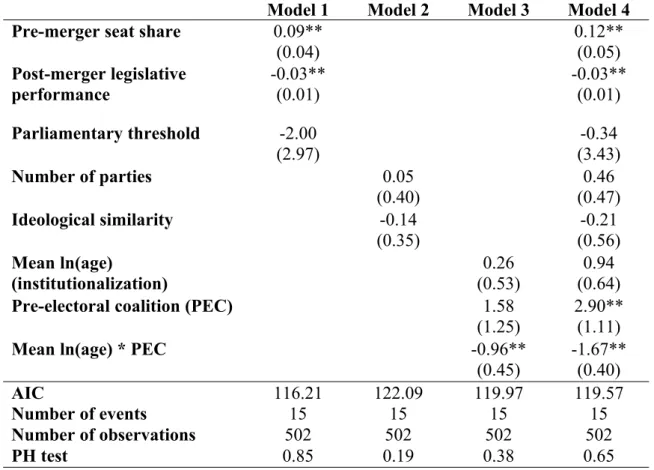
Table 1 presents the results. The first three models test three sets of hypotheses – each mirroring one of our conceptualizations of merger termination: merger termination as a new party formation, as an instance of coalition termination and as institutionalization failure. The fourth model includes all covariates. The individual tests for the Schoenfeld residuals show no evidence for non-proportional hazards for any of the variables in these models, suggesting that the key assumption of the model – that the effect of predictor variables on merger termination does not change over time – is met.
The results of Model 4 (including all explanatory variables) support two hypotheses derived from the ‘new parties literature’ highlighting the role of legislative cost-benefit assessments by constituent party elites. They also substantiate the conceptualization of merger termination as institutionalization failure stressing the importance of conditions to build a sustainable organization despite party members still being loyal to their constituent parties.
Table 1: Cox PH Models of Merger Termination
Model 1 Model 2 Model 3 Model 4
Pre-merger seat share 0.09** (0.04) 0.12** (0.05) Post-merger legislative performance -0.03** (0.01) -0.03** (0.01)
Parliamentary threshold -2.00 (2.97)
-0.34 (3.43)
Number of parties 0.05
(0.40)
0.46 (0.47)
Ideological similarity -0.14
(0.35)
-0.21 (0.56) Mean ln(age)
(institutionalization) (0.53)0.26 (0.64)0.94
Pre-electoral coalition (PEC) 1.58
(1.25)
2.90** (1.11)
Mean ln(age) * PEC -0.96**
(0.45)
-1.67** (0.40)
AIC 116.21 122.09 119.97 119.57
Number of events 15 15 15 15
Number of observations 502 502 502 502
PH test 0.85 0.19 0.38 0.65
** p< 0.05, * p < 0.1. Robust standard errors clustered by country in parentheses.
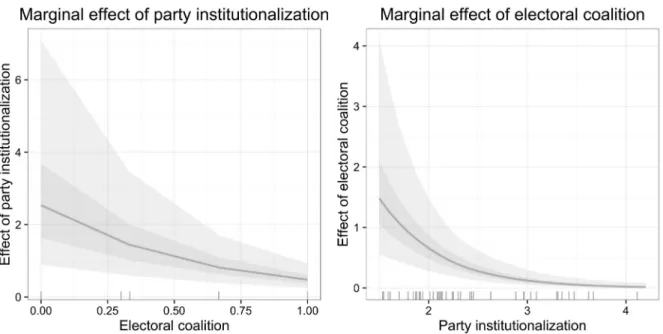
The analysis also substantiates the hypotheses derived from our conceptualization of merger termination as ‘institutionalization failure’. We evaluate the support for H6 and H7 based on the marginal effect plots presented in Figure 2. The left plot in this figure shows how the effect of the institutionalization of constituent parties (as measured by their age) on merger termination changes depending on the extent to which constituent parties engaged in electoral cooperation prior to merging or not. When all constituent parties have previously cooperated (the electoral cooperation measure equals 1), an increase in party age reduces the risk of merger termination.7 This supports our theoretical expectation: if members of institutionalized constituent parties establish trust through previous cooperation, this facilitates a transfer of loyalties to the merger, making termination less likely. In contrast, if
7As Figure 2 shows, in this case the upper bound of the 90% confidence interval of the marginal effect is below
the constituent parties did not form a pre-electoral coalition (i.e. the electoral coalition measure equals 0), or only some of them cooperated in a pre-electoral coalition (the values of the electoral coalition are higher than 0 but lower than 1), thus there was no or only a limited foundation to establish trust, an increase in our institutionalization measure ‘party age’ does not have a beneficial effect on the merger.
Furthermore, the findings support H7. The right plot in Figure 2 shows the effect of
pre-electoral cooperation for different values of constituent party age.8 For higher values of the latter measure (indicating a moderate or high institutionalization levels), the marginal effect is below 1. This means that mergers with previous electoral cooperation of constituent parties, if the latter are moderately or highly institutionalized, are less likely to be terminated than those without such cooperation.9 Only under such conditions, moderate or high institutionalization of constituent parties translates into the institutionalization of the merged party. For low values of the party age measure (indicating low institutionalization), previous electoral cooperation does not have a statistically significant effect. This suggests if loyalties to the constituent parties themselves are only weakly developed to start with, institutionalization of the merged party is difficult as well, irrespective of levels of trust generated across constituent parties through pre-electoral coalitions.10
Thus, the hypotheses derived from our conceptualization of merger termination as ‘institutionalization failure’ were insightful: constituent parties are more likely to build a sustainable joint party structure if they are institutionalized and previously collaborated in an electoral coalitions. This does not hold if at least one of these conditions is absent.
8 The plot shows the effect of the change from the absence of any previous electoral cooperation between
constituent parties to the situation where all of them formed a pre-electoral coalition prior to the merger.
9 Previous electoral cooperation reduces the risk of merger termination when the values of the party age measure
are above 2.2, which is equivalent to the average age of constituent parties being 9 years or more. One third of the merged parties in our sample had such values of the party age measure.
10 Note, however, that previous electoral cooperation increases the risk of merger termination when the values of
Figure 2: Marginal Effects of Institutionalization (Party Age) and Electoral Coalition
Note: Marginal effects based on the estimates of Model 4 in Table 1. Implemented using simPH package in the R statistical environment (Gandrud 2015). Lightly-shaded areas represent 90% confidence intervals for the marginal effects. The electoral coalition variable captures the share of dyads of parties that were in a coalition before a merger from the total number of party dyads involved in a merger. The mean logged age of constitutent parties captures party institutionalization. The marginal effect of electoral coalition is plotted only for the values of our institutionalization measure equal to or above 1.5.
Our findings do not support the hypotheses derived from the notion of merger termination as ‘coalition termination’. Neither the number of constituent parties in the merger (H4) nor their ideological similarity (H5) are significant in either Model 2 or 4. These (as our other) findings hold despite an extensive range of robustness checks.11
5. The Rationale for the Selection of Case Studies
The following theory-confirming case studies substantiate the relevance of the significant factors in our large-N analysis through the in-depth assessment of the mechanisms and processes underpinning them (Gerring 2007). The Dutch GroenLinks was among the least likely, the Italian United Socialist Party (PSU) among the most likely cases to be terminated
11 These checks fall in four categories: a) we changed the time period in which merger termination is analyzed,
in our sample. GroenLinks represents a lasting merger whose ‘risk profile’12 in terms of the variables significant in the quantitative analysis was positive: it (1) consisted of parties with only few seats, (2) gained seats post-merger, and (3) included institutionalized parties which participated in electoral coalitions prior to their merger. The ‘risk profile’ of the Italian PSU (a merger termination) is negative. It was highly likely to be terminated because it (1) consisted of relatively strong parties in terms of seats, (2) suffered post-merger legislative decline, and (3) the constituent parties were institutionalized without having cooperated before the merger.
These two cases are also insightful since according to H4 and H5 derived from the government coalition literature (which did not find statistical support), GroenLinks (a merger between four ideologically dissimilar parties) should have been terminated, while the PSU (a merger between two ideologically similar parties) should have lasted – outcomes opposite to those we find. While our case selection is based on the statistically significant variables in our large-N analysis, the overall variable configurations displayed by these two cases allow us to assess how the interplay of ‘survival-supporting’ parameters might have moderated parameters supporting termination in GroenLinks and how the ‘termination-supporting’ parameters might have moderated the ‘survival-supporting’ ones in PSU. This is also possible as a qualitative assessment allows us to examine the role of variables difficult to examine in large-N analyses.
5.1 A Theory-Confirming Surviving Merger: GroenLinks
GroenLinks is a merger of four small left parties - the Political Radical Party (PPR), the Pacifist Socialist Party (PSP), the Communist Party of the Netherlands (CPN), and the Evangelical People’s Party (EVP) which formed in 1991 and is still intact.
Starting with our conception of merger termination as new party formation, the constituent parties were small in terms of legislative support (H1) and had suffered from decline, decreasing the risk of termination. In 1977 the four parties lost ten of their sixteen seats in the Tweede Kamer and in 1986 were reduced to three. Surveys of delegates at the constituent parties’ last congresses showed that survival was one of the main motives for the merger (Voerman 1995: 110). Once formed, the merger was further consolidated by post-merger success (H2). The electoral coalition in 1989 had already led to an increase to five seats that were allocated among the participating parties plus one seat held by an independent on the list (who incidentally in 1994 became the party’s leader, see below). While the first
election after the formal merger resulted in five seats, the seat share more than doubled in 1998.
Interestingly, since 2002 - more than ten years after the merger was completed - the party started to experience a process of slow legislative decline and was reduced to only 4 seats in the 2012 national election. While initial gains post-merger were essential to stabilize the new formation, in which identities of the constituent parties could still be felt, these later losses did not trigger any defections signalling the consolidation of the merger (Lucardie and Voerman 2008: 13) and were dealt with through changes in leadership instead.13
This absence of factional struggles seems surprising as GroenLinks was formed out of four parties with different origins (pacifist, green, evangelical and Communist parties) (Lucardie and Voerman 2008: 2). They had worked together before the merger (e.g. in protests against the stationing of American cruise missiles in the Netherlands) and developed some similar opinions on issues of peace, power, and cooperation with new social movements. Yet considerable differences prevailed, as survey research of party activists at the parties’ last congresses in 1991 indicates (Lucardie et al. 1995: 99). They fundamentally differed over whether the protection of the environment requires that even the lowest incomes should fall, over the introduction of a minimum wage, or generally the prioritization of environmental protection over economic growth and redistribution. The GroenLinks party programme of 1991 was thus a compromise between ‘eco-liberals’ and ‘eco-socialists’ (Lucardie and Voerman 2008: 2). What were the reasons why the number of constituent parties and ideological differences between them did not affect the merger negatively as suggested by the conceptualization of the merger as a ‘party coalition’ (H4, H5)? One can be found in the party’s choice of leader. In 1994, three years after the merger, Paul Rosenmöller, who had not been a member of one of the constituent parties, became party leader. Under his leadership,
GroenLinks watered down its egalitarian social policies and dropped commitments to withdraw from NATO. The new direction was electorally successful and signalled to the constituent parties that leaving behind separate identities under a joint leadership paid off, which was still crucial in this early period reflecting our perspective on merger terminations
derived from the new parties literature (H1 and H2, see above). It is further indicative that
13 For example Jolande Sap resigned in 2012 following poor election results to be replaced by Bram van Ojik
https://europeangreens.eu/news/groenlinks-start-their-rebuild-after-electoral-disappointment
only one of Rosenmöller’s four successors had a constituent-party affiliation and he was only
an interim leader.14
Another factor why GroenLinks could cope with internal differences lay in the type of institutions the constituent parties jointly created when merging, which helped to manage the transition from separate to joint party structures. This brings us to the conception of merger termination as institutionalization failure and thus the question of how GroenLinks could be consolidated, given that constituent parties were already institutionalized, as visible in their own local branches, youth organizations, women’s organizations and research and training offices. The main parties involved were also relatively old and sizable groups within them had opposed giving up their independence, as several splits prior to the merger indicated. While the merger followed twenty years of debate about cooperation (Lucardie and Voerman 2003: 157), the formation of a pre-merger electoral coalition in 1989 was an important step which helped to overcome the obstacles presented by the institutionalized constituent parties
(H6/7). This pre-merger alliance required important compromises and helped to get debates about positions in parliament out of the way already before the merger. CPN accepted positions lower down the electoral list as seats were generally distributed in proportion to the parties’ memberships. The initial parliamentary group included the leaders of the PPR, PSP and CPN. Working together provided opportunities for trust to develop between these former rivals (Lees et al. 2010: 1312).
Importantly, the electoral alliance established the GroenLinks Party Board (consisting of delegates from each party) to assist the parliamentary group and intensify cooperation. The Board helped to remove some potential sources of division between constituent parties by taking difficult decisions to make the organization more efficient such as laying off some staff and disclosing sensitive information including financial details (Lees et al. 2010: 1312). The Board further formed a working group to begin devising policies, a setting directed towards overcoming ideological difference (Lucardie et al. 1991: 33). Simultaneously, it developed new party structures that embraced the constituent parties by launching new branches and forming a joint institute to produce publications. The Board also organized an association Vereniging GroenLinks to integrate new members into GroenLinks as one party,
14 Bram van Ojik was affiliated to the PPR and actively involved in the party foundation but led the party only
from 2012 -2015. He was replaced by Jesse Klaver who had no constituent-party affiliation,
while providing dual membership for members of the constituent parties (Voerman 1995: 117).
These measures provided opportunities for institutionalization across constituent parties before the merger was complete, which had important long-term repercussions. Nowadays, the institutionalization of constituent parties has been successfully overcome in favour of attachments to the merger overall, making merger termination responding to legislative (even drastic) decline unlikely, as detailed earlier. Already in 1992 – just a year after the merger was completed - 20% of the members had not been in the constituent parties. By 2002 only 41% of GroenLinks members had been a member of the constituent parties, a
number that has further declined to just 26% in 2010 (Lucardie and Schurr 2010: 168). The
only ‘remainder’ of one of the constituent parties within GroenLinks is ‘Left Cheek’ (De
Linker Wang) established by the smallest constituent party EVP as a platform for committed
Christians. Its political influence is, however, limited. We find parallel developments on the
elite level: the Board called for term limits for parliamentarians to ensure that the old guard moved aside, preventing the constituent parties from maintaining separate identities (Lees et
al. 2010: 1313). This rule remained in place long after the Party Board was abolished and by
2002 most of the parliamentary candidates had never belonged to one of the constituent parties. This, in turn, made term limits less crucial, most visible in the fact that several party leaders post-2002 stayed in office more terms than were formally allowed. Being defunct, the rule was eventually dropped from the party’s statutes in 2015.
5.2 A Theory-Confirming Merger Termination: The United Socialist Party
The United Socialist Party (PSU) presents a mirror image of GroenLinks: its basic properties made its stability unlikely. It yielded limited electoral benefits (H1 and H2), and involved highly institutionalized parties that lacked prior cooperation experience (H6/7). That it was formed by only two (ideologically similar) parties should have been conducive to its stability (H4 and H5). But this was overridden by its less favourable features.
support centrist governments led by the Christian Democracy (DC) that included the PSDI. After the 1963 election the PSI itself became a member of the government, thus providing the basis for the PSU’s foundation. The merger, however, lasted only 3 years, as the PSDI faction split off in 1969.
Legislative cost-benefit assessments associated with the notion of merger termination as new party formation played an important part in the termination of the PSU. While neither of its constituent parties were a major force in Italian politics (the seat share of the PSI and PSDI in the 1963 general election was 13.8 and 5.2 percent, respectively), they were electorally viable and had secure parliamentary representation (H1). The main motivation for the formation of the merger was to become one of the major players in the party system (Rizzi 1974: 147). Ambitions were disappointed through the electoral defeat of the merger in the 1968 election (H2). The merger obtained only 14.4 percent of seats, compared to 19.0 percent that the two parties gained when running separately in 1963. The defeat contributed to the termination of the merger by intensifying internal debate, mostly along constituent party lines, about the continued participation in the government led by the DC, given the resistance of the latter to the policies advocated by the Socialists, and possible cooperation with the Communists (Di Scalpa 1988: 164-165). As the merger did not deliver the expected legislative benefits, the necessary compromises to maintain the merger seemed not worthwhile. The performance of the two re-established constituent parties PSI and PSDI from the 1972 national election onwards substantiate this evaluation. Up to the re-structuring of the Italian party system in the 1990s both parties ensured regular parliamentary representation. The PSI’s performance (in national seats) was even above its best pre-merger performance. In 1983 it further could claim the post of prime minister and participated repeatedly in government up until the early 1990s.
1966 (Favretto 2006: 432). The constituent parties continued to function as a mere coalition, not a joint organization. This is demonstrated, for example, by the continued participation of former PSI members in sub-national government coalitions with the Communists, whose opposition included former PSDI members (Di Scalpa 1988: 163). Internal party positions were shared equally between former PSDI and PSI members (Rizzi 1974: 159) and the factional structure of the merger reflected constituent-party lines. Specifically, almost all former PSDI members formed the Socialist Renewal faction while former PSI members sustained pre-merger factions including the Socialist Autonomy led by the leader of the party Pietro Nenni, the Socialist “Ricossa” faction led by Francesco De Martino and two small leftist factions (Rizzi 1974: 157). When the PSDI faction was excluded from the dominant coalition of the merged party in 1968 (as explained below), it re-established its independence as organizational costs of a split were low and loyalty to the merger was lacking. However, these obstacles to the success of the merger were not necessarily insurmountable; Rizzi (1974: 163) argues that “perhaps a 'confederation' between the parties might have worked better, by allowing more time for the solution of organizational problems”. As in the case of
GroenLinks, this highlights the importance of organizational choices made in the formation process for the ability of the new party organization to integrate and institutionalize.
Finally, why did the fact that the PSU involved only two parties which were also
merger – yet again - presents itself as a merger with even higher chances of termination due to divisions within constituent parties and ideological differences within them. This is further supported by the timing of the termination – which occurred after the increased intra-party ideological polarization.
6. Conclusion
Why do constituent parties that participated in a party merger (that was intended to be permanent) decide to leave the latter to re-enter party competition separately? Despite a growing literature on the theme of party mergers, few studies have looked at merger survival and termination and none has done so based on a theoretical framework tested through a mixed methods design combining a large-N study with in-depth case studies.
This paper developed three conceptions of merger termination: merger termination as an instance of new party formation, as an instance of coalition termination and as an instance of institutionalization failure, thereby theorizing three sets of factors accounting for which mergers are likely to be terminated by constituent parties and which are not. An analysis of a new dataset capturing the evolution of mergers across 21 democracies points to the empirical relevance of the first and the third conceptualization. It finds support for hypotheses derived from the notion of merger termination as new party formation stressing the relevance of party elites’ legislative cost-benefit assessments: mergers are less likely to be terminated when their constituent parties had low pre-merger seat shares and the merged party gains in legislative strength in comparison to its constituent parties. It also supported the notion of merger termination as institutionalization failure: constituent parties’ institutionalization in terms of value infusion in combination with pre-electoral cooperation made merger termination less likely. The case studies of two theory-confirming cases – GroenLinks as a ‘most likely’ survival case and PSU as a ‘most likely’ termination case – substantiated these findings.
organizational choices made by merger founders. GroenLinks did not suffer from its high number of constituent parties and their considerable ideological differences because the structures the constituent parties built fostered the overall merger’s institutionalization and provided effective fora for conflict resolution over substantive issues. Vice versa, the PSU case study suggested that despite the merger only involving two parties, the structure they chose was unsuitable to assure organizational integration. Furthermore, GroenLinks early on elected a leader not belonging to any of the constituent parties, while in PSU core positions remained controlled by constituent party elites.
This findings has also conceptual repercussions, highlighting more substantive differences between governments as temporary party coalitions and mergers as permanent
ones than the analogy drawn between them in earlier work suggests (Belanger and Godbout 2010; Kohno 1997). Interestingly, government coalitions were initially conceptualized as special type of legislative coalition. Yet looking more closely at what was being formed revealed that legislative coalitions, once formed, have achieved their purpose (enacting legislation), while government coalitions, once formed, still need to ‘deliver’ (Müller et al 2008: 32). While mergers as party coalitions resemble government coalitions in the latter respect, government coalitions and mergers differ in what they ought to deliver and how. Mergers are directed towards overcoming competition permanently and constituent parties face no incentives to signal ideological differences to voters. If anything, conflict over policy is likely to damage the merger’s electoral performance and as our analysis showed, such performance is an important influence on the risk of termination (H2). Parties in government coalitions, in contrast, face fundamental trade-offs as effective cooperation in government might blur their ideological profiles, in turn, damaging their performance at the next election, possibly decreasing chances of future government entry (Müller and Strøm 1999).
conjunction, our results that support two of them, paint a coherent picture of the nature of mergers as permanent party coalitions, driven by elite as well as member dynamics.
Bibliography
Belanger, E. & Godbout, J.F. (2010). Why do parties merge? The case of the Conservative Party of Canada. Parliamentary Affairs 63(1):41–65.
Bolleyer, N. (2013) New parties in old party systems, Oxford: Oxford UP.
Bugajski, J. (2002). Political parties of Eastern Europe: a guide to politics in the Post-Communist Era. New York: ME Sharpe.
Cox, G.W. (1997). Making votes count: strategic coordination in worlds electoral systems. Cambridge: Cambridge University Press.
Di Scalpa, S.M. (1988). Renewing Italian socialism: Nenni to Craxi. Oxford: Oxford University Press.
Dinas, E. P. Riera & N. Roussia (2015). Staying in the first league: Parliamentary representation and the electoral success of small parties, Political Science Research and Methods 3 (2): 187 – 204.
Doring, H. & Manow, P.(2012). Parliament and government composition database (ParlGov).
Enyedi, Z. (2006) Party-politics in post–communist transition. In R.S. Katz & W. Crotty (eds) Handbook of Party Politics. London: Sage.
Favretto, I. (2006).The Wilson governments and the Italian centre-left coalitions: between ‘Socialist’ diplomacy and realpolitik, 1964-70. European History Quarterly 36(3): 421–444.
Gandrud, C. (2015). simPH: An R Package for Illustrating Estimates from Cox Proportional Hazard Models including for interactive and nonlinear Effects. Journal of Statistical Software
65(3): 1–20.
Gerring, J. (2007). Case study research: principles and practices. Cambridge: Cambridge University Press.
Grotz, F. & Weber, T. (2012).Party systems and government stability in Central and Eastern Europe World Politics 64(4): 699–740.
Gunther, R., & Hopkin J. (2009). A crisis of institutionalization: The collapse of the UCD in Spain. In R. Gunther, J. R. Montero and J. J. Linz (eds.), Political parties: Old concepts and new challenges. Oxford: Oxford University Press.
Haegel, F. (2004). The Transformation of the French Right: institutional imperativesand organizational changes. French Politics 2(2): 185–202.
Ibenskas, R. (2016a). Marriages of convenience: explaining party mergers in Europe. Journal of Politics. Early view.Kohno, M. 1997. Japan's postwar party politics. Cambridge: Cambridge UP.
Krouwel, A. & Lucardie P. (2008). Waiting in the wings: New parties in the Netherlands,
Acta Politica 43: 278-307.
Lees, C., Hough, D. & Keith, D. (2010).Towards an analytical framework for party mergers: operationalising the cases of the German Left Party and the Dutch Green Left.West European Politics 33(6): 1299–1317.
Levitsky, S. (1998). Institutionalization and Peronism. The concept, the case and the case for unpacking the concept. Party Politics 4(1): 77–92.
Lijphart, A. (1994). Electoral systems and party systems: A study of twenty-seven democracies, 1945-1990. Oxford: Oxford University Press.
Lucardie, P. & Voerman, G. (2008). Amateurs and professional activists: De Groenen and GroenLinks in the Netherlands. In E.G. Frankland et al. (eds.) Green parties in transition: The end of grass roots democracy? London: Ashgate.
Lucardie, P. & Voerman, G. (2003).The organisational development of Green Left. In J. Botella& L. Ramiro (eds) The crisis of communism and party change. The evolution of west European communist and post-communist parties, Barcelona: ICPS.
Lucardie, P., Voerman, G and van der Knoop J. (1995).Greening the reds or reddening the greens? The case of the Green Left in the Netherlands.In W. Rüdig (ed) Green politics three,
Edinburgh: Edinburgh University Press.
Lucardie, P., Nieboer, M. & Noomen, I. 1991). Kroniek 1990. Overzicht van de partijpolitiekegebeurtenissen van het jaar 1990. In: G. Voerman (ed) Jaarboek 1990,
Groningen: DNPP.
Lucardie, L. & W. van Schuur (2010). Meer vertrouwen in de staat dan in de straat? Een vergelijkende analyse van de opvattingen en achtergronden van de leden van GroenLinks in 1992, 2002 en 2010, P. Lucardie and G. Voerman (eds.) Van de straat naar de staat: GroenLinks 1990-2010, Amsterdam: Boom.
Lupia, A. & Strøm, K. (2008). Coalition theory and cabinet governance: an introduction. In W.C. Mueller, T. Bergman & K.Strøm (eds) Cabinets and coalition bargaining: The democratic life cycle in western Europe. Oxford: Oxford University Press.
Mair, P. (1997). Party system change: Approaches and interpretations, Oxford: Clarendon Press.
Marland, A., & Flanagan, T. (2013). From opposition to government: Party merger as a step on the road to power. Parliamentary Affairs 68(2): 272–290.
Müller, W.C, T. Bergman & K.Strøm (2008). Coalition theory and cabinet governance: An introduction. In K. Strøm, W.C. Müller, & T. Bergman, (eds), Cabinets and coalitions bargaining: The democratic life cycle in western Europe. Oxford, UK: Oxford University Press.
Olsen, J. (2007). The merger of the PDS and WASG: From eastern German regional party to national radical left party? German Politics 16 (2): 205–21.
Panebianco, A. (1988). Political parties: organization and power. Cambridge: Cambridge University Press.
Poguntke, T. (1998). Alliance 90/The Greens in East Germany: From vanguard toinsignificance?Party Politics 4(1): 33–55.
Rizzi, F. (1974). From Socialist unification to socialist scission 1966-69: Socialist unification and the Italian party system. Government and Opposition 9(2):146–164.
Saalfeld, T. (2008). Institutions, chance, and choices: The dynamics of cabinet survival. In K.Strøm, W.C. Müller, & T. Bergman, (eds), Cabinets and coalitions bargaining: The democratic life cycle in western Europe. Oxford, UK: Oxford University Press.
Stern, A.J., Tarrow, S. & Williams, M.F. (1971). Factions and opinion groups in European mass parties: Some evidence from a study of Italian socialist activists. Comparative Politics
4(3): 529–559.
Taagepera, R. (2002). Nationwide threshold of representation. Electoral Studies 21(3):383– 401.
Tavits, M. (2006). Party system change: Testing a model of new party entry. Party Politics
12(1): 99–119.
Voerman, G. (1995) The Netherlands: Losing Colours, turning green in D. Richardson & C.Rootes (eds) The green challenge: The development of Green Parties in Europe, London: Routledge.
Ware, A. (2009). The dynamics of two-party politics: party structures and the management of competition. Oxford: Oxford UP.