Flowering: a time for integration
FRANÇOIS PARCY*
Physiologie Cellulaire Végétale. CNRS UMR5168- CEA- INRA- UJF, Grenoble, France
ABSTRACT Flowering time is under the control of multiple environmental cues such as photope-riod and exposure to cold temperatures (vernalization). A few regulators named integrators of flowering time signals (LEAFY, SOC1 /AGL20 and FT ) integrate inputs from the different flowering cascades and convey the resulting outcome to floral meristem identity genes at the shoot apex. Here we review the current knowledge about the expression of integrators, their mode of action, their potential target genes and the nature of their mutual interactions. We emphasize the questions that have been generated by recent progress in this field and that remain to be addressed.
KEY WORDS:
flowering, floral pathway integrator, LEAFY, SOC1, FT
“Get yourselves organized down there” Wallace talking to the sheep in A close shave by Nick Park
Introduction
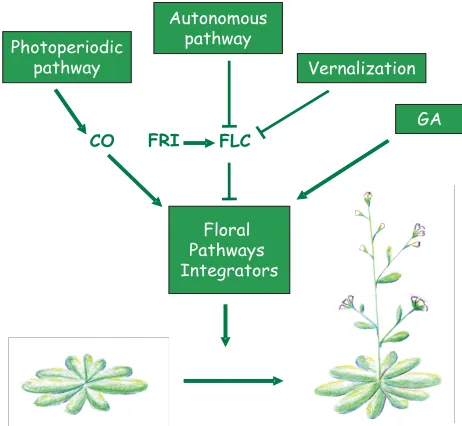
As for other plants, the floral transition is one the most drastic changes occurring during Arabidopsis thaliana life cycle. The shoot apical meristem switches from the production of leaves with associated secondary shoot meristems to bractless flowers (Hempel and Feldman, 1993, Suh et al., 2003). This transition is abrupt and irreversible, suggesting it is regulated by a robust gene regulatory network capable of driving sharp transitions. The moment at which this transition occurs is precisely determined by environmental and endogenous signals. Arabidopsis flowers earlier in long than in short days (it is a facultative long-day plant). Also, many Arabidopsis strains flower earlier after a period of cold exposure (a treatment named vernalization). Genetic analyses identified a whole set of flowering time mutants that were subse-quently assigned to four major genetic pathways according to their response to vernalization or day length (Martinez-Zapater et al., 1994). The field of flowering time has been organized around these four pathways, with the photoperiod and vernalization pathways mediating the response to environmental cues and the autonomous and the gibberellin (GA) pathways acting largely independently from these external signals (Figure 1). A large number of genes acting within these pathways have been cloned and current analyses aim at understanding how they are linked to each other and how the corresponding proteins function (Amasino, 2004, Araki, 2001, Bastow and Dean, 2003, Boss et al., 2004, Jack, 2004, Mouradov et al., 2002, Simpson and Dean, 2002, Simpson et al., 1999, Sung and Amasino, 2004a). Two genes play
*Address correspondence to: Dr. François Parcy. PCV/DRDC Bat. C2. 17, avenue des martyrs, 38054 Grenoble, cedex 9, France. Fax +33-4-3878-5091. e-mail: [email protected]
Abbreviations used in this paper: AGL20, AGAMOUS-like 20; AP1, APETALA1; CAL, CAULIFLOWER; CO, CONSTANS; FLC, FLOWERING LOCUS C; FT, FLOWERING LOCUS T; GA, gibberellins; GFP, green fluorescent protein; LD, long days; LFY, LEAFY; SD, short days; SOC1, SUPPRESSOR OF CONSTANS OVEREXPRESSION; WUS, WUSCHEL.
0214-6282/2005/$25.00
© UBC Press Printed in Spain www.intjdevbiol.com
a prominent role at the “bottom” of these promotion cascades. The CONSTANS (CO) gene is probably the most downstream actor, specific for the photoperiod pathway (Figure 1) and both the light and the internal clock precisely regulate the CO protein accumu-lation (Valverde et al., 2004). The FLOWERING LOCUS C (FLC) gene is the point of convergence of the autonomous and vernalization pathways (Figure 1). Ultimately and in part through CO and FLC, the flowering signals lead to the induction of a set of genes called floral meristem identity (FMI) genes and respon-sible for the fate change of the meristems emerging on the flanks of the shoot apex (Long and Barton, 2000). This group of genes includes LEAFY (LFY ), APETALA1 (AP1) and CAULIFLOWER (CAL ), expressed in early floral stages and responsible for their floral fate (Kieffer and Davies, 2001, Lohmann and Weigel, 2002). Recently, three genes were shown to make the junction be-tween the different flowering-time cascades and the FMI genes (Figure 1). These genes were named Floral Pathway Integrators because they are able to integrate a balance of stimulations originating from the different pathways and convert these hetero-geneous inputs into an induction of FMI genes, thereby initiating the production of the first floral meristems (Simpson and Dean, 2002).
Amasino, 2004a). In this paper, I deliberately chose to focus on Arabidopsis Floral Pathway Integrators (thereafter named integra-tors) and to review and question in some detail the available experimental evidence subtending current models of gene regula-tory network leading to flowering.
Identity of floral pathway integrators
The three genes shown to integrate the influence from different pathways are LEAFY(LFY), FLOWERING LOCUS T (FT ) and SUPPRESSOR OF CO OVEREXPRESSION (SOC1) /AGAMOUS-like 20 (AGL20) ( thereafter named SOC1 ). I will first introduce these genes and their expression and then focus on their regulation by the pathways promoting flowering.
LEAFY (LFY)
The LEAFY gene plays a key role during flower development and can be considered both as a flowering time gene and a meristem identity gene.
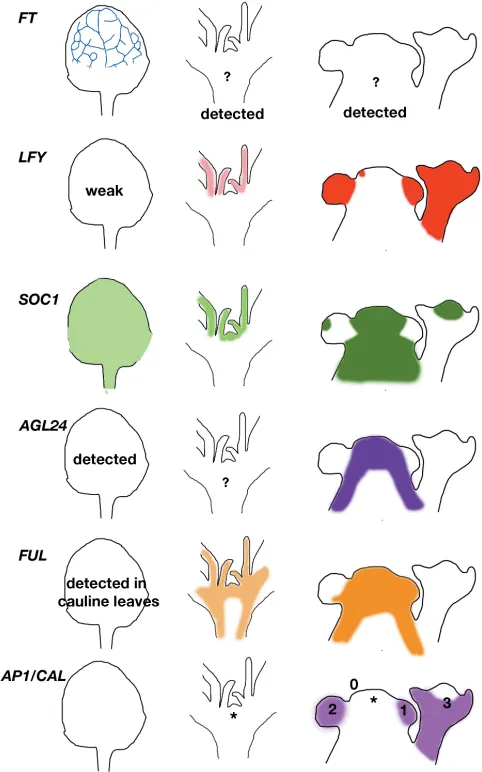
LEAFY expression precedes the floral transition: it is first detected (both the RNA and the promoter activity) in young leaf primordia and it increases to reach a maximum in young floral meristems (Blazquez et al., 1998, Blazquez et al., 1997) (Figure 2). Plants with increased LFY gene copy number or LFY constitutive expression flower early (Blazquez et al., 1997, Weigel and Nilsson, 1995) whereas plants with a mutant LFY gene bear leaves and associated shoot instead of flowers (Weigel et al., 1992) showing that LFY participates in determining the flowering time. Flower-like structures eventually appear on a lfy “inflorescence” because the FMI gene APETALA1 can be activated in an LFY-independent manner and partially compensates for the lack of LFY (Bowman et al., 1993, Huala and Sussex, 1992, Weigel and Meyerowitz, 1994). LFY expression persists throughout young floral meristems where it contributes to the specification of the young floral buds by, for instance, inducing the AP1 and CAL (Parcy et al., 1998, Wagner and Meyerowitz, 2002, Wagner et al., 2004), to the floral
meristem patterning (Lohmann et al., 2001, Parcy et al., 1998) and to the repression of shoot identity (Parcy et al., 2002, Yu et al., 2004).
LFY encodes a new type of plant specific transcription factor (Parcy et al., 1998, Weigel et al., 1992). The LFY protein appears to be localized primarily in the nucleus (Parcy et al., 1998, Wagner et al., 1999, Wu et al., 2003) but LFY-GFP fusion proteins also accumulate in the cytoplasm and the plasmodesmatal pit (Wu et al., 2003). LFY is able to travel from one cell to another through plasmodesmata but the functional importance of this movement awaits confirmation (Sessions et al., 2000). The LFY protein has been shown to bind cis-elements present in AP1 and AGAMOUS (AG) regulatory sequences (Busch et al., 1999, Lohmann et al., 2001, Parcy et al., 1998). LFY activity appears to be modulated by day-length since plants constitutively expressing LFY flower later in short days (SD) than in long days (LD), but how photoperiod affects LFY is still unknown (Nilsson et al., 1998, Weigel and Nilsson, 1995).
Flowering locus T (FT)
The FT gene was simultaneously isolated using an early-flowering activation-tagged allele and a late-early-flowering T-DNA mutant (Kardailsky et al., 1999, Kobayashi et al., 1999). The ft mutant is late in LD conditions and only slightly affected in SD, indicating that FT belongs to the photoperiod pathway (Koornneef et al., 1991). As opposed to other flowering time mutations, the ft mutation strongly enhances the lfy mutant phenotype (Ruiz-Garcia et al., 1997) and efficiently suppresses the 35S::LFY early flowering phenotype (Nilsson et al., 1998). For this reason, FT was assigned to a separate branch of the photoperiod pathway together with FWA and FD. FT encodes a protein with similarities to Phosphatidylethanolamine binding protein (PEBP) and Raf kinase inhibitor protein (RKIP) in animals (Kardailsky et al., 1999, Kobayashi et al., 1999), but its function in plants remains to be identified. Using the sensitive RT-PCR technique, FT expression was detected in all organs (Kardailsky et al., 1999, Kobayashi et al., 1999). Re-markably, FT mRNA levels in seedlings increases during vegeta-tive growth in LD, reaching its maximum around the floral transition. FT expression is reduced in SD but still shows a clear increase with time. Low expression levels have precluded a precise analysis of FT expression pattern by in situ hybridization. The FT::GUS reporter gene shows expression primarily in phloem cells of the leaves and shoot (Takada and Goto, 2003). FT constitutive expression is very potent at accelerating flowering both in LD and SD. The fastest flowering is obtained by combining constitutive expression of FT and LFY : plants produce flowers after forming only one or two leaves in LD (Kardailsky et al., 1999, Kobayashi et al., 1999).
Suppressor of CO overexpression (SOC1) /AGAMOUS-like 20 (AGL20)
SOC1/AGL20 encodes a MADS box transcription factor. Sur-prisingly, the soc1 mutant was not isolated in standard genetic screens for late flowering mutants. It came out independently in a screen for suppressor of CONSTANS overexpression (Onouchi et al., 2000, Samach et al., 2000), from an activation tagging screen in the FRIGIDA (FRI) FLC background (Lee et al., 2000) and using reverse genetics (Borner et al., 2000). Soc1 mutant flowers late in both LD and SD (Borner et al., 2000, Lee et al., 2000). SOC1 is Photoperiodic
pathway
CO
Autonomous pathway
FLC
Vernalization
GA
Floral Pathways Integrators
FRI
expressed mostly in leaves and in the shoot apex, its expression raises with time and a sharp increase occurs in the apex during the floral transition (Borner et al., 2000, Lee et al., 2000, Samach et al., 2000). SOC1 expression is absent from stage 1 flower meristem and reappears in the center of older flower meristems (Figure 2).
Regulation of floral pathway integrator expression
LFY, SOC1 and FT have recently been referred to as Floral Pathway Integrators (Simpson and Dean, 2002) because they represent convergence nodes for several promotion pathways: the photoperiod pathway through the action of its most downstream “specific” element CO, the vernalization and autonomous path-ways through the action of the FLC repressor and the GA pathway. FLC itself could also be considered as an integrator. However, we will stick to the initial definition as proposed by Simpson et al. (2002). It is worth pointing out here that the evidence for integrated regulation is derived essentially from integrators expression at the mRNA level. The three integrators proteins might also be regulated at many other post-transcriptional levels that have been poorly investigated so far.
Regulation by CONSTANS (CO)
The CO gene plays a key role in the photoperiod pathway. CO mRNA level oscillates following a circadian rhythm and the CO protein is stabilized by light (Suarez-Lopez et al., 2001, Valverde et al., 2004). In LD, CO mRNA expression and CO protein stability coincide at dusk and the CO protein accumulates to accelerate flowering. In SD, this coincidence does not occur and the CO protein never accumulates. This mechanism elegantly explains why co mutant flowers late in LD but as the wild type in SD.
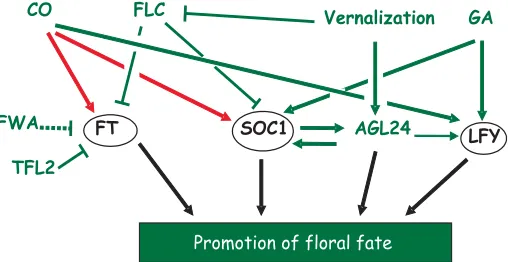
A whole set of data shows that CO triggers flowering by inducing the 3 integrators. LFY and FT expression are reduced in co mutant (Kardailsky et al., 1999, Kobayashi et al., 1999, Nilsson et al., 1998, Suarez-Lopez et al., 2001). SOC1 expression, also, might be slightly reduced (Lee et al., 2000). In addition, the late flowering phenotype of the co mutant is rescued by overexpression of FT (complete rescue), SOC1 ( rescue almost complete) or LFY (partial rescue) (Kardailsky et al., 1999, Kobayashi et al., 1999, Nilsson et al., 1998, Samach et al., 2000). These data suggest CO positively regulates LFY, FT and SOC1 (Figure 3). This hypothesis was largely confirmed by gain-of-function experiments. Constitu-tive overexpression of CO (or of the inducible CO-GR fusion) induces early flowering and increases the expression of FT, SOC1 and LFY (Samach et al., 2000, Simon et al., 1997). Induction of SOC1 and FT are rapid (a few hours) and direct (without intermediate translation step), whereas LFY induction takes one day suggesting that it might be more indirect (Samach et al., 2000). Both soc1 and ft mutations delay flowering of 35S::CO plants confirming that CO acts through FT and SOC1 induction (Onouchi et al., 2000, Samach et al., 2000, Suarez-Lopez et al., 2001). Its worth pointing out that the expression of the 3 integrators is still upregulated in the co mutant, indicating that CO is no the only factor responsible for their induction.
CO encodes a nuclear zinc finger containing protein, a potential transcription factor, but the precise mechanism of CO action is not yet understood (Putterill et al., 1995). In particular, CO has not been shown to bind DNA and is, therefore, assumed to be tethered to regulatory sequences through interaction with other (unknown)
transcription factors (Hepworth et al., 2002). The precise analysis of CO expression pattern has recently led to new and exciting questions regarding CO mode of action (An et al., 2004, Takada and Goto, 2003). Indeed, the photoperiodic signal was known to be perceived in leaves and somehow transmitted to the apex by the unknown florigen signal (Bernier et al., 1993, Colasanti and Sundaresan, 2000, Zeevaart, 1976). The discovery that CO is expressed in the vascular system of the leaves (in the phloem companion cells) and induces FT in this tissue, suggests that the florigen signal is downstream or at the same level as CO (An et al., 2004, Takada and Goto, 2003). Expression of CO from different promoters showed that CO triggers early flowering when
pressed in the leaf phloem but not in the apex (An et al., 2004, Ayre and Turgeon, 2004). These experiments nicely suggested that CO acts from the leaves and that the florigen is downstream of CO. As opposed to CO, its target gene FT can trigger early flowering when expressed either from the leaves or from the apex, suggesting either that FT itself is the florigen or that FT can induce the florigen synthesis both from leaves and the apex. The possibility that CO would need to travel to the apex and be modified on its way has also been proposed (Ayre and Turgeon, 2004) but requires further investigations. Why CO cannot trigger early flowering when ex-pressed from the apex is not understood. CO might require a leaf coregulator (maybe its DNA binding partner), absent from the apex and necessary to induce SOC1 and FT. This hypothesis could be easily tested by analyzing whether the increased FT::GUS
expres-Differences in FLC and FRI sequence or expression account for a lot of the natural variation between Arabidopsis accessions (Johanson et al., 2000, Michaels et al., 2003b). To accelerate flowering, the autonomous and the vernalization promotion path-ways repress FLC and maintain it in a repressed state using various epigenetic mechanisms (Bastow et al., 2004, He et al., 2003, Sung and Amasino, 2004b).
Several types of evidence show that FLC acts by repressing the integrators FT and SOC1 : i) FLC is necessary for the downregu-lation of SOC1 occurring in autonomous pathway mutants (Michaels and Amasino, 1999, Samach et al., 2000). ii) SOC1 is repressed in 35S::FLC transgenic plants (Michaels and Amasino, 1999) iii) Both SOC1 and FT are upregulated in an flc null mutant (Moon et al., 2003). We do not know exactly from which part of the plant FLC acts. Vernalization has been shown to be perceived at the shoot apex (Amasino, 2004) and FLC is expressed mainly in shoot and root apices but its mRNA is also detectable in leaves (He et al., 2003, Michaels and Amasino, 1999). It will be interesting to determine whether FLC represses FT and SOC1 from the leaves (where CO induces FT ) or from the apex. So far, there is no clear evidence that FLC also directly affects LFY expression. However, late flowering mutants of the autonomous pathway, LFY expres-sion is decreased and this effect is probably mediated through FLC (Nilsson et al., 1998).
FLC encodes a MADS-box factor and has been shown to bind to regulatory sequences of SOC1 necessary for its repression in leaves (Hepworth et al., 2002). However, as pointed out before, this repression has mainly been studied in leaves where its relevance remains to be established (Hepworth et al., 2002).
Regulation by GA
As attested by GA biosynthetic and response mutants, GA is crucial to promote flowering mainly in short day conditions. The ga1 biosynthetic mutant flowers extremely late (sometimes never) in SD (Blazquez et al., 1998, Wilson et al., 1992). GA acts, at least in part, by upregulating‘LFY : LFY expression is dramatically reduced in ga1 mutant in SD and constitutive expression of LFY is sufficient to rescue the late flowering of this mutant (Blazquez et al., 1998). A cis-element has been found in the LFY promoter that abolishes its response to GA without affecting LFY induction by photoperiod, indicating that the two different pathways are integrated at the level of LFY promoter (Blazquez and Weigel, 2000). This cis-element resembles a MYB factor binding site and interacts with the AtMYB33 protein in vitro (Gocal et al., 2001) but the identity of the transcrip-tion factor responsible for LFY inductranscrip-tion by GA remains to be firmly established.
GA is also involved in inducing SOC1 expression (Moon et al., 2003) and maybe also FT. This last point has not been demon-strated but, in SD, GA are required for flowering and FT displays a peak of expression (albeit lower as in LD), suggesting GA might be responsible for FT induction in these growth conditions. Also, early flowering of the ebs mutant is dependent on GA and EBS represses FT, again suggesting that GA might be responsible for FT derepression in the ebs mutant (Gomez-Mena et al., 2001, Pineiro et al., 2003).
As for CO action, it will be important to determine from where the GA signal originates and what are the steps leading to LFY upregulation. In short days, the concentration of the active gibber-ellin GA4 increases dramatically prior to floral initiation but this
CO FLC
SOC1
FT AGL24 LFY
Vernalization GA
FWA
Promotion of floral fate
TFL2
Fig. 3. Gene regulatory network around Floral Pathway Integrators.
Red arrows represent direct interactions, dashed arrows represent post-transcriptional regulation and plain arrows represent post-transcriptional regula-tion. Floral Pathway Integrators are circled.
sion of 35S::CO plants invades the shoot apical meristem (Takada and Goto, 2003).
Knowing that CO acts from the leaves to induce FT also raises many questions about the induction of SOC1 and LFY. Both LFY and SOC1 expression increase at the apex during the floral transition (SOC1 in the apex itself and LFY in the flower anlagen). LFY could be induced indirectly (for instance through SOC1 - see later) but SOC1 has been shown to be a direct target of CO in 35S::CO-GR plants (Samach et al., 2000). However, in most published reports, SOC1 expression or SOC1 promoter activation has been analyzed in whole seedlings without precise character-ization of the induction in the apex (Hepworth et al., 2002, Lee et al., 2000). The limitation of this type of analyses appears in situations where there is no correlation between the global expres-sion level of SOC1 or FT and flowering time (Hepworth et al., 2002). Precisely characterizing where does CO induce SOC1 during the transition of wild type plants and from where SOC1 is able to trigger flowering would be important to understand whether SOC1 also might be part of the florigen signal.
Regulation by FLC
increase appears to be caused by a transport of GAs into the apex (maybe from the leaves) (O. Nilsson pers. com.).
Additional levels of regulation
Although they are not clearly assigned to one of the main pathways, some other regulators have been shown to regulate the integrators expression or activity. Two potential chromatin-remod-eling factors participate to FT repression. TFL2 (also called LHP1) is a heterochromatin protein counteracting FT induction by CO (Gaudin et al., 2001, Kotake et al., 2003, Takada and Goto, 2003). EBS is a nuclear protein containing a bromoadjacent homology domain repressing FT (Gomez-Mena et al., 2001, Pineiro et al., 2003). The homeobox gene FWA also appears to counteract FT as revealed by suppression of early-flowering phenotype of FT over-expression by the late-flowering fwa mutation (Kardailsky et al., 1999; Kobayashi et al., 1999). It has been shown that FWA is ectopically expressed due to hypomethylation in promoter repeats in semi-dominant fwa plants (Soppe et al., 2000). However, the relevance of FWA action in a wild-type context has yet been elucidated.
Interactions between integrators
The integrators are not only affected by the same set of pathways but they also appear to be linked to each other, thereby forming an intricate gene regulatory network (Figure 3).
Links between FT and LFY
LFY expression was initially thought to be largely independent from FT. In leaf primordia of the ft mutant, the LFY::GUS reporter gene is expressed normally (LFY mRNA levels have not been analyzed) (Nilsson et al., 1998). However, recent evidence sug-gests that FT might be able to induce LFY. LFY was indeed found to be downregulated in ft mutant plants grown in SD and shifted to LD. The difference is already obvious before the shift, suggesting that FT is involved in LFY progressive upregulation (Schmid et al., 2003). Also, in 35S::FT plants, LFY is ectopically expressed in the apical meristem and a terminal flower forms (Kardailsky et al., 1999). In this later case, the LFY induction might be indirect. Indeed, in wild-type plants, LFY expression normally does not enter the shoot apical meristem because it is repressed by TERMI-NAL FLOWER1 (TFL1 ) (Ratcliffe et al., 1998). Since TFL1 encodes an FT homolog (but with opposite function), it is conceiv-able that an excess of FT would compete with TFL1, thereby preventing it to repress LFY in the apex.
Links between SOC1 and FT
In an ft mutant, SOC1 upregulation in the apex after a shift from SD to LD is reduced, suggesting that FT might participate in the control of SOC1 expression (Schmid et al., 2003). However this difference might just be a consequence of the delayed flowering of the ft mutant. Therefore, the relationship between SOC1 and FT requires further investigation.
Links between SOC1 and LFY
SOC1 has been propose to induce LFY (Jack, 2004, Lee et al., 2000, Mouradov et al., 2002). However there is still little data to support this attractive hypothesis. Conversion of axillary inflores-cences into solitary flowers in plants overexpressing SOC1
sug-gests LFY might be ectopically expressed in response to SOC1 (Lee et al., 2000). However, LFY expression has been studied neither in soc1 mutant nor in plants overexpressing SOC1.
One scenario has been proposed in which AGL24 would serve as an intermediate between SOC1 and LFY (Yu et al., 2002). AGL24 encodes a MADS box protein and is expressed at the shoot apex with a sharp increase at the time of floral transition (Michaels et al., 2003a, Yu et al., 2002) (Figure 2). The agl24 mutant is late flowering in both LD and SD and overexpressing AGL24 leads to early flowering (Michaels et al., 2003a, Yu et al., 2002). AGL24 is also induced by vernalization and might participate in the FLC– independent vernalization effect (Michaels et al., 2003a). AGL24 has been suggested to act downstream of SOC1 because AGL24 expression is decreased in soc1 mutant (and also in co ) (Yu et al., 2002). However, there is no consensus regarding the ability of AGL24 constitutive expression to rescue the soc1 mutant (Michaels et al., 2003a, Yu et al., 2002). In addition, AGL24 is also able to induce SOC1 expression (Michaels et al., 2003a). Understanding the interactions between SOC1 and AGL24 clearly requires additional work. Given that overexpression of one of the two genes has little effect when the other one is mutated (Michaels et al., 2003a), one can also imagine that the two proteins works together in a MADS box complex capable of autoregulation, similar to the AP3/PI complex (Krizek and Meyerowitz, 1996).
AGL24 has been suggested to regulate LFY expression (Yu et al., 2002). LFY expression is reduced in agl24 mutant at the time the wild type plant flowers. In addition, agl24 mutation do not delay flowering when LFY is expressed constitutively suggesting that AGL24 acts by upregulating LFY. It would be interesting to confirm this hypothesis by analyzing LFY expression before the floral transition, in order to demonstrate that reduced LFY expression is not just a simple consequence of agl24 late flowering.
The linear cascade from SOC1 to LFY through AGL24 is simple and attractive. However, it requires further work to be demon-strated and will not be sufficient to explain observed phenotypes. LFY expression is not abolished in soc1 or agl24 mutants, AGL24 not abolished in soc1 mutant, indicating that other factors contrib-ute to the upregulation of LFY or AGL24. The existence of functional redundancy between MADS-box genes might help explaining this complex situation. It is indeed quite remarkable that the three 3 MADS box genes SOC1, AGL24 and FRUITFULL (FUL ) are expressed with an overlapping expression pattern (Figure 2) and all trigger early flowering when overexpressed (Ferrandiz et al., 2000b, Lee et al., 2000, Michaels et al., 2003a, Yu et al., 2002). FUL has received less attention probably because the ful single mutant is only slightly late flowering (Ferrandiz et al., 2000a). Combining mutations in these three genes might reveal new roles
FT
LFY
LFY
AP1
CAL
TFL1
Fig. 4. From Integrators to activation of AP1 and CAL.
that were not obvious from single mutant analysis. It is also possible that some of these proteins participate in heterotetrameric complexes of MADS-box genes as for floral organ identity deter-mination (Honma and Goto, 2001). The existence of such com-plexes made of combination of not only activators but also of repressors (such as SVP, FLC, FLM/MAF1 or MAF2-5 ) might provide an exquisite way to regulated flowering in response to a balance of stimulations (Hartmann et al., 2000, Ratcliffe et al., 2003, Scortecci et al., 2003, Scortecci et al., 2001).
Downstream of the integrators
Once FT, SOC1 and LFY have been turned on, flowering occurs. Constitutive expression of single or pairs of these integra-tors is already very potent at inducing ‘immediate’ flowering after germination. What are the molecular events initiated by the presence of floral integrators? One obvious consequence is AP1 and CAL induction. However, since AP1 overexpression is not as potent as SOC1 or LFY/FT overexpression, it is likely that many more molecular events are initiated. Several recent studies at the whole genome scale identified LFY, FT, CO induced genes or LFY direct targets (Schmid et al., 2003, Wagner et al., 2004, William et al., 2004). Analyzing the function of all these genes will represent of large amount of work but will certainly increase our knowledge on molecular events occurring during flowering.
Regulation of AP1/CAL by LFY
AP1 and CAL are expressed after LFY in the stage 1 floral meristem. In an ap1/cal double mutant, stage 1 and 2 flower meristems form but loose their floral fate (Bowman et al., 1993). A convincing set of evidence shows that AP1 is a direct target of LFY. a) AP1 and CAL are activated in stage 1 floral meristem (figure 2), in a subpart of the domain expressing LFY (Kempin et al., 1995, Mandel et al., 1992). b) In a lfy mutant, AP1 expression is strongly delayed and, in 35S::LFY plants, AP1 expression occurs earlier (in floral buds) but also in leaf primordia (Liljegren et al., 1999, Parcy et al., 1998, Ruiz-Garcia et al., 1997, Weigel and Meyerowitz, 1993). c) The use of an inducible LFY:GR fusion demonstrated that AP1 and CAL induction by LFY does not require an intermediate translational step and that the LFY protein binds to sequences present in the AP1 promoter (Parcy et al., 1998, Wagner et al., 1999, William et al., 2004). d) Recently, LFY binding in vivo to AP1 and CAL regulatory sequences was demonstrated by chromosome immunoprecipitation (William et al., 2004).
Several points still remain to be understood. The importance of these LFY binding sites in the AP1 and CAL promoters has not yet been tested. In addition, it is known that LFY is not sufficient to activate AP1 on its own. In yeast, LFY requires an activation domain to activate the AP1 promoter (Parcy et al., 1998). In plants also, LFY or LFY-GR constitutive expression does not constitu-tively induce AP1 (Parcy et al., 1998, Wagner et al., 1999). LFY therefore probably needs a co-regulator to induce AP1 and CAL. This coregulator could be a protein binding next to LFY (such as WUSCHEL (WUS) for AGAMOUS regulation (Lohmann et al., 2001)) or a coactivator recruited by LFY at the AP1 promoter.
Regulation of AP1 by FT
As mentioned earlier, AP1 can be induced independently of
LFY. Flower like structures eventually form on a lfy mutant and not on a lfy ap1 double (Huala and Sussex, 1992, Weigel et al., 1992). The AP1 expression occurring in a lfy mutant is absent from a ft lfy double mutant showing that FT is able to induce AP1 indepen-dently of LFY (Ruiz-Garcia et al., 1997). How FT induces AP1 is not yet understood. Also, whereas CAL, as AP1, appears to be regulated by LFY, it is unclear why it cannot compensate for the loss of AP1 in lfy ap1 double mutant. This observation might indicate that FT is not able to induce CAL independently of LFY, or that CAL and AP1 meristem identity functions are not exactly equivalent.
A synergistic action of LFY and FT?
Genetic data clearly illustrate that FT is able to induce AP1 independently of LFY. However, it does not necessarily mean that FT does so during the wild-type floral transition. On the contrary, both FT and LFY appear required for the initial AP1 induction: AP1 induction is delayed in both the lfy and the ft single mutants suggesting that LFY and FT rather act synergistically. The FT pathway might actually represent the previously postulated LFY coregulator for AP1 activation. A parallel with AG activation by LFY plus WUS can be drawn where LFY and WUS are thought to act synergistically in the wild type plant but still, each of them is able to induce AG independently of the other (Lohmann et al., 2001). What is the molecular basis for LFY and FT synergistic action remains to be understood.
Interestingly, there are indications that TFL1, which encodes a homolog of FT with opposite function (Bradley et al., 1996, Ratcliffe et al., 1998) might also influence LFY capacity to induce AP1. TFL1 counteracts LFY in different ways. It prevents LFY expression from entering the shoot apex. In addition, when TFL1 is constitutively expressed, LFY appears less efficient at inducing AP1 and the FT -dependent AP1 induction also does not occur (Ratcliffe et al., 1999). FT and TFL1 proteins might compete antagonistically to control AP1 upregulation by LFY. Deciphering FT and TFL1 mode of action at the molecular level is a major challenge to our understanding of floral commitment and the interplay between meristem identity genes.
Conclusion
present in current models will soon become insufficient to account for the network complexity.
Also, as mentioned all along this review, the spatial aspects of the regulations have become increasingly important and analy-ses at the whole seedling level, as they have been performed so far, should be carefully revisited in order to draw a much more accurate picture. For instance, CO direct target genes identified using whole seedlings constitutively expressing CO, do not ap-pear to be CO target in the apex during the floral transition (Samach et al., 2000, Schmid et al., 2003). The early distinction made between flowering time genes and meristem identity genes has been very useful in structuring the field and making it easier to follow from outside. With genes like TFL1 or LFY, the frontiers have been fading and loosing part of their significance. Today, to build the gene regulatory network and understand the nature of interactions between regulators, it might be more helpful to classify proteins according to their site of action (leaf, apex, early floral meristem), even if some of them will belong to several groups. Finally, many changes occurring during flowering such as bolting or changes in phyllotaxy will have to be integrated in the global scheme.
Acknowledgments
I am very grateful to O. Nilsson for inspiring discussions and precious feedback. I would like to thank T. Araki and O. Nilsson for reviewing this review, M. Blazquez, D. Weigel, C. Ferrandiz, P. Madueño, T. Araki, P. Wigge and M.C. Kim for fruitful discussions and Bab. Martin for kindly drawing plants of Figure 1.
References
AMASINO, R. (2004). Vernalization, competence, and the epigenetic memory of winter. Plant Cell 16, 2553-2559.
AN, H., ROUSSOT, C., SUAREZ-LOPEZ, P., CORBESIER, L., VINCENT, C., PINEIRO, M., HEPWORTH, S., MOURADOV, A., JUSTIN, S., TURNBULL, C., and COUPLAND, G. (2004). CONSTANS acts in the phloem to regulate a systemic signal that induces photoperiodic flowering of Arabidopsis. Development 131, 3615-3626.
ARAKI, T. (2001). Transition from vegetative to reproductive phase. Curr Opin Plant Biol 4, 63-68.
AYRE, B.G., and TURGEON, R. (2004). Graft transmission of a floral stimulant derived from CONSTANS. Plant Physiol 135, 2271-2278.
BASTOW, R., and DEAN, C. (2003). Plant sciences. Deciding when to flower. Science 302, 1695-1696.
BASTOW, R., MYLNE, J.S., LISTER, C., LIPPMAN, Z., MARTIENSSEN, R.A., and DEAN, C. (2004). Vernalization requires epigenetic silencing of FLC by histone methylation. Nature 427, 164-167.
BERNIER, G., and PÉRILLEUX, C. (2005). A physiological overview of the genetics of flowering time control. Plant Biotechnology Journal 3, 3–16.
BERNIER, G., HAVELANGE, A., HOUSSA, C., PETITJEAN, A., and LEJEUNE, P. (1993). Physiological signals that induce flowering. Plant Cell 5, 1147-1155.
BLAZQUEZ, M.A., and WEIGEL, D. (2000). Integration of floral inductive signals in Arabidopsis. Nature 404, 889-892.
BLAZQUEZ, M.A., SOOWAL, L.N., LEE, I., and WEIGEL, D. (1997). LEAFY expression and flower initiation in Arabidopsis. Development 124, 3835-3844.
BLAZQUEZ, M.A., GREEN, R., NILSSON, O., SUSSMAN, M.R., and WEIGEL, D. (1998). Gibberellins promote flowering of Arabidopsis by activating the LEAFY promoter. Plant Cell 10, 791-800.
BORNER, R., KAMPMANN, G., CHANDLER, J., GLEISSNER, R., WISMAN, E., APEL, K., and MELZER, S. (2000). A MADS domain gene involved in the transition to flowering in Arabidopsis. Plant J 24, 591-599.
BOSS, P.K., BASTOW, R.M., MYLNE, J.S., and DEAN, C. (2004). Multiple pathways in the decision to flower: enabling, promoting, and resetting. Plant Cell 16 Suppl, S18-31.
BOWMAN, J.L., ALVAREZ, J., WEIGEL, D., MEYEROWITZ, E.M., and SMYTH, D.R. (1993). Control of flower development in Arabidopsis thaliana by APETALA1 and interacting genes. Development 119, 721-743.
BRADLEY, D., CARPENTER, R., COPSEY, L., VINCENT, C., ROTHSTEIN, S., and COEN, E. (1996). Control of inflorescence architecture in Antirrhinum. Nature 379, 791-797.
BUSCH, M.A., BOMBLIES, K., and WEIGEL, D. (1999). Activation of a floral homeotic gene in Arabidopsis. Science 285, 585-587.
COLASANTI, J., and SUNDARESAN, V. (2000). ‘Florigen’ enters the molecular age: long-distance signals that cause plants to flower. Trends Biochem Sci 25, 236-240.
FERRANDIZ, C., LILJEGREN, S.J., and YANOFSKY, M.F. (2000a). Negative regulation of the SHATTERPROOF genes by FRUITFULL during Arabidopsis fruit development. Science 289, 436-438.
FERRANDIZ, C., GU, Q., MARTIENSSEN, R., and YANOFSKY, M.F. (2000b). Redundant regulation of meristem identity and plant architecture by FRUITFULL, APETALA1 and CAULIFLOWER. Development 127, 725-734.
GAUDIN, V., LIBAULT, M., POUTEAU, S., JUUL, T., ZHAO, G., LEFEBVRE, D., and GRANDJEAN, O. (2001). Mutations in LIKE HETEROCHROMATIN PROTEIN 1 affect flowering time and plant architecture in Arabidopsis. Development 128, 4847-4858.
GOCAL, G.F., SHELDON, C.C., GUBLER, F., MORITZ, T., BAGNALL, D.J., MACMILLAN, C.P., LI, S.F., PARISH, R.W., DENNIS, E.S., WEIGEL, D., and KING, R.W. (2001). GAMYB-like genes, flowering, and gibberellin signaling in Arabidopsis. Plant Physiol 127, 1682-1693.
GOMEZ-MENA, C., PINEIRO, M., FRANCO-ZORRILLA, J.M., SALINAS, J., COUPLAND, G., and MARTINEZ-ZAPATER, J.M. (2001). early bolting in short days: an Arabidopsis mutation that causes early flowering and partially suppresses the floral phenotype of leafy. Plant Cell 13, 1011-1024.
HARTMANN, U., HOHMANN, S., NETTESHEIM, K., WISMAN, E., SAEDLER, H., and HUIJSER, P. (2000). Molecular cloning of SVP: a negative regulator of the floral transition in Arabidopsis. Plant J 21, 351-360.
HE, Y., MICHAELS, S.D., and AMASINO, R.M. (2003). Regulation of flowering time by histone acetylation in Arabidopsis. Science 302, 1751-1754.
HEMPEL, F.D., and FELDMAN, L.J. (1993). Bi-directional inflorescence development in Arabidopsis thaliana: Acropetal initiation of flowers and basipetal initiation of paraclades. Planta 192, 276-286.
HENDERSON, I.R., and DEAN, C. (2004). Control of Arabidopsis flowering: the chill before the bloom. Development 131, 3829-3838.
HEPWORTH, S.R., VALVERDE, F., RAVENSCROFT, D., MOURADOV, A., and COUPLAND, G. (2002). Antagonistic regulation of flowering-time gene SOC1 by CONSTANS and FLC via separate promoter motifs. Embo J 21, 4327-4337.
HONMA, T., and GOTO, K. (2001). Complexes of MADS-box proteins are sufficient to convert leaves into floral organs. Nature 409, 525-529.
HUALA, E., and SUSSEX, I.M. (1992). LEAFY interacts with Floral Homeotic genes to regulate Arabidopsis floral development. Plant Cell 4, 901-903.
JACK, T. (2004). Molecular and genetic mechanisms of floral control. Plant Cell 16 Suppl, S1-17.
JOHANSON, U., WEST, J., LISTER, C., MICHAELS, S., AMASINO, R., and DEAN, C. (2000). Molecular analysis of FRIGIDA, a major determinant of natural variation in Arabidopsis flowering time. Science 290, 344-347.
KARDAILSKY, I., SHUKLA, V.K., AHN, J.H., DAGENAIS, N., CHRISTENSEN, S.K., NGUYEN, J.T., CHORY, J., HARRISON, M.J., and WEIGEL, D. (1999). Activation tagging of the floral inducer FT. Science 286, 1962-1965.
KEMPIN, S.A., SAVIDGE, B., and YANOFSKY, M.F. (1995). Molecular basis of the cauliflower phenotype in Arabidopsis. Science 267, 522-525.
KIEFFER, M., and DAVIES, B. (2001). Developmental programmes in floral organ formation. Semin Cell Dev Biol 12, 373-380.
KOORNNEEF, M., HANHART, C.J., and VAN DER VEEN, J.H. (1991). A genetic and physiological analysis of late flowering mutants in Arabidopsis thaliana. Mol. Gen. Genet. 229, 57-66.
KOTAKE, T., TAKADA, S., NAKAHIGASHI, K., OHTO, M., and GOTO, K. (2003). Arabidopsis TERMINAL FLOWER 2 gene encodes a HETEROCHROMATIN PROTEIN 1 homolog and represses both FLOWERING LOCUS T to regulate flowering time and several floral homeotic genes. Plant Cell Physiol 44, 555-564.
KRIZEK, B.A., and MEYEROWITZ, E.M. (1996). The Arabidopsis homeotic genes APETALA3 and PISTILLATA are sufficient to provide the B class organ identity function. Development 122, 11-22.
LEE, H., SUH, S.S., PARK, E., CHO, E., AHN, J.H., KIM, S.G., LEE, J.S., KWON, Y.M., and LEE, I. (2000). The AGAMOUS-LIKE 20 MADS domain protein integrates floral inductive pathways in Arabidopsis. Genes Dev 14, 2366-2376.
LILJEGREN, S.J., GUSTAFSON-BROWN, C., PINYOPICH, A., DITTA, G.S., and YANOFSKY, M.F. (1999). Interactions among APETALA1, LEAFY, and TERMINAL FLOWER1 specify meristem fate. Plant Cell 11, 1007-1018.
LOHMANN, J.U., and WEIGEL, D. (2002). Building beauty: the genetic control of floral patterning. Dev Cell 2, 135-142.
LOHMANN, J.U., HONG, R.L., HOBE, M., BUSCH, M.A., PARCY, F., SIMON, R., and WEIGEL, D. (2001). A molecular link between stem cell regulation and floral patterning in Arabidopsis. Cell 105, 793-803.
LONG, J., and BARTON, M.K. (2000). Initiation of axillary and floral meristems in Arabidopsis. Dev Biol 218, 341-353.
MANDEL, M.A., GUSTAFSON-BROWN, C., SAVIDGE, B., and YANOFSKY, M.F. (1992). Molecular characterization of the Arabidopsis floral homeotic gene APETALA1. Nature 360, 273-277.
MARTINEZ-ZAPATER, J.M., COUPLAND, G., DEAN, C., and KOORNNEEF, M. (1994). The transition to flowering in Arabidopsis. In Arabidopsis, E.M. Meyerowitz and C.R. Somerville, eds (New-York: Cold Spring Harbor Laboratory Press), pp. 403-434.
MICHAELS, S.D., and AMASINO, R.M. (1999). FLOWERING LOCUS C encodes a novel MADS domain protein that acts as a repressor of flowering. Plant Cell 11, 949-956.
MICHAELS, S.D., HE, Y., SCORTECCI, K.C., and AMASINO, R.M. (2003a). Attenuation of FLOWERING LOCUS C activity as a mechanism for the evolution of summer-annual flowering behavior in Arabidopsis. Proc Natl Acad Sci U S A 100, 10102-10107.
MICHAELS, S.D., HIMELBLAU, E., KIM, S.Y., SCHOMBURG, F.M., and AMASINO, R.M. (2005). Integration of flowering signals in winter-annual Arabidopsis. Plant Physiol 137, 149-156.
MICHAELS, S.D., DITTA, G., GUSTAFSON-BROWN, C., PELAZ, S., YANOFSKY, M., and AMASINO, R.M. (2003b). AGL24 acts as a promoter of flowering in Arabidopsis and is positively regulated by vernalization. Plant J 33, 867-874.
MOON, J., LEE, H., KIM, M., and LEE, I. (2005). Analysis of flowering pathway integrators in Arabidopsis. Plant Cell Physiol.
MOON, J., SUH, S.S., LEE, H., CHOI, K.R., HONG, C.B., PAEK, N.C., KIM, S.G., and LEE, I. (2003). The SOC1 MADS-box gene integrates vernalization and gibberellin signals for flowering in Arabidopsis. Plant J 35, 613-623.
MOURADOV, A., CREMER, F., and COUPLAND, G. (2002). Control of flowering time: interacting pathways as a basis for diversity. Plant Cell 14, S111-130.
NILSSON, O., LEE, I., BLAZQUEZ, M.A., and WEIGEL, D. (1998). Flowering-time genes modulate the response to LEAFY activity. Genetics 150, 403-410.
NOH, Y.S., and AMASINO, R.M. (2003). PIE1, an ISWI family gene, is required for FLC activation and floral repression in Arabidopsis. Plant Cell 15, 1671-1682.
NOH, Y.S., BIZZELL, C.M., NOH, B., SCHOMBURG, F.M., and AMASINO, R.M. (2004). EARLY FLOWERING 5 acts as a floral repressor in Arabidopsis. Plant J 38, 664-672.
ONOUCHI, H., IGENO, M.I., PERILLEUX, C., GRAVES, K., and COUPLAND, G. (2000). Mutagenesis of plants overexpressing CONSTANS demonstrates novel interactions among Arabidopsis flowering-time genes. Plant Cell 12, 885-900.
PARCY, F., BOMBLIES, K., and WEIGEL, D. (2002). Interaction of LEAFY, AGAMOUS and TERMINAL FLOWER1 in maintaining floral meristem identity in Arabidopsis. Development 129, 2519-2527.
PARCY, F., NILSSON, O., BUSH, M.A., LEE, I., and WEIGEL, D. (1998). A genetic framework for floral patterning. Nature 395, 561-566.
PINEIRO, M., GOMEZ-MENA, C., SCHAFFER, R., MARTINEZ-ZAPATER, J.M., and COUPLAND, G. (2003). EARLY BOLTING IN SHORT DAYS is related to chromatin remodeling factors and regulates flowering in Arabidopsis by repressing FT. Plant Cell 15, 1552-1562.
PUTTERILL, J., ROBSON, F., LEE, K., SIMON, R., and COUPLAND, G. (1995). The CONSTANS gene of Arabidopsis promotes flowering and encodes a protein showing similarities to zinc finger transcription factors. Cell 80, 847-857.
RATCLIFFE, O.J., BRADLEY, D.J., and COEN, E.S. (1999). Separation of shoot and floral identity in Arabidopsis. Development 126, 1109-1120.
RATCLIFFE, O.J., KUMIMOTO, R.W., WONG, B.J., and RIECHMANN, J.L. (2003). Analysis of the Arabidopsis MADS AFFECTING FLOWERING gene family: MAF2 prevents vernalization by short periods of cold. Plant Cell 15, 1159-1169.
RATCLIFFE, O.J., AMAYA, I., VINCENT, C.A., ROTHSTEIN, S., CARPENTER, R., COEN, E.S., and BRADLEY, D.J. (1998). A common mechanism controls the life cycle and architecture of plants. Development 125, 1609-1615.
Ruiz-Garcia, L., Madueno, F., Wilkinson, M., Haughn, G., Salinas, J., and Martinez-Zapater, J.M. (1997). Different roles of flowering-time genes in the activation of floral initiation genes in Arabidopsis. Plant Cell 9, 1921-1934.
SAMACH, A., ONOUCHI, H., GOLD, S.E., DITTA, G.S., SCHWARZ-SOMMER, Z., YANOFSKY, M.F., and COUPLAND, G. (2000). Distinct roles of CONSTANS target genes in reproductive development of Arabidopsis. Science 288, 1613-1616.
SCHMID, M., UHLENHAUT, N.H., GODARD, F., DEMAR, M., BRESSAN, R., WEIGEL, D., and LOHMANN, J.U. (2003). Dissection of floral induction pathways using global expression analysis. Development 130, 6001-6012.
SCORTECCI, K., MICHAELS, S.D., and AMASINO, R.M. (2003). Genetic interactions between FLM and other flowering-time genes in Arabidopsis thaliana. Plant Mol Biol 52, 915-922.
SCORTECCI, K.C., MICHAELS, S.D., and AMASINO, R.M. (2001). Identification of a MADS-box gene, FLOWERING LOCUS M, that represses flowering. Plant J 26, 229-236.
SESSIONS, A., YANOFSKY, M.F., and WEIGEL, D. (2000). Cell-cell signaling and movement by the floral transcription factors LEAFY and APETALA1. Science 289, 779-782.
SIMON, R., IGEÑO, M.I., and COUPLAND, G. (1997). Activation of floral meristem identity genes in Arabidopsis. Nature 382, 59-62.
SIMPSON, G.G., and DEAN, C. (2002). Arabidopsis, the Rosetta stone of flowering time? Science 296, 285-289.
SIMPSON, G.G., GENDALL, A.R., and DEAN, C. (1999). When to switch to flowering. Annu Rev Cell Dev Biol 15, 519-550.
SMYTH, D.R., BOWMAN, J.L., and MEYEROWITZ, E.M. (1990). Early flower development in Arabidopsis. Plant Cell 2, 755-767.
SUAREZ-LOPEZ, P., WHEATLEY, K., ROBSON, F., ONOUCHI, H., VALVERDE, F., and COUPLAND, G. (2001). CONSTANS mediates between the circadian clock and the control of flowering in Arabidopsis. Nature 410, 1116-1120.
SUH, S.S., CHOI, K.R., and LEE, I. (2003). Revisiting phase transition during flowering in Arabidopsis. Plant Cell Physiol 44, 836-843.
SUNG, S., and AMASINO, R.M. (2004a). Vernalization and epigenetics: how plants remember winter. Curr Opin Plant Biol 7, 4-10.
SUNG, S., and AMASINO, R.M. (2004b). Vernalization in Arabidopsis thaliana is mediated by the PHD finger protein VIN3. Nature 427, 159-164.
TAKADA, S., and GOTO, K. (2003). TERMINAL FLOWER2, an Arabidopsis homolog of HETEROCHROMATIN PROTEIN1, counteracts the activation of FLOWERING LOCUS T by CONSTANS in the vascular tissues of leaves to regulate flowering time. Plant Cell 15, 2856-2865.
VALVERDE, F., MOURADOV, A., SOPPE, W., RAVENSCROFT, D., SAMACH, A., and COUPLAND, G. (2004). Photoreceptor regulation of CONSTANS protein in
photoperiodic flowering. Science 303, 1003-1006.
WAGNER, D., SABLOWSKI, R.W., and MEYEROWITZ, E.M. (1999). Transcriptional activation of APETALA1 by LEAFY. Science 285, 582-584.
WAGNER, D., WELLMER, F., DILKS, K., WILLIAM, D., SMITH, M.R., KUMAR, P.P., RIECHMANN, J.L., GREENLAND, A.J., and MEYEROWITZ, E.M. (2004). Floral induction in tissue culture: a system for the analysis of LEAFY-dependent gene regulation. Plant J 39, 273-282.
WEIGEL, D., and MEYEROWITZ, E.M. (1993). LEAFY controls meristem identity in Arabidopsis. In Cellular Communications in Plants, R. Amasino, ed (New York: Plenum Press), pp. 115-122.
WEIGEL, D., and MEYEROWITZ, E.M. (1994). Morphology and development of leafy mutants. In Arabidopsis: An Atlas of Morphology and Development, J.L. Bowman, ed (New York: Springer), pp. 206-211.
WEIGEL, D., and NILSSON, O. (1995). A developmental switch sufficient for flower initiation in diverse plants. Nature 377, 495-500.
WEIGEL, D., ALVAREZ, J., SMYTH, D.R., YANOFSKY, M.F., and MEYEROWITZ, E.M. (1992). LEAFY controls floral meristem identity in Arabidopsis. Cell 69, 843-859.
WILLIAM, D.A., SU, Y., SMITH, M.R., LU, M., BALDWIN, D.A., and WAGNER, D. (2004). Genomic identification of direct target genes of LEAFY. Proc Natl Acad Sci U S A 101, 1775-1780.
WILSON, R.N., HECKMAN, J.W., and SOMERVILLE, C.R. (1992). Gibberellin is required for flowering in Arabidopsis thaliana under short days. Plant Physiol. 100, 403-408.
WU, X., DINNENY, J.R., CRAWFORD, K.M., RHEE, Y., CITOVSKY, V., ZAMBRYSKI, P.C., and WEIGEL, D. (2003). Modes of intercellular transcription factor movement in the Arabidopsis apex. Development 130, 3735-3745.
YU, H., XU, Y., TAN, E.L., and KUMAR, P.P. (2002). AGAMOUS-LIKE 24, a dosage-dependent mediator of the flowering signals. Proc Natl Acad Sci U S A 99, 16336-16341.
YU, H., ITO, T., WELLMER, F., and MEYEROWITZ, E.M. (2004). Repression of AGAMOUS-LIKE 24 is a crucial step in promoting flower development. Nat Genet 36, 157-161.
ZEEVAART, J.A.D. (1976). Physiology of flower formation. Ann.Rev. Plant. Physiol.