Trouble information extraction based on a bootstrap approach from Twitter
Kohei Kurihara Kazutaka Shimada Department of Artificial Intelligence
Kyushu Institute of Technology 680-4 Kawazu Iizuka Fukuoka Japan [email protected]
Abstract
In this paper, we propose a method for ex-tracting trouble information from Twitter. One useful approach is based on machine learn-ing techniques such as SVMs. However, trou-ble information is a fraction of a percent of all tweets on Twitter. In general, imbalanced distribution is not suitable for machine learn-ing techniques to generate a classifier. An-other approach is to extract trouble informa-tion by using handwritten rules. However, constructing high coverage rules by handwork is costly. First, we verify these problems in a preliminary experiment. Then, to solve these problems, we apply a bootstrapping method to our trouble information extraction task. We introduce three characteristics and a scoring method to the bootstrapping. As a result, the iteration process on the bootstrapping in-creased the number of tweets and patterns for trouble information dramatically.
1 Introduction
The World Wide Web contains a huge number of on-line documents that are easily accessible. Analysis of the documents has an important role for natural language processing. One of the important informa-tion for business companies is trouble informainforma-tion of a product as the risk management. If they can mon-itor the information about products and the troubles from the Web automatically, they might be able to avoid critical damages by realizing the risk in ad-vance. Therefore trouble information extraction is a significant task in business. There are many stud-ies which handled news articles (Sakai et al., 2006),
review documents (Ivanov and Tutubalina, 2014), financial documents (Leider and Schilder, 2010), daily reports (Kakimoto and Yamamoto, 2008), a failure database on the Web (Awano et al., 2012) and so on, as the target data. However, these in-formation sources are not usually instantaneous and exhaustive. To solve this problem, we focus on Twit-ter. It is one of the most famous microblogging ser-vices and text-based posts of up to 140 characters. The posted sentences are described as “tweets.” We suppose users on Twitter often post tweets with trou-ble information because they tend to post tweets as lifelog data in real time. Some researchers focused on the characteristic (Aramaki et al., 2011; Sakaki et al., 2010; Shimada et al., 2012).
pro-posed a method to identify sarcastic tweets by using a bootstrapping algorithm. Ohmori and Mori (2010) have proposed a method based on a bootstrapping approach with words and phrases for searching for failure cases among products. We focus on trouble expressions which indicate the malfunction and fail-ure of products. We apply the trouble expressions as seeds into a bootstrapping approach. By the iter-ation process, our method obtains more trouble ex-pressions, and then extracts tweets with trouble in-formation.
2 Related work
Trouble identification is one category in sentiment analysis (Pang and Lee, 2008). The classification into trouble or non-trouble is similar to the classi-fication into positive or negative (Pang et al., 2002; Turney, 2002). However, negative opinions are not always equal to trouble information. For example, “I don’t like this product” is a negative opinion, but not trouble information. Therefore, they should be distinguished.
Saeger et al. (2008) have proposed a method to extract object-trouble relations from the Web. They acquired trouble expressions by an unsupervised method, and then classify them by using SVMs. Gupta (2011) has proposed a method to extract prob-lem information using a machine learning technique from Twitter. As the two papers mentioned, the trou-ble descriptions in the training data were rare, less than 10%. In other words, the ratio of positive and negative instances for this task tends to be biased. Therefore, machine learning approaches are not al-ways suitable for this task.
Solovyev and Ivanov (2014) have proposed a dictionary-based problem phrase extraction from product reviews. It was based on a simple pattern matching with their dictionaries. In (Ivanov and Tu-tubalina, 2014), they incorporated a clause feature, but-conjunction, with the dictionary-based method. Kakimoto and Yamamoto (2008) have proposed a method based on syntactic pieces for extracting trou-bles. The basic idea in these studies is similar to our method. However, these approaches did not contain an iteration process like bootstrapping. Although bootstrapping methods often generate noise seeds for the next process and the wrong seeds lead to the
decrease of the precision rate, namely semantic drift, the iteration process is vital to obtain the high recall rate.
Although there are studies based on a bootstrap-ping approach such as (Leider and Schilder, 2010; Ohmori and Mori, 2010), the targets are not Twitter. Riloff et al. (2013) have handled tweets and used a bootstrapping approach for their task. However, the purpose is to generate a sarcasm recognizer.
3 Trouble information
In this section, we explain the target trouble infor-mation in this paper. Here we introduce two words; trouble sentences (TS) and trouble expressions (TE). The TSs are our target in the extraction process. They are tweets with trouble information about a product1. The TEs are phrases which indicate trou-ble situation, failure and so on.
TS : Why? My smartphone isn’t powered on.... TE : not powered on
In this paper, a TS needs to contain a prod-uct name/information and TE(s). In other words, we do not handle any tweets without a product name/information. In the above instance, “smart-phone” is the product name/information. For TEs, we admit figurative phrases, emoticons and Internet slangs. For example, “My phone is dead” and “The home button on iPhone is wroooooong (ToT).”
4 Preliminary experiment
In this section, we describe some problems of a sim-ple machine learning approach and a rule-based ap-proach through an experiment.
4.1 Machine learning based
We constructed a classification model based on SVM (Vapnik, 1995). We used SVMlight(Joachims, 1998) for the implementation. Although we utilized some features about emoticons, Internet slang dic-tionaries and so on, they were not effective. There-fore, we used only the bag-of-words features for SVM.
We prepared 900 tweets for the training data; 450 positive and 450 negative instances. We evaluated
1
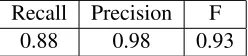
Recall Precision F
0.88 0.98 0.93
Table 1: The experimental result on the leave-one-out cross-validation.
# of EXT # of COR Precision
3,742 720 0.19
Table 2: The experimental result for a realistic situation.
the machine learning based method with the leave-one-out cross-validation. Table 1 shows the exper-imental result. The method produced high recall and precision rates for the cross-validation. How-ever, most of real tweets are non-trouble informa-tion. In other words, this situation is not on the real world. Therefore, we also evaluated our method trained by 900 tweets with 30,000 tweets that ex-tracted from Twitter randomly, as an opened test set. This is an real situation, namely unbalance data. We judged the correctness of the outputs of SVM. Table 2 shows the experimental result for the unbalance data. The EXT and COR in the table denote the number of tweets extracted by SVM and the num-ber of tweets extracted correctly, respectively. From the table, the machine learning based method was not suitable for this task because the precision rate on the realistic data set dramatically decreased.
4.2 Rule-based
We also constructed a rule-based method with a sim-ple matching approach. We prepared trouble ex-pressions (TEs) by handwork. Although trouble sentences (TSs) always contain TE(s), all sentences with TEs are not always TSs. Therefore, we also prepared NG phrases for the rule-based method. For example, “can’t charge” is a TE for mobile phones. However, “I can’t charge my phone because I don’t have a charger now” is not a TS because it is not trouble information about a product. To solve this problem, we need to add a NG phrase “because I don’t have a charger.”
We evaluated our rule-based method with 30,000 tweets in Section 4.1. Table 3 shows the experimen-tal result. We obtained high precision rate by using the rule-based method, as compared with the ma-chine learning method (See Table 2.) On the other
# of EXT # of COR Precision
474 444 0.94
Table 3: The experimental result of the rule-based method on the same situation with SVM.
hand, the number of tweets extracted correctly was reduced almost by half (720 vs. 444). As a re-sult, the simple rule-based method faced with an-other problem for this task.
4.3 Discussion
5 Proposed method
On the basis of the discussion in the previous sec-tion, we expand our rule-base method with a boot-strapping approach. The bootstrapping approach leads to the improvement of the coverage of the orig-inal rule-based method.
5.1 Outline
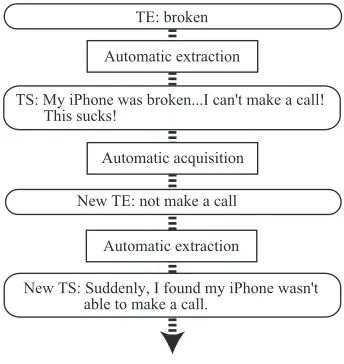
For extracting various types of trouble sentences, TSs, it is necessary to acquire new trouble expres-sions, TEs, automatically. In general, some TEs of-ten appear in one TS. We focus on this characteristic. Figure 1 shows an example. Here, “broken” is a TE, a seed for a bootstrapping approach. Assume that the TE and the phrase “not make a call” often co-occur in tweets. From this observation, our method obtains the phrase “not make a call” as a new TE, and then extract a new TS by the new TE.
The outline of our method is shown in Figure 2. First, we create seed words with strong trouble meanings for a target product by hand. By using the initial seeds, namely TEs, our method extracts TSs from a tweet corpus. For the TS extraction process, we judge the presence of TEs in each sen-tence. As exceptional treatment, we prepare some non-extraction rules. The non-extraction rules con-tain hearsay expressions such as “someone told me that” and non-factual expressions such as ”feel like.” We do not extract sentences matching with the non extraction rules as TSs. Next, our method extracts TE candidates from the extracted TSs. For the can-didates, we apply a scoring method for computing a confidence measure as new TEs. We acquire only TEs with high confidence values as new TEs. Fi-nally, we add the new TEs to the previous seeds. Our method iterates these processes until it fulfills certain conditions. In this paper, we set two condi-tions; (1) if the iteration is repeated at 5 times or (2) if the method does not acquire new TEs.
5.2 TE acquisition
TE extraction is based on surface and part-of-speech tags patterns. We focus on the following character-istics for the extraction.
Specific adverbs Adverbs are closely related to trouble information. Murakami and Nasukawa
TE: broken
TS: My iPhone was broken...I can't make a call! This sucks!
New TE: not make a call
New TS: Suddenly, I found my iPhone wasn't able to make a call.
Automatic extraction Automatic acquisition
Automatic extraction
Figure 1: An example of the extraction process.
Tweet corpus
TE acquisition
Scoring Seeds
TSs
TE candidates
New TEs
Figure 2: The outline of our method.
(2011) have proposed a method to detect po-tential problems from documents. They fo-cused on adverbs, such as “suddenly” and “ar-bitrarily”, to detect the nouns and verbs that de-scribed the actual problems. This is a language-independent characteristic. We also extract phrases with the specific adverbs as TEs.
Imperfective forms The target tweets in this pa-per are written in Japanese. As one Japanese characteristic, TSs often contain the imperfec-tive form of a verb with negation2. We extract phrases with this pattern as TEs.
Negative words As we mentioned in Section 2, negative opinions are closely related to trouble information. Tweets with negative expressions have high potentiality for TEs and TSs. On the other hand, as we also mentioned in Sec-tion 2, negative opinions are not always equal
2
to trouble information. Utilizing general senti-ment dictionaries is not always suitable for this task because they contain many negative words not related to trouble information. In this paper, we prepare negative words related to trouble in-formation about a target product, such as “bad”, “wrong” and “failure”, as a negative word set. We extract phrases with the negative words.
5.3 Scoring
A bootstrapping approach uses the previous outputs from the system as the inputs for the system in the next step. If the precision of the outputs is low, it leads to the decrease of the precision of the next out-puts. The accuracy deterioration by the change of the meaning of seeds is well-known as “Semantic drift” (Curran et al., 2007). To solve this problem, we need to keep high precision in the iteration pro-cess. In other words, we need to reject noise TEs in candidate TEs. Therefore, we need to estimate a confidence measure of each candidate TE.
One of the most successful approaches is the Espresso algorithm (Komachi et al., 2008; Pantel and Pennacchiotti, 2006). The algorithm was based on recursive definition of pattern-instance scoring metrics. It computed the pointwise mutual informa-tion between each pattern and instance recursively. The method in this paper does not handle any pat-terns for the bootstrapping process. Therefore, we cannot incorporate this algorithm into our method directly.
We introduce another scoring method for a con-fidence measure in the bootstrapping process. First, we compute confidence values of nouns, verbs and adjectives in TSs. Then, we estimate the confidence value of each TE on the basis of the confidence val-ues. The confidence measure is based on the follow-ing hypothesis:
• if a word frequently appears in TSs, the TE likelihood of the word is high.
• words appearing near a product name3contain high TE likelihood.
3It denotes not only concrete product names, such as
“iPhone”, but also product categories, such as “smartphone.”
The value of a wordwis computed as follows:
W Sw = ∑
i∈I
1 disti(w)
(1)
whereiandI are a sentence and sentences includ-ing a product name, respectively. disti(w) is the
distance between a product name and win i. The confidence measure of a TEtis the average value of
W Swin the TE.
T Escoret=
1 Nw
∑
w∈T Et
W Sw (2)
whereNw is the number of words in TEt. If a TE
contains frequent words with the highW Sw, it
ob-tains highT Escore.
After computation of T Escore, we extract phrases in the topN% as the new seeds for the next iteration. If the phrases in the current topN% are the same as the phrases in the previous step, the iter-ation is terminated.
6 Experiment
In this section, we evaluate our method with real tweets, and then discuss the results.
6.1 Result
The target product was cellphones. We collected 100,000 tweets about cellphones as the data set. These tweets contained words that related to cell-phones. As initial seeds, we set the following seven
words; (broken), (wrong),
(defect), (defect), (freeze) and (bug). We applied the seeds to the data set, and then obtained TEs and TSs by using the proposed bootstrapping method. In this experiment, the total number of iterations was 5. More properly speaking, when the number of iteration was 5, our method did not obtain new TEs. In other words, both of the two conditions in Section 5.1 were fortuitously fulfilled in this iteration.
0.75 0.76 0.77 0.78 0.79 0.80 0.81 0.82 0.83 0.84 0.85
1500 1750 2000 2250 2500 2750
Precis
ion
# of extr
acted tweet
s (
TS)
Precision
1 2 3 4 5 # of iterations
TS
Figure 3: The precision and the number of TSs in each iteration.
terms of the number of TSs and also held the high precision rate. This result denotes that the scoring method in Section 5.3 was effective for the boot-strapping in terms of the noise reduction from can-didate TEs. The experimental result shows the ef-fectiveness of our method, as compared with a non-bootstrapping method, because the result in the sec-ond step, namely bootstrapping, outperformed that in the first step, non-bootstrapping.
6.2 Analysis and discussion
Our method extracted TSs with a high precision rate through the iteration in the bootstrapping. Table 4 shows instances of TEs extracted by the method. These TEs related to the category “cellphones” and were suitable for the extraction of TSs. Our method correctly extracted some phrases with the opposite meaning, such as “turn on automatically” and “not turn on.” These TEs were distinguished by adverbs; “arbitrarily” and “suddenly.” It is difficult to extract these TEs by using only general sentiment dictionar-ies. We also obtained domain specific TEs, such as “put the speaker on mute arbitrarily.” Our method extracted various types of TEs by using the boot-strapping method.
Next, we discuss the size of the target data and the accuracy. If the data size is small, our method might not extract sufficient TEs. As a result, it leads to the decrease of the number of TSs. If the data size is large, our method might extract many
inap-(turn on arbitrarily)
(not turn on)
(power off suddenly)
(not power off)
(not push the button)
(put the speaker on mute arbitrarily)
Table 4: Extracted TEs.
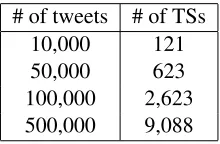
# of tweets # of TSs
10,000 121
50,000 623
100,000 2,623 500,000 9,088
Table 5: The number of extracted TSs on several data sets. The third row is the same as Section 6.1.
propriate TEs. It probably leads to the increase of the number of TSs with non-trouble information and the decrease of the precision. We investigated our method with the different size of data sets. Table 5 shows the result. For smaller data set, namely 10,000 and 50,000 tweets, the number of extracted TSs decreased dramatically. In these data sets, the number of outputs in the first iteration was insuffi-cient. As a result, our method could not obtain TSs and new TEs in the next process. Thus, our method needs an adequate amount of tweets for the TE ac-quisition process. For a larger data set, 500,000 tweets, the predicted number of TSs was approxi-mately 13,0004. The actual number of extracted TSs in the larger data set was 9,088. The result indi-cates that our method controlled noise TEs appro-priately in the bootstrapping process. In addition, our method extracted different types of TEs from the larger data set, such as
an app starts arbitrarily
(not recognize a card) and (clock not work). Our method was robust to the increase
4
of target data and could extract new TEs and TSs efficiently.
Finally, we explain the results of TSs. The follow-ing sentences are tweets extracted from our method:
•
(My cellphone ran out of charge, too hot to charge the battery and power off automatically .... This sucks!)
•
(The display of my cellphone blacked out, I removed the battery, and then I powered on it, but it isn’t turned on.)
Although these tweets did not contain direct expres-sions to trouble information, such as (bro-ken), our method correctly extracted them with
ac-quired TEs, such as (power
off automatically) and (not turn
on). The following sentence is an incorrect output TS from our method.
• iPhone ( )
( ) (The charging cable of my iPhone was broken ... I can’t charge the battery.)
This tweet is trouble information about accessories, but not a TS for a cellphone itself. In this experi-ment, we regarded this kind of outputs as negative results. This is a difficult problem in trouble infor-mation extraction. One solution is to add NG rules to the extraction process. However, we cannot solve a problem of the following sentence, which is also a negative result, by addition of NG rules.
• (
) iPhone (An accident had hap-pened (to him/her)? ... (his/her) iPhone might be broken5.)
This tweet contained a trouble expression, but it is not a TS for a cellphone. It implied that a user was
5
Note that the question mark and the word “might” in the English translation don’t appear explicitly in the original Japanese sentence.
worried about someone. This problem is more dif-ficult because we need deep analysis including se-mantics to solve it. Handling metaphor and Internet slangs appropriately is also important future work.
In the experiment, we evaluated our method in terms of the precision rate because it is difficult to measure the recall rate. Although we obtained more TSs by using our method, the number of TSs might be insufficient, namely the low recall rate. To im-prove this problem is the most important issue for our method.
We judged the correctness of the extracted TSs in Figure 3 with one annotator. We prepared a man-ual for the annotation, such as the definition of trou-ble information, in advance. However, for more cor-rect and reliable annotation, we need to annotate TSs with several annotators and compute the agreement among them. This is also important future work.
7 Conclusions
In this paper, we proposed a bootstrapping method to extract trouble information from Twitter. As a preliminary experiment, we evaluated a simple ma-chine learning method based on SVM and a sim-ple rule-based method. Although the SVM-based method worked well for the cross-validation about a small data set, the precision rate dramatically de-creased for a real and unknown tweet data set. The rule-based method obtained a high precision rate as compared with SVM. However, TSs extracted cor-rectly were reduced almost by half. The main prob-lems of these methods were (1) biased data, (2) cov-erage about non-trouble information and (3) a lim-ited number of trouble expressions (TEs).
Patrick Pantel and Marco Pennacchiotti. 2006. Espresso: leveraging generic patterns for automatically harvest-ing semantic relations. In Proceedings of the 44th annual meeting of the Association for Computational Linguistics, pages 113–120.
Ellen Riloff and Rosie Jones. 1999. Learning dictionar-ies for information extraction by multi-level bootstrap-ping. InProceeding of AAAI 99, pages 474–479. Ellen Riloff, Ashequl Qadir, Prafulla Surve, Lalindra De
Silva, Nathan Gilbert, and Ruihong Huang. 2013. Sar-casm as contrast between a positive sentiment and neg-ative situation. InProceedings of EMNLP 2013, pages 704–714.
Stijn De Saeger, Kentaro Torisawa, and Jun’ichi Kazama. 2008. Looking for trouble. InProceedings of COL-ING 08, pages 185–192.
Hiroyuki Sakai, Shouji Umemura, and Shigeru Ma-suyama. 2006. Extraction of expressions concerning accident cause contained in articles on traffic accidents (in Japanese). Journal of Natural Language Process-ing, 13(2):99–123.
Takeshi Sakaki, Makoto Okazaki, and Yutaka Matsuo. 2010. Earthquake shakes twitter users: real-time event detection by social sensors. InProceedings of the 19th international conference on World Wide Web (WWW2010), pages 851–860.
Kazutaka Shimada, Masahi Yamaumi, Ryosuke Tadano, Masashi Hadano, and Tsutomu Endo. 2010. Inter-active aspect summarization using word-aspect rela-tions for review documents. In Proceedings of the 5th International Conference on Soft Computing and Intelligent Systems and 11th International Symposium on Advanced Intelligent Systems (SCIS & ISIS 2010), pages 183–188.
Kazutaka Shimada, Shunsuke Inoue, and Tsutomu Endo. 2012. On-site likelihood identification of tweets for tourism information analysis. In Proceedings of 3rd IIAI International Conference on e-Services and Knowledge Management (IIAI ESKM 2012), pages 117–122.
Valery Solovyev and Vladimir Ivanov. 2014. Dictionary-based problem phrase extraction from user reviews. In Proceedings of TSD 2014, LNAI 8655, pages 225–232. Kentaro Torisawa, Stijn De Saeger, Yasunori Kakizawa, Jun’ichi Kazama, Masaki Murata, Daisuke Noguchi, and Asuka Sumida. 2008. Torishiki-kai, an autogen-erated web search directory. InProceedings of the Sec-ond International Symposium on Universal Communi-cation (ISUC 2008), pages 179–186.
Peter D. Turney. 2002. Thumbs up or thumbs down?: Semantic orientation applied to unsupervised classi-fication of reviews. In Proceedings of the 40th An-nual Meeting on Association for Computational Lin-guistics, ACL ’02, pages 417–424.