Automatic News Source Detection in Twitter Based on Text Segmentation
Takashi Inui Masaki Saito∗ Mikio Yamamoto Graduate School of Systems and Information Engineering
University of Tsukuba
1-1-1 Tenoudai, Tsukuba, Ibaraki 305-8573, JAPAN {inui@,masaki@mibel.,myama@}cs.tsukuba.ac.jp
Abstract
In this paper, we discuss news source detec-tion (NSD), which involves finding addidetec-tional information of a message generated in so-cial media to understand the original message more deeply. We propose an NSD method based on the text segmentation and two exten-sion models using web content and post times. Through the experiments using the real-world data, the proposed methods outperformed the baseline methods and exhibited an F-measure of 34.9.
1 Introduction
Recently, with the advent of social-media, it has be-come easy to express opinions or comment about experiences. In particular,Twitter1is a popular
ser-vice used worldwide, and extremely large number of messages (tweets) is generated every day on it. It has been widely recognized that Twitter can poten-tially contain much useful information. Therefore, many researchers have conducted content analysis on Twitter (Java et al., 2006; Krishnamurthy et al., 2008; Pennacchiotti and Gurumurthy, 2011; Mehro-tra et al., 2013).
Twitter can be regarded as a news feeder (Zhao et al., 2011). News content distributed by other me-dia are often re-distributed and diffused to more peo-ple through Twitter. For exampeo-ple, a userXposted a tweet as follows.
∗Currently, Fujitsu Limited.
1Twitter. https://twitter.com/
tex: Goal! Mario! http://example.football.com
Many people have a chance to know the details of Mario’s fantastic goal2throughtex. Web content
in-cluded in the URLhttp://example.football.com func-tions as an information source ontex. It can be said that tweets, such astex, contain suitable information for news feeders. However, such cases are rare. Al-most all tweets on Twitter are unsuitable due to a va-riety of reasons, e.g. (i)Xdid not write the informa-tion source in her stream of tweets, (ii) a tweet mes-sage and its information source (URL) were written in separate tweets, or (iii) X included a URL that was not related to the tweet message. In these cases, tweets do not function as the news feeders and peo-ple cannot obtain any additional information from them.
We discuss news source detection (NSD), which involves finding additional information of a message generated on social media to understand the original message more deeply. In Twitter, given a tweetti, the goal with NSD is to find another tweettj (̸=ti) that includes a reference to its information source on ti. The details of NSD are described in Section 2. We propose an NSD method based on the text seg-mentation. It is difficult to straightforwardly resolve NSD because a search space of tweet pair combina-tions is exponentially large. Therefore, we simplify the NSD problem from the viewpoint of the text seg-mentation and provide an approximate solution. We also discuss two extension models of the proposed method using web content and post times.
2Mario G¨otze is a German footballer who scored a goal at
!"#$%%&'()(*+!
&,-./0&+,*1,.200.-! 3+0!
!"#$%%&'()(*+!
4.0#)5,
6*(7+08.,9080/&3*8! 4.0#):,.0;.,-09+08.&3*8!
!"#$%%&'()(*+!
4.0#)<,
-*7/(0,60.0(3*8!
!"#$%%&'()(*+!
-09+08.,=!
-09+08.,<!
-09+08.,:!
-09+08.,5!
.5! .:! .<! .=! .>! .?! .@! .A! .B! .5C!
, D!
, D!
, D!
E,FG/.7&H,6*(7+08.!
.5! .:! .<! .=! .>! .?! .@! .A! .B! .5C!
7,I! -J.?K,I,7,I,.>!
-J.@K,I,7,I,.>!
Figure 1: News source detection based on text segmentation
The rest of the paper is organized as follows. First, we define NSD and introduce some concepts and their notations for a formal description of NSD in Section 2. We then propose an NSD method that is based on the text segmentation and also discuss two extensions of the proposed method in Section 3. In Section 4, we introduce related work and dis-cuss the differences between them. In Section 5, we describe the details of the experiments using real-world data and argue that the proposed method per-forms better than the baseline methods. We summa-rize the paper in Section 6.
2 News Source Detection
First, we introduce some concepts and their nota-tions for a formal description of NSD.
• target tweet(t): a tweet for finding the
infor-mation source. We call the inforinfor-mation source especially,news source, hereafter.
• source tweet(s(t)): a tweet that includes a
ref-erence to the news source ont. In this paper, we
only consider URL strings included in tweets as references.
• URL tweet(u): a tweet including a URL string.
Given a stream of tweetsT =⟨t1, t2, ..., t|T|⟩that includes at least oneu, the task of NSD is to detect
whetheruis a source tweet ontifor eachti except
u.
3 Proposed Methods
3.1 NSD based on Text Segmentation
We found two valuable findings in our preliminary analysis.
• Auadjacent to attends to be as(t)ont
(u=s(t)).
• Two target tweets, ti andtj, adjacent to each other tend to have the same source tweet (s(ti) =s(tj)).
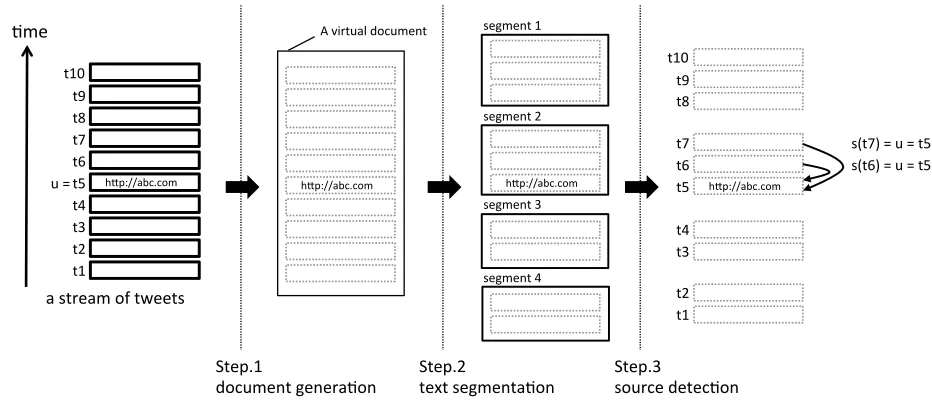
From these findings, we use text segmentation, which is one of the fundamental tasks in the NLP research domain. The goal with the text segmen-tation problem is to divide an input document into parts based on subtopics held in the input document. We designed an algorithm to solve NSD as fol-lows and illustrated in Figure 1.
Step.1 document generation. A stream of tweets is regarded as a virtual document.
Step.3 source detection. The u is detected as a
source tweet ont(u = s(t)) if and only if au
andtin the document belong to the same
seg-ment.
From a technical viewpoint, the text segmentation problem in Step.2 is the core part of this algorithm. We explain the details of Step.2 in the next section.
3.2 Applying TextTiling 3.2.1 TextTiling
We used a modified version of the text segmen-tation algorithm called TextTiling (Hearst, 1997), which is a well-known and standard text segmen-tation method, and is focused on adjacent sentence pairs. Suppose thatsiandsjis an adjacent sentence
pair in the input document, then, TextTiling deter-mines whethersiandsj belong to the same segment
or not according to a boundary score3. If the sen-tence boundarysbij betweensi andsj has a lower
boundary score than the thresholddth, the sentence
pair is detected as belonging to the same segment; otherwise, it is not. As a result, text segmentation in the input document is naturally done when all sen-tence boundaries are determined.
A boundary scoredijheld on the sentence
bound-arysbij is defined as follows:
dij = (ssl−ssij) + (ssr−ssij) (1)
where ssij indicates a similarity score at sbij and ssl(ssr) indicates a similarity score at a local
maxi-mum point on the left(right)-hand side ofsbij. Each
similarity scoressij is defined as follows:
!
w∈L
f(w, cfi)f(w, cbj) "#
w∈Lf(w, cfi)2 #
w∈Lf(w, cbj)2
(2)
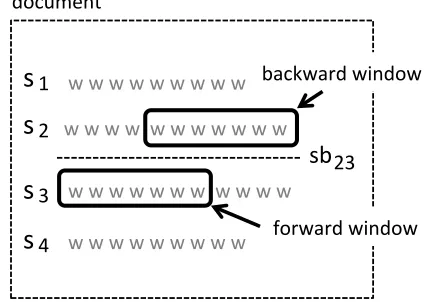
wherecfi andcbjindicate context windows, wherecfi
indicates a forward window andcbjindicates a
back-ward window (see Figure 2). The symbol L
indi-cates a lexicon set.
The function f(w, cfi)returns the number of oc-currences of a wordwin the context windowcfi and f(w, cb
j)likewise. Intuitively, this score represents a
topical coherence betweencfi andcbj. The higher the ssij, the stronger the coherence.
3This is called the “depth” score in (Hearst, 1997).
!"!"!"!""!"!"!"!"!"!"!"!
!"!"!"!"!"!"!""!"!"!"!"! !"!"!"!"!"!"!"!"!"!"!"!
!"!"!"!"!"!"!"!"!""!
#
!
$!#
!
%!#
!
&!#
!
'!#(
!&%!)*+,-./0!
1*2!32)"!4/)*!!
(3+5!32)"!4/)*!!
Figure 2: Backward and forward windows
Actually,dij is only measured at each local
mini-mum point ofssij and compared withdth. Thedth
to the boundary score is defined as dth = S − σ2.
Here,S indicates an average value of all boundary
scores andσindicates their standard deviation.
3.2.2 Modifications
We introduce three modifications to the original TextTiling algorithm to appropriately apply it to a virtual document composed of a stream of tweets.
First, we focus on tweet boundaries instead of sentence boundaries because we want to make seg-ments in units of tweets.
Second, we add another type of context window. The word-based window is only defined in the orig-inal algorithm. Figure 2 shows an example of the word-based window of size 7. We also use the post-based window. With the post-post-based window, the number of words to be included in the window varies with the length of each tweet. Therefore, we can include more meaningful context into the boundary scores.
The third is a normalization of the similarity scores. Our stream data are much shorter than those assumed in the original TextTiling algorithm. There-fore, it was frequently observed that the number of words is less than the window size at the end of the stream when using the word-based window.
data, we focused on a set of tweet pairs ⟨u, t⟩ in whichtexist within five tweets fromuin the stream then used 3,170⟨u, t⟩ pairs as our evaluation data. The problem to be solved in the experiments was detecting whetheruis the source tweet ontfor each
⟨u, t⟩in the evaluation data.
We asked two annotators to create a gold standard dataset. The annotators were required to indepen-dently judge whetheruinto ⟨u, t⟩in the evaluation data is regarded as a source tweet ont. We measured theκstatistics (Cohen, 1960) to assess the
reliabil-ity of the gold standard dataset. The result is that
κ = 0.782. This value indicates that the data sub-stantially agree.
5.2 Baseline methods
We adopted two baseline methods for comparison with the proposed methods.Naiveis the most naive method and SIM is a customized version of the method (Abel et al., 2011) proposed to resolve DA described in Section 4.
Naive For all tweet pairs in the evaluation data, the uin⟨u, t⟩is always detected ass(t)ont.
SIM This is a similarity-based method originally proposed by (Abel et al., 2011). Suppose that
U indicates a set of URL tweets in the evalua-tion data andweb(u)indicates a web page re-ferred from a URL written in u (∈ U). SIM focuses on each similarity between t and a web pageweb(u′) (u′ ∈ U) to detect whether u = s(t), that is, the uin⟨u, t⟩is thes(t) on t. First, givent in⟨u, t⟩, uo is selected using Equation (6).
uo= arg max
u′∈U sim(t, web(u
′)) (6)
After that, u is detected as a source tweet on t only when uo = u; otherwise, it is not. We used Equation (7) as the similarity function sim(t, web(u′)), which is the same setting as (Abel et al., 2011).
!
i∈T
T F(i, web(u′))∗IDF(i) (7)
where T is a set of words included in t, T F(i, web(u′))indicates the term frequency of
iinweb(u′), andIDF(i)indicates the inverse document frequency in terms of web pages in the evaluation data.
5.3 Other settings
We used the Japanese morphological analyzer
MeCab7 for word recognition. It is observed that
each tweet in the evaluation data is composed of an average of six words.
We conducted our experiments by changing the size of the context window used in the text segmen-tation phase. We set up sizes from 1 to 15 for the word-based window and from 1 to 2 for the post-based window. We used only nouns as a lexicon set L.
We used Precision and Recall as evaluation mea-sures, which are defined as
P recision = |X∩Y|
|X| ∗100,
Recall = |X∩Y|
|Y| ∗100.
The symbolX indicates a set of⟨u, t⟩instances in which the u in ⟨u, t⟩ is detected using a method as the source tweet on t and Y indicates a set of
⟨u, t⟩ instances in which the u in⟨u, t⟩ is actually source tweet on t. We also used F-measure index
2∗P recision∗Recall
P recision+Recall as a summary of the above mea-sures.
5.4 Experimental Results
5.4.1 Results of proposed method: Basic
We start by discussing the results of the simplest method proposed in Section 3, which we callBasic. We discuss the results obtained using the extended models ofBasicin the next section.
Table 1 lists the results ofBasic. The results from which the word-based window was used in the text segmentation are shown in the upper part of Table 1 and those from the post-based window are shown in the lower part. With the word-based window, Preci-sion dropped when the window size was larger. Re-call, on the other hand, tended to increase when the window size was larger. Similar phenomena were observed with the post-based window. The best F-measure value was 29.5, obtained when the size of
Table 1: Results of proposed method (Basic) word-based window
window Precision Recall F-measure size
1 100.0 0.3 0.6
2 35.3 1.9 3.6
3 40.5 10.7 17.0
4 31.7 18.3 23.2
5 23.8 23.0 23.4
6 25.8 34.4 29.5
7 20.2 33.4 25.2
8 18.8 37.2 25.0
9 18.2 38.2 24.6
10 17.1 38.8 23.7
11 8.9 21.5 12.6
12 7.7 18.6 10.9
13 8.8 21.1 12.5
14 8.1 19.9 11.5
15 8.8 21.1 12.5
post-based window
window Precision Recall F-measure size
1 35.2 21.8 26.9
2 19.5 29.7 23.5
word-based window was 6, and 26.9, obtained when the size of the post-based window was 1.
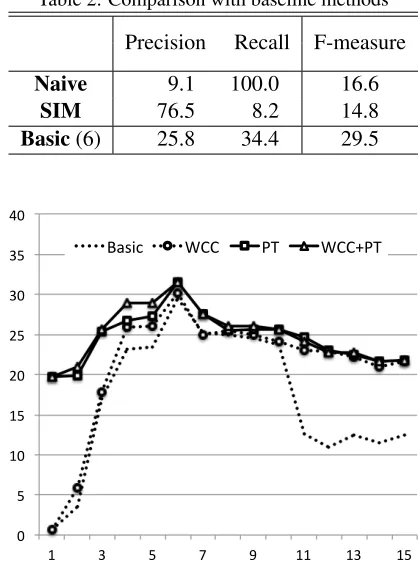
Next, we compareBasic with the baseline meth-ods. Table 2 lists the results obtained from the base-line methods. The best result obtained from Ba-sic with the word-based window of size 6 is also shown in the bottom of Table 2. Naive naturally achieved 100% Recall while Precision was very low (9.1%). SIMhad a contrary phenomenon toNaive, low Recall (8.2%) and high Precision (76.5%), since it would induce conservative decision-making by Equation (6). One can see that Basic achieved a well-balanced performance and higher F-measure than the baseline methods.
5.4.2 Effectiveness of extensions
We investigated the effectiveness of the two ex-tensions,WCCdiscussed in Section 3.3 andTP dis-cussed in Section 3.4. First, we discuss the results of
WCCand then discuss those ofPT.
Table 3 lists the results obtained from WCC.
Table 2: Comparison with baseline methods
Precision Recall F-measure
Naive 9.1 100.0 16.6
SIM 76.5 8.2 14.8
Basic(6) 25.8 34.4 29.5
!" #" $!" $#" %!" %#" &!" &#" '!"
$" &" #" (" )" $$" $&" $#"
*+,-." /00" 12" /00312"
Figure 4: F-measure values from proposed methods
WCC outperformed Basic when larger windows were used. This is because WCC was able to make good use of word information included in both tweets and web pages. This is especially evident in the cases in which the post-based window was used. The best F-measure value was 34.7 obtained with WCC with a post-based window of size 2.
Next, Table 4 lists the results obtained from PT.
PTalmost totally outperformedBasicand also out-performed WCC when small windows were used. It exhibited an F-measure of 34.9 with a post-based window of size 1. This is the best performance of all experimental conditions.
5.4.3 Sensitivity to window size
Table 3: Results of proposed method (WCC) word-based window
window Precision Recall F-measure
size
1 100.0 0.3 0.6
2 43.5 3.2 5.9
3 37.4 11.7 17.8
4 32.1 21.8 25.9
5 25.8 26.5 26.1
6 25.7 36.6 30.2
7 20.1 33.1 25.0
8 19.2 37.9 25.5
9 18.4 39.1 25.0
10 17.4 39.7 24.2
11 16.4 39.4 23.1
12 16.2 39.1 22.9
13 15.6 38.2 22.2
14 14.8 36.3 21.0
15 15.3 36.9 21.6
post-based window
window Precision Recall F-measure
size
1 33.1 31.9 32.5
2 28.7 43.8 34.7
indicates the results obtained from the method with both extension models.
One can see that all models exhibited the best per-formance when the window size = 6. This is intu-itively supported since each tweet in the evaluation data was composed of an average of six words. One can see from Figure 5 that Precision and Recall were balanced when the window size was around 6. There seemed to be a semantic boundary seemly for NSD around 6.
It is less sensitive in the case of the PT
exten-sion model and the WCC+PTcombination model.
These models exhibited almost the same F-measure values. It would be reasonable and sufficient to use
thePTextension model when it is difficult to crawl
web pages.
6 Conclusion
We proposed an NSD method based on text segmen-tation and two extension models using web content and post times. Using the TextTiling algorithm, we
Table 4: Results of proposed method (PT) word-based window
window
Precision Recall F-measure size
1 35.8 13.6 19.7
2 31.7 14.5 19.9
3 33.2 20.5 25.3
4 29.0 24.9 26.8
5 25.0 30.0 27.3
6 26.2 39.7 31.6
7 21.3 39.1 27.6
8 19.0 38.8 25.5
9 18.8 40.4 25.7
10 18.4 42.6 25.7
11 17.4 42.3 24.7
12 16.3 39.7 23.1
13 15.9 38.5 22.5
14 15.2 37.2 21.6
15 15.5 36.9 21.8
post-based window
window Precision Recall F-measure
size
1 31.0 40.1 34.9
2 20.2 38.8 26.6
achieved an F-measure of 34.9. The following issues will need to be addressed to refine our models.
• The proposed methods can provide a
lightweight, approximate solution to NSD by using text segmentation. This means that it is only applicable to continuous condi-tions. Methods applicable to non-continuous conditions should be developed to improve performance.
• We only considered web pages referred from
tweets as news sources in this paper. It
would be valuable to enlarge the target of news sources to other media such as TV and radio.
References
!" #!" $!" %!" &!" '!!"
'" (" )" *" +" ''" '(" ')"
!,-./01023" 4./566"
!" #!" $!" %!" &!" '!!"
'" (" )" *" +" ''" '(" ')"
!,-./01023" 4./566"
!" #!" $!" %!" &!" '!!"
'" (" )" *" +" ''" '(" ')"
!,-./01023" 4./566"
!" #!" $!" %!" &!" '!!"
'" (" )" *" +" ''" '(" ')"
!,-./01023" 4./566"
758"9510/" 7:8";<<".=>.31023" 7/8",?".=>.31023" 7@8";<<A,?"/2B:035C23"
Figure 5: Precision and Recall values obtained from proposed methods
of the 8th extended semantic web conference on The
semanic web, pages 375–389.
James Allen. 2002. Topic detection and tracking:
event-based information organization. Kluwer Academic
Publishers.
Jacob Cohen. 1960. A coefficient of agreement for nom-inal scales. Education and Psychological Measure-ment, 43(6):37–46.
Marti A. Hearst. 1997. Texttiling: Segmenting text into multi-paragraph subtopic passages. Computational linguistics, 23(1):33–64.
Piotr Indyk and Rajeev Motwani. 1998. Approximate nearest neighbors: towards removing the curse of di-mensionality. InProceedings of the 13th annual ACM
symposium on Theory of computing, pages 604–613.
Akshay Java, Xiaodan Song, Tim Finin, and Belle Tseng. 2006. Why we twitter: understanding microblogging usage and communities. InProceedings of the 9th We-bKDD and 1st SNA-KDD workshop on Web mining and social network analysis, pages 56–65.
Balachander Krishnamurthy, Phillipa Gill, and Martin Arlitt. 2008. A few chirps about twitter. In Proceed-ings of the rirst workhop on Lnline social networks, pages 19–24.
Rishabh Mehrotra, Scott Sanner, Wray Buntine, and Lex-ing Xie. 2013. ImprovLex-ing LDA topic models for mi-croblogs via tweet pooling and automatic labeling. In
Proceedings of the 36th international ACM SIGIR con-ference on Research and development in information retrieval, pages 889–892.
Marco Pennacchiotti and Siva Gurumurthy. 2011. Inves-tigating topic models for social media user recommen-dation. InProceedings of the 20th International World
Wide Web Conference, pages 101–102.
Sasa Petrovic, Miles Osborne, and Victor Lavrenko. 2010. Streaming first story detection with application to twitte. InProceedings of the 11th Annual Confer-ence of the North American Chapter of the Association for Computational Linguistics, pages 181–189.