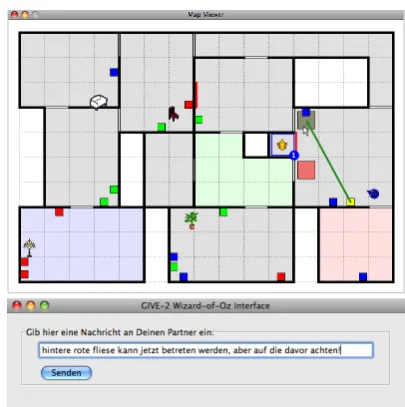
Figure 1: The view of the virtual environment, as displayed on the IF’s monitor.
the objects in the world by hovering the mouse over their icons. We also mirrored the contents of the IF’s screen on a second screen next to the IG’s monitor.
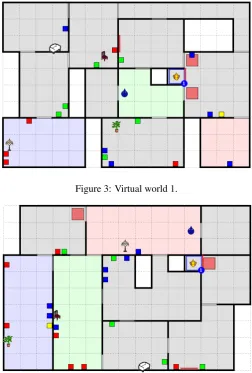
We designed three different virtual environments, shown in Figures 3–5. These were engineered so as to elicit a certain range of relevant behaviors in terms of navigation and re-ferring expressions. As in GIVE, solving the treasure hunt required pressing a sequence of buttons in the right order to open a safe, and then picking up a trophy from the safe. In each world, the task could be solved with ten such object manipulations.
Additionally, we asked each subject to fill in the Santa Bar-bara Sense of Direction (SBSOD) questionnaire (Hegarty et al., 2006), a standardized self-report scale measuring the subject’s ability to orient themselves in an environment. It consists of 15 items, which we translated into German for the German speaking participants.
2.3. Procedure
Each pair of subjects participated in three rounds of games, one for each world. To control for learning effects, we pre-sented the worlds in different orders. The subjects were randomly assigned roles (IG or IF) for the first round, and switched roles after that. We gave all subjects time to get used to the software tools, and, in the IG’s case, to familiar-ize themselves with the world before starting the round. For each round, we collected a range of data using the standard logging process of GIVE.
2.4. The GIVE-2 Corpus
The GIVE-2 corpus consists of the collected game logs, which record the experimental session with enough detail to allow for a smooth replay. Specifically, we logged the total time games took, all the instructions sent by the IG, and all the actions performed by the IF. Furthermore, we logged the IF’s position and orientation every 200 millisec-onds, making it possible to extract information about their movements in response to instructions and other events. Table 1 shows a shortened and simplified excerpt of a game log. Each line starts with a timestamp. The first line in-dicates the IF’s position and orientation and which objects he or she can see at that moment (which, in this particular example, is none). Status messages of this form are stored
Figure 2: The IG’s graphical interface, including the map interface showing the same scene as in Fig. 1 and a separate window for typing instructions.
every 200 milliseconds. The next line shows that the IG sent an instruction. This is followed by more status mes-sages before the IF acts, as indicated by the last line. This action message conveys that buttonb10was pressed and that the effect of this button press was to bring the safes1
from statesafe-state-2into statesafe-state-3. Upon request interested researchers can obtain the com-plete logs from us together with the demographic infor-mation and the SBSOD scores that we collected from all participants. Furthermore, we provide a tool to play back experimental sessions from the game logs. This tool is also available through the Internet, such that replays of the data can be viewed online.2
3.
Analysis
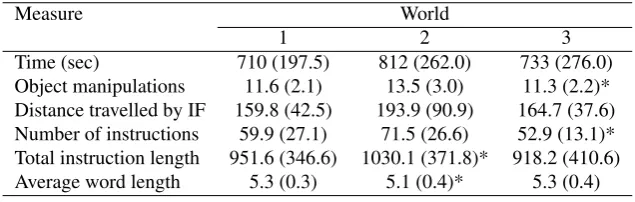
The German corpus obtained in this way consists of 2763 instructions, spread over 45 documents representing the in-dividual rounds. On average, each round contained 61.4 instructions (SD = 24.0) and took about 752 seconds (SD = 245.8); the IF performed 12.1 object manipulations per round on average (SD = 2.6). For the English corpus, there were 63 rounds consisting of 3417 instructions. Rounds consisted on average of 54.2 (SD = 20.4) instructions, and took about 553 seconds (SD = 178.4), with the IF carrying out 11.8 (SD = 4.9) object manipulations. The numbers are on the same order of magnitude across the two languages, with the exception of completion time, which we discuss below.
3.1. Task performance factors
During both the English and German data collection exper-iments, subjects completed all rounds successfully. How-ever, we can still compare the factors that influenced their performance in terms of time, number of object
manipula-2http://www.give-challenge.org/research/
Figure 3: Virtual world 1.
Figure 4: Virtual world 2.
Figure 5: Virtual world 3.
13:18:50.020 Receive: [Status: pos (1.51,1.0,6.92), facing [0.03,0.0,0.99], visible: []] 13:18:50.053 Send: [Text: hinten blauen knopf dr¨ucken]
13:18:50.210 Receive: [Status: pos (1.51,1.0,6.92), facing [0.03,0.0,0.99], visible: []] ...(more status messages every 200 ms) ...
13:18:52.426 Receive: [Status: pos (3.45,1.0,7.66), facing [0.44,0.0,0.89], visible: [p2, b10]] 13:18:52.509 Receive: [Action Message: manipulate(b10,s1,safe-state-2,safe-state-3)]
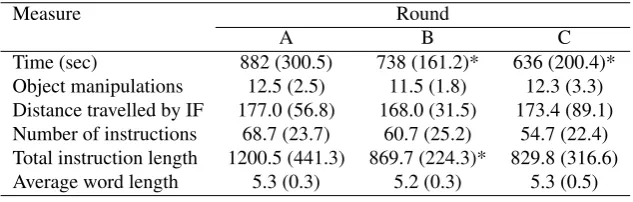
Measure Round
A B C
Time (sec) 882 (300.5) 738 (161.2)* 636 (200.4)* Object manipulations 12.5 (2.5) 11.5 (1.8) 12.3 (3.3) Distance travelled by IF 177.0 (56.8) 168.0 (31.5) 173.4 (89.1) Number of instructions 68.7 (23.7) 60.7 (25.2) 54.7 (22.4) Total instruction length 1200.5 (441.3) 869.7 (224.3)* 829.8 (316.6) Average word length 5.3 (0.3) 5.2 (0.3) 5.3 (0.5)
Table 4: For the German corpus, variation across rounds (N = 15). The asterisk * indicates that difference to left neighbor is significant atp < .05(using Paired Samples T-test).
Measure Round
A B C
Time (sec) 563 (128.0) 600 (231.0) 498 (152.3)* Object manipulations 11.5 (4.8) 12.1 (4.2) 11.9 (5.7) Distance travelled by IF 183.7 (57.0) 206.8 (129.5) 184.8 (85.4) Number of instructions 50.1 (18.6) 55.5 (20.7) 57.1 (22.2) Total instruction length 918.1 (264.2) 920.3 (431.1) 808.1 (365.3) Average word length 4.7 (0.2) 4.8 (0.2) 4.6 (0.5)
Table 5: For the English corpus, variation across rounds (N = 21). The asterisk * indicates that difference to left neighbor is significant atp < .05(using Paired Samples T-test).
gained while acting as the IF. In the English data, we do not see these learning effects from round A to round B. One possible explanation is that English participants, who tended to be more experienced with video games, benefited less from this “training round” about interaction with vir-tual worlds.
4.
Annotating referring expressions
In addition to the above analysis, we can extract more de-tailed information from our corpus by selectively annotat-ing phenomena of interest. To illustrate this, we annotated a sample of the corpus for the different strategies IGs used to refer to objects—a crucial ability of any NLG system. To gain some cross-linguistic insights into the task, we anno-tated both the German and the English sessions of World 2 (see Fig. 4).
For the annotation we devised the following scheme, which largely draws from the body of linguistic literature on spa-tial frames of reference (Levinson, 2003).
• Taxonomic property: Reference to the type of the object; e.g. “button”, “square”.
• Absolute property:Reference to a property of the ob-ject that can be determined without comparing it with other objects; e.g. “red”, “yellow”.
• Relative property:Reference to a property of the ob-ject in relation to other similar obob-jects; e.g. “first”, “middle”.
• Viewer-centered: Reference to the object’s location relative to the viewer’s; e.g. “on the left”, “behind you”.
• Micro-level landmark intrinsic: Reference the ob-ject’s location in relation to another object of a differ-ent kind that is movable; e.g. “by the chair”, “next to the plant”.
• Distractor intrinsic: Reference to the object’s loca-tion in relaloca-tion to another object of the same kind (i.e. distractor); e.g. “next to the yellow button”, “closest to the blue one”.
• Macro-level landmark intrinsic: Reference to the object’s location in relation to an immovable feature of the room (i.e., the room itself, parts of the room such as corners and walls, built-in objects such as doors, safes and alarm tiles); e.g. “on the wall”, “in that room”.
• History of interaction: Reference to the object by using elements of the interaction history (i.e. previ-ous events in the session); e.g. “from before”, “as last time”.
• Visual focus: Reference to the object by using the visual context and distinguishing visible from non-visible objects; e.g. “this one”, “that”.
• Deduction by elimination: Reference to the object by specifying which objects are not meant and letting the viewer deduce the intended one; e.g. “not that”, “other one”.
Strategy for RE Frequency (%) German English
Taxonomic property(type; e.g. “button”) 53.66 58.51
Absolute property(color; e.g. “red”) 85.37 92.53
Relative property(e.g. “first”, “middle”) 6.83 4.56
Viewer-centered(e.g. “on the left”, “behind you”) 15.61 12.45
Micro-level landmark intrinsic(e.g. “by the chair”) 13.17 17.84
Distractor intrinsic(e.g. “next to the yellow button”) 10.73 14.11
Macro-level landmark intrinsic(e.g. “on the wall”) 6.83 4.15
History of interaction(e.g. “from before”, “as last time”) 4.39 7.05
Visual focus(e.g. “this one”, “that”) 0.49 3.73
Deduction by elimination(e.g. “not that”, “other one”) 0.98 3.32
Table 6: Annotation results for RE strategies in the German and English sessions of World 2 (Fig. 4).
They thus reached agreement of κ = 0.986 in the Ger-man and κ = 0.975 in the English dataset, as indicated by Cohen’s kappa coefficient. This amounts to almost per-fect agreement, which is not surprising given our strictly specified annotation scheme.
One challenge in the annotation effort was identifying the REs in the situated corpus, as IGs occasionally referred to objects without specifying any of their properties; e.g. “yes”, “hit”. We chose not to include such instances in the annotation. Since the scheme does not consist of mutually exclusive features, we obtained the final annotation results reported here by merging the data of the two annotators. As the results in Table 6 show, the types of referring strate-gies taken up by German and English speakers are com-parable. A clear majority of the referring expressions in both languages involve an absolute property (color) of the target object, even at the cost of introducing redundancy. References that exploit the visual context from the viewer’s perspective (“on the left”), or the location of the target with respect to distractors (“next to the yellow button”) or land-marks (“by the chair”) are also frequent. The fact, on the other hand, that only slightly more than half of the REs mention the basic type (“button”) of the referent, seems specific to the task at hand, in which the only type of object that was ever manipulated was buttons, and is a matter for further investigation.
5.
Conclusion
We have presented the GIVE-2 Corpus, a new multilin-gual corpus of written instructions in virtual environments. This corpus can be used to study situated communication in general, and is designed to support developing systems for the GIVE Challenge in particular. It combines, for the first time, natural-language instructions with detailed in-formation about IF behavior and demographic data within the same resource, and opens up new possibilities of cross-linguistic research on situated language.
While we believe that even the unannotated corpus can be a useful resource, we anticipate that much more can be gained from it by selective annotation. In particular, it would be interesting to learn to generate appropriate REs and successful navigation strategies for specific contexts. We leave such efforts for future work.
6.
References
D. Byron, A. Koller, K. Striegnitz, J. Cassell, R. Dale, J. Moore, and J. Oberlander. 2009. Report on the First NLG Challenge on Generating Instructions in Virtual Environments (GIVE). InProc. 12th ENLG.
M. Hegarty, D. R. Montello, A. E. Richardson, T. Ishikawa, and K. Lovelace. 2006. Spatial abilities at different scales: Individual differences in aptitude-test perfor-mance and spatial-layout learning. Intelligence, 34:151– 176.
S. C. Levinson. 2003. Space in Language and Cognition. Cambridge University Press.
M. MacMahon, B. Stankiewicz, and B. Kuipers. 2006. Walk the talk: Connecting language, knowledge, and ac-tion in route instrucac-tions. InProc. 21st AAAI.
L. Stoia, D. M. Shockley, D. K. Byron, and E. Fosler-Lussier. 2006. Noun phrase generation for situated di-alogs. InProc. 4th INLG.
L. Stoia, D. M. Shockley, D. K. Byron, and E. Fosler-Lussier. 2008. SCARE: A Situated Corpus with Anno-tated Referring Expressions. InProc. 6th LREC. I. Zukerman, P. Ye, K. Gupta, and E. Makalic. 2009.