Annotating Spatial Containment Relations Between Events
Kirk Roberts, Travis Goodwin, Sanda M. Harabagiu
Human Language Technology Research Institute University of Texas at Dallas
Richardson TX 75080
{kirk,travis,sanda}@hlt.utdallas.edu
Abstract
A significant amount of spatial information in textual documents is hidden within the relationship between events. While humans have an intuitive understanding of these relationships that allow us to recover an object’s or event’s location, currently no annotated data exists to allow automatic discovery of spatial containment relations between events. We present our process for building such a corpus of manually annotated spatial relations between events. Events form complex predicate-argument structures that model the participants in the event, their roles, as well as the temporal and spatial grounding. In addition, events are not presented in isolation in text; there are explicit and implicit interactions between events that often participate in event structures. In this paper, we focus on five spatial containment relations that may exist between events: (1) SAME, (2) CONTAINS, (3) OVERLAPS, (4) NEAR, and (5) DIFFERENT. Using the transitive closure across these spatial relations, the implicit location of many events and their participants can be discovered. We discuss our annotation schema for spatial containment relations, placing it within the pre-existing theories of spatial representation. We also discuss our annotation guidelines for maintaining annotation quality as well as our process for augmenting SpatialML with spatial containment relations between events. Additionally, we outline some baseline experiments to evaluate the feasibility of developing supervised systems based on this corpus. These results indicate that although the task is challenging, automated methods are capable of discovering spatial containment relations between events.
Keywords: spatial relations, event relations, spatial reasoning
1.
Introduction
Events in text implicitly convey spatial information. Im-plicit spatial inference occurs when no spatial information is explicitly associated with an event. For instance, in the sentence “The [bombing] victim [died] instantly”, we un-derstand that the spatial bounds on died happened within the spatial bounds on bombing. Yet this is not directly stated by the contextual evidence. Two further examples of implicit spatial grounding are illustrated by:
(1) [Rafiq Hariri]PARTICIPANT [submitted]E1his resignation during a 10-minute [meeting]E2with the head of state at the [Baabda presidential palace]LOCATION.
(2) As[Egyptian columns]PARTICIPANT [retreated]E3, Israel’s
aircraft[attacked]E4them, using napalm bombs. The [attacks]E5destroyed hundreds of vehicles and [caused]E6heavy casualties in [Sinai]LOCATION.
In Example (1), recognizing Rafiq Hariri was located in the Baabda presidential palace in the eventE1 (submitted) requires understanding the spatial relationship betweenE1 andE2 (meeting). Moreover, the temporal connective dur-ing groundsE1 temporally within the time interval associ-ated with E2. While a temporal relation does not always guarantee a spatial relation, in this case an OCCASION dis-course relation exists betweenE1 andE2, allowing the spa-tial inference to be made as well. Since the temporal re-lation indicates eventE2 temporally contains eventE1, the inference thatE2 also spatially containsE1 may be made as well. AsE2 is contained within the location Baabda presi-dential palace,E1 is also contained within this location by the transitive property. This allows us to draw the inference that E1’s participant Rafiq Hariri is located at the palace
as well. In Example (2), understanding that the Egyptian columns are spatially related to Sinai requires understand-ing the spatial relationships between both coreferential and non-coreferential events. In this example, the event corre-sponding toE3 (retreated) refers to a motion whose source is the same location as the eventE4 (attacked). EventE4 is coreferential with eventE5 (i.e., they are both mentions of the same event). Further, E5 has the result event E6 (caused), which is located in Sinai. These two examples show that spatial containment relations between events can be inferred by relying on many discourse phenomena, in-cluding coreference and temporal relations.
Using these types of relations to determine the location of events and their participants fits into the larger work of recovering implicit information (Palmer et al., 1986), where semantically relevant information is found outside an object’s syntactic scope. The difficulty with a gener-alist approach to recovering long-distance semantic argu-ments, however, is that there is no one set of relations that describes how all implicit information can be recovered. Rather, the method for recovery depends on the type of information being sought. Temporal information, for in-stance, can be recovered through a very different set of re-lations than manner or purpose information. This work is part of an effort to create one such method for acquiring implicit spatial information through spatial containment re-lations between events. Currently, we are unaware of any linguistic resource of manually annotated spatial contain-ment relations between events. We expect the ability to au-tomatically identify spatial containment relations between events will improve the performance of generalized implied semantic role labelers.
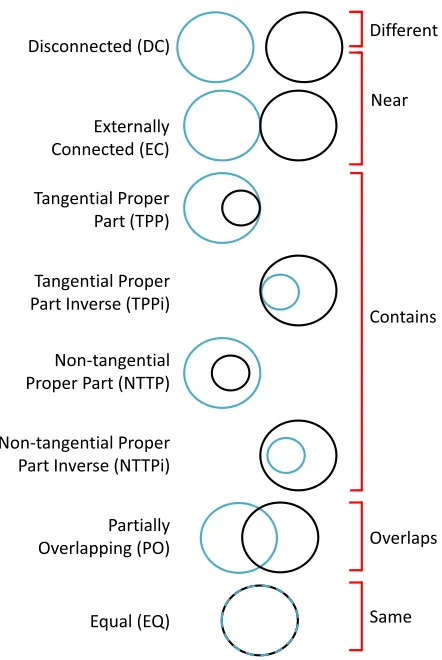
resource. We consider five basic spatial containment rela-tions between events:
1. SAME: Two eventsE1 andE2 have indistinguishable spatial bounds.
2. CONTAINS: EitherE1’s spatial bounds containE2 or vice versa (this is a directed relation).
3. OVERLAPS: E1 and E2 share partial spatial bounds but neither is a sub-set of the other.
4. NEAR:E1 andE2 do not share spatial bounds but they are within relative proximity of each other.
5. DIFFERENT:E1 andE2 have distinguishably different spatial bounds.
Annotation of all five types of containment relations is per-formed on SpatialML (Mani et al., 2008).
The remainder of this paper is organized as follows. Sec-tion 2 outlines related work in event relaSec-tions and implicit information recovery. Section 3 discusses our annotation schema, its strengths and weaknesses, as well as our guide-lines for annotators. Section 4 describes the process for the creation of our corpus, provides analysis of the annotated documents, and describes the baseline experiments we per-formed to determine the types of linguistic processing nec-essary for the automatic recognition of our spatial relations. Finally, Section 5 summarizes our work and proposes fu-ture directions for research.
2.
Related Work
Event relations represent important knowledge that can be distilled from documents, contributing to discourse and semantic processing, as well as general comprehension of textual information. Among the first to tackle inter-event relation recognition were the researchers that devel-oped TimeML (Pustejovsky et al., 2003a) and its annotated TimeBank corpus (Pustejovsky et al., 2003b). Many event relations follow from discourse theory (Hobbs, 1985b), yielding relations such as causation (Do et al., 2011), coref-erence (Chen et al., 2009; Bejan and Harabagiu, 2010), and temporal ordering (Chambers and Jurafsky, 2008). Along with these types of inter-event relations, spatial rela-tions between pairs of events allow us to better understand the knowledge that is derived from dependencies between events. In this work, we classify relations according to their inferred spatial relationships, which receive comparably lit-tle attention in discourse processing.
Several models of spatial representation in text have been considered, such as ISO-Space (Pustejovsky et al., 2011), SpatialML (Mani et al., 2008), and STML (Pustejovsky and Moszkowicz, 2008). However, the primary goal of these models and their corresponding annotated corpora is to capture spatial relationships explicitly stated in text or the handling of specific sub-classes of events such as mo-tion events. None of these models consider implicit spatial relations between events.
SpatialML in particular is designed to represent spa-tial locations, largely geographic locations and culturally-relevant landmarks referred to with the PLACEtag. PLACEs
Figure 1: Comparison of our spatial containment relations with RCC-8.
are disambiguated when necessary (e.g., to differentiate be-tween Paris, France and Paris, Texas). Further, SpatialML includes two types of relations. The PATH relation ex-presses a spatial trajectory (e.g., “[northwest] of the capital [New Delhi]”). The LINKrelation expresses containment (e.g., “a [well] in [West Tikrit]”). While the PATHrelation could be used to describe the spatial relationship between events (e.g., “the [evacuations] were occurring south of the [riots]”), this kind of relation is not commonly encoun-tered. The LINK relation, however, is directly analogous to the relations we studied in this research, and we compare the types of containment relations in SpatialML to our own relation types below.
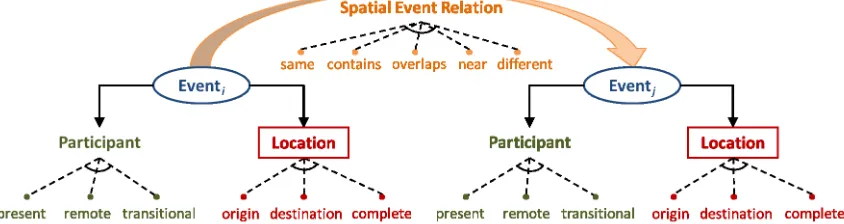
Figure 2: Spatial containment schema. Note that only the CONTAINS relation is directed, all other spatial containment relations are undirected.
3.
Annotation Schema and Guidelines
3.1. Definitions
We define an event using the TimeML (Pustejovsky et al., 2003a) convention: a situation that happens or occurs. Event mentions are words or phrases that denote events in natural language documents and are limited to tensed verbs, event nominals, and stative modifiers. For brevity, we re-fer to mentions simply as events unless the context requires further clarification.
For LOCATIONs, we follow the SpatialML convention, which includes both named (e.g., Japan) and nominal (e.g., village) toponyms. As with SpatialML, our LOCATIONs could be extended beyond geographic entities to include other types of locations such as biological markers. Our spatial relations would be valid for such domains as well. However, our annotated corpus is limited to the newswire domain, so we focus on geographic locations. Note that not all locations are necessarily event locations (e.g., in “the United States [fought] in Afghanistan”, Afghanistan is a LOCATIONbut United States is a PARTICIPANT).
We limit our definition of PARTICIPANTto persons, orga-nizations, and physical objects to guarantee all participants have spatial properties. To determine which PARTICIPANTs and LOCATIONs to associate with an event, we limit the an-notators to the syntactic scope of the event. In other words, the scope expected by a semantic role labeler.
3.2. Schema
Our annotation schema is illustrated in Figure 2. Events are linked to explicit locations in their syntactic scope. There are 3 LOCATION sub-types: COMPLETE, ORIGIN, and DESTINATION. The COMPLETE sub-type indicates that the location identifies the entire spatial bound of the event: it starts and ends at this location without leaving. The ORIGINand DESTINATIONsub-types indicate the event ei-ther starts or ends at that location, respectively.
A PARTICIPANTmay be a person, organization, or physical object. There are 3 PARTICIPANT sub-types: PRESENT, REMOTE, and TRANSITIONAL. The PRESENT sub-type indicates the participant is physically present at the loca-tion of the event. The REMOTE sub-type indicates that the participant is not physically present at the location of the event, yet participates nonetheless. This is possible largely through figurative language such as metonymy or metaphor (e.g., “the United States entered the war”). The
TRANSITIONALsub-type indicates that the participant was both present and remote, but at different times. This is com-mon for motion events, where a participant may start within the spatial bounds of the event but finish elsewhere, or vice versa. For example, in the following sentence, soldier is present only at the beginning of the event, while ballot is the event’s theme and thus present for the entire motion):
(3) The [soldier]PARTICIPANT [sent]E7his [ballot]PARTICIPANT
for the [Maine]LOCATION [election]E8.
The TRANSITIONAL type itself has two further sub-types: P→R (present to remote) and R→P (remote to present).
3.3. Annotation Guidelines
Due to the fact that spatial containment relations between events are largely implicit, they often require some degree of intuition about the spatial bounds of an event. Beyond being exposed to a limited number of examples, an annota-tor must largely rely on his or her intuition about the spatial bounds of an event. This is not entirely unprecedented in natural language annotation, as Pan et al. (2011) asked an-notators to provide their intuition for an event’s temporal duration. For an example of how the annotator is asked to provide their intuition of an event’s spatial bounds, given the text “the [bombing] victim [died]”, the annotator must determine the expected spatial bounds for the bombing and died events, then determine if there is a relationship. This is highly intuitive (does one die immediately from a bombing, or does one’s location change first?). Obviously, the context may aid in this tremendously. If the text above is followed by “in the hospital”, one can reasonably assume the vic-tim died in a different location, so the events would have a DIFFERENT relation (this relation is used as a negation of the four primary event relations when there is sufficient information to understand the events have non-intersecting spatial bounds). However, if the text above is followed by “instantly”, one can reasonably assume the victim died on the scene of the bombing. In this case the most appropri-ate relation is to say that the bombing event CONTAINSthe died event, since the spatial bounds for the bombing was likely larger.
pro-Example (1)
Example (2)
Example (3)
Example (4)
Example (5)
Example (6)
Example (7)
Figure 3: Spatial containment relations for Examples (1)-(7).
vided annotators with guidelines to simplify the annotation process1. For example, annotators were only required to look at the previous three sentences when searching for re-lated events. Since most long-distance relations will be the result of event coreference, we feel this is a reasonable limi-tation. Furthermore, since spatial containment relations are transitive (i.e., if eventAcontains eventBandBcontains eventC, thenAcontainsC), there is no need to annotate the transitivity, as this can be computed automatically.
3.4. Additional Examples
Here we present examples to cover each type of relation. The three examples above as well as the following
exam-1
For more information, see our annotation guideline: http://www.hlt.utdallas.edu/∼kirk/spatial containment standard.pdf
ples below are illustrated in Figure 3.
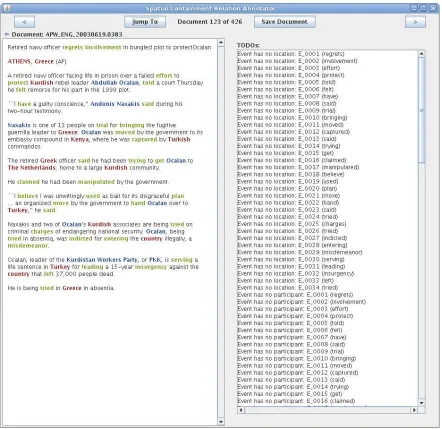
differ-Figure 4: Spatial containment relation annotator.
were defined by the locations of the retreating columns), while other PARTICIPANTs form a small part of the over-all event (e.g., the bover-allot in Example (3) is a smover-all part of the election event). Similarly, knowing how the LOCATION is spatially related to the event would be useful for infer-ence. For now, we simply assume the event CONTAINSthe PARTICIPANT, while the LOCATIONCONTAINSthe event. As with all the previously mentioned granularity issues, our primary goal with this data is to create a set of basic event relations conveying implicit spatial containment relation-ships. If, in the future, automated methods can achieve suf-ficient accuracy on these basic relations, the granularity of our annotations can be increased to suit inference needs.
4.
Corpus Creation and Analysis
We chose to annotate our spatial containment relations on the SpatialML corpus (Mani et al., 2008). SpatialML al-ready contains a wealth of spatial information, including location mentions, their gazetteer normalizations, and rela-tions between locarela-tions. Thus it is natural to use our spatial event relations to augment the corpus’s existing spatialin-formation. Many of the SpatialML documents are conver-sations and broadcast transcripts, which we do not expect to contain a significant amount of spatial event information, so our annotation effort has focused on annotating the 160 documents in SpatialML derived from newswire.
Annotators were provided with a custom annotation tool, shown in Figure 4, for efficient annotation. This tool sim-plifies the process of searching for related events and en-forces consistency in the annotations. To aid the annotators, we automatically annotated events using TARSQI (Saur´ı et al., 2005) and person/organization entities using BIOS2. To get a feel for the difficulty of the task, we gave a brief overview of the task to our three annotators (without showing them the annotation guideline) and asked them to each annotate the same five documents. As expected, ini-tial agreement was very low when evaluated with Fleiss’ Kappa (Fleiss, 1971). Initial agreement on whether two events are related (without the relation type) was 0.23, which falls into the “fair agreement” category from