CSEIT17241 | Received : 12 Sep 2017 | Accepted : 24 Sep 2017 | September-October-2017 [(2)5: 386-391]
International Journal of Scientific Research in Computer Science, Engineering and Information Technology © 2017 IJSRCSEIT | Volume 2 | Issue 5 | ISSN : 2456-3307
386
Simple Article on Segmentation Types and Its Application
A. Elakkiya
1, R. Neela
21Research Scholar, Department of computer science, AVC College (Autonomous), Tamilnadu, India 2Assistant Professor,Department of computer science, AVC College (Autonomous), Tamilnadu, India
Abstract
Image segmentation is one of the most essential image processing step to discriminate various objects in the image, it usually assist as the pre-processing step before image feature extraction, image pattern recognition and image compression. The goal of image segmentation is to rationalize and change the depiction of an image into something which is very important and easy to examine. This paper focuses on study of different image segmentation types, applications and analysis which is used for advanced techniques. Then we talked about different foundation involved in image segmentation and find the gap between them which needs to be linked so as to refine the image segmentation efficiency and performance.
Keywords : Image Processing, Segmentation, Edge Detection, Thresholding, Region Based, Clustering
I.
INTRODUCTION
Image processing is any form of signal processing for which the input is an image, such as photographs or frames of video; the output of image processing can be either an image or a set of characteristics or parameters related to the image.[1]A image is fundamentally a two-dimensional, f(x, y), where a x and y are spatial (plane) coordinates, and the amplitude of at any pair of coordinates (x, y) is called the intensity or grey level of the image at the point.[2]
f(x, y)=i(x,y).r(x,y) [1.1]
When x, y, and the intensity values of f are all finite, discrete quantities, we call the image a digital image.
1.1SEGMENTATION
Segmentation procedures partition an image into its constituent parts or objects.
Basic classifications of segmentation:
Segmentation
Autonomous Rugged Erratic
1.2 AUTONOMOUS SEGMENTATION
It is one of /the most difficult tasks in digital image processing.
1.3RUGGED SEGMENTATION
A rugged segmentation procedure brings the process a long way toward successful solution of imaging problems that require objects to be identified individually.
1.4ERRATIC SEGMENTATION
Weak or erratic segmentation algorithms almost always guarantee eventual failure.in general, the more accurate the segmentation, the more likely recognition is to succeed.
II.
TYPES OF SEGMENTATION
Basic methods 1. Points, Line, Edge Detection 2. Thresholding
2.1 EDGE DETECTION
Segmentation algorithms are based on one of the two following approaches:
1. Satisfying homogeneity property in image feature(s) over a large region.
2. Detecting abrupt change in image feature(s) within a small neighborhood.
The first approach extracts the regions as a whole over which some measure shows the presence of homogeneity in feature value, while the second one detects the border between two regions and is commonly known as edge detection.[3]
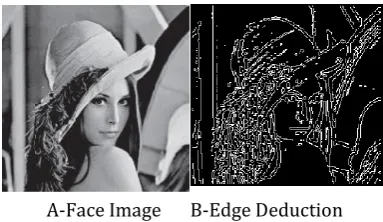
We shall define low-level features to be those basic features that can be extracted automatically from an image without any shape information. As such, thresholding is a form of low-level feature extraction performed as a point operation. All of these approaches can be used in high-level feature extraction, where we find shapes in images. It is called edge detection and it aims to produce a line drawing, like one of a face in below figure (A) and (B), something akin to a caricaturist’s sketch, although without the exaggeration a caricaturist would imbue.[4]
A-Face Image B-Edge Deduction
2.2 CORNER DETECTION
These are another low-level feature that again can be extracted automatically from the image. These are largely techniques for localized feature extraction, in this case the curvature, and the more modern approach
C-Plane silhouette D-Corner detection
2.3 OPTICAL FLOW
Finally, investigate a new technique that describes motion, called optical flow. This is illustrated in Figure (e) and (f) with the optical flow from images of a walking man: The bits that are moving fastest are the brightest points, like the hands and the feet. All of these can provide a set of points, albeit points with different properties, but all are suitable for grouping for shape extraction. Consider a square box moving through a sequence of images. The edges are the perimeter of the box; the corners are the apices; the flow is how the box moves. All these can be collected together to find the moving box.
E-Consecutive images of F-Motion detection Walking subject
2.4 THRESHOLD
Selecting objects or features within a scene or image is an important prerequisite for most kinds of measurement or analysis. The selection process is usually called thresholding. Thresholds may be set interactively by a user watching the image and using a colored overlay to show the result of turning a knob or otherwise adjusting the settings.
G-Threshold
H-Thresholding Types
III.
AUTOMATIC SETTINGS
Manual adjustment of thresholds to produce a result that is considered to be correct based on visual inspection by a human operator is common, but in most cases should be avoided. Most of the automatic methods utilize the histogram in their calculations, but some also make use of the location information for the pixels (and their neighbours).Many of the algorithms developed for automatic setting of thresholds were intended for the discrimination of printed text on paper, as a first step in optical character recognition (OCR) programs that scan pages and convert them to text files for editing or communication.
This is a standard statistical test that measures the probability that the two populations are different, so finding the threshold setting that produces the maximum value for t should correspond to the desired separation of the two groups of pixels.
The following Equation shows the calculation for the simplest form, in which the total entropy H for the foreground and background is maximized by selecting a threshold value t. The pi values are calculated from the actual histogram counts h (i) by dividing by the total number of pixels in that portion of the histogram.
The Trussell algorithm (Trussell, 1979) is probably the most widely used automatic method, because it usually produces a fairly good result and is easy to implement.
IV.
MULTIBAND IMAGES
In some cases, segmentation can be performed using multiple images of the same scene. The most familiar example is that of color imaging, which uses different wavelengths of light. For satellite imaging in particular, this may include several infrared bands containing important information for selecting regions according to vegetation, types of minerals, and so on.
Figure: Example of terrain classification from satellite imagery using multiple spectral bands. Overlaps between classes in each band require that both be used to distinguish the types of terrain.
4.1TWO-DIMENSIONAL THRESHOLDS
Figure: Schematic illustration of selecting an arbitrary region in a two-dimensional parameter space (here the hue/saturation circle) to define a combination of colours to be selected for thresholding.
4.2THRESHOLDING FROM TEXTURE
The texture information present in images is one of the most powerful additional tools available. Several kinds of texture may be encountered, including different ranges of brightness, different spatial frequencies, and different orientations (Haralick et al., 1973).
The average brightness of each of the regions is identical, as shown by the brightness histograms. Region (e) contains pixels with uniformly random brightness values covering the entire 0 to 255 range. Regions (a) through (d) have Gaussian brightness variations, which for regions (a) and (d) are also randomly assigned to pixel locations. For region (b) the values have been spatially averaged with a Gaussian smooth, which also reduces the amount of variation. For region (c) the pixels have been averaged together in one direction to create a directional texture.
Figure: (a) result of applying a variance operator; (b) histogram showing that the five regions are distinct in brightness; (c) each of the regions selected by thresholding the histogram in (b), shown using coloured overlays.
4.3MULTIPLE THRESHOLDING CRITERIA
The texture can be extracted by applying a variance operator to produce a useful grey scale distinction. Smoothing with a Gaussian blur to eliminate the texture creates an image in which the brightness differences stand out. It is necessary to use both images to select individual regions. This can be done by thresholding each region separately and then using Boolean logic to combine the two binary images.
(a) (b) (c)
(d) (e) (f)
Figure: Segmenting with multiple criteria: (a) original image; (b) texture image produced by variance operator; (c) intensity image produced by smoothing; (d) histograms of (b) and (c); (e) two-dimensional histogram; (f) colour composite as described in the text.
V.
REGION-BASED APPROACH
Image segmentation algorithms described so far are parallel in nature, i.e. every pixel is treated independently. In other words, all pixel can be processed simultaneously and the result at any pixel position does not depend on the results at other position. [3]
In this paper, we learn some algorithms that are sequential and/or iterative in nature:
1. Region Growing
Region growing is one of the conceptually simplest approaches to image segmentation; neighbouring pixels of similar amplitude are grouped together to form a segmented region.
2. Region Splitting
These algorithms begin from the whole image, and divide it up until each sub region is uniform. The usual criterion for stopping the splitting process is when the properties of a newly split pair do not differ from those of the original region by more than a threshold.
The chief problem with this type of algorithm is the difficulty of deciding where to make the partition. Early algorithms used some regular decomposition methods, and for some classes these are satisfactory, however, in most cases splitting is used as a first stage of a split/merge algorithm.
Image-Region splitting
5.1 REGION MERGING
Region splitting method is a top down method, while the present one is a bottom up method.
5.2 SPLIT AND MERGE
START: consider entire image as one region 1. If region satisfies homogeneity criteria, leave it unmodified 2. If not, split it into four quadrants and
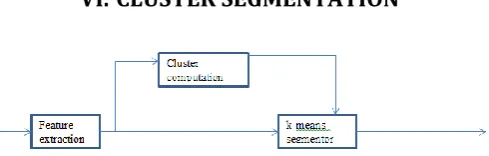
Figure : Simplified version of Coleman–Andrews clustering image segmentation method.
The above figure is a flowchart that describes a simplified version of the algorithm for segmentation of monochrome images.[5] The first stage of the algorithm involves feature computation. In one set of experiments,
Coleman and Andrews used 12 mode measurements in square windows of size 1, 3, 7, and 15 pixels. The next step in the algorithm is the clustering stage, in which
Locate tumours and other pathologies [8][9]
Measure tissue volumes
Diagnosis, study of anatomical structure [10]
Iris recognition
Traffic control systems
Video surveillance
VIII.
CONCLUSION
This paper presents as overview of various image segmentation types and applications. Some times more segmentation types are merged in advanced techniques that develops the computerized growth of segmentation. The advanced systems are every time changed. Various techniques are mentioned in this paper which is applied in very advance mission of identification of object or region image.
IX.
REFERENCES
[1]. Rafael C. Gonzalez, Richard E. Woods, "DIGITAL IMAGE PROCESSING", Third Edition., Pearson Prentice Hall, 2009.
[2]. B. chanda, D. Dutta Majumder, "Digital Image Processing and Analysis", PHI Learning Pvt. Ltd., 2006.
[3]. Mark S. Nixon, Alberto S. Aguado, "Feature Extraction and Image Segmentation", Second Edition, Academic Press is an imprint of Elsevier [4]. Forghani, M.; Forouzanfar, M.; Teshnehlab, M. (2010). "Parameter optimization of improved fuzzy c-means clustering algorithm for brain MR image segmentation". Engineering Applications of Artificial Intelligence.
[5]. william k. pratt pixelsoft, inc. los altos, California, "digital image Processing", third edition, A Wiley-Interscience Publication. [6]. Pham, Dzung L.; Xu, Chenyang; Prince, Jerry L.
(2000). "Current Methods in Medical Image Segmentation". Annual Review of Biomedical Engineering.
[7]. W. Wu, A. Y. C. Chen, L. Zhao and J. J. Corso (2014): "Brain Tumor detection and segmentation in a CRF framework with pixel-pairwise affinity and super pixel-level features", International Journal of Computer Aided Radiology and Surgery, pp. 241-253, Vol. 9. [8]. E. B. George and M. Karnan (2012): "MR Brain
image segmentation using Bacteria Foraging Optimization Algorithm", International Journal of Engineering and Technology, Vol. 4.
[9]. Kamalakannan, Sridharan; Gururajan, Arunkumar; Sari-Sarraf, Hamed; Rodney, Long;
Antani, Sameer (17 February 2010). "Double-Edge Detection of Radiographic Lumbar Vertebrae Images Using Pressurized Open DGVF Snakes". IEEE Transactions on Biomedical Engineering.