Evaluation of a Generic Lexical Semantic Resource in Information Extraction
Joyce Yue Chai
IBM T. J. Watson Research Center 30 Saw Mill River Rd, Hawthorne, NY 10532, USA
Abstract
We have created an information extraction system that allows users to train the system on a domain of interest. The system helps to maximize the effect of user training by applying WordNet to rule generation and validation. The results show that, with careful control, WordNet is helpful in generating useful rules to cover more instances and hence improve the overall performance. This is particularly true when the training set is small, where F-measure is increased from 65% to 72%. However, the impact of WordNet diminishes as the size of training data increases. This paper describes our experience in applying WordNet to this system and gives an evaluation of such an effort.
1.
Introduction
Lexical information is important for natural language processing. It provides grammatical, syntactic, and semantic information about individual words or word strings (Guthrie et al., 1996). For some applications, lex-ical information can be acquired from the existing reposi-tories of lexical knowledge, i.e., generic lexical resources. Those resources are generally in the forms of machine read-able dictionaries and thesauri. Most resources organize lex-ical terms by alphabetlex-ical order. Roget’s Thesaurus (Chap-man, 1992) and WordNet (Miller, 1990) are probably best known for organizing lexical information in terms of se-mantic meanings.
Many researchers have attempted to extract computa-tionally useful lexical information from machine readable dictionaries and convert this information into formal rep-resentations (Montemagni and Vanderwende, 1993). The syntactic information (i.e., parts of speech and morpholo-gies) is routinely utilized for syntactic analysis. How-ever, the use of semantic information from the generic lexical resources is still very limited. Generic lexical se-mantic resources have been used for some natural lan-guage processing tasks including word clustering, word sense disambiguation (Resnik, 1995; Yarowsky, 1992), and prepositional phrase attachment (Jensen and Binot, 1987; Harabagiu, 1996). However, the use of these resources in information extraction has not been fully investigated.
The purpose of information extraction (IE) is to iden-tify and extract target information from a document and group this information into a coherent structural represen-tation (i.e., templates). This task generally requires domain specific knowledge. The major concern is that the lexical semantic definitions given by the generic resources some-times cannot meet the actual needs of the specific domain. The classification of words is sometimes too coarse and does not provide sufficient distinctions between words, and sometimes the classification is unnecessarily fine grained. Therefore, most IE systems have domain dependent lexi-cons (MUC6, 1995). No use is made of existing general lexical semantic resources by any of the MUC systems. IE system builders have tended to hand-craft resources for each application domain. This process is tedious, time
con-suming, and difficult to customize over different domains. Recently, the machine learning community has made sev-eral attempts to automatically learn the extraction rules from a relatively large set of training samples. This process involves manual annotation of the target information. This annotation usually requires considerable time and a certain amount of expertise (Riloff and Lehnert, 1993; Califf and Mooney, 1997; Soderland, 1999).
We have created a system that allows users to train the system on a small sample of documents. Then the sys-tem will generate and validate a set of rules based on the training information and WordNet. The validated rules will be applied to process new information. The system has three characteristics. First, the system generates rules au-tomatically while traditional approach requires linguists to hand-craft extraction rules. Second, the system generates rules based on a small set of training samples and semantic knowledge from WordNet, while other automated learning approaches require a large number of annotations. Third, the system makes most linguistic features transparent such that users without strong linguistic expertise can customize the system for their domain of interest.
This paper describes the application of WordNet in such a system. After a brief overview of our earlier effort in applying WordNet for information extraction, the use of WordNet in rule generation and validation is described and evaluated. The results show that WordNet can help maxi-mize effect of user training.
2.
Information Extraction
Many information extraction systems rely heavily on hand-crafted, domain specific extraction rules. Other sys-tems apply machine learning techniques on pre-annotated documents to automatically generate extraction rules. It is desirable to reduce the training effort and yet achieve rea-sonable results. We have explored WordNet for this pur-pose.
2.1. WordNet and Semantic Generalization
semantic generalization. However, the effectiveness of us-ing WordNet in information extraction has been questioned. NYU’s MUC-4 system used WordNet hierarchies for se-mantic classification. However, they ran into the problem of automated sense disambiguation because WordNet hier-archy is sense dependent. They concluded that “WordNet may be a good source of concepts, but that it will not be of net benefit unless manually reviewed with respect to a par-ticular applications” (Grishman et al., 1992). The RAPIER system at the University of Texas tried to use WordNet to enhance the coverage of the extraction patterns learned from a comparably large training set, and they claimed that the impact of WordNet is not obvious.
We have applied several approaches to experiment the usefulness of WordNet in an information extraction system. In one of our earlier approaches, the system generates spe-cific rules based on training examples (Bagga et al., 1997). A specific rule is made up of three entities. The first and the third entities are the target objects in the form of noun phrases. The second entity is the verb phrase or the prepo-sition indicating the relationship between the two objects. WordNet is applied to generalize the first and third entities. We have conducted experiments to generalize rules to dif-ferent degrees, (i.e., the system replaces the first and the third entities with the different concepts on the hypernym path). The results show that, within expectations, with the increase in the degree of generalization, precision tends to decrease while recall tends to increase. However, the best compromise between precision and recall as a function of generalization degree needs to be determined. Furthermore, the ability of the user to adjust precision at the cost of recall (or vice-versa) needs to be addressed.
Driven by those issues, we have designed a Generaliza-tion Tree Model that automatically learns the optimal level of semantic generalization based on user feedback (Chai and Biermann, 1997). The system first generalizes spe-cific rules to the most general rules (i.e., replaces the first and the third entity with their respective top hypernym in WordNet hierarchy). Then it applies the most general rules back to the training set and extracts target objects and re-lations. It then asks the user to select the relevant target objects. Based on the user feedback, the system statisti-cally determines which hypernyms on the path should be used to replace the first and the third in order to achieve the best performance.
To further simplify the training process, we have im-proved the system and designed rule generation and valida-tion strategies to make better use of WordNet. In the fol-lowing sections, we give a brief overview of the improved system and rule generation and validation strategies.
2.2. Overview of an Information Extraction System
The system consists of three major components that per-form the basic sentence analysis: a Tokenizer, a Lexical Processor and a Partial Parser. The Tokenizer segments the input text into words and sentences. The Lexical Proces-sor assigns words with syntactic information (such as mor-phological information) from CELEX databases (Baayen et al., 1993). The syntactic information is used in the
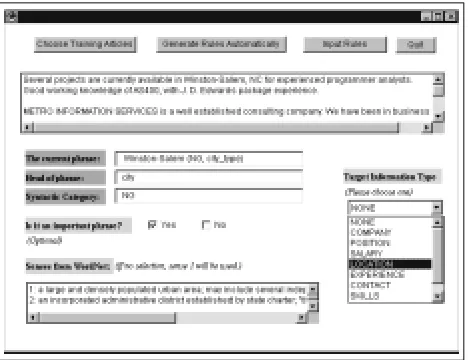
Par-Figure 1: Screen shot of Training Interface
tial Parser which applies a finite state model to discover noun phrases, verb phrases and prepositions. In addition, the Lexical Processor employs a word sense disambigua-tion module to assign semantic informadisambigua-tion (i.e., senses from WordNet) to heads of phrases. In particular, a Se-mantic Classifier is used to identify special seSe-mantic types such as email and web addresses, file and directory names, dates, times, and dollar amounts, telephone numbers, and many others.
The system provides a graphical user interface for the user to train a small number of documents. As in Figure 1, depending on the position the cursor points to in the docu-ment, the interface shows the corresponding phrase identi-fied by the Partial Parser. Associated with each phrase, the syntactic category, semantic type, headword, and potential senses (from WordNet) for the headword are also given. For example, in Figure 1, the current phrase is “Winston-Salem”. It is a noun phrase (NG) and is identified as a city type. Since it’s recognized as a special semantic type, the headword is the semantic type itself. Otherwise, the headword of a phrase is usually the base form of the last word in that phrase. During the training process, the user is required to identify some phrases as the information of interest (i.e., the target information). For example, in Fig-ure 1, “Winston-Salem” is tagged as target information
LO-CATION type. Furthermore, the user needs to specify the
correct sense for the headword. The training interface pro-vides sense definitions to help the user make decisions. If no specification is given, the system assigns sense one, the most frequently used sense in WordNet to the headword. In addition, if the user is experienced, he/she can assist by specifying important phrases in the sentence that are crucial to the rule generation. If no such specification is given, the system will regard every phrase as an important phrase.
There is one rule corresponding to each combination of
d
1(
i
)andd
2(
j
). If the distance fromfproject;N;
1;
0gto its root concept in the hypernym hierarchy isD
1 and the distance fromfanalyst;N;
1;
0gto its root concept isD
2, then totally((
D
1
+1)(
D
2+1);1)rules will be generated.
2.3.2. Validation Strategies
Validation strategies are applied to select useful rules from the large pool of potential rules.
Strategy 1: Select rules with precision rate above cer-tain threshold.
The system applies the generated rules back to the train-ing examples. Based on the annotated information, the system computes precision rate for each rule. The
preci-sion rate of a rule is defined as the percentage of the correct
information extracted by that rule. A threshold
is prede-fined to control the process. If the precision is important to the user, the threshold should be set high (such as 0.9). If the recall is important, the threshold should be set relatively low (such as 0.6).Strategy 2: Select semantically more generalized rules.
Suppose two rules
r
1andr
2have the same number of entities, and the precision rate for both rules is above the threshold. If every entity ofr
1corresponds to a more gen-eral concept than that ofr
2, then the system will keepr
1 and discardr
2. The system will also sort the remaining rules to avoid repetitions.By following these two validation strategies, the system selects a set of useful rules. Those rules will be applied to extract the target information from new documents.
When applying those rules on new documents, the sys-tem starts with rules with maximum number of entities. If there are some matches, the system extracts the target infor-mation as identified by the most number of matched rules. Otherwise, the system relaxes constraints by matching rules with fewer rule entities. This approach will first achieve the highest precision and then gradually increase recall without sacrificing precision.
3.
Evaluation
We have tested the system on the triangle.job news-group where job advertisements are posted. The types of target information are defined as the following:
COM-PANY (the name of the company which has job openings), POSITION (the name of the available position), SALARY
(the salary, stipend, compensation information),
LOCA-TION (the state/city where the job is located), EXPERI-ENCE (years of experience), CONTACT (the phone number
or email address for contact), SKILLS (the specific skills required, such as programming languages, operating sys-tems, etc), BENEFITS (the benefits provided by the com-pany, such as health, dental insurance, etc).
In our previous experiments (Chai et al., 1999), we ran-domly selected 24 documents for training and 40 docu-ments for testing. Training articles were grouped into three training sets. The first training set contained 8 articles; the second contained 16 articles including ones in the first set; the third training set consisted of all 24 articles. In all of the experiments, the precision rate threshold was set to 0.8
since it balanced recall and precision. In this particular trial, we have learned that rules generated by using Word-Net enhanced the overall F-measurement about 10% when the training set only contained eight documents. In par-ticular, those rules were very helpful in extracting certain facts. For LOCATION and BENEFIT, the performance was increased about 30% by those rules.
To continue our previous work, we conducted cross val-idation experiments. In each trial, from a total of 64 docu-ments, we randomly selected 32 documents for training and the remaining 32 documents for testing. We further seg-mented 32 training documents into eight training sets with each containing 1, 2, 4, 8, 12, 16, 20, 24, 28, 32 documents. We conducted 10 trials and the performance reported here is the average performance.
In order to evaluate the use of WordNet, five types of rules were generated for comparison. Rules in the first category were generated without using WordNet (the per-formance is represented by word only curve). Rule en-tities only included headwords of important phrases from training examples. The rule match was only based on matching words and parts of speech. Rules in the second category were generated using WordNet synonyms (i.e.,
max level
= 0curve). Rule entities included synonyms of important headwords from training examples. The third type used WordNet hypernyms one level up in the hier-archy (i.e.,max level
= 1curve). The fourth type in-cluded hypernyms two levels up (i.e.,max level
= 2 curve) and the fifth included hypernyms three levels up (i.e.,max level
=3curve).0 4 8 12 16 20 24 28 32 0
0.1 0.2 0.3 0.4 0.5 0.6 0.7 0.8 0.9 1
Precision vs. Training Effort
Number of training documents
Precision
word only max level = 0 max level = 1 max level = 2 max level = 3
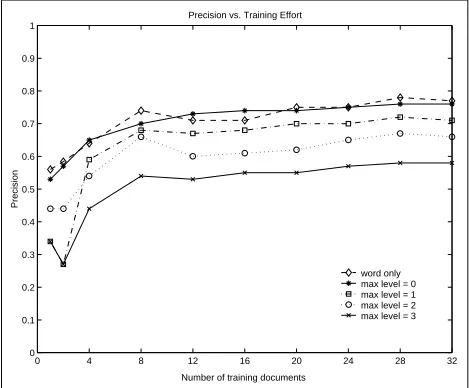
Figure 2: Rules with WordNet synonyms (denoted as
max level
=0) achieve comparable precision with respect to rules without using WordNet (denoted as word only). They both outperform rules with WordNet hypernyms (de-noted asmax level
=1;
2;
3).outperform rules including different levels of hypernyms. Because of the use of a threshold (0.8) in controlling the
precision rate of each rule, for all types of rules (except for
the point at 1 and 2 training documents), precision goes up with the increase in the number of training documents.
0 4 8 12 16 20 24 28 32 0
0.1 0.2 0.3 0.4 0.5 0.6 0.7 0.8 0.9 1
Number of training documents
Recall
Recall vs. Training Effort
word only max level = 0 max level = 1 max level = 2 max level = 3
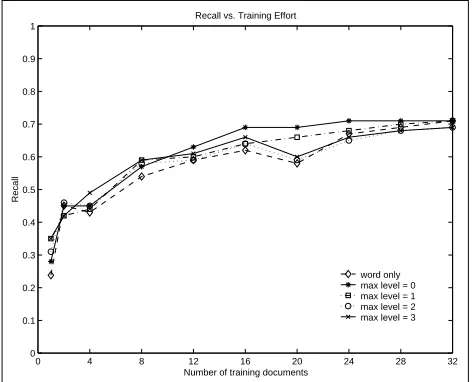
Figure 3: The use of WordNet improves recall. In partic-ular, from 10-28 training documents, the use of synonyms (denoted as
max level
= 0) outperforms the rest. When the training set is 32 documents and larger, the impact of WordNet becomes insignificant.Figure 3 shows the average recall performance respond-ing to the increase in trainrespond-ing effort. Within expectations, rules with WordNet synonyms perform better than rules without using WordNet. The recall difference increases from 2% to 11% with the increase in the number of train-ing documents up to 20 documents. After that, the differ-ence diminishes. Because vocabularies used in this domain are very limited, and variations of words can be directly learned after certain amount of training (for example, 32 documents).
Figure 4 shows the overall performance in response to an increase in training effort. In this example, WordNet synonyms achieve the best performance. With 20 docu-ments, rules with synonyms achieve 72% F-measure, and rules without WordNet reach 65%. After this point, the dif-ference again diminishes. With 32 training documents, the difference is negligible. This observation also confirms the claim that the impact of WordNet is not significant with the large training set.
4.
Discussion
When customizing an information extraction system to a new domain, one can either hand-craft specific extrac-tion rules or allow the system to learn extracextrac-tion rules based on pre-annotated data. Both approaches require special ex-pertise and are time consuming. Our system allows inex-perienced users to train the system with minimum effort. The system automatically generates rules to maximize this effect of training by use of WordNet. The experiments demonstrate that WordNet can enhance the performance
0 4 8 12 16 20 24 28 32 0
0.1 0.2 0.3 0.4 0.5 0.6 0.7 0.8 0.9 1
Number of training documents
F−measure
F−measure vs. Training Effort
word only max level = 0 max level = 1 max level = 2 max level = 3
Figure 4: Training 16 documents with WordNet synonyms (denoted as
max level
= 0) achieves comparable over-all performance as Training 28 documents without using WordNet (denoted as word only). This is an example of WordNet synonyms helping reduce training effort.when the training data is small. As the training data be-comes larger, the use of WordNet bebe-comes less significant. However, since it is expensive to train a large amount of data, the use of WordNet can ease this process.
WordNet also has many limitations in information ex-traction. First of all, since WordNet hierarchy is sense de-pendent, word sense disambiguation is important. Our sys-tem includes a word sense disambiguation module. By al-lowing the user to select correct senses through the user in-terface, the system automatically generates word sense dis-ambiguation rules (Chai and Biermann, 1999). Although we have observed that most words are used as sense one in WordNet and senses tend to remain the same in a specific domain, word sense disambiguation is still important with WordNet. Our experiments show that the overall system performance is enhanced by 8% when the word sense dis-ambiguation module is applied. Word sense disambigua-tion certainly adds complexity to the use of WordNet; how-ever, the sense training process is easier than the creation of a specific domain knowledge base, especially when defini-tions of senses are provided.
betweenfIBMgandfcompanyg. Although WordNet does not provide semantic information to describe proper nouns and domain specific nouns, it does have a good coverage for verbs. To correctly extract target information, verbs are important since they convey certain relationships between different pieces of information. For example, in MUC6 do-main, to extract the target information about who is leav-ing a certain position, suppose we have “resign” and “fire” as seed verbs which indicate this event. By only ing these seed verbs, 51.9% recall is achieved. By apply-ing WordNet, 81.9% is achieved. The hypernyms and hy-ponyms of “resign” and “fire” are responsible for enhancing the performance.
Furthermore, in some cases, definitions of concepts in WordNet can not describe the intended use in the domain. For example, in the sentence “DCR Inc. is looking for accounting people”, the word “people” has four senses in WordNet and they are all subsumed to the conceptfgroup, groupingg. However, “people” in this sentence is referring to “professional” which is a kind of “person”.
Based on above observations in using WordNet, it is de-sirable for WordNet to provide APIs for developers of in-formation extraction systems to modify the database based on their needs. WordNet is a great resource and can be served as a core knowledge provider. The additional APIs can make the resource tailored toward specific needs.
5.
Conclusion
WordNet can help maximize the effect of user effort in a trainable information extraction system. When the train-ing data is small, the use of WordNet enhances the system performance by about 10%. However, when the training data is large, the impact of WordNet becomes insignificant. WordNet hypernyms have the risk of reducing performance because of over-generation. However, WordNet synonyms are beneficial to information extraction. By applying Word-Net synonyms in rule generation and validation, our system generates useful rules based on the minimum training.
6.
Acknowledgments
The author would like to thank Alan Biermann for in-sightful discussions and guidance; Jerry Hobbs for the finite state rules for the Partial Parser; Amit Bagga for develop-ing the Tokenizer and the Semantic Classifier; and Robert McGough for his contributions to this manuscript.
7.
References
Baayen, R. H., R. Piepenbrock, and H. van Rijn, 1993. The
CELEX Lexical Database on CD-ROM. Philadelphia:
Linguistic Data Consortium.
Bagga, A., J. Chai, and A. Biermann, 1997. The role of WordNet in the creation of a trainable message under-standing system. Proceedings of AAAI-97/IAAI-97:941– 948.
Califf, M. and R. Mooney, 1997. Relational learning of pattern-match rules for information extraction.
Proceed-ings of Computational Language Learning’97.
Chai, J. and A. Biermann, 1997. Corpus based statistical generalization tree in rule optimization. Proceedings of
Fifth Workshop on Very Large Corpora (WVLC-5).
Chai, J. and A. Biermann, 1999. The use of word sense dis-ambiguation in information extraction. Proceedings of
Eleventh Conference on Innovative Applications of Arti-ficial Intelligence (IAAI’99).
Chai, J., A. Biermann, and C. Guinn, 1999. Two dimen-sional generalization in information extraction.
Proceed-ings of Sixteenth National Conference on Artificial Intel-ligence (AAAI’99).
Chapman, L.R., 1992. Roget’s International Thesaurus. Harper Collins, 5th edition.
Grishman, R., C. MacLeod, and J. Sterling, 1992. New York University PROTEUS system: MUC-4 test results and analysis. Proceedings of the Fourth Message
Under-standing Conference (MUC-4):124–127.
Guthrie, L., J. Pustejovsky, Y. Wilks, and B. Slator, 1996. The role of lexicons in natural language processing.
Communications of ACM.
Harabagiu, S., 1996. An application of WordNet to prepo-sitional attachment. Proceedings of ACL96.
Jensen, K. and J. Binot, 1987. Disambiguating preposi-tional phrase attachments by using on-line dictionary definitions. Computational Linguistics, 13(3):251–260. Miller, G., 1990. WordNet: An on-line lexical database.
International Journal of Lexicography:235–312.
Montemagni, S. and L. Vanderwende, 1993. Structural pat-terns versus string patpat-terns for extracting semantic infor-mation from dictionaries. Natural Language Processing:
The PLNLP Approach:149–159.
MUC6, 1995. Proceedings of Sixth Message
Understand-ing Conference.
Resnik, P., 1995. Disambiguating noun grouping with re-spect to WordNet senses. Third Workshop on Very Large
Corpora.
Riloff, E. and W. Lehnert, 1993. Automated dictionary construction for information extraction from text.
Pro-ceedings of Ninth IEEE Conference on Artificial Intelli-gence for Applications.
Soderland, S., 1999. Learning information extraction rules for semi-structured and free text. Machine Learning
Journal Special Issues on Natural Language Learning,
34.
Yarowsky, D., 1992. Word-sense disambiguation using sta-tistical models of Roget’s categories trained on large cor-pora. Proceedings of the Fifteenth International