Development of Amharic Grammar Checker Using Morphological
Features of Words and N-Gram Based Probabilistic Methods
Aynadis Temesgen Department of Computer Science
Addis Ababa University
Yaregal Assabie
Department of Computer Science Addis Ababa University
Abstract
Amharic is one of the most morphologically complex and under-resourced languages which effectively hinder the development of efficient natural language processing applications. Am-haric words, especially verbs, are marked for a combination of several grammatical functions which makes grammar checking complex. This paper describes the design and development of statistical grammar checker for Amharic by treating its morphological features. In a given Amharic sentence, the morphologies of individ-ual words making up the sentence are analyzed and then n-gram based probabilistic methods are used to check grammatical errors in the sen-tence. The system is tested with a test corpus and experimental results are reported.
1 Introduction
With the rise of electronic documents, the need of natural language processing (NLP) applications that automatically process texts has drastically in-creased. One of such important NLP applications is grammar checker which automatically checks grammatical errors in texts and also possibly sug-gests the user to choose among other alternatives. Initially, most of the grammar checkers were based on checking styles, uncommon words and sentence structures, but now they are upgraded to high ca-pacity with the capability of analyzing complex sentence structures, not only as a part of other pro-grams but also as easy software to be installed in many operating system (Richardson, 1997; Liddy, 2001; Mudge, 2010; Mozgovoy, 2011). Various techniques and methods have been proposed so far to build systems that could check the grammars of texts. Among the most widely used approaches to
implement grammar checkers are rule-based, sta-tistical and hybrid (Tsuruga and Aizu, 2011; Ehsan and Faili, 2013; Xing et al, 2013). Rule-based sys-tems check grammars based on a set of manually developed rules which are used to match against the text. However, it is very difficult to understand and include all grammatical rules of languages, especially for complex sentences. On the other hand, in statistical grammar checking, part-of-speech (POS)-annotated corpus is used to automat-ically build the grammatical rules by identifying the patterns of POS tag sequences in which case common sequences that occur often can be consi-dered correct and the uncommon ones are reported to be incorrect. This has lead statistical approaches to become popular methods to build efficient grammar checkers. However, it is very difficult to understand error messages suggested by such checking system as there is no specific error mes-sage. Hybrid grammar checking is then introduced to benefit from the synergy effect of both ap-proaches (Xing et al, 2013). A number of grammar checkers have been developed so far for many lan-guages around the world. Among the most notable grammar checkers are those developed over the past few years for resourceful languages such as English (Richardson, 1997; Naber, 2003), Swedish (Arppe, 2000; Domeij et al, 2000), German Schmidt-Wigger, (1998), and Arabic (Shaalan, 2005), etc. However, to our best knowledge, there is no commercial Amharic grammar checker or published article that presents grammar checking for Amharic.
presents the statistical methods applied to develop the system. Experimental results are presented in Section 4. In Section 5, we present our conclusion and recommendation for future works. A list of references is provided at the end.
2 Grammatical Structure of Amharic
2.1 Amharic Morphology
Amharic is the working language of Ethiopia having a population of over 90 million at present. Even though many languages are spoken in Ethiopia, Amharic is the dominant language that is spoken as a mother tongue by a large segment of the population and it is the most commonly learned second language throughout the country (Lewis et al, 2013). Amharic is written using its own script which has 33 consonants (base characters) out of which six other characters representing combinations of vowels and consonants are derived for each character.
Amharic is one of the most morphologically complex languages. Amharic nouns and adjectives are marked for any combination of number, definiteness, gender and case. Morover, they are affixed with prepositions. For example, from the noun ተማሪ (tämari/student), the following words are generated through inflection and affixation: ተማሪዎች (tämariwoč/students), ተማሪው (tämariw/ the student {masculine}/his student), ተማሪየ (tämariyän/my student), ተማሪየን (tämariyän/my student {objective case}), ተማሪሽ (tämariš/your {feminine} student), ለተማሪ (lätämari/for student), ከተማሪ (kätämari/ from student), etc. Similarly, we can generate the following words from the adjective ፈጣን (fäţan/fast): ፈጣኑ (fäţanu/fast, {definite} {masculine} { singular}), ፈጣኖች (fäţanoč/fast {plural}), ፈጣኖቹ (fäţanoču/fast {definite}{plural}), etc.
Amharic verb inflections and derivations are even more complex than those of nouns and adjectives. Several verbs in surface forms are derived from a single verbal stem, and several stems in turn are derived from a single verbal root. For example, from the verbal root ውስድ (wsd/to take), we can derive verbal stems such as wäsd,
wäsäd, wasd, wäsasd, täwäsasd, etc. From each of these verbal stems we can derive many verbs in their surface forms. For example, from the stem
wäsäd the following verbs can be derived:
ወሰደ (wäsädä/he took) ወሰደች (wäsädäč/she broke) ወሰድኩ (wäsädku/I broke)
ወሰድኩት (alwäsädkutĭm/I took [it/him]) አልወሰድኩም (alwäsädkum/I didn’t take) አልወሰደችም (alwäsädäčĭm/she didn’t take) አልወሰደም (alwäsädäm/he didn’t take) አልወሰደኝም (alwäsädäňĭm/he didn’t take me) አስወሰደ (aswäsädä/he let [someone] to take) ተወሰደ (täwäsädä/[it/he] was taken)
ስለተወሰደ (sĭlätäwäsädä/as [it/he] was taken) ከተወሰደ (kätäwäsädä/ if [it/he] is taken) እስኪወሰድ (ĭskiwäsäd/until [it/he] is taken) ሲወሰድ (sĭwäsäd/when [it/he] is taken) .
. . etc.
[image:2.595.305.518.435.573.2]Amharic verbs are marked for any combination of person, gender, number, case, tense/aspect, and mood resulting in thousands of words from a single verbal root. As a result, a single word may represent a complete sentence cosutructed with subject, verb and object. For example, ይወስደኛል (yĭwäsdäňal/[he/it] will take me) is a sentence where the verbal stem ወስድ (wäsd/ will take) is marked for various grammatical functions as shown in Figure 1.
Figure 1. Morphology of the word ይወስደኛል.
2.2 Grammatical Rules of Amharic
Common for most languages, if not for all, gram-mar checking starts with checking the validity of the sequence of words in the sentence. This is also true for Amharic. In addition, since Amharic is morphologically complex language where verbs, nouns and adjectives are marked for various grammatical functions, the following agreements are required to be checked: adjective-noun,
adjec-ይ ወ ስ ደ ኛ ል
yĭ wä s dä ňa l
ይ....ል/yĭ....l
Marker for the subject “he/it” The verbal stem ወስድ
(wäsd/ will take)
tive-verb, subject-verb, object-verb, and adverb-verb (Yimam, 2000; Amare, 2010).
Word Sequence: Amharic language follows subject-object-verb (SOV) grammatical pattern as opposed to, for example, English language which has SVO sequence of words. For instance, the Amharic equivalent of sentence “John ate bread” is written as “ጆን (jon/John) ዳቦ (dabo/bread) በላ (bäla/ate)”. Here, the part-of-speech (POS) tags of individual words are used as inputs to check the validity of grammatical patterns.
Adjective-Noun Agreement: Amharic nouns are required to agree for number of modifying ad-jectives. For example, ረጃጅም ልጆች (räjajĭm lĭjoč/ tall {plural} children) is a valid noun phrase whe-reas ረጃጅም ልጅ (räjajĭm lĭj/ tall {plural} child) is an invalid noun phrase construction.
Subject-Verb Agreement: Amharic verbs are marked for number, person and gender of subjects. For example, ልጆቹ መስኮት ሰበሩ (lĭjoču mäskot säbäru/the children broke a window) is a valid Amharic sentence. However, ልጅቷ መስኮት ሰበረ (lĭjtwa mäskot säbärä/the girl broke {masculine} a window) is not a valid Amharic sentence since the subject ልጅቷ (lĭjtwa/the girl) is feminine and the verb ሰበረ (säbärä /broke {masculine}) is marked for masculine.
Object-Verb Agreement: Amharic verbs are also marked for number, person and gender of ob-jective cases. For example, in the sentence ልጆቹ መስኮቶቹን ሰበሯቸው (lĭjoču mäskotočun säbärw a-čäw/the children broke {plural} the windows), the verb ሰበሯቸው (säbäru/broke {plural}) is marked for the plural property of the object መስኮቶቹን (mäskotočun/the windows).
Adverb-Verb Agreement: Tenses of verbs are required to agree with time adverbs. For example, ትላንት ሰበሩ (tĭlant säbäru/ [they] broke yesterday) is a valid verb phrase construction whereas ትላንት ይሰብራሉ (tĭlant yĭsäbralu/ [they] will break yester-day) is an invalid construction.
3 The Proposed Grammar Checker
The proposed grammar checker for Amharic text passes through three phases:
• Checking word sequences;
• Checking adjective-noun-verb agreements; • Checking adverb-verb agreement.
In the first two phases, we employ the n-gram based statistical method. The n-gram probabilities
are computed from the linguistic properties of words in a sentence.
3.1 Representation of the Morphological Properties of Words
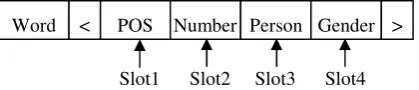
To check grammatical errors in an Amharic sen-tence, the morphological properties of words is required. The morphological property of Amharic words contains linguistic information such as number, gender, person, etc. Such linguistic infor-mation is used to check whether the linguistic properties of one word agree with that of the other words in the sentence. For this task, we used an Amharic morphological analyzer known as HornMorpho developed by Gasser (2011). After performing morphological analysis for a given word, the morphological property of the word is stored along with its POS tag using a structure with four slots as shown in Figure 2.
Figure 2: A structure for representing the linguistic properties of words
Slot1: This slot contains information about the POS tag of the word. The corpus we used in this work contains 31 types of POS tags, and the value for this slot is retrieved from the corpus. In addi-tion to checking the correct POS tag sequence in a sentence, this slot is required to check agreements in number, person and gender as well.
Slot2: This slot holds number information about the word, i.e. whether the word is plural (P), singu-lar (S), or unknown (U). In the case of nouns and adjectives, it has three values: P, S, or U. Since Amharic verbs are marked for numbers of subject and object, the value for this slot are combinations of the aforementioned values for subject and objec-tive cases. We use the symbol “^” to represent such combinations. For example, a verb marked for plural subject and singular object is represented as SP^OS; a verb marked for singular subject and singular object is represented as SS^OS; etc.
Slot3: This slot stores person information about the word, i.e. first person (P1), second person (P2), third person (P3), or unknown (PU). The slot has four different possible values for the nouns and adjectives: P1, P2, P3 and PU. However, verbs can
Word < POS Number Person Gender >
[image:3.595.305.515.354.399.2]have a combination of these four values for subject and object grammatical functions. Examples of slot values for verbs are the following.
SP1^OP1: verb marked for first person subject and first person object
SP2^OP1: verb marked for second person sub-ject and first person obsub-ject
SP3^OP1: verb marked for third person subject and first person object
SP2^OP3: verb marked for second person sub-ject and third person obsub-ject
. . . etc.
Slot4: This slot holds gender information about the word, i.e. whether the word is masculine (M), feminine (F), or unknown (U). In the case of nouns and adjectives, it has three values: M, F, or U. The values of this slot for verbs are are combinations of the aforementioned values for subject and objec-tive cases. Accordingly, a verb marked for mascu-line subject and feminine object is represented as SM^OF; a verb marked for feminine subject and masculine object is represented as SF^OM; etc.
[image:4.595.305.520.342.637.2]For example, the linguistic information built for the noun ፕሬዚዳንቱ (prezidantu/the president {mas-culine}) is: ፕሬዚዳንቱ <N|S|P3|M>. Likewise, the linguistic information for the verb ደረሰችበት (däräsäčĭbät/she reached at him) is: ደረሰችበት <V|SS^OS|SP3^OP3|SF^OM>. Accordingly, the linguistic information about each word in the entire corpus is automatically constructed so as to use it for training and testing.
3.2 Word Sequences
To check the validity of POS tag sequence for a given sentence, we use n-gram probability pt com-puted as:
) ... (
) ... ( )
... | (
1 2 1
1 2 1 1
2 1
− −
− =
n n n n
n t
w w w count
w w w w count w
w w w
p (1)
where n is the number of words in a sequence and
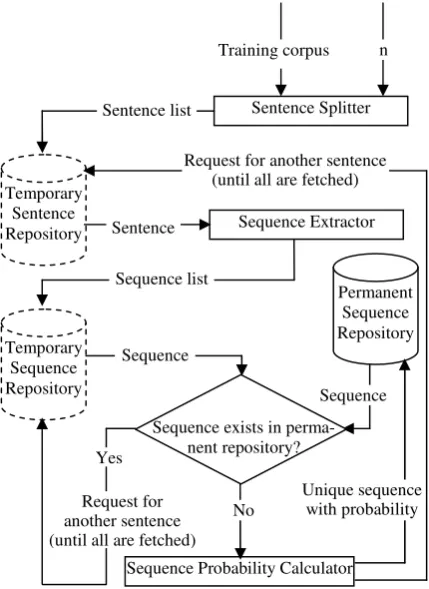
w is POS tags of words. We have calculated n-gram values for n=2 (bigram) and n=3 (trigram) where they are saved in repository and used in grammar checking process. The probabilities of sequence occurrences are determined from the cor-pus, which is used to train the system. The training process starts by accepting the training corpus and the n-value as inputs. For each sentence in the cor-pus, the sequences of POS tags of words are
ex-tracted. For each unique sequence of POS tags, the probability of the occurrence of the sequence is computed using n-gram models. The n-gram prob-abilities of POS tag sequences stored in the perma-nent repository are accessed to check grammatical errors in a given sentence. The probability pst of the correctness of the POS tag sequence of words in a given sentence construction is computed as:
=
∏
n=i t
st pi
p
1 (2)
where n is the number of POS tags extracted in the sentence. Sentence with higher values of pst are considered to be having a valid sequence of words whereas those with low values are regarded as hav-ing unlikely sequence of words. Finally, the deci-sion is made based on a threshold value set by em-pirical method. The training process is illustrated in Figure 3.
Figure 3: A flowchart of the training process for check-ing sequences of words.
3.3 Adjective-Noun-Verb Agreements
The agreements between words serving various grammatical functions in Amharic sentence are also checked using n-gram approach. Number,
per-Sentence Splitter
Temporary Sentence
Repository Sequence Extractor
Temporary Sequence Repository
Permanent Sequence Repository Sentence list
Sequence
Sequence Probability Calculator No
Yes Sequence
Request for another sentence (until all are fetched)
Request for another sentence (until all are fetched)
Unique sequence with probability Sequence list
n Training corpus
Sentence
son and gender agreements are checked at this phase. We perform this task by analyzing the four slots representing linguistic information about words as discussed in Section 3.1. Since the values for number, person, and gender depends on the word class, the POS tag information is required. Thus, for each word in the corpus, we extract such information as <slot1,slot2>, <slot1|slot3> and <slot1|slot4> where slot1, slot2, slot3 and slot4 represent POS tag, number, person and gender in-formation, respectively. Given the POS tag w of a word, the sequence probability pa of adjective-noun-verb agreement for a slot is computed as:
) ... ( ) ... ( ) ... | ( 1 1 1 1 1 1 1 1 1 1 − − − − = n n n n n n n n a v w v w count v w v w count v w v w v w
p (3)
where v is the value of the slot. The n-gram proba-bility values for each unique pattern was computed and stored in a permanent repository which would be later accessed to adjective-noun-verb agree-ments in a given sentence. The probability psa of the correctness of the adjective-noun-verb agree-ments in a given sentence is then computed as:
=
∏
n=i a
sa pi
p 1 (4)
3.4 Adverb-Verb Agreement
Amharic adverbs usually come before the verb they modify. When adverb appears in the sentence it usually modifies the next verb that comes after it. There could be a number of other words in be-tween the adverb and the verb, but the modified verb appears next to the modifier before any other verb in the sentence. As Amharic adverbs are few in number, adverb-verb agreement was not checked in the previous phases. To check time agreement between the adverb and the verb, the tense for the verb that the adverb modifies should be identified. In this work, we considered four dif-ferent types of tenses: perfective, imperfective, jussive/ imperative and gerundive. The pattern of time adverbs associated with each tense type was extracted from the corpus and stored in repository. Whenever these time adverbs are found in the sen-tence to be checked, the tense type of the next verb is extracted by using morphological analysis. If the tense type extracted from the given sentence matches with an adverb-tense pattern in the reposi-tory, the adverb and the verb are considered to
have correct agreement. Otherwise, it is reported as grammatically incorrect sentence.
4 Experiment
4.1 The Corpus
We used Walta Information Center (WIC) news corpus which contains 8067 sentences where words are annotated with POS tags. We used 7964 sentences for training and the remaining for test-ing. In addition, to test the performance of the sys-tem with grammatically wrong sentences, we also used manually prepared sentences which are grammatically incorrect.
4.2 Test Results
In order to test the performance of the grammar checker, we are required to compute the number of actual errors in the test set, number of errors re-ported by the system and the number of false posi-tives generated by the system. These numbers were then used to calculate the precision and recall of the system as follows.
% 100
* ged errors er of flag
total numb rors flagged er correctly number of precision= % 100 * rors matical er er of gram
total numb
rors flagged er correctly
number of
recall= (6)
Accordingly, we tested the system with simple and complex sentences where we obtained experi-mental results as shown in Table1.
Type of Sentence
n-gram model
Precision Recall
Simple Bigram 59.72% 82.69%
Trigram 67.14% 90.38% Complex Bigram 57.82% 65.38% Trigram 63.76% 67.69% Table 1: Experimental results.
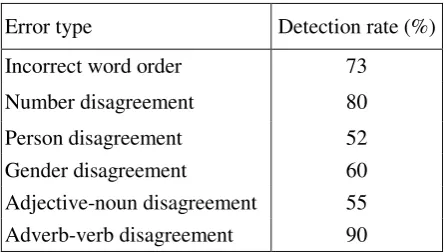
Experimental results were also analyzed to eva-luate the performance of the system with regard to identifying various types of grammatical errors. The detection rate of the various grammatical error types is shown in Table 2.
Table 2: Detection rate by error types.
4.3 Discussion
A complete system that checks Amharic gram-matical errors is developed. To train and test our system, we used WIC corpus which is manually annotated with POS tags. However, we have ob-served that a number of words are tagged with wrong POS and many of them are also misspelled. Since Amharic is one of the less-resourced lan-guages, to our best knowledge, there is no tool that checks and corrects the spelling of Amharic words. Although attempts have been made to correct some of the erroneously tagged words in the corpus, were were unable to manually correct all wrongly tagged words. POS tag errors cause the wrong tag patterns to be interpreted as correct ones during the training process which would ultimately affect the performance of the system. Thus, the performance of the system can be maximized if the system is trained with error-free corpus. Moreover, since the corpus is collected from news items, most of the sentences contain words which refer to third per-son. For this reason, occurrence of first and second person in the corpus is very small. This has af-fected the system while checking person disagree-ment. This is evidenced by the low accuracy ob-tained while the system detects number disagree-ment (see Table 2).
To our best knowledge, HornMorpho is the only tool at present publicly available to morphological-ly anamorphological-lyze Amharic words. However, the tool ana-lyses only some specific types of verbs and nouns. Adjectives analyzed as nouns and adverbs are not analyzed at all. Since Amharic is morphologically very complex language where combinations of var-ious linguistic information are encoded in a single word, the effectiveness of grammar checking is hugely compromised if words are not properly ana-lyzed. Thus, the performance of the system can be
greatly enhanced by using a more effective Amhar-ic morphologAmhar-ical analyzer.
Test results have shown that trigram models per-form better than bigram models. In Amharic, head words in verb phrases, noun phrases, adjective phrases are located at the end of the phrases (Yi-mam, 2000). This means that, for verb phrases, the nouns and adjectives for which verbs are marked come immediately before the head word (which is a verb). Likewise, sequences of adjectives modify-ing nouns in noun phrases come immediately be-fore the head word (which is a noun). Thus, se-quences of multiple words in phrases are better captured by trigrams than bigrams. We have also seen that grammatical errors in simple sentences are detected more accurately than in complex sen-tences. The reason is that complex sentences have complex phrasal structures which could not be di-rectly treated by trigram and bigram models. However, the performance of the system can be improved by using a parser that generates phrasal structures hierarchically at different levels. We can then systematically check grammatical errors at various levels in line with the parse result.
5 Conclusion and Future Works
Amharic is one of the most morphologically com-plex languages. Furthermore, it is considered to be less-resourced language. Despite its importance, these circumstances lead to unavailability of effi-cient NLP tools that automatically process Amhar-ic texts at present. This work is aimed at contribut-ing to the ever-increascontribut-ing need of developcontribut-ing Am-haric NLP tools. Accordingly, the development of Amharic grammar checker using morphological features and n-gram probabilities is presented. In this work, we have systematically treated the mor-phological features of the language where we represented grammar dependency rules extracted from the morphological structures of words.
However, lack of error-free corpus and effective morphological analyzer are observed to be affect-ing the performance of the developed grammar checker. Thus, future works are recommended to be directed at improving linguistic resources and developing effective NLP tools such morphologi-cal analyzer, parser, spell checker, etc. for Amhar-ic. The efficiency of these components is crucial not only for Amharic grammar checking but also for many Amharic NLP applications.
Error type Detection rate (%)
Incorrect word order 73
Number disagreement 80
Person disagreement 52
Gender disagreement 60
Adjective-noun disagreement 55
References
Amare, G. (2010). ዘመናዊ የአማርኛ ሰዋስው በቀላል አቀራረብ (Modern Amharic Grammar in a Simple Approach). Addis Ababa, Ethiopia.
Arppe, A. (2000). “Developing a Grammar Checker for Swedish”; In Proceeding of the 12th Nordic confe-rence on computational linguistic. pp 9 – 27.
Domeij, R., Knutsson, O., Carlberger, J. and Kann, V. (2000).“Granska: An efficient hybrid system for Swedish grammar checking”; In Proceedings of the 12th Nordic conference on computational linguistics, Nodalida- 99.
Ehsan, N. and Faili, H. (2013), “Grammatical and con-text-sensitive error correction using a statistical ma-chine translation framework”; Softw: Pract. Exper., 43: 187–206. doi: 10.1002/spe.2110.
Gasser, M. (2011). “HornMorpho: a system for morpho-logical analysis and generation of Amharic, Oromo, and Tigrinya words”’ In Proceedings of the Confe-rence on Human Language Technology for Devel-opment.
Lewis, M. Paul, Gary F. Simons, and Charles D. Fennig (2013); Ethnologue: Languages of the World, Seven-teenth edition. Dallas, Texas: SIL International.
Liddy, E. D. (2001) “Natural language processing”, In Encyclopedia of Library and Information Science, 2nd Ed. Marcel Decker, Inc.
Mozgovoy, M. (2011). “Dependency-based rules for grammar checking with LanguageTool”, Federated
Conference on Computer Science and Information Systems (FedCSIS) Sept. 18-21, 2011, pp. 209-212, Szczecin, Poland.
Mudge, R. (2010). “The design of a proofreading soft-ware service”; In Proceedings of the NAACL HLT 2010 Workshop on Computational Linguistics and Writing: Writing Processes and Authoring Aids. pp 24-32, Stroudsburg, PA, USA.
Naber, D. (2003). “A Rule-Based Style and Grammar Checker”; PhD Thesis, Bielefeld University, Germa-ny.
Richardson, S. (1997). “Microsoft Natuaral language Understanding System and Grammar checker”; Mi-crosoft, USA,.
Schmidt-Wigger, A. (1998). “Grammar And Style Checking in German”; In Proceedings of CLAW. Vol 98.
Shaalan, K. (2005). “Arabic Gramcheck: A Grammar Checker for Arabic”; The British University in Du-bai, United Arab Emirates.
Tsuruga, I. and Aizu W. (2011). “Dependency-Based Rules for Grammar Checking with LanguageTool”. Maxim Mozgovoy. University of Aizu. IEEE. Japan, 2011.
Xing, J., Wang, L., Wong, D. F., Chao, S., and Zeng, X. (2013). “UM-Checker: A Hybrid System for English Grammatical Error Correction”; In Proceedings of CoNLL-2013, vol. 34.