Service Composition Scenarios for Task-Oriented Translation
Chunqi Shi, Donghui Lin, Toru Ishida
Department of Social Informatics, Kyoto University Yoshida-Honmachi,Sakyo-Ku, Kyoto, 606-8501, Japan [email protected],{lindh,ishida}@i.kyoto-u.ac.jp
Abstract
Due to instant availability and low cost, machine translation is becoming popular. Machine translation mediated communication plays a more and more important role in international collaboration. However, machine translators cannot guarantee high quality translation. In a multilingual communication task, many in-domain resources, for example domain dictionaries, are needed to promote translation quality. This raises the problem of how to help communication task designers provide higher quality translation systems, systems that can take advantage of various in-domain resources. The Language Grid, a service-oriented collective intelligent platform, allows in-domain resources to be wrapped into language services. For task-oriented translation, we propose service composition scenarios for the composition of different language services, where various in-domain resources are utilized effectively. We design the architecture, provide a script language as the interface for the task designer, which is easy for describing the composition scenario, and make a case study of a Japanese-English campus orientation task. Based on the case study, we analyze the increase in translation quality possible and the usage of in-domain resources. The results demonstrate a clear improvement in translation accuracy when the in-domain resources are used.
Keywords:Machine Translation Mediated Communication, Task-Oriented, Scenario, Service Composition
1.
Introduction
Machine translation mediated communication is being de-manded with greater urgency. Because most people have difficulty in mastering a foreign language, international col-laboration makes translation mediated communication es-sential. Compared with human translation, machine trans-lation (MT) systems have the advantages in of lower cost, higher speed, and greater availability, all of which are at-tracting increasing numbers of users. Though MT transla-tion becomes much more popular, in most cases, MT sys-tems do not provide assured translation quality. In interna-tional collaboration, the accurate transfer of concepts (for example, facts, experiences, or theories), is very impor-tant and necessary, especially for task-oriented translation (compared with social/emotion-oriented services). Thus, in task-oriented machine mediated translation, the words and sentences expressing state concepts should be trans-lated with higher accuracy. For example, in the task of providing campus orientation to a foreigner, disaster can result if the graduate policies are wrongly translated, or the locations of important actions are wrongly translated. We have already studied how to automatically locate the oc-currence of misconceptions in MT mediated communica-tion (Yamashita and Ishida, 2006).
Here, we focus on designing an MT system for a task-oriented MT mediated communication, with the goal of making good use of in-domain resources to improve the translation accuracy. Integrating more in-domain resources (for example, dictionaries and parallel texts) is an efficient way of raising translation accuracy (Wu et al., 2008). Gen-erally speaking, the designer of an MT mediated commu-nication task can clearly master the overall requirements of the in-domain resources needed, which is helpful in raising translation accuracy. However, since most potential task designers are not computing professionals, a mechanism is
needed to help them by providing the information of in-domain resources and allowing their easy use. Besides, considering the multiplicity of short-term communication tasks, the way of training a new system is too costly and too inflexible for the task designer. Thus, a light-weight mechanism to handle in-domain resource usage is needed.
To design such a light-weight MT system, two main issues should be addressed. (1) How to best utilize the in-domain materials in a light-weigh manner. Many studies have ex-amined domain adaptation for promoting translation qual-ity. For example, in-domain dictionary and parallel text are used for training language model in a statistical machine translation system (Och et al., 1999; Wu et al., 2008). (2) How to help the task designer by providing the necessary information. Different communication tasks have different topics and different participants (Bangalore et al., 2006). When topics are changed, the task designer has to identify the information of the new in-domain resources needed to perform the translation.
For the latter, we use a clear scenario-based mechanism to analyze the requirements of the topics present in a commu-nication task, and the mapping of language services. More-over, we design a simple declarative script language as the interface that allows the task designer to describe this sce-nario. Based on the described scenario, a composite service is generated for task-oriented translation.
2.
Motivation
The emergence of Web techniques has changed both the way of human communication and the usage of machine translation. With regard to the former, machine medi-ated communication becomes so popular that people have begun to live through the Internet, learn through the In-ternet, and work through the Internet. Moreover, inter-national collaboration has becomes much more common. The chance of multilingual people communicating with each to finish a task has been greatly increased. It means that machine translation mediated communication will be very helpful, if the translation quality is adequate. Dif-ferent from social/emotion-oriented communication, task-oriented communication is more domain specific, which means that the domain involved can predicted before com-munication. Thus, better translation quality can be achieved for task-oriented MT communication by preparing the ap-propriate in-domain resources. For the latter, the transla-tion services have emerged as an easy way to access trans-lations, like Google Translate 1. People, who have cre-ated their in-domain resources are beginning to share them through the Internet. For example, a large number of ser-vices are shared through Language Grid. Moreover, re-search on MT service selection and aggregation is provid-ing new ways to enhance translation quality (Ishida, 2011)
In task-oriented MT mediated communication, the partici-pants of communication, such as the task designer and the communication subjects, can be active in promoting trans-lation quality if proper in-domain resources are available. The task designer can prepare the necessary in-domain re-source, like dictionaries, for reuse. Communication sub-jects can choose different expressions to better transfer their ideas, which is different from document translation. How-ever, such participation in quality promotion has been ig-nored. To facilitate such participation, a light-weight solu-tion is necessary for in-domain resources utilizasolu-tion.
Take the example of a Japanese-English orientation task on the Internet. The task designer planned two topics: legal procedures and student life. If only Google was used for translation, the translation quality of student life informa-tion would be poor because of the in-domain informainforma-tion like the address location. The translation quality can be promoted by using a dictionary holding suitable address in-formation. Of course, it happens that the communication subjects manually post-edit the translation result according to the dictionary results. However, manual usage of these in-domain resources will reduce the communication effi-ciency, and raise the problem of inconsistent translation of ignored words.
1
http://translate.google.com/
Thus, our scenario design aims to enable the task-oriented communication designer to participate in raising the qual-ity, by creating different composite language services with suitable in-domain resources.
3.
Scenario as Requirement
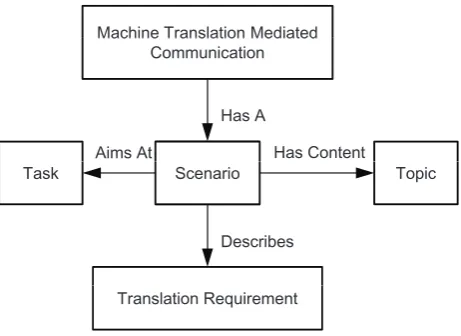
A scenario of MT mediated communication is a description of the topics that are likely to be raised in the designed task (see Figure 1). The content of task-oriented communica-tion can be particommunica-tioned into topics (Bangalore et al., 2006). To succeed in task-oriented translation, high quality trans-lations in each topic are necessary. Meanwhile, there are subjects (sender and receiver) of the communication task. And there are requirements of translation properties from the subjects. Thus the task designer should write scenarios for improving task-oriented translation.
For example, in the Japanese-English orientation task, the scenario aims at supporting translations for the Japanese student to introduce school information to the English stu-dent. The task has two topics: legal procedures and student life. With regard to legal procedure translations, existing high quality parallel texts can be used. Next we consider how to make scenario descriptions.
0DFKLQH 7UDQVODWLRQ 0HGLDWHG 0DFKLQH7UDQVODWLRQ0HGLDWHG
&RPPXQLFDWLRQ
+DV$
+DV&RQWHQW $LPV$W
6FHQDULR 7RSLF
7DVN
'HVFULEHV
7UDQVODWLRQ5HTXLUHPHQW
Figure 1: The role of a scenario in a task-oriented machine translation mediated communication
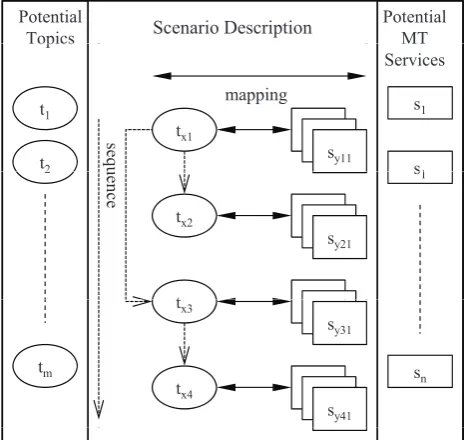
Here, a scenario describes the translation of each particular topic (see Figure 2). First, the sequence of topics obviously affects the scenario description. There are generally two types of sequences: fixed and dynamic. The medical recep-tion for foreigners is a typical fixed sequence. With regard to dynamic sequences, remote fault diagnosis has no fixed topics, because different faults are encountered. It is easy to detect fixed sequence topics by using techniques such as tracking and boundary segmentation. To detect dynamic ones requires classification or searching according to fea-ture data, such as comparable texts or keywords (Shen et al., 2006).
based on his own understanding and provide feedback to the sender. Given the receivers feedback, which in-dicates the status of understanding, the sender can ex-plain further as needed. But they face the problem of poor translation, which breaks the communication cir-cle. If the translation quality can be promoted, they will communicate more fluently.
• Task designer: He/she has a clear image of topics as-sociated with this task, the requirement of the sub-jects, and information of in-domain resources. The designer has the duty of configuring in-domain re-sources for raising translation quality, which is essen-tial for efficient communication. This designer depicts the scenario of this task, including the topic structure, mapped MT services, and requirements (more details are explained in Section 4.2.). Note that the task de-signer is not likely to be a computing professional, so a simple interface is preferred.
• Communication designer: He/she represents a com-puting professional person, who can implement and configure the system, especially the management of categories of potential topics and MT services. Mostly, this person is not often involved with the de-tails of concrete communication tasks.
The inner architecture includes four main components: topic detection, compiler and interpreter, MT service selec-tion and composiselec-tion, and MT service executor (see Fig-ure 3). The functions of four components are depicted as follows.
1) Topic Detection: It locates topics in the source messages from the sender. The categories of topics are the output of the Compiler and Interpreter component. The con-tent of detected topic will be translated by mapped MT services.
2) Compiler and Interpreter: According to syntax, they compile the scenario description script provided by the task designer, and interpret the topics, MT services, and requirements.
3) MT Service Selection and Composition: They deduce the most appropriate composite solution for translat-ing the detected topic content. For each detected topic, based on the requirements and the candidate MT ser-vices, one translation service will be selected.
4) MT Service Executor: It accesses the language grid platform and returns the translation results. The results are sent to the receiver.
We briefly introduce the implementation of the main com-ponents below.
1) Topic Detection: We implement this function by simply tracking appointed keywords for fixed topics, or classi-fying keywords for dynamic topics. For complex situa-tions, existing research can be used (Allan, 2002).
2) Compiler and Interpreter: We use SWI-Prolog2 for compiling and interpreting the declarative interface lan-guage, which is easy.
2
http://www.swi-prolog.org/
3) MT Service Selection and Composition: After interpre-tation, the requirements on MT service are interpreted to yield quality of service (QoS) constraints. Then QoS-based MT service selection and composition can be ap-plied (Yu et al., 2007).
4) MT Service Executor: A Language Grid client is used, and the selected service can executed upon the input of service name and parameters. The translation result is passed to the receiver. Thus, various services can be invoked from the Language Grid platform.
Two category databases (based on PostgreSQL3) are illus-trated functionally.
• Topics Category: It holds topic name (as keyword) and information for topic detection, such as description, keywords, and task relationship. It is maintained by the communication designer, and new topics can be submitted by the task designer.
• MT Services Category: It holds MT service name, URL, operation names, and parameters. It is main-tained by the communication designer.
4.2. Scenario Description Language
For scenario description, we provide a declarative script language as interface, Scenario Description (SDL) Lan-guage. A Backus-Naur Form (BNF) definition is described (see Table 1). It contains three parts: topic structure, MT services, and requirements.
• Topic Structure: The topics of different grain lev-els and their sequence are depicted by a topic forest <topic-forest>. Fixed topic sequences can be well depicted by topic tree<topic-tree>. For the dynamic topic sequence, it is depicted as a set of fixed topics, which is a topic forest.
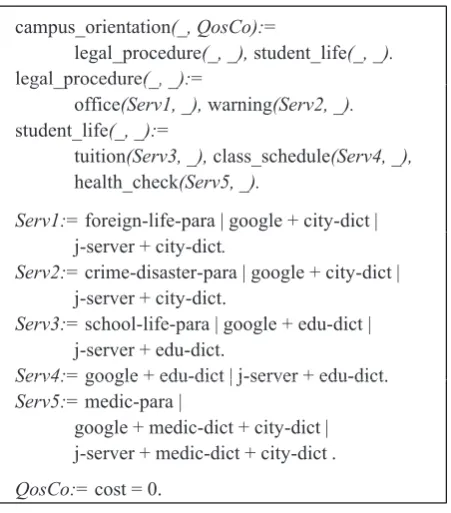
• MT Services: Several candidate services are mapped to a topic <topic-name>. A service vari-able <service-variable>represents these candidates <candidates>. Two relationships, the alternative se-lection and composition of dictionary and transla-tor, are depicted by two marks, ‘|’ and‘+’, respec-tively, for example,f oreign-lif e-para| google+city-dict(see Figure 4).
• Requirements: A requirement variable< requirement-variable> is mapped to a topic <topic-name>. A requirement is depicted as a list of constraints <constraint-list>on properties.
For example, the task designer wants to plan the task of campus orientation communication. It includes two fixed sequenced topics, legal procedure and student life (see Figure 4). They are noted as two top-grained topics, each of which has low-grained sub-topics. Here,officeandwarning are the low-grained sub-topics of legal procedure. Each sub-topic is mapped variables of MT services, e.g. office is mapped withServ1. For the task, on the root topic cam-pus orientation, a requirement variable is mappedQosCo. Finally, the variables,Serv[1-5]andQosCo, are concreted
3
Table 1: Scenario description language for general translation service developer
Name Syntax Description
Program <program>::= Program contains topic structure, MT
services and user requirements. <topic-forest>|<services>|<requirements>.
Topic <topic-forest>::=<topic-tree>|<topic-forest>. Parent-child link depicted by ‘:=’; Precedence depicted by sequence list; Each topic combined with a service variable and a requirement variable. Structure <topic-tree>::=<topic>‘:=’<topic-list>.
<topic>::=<topic-name>(<service-variable>,<requirement-variable>). <topic-list>::=<topic>|<topic-list>,<topic>.
MT <services>::=<service>|<services><service>. MT Service variable assigned with a list of service candidates;
Alternatives connected with ‘|’; Composite service depicted by ‘+’. Services <service>::=<service-variable>‘:=’<candidates>.
<candidates>::=<service-name>|<candidates>‘|’<service-name>. <service-name>::=<atomic-name>|<service-name>‘+’<atomic-name>.
Requirements <requirements>::=<requirement>|<requirements><requirement>. Requirement variable assigned with a list of constraint;
Each constraint is a value limitation on certain property.
<requirement>::=<requirement-variable>‘:=’<constraint-list>. <constraint-list>::=<constraint>|<constraint-list>,<constraint>. <constraint>::=<property-name><operator><value>.
by the candidate services and constraints. (see Figure 4).
campus_orientation(_, QosCo):=
legal_procedure(_, _), student_life(_, _).
legal procedure( , ):=
legal_procedure(_, _):
office(Serv1, _), warning(Serv2, _).
student_life(_, _):=
tuition(Serv3, _), class_schedule(Serv4, _),
health_check(Serv5, _).
Serv1:=foreign-life-para | google + city-dict | j-server + city-dict.
Serv2:=crime-disaster-para | google + city-dict | j-server + city-dict.
Serv3:=school-life-para | google + edu-dict | j-server + edu-dict.
Serv4:=google + edu-dict | j-server + edu-dict.
Serv4: google + edu dict | j server + edu dict.
Serv5:=medic-para |
google + medic-dict + city-dict | j-server + medic-dict + city-dict .
QosCo:=cost = 0.
Figure 4: A script of scenario description for campus ori-entation task
(“-para”: parallel text; “-dict”: dictionary; “+”: composition of dictionary and translator; “|”: alternative services;“ ”: empty
combination)
4.3. Service Composition Algorithm
The composition algorithm will choose the most appropri-ate service composition, when the topic structure, MT ser-vices, and requirements are provided. Here, considering the cost of time, we provide a simple translation service com-position algorithm that focuses on providing adequate qual-ity rather achieving the optimum qualqual-ity. It selects candi-date services for each topic, by checking whether the com-bination of candidate services fulfill the requirement con-straints. It includes two parts. The former prepares the necessary data (see Algorithm 1). The latter uses the
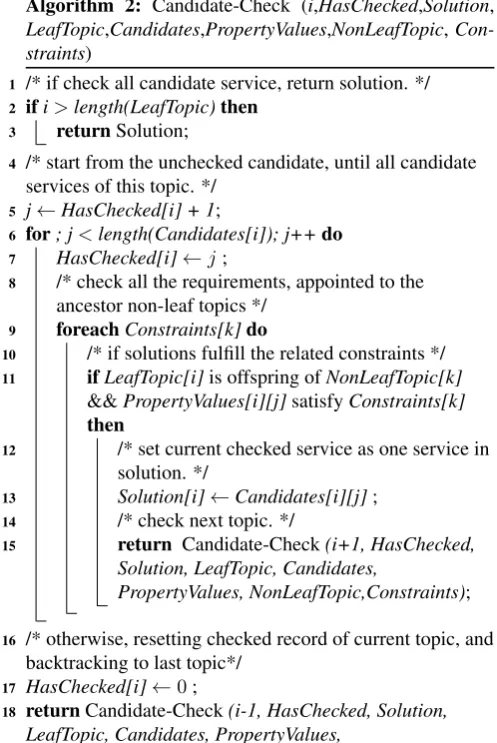
back-tracking strategy to check the potential candidates (see Al-gorithm 2).
In preparing the necessary data (see Algorithm 1), we briefly describe the input of MT service composition. As mentioned previously, topics can be represented as topic forests. Because of the independence between topic trees in the topic forest, we only focus on the topic tree.
Topic Structure (TopicStructure):
• Leaf Topics (LeafTopic): It represents a unit of com-munication content, the lowest-grain topic. The task designer will appoint service candidates to it. Mean-while, it is constrained by the requirements of its ancestor. For example, service candidate Serv1 is mapped to leaf topic office, which is constrained by QoSCo(see Figure 4).
• Non-Leaf Topics (NonLeafTopic): It represents the structure of topics, which is the ancestor of a leaf topic. A designer might appoint requirements to it. For example, requirementQosCois mapped to non-leafcampus orientation(see Figure 4).
MT Services (MTServices):
• Candidate Service (Candidates): They represent ser-vice choices mapped to one leaf topic. For example, the topicofficeis mapped toforeign-life-paraparallel text service,google + city-dict, service, andj-server + city-dictservice (see Figure 4).
Properties and Requirements(Properties and Require-ments):
• Property Values (PropertyValues): They represent the QoS properties of one candidate service. The values of QoS properties are taken from the QoS properties pro-file, and are updated during execution (see Figure 3).
• Constrains (Constraints): They represent the overall constraints on the MT services mapped to topic. For example, cost=0means thecost property of services should be zero in translating the whole topic of cam-pus orientation(see Figure 4).
apply-Algorithm 1: Service-Composition (TopicStructure, MT-Services, Properties, Requirements)
Input:TopicStructure: the topic structure, including leaf topics and non-leaf topics;
MTServices: a set of candidate MT services mapped to the leaf topics;
Properties: the QoS properties of all the candidates services;
Requirements: the constraints on all the non-leaf topics;
1 /* prepare leaf topic related data*/
2 LeafTopic← {leaf-topic|the leaf topic belongs to TopicStructure};
3 foreachLeafTopic[i]do
4 Candidates[i]← {candidate|the candidate mapped
toLeafTopic[i]inM T Services};
5 foreachCandidates[i][j]∈Candidates[i]do 6 PropertyValues[i][j]← {property-value|the
property value ofCandidates[i][j]service in Properties};
7 /* prepare non-leaf topic related data*/
8 NonLeafTopic← {non-leaf-topic|the non-leaf topic
belongs toTopicStructure};
9 foreachNonLeafTopic[i]do
10 Constraints[i]← {constraint|the constraint in
Requirementsmapped toNonLeafTopic[i]};
11 /* check potential solution by backtracking strategy */ 12 Solution← ∅;HasChecked← ∅;i←0;
13 /* call backtracking check, and return solution */
14 Solution←Candidate-Check (i, HasChecked, Solution, LeafTopic, Candidates, PropertyValues,
NonLeafTopic,Constraints);
15 returnSolution;
ing the backtracking strategy. A record of visit topic (i) and candidates (HasChecked) are used in backtracking. When-ever a candidate is selected as one solution (Solution),all the constraints will be checked (Constraints). If the constraints are satisfied, then the next candidate will be checked, oth-erwise, the visit record of current topic will be cleared, and the algorithm backtracks to last visited leaf topic.
5.
Case Study
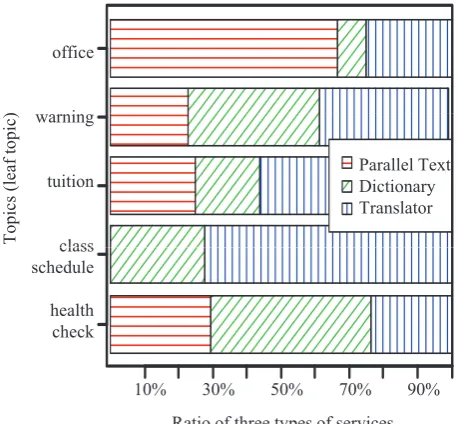
We conduct a case study, Japanese-English campus ori-entation communication, analyze the increase in accuracy achieved and the in-domain resource usage. Accuracy is manually checked using the five-level score (5:All, 4:Most, 3:Much, 2:Little, 1:None) method from DARPA TIDES Project at University of Pennsylvania4. For the in-domain resource usage analysis, we analyze two in-domain re-sources, the dictionary and the parallel texts. We count the number of translated sentences in three situations: paral-lel text used, dictionary plus machine translator, and only machine translator used.
We analyze the translation accuracy of the sentences that a Japanese student sent to an English student in this
ori-4
http://projects.ldc.upenn.edu/tides/translation/transassess04.pdf
Algorithm 2: Candidate-Check (i,HasChecked,Solution, LeafTopic,Candidates,PropertyValues,NonLeafTopic, Con-straints)
1 /* if check all candidate service, return solution. */ 2 ifi>length(LeafTopic)then
3 returnSolution;
4 /* start from the unchecked candidate, until all candidate
services of this topic. */
5 j←HasChecked[i] + 1;
6 for; j<length(Candidates[i]); j++do 7 HasChecked[i]←j;
8 /* check all the requirements, appointed to the
ancestor non-leaf topics */
9 foreachConstraints[k]do
10 /* if solutions fulfill the related constraints */ 11 ifLeafTopic[i]is offspring ofNonLeafTopic[k]
&&PropertyValues[i][j]satisfyConstraints[k] then
12 /* set current checked service as one service in solution. */
13 Solution[i]←Candidates[i][j];
14 /* check next topic. */
15 return Candidate-Check(i+1, HasChecked,
Solution, LeafTopic, Candidates,
PropertyValues, NonLeafTopic,Constraints);
16 /* otherwise, resetting checked record of current topic, and
backtracking to last topic*/
17 HasChecked[i]←0;
18 returnCandidate-Check(i-1, HasChecked, Solution,
LeafTopic, Candidates, PropertyValues, NonLeafTopic,Constraints);
Table 2: Adequacy comparison between Google, J-Server and scenario based composite services
Topic (number of sentences) Adequacy
Google J-Server Scenario Based
campus orientation (51) 2.8 2.9 3.8
1 legal procedure (22) 2.3 2.5 4.1
1)office (14) 2.4 2.7 4.2 2)warning (8) 2.1 2.4 4.1
2 student life (29) 3.0 3.1 3.6
1)tuition (9) 2.7 2.9 3.7 2)class schedule (11) 2.9 2.8 3.6 3)health check (9) 2.6 2.7 3.9
conducted scenario-based analysis, designed the architec-ture for our system, and provided a declarative language for the communication task designer. We also described a simple case to explain how it works.
By using our architecture, it is easy to take advantage of existing MT services on the Language Grid platform, refer to and reuse already configured topics and MT services, and automatically select proper MT services.
By using the simple SDL language, a task designer can easily combine the topics of communication tasks with in-domain resources. Language Grid provides tools to con-veniently wrap in-domain resources into dictionary service and parallel text service. With the services of in-domain resources available, and the SDL program script of compo-sition scenario from the task designer, QoS based MT ser-vice composition will be executed yielding more accurate translation results.
Finally, our case study of a campus orientation task showed translation accuracy can be raised by up to 31% and con-firmed the convenient reuse of components in new machine translation mediated communication tasks.
Acknowledgement
This research was partially supported by Service Science, Solutions and Foundation Integrated Research Program from JST RISTEX.
7.
References
James Allan, editor. 2002. Topic detection and track-ing: event-based information organization. Kluwer Academic Publishers, Norwell, MA, USA.
Srinivas Bangalore, Giuseppe Di Fabbrizio, and Amanda Stent. 2006. Learning the structure of task-driven human-human dialogs. InProceedings of the 21st Inter-national Conference on Computational Linguistics and the 44th annual meeting of the Association for Compu-tational Linguistics, ACL-44, pages 201–208, Strouds-burg, PA, USA. Association for Computational Linguis-tics.
Toru Ishida. 2011. The Language Grid: Service-Oriented Collective Intelligence for Language Resource Interop-erability. Springer.
Donghui Lin, Yoshiaki Murakami, Toru Ishida, Yohei Mu-rakami, and Masahiro Tanaka. 2010. Composing human and machine translation services: Language grid for im-proving localization processes. InLREC 10, pages 500– 506.
Yohei Murakami, Donghui Lin, Masahiro Tanaka, Tako Nakaguchi, and Toru Ishida. 2010. Language service management with the language grid. In LREC, pages 3526–3531.
Franz Josef Och, Christoph Tillmann, Hermann Ney, and Lehrstuhl Fiir Informatik. 1999. Improved alignment models for statistical machine translation. InUniversity of Maryland, College Park, MD, pages 20–28.
Dou Shen, Qiang Yang, Jian-Tao Sun, and Zheng Chen. 2006. Thread detection in dynamic text message streams. InProceedings of the 29th annual international
ACM SIGIR conference on Research and development in information retrieval, SIGIR ’06, pages 35–42, New York, NY, USA. ACM.
H. Wu, H. Wang, and C. Zong. 2008. Domain adaptation for statistical machine translation with domain dictionary and monolingual corpora. InCOLING, pages 993–1000. Naomi Yamashita and Toru Ishida. 2006. Automatic prediction of misconceptions in multilingual computer-mediated communication. InIUI06.