Smart Bus System for Visually Challenged
People
Akshay Mukesh A1, Krishna Kumar G2, Arun Prasad T3, Karthick S4, Vikram A5
B.E Student (Final Year), Department of CSE, Saranathan College of Engineering, Venkateswara Nagar, Panjappur, Trichy, India1,2,3,4
Assistant Professor, Department of CSE, Saranathan College of Engineering, Venkateswara Nagar, Panjappur, Trichy, India5
ABSTRACT: There are many techniques available for visually challenged people in navigating from one place to another place, travelling in a real-time traffic is a main problem in their day to day life. Objective of the project is to give a solution for the visually challenged people and to let them make use of our public transport system in an easy manner. The expected output of the project is to obtain the easy navigation system for the visually challenged people. The details about the bus will be conveyed to the users (visually challenged people) in terms of text format through BLE beacon (Bluetooth Low Enabled Beacon) then the text will be converted into audio format. The text file will be received to the users through the android app which is already installed in the users device. The beacon will send the details about the bus for those corresponding users. The driver app will send the details about the destination to the beacon and then the beacon starts to broadcast the details to the required destination to help the visually challenged people.
KEYWORDS: Android Studio, Android devices, BLE Beacon, GPS, Voice to Text, Text to Voice.
I. INTRODUCTION
Visual impairment, also known as vision impairment or vision loss, is a decreased ability to see to a degree that causes problems not fixable by usual means, such as glasses. Some also include those who have a decreased ability to see because they do not have access to glasses or contact lenses. The term blindness is used for complete or nearly complete vision loss. Visual impairment may cause people difficulties with normal daily activities such as driving, reading, socializing, walking, and using public transport system and so on. The Objective of the project is to help the visually challenged people in using public transport system, so that they (visually challenged people) may feel easy to navigate from one place to another place without the help of any Strangers.
II .LITERATURE SURVEY
A. Bus Navigation For Blind
The goal of the proposed project is to design a system which is useful for visually impaired people to make them become more independent in tackling mundane tasks. The proposed system uses a transport unit using wireless sensor networks (WSNs) and a wearable assistive smart and intelligent system using flex sensor, which could be the replacement of the blind stick as the real time current location is provided through speaker/headphone using GPS to reduce passengers’ tardiness and offer easy navigation around the city. The blind system contains a ZigBee unit which is recognized by the ZigBee unit in the bus. Upon the connection established by the ZigBees, buzzers in both the blind and bus units ring. This helps in boarding the bus. To alight from the bus, destination is tracked using GPS unit in blind system with the movement of flex sensor placed on his finger and voice system informs him to get off the bus. The blind system is equipped with an ultrasonic sensor to assist him by providing with information about the approaching obstacle.
This paper presents a Smart system for visually impaired, that make use of ultrasonic sensor and RF transceiver as assistive devices. Visually impaired individuals find navigation difficult as they struggle every day in performing actions for bypassing obstacles and hurdles in their path. In order to help blind people navigate safely and quickly this system is proposed. This system is based on embedded technology. Ultrasonic sensor is placed on the spectacle which is used for obstacle detection with distance indication. RF transceiver simulator is 9 used to provide the traffic signal information for pedestrian crossing in real time scenario and also the bus route information to help the user know about the desired bus. The project hypothesizes a smart walking stick that alerts visually-impaired people over ground level obstacles, pit and water in front which could help them to walk with less accident. The main aim of this work is to design a voice based alerting system for the blind people.
C. Smart Bus Alert For Blind
In smart bus alerting system, helping the visually impaired people is the main goal. Here, ZigBee system is used for indicating the presence of blind person in the bus station. Voice module and APR9600 audio playback systems are used to update and inform the blind person about the bus arriving and reaching destinations and to guide him as to what he has to do next. Microcontroller analysis the information provided and generates the corresponding bus number. ZigBee transceiver sends the bus number and announced in the microphone attached with the system. The system is connected with GPS which indicates the destination given. Audio output is generated by the voice synthesizer. The expected outcome of the project is to obtain an easy navigation system for people with visually impaired.
III. SYSTEM DESIGN
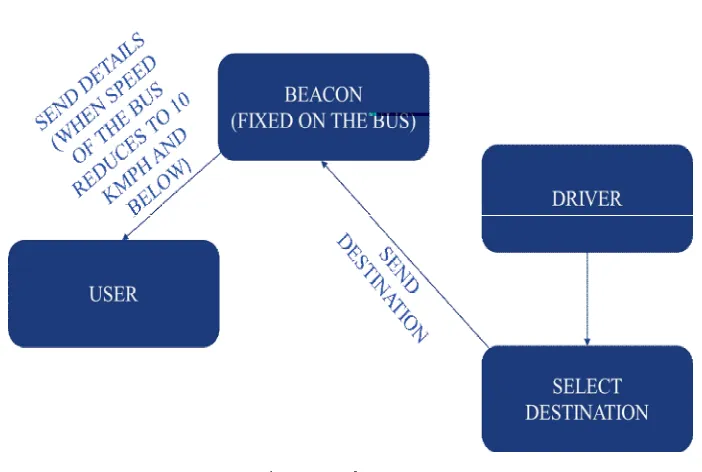
Fig 1 System Architecture
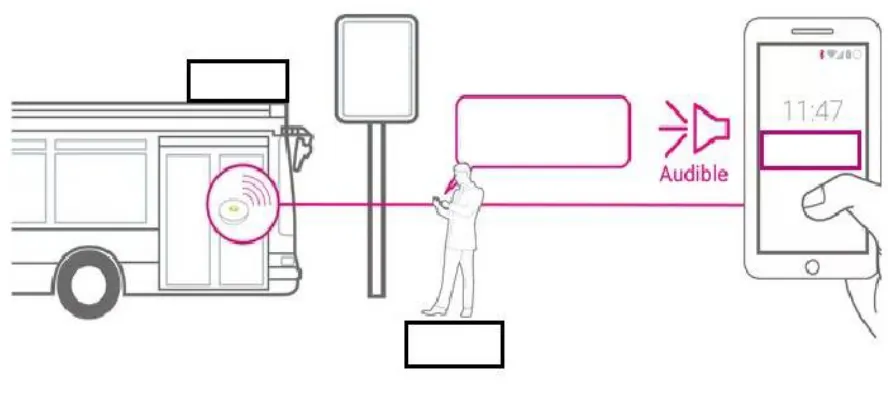
number of messages from different destination’s details. So, in the user app the matching function will be performed and then the correct details will be sent to the user. The user will receive the details about the bus according to the destination he gave. This function will be continued under the help of beacon, android device.The driver sets the destination of the bus in the driver app. The users will give their destination in user app. When the bus reaches near the user’s current location a message will be broadcasted by the beacon
Figure 2 Transmission Diagram
B. BEACON
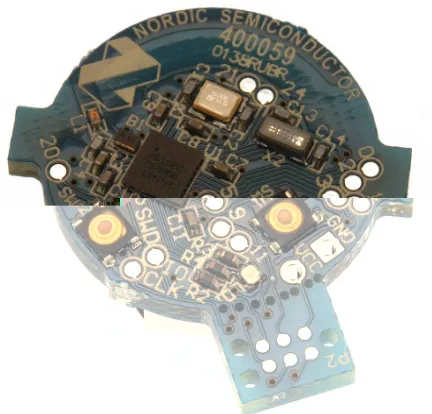
Fig 3 Beacon
Bluetooth beacons uses Bluetooth low energy proximity sensing to transmit a universally unique identifier picked up by a compatible app or operating system. The identifier and several bytes sent with it can be used to determine the device's physical location, track customers, or trigger a location-based action on the device such as a check-in on social media or a push notification. One application is distributing messages at a specific Point of Interest, for example a store, a bus stop, a room or a more specific location like a piece of furniture or a vending machine. This is similar to previously used geopush technology based on GPS, but with a much-reduced impact on battery life and much extended precision. Another application is an indoor positioning system, which helps Smartphone’s determine their approximate location or context. With the help of a Bluetooth beacon, a Smartphone’s software can approximately find its relative location to a Bluetooth Beacon in a store. Brick and mortar retail stores use the beacons for mobile commerce, offering customers special deals through mobile marketing, and can enable mobile payments through point of sale systems. Bluetooth beacons differs from some other location-based technologies as the broadcasting device (beacon) is only a 1-way transmitter to the receiving smart phone or receiving device, and necessitates a specific app installed on the device to interact with the beacons. This ensures that only the installed app (not the Bluetooth beacon transmitter) can track users, potentially against their will, as they passively walk around the transmitters. Bluetooth beacon transmitters come in a variety of form factors, including small coin cell devices, USB sticks, and generic Bluetooth 4.0 capable USB dongles.
IV.PROPOSEDSYSTEM
using android device. Every people using public transportation in their daily life. Our application helps the users to catch the bus easily. The application depends on the support of GPS and Internet connection of the android mobile. Any person who is familiar with their current place and destination place can easily use this app and experience the benefits of the app.
V. IMPLEMENTATION
A. User Module The user module is an app installed in the user’s device. The user gives his / her destination as input in
voice format. The app converts the voice message into text message and save it in the mobile. When the app receives the message broadcasted by the beacon it compares the destination in the received message with the destination given by the user. If the destination matches then it intimates the user with a voice message that the bus is arriving.
Figure 4 User Module
B. Driver Module
Driver module is an app installed in driver’s device. The driver gives the destination of the bus as input. The route is displayed in the device when the driver hits the button. Whenever the bus reaches a stop automatically the driver app notify that there is a user standing in the bus stop (number of users may be one or more than one) and again driver click a button which will notify the user about the bus.
C. Message Broadcasting
VI STIMULATION AND RESULTS
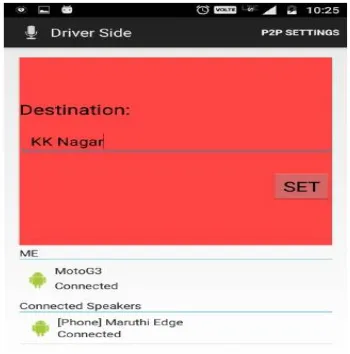
Fig 5 Setting Destination
Fig 6 Destination Fixed
VII. CONCLUSION
we can know what is happening in the world at current time, we can hear songs, watch movies, play games, communicate with our people, using mobile as a guide for navigating from one place to another. Our main aim is the visually challenged people also have to use the mobile for navigate from one place to another through public transport with the help of their own smart phone.
VIII. FUTURE ENHANCEMENT
We have implemented the broadcasting system through manual operation and the signal ranges only up to 60-70 meters. In future enhancement, the system will be improved to a wider range of signal broadcasting and the schedule of all the buses that reaches the destination given by the user.
REFERENCES
[1] MK Pushpa, Shunmuga Priya M, Nandini T.G., Shilpa C.K, Sunitha, “Smart guiding system for blind”, International Journal of Innovative Research in Electrical, Electronics, Instrumentation and Control Engineering, Vol. 3, Issue 5, May 2015.
[2] Adarsh Holikatti MTech student, Dr. S. Mohan Kumar Professor, “Smart Bus Alert System for Easy Navigation of Blind”, International Journal of Advanced Networking & Applications, ISSN: 0975-0282.
[3] Baun, G., Venard, O., Uzan, G., Paumier, A., Cesbron, J.: Le projet rampe: syst`Eme interactif d’information auditive pour la mobilit´E des persones aveugles dans les transports publics. In: Proceedings of the 2nd French-Speaking Conference on Mobility and Ubiquity Computing, UbiMob 2005, pp. 169–176. ACM (2005).
[4] Bischof, W., Krajnc, E., Dornhofer, M., Ulm, M.: NAVCOM – WLAN communication between public transport vehicles and smart phones to support visually impaired and blind people. In: Miesenberger, K., Karshmer, A., Penaz, P., Zagler, W. (eds.) ICCHP 2012, Part II. LNCS, vol. 7383, pp. 91–98. Springer, Heidelberg (2012).
[5] Dornhofer, M., Bischof, W., Krajnc, E.: Comparison of open source routing services with openstreetmap data for blind pedestrians - pgrouting, opentripplanner and opensourceroutingmaschine. In: Foss4g Europe2014 (2014).