www.wjpr.net Vol 8, Issue 13, 2019. 1248
DEVELOPMENT AND VALIDATION OF RP- HPLC METHOD AND
FORCE DEGRADATION STUDIES FOR ESTIMATION OF
VORTIOXETINE HBR IN BULK DRUG AND DOSAGE FORM
Vivek G. Dhuri* and Dr. Purnima D. Hamrapurkar
Department of Pharmaceutical Analysis, Prin K. M. Kundnani College of Pharmacy Mumbai,
Maharashtra, India.
ABSTRACT
A simple, rapid high-performance liquid chromatographic method with
PDA detection has been developed and validated according to the ICH
guidelines for the estimation of Vortioxetine HBR in bulk drugs and d
dosage form. Chromatographic separation was carried out in a
INERTSIL ODS-3V C-18 column (250mm x 4.6mm x 5μ) with mobile
phase composition of a mixture of Ammonium acetate(pH 4.5) and
Acetonitrile (40:60) at a flow rate of 1ml/min and sample injection of
10 µL was injected. The eluent was monitored with a chrom nav
software with PDA detector set at 228 nm with a total run time of 15
minutes. The method was linear over the concentration range of 2.5 to
7.5 µg/ml for Vortioxetine HBR with a correlation coefficient of
0.9960 Accuracy was found to be 99.58 to 101.17%. The developed
and validated method was successfully applied to assay of Vortioxetine HBR In dosage form.
KEYWORDS: Vortioxetine HBR, method development, RP-HPLC, PDA detector, stability
indicating method, validation.
INTRODUCTION
Analytical methods are applied to find out identity, purity, physical characteristics and
potency of the active pharmaceutical ingredient and formulation.[1] HPLC is most useful
qualitative and quantitative technique. It is the foremost versatile, safest, dependable and
fastest chromatographic technique for the quality control of drug components. advantage of
these technique is that it will more accurate and reliable result and also reduce the time of
analysis.[2]
Volume 8, Issue 13, 1248-1257. Research Article ISSN 2277– 7105
Article Received on 21 Oct. 2019,
Revised on 11 Nov. 2019, Accepted on 01 Dec. 2019,
DOI: 10.20959/wjpr201913-16340
*Corresponding Author
Vivek G. Dhuri
Department of
Pharmaceutical Analysis,
Prin K. M. Kundnani
College of Pharmacy
Mumbai, Maharashtra,
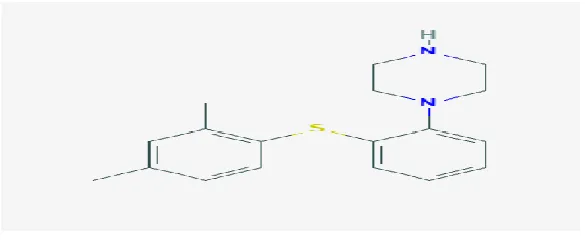
Vortioxetine HBR is chemically 1-{2-[2,4-dimethylphenyl)sulphynyl]phenyl}piprazine
monohydrobromide.[3] Vortioxetine HBR is used for the treatment of major depressive
disorder. Vortioxetine HBR combines with serotonin transporter and its antidepressant action
is due to enhancing serotonin level in central nervous system by reduction in reuptake of
serotonin. Vortioxetine HBR is a serotonin modulator and simulator. It is partial agonist of 5
[image:2.595.152.445.209.332.2]HT1B receptor and agonist of 5 HT1A and antagonist of 5HT3 receptor.[4]
Fig. 1: Structure of Vortioxetine.
1-{2-[(2,4-dimethylphenyl)sulfanyl]phenyl}piperazine monohydrobromide.[5]
Literature survey reveals that there are very few methods available for assay of Vortioxetine
HBR by using HPLC[3,4] hence attempt has been made to develope and validate stability
indicating rp- hplc method for estimation of Vortioxetine HBR in bulk drug and dosage form
And developed method was applied to marketed dosage form.
MATERIALS AND METHODS
Chemicals and Reagents: API sample of Vortioxetine HBR was obtained from Piramal
pharma Mumbai as a gift sample. Brintellix 10 mg tablet was obtained from local market.
Acetonitrile (HPLC Grade from MERCK)), Ammonium acetate (analytical grade from
RANKEM), glacial acetic acid), and HPLC-grade water (from J. K. LAB) were among the
other chemicals and reagents used in the analysis.
Instrumentation and Chromatographic Conditions: HPLC apparatus (JASCO; Model)
consisted of gradient quaternary pump, multiple wavelength PDA detector, and chromnav
software. Chromatographic separation was performed isocratically using a INERTSIL
ODS-3V C-18 column (250mm x 4.6mm x 5μ) mobile phase composition of a mixture of
Ammonium acetate(pH 4.5) and Acetonitrile (40:60) at a flow rate of 1ml/min and sample
injection of 10 µL was injected. The eluent was monitored with a PDA detector set at 228
Preparation of mobile phase: Mobile phase was consist of Ammonium acetate buffer and
Acetonitrile in ratio of 40:60 and pH of buffer was adjusted to 4.5 using Glacial acetic acid.
The mixture was sonicated for 15 mins with intermittent shaking. This solution used as
mobile phase for further analysis.
Preparation of Stock and Working Solutions
For hplc method development and validation: 12.5 mg of vortioxetin HBR was accurately
weighed and transferred to 100 ml volumetric flask and adjust volume with methanol (125
ug/ml solution A). 10ml of solution A was pipette out and transferred to 100 ml of volumetric
flask and adjust the volume with diluent (12.5 ug/ml. solution B).
For force degradation studies: 50 mg of API was accurately weighed and transferred to 50
ml of volumetric flask and 25 ml of methanol was added and sonicated it for 15 min and
volume was adjusted for 50 ml with methanol (1000 ug / ml Solution C). this solution was
used as stock solution for force degradation studies.
Initial method development
Initially method development was started with 50:50 ACN water but peak eluted after long
time. Then 70:30 ACN water combination used but peak elute to early and retention time is
also fluctuating hence the final combination was ACN:Amm. acetate buffer with Ph 4.5 was
used and diluent was mixture of ACN and buffer then all peak parameter within specfication
but interfering peaks of diluent was observed hence buffer was remove from diluent and only
ACN water mixture is used as diluent. And finally peaks was observed with proper system
suitability parameter.
Method Validation[6]: The developed method was validated for Linearity and Range, Precision, Specificity, Accuracy, Limit of detection (LOD), Limit of quantitation (LOQ), and
System Suitability according to ICH guidelines.[6]
System suitability: System suitability testing was carried out by injecting 6 replicates of 5
μg/ml Standard Vortioxetine HBR solution. In this test, system suitability parameters like
%RSD of Peak area, retention time and number of theoretical plates (NTP) were evaluated.
Specificity: Specificity of the method was determined by recording the chromatogram of the
Standard stock solution of Vortioxetine HBR (5 μg/ml) and Blank chromatogram (only
Linearity and Range: The linearity of the method was evaluated in the range of 2.5 ug / ml
to 7.5 ug / ml for Vortioxetine HBR. The calibration standard for linearity was prepared at a
concentration of 2.5, 3.75, 5, 6.25, 7.5 ug/ml by further dilution of solution B and volume
was adjust with diluent. Then each level was injected six times in HPLC, Chromatogram was
recorded and peak area was calculated for all the peak. The calibration curve was plotted as
mean peak area of the analyte against concentration of Vortioxetine HBR in ug / ml.
Precision: Precision was estimated at three different concentration of Vortioxetine HBR at
2.5 ug / ml, 5 ug / ml and 7.5ug/ml (50%, 100% and 150% of working level) on intraday
precision and interday precision. Then mean area, standard deviation and % RSD were
calculated.
Accuracy: The accuracy of the method was calculated as % recovery from blank solution
spiked with 50%, 100% and 150%. The experiment was conducted in triplicate. The %
recovery was calculated for each solution.
LOD and LOQ: The LOD and LOQ of method was estimated by applying injections of low
concentrations of Vortioxetine HBR standard solution. The concentration of solution which
give signal to noise ratio of NLT 3:1 is LOD and concentration of solution which give signal
to noise ratio of NLT 10:1 is LOQ of method.
APPLICATION OF DEVELOPED METHOD FOR MARKETED FORMULATION
Vortioxetine HBR available with dose strength 10 mg. 10 tablets were weighed and average
weight of tablet was calculated. 10 tablets were crushed in morter with help of pestle. Powder
equivalent to 10 mg of Vortioxetine HBR was weighed on weighing balance and transferred
to 10 ml of volumetric flask and 6 ml of methanol was added and continuous shake for 30
min and then sonicated for 30 min with occasional swirling. Volume was adjusted for 10 ml
with methanol. further dilutions was made to make final concentration of 5 ug/ml of
Vortioxetine HBR and volume was adjusted with diluent.
FORCED DEGRADATION STUDIES OF VORTIOXETINE HBR USING
VALIDATED METHOD
Forced degradation studies were carried out by exposing the stock solution of the drug to the
following conditions:
2. Base hydrolysis
3. Oxidative Degradation
4. Thermal degradation
5. Photolytic degradation
Acid Hydrolysis: 2 ml of stock solution (Solution C) was pipette out and transferred to a
round bottom flask and 2 ml of 1N HCl was added in round bottom flask and this mixture
was refluxed on a water bath for 15 min at 60°C. After the reflux, the round bottom flask
containing the stressed solution was cooled to room temperature, transferred to a 10 ml
volumetric flask, neutralized with the corresponding base and volume was made up with
diluent. Finally, this solution was filtered through 0.45μ filter paper and was loaded into
HPLC and the corresponding chromatogram was recorded.
Base Hydrolysis: 2 ml of stock solution was pippette out and transferred to a round bottom
flask and 2 ml of 0.1N NaOH was added in round bottom flask and this mixture was refluxed
on a water bath for 15 min at 60°C. After the reflux, the round bottom flask containing the
stressed solution was cooled to room temperature, transferred to a 10 ml volumetric flask,
neutralized with the corresponding acid and volume was made up with diluent. Finally,
this solution was filtered through 0.45μ filter paper and was loaded into HPLC and the
corresponding chromatogram was recorded.
Thermal Degradation: 2 ml stock solution was pipeette out and transferred to a round
bottom flask and this was refluxed on a water bath for 1 hrs at 80°C. After the reflux, the
round bottom flask containing the stressed solution was cooled to room temperature,
transferred to a 10 ml volumetric flask and volume was made up with diluent. Finally, this
solution was filtered through 0.45μ filter paper and was loaded into HPLC and the
corresponding chromatogram was recorded.
Oxidative degradation: 2ml of stock solution was pipeette out and transferred to a round
bottom flask. and 2 ml of 3% Hydrogen Peroxide was added in round bottom flask and this
mixture kept as such at room temperature for 30 minutes. After 30 min, the round bottom
flask containing the stressed solution was transferred to a 10 ml volumetric flask and volume
was made up with diluent. Finally, this solution was filtered through 0.45μ filter paper and
Photolytic degradation: The photolytic degradation was carried out by exposing drug
substance i.e. Vortioxetine HBR (10 mg) in the UV chamber for one week. After 1 week, the
drug substance was dissolved in 10 ml volumetric flask and then the volume was made up
with diluent. 2 ml of this solution was further diluted to 10 ml with diluent. Finally, this
solution was loaded into HPLC and the corresponding chromatogram was recorded.
[image:6.595.89.501.225.362.2]RESULTS AND DISCUSSION
Table no 1: Optimized chromatographic conditions.
Parameter Specifications
Pump Jasco PU-2089 Plus Quaternary Gradient HPLC Pump
Detector Jasco MD-2018 Plus intelligent PDA Detector
Software ChromNAV Software
Column INERTSIL ODS-3V C18 column (250mm x 4.6mm x 5μ)
Mobile Phase Ammonium acetate buffer (Ph 4.5): ACN (40 : 60)
Wavelength 228 nm
Injection volume 10 ul
Flow Rate 1 ml / min
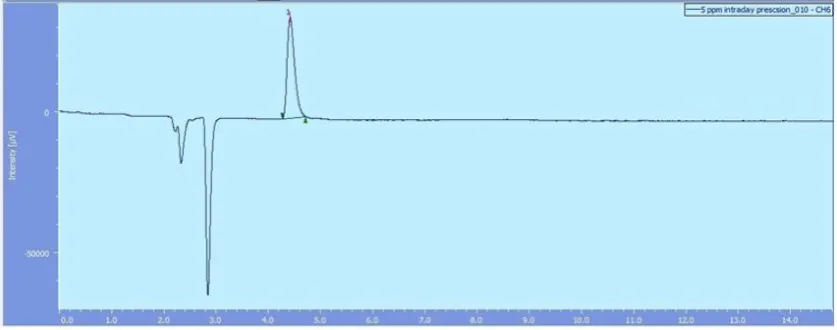
Representative Chromatogram of Vortioxetine HBR Standard Solution (5 ug/ml).
Fig. 2: Chromatogram of Vortioxetine HBR Standard (5μg/ml).
VALIDATION OF OPTIMIZED CHROMATOGRAPHIC METHOD OF
VORTIOXETINE HBR BY USING HPLC
System Suitability
The Vortioxetine HBR Standard Solution of 5 μg/ml was injected in six replicates. The
[image:6.595.89.508.399.564.2]Table no 2: System suitability data for Vortioxetine HBR.
Sr. no System suitability parameter Observations Acceptance criteria
1 Vortioxetine HBR standard 5 ug/ml
2 Area % RSD 0.4713 NMT 2%
3 Retention time (Rt) 4.4 min
4 NTP 4775 NLT 2000
5 Symmetry factor 1.471 0.8 TO 2
The System Suitability parameters were within specification.
Specificity: The Specificity is done mainly for Identification, Interference and Peak Purity of
drug. Blank (Diluent) and Vortioxetine HBR Standard Solution (5μg/ml) were injected and
[image:7.595.80.516.303.464.2]the representative Chromatograms for specificity are shown below.
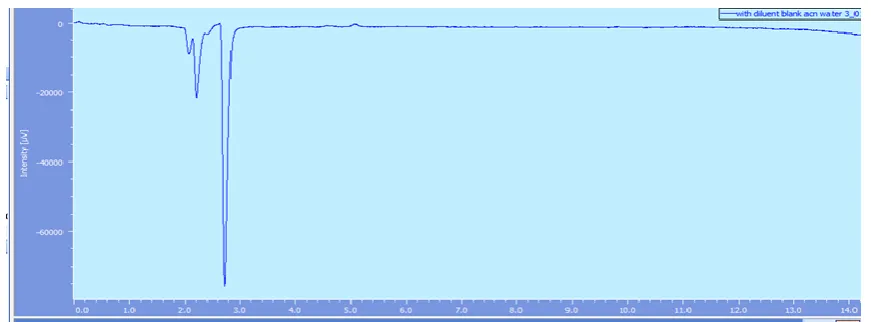
Fig no 3: Chromatogram for Blank.
There was no any interfering peak around retention time of API (4.4) hence the method was
proved to specific.
Linearity and range: Linearity was done over the range of 50 to 150% of working level i.e
5ug/ml in six replicates for Vortioxetine HBR was determined and observation is as follows.
Table no 3: Linearity for Vortioxetine HBR.
Concentration (ug/ml)
Peak area
Lin 1 Lin 2 Lin 3 Lin 4 Lin 5 Lin 6 Mean
2.5 184682 186362 182756 185340 180847 186881 184478
3.75 24886 249056 248851 249466 248240 248543 248840.3
5 350197 348420 349719 346637 345021 348762 348142.7
6.25 441393 442766 440240 440422 439167 440554 440757
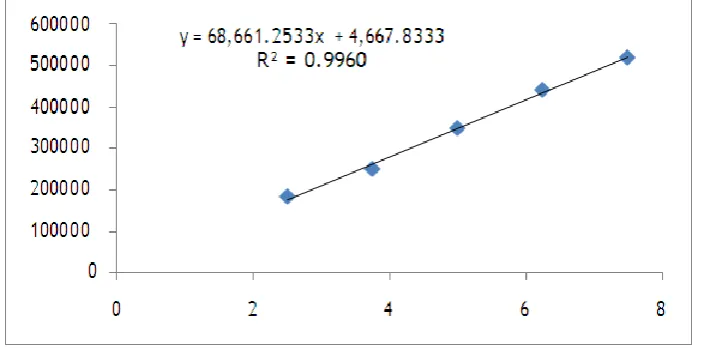
Graph no 1: Calibration graph for Vortioxetine HBR.
The Linearity was done in the range of 2.5 to 7.5 ug/ml. The Correlation Coefficient (r2) was
found to be 0.9960 Thus, the data shows that the response was found to be linear.
Precision
Intraday Precision: Intraday precision of Vortioxetine HBR was determined by taking six
replicates of 50%, 100% and 150% of working level i.e. 2.5μg/ml, 5μg/ml and 7.5μg/ml
concentration at different time intervals on same day.
Interday Precision: Interday precision of Vortioxetine HBR was determined by taking six
replicates of same 3 concentration on two consecutive days.
The % RSD for Intraday and Interday Precision of three concentration levels was found to be
0.45 and 1.69 respectively which is below 2% which shows that method was found to be
precise.
E) Accuracy
% Recovery study was performed using a minimum of 3 concentration level i.e 50%, 100%
[image:8.595.123.474.75.252.2]and 150% of working level concentration. Results for % Recovery summarized below.
Table no 4: Accuracy Data of Vortioxetine HBR.
Sr. no Conc. (ug/ml) % Recovery
1 2.5 101.17
2 5 100.42
F) Limit of Quantitation (LOQ) and Limit of Detection (LOD)
For LOQ signal to noise ratio is 10:1 and for LOD signal to noise ratio is 3:1.
Limit of Quantification (LOQ)
The limit of quantitation was found to be 12.5 ng. Hence method was found to be sensitive.
Limit of Detection (LOD)
The LOD was found to be 6.5 ng. This proves that method was sensitive.
APPLICATION OF DEVELOPED AND VALIDATED METHOD FOR ASSAY OF
MARKETED FORMULATION
The developed and validated method is applied sucessfully for assay determination of
[image:9.595.93.503.338.465.2]marketed formulation. The representative chromatogram of is as shown below.
Fig No. 3: Chromatogram of Marketed Formulation.
Table no 5: Assay of Marketed formulation.
Sample Assay
Marketed Formulation 99.61%
STABILITY INDICATING ASSAY METHOD OF VORTIOXETINE HBR BY USING
HPLC
To prove that the developed method method is stability-indicating Forced degradation is
performed. The result obtained for various stress studies are shown below.
Table no 6: Force degradation data for stability studies.
Sr no degradation Concentration % degradation
1 undegraded 200 ug/ml 0.00
2 Acid hydrolysis 200 ug / ml 9.9% 3 Base hydrolysis 200 ug/ml 1 %
5 Thermal 200ug/ml 2%
6 photolysis 200ug/ml 0.00
7 Total degradations 19.9%
CONCLUSION
Here, we have developed and validated an HPLC-PDA method that has provides simple
mobile phase composition for chromatographic separation, shorter run time for analysis,
simple sample preparation as well as improved sensitivity. Therefore, this method leads to a
simple, feasible, cost-effective, rapid method with a high degree of accuracy and
specificity to quantify Vortioxetine HBR in bulk and tablet dosage form. The developed
method was proved to be stability indicating assay method.
REFERENCES
1. Chauhan A., Harti Mittu B, Chauhan P, Analytical method development and validation: A
Consice review, J Anal and bioanal Tech., 6: 233.
2. Azim Md. Sabir et al. Int. Res. J. Pharm, 2013; 4(4).
3. Rubeena sulthana, k. Rajeswar dutt, R. Vasanthi, M. Alagar raja, K. N. vrao, validated
RP-HPLC method for estimation of Vortioxetine HBR in bulk drug and in tablet dosage
form, pharma science monitor, Apr-jun, 2017; 8(2): 611-624.
4. Wroblewski, K, Ptruckzynik, A, Buszewski, Szultka-mlynska M, Karakula-Juchnowicz,
H, Waksmundzka-Hajnos, M. Determination of Vortioxetine HBR in Human serum and
Saliva samples by HPLC-DAD and HPLC-MS Acta Chromatogr, 2016; 29(3): 325-344.
5. http://pubchem.ncbi.nlm.nih.gov/compound/Vortioxetine HBR0_hyd.
6. ICH Guidelines on Validation of Analytical procedure: Text and Methodology Q 2 (R1),