A Review on Implementation of Virtual ARM
Processor Using FPGA
Harshada Daphal
1, Niranjana Bhujbal
2, Bharati Kusale
3, Prof.T.V. Kafare
4B. E Student, Department of E&T, JSPM’s BSIOTR, Pune, India B. E Student, Department of E&T, JSPM’s BSIOTR, Pune, India B. E Student, Department of E&T, JSPM’s BSIOTR, Pune, India Asst. Professor, Department of E&T, JSPM’s BSIOTR, Pune, India
ABSTRACT: We know that the well known companies like Samsung, Nokia, Micromax develop their own processor ICs. It is very cost efficient to develop ICs in lacks and crores of amount as they require the with their own decided parameters, requirements. But if one wants to design a single IC , it is very cost effective. For single IC, it is not convenient to spend a lot of time for design purpose, manufacturing purpose, testing fault finding and repairing purpose. It increses the unit cost, time to market, manpower too. So the alternative is to design the software for it and dumping the code in userfriendly, low end device SPARTAN III. For that we are designing the ARM 7 soft core processor instead of other because it is easy to test the outputs of each functional block of ARM processor. Simulation results are observed for crosschecking the functionality of ARM processor. The functionality of block UART is crosschecked by sending the databits to the FPGA kit and displaying it through blinking the corresponding LEDs. An android application is executed to test functionality of entire ARM processor, the command is send through mobile device to ON/OFF relay.
KEYWORDS: FPGA, SpartanIII, UART, VLSI, VHDL.
I. INTRODUCTION
II. PROPOSED WORK
Figure.1 Block Diagram of Proposed System
Block diagram in fig1. Contens the Date path controller , Rom &communication modules are UART& SPI module. The block diagram comprises of
1) UART 2) ROM 3) Controller 4) Register file 5) Barrel shifter 6) ALU
1. UART:The UART or universal Asynchronous Receiver/ Transmitter is most important component in serial communication between computer &low speed peripheral devices like Keyboard ,Mouse Model & with terminal.
2. ROM:Hex code generated using ARM architecture used to test the implemented ARM processor is in the ROM.
3. Comtroller:Generates control signal to flow of data path for execute of instruction given in ROM controller play important role as it controller operation of system.
4. Register File:Register file consist of 10 negligible each of 32 bit length including program counter(PC) , control program status register(CPSR).
C. Hardware Description 1) SPARTAN III:
Figure 2: SPARTAN III Specifications:
1) FPGA: Spartan-3 XC6SLX9 in TQG144 package 2) Flash memory: 16 Mb SPI flash memory (M25P16) 3)100MHz CMOS oscillator
4) USB 2.0 interface for On-board flash programming 5) FPGA configuration via JTAG and USB
6) 8 LEDs and four switches for user defined purposes 7) 70 IOs for user defined purposes
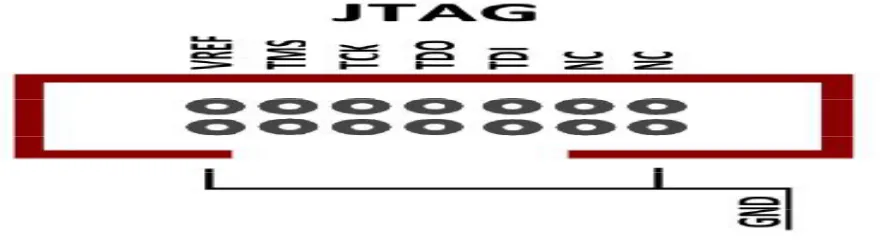
8) On-board voltage regulators for single power rail operation. 2) JTAG Connector:
Figure 3:JTAG Connector
III.PROPOSED SYSTEM
Figure 4: Proposed system SIMULATION RESULTS
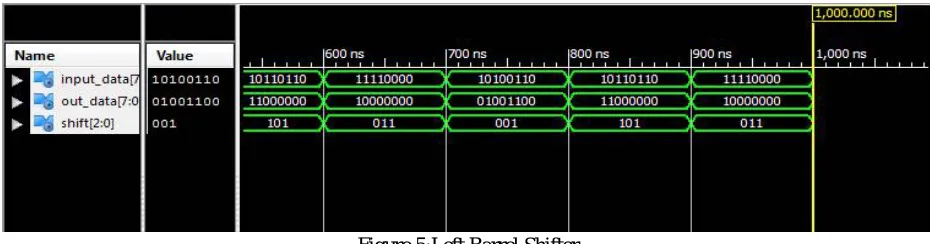
A. Left barrel shifter:For Left barrel shifter, the input and outputs are given bellow and are clearly shown in fig,
• Input data= 10100110
• Shift= 001
• Output data= 01001100
Figure 5:Left Barrel Shifter
B. Right barrel shifter:For Right barrel shifter, the input and outputs are given bellow and are clearly shown in fig,
Input data= 11010001
Figure 6:Right Barrel Shifter
C. Left rotator:For left rotator, the input and outputs are given bellow and are clearly shown in fig,
Input data= 11010001
Rotate= 010
Output data= 01000111
Figure 7:Left Rotator
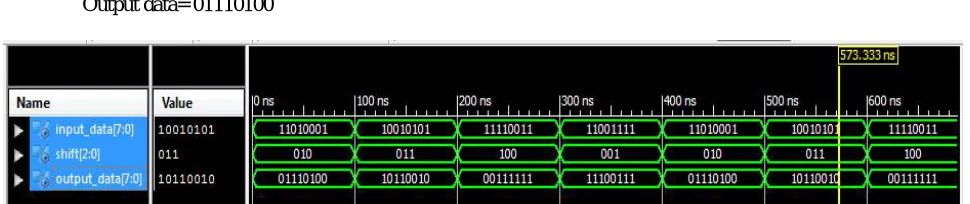
D. Right rotator:For Right rotator, the input and outputs are given bellow and are clearly shown in fig,
Input data= 11010001
Rotate= 010
Output data= 01110100
E. Synthesis Report:
Figure 9: Synthesis Report IV.APPLICATIONS
1. DSP:For simulation and execution of digital signal in ISE Design Suite14.7. Any digital signal can be simulated using this suite.
2. ASIC prototyping: For executing specific application using ARM processor. It reduces the memory space consumed than that consumed by any other processor and writing code for specific application with suitable memory.
3. Aerospace: Main aim while designing any system is implement design with reduced hardware which can be achieved by FPGA.
4. Industry system monitoring: Virtual ARM processor can be used further for industrial system monitoring, analyzing and future record purpose.
5. It can be used in applications like Medical imaging, Cryptography, Speed recognition, etc. V. CONCLUSION
In this venture we have built up an android application to associate with Bluetooth module and given the instructions to start the relay, ON/OFF LEDs.A shrewd correspondence system is made with an end goal to achieve complete hardware customization and reduced memory consumption with less i/o pins.The high end FPGA device can be used for Better efficiency verification ARM platform can be Executed with ARM 9, ARM 11 Processor.
REFERENCES
1. Y B T Sundari, T. Surender Reddy, Dr. Laxminarayana G, “Implementing the ARM7 soft core processor in FPGA”, Aurora’s Scientific & Technological Institute, Hyderabad, India, IJCER, vol.2, pp 153-159 Apr. 2013.)
2. Alex Heunhe Han, Young-Si Hwang, Young Ho An, So-Jin Lee, Ki-Seok Chung, “Virtual ARM Platform for Embedded System Developers”
Dept. of Electronics and Computer & Communications Engineering, Hanyang University, IEEE 2008 pp586-592.
3. J. O. Hamblen, T. S. Hall, “Using System-on Programmable-Chip Technology to Design Embedded System”Southern Adventist University,
[email protected], IJCA, Vol. 13, No. 3, pp 1-11, Sept. 2006.
4. Goslin, G. R. “A Guide to Using Field Programmable Gate Arrays (FPGAs) for application Specific Digital Signal Processing Performance”, Xilinx Application Note, 1995.
5. Mukesh P. Mahajan, Pramod S. Aswale, Vivek D. Ugale, “FPGA Implementation of ARM Processor”,Assistant Professor, Dept. of ETC, SITRC, Nashik, Maharashtra, India, IJAREEIE Vol. 3, Issue 11, November 2014.
6. ARM Architecture Reference Manual.
7. Nazeih Botros, “HDL Programming Fundamentals”, 2007. 8. Volnei A. Pedroni, “Circiuit Design with VHDL”, 2004.