Efficient File Download Time Reduction
System for Multi-Client Fog/Cloud
Environment
K.Priyanga, V.Janakiraman,
M.E. Computer Science and Engineering, Department of Computer Science and Engineering, Shanmuganathan Engineering College, Thirumayam Rd, Arasampatti, Pudukkottai, Tamilnadu, India
Assistant Professor, Department of Computer Science and Engineering, Shanmuganathan Engineering College, Thirumayam Rd, Arasampatti, Pudukkottai, Tamilnadu, India
ABSTRACT: The main aim of this study is to design conflict-free algorithm to minimize the download time of these multiple files requested by the multiple network clients from the cloud or fog storage servers, using network coding. The problem of reducing the download time of multiple files requested by multiple clients from multiple cloud/fog storage servers. Given possible previous file downloads by the clients, network coding can be efficiently exploited to expedite the download process. Since each client can tune to only one server at a time, the sets of clients served by the different servers must be disjoint in order to guarantee a maximum reduction in download time. To accomplish disjoint download mechanisms, a dual conflict network coding graph is proposed. Given the intractability of the long-term optimal solution, we propose an online algorithm using the designed dual conflict graph. For the case of one file request per client, both asymptotic lower and upper bounds of the performance of the proposed conflict-free algorithm are derived.
KEYWORDS: Fog Computing, Cloud Computing, Fog Radio Access Networks, Network Coding.
I. INTRODUCTION
obile computing is human–computer interaction by which a computer is expected to be transported during normal usage. Mobile computing involves mobile communication, mobile hardware, and mobile software. Communication issues include ad hoc and infrastructure networks as well as communication properties, protocols, data formats and concrete technologies. Hardware includes mobile devices or device components. Mobile software deals with the characteristics and requirements of mobile applications. Mobile Computing is "taking a computer and all necessary files and software out into the field. Mobile computing is any type of computing which use Internet or intranet and respective communications links, as WAN, LAN, WLAN etc. Mobile computers may form wireless or a pioneer. Many types of mobile computers have been introduced since the 1990s including the:
(a) Portable computer (discontinued)
(b) Personal digital assistant/Enterprise digital assistant (discontinued) (c) Ultra-Mobile PC (discontinued)
(d) Laptop
This paragraph illustrates the details of authors and copyright owners who owned this paper and having rights for the implementation mentioned in paper.
K.Priyanga, M.E. Computer Science and Engineering, Department of Computer Science and Engineering, Shanmuganathan Engineering College, Thirumayam Rd, Arasampatti, Pudukkottai-622507.
MR.V.Janakiraman, Assistant Professor, Department of Computer Science and Engineering, Shanmuganathan Engineering College, Thirumayam Rd, Arasampatti, Pudukkottai-622507.
(e) Smartphone (f) Tablet computer (g) Wearable computer (h) Computer
A. In-vehicle computing and Fleet Computing
Many commercial and government field forces deploy a ruggedized portable computer with their fleet of vehicles. This requires the units to be anchored to the vehicle for driver safety, device security, and ergonomics. Rugged computers are rated for severe vibration associated with large service vehicles and off-road driving and the harsh environmental conditions of constant professional use such as in emergency medical services, fire, and public safety. Other elements affecting function in vehicle:
(a) Typical fan-based cooling has stated limits of operating temperature: A vehicle cabin can often experience temperature swings from -20F to +140F. Computers typically must be able to withstand these temperatures while operating.
(b) 95F-100F of ambient temperature and temperatures below freezing require localized heaters to bring components up to operating temperature (based on independent studies by the SRI Group and by Panasonic R&D).
(c) Vibration can decrease the life expectancy of computer components, notably rotational storage such as HDDs. Visibility of standard screens becomes an issue in and navigation equipment.
(d) Bright sunlight Touch screen users easily interact with the units in the field without removing gloves. High-temperature battery settings: Lithium ion batteries are sensitive to high High-temperature conditions for charging. A computer designed for the mobile environment should be designed with a high-temperature charging function that limits the charge to 85% or less of capacity.
(e) External antenna connections go through the typical metal cabins of vehicles which would block wireless reception, and take advantage of much more capable external communication Several specialized manufacturers such as First Mobile Technologies, National Products Inc (Ram Mounts), Gambler Johnson and Lecco build mounts for vehicle mounting of computer equipment for a wide range of vehicles.
(f) The mounts are built to withstand the harsh conditions and maintain ergonomics. Specialized installation companies design the mount design, assembling the parts, and installing them in a safe and consistent manner away from airbags, vehicle HVAC controls, and driver controls. Frequently installations will include a WWAN modem, power conditioning equipment, transceiver antennae mounted external to the vehicle, and WWAN/WLAN/GPS/etc.
B. Portable Computing Devices
Fig.1 Mobile Model
(a) An ultra mobile PC (discontinued) is a full-featured, PDA-sized computer running a general-purpose operating system.
(b) A tablet computer that lacks a keyboard (also known as a non-convertible tablet) is shaped like a slate or a paper notebook. Instead a physical keyboard it has a touch screen with some combination of virtual keyboard, stylus and/or handwriting recognition software. Tablets may not be best suited for applications requiring a physical keyboard for typing, but are otherwise capable of carrying out most of the tasks of an ordinary laptop.
(c) A smart phone has a wide range of features and install-able applications.
(d) A carpeted is installed in an automobile. It operates as a wireless computer, sound system, GPS, and DVD player. It also contains word processing software and is Bluetooth compatible.
(e) A Pen top (discontinued) is a computing device the size and shape of a pen. It functions as a writing utensil, MP3 player, language translator, digital storage device, and calculator
(f) Boundaries that separate these categories are blurry at times. For example, the OQO UMPC is also a PDA-sized tablet PC; the Apple e Mate had the clamshell form factor of a laptop, but ran PDA software. The HP Omni book line of laptops included some devices small more enough to be called ultra mobile PCs. The hardware of the Nokia 770 internet tablet is essentially the same as that of a PDA such as the Azures , both the 770 and the Azures can run some desktop Linux software, usually with modifications. 6000; the only reason it's not called a PDA is that it does not have PIM software. On the other hand
C. Mobile Data Communication
II. SYSTEMIMPLEMENTATION
A. CONFLICT-FREE DOWNLOAD PATTERN
Solution in a systematic mannerfor an number of clients, files and servers. This motivates the introduction of the novel dual-conflict graphmodel in the next section, which will be shown to systematically identify the above conflict-free download pattern andcoded transmissions.
Download Time Unit
(a) Separately and finds theconflict-free IDNC combination that it is required to transmitin each DTU.
(b) Since the content update rate of cloud/fogstorage systems is orders of magnitude lower compared toDTUs, the decentralized approach can be maintained andwork appropriately at each server without frequentlyexchanging information regarding stored files.
The download time performance of our proposed online algorithm solution for the following scenario:
(a) Lossless channels (b) Fixed storage model (c) One file request per client
(d) Asymptotically speaking, the severs and clients will go through all possibilities of file storage and requests. Thus, the file identities can be ignored in this analysis.
ALGORITHM IMPLEMENTATION
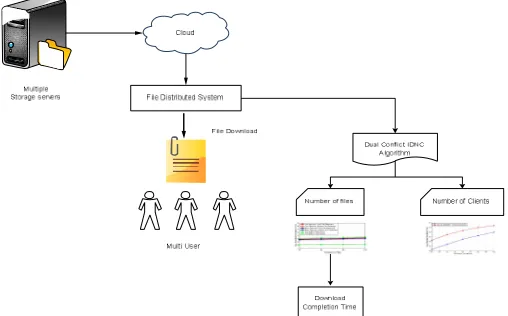
The proposed conflict-free IDNC algorithm in either centralized or decentralized (distributed) approach. In the former approach, a cloud/fog storage controller, which knows the side information of all clients(from the prior download log files) and the stored content at the servers, can build the dual-conflict graph and use Algorithm to schedule the conflict-free IDNC download pattern for each DTU. In the latter scenario, each server can build the dual-conflict graph separately, by exchanging their knowledge of content and the clients sub-channels parameters with each other using their backbone connections. Each server runs Algorithm separately and finds the conflict-free IDNC combination that it is required to transmit in each DTU. Since the content update rate of cloud/fog storage systems is orders of magnitude lower compared to DTUs, the decentralized approach can be maintained and work appropriately at each server without frequently exchanging information regarding stored files.
B. DATA OWNER UPLOAD FILES
The data owner chooses the file to upload in the cloud. Then they generate key to encrypt the data for secured storage. The data owner then encrypts the data using the key. After encrypting the data, the owner uploads the encrypted files in the cloud.
C. STORE THE DATA AND VIEW DETAILS
The data owner store the encrypt data for secured storage and uploads files for data chunk compression of decrypt key. Cloud storage has several provides over the traditional data compression storage. The data owner can view the all registered user and also can view the all files.
D. ACCESSING CLOUD FILE BY USER
E. DOWNLOAD FILE BY MULTIPLE USER OR MULTIPLE FILE BY SINGLE USER
Multiple requests of different clients can be served simultaneously from the different cloud servers. In this module multiple user or client can download the single file from the fog or may be the single user download the multiple file by using conflict free algorithm in this both process download time will reduced simultaneously. Simulation results show that this proposed algorithm exhibits near optimum performance compared to the optimum solution, and a significant reduction in download time as compared to the per-server network coding scheme.
III. LITERATURESURVEY
Service Migration from Cloud to Multi-tier Fog Nodesfor Multimedia Dissemination with QoE Support - Denis Rosário - 2018. [1]. A wide range of multimedia services is expected to be offered for mobile users via variouswireless access networks. Even the integration of Cloud Computing in such networks does notsupport an adequate Quality of Experience (QoE) in areas with high demands for multimediacontents. Fog computing has been conceptualized to facilitate the deployment of new services thatcloud computing cannot provide, particularly those demanding QoE guarantees. These servicesare provided using fog nodes located at the network edge, which is capable of virtualizing theirfunctions/applications. Service migration from the cloud to fog nodes can be actuated by requestpatterns and the timing issues. To the best of our knowledge, existing works on fog computing focuson architecture and fog node deployment issues. In this article, we describe the operational impactsand benefits associated with service migration from the cloud to multi-tier fog computing for videodistribution with QoE support. Besides that, we perform the evaluation of such service migration ofvideo services. Finally, we present potential research challenges and trends.
Techniques Used:
(a) Based on QoE, network conditions, and user characteristics, theABR service running on a virtualized service at the cloud can be migrated to a given fog node.
(b) In thiscontext, migration decisions are directly related to the number of users, user experience, and theheterogeneity found across fog nodes.
Demerits:
(a) Frequent switching in bit rates can degrade the QoE.In this way, the initial bitrate, number of bitrate switching events, average bitrate, and final bitrateaffect the user experience on consuming video services.
(b) The client does not receive thevideo configured in 4K or even with higher bitrates by downloading from the Tier 1.
Coding for Distributed Fog Computing - Songze Li - 2017. [2] Redundancy is abundant in Fog networks (i.e., many computingand storage points) and grows linearly with networksize. We demonstrate the transformational role of coding inFog computing for leveraging such redundancy to substantiallyreduce the bandwidth consumption and latency of computing.In particular, we discuss two recently proposed codingconcepts, namely Minimum Bandwidth Codes and MinimumLatency Codes, and illustrate their impacts in Fog computing.We also review a unified coding framework that includes theabove two coding techniques as special cases, and enables atradeoff between computation latency and communication loadto optimize system performance. At the end, we will discussseveral open problems and future research directions.
Technique Used:
(a) The impact of Minimum Bandwidth Codes on reducingthe response time has been recently demonstrated in through a series of experiments over Amazon EC2 clusters.
Demerits:
(a) No redundancy is imposed on the computations, i.e., each file is mapped exactly once.
Demystifying Fog Computing: Characterizing Architectures, Applications and Abstractions - Prateeksha Varshney - 2017. [3] Internet of Things (IoT) has accelerated the deployment of millions of sensors at the edge of the network, through Smart City infrastructure and lifestyle devices. Cloud computing platforms are often tasked with handling these large volumes and fast streams of data from the edge. Recently, Fog computing has emerged as a concept for low-latency and resource-rich processing of these observation streams, to complement Edge and Cloud computing. In this paper, we review various dimensions of system architecture, application characteristics and platform abstractions that are manifest in this Edge, Fog and Cloud eco-system. We highlight novel capabilities of the Edge and Fog layers, such as physical and application mobility, privacy sensitivity, and a nascent runtime environment. IoT application case studies based on first-hand experiences across diverse do-mains drive this categorization. We also highlight the gap between the potential and the reality of Fog computing, and identify challenges that need to be overcome for the solution to be sustainable. Together, our article can help platform and application developers bridge the gap that remains in making Fog computing viable.
Technique Used:
(a) IoT applications and services to be hosted remotely. Their on-demand access to seemingly infinite resources accessed through simple webservice APIs, combined with the pay-as-you-go billing model that capitalizes on economies of scale have made Cloud computing popular for supporting millions of clients at the edge.
Demerits:
(a) Edge computing suffers from several dependencies. The edge plat- forms tend to be constrained devices, with battery capacity or memory often being the limiting factor rather than even compute capability.
Fog Computing: An Overview of Big IoT Data Analytics - Muhammad Rizwan Anawar - 2018. [4] A huge amount of data, generated by Internet of Things (IoT), is growing up exponentially based on nonstop operational states. Those IoT devices are generating an avalanche of information that is disruptive for predictable data processing and analytics functionality, which is perfectly handled by the cloud before explosion growth of IoT. Fog computing structure confronts those disruptions, with powerful complement functionality of cloud framework, based on deployment of micro clouds (fog nodes) at proximity edge of data sources. Particularly big IoT data analytics by fog computing structure is on emerging phase and requires extensive research to produce more proficient knowledge and smart decisions. This survey summarizes the fog challenges and opportunities in the context of big IoT data analytics on fog networking. In addition, it emphasizes that the key characteristics in some proposed research works make the fog computing a suitable platform for new proliferating IoT devices, services, and applications. Most significant fog applications (e.g., healthcare monitoring, smart cities, connected vehicles, and smart grid) will be discussed here to create a well-organized green computing paradigm to support the next generation of IoT applications.
Technique Used:
(a) The techniques of big data analytics based protected cluster management framework for optimized control plane at Software Define Network (SDN). Finally, ant colony algorithm is used to facilitate a big data analysis scheme for significantly improving the processing and accuracy of applications running in SDN.
Demerits:
IV. SYSTEMANALYSIS
A. Existing System
Very limited works have addressed the scheduling problems of such file downloads. Each client can tune to only one server at a time, the sets of clients. This is considered not only a waste of resources as each client can listen to only one server at a time. The clients can thus access these files from this fog storage network thus offloading this kind of heavy-load traffic. Maximize the total downheavy-load time of files requested by multiple clients from cloud/fog storage servers.
DISADVANTAGES OF EXISTING SYSTEM
(a) Fixed storage model (b) One file request per client (c) Download time is high.
(d) One client access with one server at same time (e) Throughput is not efficiency
B. Proposed System
An online algorithm using the designed dual conflict graph and for the case of one file request per client, both asymptotic lower and upper bounds of the performance of the proposed conflict-free algorithm are derived. First, the point-to-multipoint model considered in this work limits the potentials of cloud storage servers to operate in a multipoint-to-multipoint fashion. Indeed, the multiple requests of different clients can be served simultaneously from the different cloud servers. Second, it ignores the possibility of prior file downloads by the clients from the cloud servers. Multipoint-to-Multipoint system and its effect on the overall download time problem. The proposed dual-conflict IDNC approach eliminates all such transmission dual-conflict events completely, thus fully utilizing the gain of increasing the clients’ side information size.
ADVANTAGES OF PROPOSED SYSTEM
(a) Minimization of Download Times problem as a stochastic shortest path (SSP) problem,.
(b) Minimizing the total download time of files requested by multiple clients from cloud/fog storage servers (c) Lossless channels
(d) Systematically identify the above conflict-free download pattern and coded transmissions. (e) Thus fully utilizing the gain of increasing the clients side information size.
V. RESULTSANDDISCUSSION
In this section, we provided the simulated results of entire project with its practical proofs. The following figure shows the Homepage perspective of the Proposed System.
Fig.3 Home Page
The following figure illustrates the User Login Page of the proposed system.
Fig.4 User Login Page
The following figure illustrates the Registration Page of the proposed system.
The following figure illustrates the File Uploading View of the proposed system.
Fig.6 File Uploading
VI. CONCLUSIONANDFUTURESCOPE
The multi-client download time reduction problem from cloud/fog storage servers was investigated in perfect and imperfect feedback environments. Applying the conventional PMP IDNC algorithm at each server separately was shown to result in transmissions conflicts, which reduced the download efficiency. Consequently, A novel dual-conflict graph model that avoids such dual-conflicts and guarantees dual-conflict-free trans- missions. The download time reduction problem was first formulated as an SSP problem and shown to be intractable. An online heuristic algorithm that applies maximum weight vertex search over the dual- conflict graph to find the most suitable file download pat- tern at DTU.
In future, the proposed work is further extended by means of some intensive algorithms such as Machine Learning with ANN Algorithms with powerful authentication strategies and has a plan to improve the accuracy range higher than the proposed system.
REFERENCES
[1] A. A. Al-Habob, S. Sorour, N. Aboutorab, and P. Sadeghi, “Conflict free network coding for distributed storage networks,” in Proc. IEEE Int. Conf. Commun., Jun. 2015, pp. 5517–5522.
[2] A. G. Dimakis, K. Ramchandran, Y. Wu, and C. Suh, “A survey on network codes for distributed storage,” Proc. IEEE, vol. 99, no. 3, pp. 476– 489, Mar. 2011.
[3] D. S. Papailiopoulos, J. Luo, A. G. Dimakis, C. Huang, and J. Li, “Simple regenerating codes: Network coding for cloud storage,” in Proc. IEEE INFOCOM,Mar. 2012, pp. 2801–2805.
[4] H. Weatherspoon and J. D. Kubiatowicz, “Erasure coding vs. replication: A quantitative comparison,” in Proc. Int. Workshop Peer-to-Peer Syst., 2002, pp. 328–337.
[5] A. G. Dimakis, V. Prabhakaran, and K. Ramchandran, “Decentralized erasure codes for distributed networked storage,” IEEE Trans. Inf. Theory, vol. 52, no. 6, pp. 2809–2816, Jun. 2006.
[6] A. Kamra, V. Misra, J. Feldman, and D. Rubenstein, “Growth codes: Maximizing sensor network data persistence,” ACM SIGCOMM Comp. Commun. Rev., vol. 36, no. 4, pp. 255–266, 2006.
[7] U. J. Ferner, P. Sadeghi, N. Aboutorab, and M. Mdard, “Scheduling advantages of network coded storage in point-to-multipoint networks,” in Proc. Int. Symp. Netw. Coding, Jun. 2014, pp. 1–6.
[8] R. Tandon and O. Simeone, “Harnessing cloud and edge synergies: Toward an information theory of fog radio access networks,” IEEE Commun. Mag., vol. 54, no. 8, pp. 44–50, Aug. 2016.
[9] S. H. Park, O. Simeone, and S. Shamai, “Joint optimization of cloud and edge processing for fog radio access networks,” in Proc. IEEE Int. Symp. Inf. Theory, Jul. 2016, pp. 315–319.
[11] N. Golrezaei, K. Shanmugam, A. G. Dimakis, A. F. Molisch, and G. Caire, “FemtoCaching: Wireless video content delivery through distributed caching helpers,” in Proc. IEEE INFOCOM, Mar. 2012, pp. 1107–1115.
[12] F. Pantisano, M. Bennis, W. Saad, and M. Debbah, “Cache-aware user association in backhaul-constrained small cell networks,” in Proc. 12th Int. Symp. Model. Optimization Mobile Ad Hoc Wireless Netw., May 2014, pp. 37–42.
[13] B. Blaszczyszyn and A. Giovanidis, “Optimal geographic caching in cellular networks,” in Proc. IEEE Int. Conf. Commun., Jun. 2015, pp. 3358–3363.
[14] S. Krishnan and H. S. Dhillon, “Distributed caching in device-to-device networks: A stochastic geometry perspective,” in Proc. 49th Asilomar Conf. Signals Syst. Comput., Nov. 2015, pp. 1280–1284.
[15] M. Ji, G. Caire, and A. F. Molisch, “Wireless device-to-device caching networks: Basic principles and system performance,” IEEE J. Select. Areas Commun., vol. 34, no. 1, pp. 176–189, Jan. 2016.
[16] M. A. Maddah-Ali and U. Niesen, “Fundamental limits of caching,” IEEE Trans. Inf. Theory, vol. 60, no. 5, pp. 2856–2867, May 2014. [17] M. A. Maddah-Ali and U. Niesen, “Decentralized coded caching attains order-optimal memory-rate tradeoff,” IEEE/ACM Trans. Netw., vol. 23, no. 4, pp. 1029–1040, Aug. 2015.
[18] M. A. Maddah-Ali and U. Niesen, “Coding for caching: Fundamental limits and practical challenges,” IEEE Commun. Mag., vol. 54, no. 8, pp. 23–29, Aug. 2016.
[19] Y. N. Shnaiwer, S. Sorour, N. Aboutorab, P. Sadeghi, and T. Y. Al-Naffouri, “Network-coded content delivery in femtocachingassisted cellular networks,” in Proc. IEEE Global Commun. Conf., Dec. 2015, pp. 1–6.
[20] R. Ahlswede, N. Cai, S. Y. R. Li, and R. W. Yeung, “Network information flow,” IEEE Trans. Inf. Theory, vol. 46, no. 4, pp. 1204–1216, Jul. 2000.
[21] S. K. D. K. W. Hu and H. R. M. Medard, “The importance of being opportunistic: Practical network coding for wireless environments,” Newslett. ACM SIGCOMM Comput. Commun. Rev., vol. 36, no. 4, pp. 1–10, 2006.
[22] S. Katti, H. Rahul, W. Hu, D. Katabi, M. Medard, and J. Crowcroft, “XORs in the air: Practical wireless network coding,” IEEE/ACM Trans. Netw., vol. 16, no. 3, pp. 497–510, Jun. 2008.
[23] P. Sadeghi, D. Traskov, and R. Koetter, “Adaptive network coding for broadcast channels,” in Proc. Workshop Netw. Coding Theory Appl., Jun. 2009, pp. 80–85.
[24] P. Sadeghi, R. Shams, and D. Traskov, “An optimal adaptive network coding scheme for minimizing decoding delay in broadcast erasure channels,” EURASIP J. Wireless Commun. Netw., vol. 2010, 2010, Art. no. 4.
[25] D. Nguyen, T. Tran, T. Nguyen, and B. Bose, “Wireless broadcast using network coding,” IEEE Trans. Veh. Technol., vol. 58, no. 2, pp. 914– 925, Feb. 2009.