University of Windsor University of Windsor
Scholarship at UWindsor
Scholarship at UWindsor
Electronic Theses and Dissertations Theses, Dissertations, and Major Papers
2009
Enabling reliable and power efficient real-time multimedia delivery
Enabling reliable and power efficient real-time multimedia delivery
over wireless sensor networks
over wireless sensor networks
Tarik El-Amsy University of Windsor
Follow this and additional works at: https://scholar.uwindsor.ca/etd
Recommended Citation Recommended Citation
El-Amsy, Tarik, "Enabling reliable and power efficient real-time multimedia delivery over wireless sensor networks" (2009). Electronic Theses and Dissertations. 8092.
https://scholar.uwindsor.ca/etd/8092
This online database contains the full-text of PhD dissertations and Masters’ theses of University of Windsor students from 1954 forward. These documents are made available for personal study and research purposes only, in accordance with the Canadian Copyright Act and the Creative Commons license—CC BY-NC-ND (Attribution, Non-Commercial, No Derivative Works). Under this license, works must always be attributed to the copyright holder (original author), cannot be used for any commercial purposes, and may not be altered. Any other use would require the permission of the copyright holder. Students may inquire about withdrawing their dissertation and/or thesis from this database. For additional inquiries, please contact the repository administrator via email
NOTE TO USERS
This reproduction is the best copy available.
Enabling Reliable and Power Efficient Real-Time
Multimedia Delivery over Wireless Sensor Networks
By
TARIKEL-AMSY
A Thesis
Submitted to the Faculty of Graduate Studies through Computer Science
in Partial Fulfillment of the Requirements for The Degree of Master of Science at the
University of Windsor
Windsor, Ontario, Canada
1*1
Library and Archives CanadaPublished Heritage Branch
395 Wellington Street OttawaONK1A0N4 Canada
Bibliotheque et Archives Canada
Direction du
Patrimoine de I'edition
395, rue Wellington OttawaONK1A0N4 Canada
Your file Votre reference ISBN: 978-0-494-57629-8 Our file Notre reference ISBN: 978-0-494-57629-8
NOTICE: AVIS:
The author has granted a
non-exclusive license allowing Library and Archives Canada to reproduce, publish, archive, preserve, conserve, communicate to the public by
telecommunication or on the Internet, loan, distribute and sell theses
worldwide, for commercial or non-commercial purposes, in microform, paper, electronic and/or any other formats.
L'auteur a accorde une licence non exclusive permettant a la Bibliotheque et Archives Canada de reproduire, publier, archiver, sauvegarder, conserver, transmettre au public par telecommunication ou par I'lnternet, prefer, distribuer et vendre des theses partout dans le monde, a des fins commerciales ou autres, sur support microforme, papier, electronique et/ou autres formats.
The author retains copyright ownership and moral rights in this thesis. Neither the thesis nor substantial extracts from it may be printed or otherwise reproduced without the author's permission.
L'auteur conserve la propriete du droit d'auteur et des droits moraux qui protege cette these. Ni la these ni des extraits substantiels de celle-ci ne doivent etre imprimes ou autrement
reproduits sans son autorisation.
In compliance with the Canadian Privacy Act some supporting forms may have been removed from this thesis.
Conformement a la loi canadienne sur la protection de la vie privee, quelques
formulaires secondaires ont ete enleves de cette these.
While these forms may be included in the document page count, their removal does not represent any loss of content from the thesis.
Bien que ces formulaires aient inclus dans la pagination, il n'y aura aucun contenu manquant.
DECLARATION OF PREVIOUS PUBLICATION
This thesis includes one original paper that has been previously published in peer
reviewed conference proceedings, as follows:
Thesis Chapter
Part of Chapter 4 and
Chapter 5
Publication title/full citation
T. Elamsy, and R. El-Marakby. "Flooding Zone Initialization Protocol (FZIP): Enabling efficient multimedia diffusion for multi-hop wireless networks". IEEE Symposium on Computers and Communications (ISCC08). pp: 1056-1061, 2008.
Publication status
published
I certify that I have obtained a written permission from the copyright owner(s) to
include the above published material(s) in my thesis. I certify that the above material
describes work completed during my registration as graduate student at the University of
Windsor.
I declare that, to the best of my knowledge, my thesis does not infringe upon
anyone's copyright nor violate any proprietary rights and that any ideas, techniques,
quotations, or any other material from the work of other people included in my thesis,
published or otherwise, are fully acknowledged in accordance with the standard
referencing practices. Furthermore, to the extent that I have included copyrighted
material that surpasses the bounds of fair dealing within the meaning of the Canada
Copyright Act, I certify that I have obtained a written permission from the copyright
owner(s) to include such material(s) in my thesis.
I declare that this is a true copy of my thesis, including any final revisions, as
approved by my thesis committee and the Graduate Studies office, and that this thesis has
ABSTRACT
There is an increasing need to run real-time multimedia applications, e.g. battle
field and border surveillance, over Wireless Sensor Networks (WSNs). In WSNs, packet
delivery exhibits high packet loss rate due to congestion, wireless channel high bit error
rate, route failure, signal attenuation, etc... Flooding conventional packets over all sensors
redundantly provides reliable delivery. However, flooding real-time multimedia packets
is energy inefficient for power limited sensors and causes severe contentions affecting
reliable delivery.
We propose the Flooding Zone Initialization Protocol (FZIP) to enhance
reliability and reduce power consumption of real-time multimedia flooding in WSNs.
FZIP is a setup protocol which constrains flooding within a small subset of intermediate
nodes called Flooding Zone (FZ). Also, we propose the Flooding Zone Control Protocol
(FZCP) which monitors the session quality and dynamically changes the FZ size to adapt
to current network state, thus providing a tradeoff of good quality and less power
DEDICATION
ACKNOWLEDGMENTS
After ALLAH'S guidance, mercy, and blessing, there are a number of people without whom this thesis might not have been completed and to whom I am greatly thankful.
First and foremost, I would like to thank my supervisor, Dr. Randa El-Marakby, for her endless support and encouragement. I appreciate her continuous advices and constructive criticism.
Next, I would like to thank my parents and my beloved wife Rana. Without their patience and encouragement, this work would not come to light.
I am also grateful to my committee readers, Dr. A. Asfour and Dr. B. Boufama, for their effort reading and commenting on this thesis. Their comments and recommendations helped improving my thesis quality.
Finally, I would like to thank Nizar, Fadi, and Anas, my friends and colleagues at the University of Windsor. Their support, discussions, and advice have always helped me to complete this thesis. Thank you all.
TABLE OF CONTENTS
DECLARATION OF PREVIOUS PUBLICATION iii
ABSTRACT iv
DEDICATION v
ACKNOWLEDGMENTS vi
LIST OF TABLES x
LIST OF FIGURES xi
1. INTRODUCTION 1
1.1 Real-time Multimedia Applications Requirements 1
1.2 Challenges of real-time multimedia delivery in WSNs 2
1.2.1 Timeliness Requirement (End-To-End Delay) 3
1.2.2 Reliability Requirement (Packet Loss ratio) 5
1.2.3 Power efficiency Requirement 6
1.3 Problem Description and Proposed Solution 7
1.4 Objectives, Contributions, and Significance 9
1.5 Thesis Organization 10
1.6 Summary 11
2. LITRETURE REVIEW 12
2.1 Wireless Networks 12
2.1.1 Infrastructure mode 12
2.1.2 Infrastructure-less mode (Ad hoc mode) 14
2.2 Ad hoc Networks 15
2.2.1 Quasi-static ad hoc networks 16
2.3 Wireless Sensor Networks (WSNs) 17
2.3.1 Applications of WSNs 17
2.3.2 WSNs Architecture 18
2.3.3 Characteristics and limitations of WSNs 19
2.4 Multimedia Real Time Protocol (RTP) 21
2.5 Summary 24
3. RELATED WORK 26
3.1 Flooding 27
3.2 Directed Flooding 29
3.3 Video Diffusion 31
3.4 Constrained Flooding 33
3.5 Real-Time Control Protocol (RTCP) 34
4. FLOODING ZONE INITALIZATION AND CONTROL PROTOCOLS 36
4.1 Flooding Zones 36
4.1.1 Flooding and Flooding Zones 36
4.1.2 Motivation: Impact of Flooding Zone Size on Efficiency 37
4.1.3 Flooding Zone Depth 39
4.2 FZIP: Flooding Zone Initialization Protocol 42
4.2.1 Overview 42
4.2.2 FZIP Protocol Description 43
4.3 FZCP: Flooding Zone Control Protocol (FZCP) 50
4.3.1 Overview of FZCP 50
4.3.2 Problem and Motivation 50
4.3.3 FZCP Protocol Description 52
5. EXPERIMENTAL SIMULATION 59
5.1 Overview of the Network Simulator (NS-2) 60
5.2 Simulation Environment and Configuration 61
5.3 FZIP Simulation 64
5.3.1 Simulation Approach 64
5.3.2 FZIP Simulation Scenario 1 (end-to-end hop distance) 67
5.3.3 FZIP Simulation Scenario 2 (Channel Error Rate) 71
5.4 FZCP Simulation 78
5.4.1 FZCP Simulation Approach 79
5.4.2 FZCP Simulation Scenario 1 (Unchanging Network Conditions) 79
5.4.3 FZCP Simulation Scenario 2 (Changing Network Conditions) 85
5.5 Summary 94
6. CONCLUSIONS AND RECOMMENDATIONS 95
REFERENCES 98
APPENDIX A - ABBREVIATIONS 102
LIST OF TABLES
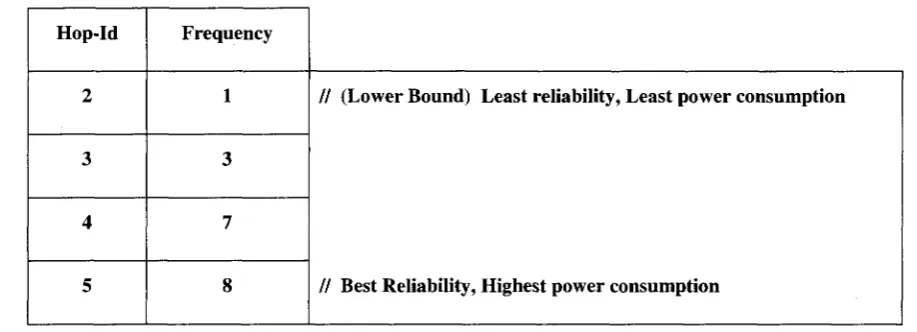
Table 1: FZ-depth table 45
Table 2: FZIP Init-msg pseudo code 47
Table 3: FZIP Ack-msg Pseudo Code 48
Table 4: Decision making algorithm pseudo code 56
Table 5: FZCP Resize-msg Pseudo Code 58
Table 6: Used wireless module configuration 63
Table 7: Average packet loss, average power, and average latency simulation results... 83
Table 8: Comparison of VD+FZIP-II and VD+FZIP+FZCP simulation results 83
LIST OF FIGURES
Figure 1: A distributed system of an infrastructure mode wireless network. 13
Figure 2: Example of an infrastructure-less wireless network 14
Figure 3: Ad hoc network diagram showing topology changes as nodes are moving 15
Figure 4: Wireless sensor hardware and network architecture 19
Figure 5: RTP protocol divided into RTP data transmission & RTCP control protocol.. 22
Figure 6: RTP header format [SCFJ03] 22
Figure 7: Directed flooding showing different computed virtual apertures 29
Figure 8: Video Diffusion 32
Figure 9: 100 node Grid multi-hop network 38
Figure 10: a 36 node Gird topology WSN... 41
Figure 11: FZIP Packet Header Format (Init-Msg and Ack-msg) 43
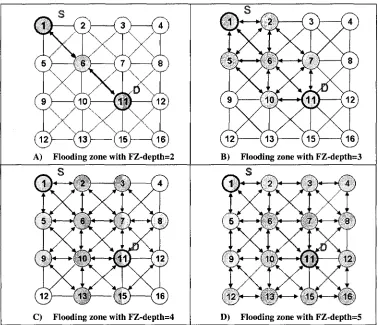
Figure 12: FZ with different FZ-depth values 46
Figure 13: Init-msg flow .. .49
Figure 14: Ack-msg flow 49
Figure 15: Initialized FZ 49
Figure 16: FZCP Packet Header Format 57
Figure 17: 100 node flat grid topology 68
Figure 18: Average packet loss rate versus number of hops 69
Figure 19: Average energy spending versus number of hops 70
Figure 20: A 20 x 20 flat grid topology 73
Figure 21: Average packet loss rate as a function of Channel Error Rate 74
Figure 22: Average Energy consumption 76
Figure 23: Average packet delivery latency by the simulated protocols 77
Figure 24: A 100 node flat grid topology 81
Figure 25: Fraction of packet loss % versus time intervals (seconds) 84
Figure 26: A 100 node flat grid topology 86
Figure 27: Average fraction of packet loss at every 1 second time intervals 88
Figure 28 : Average fraction of packet loss for VD+FZIP+FZCP 90
1. INTRODUCTION
Wireless Sensor Network (WSNs), are emerging technologies and have been
receiving a large attention in the last decade. A typical wireless sensor network consists
of large number of small size, low cost, power scarce, and self-organizing sensor nodes
which are often densely deployed in the area to be monitored [ASSC02][RSZ04]
[SACL03]. Habitat monitoring, fire and earth quack detection are only some WSNs
applications. However, the extremely constrained resources of sensors, non-rechargeable
batteries, and the large scale deployment have influenced the researchers to seek several
scalable and energy efficient data communication protocols.
More recently, advances in miniaturizing multimedia hardware (e.g. tiny CMOS
cameras and microphones), have encouraged the integration of sensors nodes with
multimedia capabilities [MRX08] [AMC07]. These advances have enabled new
multimedia WSN's applications such as traffic control, health monitoring, and security
surveillance for military battlefield. However, in order for these envisioned applications
to be successful, multimedia WSNs necessitate efficient and scalable real-time
multimedia protocols in terms of timeliness, reliability, as well as power efficiency.
This chapter gives a brief overview of real-time multimedia applications general
requirements. In more details, it highlights the challenges and requirements in providing
efficient real-time multimedia delivery over multi-hop WSNs. Then, we present our
research statement and the proposed solution. Finally, thesis organization is presented.
1.1 Real-time Multimedia Applications Requirements
Real-time multimedia applications involve transporting audio/video digital data
which are massive in size and require high transmission bandwidth. A typical multimedia
session includes the transmission of continuous, enormous size, and great number of
audio/video packets to a receiving application. In addition, real-time multimedia
from elastic application requirements such as Web, e-mail, or FTP, where long delay is
annoying but not principally harmful while packet-loss free delivery is of critical
importance.
Timeliness consideration is critical for delay sensitive real-time applications as
packets incurring a delay more than few hundred milliseconds are useless for some
applications. For example, an interactive voice over IP conversation can tolerate up to
400 ms delay [KR03]. Any additional latency will result in users complaining about the
quality. On the other hand, real-time multimedia applications are loss-tolerant. That is to
say, infrequent loss produces only insignificant glitches while playing the incoming
audio/video flow. In addition, these losses can be corrected, partially or fully, by some
loss anticipation mechanisms such as Forward Error Correction (FEC) or interleaving
[KR03]. However, there is a limit of packet loss which can be tolerated by the
application. In summary, for preserving good audio and video quality, a real-time
multimedia protocol should provide a service such that delay is minimal and packet loss
is not very large.
1.2 Challenges of real-time multimedia delivery in WSNs
These special characteristics and constrains of real-time multimedia bring
challenges and new Quality of Service (QoS) requirements to the wired network (e.g.
Internet). Several network software, architectures, algorithms, and protocols have been
proposed to overcome this problem. However, when it comes to WSNs, providing a
similar service for multimedia applications is more challenging. In a wired network,
wired links have high and steady bandwidth rate. Packet losses due to transmission errors
are rare and often negligible. The main source of packet loss in wired networks, which
degrades the quality of a multimedia session, is router congestion. A congested router
imposes significant queuing delay on outgoing packets which increases delay and jitter1
(delay variation). In addition, if the congested router's buffer gets full, arriving packets
are dropped and not delivered to the receiving application. This fact has drawn the
attention of researchers to solve the problem of real-time multimedia, especially in wired
network, by solving the congestion problem. Two new main approaches are proposed:
Differentiated Service (DiffServ) and Integrated Services (IntServ) [KR03].
However, the problem of transporting real-time multimedia streaming in WSNs is
more challenging. The harsh and error prone nature of a wireless network links incur
severe transmission errors and fluctuating bandwidth rates. The quality of the wireless
link in sensor networks is highly variable and unpredictable. The degradation of audio/
video quality can be caused not only by late delivery due to congestion, but also by actual
packet loss over unreliable wireless links before reaching the final destination.
Furthermore, sensor nodes include limited and often irreplaceable power sources. Thus,
an efficient real-time multimedia session mandates optimized energy spending to prolong
overall network life time. In the following subsections, real-time multimedia
communication challenges from the prospective of WSNs are discussed in more details.
1.2.1 Timeliness Requirement (End-To-End Delay)
Different than elastic applications, multimedia applications are delay-sensitive
and require stringent end-to-end latency. Thus, each packet has to reach the destination
within the specified deadline, after which it becomes useless (i.e. considered lost). As
many applications in WSNs need to be deployed in rural areas (e.g. fire detection, border
surveillance), WSNs are envisioned to support remote user monitoring by linking the sink
node to the Internet [ASSC02]. In such situation, the real-time multimedia application
requires further strict latency which spans the WSN network topology as well as the
Internet. The main sources of delay for real-time multimedia transportation in WSNs are
summarized in the following points:
Congestion
Multimedia traffic is massive in size and requires high bandwidth while sensor
nodes are scarce in memory and bandwidth resources. Sensor nodes which are located
and thus can easily get congested. Congestion causes late packet delivery due to queuing
delay or entire packet loss when routing buffer is full [KR03].
A solution to this problem is the use of Quality of Service (QoS) aware routing
protocol [SKK08] [WL06]. QoS aware routing can distinguish between different traffic
priorities and thus can provide better service for high priority traffic. QoS is a complex
task and requires efficient scheduling policies with resource limited sensor nodes.
Furthermore, the shared wireless link and the density of sensor nodes within a particular
area make the quality and the bandwidth rate of the wireless link unpredictable. Thus,
QoS mechanisms can't honor a guaranteed service.
Routing
Multi-hop wireless networks, in general, have self-organizing capabilities where
each node works as a sensor and a router. Multi-hop wireless networks topology is
dynamic and mandate frequent routing links update and new path exploration processes.
A link between two neighboring nodes could be down due to node failure (i.e. jamming
or running out of power), interference, or node movement. Moreover, new nodes can be
deployed frequently to replace nodes which run out of power[ASSC02]. Therefore,
wireless nodes execute distributed routing algorithms to discover routing paths
continuously. Transferring data between nodes over multi-hops wireless networks has a
store and forward nature, which adds extra processing and queuing delay as the number
of hops of the path is increased. A typical flat WSN deployment consists of thousands of
sensor nodes. Transmission over the shortest path (i.e. least number of hops between
source and destination) is desirable not only because it reduces latency but also it reduces
total energy depletion. Nevertheless, in the sense of timeliness that is not true always. For
example, when a forwarding node becomes congested due to serving many sessions,
end-to-end delay may vary and there would be no guarantee of timely delivery. In such case, a
relatively longer but less busy path can deliver packets faster than the shortest path.
Detecting such case in a self-organizing and dynamic nature of WSNs is complex and the
Another important source of delay in multi-hop wireless networks is the
miss-interpretation of temporary fault transmission as a route failure. Wireless transmission
can fail due to several factors such as interference, collision, or hidden terminal problem
[EE06]. A temporary transmission failure due to interference can be miss-interpreted by
the routing protocol as a path failure [ZH06]. In such case, the routing protocol blocks
transmission, starts a path exploration process to find a new route, then enables
transmission again. Such long process increases delay which can lead to packet loss due
to late arrival. In addition, the energy consumption overhead of such process is high.
1.2.2 Reliability Requirement (Packet Loss ratio)
Multimedia applications can tolerate packet losses up to a certain level [KR03].
Hence, they come under the category of soft real-time multimedia applications. In that
sense, reliability for a real-time multimedia protocol in WSNs doesn't mandate or
guarantee a 100% packet delivery ratio. Reliability, in this thesis, is argued as the
protocol ability to provide adequate level of packet delivery ratio required by the
application at the destination node. That is to say, a reliable multimedia protocol doesn't
necessitate receiving all packets, rather it has to receive certain amount of multimedia
data required by the application.
Packet loss in wired networks is caused mainly by congested routers which
discard packets when the routing buffer gets full, thus the packet never arrives at the
receiving node. Packet loss due to transmission error is rare and uncommon in wired
network links. In contrast to wired links, a wireless link usually has high transmission
error rate caused by shadowing, fading, path loss, interference from other transmitting
nodes, or hidden terminal problem". An end-to-end path in WSNs has an even higher
error rate since it is the concatenation of multiple wireless links. The error rate grows
exponentially as the number of hops between source and destination increases [WCK02].
To better explain this problem, assume that e is the error probability a packet gets during
transmission, then the chances of the packet to be delivered to next hop without errors
is (1 — e). Clearly, the chance of successful delivery for n hops distance will decrease to
(1 — e )n . This problem necessitated the use of different reliability mechanisms at the
MAC and the Network Layers (e.g. ARQ and CTS/RTS/ACK) [SH03]. These methods
depend on negotiating before transmission and acknowledgment of reception and the
process can be repeated several times before giving up. Although these reliability
methods reduce the chance of packet loss caused by transmission errors, it can be too
expensive in terms of latency for real-time multimedia especially in large WSNs
deployments (i.e. packet loss due to late arrival).
Some researchers have proposed redundant transmission to provide reliability. By
transmitting the same packet more than one time repeatedly, a packet has more chance to
arrive error free at the destination [DBN03]. In such situations, ARQ and other reliability
mechanisms can be avoided. However, the disadvantage in such approach is the increased
delay and bandwidth requirements and thus might not be practical for real-time
multimedia delivery.
1.2.3 Power efficiency Requirement
As sensor nodes have limited power supply which often can't be recharged,
power efficiency is a major requirement when designing a communication protocol for
WSNs. Since multimedia applications include transmission of huge number of packets,
sensor nodes can get drained out of power quickly, thus interrupting the communication.
In addition, as the reduction in processor size and cost has outpaced that of a battery,
energy constraint is a dominant factor for system design choices in WSNs.
The goal of a power efficient communication protocol is to extend the lifetime of
the deployed WSN. This can be achieved by optimizing wireless communication (i.e.
reducing the number of wireless transmission to save power) and load balancing traffic
among all nodes as possible.
It is important to realize that wireless communication subsystem of a sensor node
consumes relatively more energy than other subsystems (e.g. sensing, data processing).
as much as possible. The example illustrated in [PKOO] effectively exemplifies this
disparity where the energy required to transmit 1 KB over a distance of 100 meters is
comparable to the energy required to execute 3 million instructions by a 100 (MIPS)
processor. Hence, local data processing before relaying data packets to next hop is an
effective way to minimizing power consumption in WSNs [ASSC02]. For example, in a
fire detection WSN application, when an intermediate node receives multiple temperature
reading data packets, it will be more power efficient to relay a single data packet
containing the average temperature instead of relaying each data packet individually. In
addition, load balancing communication among the different nodes extends the overall
lifetime of the WSNs. That is to say, unbalanced utilization in WSNs segments the
network into isolated islands of sensor nodes.
1.3 Problem Description and Proposed Solution
The success of real-time multimedia applications in WSNs necessitates low
packet loss and lower power consumption. In a wired network, a real-time multimedia
session can experience bad quality (i.e. high packet loss rate) because of congestion.
However, packet loss, as discussed in the previous section, is more often in WSNs and
occurs due to diverse reasons other than congestion. That is to say, packet loss can be due
to:
• Wireless channel characteristics including shadowing, collision, fading, interference,
channel contention, and hidden terminal problem.
• Dynamic nature of WSN topology, which leads to routing path failure caused by
node mobility or node power failure. This results in interruption imposed by new
path exploration and recovery processes.
• Congestion due to sensor nodes' limited routing queue and massive multimedia data
size.
• Wireless sensors' limited bandwidth and resources.
An intuitive way of solving the packet loss problem in WSNs is the use of
flooding protocol [ASSC02, AK04]. In flooding, several copies of the same packet are
a packet is lost for any reason (e.g. congestion, fading, interference, e t c . ) , another copy
or copies will have the chance to reach the destination in time over different path(s).
However, flooding has two major drawbacks when used for real-time multimedia data in
WSNs. First, flooding of multimedia packets over all nodes consumes huge amount of
power which causes sensor nodes (which are limited in power) to drain out of power
quickly. Moreover, while flooding works fine for classical data sensors (e.g. temperature
reading) which are small in size and intermitted (i.e. send data periodically and non
continuous), the participation of all nodes in flooding continuous multimedia data can
lead to severe broadcast collision and channel contention which degrades overall
reliability and scalability.
To solve the problem of huge power consumption and reduce packet collision of
flooding real-time multimedia packets to the whole WSN, we introduce the flooding zone
concept. Instead of flooding over all network nodes, the flooding-storm can be
constrained by initializing a small set of interconnected nodes between source and
destination called "flooding Zone". The initialized flooding zone acts as a subset which
constrains the flooding-storm propagation inside it. As a result, flooding can achieve not
only reduced power consumption but also reduced packet loss rate in comparison with
overall flooding. Consequently, we propose the Flooding Zone Initialization Protocol
(FZIP) [EE08]. FZIP is developed to enable reliable and power efficient real-time
multimedia flooding in a WSN environment. FZIP can be used by multimedia flooding
protocols (e.g. Video diffusion) to initialize a suitable Flooding Zone (FZ) before starting
flooding real-time multimedia data. Only initialized nodes (i.e. FZ members) participate
in the multimedia data flooding. The selection of the flooding zone members has a direct
impact on the flooding performance (i.e. packet loss rate, power consumption, and delay).
Thus, the flooding zone size is estimated by a customizable mechanism that provides a
tradeoff of reliability, timeliness, and energy efficiency.
Because WSNs is highly dynamic and the network state may change over time,
having a fixed FZ initialized by FZIP will not provide the same level of service during
the whole real-time multimedia session lifetime. To optimize power spending and ensure
during the session. Thus, the Flooding Zone Control Protocol (FZCP) is proposed. FZCP
monitors the multimedia delivery quality at the sink node and dynamically changes the
FZ size when deteriorated performance is encountered. Monitoring the incoming
multimedia data helps to detect undesirable performance issues as they happen before
taking a corrective action including computing and reinitializing a new FZ. For example,
if packet loss is high and quality is bad, FZCP increases the FZ size to reduce packet loss
and improve quality. However, if packet loss is minimal and quality is very good, FZCP
reduces the FZ size to reduce power consumption while delivering good quality. In this
way, the flooding zone size, during the lifetime of the multimedia session, is no longer
fixed and can flexibly change over time according to current network conditions.
Using FZIP and FZCP with flooding, delivery of real-time multimedia becomes
responsive to dynamically changing network conditions allowing reliable delivery even
over WSNs with harsh network conditions and high transmission error rates.
1.4 Objectives, Contributions, and Significance
The main objective of this thesis is to enable reliable and energy efficient
real-time mulreal-timedia delivery for wireless sensor networks. To the best of our knowledge, our
work is different than other by studying the problem of reliable real-time multimedia
delivery in WSNs at the different network layers (i.e. physical, data link, and network).
That is to say, most of the previous work consider the congestion problem, as the main
source of quality deterioration, and neglect many other important aspects encountered in
the real world implementation. Wireless sensors are implanted in the real world and get
affected by the dynamically changing physical environment in which they reside. We
believe that without making real-time multimedia communication protocols resilient to
rapidly changing and harsh wireless networks operating conditions, the implementation
of wireless multimedia sensor network technology may be jeopardized.
To achieve this objective, this thesis makes the following contributions:
• We introduce and propose the novel concept of Flooding Zone which makes
discussion of the impact of flooding zone size on the flooding performance are
presented.
• FZIP protocol, a distributed algorithm protocol which can help multimedia flooding
protocols to initialize a suitable flooding zone. FZIP is simple, light, hardware
independent, easy to customize, and MAC and Network layer independent. These
features conform to sensors limitations and facilitate straightforward integration into
diverse WSNs architecture and applications.
• FZCP protocol, a complimentary protocol which monitors the multimedia delivery
and changes the FZ size to dynamically adapt to current network conditions, thus
maintaining good level of quality and reduce power consumption.
• FZIP and FZCP have been implemented and validated in the Network Simulator
(NS-2) [NS2].
Several flooding-based protocols [FM06] [ROG04] [M04] have been proposed as
a mean of reliable delivery for simple applications in WSNs (e.g. fire detection,
temperature reading). However, there has been little or no work on using flooding for
multimedia delivery in WSNs because of the associated high power consumption and
severe broadcast collisions caused by flooding. However, the introduced FZ concept
along with the proposed FZIP [EE08] and FZCP protocols enable resilient, reliable, and
power efficient real-time multimedia data delivery in WSNs. Constraining the broadcast
storm within a small and carefully selected set of nodes helps reduce power consumption
and collision significantly in comparison with normal open flooding. Moreover,
monitoring the flooding performance and adapting to the current network state provides
soft quality of service assurance for transporting mission critical real-time multimedia
data under wide range and highly changing wireless sensor networks conditions.
1.5 Thesis Organization
The thesis is organized as follows. Chapter 2 provides literature review and
background about wireless networks architecture and requirements. We review ad hoc
networks in general and wireless sensor networks more specifically. We also review the
chapter 3, several related works are reviewed and compared to our proposed protocols.
Chapter 4 starts with an explanation and an analysis of the flooding problem and our
motivation of the Flooding Zone concept. Then, it describes our proposed FZIP and
FZCP solution protocols in details. Chapter 5 describes our simulation topology,
experimental scenarios, and the gathered results. Chapter 6 concludes the thesis and gives
some future works. Appendix A is for the abbreviations.
1.6 Summary
As the need to optimize power expenditure has driven most of the research in
wireless sensor networks so far, very little work has been done in the context of real time
multimedia applications. Moreover, while congestion avoidance protocols are effective
solutions in wired networks, most of these work need to be rethought in the prospective
of WSNs limitations. Mechanisms to efficiently deliver application-level QoS under
dynamic and high error prone WSNs, and to map these requirements to metrics (most
notably reliability, power consumption, and latency) have not been the primary concern
in the majority of research on WSNs. The success of efficient real-time multimedia
protocols in WSNs mandates mechanisms to balance between reliability (tolerable
packet-loss rate), and power efficiency to preserve acceptable performance. Moreover,
the communication protocol should be responsive to dynamically changing wireless
network conditions. A real-time multimedia protocol which is not adaptive to network
conditions and does not have a notion of performance awareness would either be
2. LITRETURE REVIEW
This chapter starts with a brief, but important, overview of wireless networks
architecture highlighting the difference between infrastructure mode and ad hoc mode. A
closer look at ad hoc networks is followed with a brief discussion of their types,
applications, and challenges. Next, an overview of Wireless Sensor Networks (WSNs) is
presented, discussing their hardware architecture, applications, and limitations.
2.1 Wireless Networks
The recent advances in producing low cost and robust wireless communication
technologies accelerated the widespread deployment of wireless communication enabled
devices such as laptops, gaming devices, and PDAs. Owing to their "anytime anywhere"
capabilities, wireless communication is one of the most promising developments in
computer networking. It is expected, in the near future, that wireless devices will be
embedded in automobiles, pets, kitchen appliances, cameras, and buildings enabling new
type of applications and playing an essential part of human's lives [KR03] [ASC01]. In
what follows, different wireless network architectures are discussed.
The architecture of wireless networking can be classified into two categories:
infrastructure mode and infrastructure-less mode. The main difference which
distinguishes the former from the later is the presence of special nodes, called Access
Points (APs), which need to be installed and configured.
2.1.1 Infrastructure mode
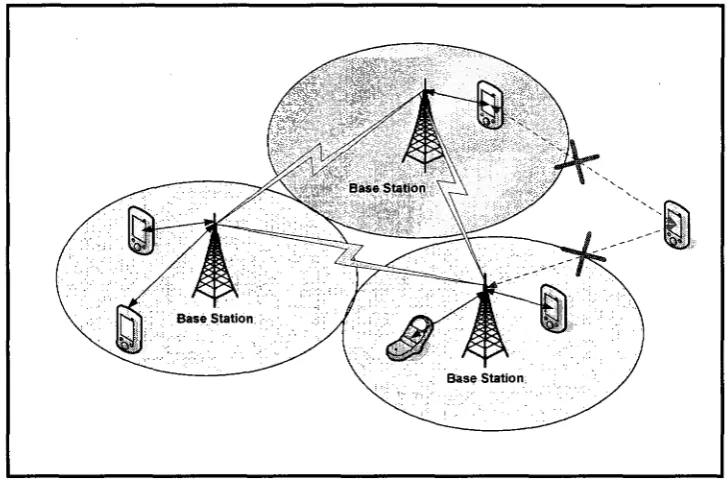
In an infrastructure mode wireless network such as a Wireless Local Area
Network (WLAN), the wireless network consists of one or more mobile clients directly
connected to a Centralized Base Station (BS)AAccess Point (AP) over wireless links
[KR03]. Mobile clients of such networks have no direct connection with each other, but
rather, all wireless communication must always pass through the central AP. This
or the base station can be wired to an ISP to provide network clients with access to the
internet. In addition, it is possible to have multiple APs connected together, with or
without wires, to form a distributed system (DS). A wireless distributed system is used to
overcome the limited wireless communication ranges. It also enables the mobile clients to
move to various places (e.g. meeting rooms, classrooms, cafeterias, etc..) without losing
access to the network services.
Figure 1: A distributed system of an infrastructure mode wireless network.
In an infrastructure mode wireless network, the APs and all the clients must be
configured to use the same network name known as Service Set Identifier (SSID)
[KR03]. Due to its centralized topology; infrastructure mode wireless network has the
advantage of scalability, centralized security and robustness in comparison to
infrastructure-less mode wireless networks, as will be explained in the following
2.1.2 Infrastructure-less mode (Ad hoc mode)
Recently, and in contrast to this traditional infrastructure mode communication
paradigm, infrastructure-less multi-hop wireless networks are receiving a lot of attention.
Due to their infrastructure-less nature, such networks demonstrate the advantage of a
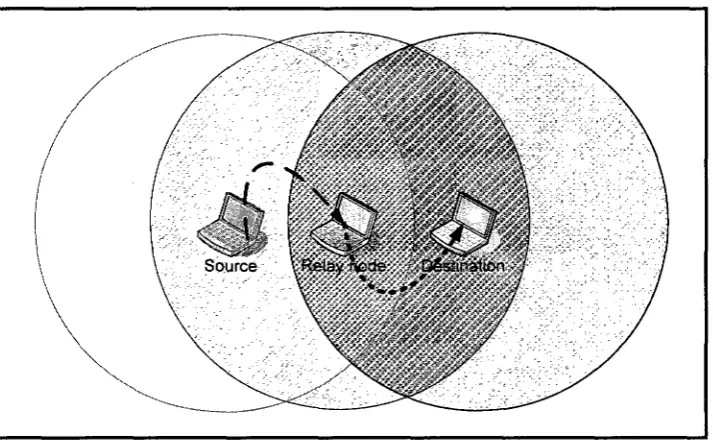
quick and cost-effective deployment. In an infrastructure-less wireless network, e.g.
MANET [FJLOO], wireless mesh networks [AX05], and wireless sensor networks
[ASSC02], wireless communication involves multiple wireless nodes which relay data in
a hop-by-hop fashion from a source node to a destination node [FJLOO]. Multi-hop
wireless networks are infrastructure-less, self-organizing, and self-healing networks. It
facilitates new type of applications where network can be set up on the fly and doesn't
require costly and timely consuming configuration and installation.
Figure 2: Example of an infrastructure-less wireless network
Some research studies and projects in this field are dealing with issues concerning
wireless multi-hop communications such as: routing [RFC3561][MZP01], mobility
support, resource management, media access control, Quality of Service (QoS) [WL06]
2.2 Ad hoc Networks
An ad hoc network is an independent collection of communication devices
(nodes), possibly mobile, communicating with each other over a shared, bandwidth
constrained, and unfixed wireless links. The decentralized nature of ad hoc networks and
node mobility may change the network topology rapidly and unpredictably any time
[FLJOO]. In ad hoc networks, nodes may not have direct connection to each other, thus
nodes should be able to route/relay packets on behalf of other nodes across the network.
Therefore, ad hoc nodes incorporate routing functionalities and perform network activity
such as discovering the topology and delivering other nodes messages. This makes ad hoc
networks different than structured wired networks, in which dedicated and pre-configured
routers perform this task. This multi-hop communication is also in contrast to
infrastructure mode wireless networks where communication of all clients is managed
through a dedicated and previously setup AP.
s
° •—-*•
\
A
• D
(a)
s
• . ' ?
s< --"-»*
•A
•
D
(b)
Figure 3: Ad hoc network diagram showing topology changes as nodes are moving.
In Figure 3-a, the source node (S) is sending data to destination node (D). As the
nodes are moving, a different path is established for communication between (S) and (D)
dynamically (See Figure 3-b).
The earliest wireless ad hoc network "packet radio" (PRNET) based on ALOHA
net was first implemented in the 1970s [FJLOO]. Although ad hoc networks are not new,
it became a hot research area only in the last decade. The availability of cheap devices
with wireless communication capabilities (e.g. PDAs, Laptops, MP3 players) motivated
new type of applications benefiting from ad hoc networks "anywhere and anytime
communication" availability.
The unstructured wireless links of ad hoc networks is useful for many application
areas such as military, disaster rescuing operations, and public-safety. For example,
rescue teams require fast and effective communications when they rush to a rural disaster
area to rescue victims. In such cases, it is time consuming to run cabling and setup
networking hardware. The rescue team members can utilize their laptops, smart
protection helmets equipped with wireless cameras, and PDAs to enable wireless data
communications on the fly as soon as they reach the disaster scene.
Based on their mobility support, wireless ad hoc networks are divided into two
main categories: quasi-static [IPK05] and MANET [RR02].
2.2.1 Quasi-static ad hoc networks
A static/quasi-static ad hoc network consists of static (non-mobile) nodes. This
static nature makes routing protocols simpler. However, due to power failure, temporary
device jamming, and link instability, the network topology may frequently change.
2.2.2 Mobile Ad hoc Networks (MANETs)
In Mobile Ad hoc Networks (MANETs) [LonOl], all nodes may be mobile and
thus the network topology is expected to be frequently changing. Coping with rapid
topology changes, efficiency is one of the main challenges in MANET.
The challenges associated with ad hoc networking cover the entire layer model of
the standard protocol stack. Efficient Media Access Control (MAC) layer protocols need
to minimize collisions while providing fair access. It is also important for the MAC layer
shared wireless link (e.g. CTS/RTS/ACK). In the network layer, the routing protocol
needs to discover a routing path based on application requirements such as expected
packet loss rate, time, and energy consumption. It also mandates self-organizing and
auto-configuration capabilities to smoothly operate in dynamic and changing network
topology. Finally, users' applications need to handle link disconnection possibilities with
varying delay and packet loss characteristics [RR02].
2.3 Wireless Sensor Networks (WSNs)
The technological advances in manufacturing Micro Electro-Mechanical Systems
(MEMS) and wireless communications have enabled the production of small size and low
cost wireless sensor devices [AMC07]. A typical sensor device combines a limited
processing unit, few kilobytes of memory, and a wireless communication component
operated by a limited and often irreplaceable battery. These devices have the potential of
sensing specific phenomena within its vicinity (e.g. temperature, motion, light, etc..) and
send the gathered information wirelessly to a base station (sink) over a multi-hop with
store-and-forward fashion topology. The formation and collaboration of many
autonomous sensor nodes is known as Wireless Sensor Network (WSNs). A WSN
typically consists of a large number of sensor nodes often deployed densely and
randomly in the area to be monitored and thus requires self-organizing capabilities in
order to effectively collaborate in an ad hoc manner. In general, the majority of the
wireless sensor networks architectures consider stationary (non-mobile) sensor nodes.
While WSNs with mobile sink nodes and cluster heads seems to be important for power
efficiency [AMC07] [CMY06], little work consider architectures with mobile sensor
nodes.
2.3.1 Applications of WSNs
The early motivations behind the development of WSNs were military
applications such as battlefield monitoring systems. However, the previously described
functionalities and capabilities of WSNs extended their usage to a wide range of other
environmental application areas, including natural disaster detection, habitat monitoring,
industrial purposes, healthcare applications, home automation, traffic monitoring control
on the highways and railways, etc... [AMC07, ASSC02]
For example, in a fire detection WSN application, thousands of low cost sensor
nodes are deployed densely and randomly, possibly by a helicopter, in the forest. These
sensors are configured to periodically report temperature readings to one or more base
stations. The base stations, also known as sinks, are more powerful computers which can
be connected to the internet through a communication gateway allowing remote
application monitoring and management. In healthcare applications, physiological data of
patients can be reported to a remote health center allowing doctors to better understand
their patient's conditions in a more convenient way [ASSC02]. Early disaster detection
application such as "Tsunami"4 can save thousands of human lives. In summary, WSNs
can enable better understanding of the environment and is envisioned to be an essential
part of people's lives in the near future.
2.3.2 WSNs Architecture
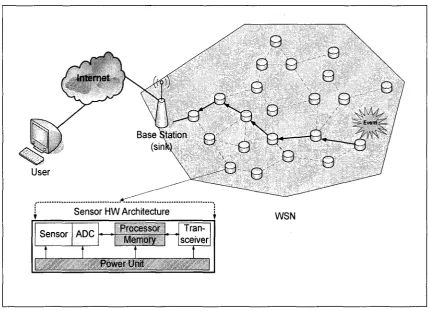
Looking inside typical sensor node hardware, we find it consists of four
components as shown in Figure 4: a sensing unit, a processing unit, a communication unit
and a power source unit [ASSC02]. The sensing unit captures the analog signal observed
from the phenomenon then changes it, using an analog to digital converter (ADC), to a
digital signal before feeding it to the processing unit. The processing unit, which consists
of a small microprocessor and memory, apply required computation before transporting
the produced data via the communication unit. Consecutively, the communication unit
transports the data coming from its processor by transmitting it on the wireless link.
Finally, the power unit, which is often small and 'un-rechargeable' battery, supplies the
above mentioned units with required power to operate. A sensor may also have additional
application specific components such as a Global Positioning System (GPS) or a
mobilization component [ASSC02]. Nevertheless, it is argued in [SHS01] that supplying
all sensor nodes with GPS hardware is not practicable for sensor networks due to
production cost and energy consumption issues.
A typical WSN consists of many sensor nodes and one or more base station nodes
(sink). The sink nodes are more powerful nodes with less power concerns. Sensor nodes
are scattered in a sensor field as illustrated in Figure 4. Each wireless sensor node senses
the area around it and route collected data in a hop-by-hop infrastructure-less fashion to
reach the sink. The sink can be linked to the Internet to route the data to the end user.
Figure 4: Wireless sensor hardware and network architecture
2.3.3 Characteristics and limitations of WSNs
A wireless sensor network shares many similarities with an ad hoc network and is
commonly considered a member of the mobile ad hoc network family. Nevertheless,
hoc networking. The large and densely deployment of sensor network along with the
extreme limitation in power and processing capabilities prevent direct applying of ad hoc
network protocols and algorithms to sensor networks. To emphasize this fact, the
differences between WSNs and ad hoc networks are briefly outlined and discussed below
as follows.
2.3.3.1 Network size and density
A WSN application generally requires large number of sensor nodes deployed
densely in the area to be monitored. The number of sensor nodes deployed in a WSN
(e.g. fire detection application) can be a number of orders of magnitude higher than the
number of nodes in an ad hoc network [HHS08]. The number of sensor nodes deployed
in fire detection application, for example, may include hundreds or thousands of sensors.
Moreover, because sensor nodes are prone to failure, sensors are densely deployed in the
region to be monitored. The required communication protocol, data dissemination
framework, or routing algorithm in such scenarios must be scalable in a way to support
applications with large number of nodes. They must also efficiently utilize the high
density nature of the sensor networks.
2.3.3.2 Frequently changing multi-hop wireless topology
A sensor node communicates with a base station (sink) over several unstructured
multi-hops pattern. A sensor node, in such ad hoc topology, acts as a sensor and a router
sending its own data as well as relaying data received from neighbors in a hop-by-hop
store and forward paradigm. A typical WSN network topology is frequently changing
even with static sensor nodes (i.e. non-mobile nodes). The large numbers of error prone,
inaccessible, unattended, and possibly mobile sensor nodes, make the multi-hop network
topology frequently changing. In addition, sensor device failure is a common incident due
to energy depletion or jamming. Moreover, additional sensors might be redeployed in
some areas over time to replace sensors which ran out of power. Therefore, having a
fixed topology in WSNs is an impracticable task for large scale deployment. Handling
frequent topology changes in WSNs that have large number of nodes and limited power
supply requires special networking protocols compared to ad hoc networks with lower
In addition, sensor nodes may not have unique addressing identifiers because of
the large amount of overhead for the large number of deployed sensors which makes
id-based routing approaches unsuitable. Rather, sensor nodes use broadcast communications
mainly instead of point-to-point communications used in ad hoc networks.
Data centric routing which depends on routing packets based on data they have
rather than node id are unique and promising data dissemination paradigms in WSNs
(e.g. Directed Diffusion [IGEOO]).
2.3.3.3 Extreme limitation in power, processing capabilities, and memory
One of the most important differences and limitations between ad hoc and WSNs
is the low power consumption requirement. While wireless nodes in ad hoc network (e.g.
PDA, laptop) carry limited power source which can be recharged, sensor nodes carry
extremely limited and generally irreplaceable power batteries. For this important reason,
sensor network protocols can't neglect power conservation for achieving high quality of
service (QoS). They must be capable of providing flexible trade-off mechanisms that
enable power saving options at the cost of lower quality (e.g. throughput, reliability or
transmission delay). In addition, the limited processing capabilities and small size
memory can't execute complex algorithms or cache huge size of associated data.
Therefore, the development of communication protocols for sensor networks are
influenced by the limited power supply and resource capabilities of sensors.
2.4 Multimedia Real Time Protocol (RTP)
RTP is an application layer protocol [SCFJ03], which is widely used for
transporting real-time multimedia data over the Internet. RTP provides several functions
for end-to-end network transportation of real-time multimedia data (e.g. audio and video)
and supports multicast and unicast network communications. The most important
functionalities supported by RTP are: payload type identification, sequence numbering,
time-stamping, and data transmission QoS monitoring.
RTP is independent of the underlying transport and network layers and does not
real-time mulreal-timedia transportation over the Internet. In addition, RTP is integrated into the
application processing and can be tailored as needed through headers modifications and
additions [SCFJ03].
Data Transmission SR RR SDES BYE APP
Figure 5: RTP protocol divided into RTP data transmission and RTCP control protocol.
RTP consists of two collaborating protocols: (1) RTP for real-time data
transportation and (2) Real-time Control Protocol (RTCP) for controlling the session.
RTP data transfer protocol assists in sequencing, payload identification, and play back of
media.
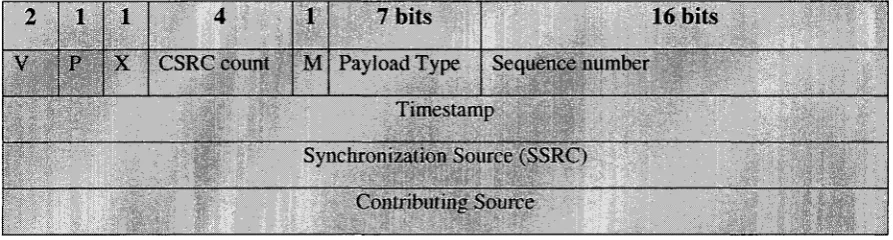
Each RTP data packet contains a header and a payload data. Figure 6 shows the
standard RTP header format and the important fields are explained below:
•>
V ; 1
i
l
X
4
CSRC count
1
M
7 bits
Payload Type
16 bits
Sequence number
Timeslamp
Synchronization Source (SSRC)
Contributing £ lource
Version (V): identifies the used version of RTP protocol.
Marker (M): marks the important events in the packet stream.
Payload type (PT): identifies the format of RTP.
Sequence number: an initial random number generated by the source. It gets
incremented by one for each sent RTP data packet. The receivers can use these numbers
to calculate packet loss and repair received packet sequence.
Timestamp: represents the sampling instant of the first octet in RTP data packet.
SSRC: A unique random number which identifies the synchronization source (i.e.
camera or microphone).
The RTP data transport is improved by the RTCP control protocol. RTCP
provides QoS monitoring, bandwidth scaling, and source identification functionalities by
sending different type of control packets periodically to all the participants in the
real-time mulreal-timedia session. The main RTCP packet types are as follows:
• RR: Receiver Report packets are sent by receivers and contain statistical information
about the running multimedia session (e.g. fraction of packet loss).
• SR: Sender Report packets are the same as RR but sent by a member which is a
sender and a receiver in the session.
• SDES: Source description information (e.g. CNAME, e-mail, address, etc...)
• BYE: Used to indicate end of participation.
• APP: Application-specific functions.
Monitoring the QoS of the session
The most important RTCP packets are the SR and the RR packets. The packet
contains statistical information such as the fraction of packet loss, highest sequence
number received, jitter, and other information to compute round trip time delay. The SR
packet contains more statistics, i.e. timestamp, count of data packets, and number of
analyzing these SR and RR feedback packets between the session members. This allows
the data sender to adjust the transmission rate or change the data encoding according to
the current network state. In bad network condition states, reducing the transmission rate
can alleviate congestion and improve QoS.
Source Identification
As participants enter and leave the session without membership, the Source
DEScription (SDES) feedback packets allow keeping track of each participant in the
session. This allows synchronization of the received audio and video data. Each SDES
packet contains at least the canonical name (CNAME) and may contain other identity
information such as e-mail or telephone number [SCFJ03].
Bandwidth Scaling
RTCP is limited to use only 5% of the bandwidth for exchanging control packets
shared by all participants. The other 95% is used for RTP data transmission. However, to
provide scalable operation over a limited bandwidth, the RTCP transmission rate of
feedback packets should be controlled. For doing this, each participant keeps track of the
number of participants in the session independently to compute and to adjust its feedback
control transmission rate.
2.5 Summary
Although wireless communications is not a new technology, we are witnessing a
wide spread of wireless enabled devices around the globe. New type of applications
necessitates different type of wireless network architecture. In contrast to the stable and
widely deployed infrastructure mode architecture, ad hoc mode (e.g. MANET, WSN) is
attracting many researchers. However, it is important to realize the unique requirements
of WSNs for wide implementation in the near future. Limitations such as scalability, cost,
fault tolerance, topology changes, and low power consumption should be considered.
While many researchers are currently engaged in developing schemes that fulfill WSNs
requirements, less effort has been done for supporting real-time multimedia over WSNs.
to date for sensor networks and highlight the importance and the added functionality of
3. RELATED WORK
Despite the existence of several reliable and energy efficient dissemination
protocols for WSNs, to the best of our knowledge, none of these protocols address
reliable real-time multimedia communication support with strict delay bounds. For
example, in [WCK02], Wan et al proposed the Pump slowly Fetch Quickly (PSFQ)
protocol to allow reliable programming/ re-tasking sensors in WSNs (i.e. sink to sensor
nodes communication). The Reliable Multi Segment Transport protocol (RMST) [SH03]
can provide reliable sensor to sink conventional data transport service. However, most of
these routing protocols and data dissemination frameworks are targeting many-to-one
applications which are delay tolerant (e.g. fire detection, motion detection, e t c . ) . The
delay tolerance of these applications allows using data caching, aggregation, and
in-network processing techniques to provide hop-by-hop recovery and power efficiency.
The use of a data cache is required to buffer messages to ensure successful delivery. As
the application data are delay tolerant, recovery from packet loss can be achieved by
retransmitting the data packets repeatedly until successful reception. In addition, by
caching data packets at intermediate nodes, multiple packets can be aggregated together
to allow a single transmission to the next hop, thus reducing power consumption.
Furthermore, by processing multiple data packets coming from different sources (e.g. by
computing average or maximum of several temperature readings), the amount of data
flowing to the sink node is reduced, thus reducing power consumption.
However, real time multimedia applications often have different characteristics
and stringent latency requirements. Video segments are massively large in size and can't
be cached due to their strict play out schedule and extremely small sensor memory size. It
is also impractical to decode compressed video frames at intermediate nodes, combine
them with other frames from other sources, and then compress them again before sending
them to the next hop towards the destination sink. This is because of the complexity of
such coding technique, the limited processing and storage power of sensor nodes, and the
often exceeds the Maximum Transmission Unit (MTU), aggregation of multiple video
segments is inapplicable. Furthermore, a hundred percent packet loss free reliability is not
mandatory. Multimedia applications can tolerate some packet loss, thus successful
delivery of all packets is not required.
For all these reasons, we adopted a different approach in providing reliable
real-time mulreal-timedia delivery in WSNs. Using flooding techniques, reliability can be
achieved by concurrent and redundant data transmission and avoiding any delaying
mechanism to ensure successful and in time delivery. While this concept is not new (i.e.
flooding), this is the first attempt to use flooding for reliable and energy efficient
real-time mulreal-timedia delivery in WSNs. That is because flooding of real-real-time mulreal-timedia
over WSNs consumes large amount of power, while reducing quality because of
collisions and contention of the shared wireless channel.
In this thesis, we are not introducing a new flooding protocol. Rather, we are
introducing FZIP, a novel setup protocol which can constrain the multimedia flooding in
a small size flooding zone. In addition, the size of the flooding zone is controlled by
FZCP to balance between reliability, latency, and power consumption. The mechanism of
constraining and controlling the flooding storm provided by FZIP and FZCP enables
reliable and power efficient multimedia flooding over WSNs. In what follows, we
review some of the previous work and compare it with our proposed protocols.
3.1 Flooding
Flooding is an old technique used for data communication which doesn't mandate
previous knowledge of network topology or complex routing algorithm [AK04] [HL88].
When a node needs to send a data packet, it simply broadcasts it to all of its neighbors.
Each neighboring node in turn rebroadcasts the message to its neighbors, exactly one
time, until the packet is reached to the desired destination(s). In addition, flooding nodes
have to detect a duplicate received message which is essential to prevent broadcasting
messages between neighbors back and forth endlessly. To do this, flooding techniques
use one or more associated header fields (e.g. sequence numbers) to detect and eliminate
these duplicate messages.
Flooding (or Broadcasting) is an essential and common operation in
communication to resolve many issues (e.g. hello messages between neighbors, hosts
paging). Moreover, flooding in flat multi-hop wireless networks is widely used by routing
protocols during its setup phase in order to establish knowledge about the current
network topology. Flooding is simple because it doesn't require previous knowledge
about network topology and can work in situations where nodes lack to have ID
addresses (e.g. WSNs). In addition to its support of one-to-all (broadcast) or one-to-many
(multicast) data delivery communications, flooding is also used for one-to-one
communications benefiting from its robust and fault tolerant nature.
However, flooding has several disadvantages especially when used in multi-hop
wireless networks. Since radio signals of a node overlaps with other neighboring nodes
signals, it is likely to have serious redundancy, contention, and collision when simple
flooding technique is used. In [NTCS99], Sze-Yao Ni et al studied this phenomenon in
multi-hop wireless networks which they refer to it as the "broadcast storm problem".
Redundancy occur when a node receives a message several times, or more specifically
when a node tries to broadcast a message while all of its neighbors have received the
same message already. The possibility of having many neighboring nodes to rebroadcast
a message can severely content with each other and increases collision possibilities. This
problem has been studied extensively in the literature and many algorithms and broadcast
schedules were proposed to reduce the possibility of broadcast collisions (e.g. [CK85]
[LAB93] [CW85]). In [HKB99], Heinzelman et al stated similar problem of flooding in
WSNs and listed implosion, overlap, and power blindness problems.
In our FZIP proposed protocol, and in order to reduce the power inefficiency of
flooding, we constrain the flooding storm within a small area between source and
destination. Thus, we limited the flooding storm in a small area which minimizes the
problem scope significantly. The flooding zone also alleviates flooding contention and
collision problem by limiting flooding packets to the flooding zone members. In addition,
by monitoring data delivery rate at destination sink node, the number of nodes
3.2 Directed Flooding
Farivar et al [FM05] proposed "Directed Flooding" (DF), a fault tolerant and
energy efficient flooding based routing protocol for wireless sensor networks. The
functionality of this proposed protocol is built on a very important assumption in which
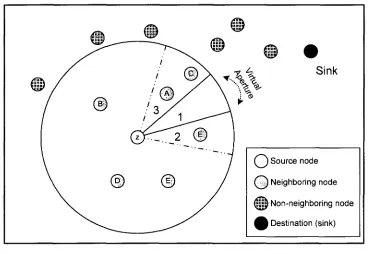
nodes are aware of their geographical location (i.e. x and y coordinates). When a node
decides to send a data packet it uses the x and y coordinates to compute a pie-shaped
space called "virtual aperture" and encapsulates this computed value with the data packet
(see Figure 7). Once the packet is broadcasted, each receiving node checks the computed
aperture. If the node's position is within the aperture, it sends an acknowledgment
message back to the sending node before repeating the same forwarding packet step (i.e.
computes a new "virtual aperture") until the destination node (sink) is reached.
Sink
( ^ ) Source node
£ 3 Neighboring node
y|f|> Non-neighboring node
^ f e Destination (sink)
Figure 7: Directed flooding showing different computed virtual apertures.
If the sending node did not receive an acknowledgment within a certain period of
time (i.e. when none of the neighboring nodes lie in the virtual aperture), the sending
node computes a new virtual aperture clockwise then counterclockwise and repeat the
It is important to emphasize the impact of the "virtual aperture" size on
communication efficiency. Computing a large aperture size increases the possible number
of nodes lying in it thus increases redundancy and successful packet delivery on the price
of more energy consumption. Finding an optimum or suboptimum virtual aperture is a
difficult task and depends on the network density. The protocol in [FM05] has not
provided any adaptive way for selecting suitable virtual aperture size. Moreover, the used
send and acknowledgement mechanism doesn't suit delay sensitive applications such as
real-time multimedia. A sending node might repeat the process of virtual aperture
computation several time until a neighboring node is reached. This communication
mechanism increases latency, jitter (delay variability), and may lead to packet loss due to
late arrival. It is clear that such communication mechanism doesn't provide support for
real-time multimedia applications. In addition, Directed Flooding may fail to bypass
network holes. A hole occurs when a node doesn't have a neighboring node closer to the
targeting region. In addition, the ability of the sensor node to have location awareness
requires GPS capabilities. Nevertheless, supplying all sensor nodes with GPS hardware
may not be feasible for sensor networks due to production cost and energy consumption
issues [SHS01].
In our proposed FZIP protocol we have used similar concept of constraining the
flooding process, within a limited area (i.e. FZ), but without the need to have
geographical node location awareness (i.e. expensive GPS capabilities). The FZ connects
the source and the sink over the shortest possible path/paths, as long as they are
reachable, thus bypassing any network holes. The flooding zone size is similar to the
virtual aperture in limiting nodes which will relay data packets redundantly. However, the
FZ size is computed and at the sink node during the FZIP initialization process, and can
be controlled (i.e. increased or decreased) by the FZCP protocol based on the current
performance and the network state. [FM05] did not provide any adaptive mechanism for
selecting suitable virtual aperture size. Moreover, FZIP and FZCP work in a real-time
multimedia session, while the Directed Flooding protocol is not suitable for real-time