An Energy Efficient Power Management in
Wireless Sensor Networks
Jeny Rajamma Thomas1, Mercy Mathew2
PG Student [CE], Dept. of ECE, BC CAARMEL Engineering College, Pathanamthitta, Kerala, India1
Assistant Professor, Dept. of ECE, BC CAARMEL Engineering College, Pathanamthitta, Kerala, India2
ABSTRACT: In this paper, we propose a Transmission Power Control(TPC) algorithm for power management,
energy-efficiency and delay- aware communication in wireless sensor network. Transmission Power Control Algorithm not only prolong the lifetime of sensor nodes by saving the energy consumption but enhance throughput and performance of packet delivery ratio. Apart from that, it can also reduce the interference between transmitting nodes. According to this algorithm, each node utilizes the RSSI (Received Signal Strength Indicator)value to determine the appropriate transmission power for its neighbors. Proposed algorithm can dynamically adjust the transmission power with the environment change. The experimental results show that our algorithm can save power energy, improve network lifetime, throughput and packet delivery ratio.It enables each node to determine and regulate its transmission strategy to provide minimum energy consumption without sacrificing end-to-end delay performance and also each node can select an optimal path for data transmission. It is implemented using Network Simulator-2.
KEYWORDS: Power Management, Transmission Power Control, RSSI, Throughput.
I.INTRODUCTION
Wireless Sensor Networks(WSN) consist of small sensing devices called nodes and consist of CPU(for data processing), memory(for data storage), battery(for energy) and transceiver(for receiving and sending signals or data from one node to another). Nodes in a WSN are deployed to sense physical or environmental conditions for a wide range of applications, such as environment monitoring, scientific observation , emergency detection, field surveillance, and structure monitoring. Source nodes deliver packets to sink nodes via multiple hops, leading to the problem on how to find routes that enable all packets to be delivered in required time frames, while simultaneously taking into account factors such as energy efficiency and load balancing[1]. Many previous research efforts achieved trade-offs in terms of delay, energy cost, and load balancing for such data collection tasks but does not achieved power management to enhance lifetime and throughput of the network .Sensor node works on power source which is necessary for communication. Lifetime of a power source is a critical factor for lifetime of a sensor node. So, Power saving is one of the most important issues in wireless sensor networks (WSNs).Designing an algorithm for power management is essential in a Wireless Sensor Network.
II.RELATED WORKS
Two categories of literatures are related to our research. One is to investigate the characteristic of wireless links in sensor networks through analyzing several experimental data. The other is considering how to achieve controlling transmission power in WSNs. Here are some researches [5, 6, 7, 8, 9] related to the first category. In [9], the authors have done several experiments and analyzed the relationship between the RSSI value and LQI value with packet delivery ratio. Because the fluctuation of LQI value is much more than the RSSI value within a period of time detected by a sensor, the authors presented a method to predict the packet delivery ratio by collecting the numbers of LQI value. They found that average these LQI value in different average window size will affect the accuracy of prediction of the packet delivery ratio. Average window size is the average LQI value of several numbers of packets. Therefore, the more average window size will result in higher accuracy of prediction. The authors in [5] presented one kind of cost metric named as “link inefficiency” to measure the energy cost of links. The link inefficiency is the inverse of the packet delivery ratio. Note that, a perfectly efficient link has link inefficiency 1. The link inefficiency grows as a link get worse. In other word, the inefficiency increases corresponding to a larger amount of energy spent on that link due to retransmissions. In this concept, they also proposed a mathematical way to predict the relation between the signal to noise value and the packet delivery ratio, beside they also provide a measuring way with the energy cost on the link.
III.TRANSMISSION POWER CONTROL SCHEMES
This section reviews Transmission Power Control schemes specifically developed for wireless networks.There are two approaches used for Transmission Power Control algorithm. They are location based TPC algorithms and RSSI based TPC algorithms. Three different location based TPC algorithms have been investigated, namely: (i) Location Aided TPC algorithm [LATPC], (ii) TPC algorithm based on Location Prediction using a fixed channel model [LPTPC] and (iii) TPC algorithm based on Location Prediction using Markov Model [LPMTPC] Location Aided TPC algorithm (LATPC). Four different RSSI based TPC algorithms have been investigated, namely: (i) RSSI based TPC algorithm using Simple Mapping [SMTPC] (ii) Fuzzy Logic based TPC algorithm using RSSI and LQI [FTPC1] (iii) Modified
Fuzzy Logic based TPC algorithm using RSSI and Ptsrc [FTPC2] and (iv) Enhanced Fuzzy Logic based TPC algorithm
with Markov model for RSSI prediction [EFTPC].Here in our paper we use RSSI based TPC algorithm.
In location based Transmission Power Control (TPC) algorithms, the distance information is derived from the Received Signal Strength Index (RSSI). Hence, TPC algorithms can be implemented efficiently using RSSI values directly. RSSI based TPC algorithms utilize the currently observed RSSI value of a received packet as the primary input along with
additional inputs such as transmission power of the source node (Ptsrc) and Link Quality Index (LQI) for deciding the
required transmission power(Ptreq)
.
IV. TRANSMISSION POWER CONTROL ALGORITHM
Our power control algorithm is based on the RSSI value and LQI value of the received packets. LQI and RSSI value have a very high correlation. The LQI value is not only the indicator of quality of a received packet but also an indicator of the received signal strength. In our algorithm, we will utilize both RSSI and LQI value as a basis of adjusting transmission power level. Our algorithm consists of initial phase and maintaining phase. In initial phase, each node tries to find a proper transmission power level for its neighboring nodes. In maintaining phase, each node will dynamically adjust a proper transmission power level according to the average RSSI and LQI value of the received packets[2].Value of RSSI can be calculated using the equations given below:
Distance(i, j) = sqrt( (node_coord(j,1)-node_coord(i,1))^2 + (node_coord(j,2) - node_coord(i,2))^2 )
Rss(i,j)= (Total transmission power/distance)
of packets received from each neighboring node with each power level. Each node can determine a minimum transmission power level for each of its neighboring nodes according to if the number of packets received for the minimum transmission power level is larger than a threshold. Since each node broadcasts 100 RTS packets for each transmission power level and the packet delivery ratio is about 90%, the threshold is set as 80. When a node broadcasts all the RTS packets, it can find the initial transmission power level for each of its neighboring nodes. Then each node will broadcast an Initial Power Level packet including the initial transmission power level of its neighboring nodes. For a source node, it is transmission power of source node. When a node received the Initial Power Level packets from its neighboring nodes, it will enter the maintaining phase.
The main purpose of the maintaining phase is adaptively determining and adjusting the required transmission power level with environmental change. Each sensor node utilizes the collected RSSI value and LQI value to determine the required transmission power level that can achieve high packet delivery ratio and save transmission energy[2]. Each node utilizes the RSSI value for route construction also .After the route have been constructed, each node establish session key. By using session key the data is send from source node to intermediate nodes. The intermediate nodes then authenticate with neighboring nodes by using session key .if the session key for the two nodes are not identical, then that node is not used for data sending to the destination. Based on RSSI value and remaining energy of each node, the optimal path is selected. Each node attaches the used transmission power level when forwards or transmits data packets to one of its neighboring nodes. Once anode receives a data packet, it will send an ACK packet back to the sender. The ACK packet piggybacks the RSSI and LQI values .when received the data packet. Each node can collect the received RSSI value and LQI value from its neighboring nodes. After each sensor node collects a number of RSSI and LQI values, the node will determine a new transmission power level for each of neighbor nodes accordingly.
A transmission power level is determined according to the received RSSI and LQI values. When a node A received a number of RSSI and LQI values from one of its neighbors B, node A averages the RSSI values and LQI values which are denoted AvgRSSI and AvgLQI, respectively. If the AvgRSSI is larger than a threshold RH (RH <AvgRSSI), node A will decrease the transmission power level by one for node B. If the AvgRSSI is smaller than a threshold RL (AvgRSSI <RL), node A will increase the transmission power level by one for node B. If the AvgRSSI is between the
RSSI thresholds RL and RH (RL≤ AvgRSSI≤ RH) and AvgLQI is smaller than a threshold LTH (AvgLQI <LTH),
node A will increase one transmission power level for node B. This is because the link quality is not good enough and the signal strength may become weak or break later. In the rest conditions, node A will keep the same transmission power level for node B[2].
V.POWER MANAGEMENT FOR THROUGHPUT ENHANCEMENT
This power management approach would help in reducing the system power consumption and hence prolonging the battery life of mobile nodes. Furthermore, it improves the end-to-end network throughput as compared to other networks. The improvement is due to the achievement of reduction in the average number of hops to reach a destination, and the average number of transmissions. The algorithm determine an optimal path where power consumption can be minimized so as to reach the destination nodes in the network to achieve enhanced throughput. It is seen a network with such a power management scheme would achieve a better throughput performance and lower transmit power than a network without such a scheme[4].
The radio transceiver of a sensor node consumes current at different rates depending on its state: sleep, idle listening or transmission, and setting the radio transmission power changes the current consumption at transmission state. Since increasing the radio transmission power has both positive (reduced number of hops to the destination) and negative effects (increased interference among nodes), the radio transmission power needs to be set to the right level to achieve the best performance. We are calculating the RSSI value for each node then the node will be selected by the RSSI value. If RSSI value is high then the selected node is enter into the routing path. Power management is essential for a Wireless Sensor Network. Its reduces the transmission power of data so as to improve throughput of network. Transmission Power Control Algorithm based on RSSI is used in our work. RSSI value can be measured from distance between source node and destination node and total transmission power.
VI. SYSTEM MODEL
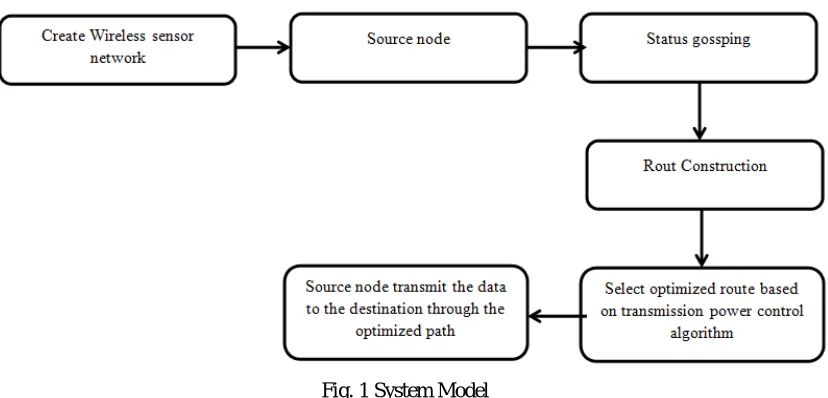
In the fig 1, it shows the system model for energy-efficient power management in a Wireless Sensor Network by using transmission power control algorithm.
Fig. 1 System Model
VII. SIMULATION RESULTS
Fig. 2 Optimal route for sending data
In the fig 2, it shows the optimal path selected between source and destination node for sending data by using Transmission Power Control Algorithm. An optimal path reduces the cost for transmitting data from source to destination .Least cost is an advantage for a sensor network. As shown in the fig 2, red path indicates the optimal path.
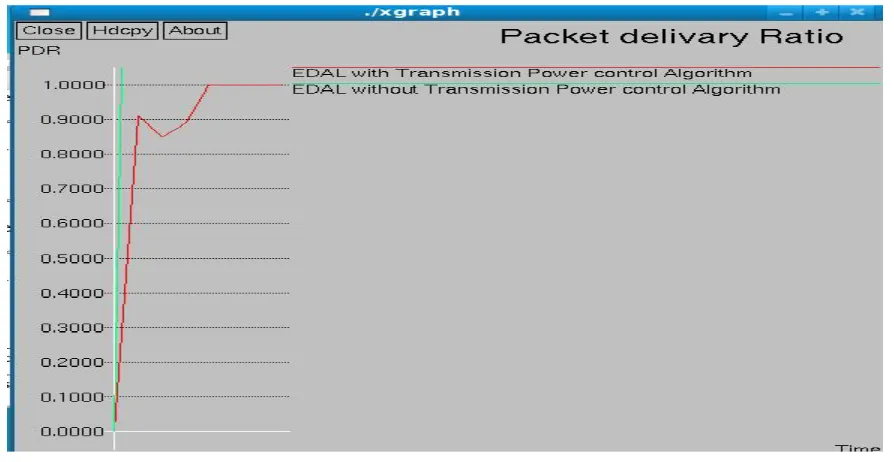
Fig .3 Packet delivery ratio
Fig.4 Lifetime comparison
In Fig.4, shows the comparison between lifetime of network with Transmission Power Control Algorithm and network without Transmission Power Control Algorithm. As power consumption at each node is minimized, the lifetime of each sensor node increases and therefore lifetime of the sensor network increases.
VIII.CONCLUSION
In this paper, Energy efficient power management is carried out in Wireless Sensor Networks. Here, in this work performed a comparison between the network with power management and network without power management. Power management is based on Transmission Power Control Algorithm. Transmission power Control Algorithm based on value of RSSI is carried out in the Wireless Sensor Networks. This method reduces the power consumed at each node and therefore resulted in the reduction of power consumption throughout the network .As a result, the lifetime and throughput of the network is improved. Simulation results were obtained and comparison between network with power management based on TCP and network without this scheme is performed and obtained.
REFERENCES
[1] Merina Devi Hemam, N.V. Uma Reddy, “An Energy-Efficient, Delay-Aware ,Lifetime-Balancing and Data Collection Protocol for Heterogeneous Wireless Sensor Networks, ”International Journal of Soft Computing and Engineering (IJSCE) ISSN: 2231-2307, vol. 5, no. 18, pp. 1983-1997, Dec.20
[2] Jang-ping sheu, Kun-ying hsieh and Yao-kun cheng, “Distributed Transmission Power Control Algorithm for Wireless Sensor Networks, “journal of information science and engineering, pp. 1447-1463, Feb. 2009.
[3] I . Khemapech, A. Miller and I. Duncan, “A Survey of Transmission Power Control in Wireless Sensor Networks,” IEEE Commun. Mag. vol. 46, pp. 50–55, Apr. 2008.
[4] Tamer A. ElBatt , Srikanth V. Krishnamurthy_, Dennis Connors_ and Son Dao, “Power management for throughput enhancement in wireless
ad-hoc networks.
[5] D. Lal, A. Manjeshwar, F. Herrmann, E. Uysal-Biyikoglu, and A. Keshavarzian, “Measurement and characterization of link quality metric in energy constrained wireless sensor networks,” IEEE Global Communications Conference, Vol. 1, 2003, pp. 446-452.
[6] O. Landsiedel, K. Wehrle, and S. Gotz, “Accurate prediction of power consumption in sensor networks,” IEEE Embedded Networked Sensors, Vol. 1, 2005, pp. 37-44.
[7] D. Son, B. Krishnamachari, and J. Heidemann, “Experimental study of concurrent transmission in wireless sensor networks,” ACM Conference on Embedded Networked Sensor Systems, 2006, pp. 237-250.
[8] K. Srinivasan and P. Levis, “RSSI is under appreciated,” IEEE Workshop on Embedded Networked Sensors, 2006 pp.1-5.
[9] J. Zhao and R. Govindan, “Understanding packet delivery performance in dense wireless sensor networks,” ACM Conference on Embedded Networked Sensor Systems, 2003, pp. 1-13.