*Corresponding Author
784
DESIGN AND PRODUCTION OF MULTIMEDIA TRAINING PROGRAMS FOR
PROBLEM SOLVING SKILL AND ITS EFFECT ON THE MENTAL HEALTH
OF HIGH SCHOOL FEMALE STUDENTS IN KERMANSHAH
Shahnaz Bahrami
1*
--- Saeed Vaziri Yazdi
21, 2Department of Educational Sciences, Yazd Branch, Islamic Azad University, Yazd, Iran
ABSTRACT
This paper addresses the design and production of multimedia training programs for problem solving skill and its effect on the mental health of high school female students in Kermanshah. The
studied group included students sponsored by Imam Khomeini Relief Foundation. From five Relief Foundations in Kermanshah, Foundation Office Region 2 was randomly selected; female students were selected from all male and female students sponsored by the foundation. High school students
were selected among students of elementary, middle school and high school. Finally, first grade students were randomly selected among high school students (multi-stage cluster sampling). This
quasi-experimental study (pre-test/post-test) was conducted using an experimental group and a control group. The control group was trained in problem solving skill without training, and the experimental group was trained in the same skill through multimedia environment for 10 sessions.
Data relating to mental health was gathered by standardized questionnaire(28-GHQ), which was administered in three phases: pre-test, post-test and retention test. In order to analyze data, both
methods of descriptive statistics(frequency distribution, mean, standard error, graphs and tables) and inferential statistics (covariance and t test) was used. The results showed that
multimedia-training programs for problem-solving skills is effective on the mental health of students, and its educational effects will be relatively stable over time.
© 2014 Pak Publishing Group. All Rights Reserved.
Keywords: Multi-media, Problem solving skills, Mental health, Retention.
Contribution/ Originality
This study reviews literature and to-date research done on the subject, in Iran and other
countries to develop all aspects of the dependent variable and independent variable. This study uses
a new estimation method which distinguishes this study from other researches. This new method is
retention test to determine the effect of multimedia training for problem solving skills in the
context of time.This study presents a new formulation in training young educating people. Due to
Journal of Asian Scientific Research
785
inactivity of the audience, previous practices were less effective; in this method, while, learners are
a main part of the teaching process. This study is one of the few studies addressing the problem
solving skills. Problem solving is a key process to overcome the problems. Success in learning this
skill leads to success in other aspects of life. In this paper, the role of rational analysis is to
compare the effect of multimedia training for problem solving on audience. The main contribution
of this paper is to find solutions to the problems through a process. Contribution of multimedia
teaching style is very important and valuable. This study evaluates the effect of multimedia
problem solving training on mental health of students.
1. INTRODUCTION
Although advances in technology and industry have increased the power and wealth, they
eliminated the chances of a peaceful life. In fact, quality has been sacrificed for quantity;
moderation and appropriateness have been replaced by neurological-mental and psychosomatic
diseases. Adolescence is considered as an important step in the social and emotional growth [1]. in
this period, the most important needs of adolescents include the need for emotional balance,
especially the balance between emotions and intellect, understanding of the existential value of self,
self-consciousness, real goal setting in life, emotional independence from family, mental and
emotional balance against environmental stress factors, healthy relationships with others,
acquisition of necessary social skills, and understanding of a healthy and effective life. Thus, it is
necessary to help adolescents in development and growth of essential skills for effective life,
creation or increase in confidence in dealing with problems and solving them for adjustment with
social environment and effective and productive life in the society [1].
Life skill training focusing on the most important personal and social problems of adolescents
is an important and undeniable principle. Despite the special attentions paid by many countries and
the special emphasis of World Health Organization (WHO), the curriculum of Iranian schools
lacks this. Recently, some attempts have been made that require more scientific and academic
attention. According to Bandura’s social learning theory, learning is an active experience-based
process; thus, children actively engage in learning life skills during learning and teaching
processes. Therefore, this method of teaching calls for approaches facilitating active participation
of children and adolescents in training. These approaches include formation of small binary groups,
brainstorming, role-playing, discussion and debate [2]. Life skill training has been effective in a
variety of programs.
2. LITERATURE REVIEW
2.1. Training MultimediaTraining multimedia can provide organized programs of learning experiences for individuals
or groups by particular emphasis on learning through different senses [3]. Training multimedia can
be used for application of various education theories [3].
One of the important discussions raised in educational technology is how to select appropriate
training media; therefore, teachers are provided with a growing mass of visual–audio materials
786
selected by a variety of factors including the nature of learning situation, the desired efficiency of
learning, characteristics of learners, learning environment, educational-cultural level of
development in the target society, and practical factors including accessibility, acceptability and
costs [4].
Characteristics of an appropriate training medium include 1) consistency with goals, content
and methods oftraining,2) the ability to convey the desired message,3) compliance with
characteristics oflearners,4) validity,5) good technical and artistic quality, 6) practicality, 7)
economic justification [5].
There is a wide range of multimedia training software including foreign language teaching
software, programming languages, diets, tutorial programs, cooking, scientific entertainment,
music training [6].
Schools are concerned with mental-social development of students besides emphasis on their
intellectual development; regarding the role of schools in preventing and promoting mental health,
school-based preventive programs have been developed. In fact, objectives of education and mental
health are the same because both focus on growth of healthy, helpful and happy people [7].
Currently, the advent of new educational technologies and computer applications in teaching
have preoccupied the concern of learning experts in all sciences as well as behavioral scientists and
psychologists. Therefore, multimedia environments due to the explosion of information and
knowledge have replaced common trainings in schools and have seriously changed the training
procedures [8].
2.2. Mental Health
Mental health refers to the feeling of well-being and ensured self-effectiveness, self-reliance,
competitiveness, attachment between generations and self-actualization of potential
intellectual-emotional abilities, etc. considering the differences between cultures, however, providing a
comprehensive definition of mental health seems impossible. Nevertheless, there is consensus that
mental health is more than just the absence of mental disorders. Understanding mental health, and
in a broader sense, psychological functioning is important, because it provides a basis for a fuller
understanding of how psychological and behavioral disorders appear [9].
Health as a wide range to enable individual or group realizes the hopes and aspirations and
satisfies the needs on the one hand and on the other hand changes environments or copes with the
environment. According to the above definition, it seems that health is a resource for everyday life,
rather than a means to live; it is a practical and positive concept emphasizing both physical ability
of individuals and their personal and social resources [10].
2.3. Problem Solving
By definition, one is faced with a problem when the learner is faced with a situation in which
he cannot immediately respond using information and skills available at the time or when one sets
goals but does not know how to realize. Given the definition, problem solving refers to detection
and application of knowledge and skills which lead to a correct respond of the learner to the
787
already learned in new situations. Problem solving is emphasized and is defined as the application
of knowledge and skills to achieve specific goals.
As Gagné [11] theorized, problem solving is called as learning the higher-order rules.
According to his theory, learner combines simple rules to make higher-order rules, which causes a
problem to be solved. Thus, prior learnings, especially rules or principles already learned, must be
combined in a new way to solve a problem.
2.4. Current Study
The acquisition of skills for life, along with education and appropriate changes in attitudes and
values, as well as reinforcement of appropriate behaviors, will lead to healthy behaviors which in
turn eliminate obstacles and problems of mental health, and thus enhance mental health. Programs
promoting mental health are based on primary prevention through education; considering the
prominent role of life skill trainings on mental health, the role of schools, organizations and
departments is of great importance in developing and promoting new trainings in the present
Iranian society. According to above, the present study tries to find out that whether training
problem-solving skills through multimedia approaches enhance the mental health of high-school
female students.
3. METHODOLOGY
The research study is a quasi-experimental (semi-empirical) research using pre-test and
post-test for control group and random sampling.
3.1. Participants and Samples
Participants in this study included 1813 students sponsored by Imam Khomeini Relief
Foundation in Kermanshah during academic years 2012-2013. From five Relief Foundations in
Kermanshah, Foundation Office Region 2 was randomly selected. Then, female students were
selected among all male and female students sponsored by the foundation. In the next stage, high
school students were selected among students at all grades. At last, first-grade students were
randomly selected among high school students (multi-stage cluster sampling). Using multi-stage
cluster sampling, 30 students were selected as convenient samples.
3.2. Materials
3.2.1. Goldberg's General Health Questionnaire (GHQ-28)
In order to measurement a health, this study used General Health Questionnaire proposed by
Goldberg. Goldberg has developed GHQ for non-psychotic mental disorders in medical centers and
communities. This study used the 28-item questionnaire developed by Goldberg and Hillier [12].
Respondents were asked to complete the questionnaire by marking one of the four choices (Not at
all, a little, much, very much and not at all, no more than usual, more than usual, much more than
usual).The questionnaire consists of four scales each of whichhas7 items. The four scales of
questionnaire include somatic symptoms, anxiety and insomnia, impairment in social interaction,
788
Questionnaire (G.H.Q) has been evaluated in many studies, and its reliability and validity have
been proved.
3.2.2. Training Materials (Multimedia Training in Problem Solving)
In fact, students go beyond the limitations of traditional training methods; teachers as a guide
in the direction of education are the cores of educational system. Elements of multimedia systems
for problem solving include.
1. Text
Writing is combined with other media to create a successful and powerful collection to deliver
information; in multimedia problem solving, texts are used for titles, menus and expression of
project contents.
2. Audio
Audio plays an important role in effectiveness of videos, texts and images on students. Texts
convey messages to audience; however, they clearly lack an element, i.e. sound, which is
considered in this multimedia approach. Videos and music are consistent with content of texts.
3. Pictures
Pictures used in this multimedia pursue only one goal: to facilitate understanding and learning
by providing complex information in order to help learners innovatively perceive pictures available
in the multimedia.
4. Videos
By playing good videos, beautiful demonstrations are provided for multimedia a projects of
problem solving; admittedly, video and audio will be more effective than text. Therefore, a good
training environment was provided using pre-prepared videos for introduction of people successful
in overcoming difficulties, training ways to deal with problems, and solving problems among
animals. In training sessions, problem-solving skills were presented by multimedia to students.
Considering the content of this multimedia including videos, texts, hobbies, pictures and
assessments, students were enables to solve problems by using previous knowledge and skills in
new situations. Problem solving multimedia lead to effective and efficient learning, and help
students follow instructions provided in the multimedia and choose the best for their personal,
educational and professional choices. By advances in computer sciences and emergence of
multimedia systems, information shifts from merely text to videos, audios, images, etc. Learning
will be more enjoyable and interesting by multimedia training environments.
4. METHODS
Educational content in the present study is derived from Seif [13], Seif [14] “Modern
789
Using this training program, materials of training sessions and practical
exerciseswereorganizedin10sessions. Referring to the office advisor and determining the subjects,
the test was conducted for subjects. It is noteworthy that instructions were read aloud by the time
the test was distributed, and subjects were asked to complete the test carefully according to
specifications. After the pretest, scoring and obtaining the results, 15 subjects who had earned
higher scores(lower mental health) were maintained in the experimental group; the remaining15
cases were placed in the control group. Accordingly, the experimental group was exposed to
multimedia problem solving trainings to evaluate their effects on mental health. Training course of
problem solving skills were divided into ten 45-minute sessions based on the number of training
topics. The first 15 minutes were devoted to presentation of facts on the topic. In the second half of
the session, students work personally on exercises and practical activities presented in the
multimedia content.
4.1. Data Analysis
Data analysis was performed at two levels: descriptive (mean, standard deviation) and analytic
(analysis of covariance, t-test) by SPSS software.
5. RESULTS
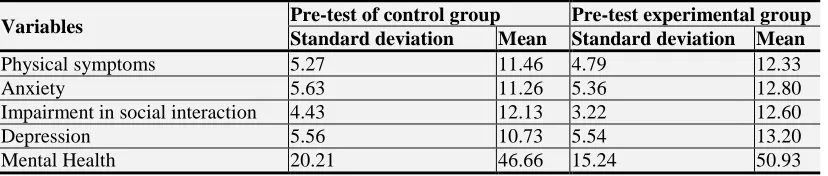
Table 1 reports descriptive indicators of variables for pretest scores of experimental group and
control group.
Table-1. Central distribution of mental health and its indicators
Variables Pre-test of control group Pre-test experimental group Standard deviation Mean Standard deviation Mean
Physical symptoms 5.27 11.46 4.79 12.33
Anxiety 5.63 11.26 5.36 12.80
Impairment in social interaction 4.43 12.13 3.22 12.60
Depression 5.56 10.73 5.54 13.20
Mental Health 20.21 46.66 15.24 50.93
Table 2 reports descriptive indicators of variables for post-test scores of experimental group
and control group.
Table-2.Central distribution of mental health and its indicators
Variables Post-test of control group
Post-test experimental group
Standard deviation Mean Standard deviation Mean
Physical symptoms 8.46 4.06 9.20 2.87
Anxiety 7.33 3.88 9.80 3.02
Impairment in social interaction 8.20 3.07 12 3.52
Depression 7.73 4.28 10.93 3.28
Mental Health 30.41 10.28 40.86 8.86
790 Table-3.Central distribution of retention
Variables Experimental group Control group
Mean Standard deviation Mean Standard deviation
Physical symptoms 7.53 3.09 9.46 3.15
Anxiety 6.73 3.55 10.33 2.94
Impairment in social interaction 6.53 2.16 11 2.90
Depression 7.20 3.16 12 3.40
Mental Health 27.33 6.62 42.80 8.91
Covariance assumptions were evaluated to test hypothesis.
Table-4.Kolmogorov-Smirnov test for normal distribution of variables(Pre-tests of control and experimental groups) Significance level of the Kolmogorov
Smirnov test Variables
0.24 Physical symptoms
0.06 Anxiety
0.06 Impairment in social interaction and
relationships
0.54 Depression
0.20 Mental Health
According to Table 4 and the significance level of all variables, which is > 0.05, it can be
concluded that all variables follow a normal distribution.
Table-5. Kolmogorov-Smirnov test for normal distribution of variables (Post-tests of control and experimental groups) Significance level of the Kolmogorov
Smirnov test Variables
0.92 Physical symptoms
0.92 Anxiety
0.33 Impairment in social interaction and
relationships
0.38 Depression
0.83 Mental Health
According to Table 5 and the significance level of all variables, which is > 0.05, it can be
concluded that all variables follow a normal distribution.
Table-6.Kolmogorov-Smirnov test for normal distribution of variables (Retention tests of control and experimental groups) Significance level of the Kolmogorov
Smirnov test Variables
0.95 Physical symptoms
0.75 Anxiety
0.73 Impairment in social interaction and
relationships
0.33 Depression
791
According to Table 6 and the significance level of all variables, which is > 0.05, it can be
concluded that all variables follow a normal distribution.
In order to examine whether multimedia training for problem solving skills leads to the
enhancement of mental health, covariance analysis tests were used.
Table-7.Descriptive statistics
Standard deviation Mean
number Groups
Tests
20.21 46.66
15 Control group
Pre-test
15.24 50.93
15 Experimental group
2.86 40.86 15
Control group Post-test
10.28 30.41
15 Experimental group
Given that significance level of Leuven test should be > 0.05, as it is true here (0.19), the error
rate of both groups is equal, and there is no difference. Therefore, the precondition is true for the
test, that is, covariances are equal. Therefore, covariance test can be used.
Table-8.ModelTesting Significance level Value
0.0001 16.25
The significance level of the test (Table 8) is equal to 0.0001 which is < 0.05 suggesting a
significant difference in means of pre-test and post-test of mental health. In general, training through problem solving multimedia leads to the improvement in students’ mental health.
In order to examine whether training through problem solving multimedia decreases the
anxiety of students covariance analysis tests were used.
Table-9.Descriptive Statistics
Standard deviation Mean Number Groups Tests
5.63 11.26 15 Control group
Pre-test
5.36 12.80 15 Experimental group
6.02 9.80 15 Control group
Post-test
3.88 7.33 15 Experimental group
Given that significance level of Leuven test should be > 0.05, as it is true here (0.06), the error
rate of both groups is equal, and there is no difference. Therefore, the precondition is true for the
test, that is, covariances are equal.
Table-10.ModelTesting Significance level Value
0.0001 16.2
The significance level of the test (Table 10) is equal to 0.0001 which is < 0.05 suggesting a
792
In general, training through problem solving multimedia leads to the decrease in students’ anxiety.
In order to examine whether training through problem solving multimedia decreases the
depression of students covariance analysis tests were used.
Table-11. Descriptive Statistics
Standard deviation Mean Number Groups Tests
5.56 10.73 15 Control group
Pre-test
5.54 13.20 15 Experimental group
3.28 10.93 15 Control group
Post-test
4.28 7.73 15 Experimental group
Significance level of Leuven test showed that error rate of both groups is equal, and there is no
difference. Therefore, the precondition is true for the test, that is, covariances are equal.
Table-12.Testing Model Significance level Value
0.0001 8.64
The significance level of the test is equal to 0.0001 which is < 0.05 suggesting a significant
difference in means of pre-test and post-test of depression. In general, training through problem solving multimedia leads to the decrease in students’ depression.
In order to examine whether training through problem solving multimedia decreases the
dysfunction of social interaction among students covariance analysis tests were used.
Table-13.Descriptive Statistics
Standard deviation Mean Number Groups Tests
4.43 12.13 15 Control group
Pre-test
3.22 12.60 15 Experimental group
3.52 12 15 Control group
Post-test
3.07 8.20 15 Experimental group
Significance level of Leuven test showed that error rate of both groups is equal, and there is no
difference. Therefore, the precondition is true for the test, that is, covariances are equal.
Table-14. Testing Model Significance level Value
0.0001 9.63
The significance level of the test (Table 14) is equal to 0.0001 which is < 0.05 suggesting a
significant difference in means of pre-test and post-test of dysfunction of social interaction. In
general, training through problem solving multimedia leads to the decrease in students’ dysfunction
793
In order to examine whether training through problem solving multimedia decreases the
physical symptoms of students covariance analysis tests were used.
Table-15.Descriptive Statistics
Standard deviation Mean Number Groups Tests 5.27 11.46 15 Control group Pre-test 4.79 12.33 15 Experimental group 2.78 9.20 15 Control group Post-test 4.06 8.46 15 Experimental group
Significance level of Leuven test showed that error rate of both groups is equal, and there is no
difference. Therefore, the precondition is true for the test, that is, covariances are equal.
Table-16.Testing Model
Significance level Amount of Testing
0.0001 5.35
The significance level of the test (Table 16) is equal to 0.0001 which is < 0.05 suggesting a
significant difference in means of pre-test and post-test of physical symptoms. In general, training
through problem solving multimedia leads to the decrease in students’ physical symptoms.
In order to examine whether the effect of training through problem solving multimedia is
constant over time t-tests was used.
Table-17. Descriptive Statistics
standard error of deviation Standard deviation Mean 1.05 4.06 8.46 Experimental group Physical symptoms 0.79 3.09 7.53 Retention 1.003 3.88 7.33 Experimental group Anxiety 0.91 3.55 6.73 Retention 0.79 3.07 8.20 Experimental group
Impairment in social
interaction and relationships
0.55 2.16 6.53 Retention 1.10 4.28 7.73 Experimental group Depression 0.81 3.16 7.20 Retention 2.65 10.28 30.40 Experimental group Mental Health 1.71 6.62 27.33 Retention
Table-18. Paired t-test
Differences in mean
Level of significance Degrees of freedom T test Examined variable 0.93 0.48 14 0.71 Retention in Physical symptoms
0.60 0.53
14 0.63 Retention in Anxiety
794
1.66 0.17
14 1.44 Retention in Impairment in interactions
0.53 0.61
14 0.51 Retention in Depression
3.06 0.18
14 1.39 Retention in mental health
According to Table 18, significance levels listed in t-test table are greater than 0.05; therefore,
the effect of training by problem solving multimedia is constant over time. Descriptive statistics of
Table 17 show no significant difference in means. There is no significant difference in means of
post-test and retention of the experimental group for all mental health variables as well as mental
health itself; according to the above test, particularly the mental health, the above hypothesis can be
accepted.
6. DISCUSSIONAND CONCLUSIONS
The purpose of this study was to design and produce multimedia training programs for
problem solving skills and its effect on mental health of high school female students in
Kermanshah.
The results of covariance analysis indicated that multimedia training of problem solving skills
increase mental health among students. The results of the present study are consistent with Shamsi
Khani, et al. [15], Baba, et al. [16]. Application of multimedia training for problem solving skills
significantly increases the motivation of female students. Due to effective use of information and
communication technology, students reveal their abilities and capabilities quickly and teachers
have more choices in teaching, assessment and communication with students. Multimedia
technology for training problem solving skills will result in an increase in the quality of education,
by facilitating the basic skills acquisition. It also acts as a transferring means when it is applied
correctly, provoking students to listen and engage in content. In such a situation, students are active
rather than passive. They are encouraged to be independent thinkers and problem solvers. They are
provoked to get real answers and earn the opportunity for hypothesizing, analyzing and predicting
the consequences of implementing the solutions. Communication and collaboration with others on
assignments are other basic components of multimedia training for problem solving skills; students
are enabled to expand their ideas and concepts. Reliance on God is an active approach in dealing
with issues and problems; Reliance is an active approach, it will lead to motion, activities, vivacity,
and utilization of the available tools, hope, and expectation to find innovative ways to solve the
problem.
The results of covariance analysis tests showed that multimedia training of problem solving
skills decreases anxiety among students. The results of the present study are consistent withIzadi
Tamh [17], Shahbazi and Rahim Ali Mehr [18], Fallahi [19], and Baba Shahabi and Zahra [20].
Multimedia training of problem solving skills results in positive self-concept in students because
problem solving as a shield protects the individual against negative events. It is possible by
educational movies, creative exercises and educational texts. Adolescents have destructive inter
personal relationships and academic problems; multimedia training for problem solving skills
795
Promotion of adjustment and employment of cognitive skills including problem-solving skills.
Multimedia training for problem solving skills decreased anxiety in students because they were
able to solve their problems by studying the correct ways to solve the problem; in this manner, they
were able to recognize the reasons for their failure by reviewing the solution if they were not
successful in solving their problems. This will reduce their anxiety in dealing with everyday issues,
and these coping skills increase self-confidence. Trust in God and believe in His wisdom change
our attitudes towards daily events; in this regard, we can see the hidden meaning of all events,
which reduces many unnecessary stresses.
The results of covariance analysis tests implied that multimedia training of problem solving
skills decreases depression among students. The results of the present study are consistent with
Sahebi [21], Bapiri [22], Sharifi Gholam [23], Elliott, et al. [24]. Multimedia training for problem
solving skills allows students to learn how to use systematic approaches of problem solving instead
of hasty reactions to deal with problems. This increases social competence and raises the level of
their inter personal relationships; moreover, self-sufficiency and relationships with peers reduces
depression. Multimedia training helps students describe the problem, describe the negative or
limiting factors involved in the problem, describe the positive and constructive elements, describe
the scope of the problem, describe the consequences of a solution for the problem, and ultimately
provide a list of existing solutions. Being aware of the barriers, students learn to not suffer from
depression when solving problems and to make correct decisions by a positive inner dialogue (I can
solve my own problems). These methods increase mechanism of impulse control and optimism,
which brings motivation.
The results of covariance analysis tests implied that multimedia training of problem solving
skills decreases dysfunction in social interaction. The results of the present study are consistent
with Mo’tamedi, et al. [25], Sodani, et al. [26], Hatami Fard, et al. [27] and Mobaleghi [28].
Multimedia training for problem solving skills lead to a significant learning and effective ways to
solve problems by students. It will increase their motivations because they find a chance to
experience inner happiness in the process of problem solving. It enables students to engage actively
in the process of acquiring meaning or knowledge and to pave the way for education through
personal experiences and interactions with others. Thereby, directed exploratory learning method is
presented. According to features of multimedia-based learning, the teacher plays the role of
facilitator, the students encounter with real problems, the system is dynamic, and the educational
goals are met. Students are prepared for eagerly systematic study of an issue or problem from
different perspectives with their own views; they will have a greater tendency to identify, examine
and assess different ways and a special emotional readiness to deal systematically with assignments
and complex problems. Multimedia training for problem solving skills improves decision-making
and adoption of appropriate solutions, and provokes students to learn the knowledge according to
present requirements, to fulfill their potential abilities, and to convert them to desired behaviors in
their lives.
The results of covariance analysis tests implied that multimedia training of problem solving
skills decreases physical symptoms among students. The results of the present study are consistent
796
training for problem solving skills changes students’ beliefs regarding their ability to solve
problems, which results in an increase in their enjoyment and motivation for solving the future
problems in their daily lives. Positive attitude toward their capabilities in dealing with problems,
creativity, saving time, eliminating unhelpful activities, spending more time to communicate with
others, discussions, presentations, identifying different styles of learning, active learning with
feedback, repeatability as well as control over the learning process, facilitating participation in the
activities and balance and mutual relationship with the user are characteristics of students who are
trained by the multimedia approach. They learn correctly to combine reading, writing, listening and
speaking skills. At last, multimedia training for problem solving skills is consistent with students’
capabilities away from detrimental competitions.
Results of t-test revealed no significant difference in all mental health variables as well as
mental health itself as a variable for means of post-test of experimental group and retention of
experimental group; the effect of multimedia training for problem solving is constant over time.
The results of this study are consistent with Zahra Kar, et al. [33], Ganji and Kamran [34].
multimedia training for skills which eliminates extra and unnecessary cognitive loads, is applied by
combining the body of contents with learning materials mostly in form of text(written and oral),
image(photo, shape, etc.) and videos. It enhances the efficiency of working memory, and provides
significant learning by attaching new information to former knowledge. If students feel academic
success and learn new things, their level of motives will be enhanced, and finally, the level of
recovery will met the minimum rate. Unprocessed information leaves only a temporary emotional
influence (sensory memory), repeated information are processed superficially (short-term memory),
and the information processed more than others is relegated into long-term memory. Multimedia
training for problem solving skills contains both subjective and objective types of experiences.
Appropriate learning experience for learners begins in the lower stages, moves toward the higher
stages, and includes a proper collection of learning experiences by combining senses. All these
together provide the representation system through a variety of stimuli (images sound and motion)
and different learning needs(cognitive, affective, and psychomotor).
REFERENCES
[1] A. K. Shoari Nezhad, The role of extracurricular activities in adolescent education, 4th ed. Tehran: Ettelaat Institute, 1999.
[2] R. Noori Ghasem Abadi and K. Parvaneh Mohamad, "Life skills training. Tehran. Department of health," Psychology and the Prevention of Substance Abuse, 1998.
[3] S. A. Razavi, Modern topics of educational technology. Ahvaz, Iran: Shahid Chamran University Press, 2003.
[4] R. M. Ganiyeh, G. Briggs Walter, and W. Vigour, Principles of instructional design. Translation: Khadija Ali Abadi. Tehran: Dana Publication, 1983.
[5] T. Amir and H. Mohammad, Educational media: Identification, selection, production and application. Shiraz, Iran: Saman Publication, 1998.
797
[7] S. Shamlou, Mental health, 13th ed. Tehran: Roshd Publications, 2009.
[8] H. Fardanesh, Theoretical foundations of educational technology, 5th ed. Tehran: SAMT, 2003. [9] S. A. Bagheri Yazdi, H. Peyravi, and J. Bolhari, "Mental health among students of Tehran
university," Psychiatry and Clinical Psychology, vol. 4, pp. 30-39, 1995.
[10] WHO (World Health Organization), Training plan for life skills. Department of psychology and prevention of drug abuse. Tehran, Iran, 2001.
[11] R. M. Gagné, The conditions of learning and theory of instruction. New York: Holt, Rinehart and Winston, 1985.
[12] D. Goldberg and V. Hillier, "A scaled version of general health questionnaire," Psychological Medicine, vol. 9, pp. 131- 145, 1979.
[13] A. A. Seif, New educational psychology: Psychology of teaching and learning. Tehran: Doran Publication, 2007.
[14] A. A. Seif, Measurement, assessment, educational evaluation. Tehran: Doran Publication, 2008. [15] S. Shamsi Khani, G. Abolfazl Rah, K. Masoud Fallahi, and R. Mahdi, "The impact of problem
solving skills on coping skills of suicide attempters," Journal of Nursing Research, pp. 39-31, 2006. [16] P. Baba, K. R. Z. T. Khairedinm, A. Javad, and A. Ali, "Study the relationship between problem
solving approaches and psychological health of students," Journal of Psychology, vol. 7, pp. 3-16, 2003.
[17] A. Izadi Tamh, "A comparative study of the educational effects of tolerance, problem solving, and combined method tolerance and patience on elements of studens’ hardiness in a military university,"
Journal of Military Psychology. First Issue, pp. 72-52, 2011.
[18] S. Shahbazi and S. Rahim Ali Mehr, "The effect of problem solving skills in the rate of nursing students’ stress," Shahrekord University of Medical Sciences, vol. 13, pp. 37-32, 2010.
[19] A. Fallahi, "Evaluation of the effect of teaching problem solving skills in the increase of self- esteem and reduction of anxiety in Rodehen suniversity students," MSc Thesis, Islamic Azad University Ahvaz Science and Research Branch, 1992.
[20] R. Baba Shahabi and K. Zahra, "Study the impacts of problem solving skills on anxiety of juveniles’ lack of effective supervisions living in boarding centers sponsored by Kurdistan welfare office,"
Scientific Journal of Kurdistan University of Medical Sciences, vol. 12, pp. 25-18, 2007.
[21] A. Sahebi, "Evaluation of problem-solving approaches in depressed individuals, and a comparison with normal subjects," Journal of Psychology, vol. 1, pp. 24-42, 2001.
[22] O. A. Bapiri, "Studying the impacts of training group problem-solving skills on the treatment of adolescent suicide attempters in Ilam," Master Thesis: Clinical Psychology. Iran University of Medical Sciences and Health Services. Tehran Psychiatric Institute, 1998.
[23] R. Sharifi Gholam, "Studying the impacts of training problem solving skills on the treatment of depression symptoms in adolescents psychology," Master's Thesis, Iran University of Medical Sciences. Institute of Psychiatry, Tehran, 1993.
[24] T. Elliott, S. Herrick, and T. Witty, "Problem-solving appraisal and the effects of social support among college students and persons with physical disabilities," J Cognitive Therapy & Research,
798
[25] Mo’tamedi, Seyed Hadi, Hosein Haj Babaee, Akbar Biglarian, and S. K. Manizheh Fallah, "Educational effect of problem solving skills in increasing social competence among adolescent girls," Social Research Quarterly, vol. 5, pp. 17-29, 2012.
[26] M. Sodani, A. Abdolah Shafi, and Z. Azam Imani, "The effectiveness of training the problem solving skills in increasing personal-social compatibility of divorced women in Kermanshah,"
Journal of New Findings in the Psychology, Issue, vol. 23, pp. 127-115, 2012.
[27] S. Hatami Fard, K. Seyed Mosa, and R. Vahid Khosh, "The effectiveness of training problem solving and parents’ assertiveness skills on the degree of social adjustment and academic
achievement of their children," Journal of Counseling and Psychotherapy Dictionary, Second Issue,
vol. 2, pp. 68-84, 2011.
[28] N. Mobaleghi, "A comparative study of the effectiveness of educational approaches of assertiveness and problem solving skills in compatibility and aggressiveness of first year female high school students," Master's Thesis, General Psychology. Azad University Tonekabon Branch, 2011. [29] F. Bahrami, M. Seyed Ali Hosseini, and M. Ameneh, "The effectiveness of training problem solving
and decision-making skills on the reduction of positive attitude of opioid dependence," Quarterly Journal of Substance Abuse: Drug Addiction Studies, vol. 7, pp. 58-73, 2013.
[30] Y. Shahni, "Studying the methods of delay and the impact of cognitive – behavioral treatments of managers on its reduction in high school students in Ahvaz," Shahid Chamran Journal of Psychology, vol. 13, pp. 1-30, 2006.
[31] A. Rastgoo, "Study of teachers' use of teaching methods based on problem solving skills in the classroom," PhD Thesis Philosophy of Education, Tehran University, 2003.
[32] A. Shafi Abadi and S. Soraya, "Studying the effectiveness of group therapy and problem solving skills in some demographic characteristics of adolescent suicide attempters. Tehran," Quarterly Journal of New Research in Consultancy, vol. 2, pp. 21-40, 2000.
[33] K. Zahra Kar, Z. Azadeh Reza, and Ghodsi Ahghar, "Studying the effectiveness of training the problem solving skills in high school female student self-efficacy in Rasht," New Journal of Educational Sciences, vol. 5, pp. 133-150, 2010.