IJEDR1504067
International Journal of Engineering Development and Research (www.ijedr.org)1
Analytic Subbing On Application Based Denoising
Techniques Using Wavelet Transform
1Sudipta Nag, 2Jaspal Bagga
1M.E. Scholar, 2Professor SSGI, Bhilai (C.G.) India
________________________________________________________________________________________________________
Abstract- Data pre-processing is challenging as it involves extensive manual effort and time, includes the process of noise removal referred as signal denoising or simply denoising. Noises present in signals are difficult to recover using the traditional methods. Now Wavelet Transform is used for denoising techniques. The implementation results reveal that the proposed technique achieves a state-of-the-art denoising performance in terms of signal-to-noise ratio.
Index Terms - Data Preprocessing, Denoising, Noise, Signal-to-noise ratio, Wavelet Transform (WT)
________________________________________________________________________________________________________
I.INTRODUCTION
With sensors becoming ubiquitous and computers becoming more powerful, scientists are collecting and analyzing data at an evergreen pace. In many fields, such as, the data that is collected is often noisy, either as a result of data acquisition process or due to natural phenomenon such as atmospheric disturbances. This noise must be removed from the data before analysed. Removing the noise from data can be considered as the process of constructing optimal estimates of the unknown signal from the available noisy data. There are several different ways in which denoising can be done. In wavelet transform, basic idea is to use wavelets to transform data into a different basis, where “large” coefficients correspond to the signal, while “small” ones represent mostly noise. The wavelet coefficients are suitably modified and the denoised data is obtained by an inverse wavelet transform of modified coefficient. [1]
Modulated radio signals are used, by radio signals, one understands signals in the frequency range of 3 Khz to 300 Ghz. PSK ( Phase Shift Keying), FSK (Frequency Shift Keying), QAM (Quadrature Amplitude Modulation) belong to the best-known digital modulations. Signals expecting 4PSK, 8PSK, 4FSK, 8FSK, 16QAM, 64QAM with varying SNR in the range of -15 dB to 15 dB. In [1], Implementation of global, level-dependent, subband dependent wavelet based techniques on two dimensional signals takes place.
In [2], non-linear thresholding techniques in wavelet domain such as hard and soft thresholding, wavelet shrinkages such as Visu-shrink (non- adaptive) and SURE, Bayes and Normal Shrink (adaptive), using Discrete Stationary Wavelet Transform (DSWT) for different wavelets, at different levels, discussed to denoise and determine the best one out of them.
There are many approaches in the literature for the task of denoising, roughly divided into two categories: denoising in the original signal domain (e.g., time or space) and denoising in the transform domain (e.g., Fourier or wavelet transform).[3] In [4], wavelet transform is used for denoising techniques. The hard and soft thresholding are used, but there is a main drawback i.e. around discontinuities it creates Gibbs phenomenon. Here, traditional method of total variation minimization is used for denoising.Due to simple calculation and good denoising effect, in [5] wavelet threshold denoising method has been discussed. Threshold is an important parameter that affects the denoising effect. To improve the denoising, a new threshold considering interscale correlation is presented. Another signal denoising method based on the classical three step procedure analysis-threshold-synthesis and the Spectral Intrinsic Decomposition (SID) in [6]. This method consists of an iterative thresholding of the SID components. The SID-based removal method reduces noise and can retain useful discontinuities of the signal as effectively as the wavelet techniques based on soft thresholding. Also, using discrete wavelet transforms using different wavelet bases (Daubechies and Symlets) [7], reduce the background noise in speech signals.
In [8], a time-domain method for smoothing and reducing the noise level in LiDAR data, where Singular Value Decomposition (SVD) based Savitzky-Golay (S-G) approach is used.
In this paper, we studied wavelet based techniques for denoising, focusing on shrinkage methods (Visushrink and Sureshrink) and analysis was done based on Bit Error Rate (BER). The remainder of this paper is organized as follows: Section 2 describes the proposed methodolody, Section 3 summarizes the basic theory of wavelet based denoising techniques. Section 4 contains Experimental results.Finally, conclusions are given in Section 5.
II.PROPOSEDMETHODOLOGY
IJEDR1504067
International Journal of Engineering Development and Research (www.ijedr.org)424
Fig 1:Block Diagram of Methodogy2.Variation In Channel Parameter While Transmission: While transmission of digital signals AWGN (Additive White Gaussian Noise) with varying SNR ( -15db to 15db) is added.
IJEDR1504067
International Journal of Engineering Development and Research (www.ijedr.org)425
Fig 3:Amplitude Vs Time plot of FSK signal with AWGNFig 4:Amplitude Vs Time plot of QPSK signal with AWGN The Received signal is represented as
𝑟𝑖 (𝑡) = 𝑠𝑖 (𝑡) + 𝑛(𝑡)
Where ri (t) is the Received signal, si (t) is the Transmitted signal, and n(t) is the Additive White Gaussian Noise.
3.Preprocessing In Receiver End: Signal Preprocessing can include amplification, filtering, denoising, compression, converting, range matching, isolation and any other processes required to make sensor output suitable for processing after conditioning.
III.DENOISING
The main aim of a signal denoising algorithm is to achieve both noise reduction and feature preservation. In this, wavelet-based methods are of particular interest. In the wavelet domain, the noise is uniformly spread throughout coefficients while most of the signal information is concentrated in a few large ones.
Algorithm
Load noisy signal.
Perform Wavelet decomposition & calculate wavelet coefficients. Estimate the noise standard deviation from the detail coefficients. Select global threshold for signal denoising.
IJEDR1504067
International Journal of Engineering Development and Research (www.ijedr.org)426
A.Thresholding TechniquesThresholding [13,14] is a simple non-linear technique, which operates on one wavelet coefficient at a time. In its most basic form, each coefficient which is smaller than threshold, set to zero, otherwise, it is kept or modified. The small co-efficient are dominated by noise, while coefficient with large absolute value carry more signal information than noise. Replacing noise co-efficient (small coco-efficients below a certain threshold value) by zero and an inverse wavelet transform may lead to a re- construction that has lesser noise. This thresholding idea is based on the following:
1) The de-correlating property of wavelet transform creates a sparse signal. Most untouched coefficient is zero or close to zero. 2) Noise is spread out equally along all co-efficient.
3) The noise level is not too high so that one can distinguish the signal wavelet coefficients from binary ones.
This method is an effective and thresholding is simple and efficient method for noise reduction.There are two types of thresholding :
1.Hard thresholding. 2.Soft thresholding.
Hard Thresholding
One of the most attractive features of wavelet thresholding is that, for the type of random noise frequently encountered, in signal transmission, it is possible to automatically choose a threshold for denoising without any prior knowledge of the signal. By choosing a threshold that is significantly large, and multiplying with the standard deviation of the random noise, it is possible to remove most of the noise by thresholding the wavelets transform coefficients. This process is known as hard thresholding.
𝑇𝜏𝐻𝑎𝑟𝑑(𝑌[𝑚, 𝑛]) = {
𝑌[𝑚, 𝑛], |𝑌[𝑚, 𝑛]| > 𝜏 0, |𝑌[𝑚, 𝑛]| < 𝜏 }
Where, 𝜏 is the threshold value.
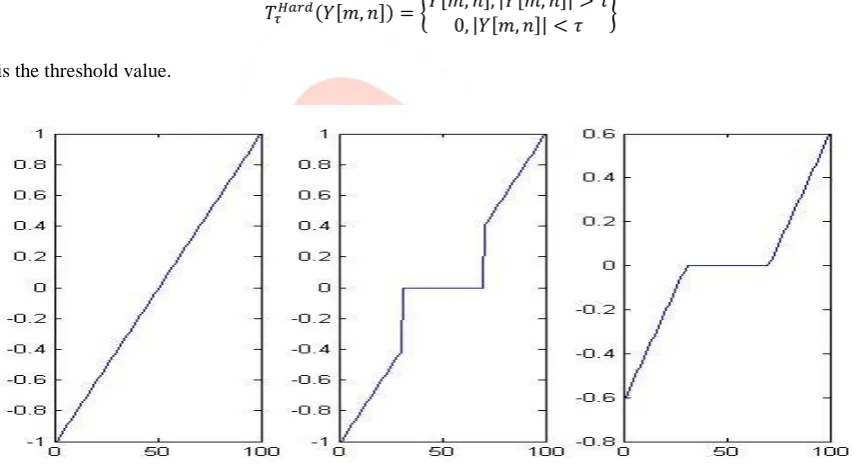
Fig 5: Original Signal, Hard Thresholded Signal, Soft Thresholded Signal
From figure 4, we can see that hard thresholding can create discontinuities, and thus greatly exaggerates small differences in the transform value whose magnitudes are near the threshold value 𝜏 . If the value is only slightly less than 𝜏, then this value is set equal to zero, while a value whose magnitude is only slightly greater than is left unchanged. Therefore, hard thresholding is not suitable for most noise removal.
Soft Thresholding :
With a slight modification to the hard thresholding approach, a method known as soft thresholding can be created. 𝑇𝜏
𝑆𝑜𝑓𝑡(𝑌[𝑚, 𝑛]) = {𝑠𝑔𝑛(𝑌[𝑚, 𝑛])(|𝑌[𝑚, 𝑛]| − 𝜏), |𝑌[𝑚, 𝑛]| > 𝜏
0, |𝑌[𝑚, 𝑛]| ≤ 𝜏 }
Where, 𝜏is the threshold value.
Since soft thresholding is a global operation, in the sense the entire signal is used for the denoising process, it cannot concentrate on just one part of the signal. But, if the de- noised signal has to be processed again, then the one half of the signal would be over processed, and defects can be introduced. Some original details of the signal is removed along with the noise. This is because the noise obscured most of the small magnitude values that result from the original signal. Consequently, when thresholding is applied, it removes many of the transform values of the original signal, which are needed for accurate approximation. To overcome this problem wavelet shrinkages are used.
Shrinkages
IJEDR1504067
International Journal of Engineering Development and Research (www.ijedr.org)427
retain whatever signal is present regardless of the frequency content of the signal. For example, when we denoise music corrupted by noise, we would like to preserve both the treble and the bass. It is denoising by shrinking (i.e, nonlinear soft thresholding) in the wavelet transform domain.It consists of three steps: 1) a linear forward wavelet transform, 2) a nonlinear shrinkage denoising and 3) a linear inverse wavelet transform. Because of the nonlinear shrinking of coefficients in the transform domain, this procedure is distinct from those denoising methods that are entirely linear. Finally, wavelet shrinkage denoising is considered a non-parametric method. Thus, it is distinct from parametric methods in which parameters must be estimated for a particular model that must be assumed a priori[15]. Techniques involves:1.Visu shrink. 2.Sure shrink.
Visu shrink
Visu Shrink is thresholding by applying the universal threshold proposed by Donoho and Johnstone.
This threshold is given by 𝜎√2log𝑀
where σ is the noise variance.
For denoising signals, VisuShrink is found to yield an overly smoothed estimate.
Sure shrink
Sure shrink is a thresholding applied to sub- band adaptively. It is based on Stein’s Unbiased Risk Estimator (SURE), a method for estimating the loss in an unbiased fashion.
Let wavelet coefficients in the jth sub-band be {Xi: i = 1, ···, d} .For the soft threshold estimator 𝑋̂ = 𝜂𝑖 𝑡 (𝑋𝑖)
we have
SURE(t,X)=d-2#{i:| 𝑋𝑖| ≤t}+∑𝑑𝑖=1min (|𝑋𝑖|, 𝑡)2
Select threshold 𝑡𝑠by
𝑡𝑠=argmin SURE(t,X).
IV.EXPERIMENTALRESULTS
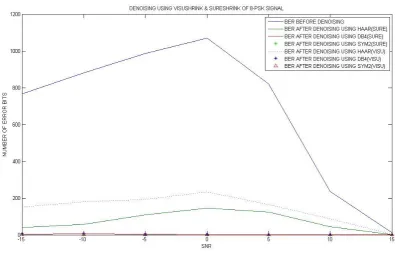
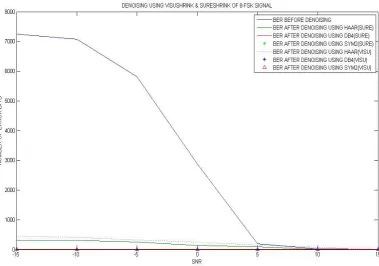
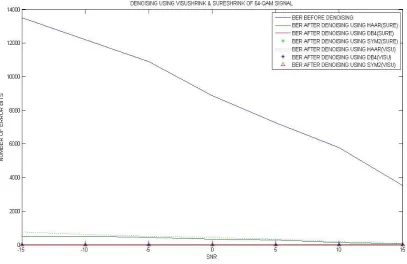
The simulations compare and contrast orthonormal wavelet domain techniques. Figure 6 through Figure11 illustrate BER results between wavelet-based methods.
A number of quantitative parameters can be used to evaluate the performance of the system, in terms of reconstructed signal quality. The following parameters are compared:
: Signal to Noise Ratio (SNR) : Bit Error Rate (BER)
The results obtained for the above quantities are calculated using the following formulas: 1. Signal to Noise Ratio
SNR=10log10 𝜎𝑋2
𝜎𝑒2
𝜎𝑥2 is the mean square of the signal and 𝜎𝑒2 is the mean square difference between the original and reconstructed signals.
2. Bit Error Rate BER=1/2erfc√𝐸𝑏
𝑁𝑜
IJEDR1504067
International Journal of Engineering Development and Research (www.ijedr.org)428
Fig 6: No. of Error Bits Vs SNR plot of 4-PSK using Visushrink & Sureshrink methods.IJEDR1504067
International Journal of Engineering Development and Research (www.ijedr.org)429
Fig 8: No. of Error Bits Vs SNR plot of 4-FSK using Visushrink & Sureshrink methods.IJEDR1504067
International Journal of Engineering Development and Research (www.ijedr.org)430
Fig 10: No. of Error Bits Vs SNR plot of 16-QAM using Visushrink & Sureshrink methods.Fig 11: No. of Error Bits Vs SNR plot of 64-QAM using Visushrink & Sureshrink methods.
Based on performance, Sureshrink techniques yields better results for this signal. Recall that visual thresholding is less desirable for PSK signals because of its lower performance due to the large threshold size . However, the benefits of Visual thresholding may outweigh for FSK and QAM data samples.
V.CONCLUSION
IJEDR1504067
International Journal of Engineering Development and Research (www.ijedr.org)431
VI.REFERENCES
[1] Denoising Through Wavelet Shrinkage: An Empirical Study, Journal Of Electronic imaging.July27,2001.
[2] Denoising of an Image Using Discrete Stationary Wavelet Transform and Various Thresholding Techniques, Abdullah Al Jumah,College of Computer Engineering & Science, Salman bin Abdul Aziz University, Al-Kharj, Saudi Arabia.
[3] Signal Denoising Using Wavelets Rami Cohen February 2012.
[4] Signal Denoiser Using Wavelets And Block Matching Process B. Jai Shankar, K. Durai swamy Asian Journal Of Computer Science And Information Technology2: 1 (2012) 1 – 3.
[5] A New Wavelet Threshold Determination Method Considering Interscale Correlation in Signal Denoising Can He, Jianchun Xing, Juelong Li, Qiliang Yang, and Ronghao Wang,Hindawi Publishing Corporation Mathematical Problems in Engineering Article ID 280251
[6] A New Signal Denoising Method using Iterative Thresholding of the Spectral Intrinsic Decomposition Oumar Niang, Abdoulaye Thioune, Mouhamed Cheikh El Gueirea, Eric De echelle and Jacques Lemoine. IJCSI International Journal of Computer Science Issues, Vol. 9, Issue 6, No 3, November 2012.
[7] A Wavelet Based Denoising of Speech Signal V.S.R Kumari, Dileep Kumar Devarakonda International Journal of Engineering Trends and Technology (IJETT) – Volume 5 number 2 - Nov 2013.
[8] A Signal Denoising Method For Full-Waveform Lidar Data Mohsen Azadbakht, Clive S. Fraser, Chunsun Zhang, Joseph Leach bisprs Annals of the Photogrammetry, Remote Sensing and Spatial Information Sciences, Volume II-5/W2, 2013.
[9] A comparison of denoising methods for one dimensional time series Torsten kohler, Dirk Lorenz.
[10] Denoising of Audio Data by Nonlinear Diffusion Martin Welk, Achim Bergmeister, and Joachim Weickert.
[11] Generalized methods and solvers for noise removal from piecewise constant signals. By Max A. Little And Nick S.Jones in rspa. royal society publishing April 8, 2015.
[12] On The Equivalence Of Soft Wavelet Shrinkage, Total Variation Diffusion, Total Variation Regularization, And Sides. Gabriele Steidl, Joachim Weickert, Thomas Brox, Pavel Mr Azek, And Martin Welk Siam J. Numer. Anal.2004 Society for Industrial and Applied Mathematics Vol. 42, No. 2, pp. 686–713.
[13] Denoising Gabor Transforms, James S. Walker and Ying-Jui Chen, Member, IEEE. [14] Robust Wavelet Denoising, Sylvain Sardy, Paul Tseng, and Andrew Bruce.