Recognizing Traffic Signs in video using
Neural Networks
K Kalpana Reddy
M.Tech, Dept. of ECE, Shree Rama Educational Society Group of Institutions, Tirupathi, AP, India
ABSTRACT: Traffic Sign Recognition (TSR) is used to regulate traffic signs, warn a driver, and command or prohibit certain actions. Fast real-time and robust automatic traffic sign detection and recognition can support and disburden the driver and significantly increase driving safety and comfort. Automatic recognition of traffic signs is also important for an automated intelligent driving vehicle or for driver assistance systems. This paper presents a study to recognize traffic sign patterns using Neural Network technique. Images are pre-processed with several image processing techniques, such as, threshold techniques, Gaussian filter, canny edge detection, Contour and Fit Ellipse. Then, the Neural Networks stages are performed to recognize the traffic sign patterns. The system is trained and validated to find the best network architecture. The experimental results show highly accurate classifications of traffic sign patterns with complex background images as well as the results accomplish in reducing the computational cost of this proposed method.
KEYWORDS: Traffic Sign Recognition, Intelligence Vehicle, Neural Network
I. INTRODUCTION
Fig.1. The concept of automated intelligent driving vehicle.
The difficulties of traffic sign detection and recognition are involved with the performance of a system in real time. Highly efficient algorithms and powerful performance hardware are required in the system. Furthermore, the environmental constraints include lighting, shadow occlusion, air pollution, and weather conditions (sunny, rainy, foggy, etc.) as well as additional image distortions, such as, motion blur, vehicle vibration, and abrupt contrast changes which can possibly occur frequently in an actual system. In recent studies, the detection and recognition of traffic signs have been developed in many research centers. A vision system for the traffic sign recognition and integrated autonomous. Moreover, many techniques have been developed for road sign recognition. For example, Pacheco et al. used special color barcodes under road signs for detecting road signs in a vision-based system; however, this took a lot of time and resources. A genetic algorithm was also proposed by Aoyagi and Assure to identify road sign from gray-level images. Because of a limitation of crossover, mutation operator, and optimal solution, it is not guaranteed to achieve results. Color indexing was proposed by Lalonde and Li to approach identifying road sign, unfortunately, the computation time was not accepted in complex traffic scenes.This paper is proposed to develop the real implementation using in intelligent vehicle. The main objective is to reduce the search space and indicate only potential regions for increasing the efficiency and speed of the system. A higher robust and faster intelligent algorithm is required to provide the necessary accuracy in recognition of traffic signs. In the detection phase, the acquisition image is preprocessed, enhanced, and segmented according to the sign properties of color and shape. The traffic sign images are investigated to detect potential pixel regions which could be recognized as possible road signs from the complex background.
II. OBJECT RECOGNITION
Detection can be considered a special case of a classification problem with only two classes: the target and the background. In certain applications the problem to solve is defined such that only the anonymous instances of the target class need to be captured. A good example is a traffic monitoring system for vehicle counting or a human detector. In such systems the determination of the exact type or identity of the object is explicitly considered irrelevant, or for objective or technical reasons it cannot be found, e.g. because all instances of the target class look the same or the target is too far away from the camera. However, other problems clearly separate the detection from the classification. For example, a traffic sign recognition system operating on board of a moving vehicle must not only capture the sign instances in the scene, but also their exact types have to be determined in order to issue correct signals to the driver. Similarly, the contemporary visual access control systems not only detect human faces, but further, for verification, also match them to the database-stored pictures of the individuals with granted access to the guarded premises.
III. SYSTEM DESCRIPTION OF IMAGE PROCESSING STAGES
traffic signs contained in each image and generates the small images called blobs. Each blob will be performed by a Form Recognition Stage to be valuable parameter input to Artificial Neural Networks in the Recognition Stage which is the final part. Fig. 2 illustrates the system configuration. Then, the output of traffic sign recognition will be presented. The system is based on previous work presented. The description of the traffic sign recognition system can be explained as the Traffic Sign Pre-processing Stage and Recognition Core. For the Traffic Sign Pre-processing Stage, it is divided in two parts: Sign Detection & Extraction and Form Recognition Stage. Fig. 2 displays block diagram of the system description.
Fig. 2. System configuration
IV. TRAFFIC SIGN PRE-PROCESSING STAGE
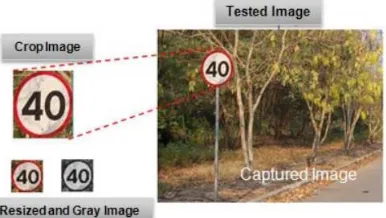
Sign Detection and Extraction: This stage is the image processing procedure. Image input from the video sequence with natural background viewing image is fed into the system. The image data is read both in color, red and green mode. As the red and green mode, image is the base image used to find the threshold of this image. This threshold is the criterion to change an image from red and green to a binary image. Moreover, the binary image is used to find contours and the interesting region later on. Before the red and green image is changed to binary, the technique of smooth image with Gaussians filter and Canny edge detection to enhance image. Therefore, it shows that the smooth technique has potential to enhance the image to obtain the required region. According to obtaining the binary image, it is processed to retrieve contours by find the contour function for a binary image, and to return the number of retrieved contours which are stored in the chain format. In the program, it checks if vertical and horizontal sizes are not different for more than the criteria of pixels. If the sizes of two ellipse axes pass the criteria that it is a circle of a traffic sign, then the point of the center of the ellipse is used to be a center of the crop image. The algorithm of the crop image is designed according to the structure of the image in pixels.
Furthermore, the crop image is resized to 30x30 pixels in each RGB layer, so that there are totally 2,700 pixels for each resized region. The crop region is converted from three channels (R, G, and B) to a single channel of grayscale ubsequently. The single layer gray scale image is called a “blob” which presented as input of the Neural Network.
Fig.4. Block diagram of pre-processing stage.
V. TRAFFIC SIGN DATA BASE DESCRIPTION
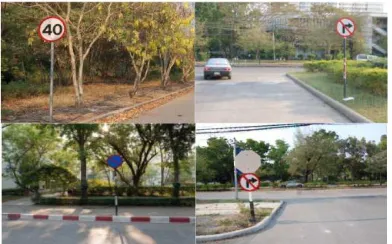
Fig :The 4 patterns of training data without problem in 5 different views.
VI. RECOGNITION CORE OBJECTS
Pattern recognition can be implemented by using a trained feed-forward neural network. Multilayer neural network is one of the most new discovery and widespread disseminated effective methods. The supervised back propagation which is frequently used in many applications is a learning technique used in this paper. In this research, multilayered feed forward neural network learns by using a back propagation algorithm. Because of its easy implementation, fast and efficient operation, multilayered feed forward network is widely accepted for applying to such this application. In the training process, the network obtains 63 essential training data parameters which are extracted by the Form Recognition Stage. The weights of 63 node-input layers are altered, and then the parameters are passed to the hidden layer respectively. When performing the network, the network recognizes the input patterns and attempts to distinguish the associated output patterns. The network progressively tunes the associated outputs with respect to input patterns until approaching the criteria. Subsequently, the best network architecture is accomplished selected by the validation data. After validating, the network finally delivers the output corresponded to a training input pattern with the least distance from those in input pattern.
VII. EXPERIMENTAL RESULT AND ANALYSIS
We have performed extensive benchmarking on the above described system, based on 30 minutes of traffic sign video material. The frame resolution in the videos is 384×288, typical signs appear in 10–55 pixels diameter. The scenario in the videos includes urban, highway, and freeway traffic, taken during both day and night time. Weather conditions are cloudy and sunny. It should be stated that the data is very difficult as most of the signs appear only in small resolution, that is, smaller than 20 pixels diameter.
This study discussed Traffic Sign Recognition (TSR) using Neural Networks technique. The images were pre-processed in stages with image processing techniques, such as, threshold technique, Gaussian filter, Canny edge detection, Contour and Fit Ellipse. The images have been extracted to small area region of traffic sign called “blob.” The main reason to select this method is to reduce the computational cost in order to facilitate real time implementation. Then, the Neural Network stages were performed to recognize the traffic sign patterns. The first strategy is to reduce the number of MLP inputs by pre-processing the traffic sign image, and the second strategy is to search for the best network architecture by selecting a suitable error criterion for training. The system was trained by a training data set, and validated by a validating data set to find the suitable network architecture. The cross-validation technique was implemented by a training data set, validating data set, and test set. The experiments show consistent results there with accurate classifications of traffic sign patterns with complex background images. The processing time in each frame of an image is approached and satisfied to apply in the real intelligent vehicle or driver assistance application.
REFERENCES
[1] R. Vicen-Bueno, R. Gil-Pita, M.P. Jarabo-Amores and F. L ́opez-Ferreras, “Complexity Reduction in Neural Networks Applied to Traffic Sign Recognition”, Proceedings of the 13th European Signal Processing Conference, Antalya, Turkey, September 4-8, 2005.
[2] R. Vicen-Bueno, R. Gil-Pita, M. Rosa-Zurera, M. Utrilla-Manso, and F. Lopez-Ferreras, “Multilayer Perceptrons Applied to Traffic Sign Recognition Tasks”, LNCS 3512, IWANN 2005, J. Cabestany, A. Prieto, and D.F. Sandoval (Eds.), Springer-Verlag, Berlin, Heidelberg, 2005, pp. 865-872.
[3] H. X. Liu, and B. Ran, “Vision-Based Stop Sign Detection and Recognition System for Intelligent Vehicle”, Transportation Research Board (TRB) Annual Meeting 2001, Washington, D.C., USA, January 7-11, 2001.
[4] H. Fleyeh, and M. Dougherty, “Road And Traffic Sign Detection And Recognition”, Proceedings of the 16th Mini - EURO Conference and 10th Meeting of EWGT , pp. 644-653.
[5] D. S. Kang, N. C. Griswold, and N. Kehtarnavaz, “An Invariant Traffic Sign Recognition System Based on Sequential Color Processing and Geometrical Transformation” , Proceedings of the IEEE Southwest Symposium on Image Analysis and Interpretation Volume , Issue , 21-24 Apr 1994, pp. 88 – 93.
[6] M. Rincon, S. Lafuente-Arroyo, and S. Maldonado-Bascon, “Knowledge Modeling for the Traffic Sign Recognition Task”, Springer Berlin / Heidelberg Volume 3561/2005, pp. 508-517.
[7] C. Y. Fang, C. S. Fuh, P. S. Yen, S. Cherng, and S. W. Chen, “An Automatic Road Sign Recognition System based on a Computational Model of Human Recognition Processing”, Computer Vision and Image Understanding, Vol. 96 , Issue 2 (November 2004), pp. 237 –268.