ISSN(Online): 2320-9801
ISSN (Print): 2320-9798
I
nternational
J
ournal of
I
nnovative
R
esearch in
C
omputer
and
C
ommunication
E
ngineering
(An ISO 3297: 2007 Certified Organization)
Vol. 4, Issue 2, February 2016
Process Instrumentation Made Easy Using
LabVIEW and Soft PID
Dr. Neelima Iyer1, Pooja Pawar2, Nagappa Karaganagi3, Umesh Borole4, Gaurav Bandal5
Sr. Principal Scientist and Chair, Instrumentation & Communication Unit, CSIR- National Chemical Laboratory,
(NCL), Pune
,
IndiaProject Student, Department of E & TC, Instrumentation & Communication Unit, NCL, Pune, India
Assistant Professor, Department of Instrumentation & Control Engineering, Government College of Engineering &
Research, Awasari (Kd), (GCOEARA) Pune, India
Sponsored Final year Students, Department of Instrumentation & Control Engineering, GCOEARA, Pune, India
ABSTRACT: With the development and popularization of computer technology, digitizer is replacing analog device
gradually. The measurement and control technology plays an important role in the process of production. As the time going, the traditional instruments are appearing the shortages. It becomes necessary to improve traditional instruments. The aim of our paper is to replace the traditional PID instrument with virtual, soft PID that has same controlling capabilities as that of traditional instrument. This designing is possible using LabVIEW – proprietary development by National Instruments (NI). NI PC add on DAQ card is used for interfacing with the hardware
.
KEYWORDS: PID, LabVIEW, simulation, control, industry, real time.
I. INTRODUCTION
A typical Process Instrumentation, four parameters are important – flow, temperature, pressure and level. To control these parameters PID controllers are used. The PID controller means Proportional Integral Derivative Controller used in many industries to compensate the tracking errors occurred in the various processes. PID controllers are used in control systems which are being used in the automated processes in industries. The job of a typical control system is to maintain something that is variable or changeable in a prescribed state. PID controllers are manufactured by Honeywell Experion, Emerson – Delta V, Foxboro, Yokogawa, GEFRAN etc. The operation of PID controller used in process is as per programming done. Language of PID controller and programming differs from manufacturer to manufacturer. Engineer trained for a particular Process Instrumentation application using PID from say Honeywell can not immediately adopt the operation of say Yokogawa PID. PID controller tuning is done by various methods i.e. Ziegler-Nichols, Cohen-coon, Lambda tuning etc. PID controller tuning for Honeywell and Emerson is done by controller gain (Kc) and for Yokogawa & Foxboro is done by proportional band. PID configured and programmed for a particular process can not be immediately reconfigured for another process. If there is a problem with hard PID, rectifying problem and sometimes ordering the same new PID takes lot of time. All these problems can be solved by using Soft PID using LabVIEW as mentioned below.
II. RELATED WORK
1. PID THEORY
ISSN(Online): 2320-9801
ISSN (Print): 2320-9798
I
nternational
J
ournal of
I
nnovative
R
esearch in
C
omputer
and
C
ommunication
E
ngineering
(An ISO 3297: 2007 Certified Organization)
Vol. 4, Issue 2, February 2016
is for the controller to act so that the process value is as close to the set point as possible. In a basic process control loop, the control engineer utilizes the PID algorithms to achieve this.
A. Proportional action :-
The proportional mode alone is simplest of the three. It characterized based on continuous linear relationship between controller input and output. It is also known as correspondence control, droop control and modulating control. The adjustable parameter of the proportional mode, Kc, is called as proportional gain. It simply amplifies the error based upon the gain. P mode generates offset. The proportional action responds to error in one to one correspondence.
B. Integral action :-
The integral mode sometimes used as single mode controller but is commonly found in combination with proportional mode. However, integral controller alone can not be used due to integral wind up problem. The adjustable parameter associated with integral mode is integral time Ti, or reset rate 1/Ti. The integral term magnifies the effect of long-term steady-state errors, applying ever-increasing effort until they reduce to zero.
C. Derivative action:-
The derivative mode of control is also called as rate control or preact control because its output is based on rate of change of input variable. This control is never used alone and commonly found in combination with proportional controlbecause output of this mode alone would be zero for constant value of input.
III. VIRTUAL INSTRUMENTATION VERSUS TRADITIONAL INSTRUMENTATION
Virtual instruments are defined by the user while traditional instruments have fixed vendor-defined functionality. Every virtual instrument consists of two parts – software and hardware. A virtual instrument typically has a sticker price comparable to and many times less than a similar traditional instrument for the current measurement task. However, the savings compound over time, because virtual instruments are much more flexible when changing measurement tasks. By not using vendor-defined, prepackaged software and hardware, engineers and scientists get maximum user-defined flexibility. A traditional instrument provides them with all software and measurement circuitry packaged into a product with a finite list of fixed-functionality using the instrument front panel. A virtual instrument provides all the software and hardware needed to accomplish the measurement or control task. In addition, with a virtual instrument, engineers and scientists can customize the acquisition, analysis, storage, sharing, and presentation functionality using productive, powerful software.
A. DATA ACQUISITION:-
ISSN(Online): 2320-9801
ISSN (Print): 2320-9798
I
nternational
J
ournal of
I
nnovative
R
esearch in
C
omputer
and
C
ommunication
E
ngineering
(An ISO 3297: 2007 Certified Organization)
Vol. 4, Issue 2, February 2016
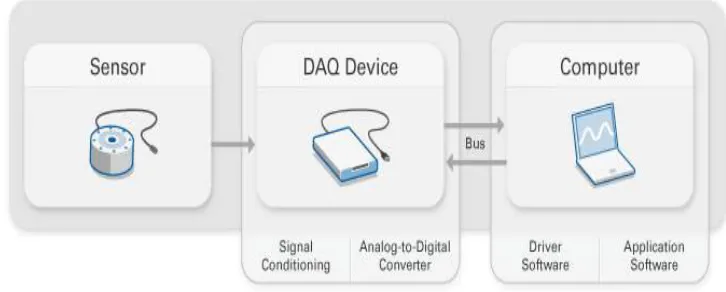
Data acquisition (DAQ) is the process of measuring an electrical or physical parameter such as voltage, current, temperature, pressure, or sound with a computer. A DAQ system consists of sensors, DAQ measurement hardware, and a computer with programmable software. Compared to traditional measurement systems, PC based DAQ systems take advantage of the processing power, productivity, display, and connectivity capabilities of industry-standard computers providing a more powerful, flexible and cost-effective measurement solution.
Process Instrumentation application for level control and measurements is developed at Instrumentation & Communication Unit, NCL, Pune.
IV. PROCESS BLOCK DIAGRAM
Fig. 2 Process block diagram
Figure 2 shows the process block diagram of overall system. Level is measured by level sensor, an output of which is voltage/current signal. This transmitter signal is sent to LabVIEW based soft PID Controller using DAQ. LabVIEW based soft PID Controller is used to generate the control signal. The control signal is a voltage signal, which is fed to final control element using DAQ. In this application we regulate the level of tank. Level of the tank is being measured by the level sensor. The output of level sensor is feed to the controller through data acquisition card NI PCI 6014. The signal is given to the soft PID as the process variable, and set point will be set by user. The corresponding control action will be generated by the PID. Further the control signal is used to produce PWM signal. This work is carried out in a laboratory. Real time control process will be executed shortly.
A. Soft PID:-
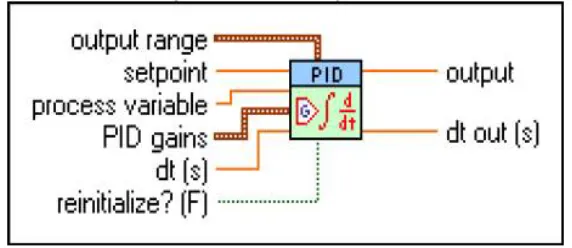
AS mentioned in the introduction, there are number of advantages of using LabVIEW Soft PID over hard PID. First of all very less maintenance cost, in fact non maintenance cost, Usage is flexible, reconfiguration of PID can be done by engineer in the control room. As soft PID is used on LabVIEW platform, number of LabVIEW based functionalities and tool kits can be added along with soft PID for Process Automation and control. This becomes a total solution. The following block is used to build the soft PID (Fig.3)
ISSN(Online): 2320-9801
ISSN (Print): 2320-9798
I
nternational
J
ournal of
I
nnovative
R
esearch in
C
omputer
and
C
ommunication
E
ngineering
(An ISO 3297: 2007 Certified Organization)
Vol. 4, Issue 2, February 2016
output range :-specifies the range to which to coerce the control output.
Setpoint specifies the setpoint value, or desired value, of the process variable being controlled.
process variable specifies the measured value of the process variable being controlled. This value is equal to
the feedback value of the feedback control loop.
PID gains specifies the proportional gain, integral time, and derivative time parameters of the controller.
proportional gain (Kc) specifies the proportional gain of the controller. The default is 1. In the equation that
defines the PID controller, KC represents the proportional gain.
integral time (Ti, min) specifies the integral time in minutes. The default is 0.01.
derivative time (Td, min) specifies the derivative time in minutes. The default is 0.
dt (s) specifies the loop-cycle time, or interval in seconds, at which this VI is called.
reinitialize? specifies whether to reinitialize the internal parameters, such as the integrated error, of the controller. Set reinitialize? to TRUE if your application must stop and restart the control loop without restarting the entire application. The default is FALSE.
outputreturns the control output of the PID algorithm that is applied to the controlled process. If this VI receives an invalid input, output returns NaN.
dt out (s) returns the actual time interval in seconds. dt out (s) returns either the value of dt (s) or the computed interval if you set dt (s) to –1.
V. SIMULATION AND RESULTS
LABVIEW BASED SOFT PID:-
Fig.4 Simulation block diagram
ISSN(Online): 2320-9801
ISSN (Print): 2320-9798
I
nternational
J
ournal of
I
nnovative
R
esearch in
C
omputer
and
C
ommunication
E
ngineering
(An ISO 3297: 2007 Certified Organization)
Vol. 4, Issue 2, February 2016
Fig.5 soft PID response
In above mentioned figure 5, white signal is input signal i.e. step to PID. Green signal is control signal. Red is output signal. Ziegler- Nichols method is sued for calculation the P, I and D parameters of PID. Calculated P value = 20 and I value = 70 are fed as input to PID gain block (Fig. 4). Third order transfer function (30s + 70) / (S3 + 10s2 + 50s + 70) is used for simulation purpose.
Fig.6 PWM signal
Please refer to Fig. 4, In simulation signal block, PID block output is also given to duty cycle input terminal. As PID output changes, the duty cycle of PWM signal changes (in Fig.6). PWM signal can be used for control action.
VI. CONCLUSION AND FUTURE SCOPE
ISSN(Online): 2320-9801
ISSN (Print): 2320-9798
I
nternational
J
ournal of
I
nnovative
R
esearch in
C
omputer
and
C
ommunication
E
ngineering
(An ISO 3297: 2007 Certified Organization)
Vol. 4, Issue 2, February 2016
With LabVIEW RT, complicated process scenario can be handled by making interrupt driven system. LabVIEW RT as a Master control, instrumentation solution can also be further enhanced using wireless communication protocols for sub system in process instrumentation.
REFERENCES
1. Instrument Engineers’ Handbook : Process Control – Bela G. Liptak – Vol. II, Edition III
2. Process Control Instrumentation Technology by Curtis D. Johnson
3. Pooja Pawar, Neelima Iyer, Vinayak Shinde “LabVIEW based communication – A real time & Robust solution for engineers” proceeding
NCECE-2016
4. National Instruments CSD manual
BIOGRAPHY
Dr. Neelima Iyer is Senior Principal Scientist and Chair, Instrumentation & Communication Unit, CSIR-National Chemical Laboratory, Pune, India. She is also Professor, Engineering Sciences, Academy of Scientific & Innovative Research (AcSIR). She perused Master from Pune University, Master from BITS, Pilani and Doctorate in Instrumentation Science from Pune University. She has research experience of 28 years in the field of instrument development, embedded electronics, PC based, LabVIEW based, Wireless Instrumentation & Non Invasive developments and 11 years experience in the field of Voice Over IP (VOIP) telecommunication.