A Study on Learning Technical English by Language
Low Achivers and Language High Achivers in the
Engineering Colleges
V.Karunanithi1
Assistant Professor, Dept. of English, Sasurie College of Engineering, Tirupur, Tamilnadu, India1
ABSTRACT:Learning of language is a meaningful process involving individual perceptions that is why language
learning effects vary among individual learners. The understanding of low achievers and high achievers in erode district Are to discuss whether it is necessary to propose an effective strategy on language low achievers and high achievers. The result indicates the variables of both learners
I. INTRODUCTION
Both the teachers and the learners face a number of difficulties while learning the English as a second language. There are different kinds of opinion regarding how to proceed to teach the language; what sort of book should be prepared for the students.
1.1.ENGLISH LANGUAGE TEACHING IN TAMIL NADU
As far as the Tamilnadu is concerned, our government welcomes English as a link language. In Tamil Nadu, it is made compulsory to learn English from primary level as a second language even in Tamil medium schools. In most of the government and government-aided schools, the medium of instruction is Tamil and rarely in some schools are subjects
taught through the medium of English whereas in matriculation and
Anglo-Indian schools the medium of Instruction is only English.
1.2 THE ROLE OF THE ENGLISH TEACHER
In fact, John Marenbon, the author of the pamphlets attacking the current orthodoxies of the English teaching profession, presents quite a convincing case for the notion of appropriateness, trying to characterize what was wrong with it.
1.3 THE ROLE OF ENGLISH LANGUAGE FOR ENGINEERING COMMUNICATION
Today’s engineer has to communicate with more number of his counter parts across the globe. A Large number of Indian engineers have to now travel to many continents and work away from their home country. Also, among the scientists, technologists and business experts from culturally and linguistically different communities, English has become the predominant language for communication.
II. GENERAL OBJECTIVES OF ENGINEERING COLLEGES
III. STATEMENT OF THE PROBLEM
Although sufficient time and efforts have been invested both on the part of learners and of planners for English learning and teaching respectively, the learning achievements achieved by the English learners are not up to the mark. There are miles to go in achieving perfection in English language. This trend prevails in all quarters of learners. The engineering students are also not freed from these problems. This rational prompted the present research to penetrate into problems of engineering students studying in the engineering colleges of Erode district, while learning technical English.
3.1 STUDIES IN INDIA
The researches on errors on Indian users of English as Second languages were practically few. Of these, the researches investigating the role of different variables in relation to errors comprised a humble assortment with hardly anyone directly related to the present investigation.
Prasher (1977) undertook a study of the errors in English of Hindi-Speaking undergraduate students for the Central
Institute of English and Foreign Languages, Hyderabad (India). The sample comprised of 100 first year students from different colleges in Madhya Pradesh. The study focused on investigation of errors in certain selected areas of English grammar and lexis only. The errors of students were described in linguistic terms and some of the probable sources of errors were explained.
Samples of students’ English were obtained through a free composition and a passage for translation form Hindi into
English. In all, 4161 errors were identified and categorized under
15 major areas listed in order of frequency of recurrence. Of these, errors in the verb phrase formed the bulk of the total errors. Interference of the Mother Tongue was identified as the primary source of errors.
Patrikar (1981) studied the errors committed in the first year, second year and final year under graduate
students of Nagpur, Ankola and Amravati in the Vidharba region in the different areas of written language. To judge the errors in their proper context, sentences were examined in free compositions. A total of 300 scripts (valued answer books) were studied. The observed errors were classified into four major categories namely; Lexical, Morphological, Orthographical and Syntactical. The study revealed that the students’ knowledge of English vocabulary, morphology and syntax as very “confused.” “use of wrong items, omissions and wrong substitutions, lack of knowledge and control over the structure of language, interference of the mother tongue and lack of fundamental grounding for the receptivity of students from psychological and environmental points of view were the major causes” of the errors.
IV. OBJECTIVES
This study has the following objectives.
i) To unearth the errors in terms of impediments experienced by the engineering students of the colleges of Erode district while using technical English in all the linguistic levels viz., phonological, Graph logical, morphological, lexical, syntactical and semantically and thereby understanding the learning process and strategies adopted by the Engineering students.
ii) LIMITATION
iii) The present study confines its purview with only to the first year engineering students of the
engineering colleges of Erode district. It does not pay its heed on understanding the performance differences of the students belonging to various social variables, like, medium of education, mother tongue, region, discipline, sex etc., Thus, it talks about the holistic performance of the students of the Engineering colleges of Erode District, without differentiating their performance based on the heterogenic nature of the them.
V. SELECTION OF SAMPLES
analysis has not been made with a view to differentiate these variables. The data have been elicited from four colleges in Erode district From the total population, about 200 students representing the cited variables have been chosen for the present study from the first year students of various colleges located in Erode District.
VI. CORPUS ELICITATION
Relevant corpuses have been gathered in the light of objectives envisaged from the 200 informants. To obtain data, a special research tool, i.e. a test device has been designed in such a way to appraise the performance of the students under study. This test device has been administered with the samples selected. The samples have been instructed to accomplish all the language tasks articulated in the test device, their class notes on various subjects and internal exam papers on varying subjects have also been referred to. Informants’ informal linguistic behavior in English language has also been observed for obtaining corpus by the researcher. In many an occasion the researcher had attended the regular classes conducted for these students with an aim to observe their linguistic behaviors in the classroom situations. Since the researcher himself is teaching English in one of the colleges of Erode District, it enabled him to augment the data as per his requirements.
VII. RESEARCH TOOL
A specially prepared test device has been administered for the present task.
This tool consists of questions pertaining to all the skills. For testing various skills questions were posed for understanding spelling problems, morphological problems, lexical problems, syntactical problems and semantic problems. However importance is given to technical terms of engineering subjects. Apart from that, students were requested to perform various types of linguistic behavior using technical and general English.
VIII. RESEARCH METHODS
The present study adopted Descriptive and Analytic methods besides applying modern linguistic principles pertaining to language teaching in general, second language teaching in question. The corpus elicited through research tools and by scanning the students note books and exam papers have been categorized and processed based on the objectives envisaged and those data have been analyzed applying the modern linguistic principles so as to unearth the causes for those problems and to understand the learning processes adopted by the students. Based on the findings of the analysis, the problems of engineering students have been identified and suitable solutions for averting those problems have also been advocated.
IX. SOCIAL RELEVANCE OF THE STUDY
The findings and results obtained through the present study yield many a fruit both to the field of English Language Teaching in question and society in general.
As far as Erode is concerned, no study, similar to the present study, has been made topicalizing the Engineering students of Erode district on technical English learning. Thus, the present study would present totally a new corpus to the field of English Language Teaching. That, in turn, improves the quality of ELT research in future.
X. BEHAVIORAL THEORIES
10.1COGNITIVE THEORIES
These theories point out the active engagement of the mind in relation to matter and consideration. In this type of theory, importance is given to the process involved in creative responses and to the organization of perception that goes on in the mind.
10.2. HUMANIST THEORIES
These learning theories are more recent in origin and are not as coherent as those found in the other two theories. In these, also importance is given to the active nature of the learners. Indeed the learners’ actions largely create the learning situation.
10.3ERRORS IN PREPOSITION
People rushed towards the company ofseat . I am professor in Mechanical Engineering.
In these two construction of has to be replaced by ‘for’ and ‘in’ has to be replaced by ‘of ‘. The students, without knowing the meaning variation, wrongly substituted those preposition for the purpose of meaning making. So, in turn, they could not get the correct meaning of these utterances. Consider the following example,
10.4ERRORS IN ARTICLE
As stated above, the article has no significant role to play in the process of meaning making. In certain occasions (to specify the oneness or the item already referred to) it is useful, but in most of the contexts it does play any major or significant role. So the students, with their wish and need put article. i.e., they pay less attention on those grammatical categories, therefore they are not in a position to properly handle both in productive and receptive skills.
10.5. MAKING NOMINAL COMPOUNDS
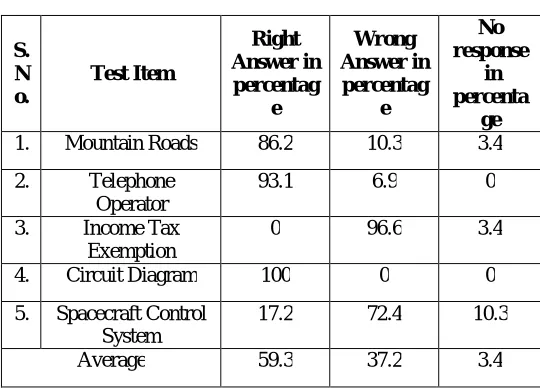
In Analysis of the scores showed that the maximum score was four and minimum score was 1 with an
average of 3 for the test. All the students came up with the right answer for test item no.4. Test item no.2 registered 93% correct, test item 1, 86% and test item 5, 17%. None of the students had got the right answer for item no. 3.
TABLE – 10.5 TEST I-MAKING NOMINAL COMPOUNDS
S. N o.
Test Item
Right Answer in percentag
e
Wrong Answer in percentag
e
No response
in percenta
ge
1. Mountain Roads 86.2 10.3 3.4
2. Telephone
Operator
93.1 6.9 0
3. Income Tax
Exemption
0 96.6 3.4
4. Circuit Diagram 100 0 0
5. Spacecraft Control
System
17.2 72.4 10.3
Average 59.3 37.2 3.4
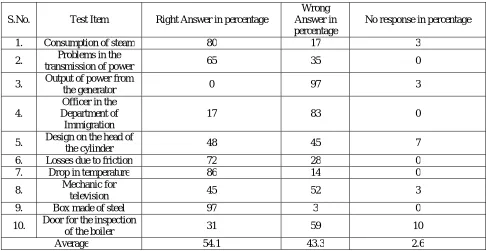
In Test II, 10 compound nouns were presented which required the test takers to expand them to present the concept in a different way. The students were to understand the test item given and give the expanded version of the compound noun. This tested not only the conceptual knowledge of the students but also their knowledge of grammar in the use of right prepositions while expanding the compound nouns.
The maximum and minimum score for test no VII were 4.5 and 1 respectively. The mean score for test VII was 2.5. Test II reveals interesting factors. For test item no. 9 there was 97% correct answers followed by item no. 7 (86.2%) and item no.1 (79.3%). Maximum number of students 97% answered item no.3 wrongly, followed by item no.4 and item no.10. the maximum ‘no response’ for this test was 10% for test item no.10 and the minimum was 0% for test item nos. 2,4,6,7,9.
TABLE – 10.6. TEST-II-EXPANSIONS OF NOMINAL COMPOUNDS
There were also clear cases of not understanding the concept and hence answers like ‘a machine which consumes steam’ in test item 1, ‘problems faced by power transmission’ in test item 2, ‘design that has a cylindrical head’ in test item 5, ‘drop due to temperature’ in test item 7, ‘mechanic in television’ and ‘mechanic television’ in test item 8, ‘box in steel’ in test item 9 etc. students’ lack of knowledge and improper use of preposition was manifested in answers ‘consumption by steam’ in test item 1, ‘problems about power transmission’ in test item 2, ‘losses in friction’ and ‘losses of friction’ in test item 6, ‘drop of temperature’ in test item 7, ‘box in steel’ in test item 9, ‘door with boiler inspection’, ‘door under inspection boiler’ in test item 10 etc.
From the above instances, it was clear that there were quite a number of learners who lack the ability to say the right thing in the right way. The errors also suggested that the learners do not learn all compounds as single new items but rather put parts together to create the compounds. Of the two tests, students had performed remarkably well in making compounds nouns rather than expanding them. This explicitly showed that students to some extent were aware of the rules of compounding and had tried to expand them by putting together the meanings of the constituent words in an acceptable manner.” (p 23).
The analysis of the errors in test I and II shows that, “Even though many languages use compounding to create new words second language learners often find these forms difficult. Learners are not always sure whether the compound is possible” (Hatch &Brown, 1995, p 194).
S.No. Test Item Right Answer in percentage
Wrong Answer in percentage
No response in percentage
1. Consumption of steam 80 17 3
2. Problems in the
transmission of power 65 35 0
3. Output of power from
the generator 0 97 3
4.
Officer in the Department of
Immigration
17 83 0
5. Design on the head of
the cylinder 48 45 7
6. Losses due to friction 72 28 0
7. Drop in temperature 86 14 0
8. Mechanic for
television 45 52 3
9. Box made of steel 97 3 0
10. Door for the inspection
of the boiler 31 59 10
XI. CONCLUSION