IOT - Wearable Device – Yoga and Exercise
Streamer
Rakshitha K S1, Deveshkumar Chotrani2, Jyoti Verma3
Assistant Professor, Department of Computer Engineering, Sri Krishna Institute of Technology Bengaluru, India1
U.G. Student, Department of Computer Engineering, Sri Krishna Institute of Technology, Bengaluru, India2,3
ABSTRACT: With the rapid development of the Internet of Things, cloud computing, and big data, more
comprehensive and powerful applications become available. Meanwhile, people pay more attention to higher QoE and QoS in a “terminal-cloud” integrated system. Specifically, both advanced terminal technologies (e.g., smart clothing) and advanced cloud technologies (e.g., big data analytics and cognitive computing in clouds) are expected to provide people with more reliable and intelligent services. Therefore, in this article we propose a Wearable 2.0 healthcare system to improve QoE and QoS of the next generation healthcare system. In the proposed system, washable smart clothing, which consists of sensors, electrodes, and wires, is the critical component to collect users’ physiological data and receive the analysis results of users’ health and emotional status provided by cloud-based machine intelligence.
KEYWORDS: MVC, GPS, GSM, Fuel, A Bus arrival information system, ATmega8 microcontroller
I. INTRODUCTION
Due to the ever growing number of elderly people coupled with limited resources in terms of medical facilities and personnel in many countries, the burden that conventional healthcare systems carry is becoming heavy. On the other hand, traditional human face-to-face communications are mostly replaced by networking in social and cyber spaces, which causes various unhealthy living habits, such as insufficient physical exercise, unhealthy diet, irregular sleeping, and more frequent “burning the midnight oil.” All these factors are usually the keys to triggering chronic diseases, including cardiovascular disease, hyperlipemia, diabetes, tumor, obesity, and chronic respiratory disease. As reported in “The Leading Causes of Death and Disability in the United States,”1 50 percent of people in the United States suffer from one or more kinds of chronic diseases at different levels, while 80 percent of medical funds in the United States are used to treat chronic disease. In 2015, the United States spent $2.7 trillion on chronic disease treatment, which accounts for 18 percent of the U.S. gross domestic product.
Therefore, it is a great challenge to design a cost-effective heathcare system for handling chronic diseases, especially considering the large population of elderly people and empty nesters, most of whom suffer from one or more chronic diseases. To address this issue, we should lower the operating cost and improve their scalability of healthcare systems, which are expected to provide various basic healthcare services [1], such as physiological monitoring, early warning via abnormal vital signs, and online patient consultations [2]. Fortunately, with the assistance of cloud computing and big data, various advanced services become possible by the use of big data analysis for chronic disease detection and intelligent health monitoring [3]. However, it is difficult to solve the following undesirable issues in existing healthcare systems.
Physiological Data Collection: Without considering users’ mobility, traditional physiological data collection is uncomfortable for users because they must wear multiple sensors or related devices. On the other hand, if only simple devices (e.g., smart bracelet and smart watch) are carried, the collected data is inaccurate. Thus, how to accurately collect sufficient physiological data in a comfortable way is still an unsolved problem..
Sustainable Big Physiological Data Collection: Nowadays, wearable techniques are widely accepted in the market, including smart watches, smart bracelets, wearable sleep aid devices, sport monitoring and promotion, and so on. Although users may not have observable discomfort while wearing such devices in their daily life, the collected physiological data are usually simple and cannot be called “big data,” even for long-term monitoring.
II. RELATEDWORK
SYSTEM DESIGN
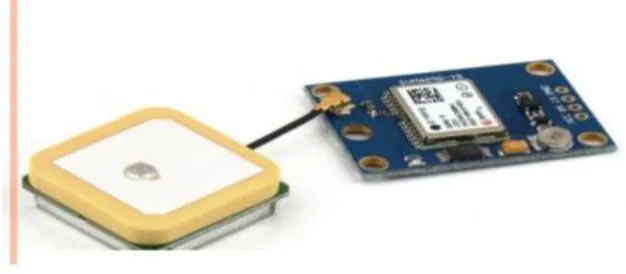
GPS TECHNOLOGY
The global positioning system (GPS) is a satellite-based navigation system consists of a network of 24 satellites located into orbit as shown at figure 2. The system provides essential information to military, civil and commercial users around the world and which is freely accessible to anyone with a GPS receiver. GPS works in any weather circumstances at anywhere in the world. Normally no subscription fees or system charges to utilize GPS.
Fig 1:GPS Module
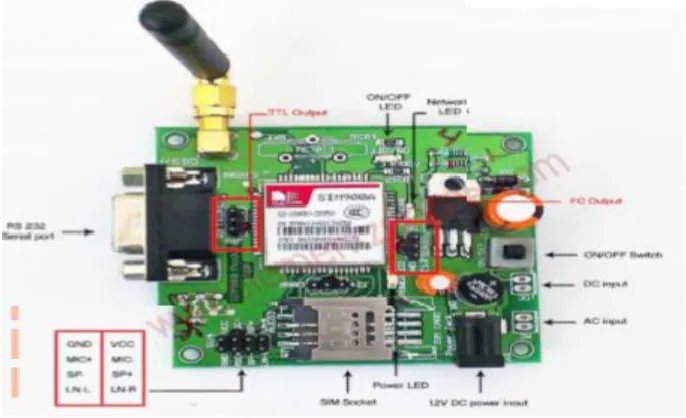
GSM MODULE
Fig 2:GSM Module
SYSTEM ARCHITECTURE
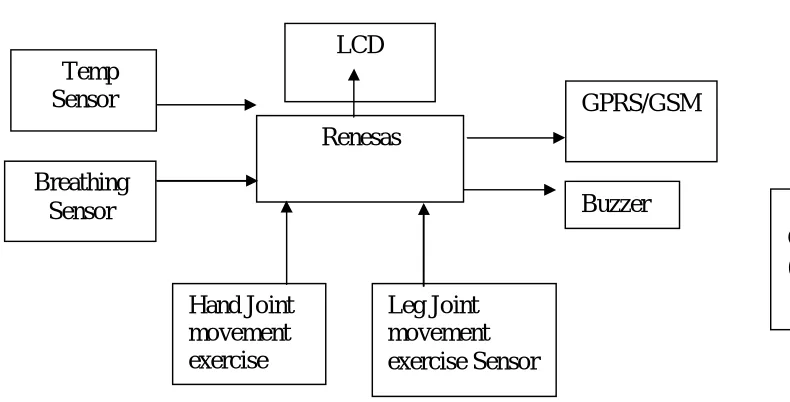
A system architecture or systems architecture is the conceptual model that defines the structure, behavior and more views of a system. An architecture description is a format description and representation of a system, organized in a way that supports reasoning about the structures and behaviors of the system. A system architecture can comprise system components, the expand systems developed, that will work together to implement the overall system. System architecture conveys the informational content of the elements comprising a system, the relationship among those elements, and the rules governing those relationships.
The architectural components and set of relationships between these components that an architecture description may consist of hardware, software, documentation, facilities, manual procedures or roles played by organizations or people. The below figure shows the system architecture or the block diagram of our project which portrays the system components and their working and also their interaction.
MODULES DESIGN
Fig 3: System Architecture
Micro Controller
Fig4 : Micro Controller
As we know that a microcontroller is a small computer on a single integrated circuit. In modern technology it is similar to, but less sophisticated than , a system on a chip .The AT89C51 is a low power , high performance COMS 8-bit microcomputer with 4K bytes of Flash programmable and erasable read only memory. It control unit of the entire project .Here we are using a 40 pin IC and the IC Number is SST89E516RD2(Silicon Storage Technology). MAX 232 IC is used to covert RS (register select ) to TTL(translator transistor logic).Two types of capacitor are used one is ceramic capacitor of 0.01MF for the purpose of synchronization and other is the electrolyte capacitor of 4.7MF. And overall a 12V power supply is given to it.
This device is manufactured using Atmel’s high-density non-volatile memory technology. The on-chip Flash allows the program memory to be reprogrammed in-system or by a conventional nonvolatile memory programmer. By combining
LCD
Renesas
Breathing
Sensor
Hand Joint
movement
exercise
Sensor
Temp
Sensor
GPRS/GSM
Amazon
Cloud Server
(AWS Graph
Buzzer
a versatile 8-bit CPU with Flash on a monolithic chip, the Atmel AT89C51 will act as a powerful microcomputer which provides a highly-flexible and cost-effective solution to many embedded control applications.
A microcontroller is a small and low cost computer built for the purpose of dealing with specific tasks, such as displaying information in a microwave LED or receiving information from a television’s remote control. A microcontroller is a computer present in a single integrated circuit which is dedicated to perform one task and execute it.
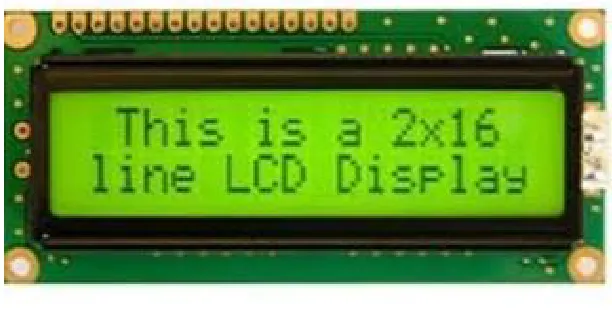
LCD 16*2
Fig 5 : LCD 16*2
LCD stands for Liquid Crystal Display which is used to display the location of bus. We are using 14 pins LCD which are given below:
Pin 7 to Pin 14 All 8 pins are responsible for the transfer of data. Pin 4 This is RS i.e, register select pin. 5 This is R/W.
Pin 6 This is Enable pin Pin 2 This is VDD Pin 1 This is VSS Pin 3 This is short pin
A liquid crystal display is a thin, flat electronic visual display that uses the light modulating properties of liquid crystals (LCs). LCs does not emit light directly. In liquid
crystal displays (LCDs) of liquid crystal technology is the most common applications. An advanced VGA computer screen from the pervasive wrist watch and pocket calculator, this type of display has evolved into an important and ambidextrous interface.
Consist of a liquid crystal display, an array of tiny segments (called pixels) and to present the information that can be manipulated. This basic common idea is to all displays, alienate from simple calculators to a full color LCD television.
The primary factor was size, an LCD consisting of primarily with some liquid crystal material between them of two glass plates. There is no bulk amount picture tube. This gives LCDs practical for applications where size (as well as weight) is necessary.
SIM908 GPS/GSM
Fig6 : SIM908 GPS/GSM
SIM908 is a Tri-band GSM/GPRS engine that works on frequencies EGSM 900 MHz, DCS 1800 MHz and PCS 1900 MHz. SIM300 features GPRS multi-slot class 10/ class 8 (optional) and supports the GPRS coding schemes 1, CS-2, CS-3 and CS-4.
You can use AT Command to get information in SIM card. The SIM interface supports the functionality of the GSM Phase 1 specification and also supports the functionality of the new GSM Phase 2+ specification for FAST 64 kbps SIM (intended for use with a SIM application Tool-kit).Both 1.8V and 3.0V SIM Cards are supported. The SIM interface is powered from an internal regulator in the module having nominal voltage 2.8V. All pins reset as outputs driving low.
The "AT" or "at" prefix must be set at the beginning of each command line. To terminate a command line enter <CR>. Commands are usually followed by a response that includes.”<CR><LF><response><CR><LF>”. Throughout this document, only the responses are presented, <CR><LF> are omitted intentionally.
Global system for mobile communication (GSM) is a globally accepted standard for digital cellular communication. GSM is the name of a standardization group established in 1982 to create a common European mobile telephone standard that would formulate specifications for a pan-European mobile cellular radio system operating at 900 MHz. It is estimated that many countries outside of Europe will join the GSM partnership.
III. IMPLEMENTATION
We have developed a prototype module. in future, this project can be taken to the product level. to make this project as user friendly and durable, we need to make it compact and cost effective. going further, most of the units can be embedded along with the controller on a single board with change in technology, thereby reducing the size of the system.
A prototype module will be developed for the project. It includes individual PCB boards for all interfaces according to the block diagram. Every PCB will be inter-connected with jumper wires.
Renesas microcontroller is used to control all the operations.
LCD is used to show all the operations that are going inside the microcontroller.
Temperature Sensor is used to measure body temperature of pateint
Joint movement exercise sensor is used to measure regular exercise of the patient.
GSM/GPRS is used to send data from controlling unit to Android, and also it gets updated to Amazon server.
IV.EXPERIMENTALRESULT
Problem definition of our underlying system which is basically useful for doctor’s for monitoring patient’s health parameter and gets the accurate result.
The doctors are continuously monitor the health parameter of ICU patients from any location and virtually connected to the patient through website.
Also through this system real time parameter values can be measured so this system is beneficial for hospitals as well as in clinic also.
Through this system, the doctor can able to calculate temperature, ECG, heart rate values efficiently and store data on raspberry pi temporarily.
The values are in form of - Temperature we are getting Celsius, heart rate in pulses, ECG in percentage shown on display as well as on website.
The any threshold value will be fluctuating from specified value then the alarm will be triggered which is connected through raspberry pi and RMO’s get the alert.
V. CONCLUSION
In this article, we comprehensively investigate the disadvantages of the existing healthcare system and the trend of wearable computing. Then a Wearable 2.0 healthcare system is proposed based on smart clothing to improve QoE and QoS of the next generation healthcare system. In the proposed system, the user’s physiological data is unconsciously collected, and personalized healthcare services are big data analytics on clouds. Furthermore, this article presents system architecture, functional components, and the design details of smart clothing based on a Wearable 2.0 healthcare system. Finally, a testbed with various compelling scenarios are presented to verify the feasibility of the proposed architecture.
REFERENCES
[1] M. S. Hossain and G. Muhammad, “Cloud-Assisted Industrial Internet of Things (IIoT)–Enabled Framework for Health Monitoring,” Computer
Networks, vol. 101, 2016, pp. 192–202.
[2] S.-H. Seo, J.-W. Jang, and S.-W. Jang, “Design and Implementation of a Smart Clothing System Coping with Emergency Status,” Int’l. Info.
Inst., Tokyo, vol. 19, no. 1, 2016, p. 175.
[3] K. Zhenget al., “Big Data-Driven Optimization for Mobile Networks Toward 5G,” IEEE Network, vol. 30, no. 1, Jan. 2016, pp. 44–51.
[4] M. Chen et al., “Smart Clothing: Connecting Human with Clouds and Big Data For Sustainable Health Monitoring,” Mobile Networks and
Applications, 2016, pp. 1–21.
[5] L. Hu et al., “Software Defined Healthcare Networks,” IEEE Wireless Commun., vol. 22, no. 6, Dec. 2015, pp. 67–75.