ABSTRACT
THUMMALAPENTA, SURESH. Improving Software Productivity and Quality via Mining Source Code. (Under the direction of Tao Xie.)
The major goal of software development is to deliver high-quality software efficiently. To achieve this goal of delivering high-quality software efficiently, programmers often reuse existing frameworks or libraries, hereby referred to as libraries, instead of developing similar code arti-facts from the scratch. However, programmers often face challenges in reusing existing libraries due to two major factors. First, many existing libraries are not well-documented. Even when such documentations exist, they are often outdated. Second, many existing libraries expose a large number of application programming interfaces (APIs), which represent interfaces through which libraries expose their functionalities. For example, the .NET base library provides nearly 10,000 API classes. Due to these two preceding factors, there exist three major problems that affect both software productivity and quality. First, programmers often spend more time in reusing existing libraries, thereby reducing software productivity. Second, programmers intro-duce defects while using APIs due to lack of proper knowledge on how to reuse those APIs. Third, existing white-box test generation techniques face challenges in effectively generating test inputs for the client code that reuses libraries.
To address these three preceding issues, in this dissertation, we propose a general frame-work, calledWebMiner, that uses existing open source code available on the web by leveraging a code search engine. In particular, WebMiner infers usage specifications for API methods under analysis by automatically collecting relevant code examples from the open source code available on the web. WebMiner next applies data mining techniques on those collected code examples to identify common patterns, which represent likely usage of APIs, referred to as API usage specifications. The primary reason for identifying common patterns is based on the observation that majority of the programmers correctly adhere to API usage specifications and those common patterns are likely to represent the correct usage of APIs.
available for the API methods under analysis or usage information is not sufficient to achieve the SE task under analysis.
c
⃝ Copyright 2011 by Suresh Thummalapenta
Improving Software Productivity and Quality via Mining Source Code
by
Suresh Thummalapenta
A dissertation submitted to the Graduate Faculty of North Carolina State University
in partial fulfillment of the requirements for the Degree of
Doctor of Philosophy
Computer Science
Raleigh, North Carolina 2011
APPROVED BY:
Mladen Vouk Laurie Williams
Yan Solihin Tao Xie
DEDICATION
BIOGRAPHY
ACKNOWLEDGEMENTS
First, I would like to thank my advisor, Tao Xie, for his invaluable guidance and financial support throughout my Ph.D. studies. His professional advice helped me improve my research skills, technical writing, and effective presentation, and will continue to benefit me in my future career. I thank Mladen Vouk, Laurie Williams, and Yan Solihin for serving on my dissertation committee and providing valuable feedback on my dissertation research. Portions of this dis-sertation were previously published at ASE 07 [119] (Chapter 3), ASE 08 [120] (Chapter 3), ASE 09 [121] (Chapter 4), ICSE 09 [122] (Chapter 4), ESEC/FSE 09 [125] (Chapter 5), and TAP 10 [118] (Chapter 5). The material included in this dissertation has been updated and extended.
I thank my internship mentors in the industry, who have immensely helped me expand my research to a broader scope: Massimiliano Di Penta (RCOST, Italy), Guofei (Geoff) Jiang, Franjo Ivancic, and Sriram Sankaranarayanan (NEC Laboratories, USA), Nikolai Tillmann, Peli de Halleux, and Wolfram Schulte (Microsoft Research, USA). I thank Massimiliano Di Penta, Guofei Jiang, Nikolai Tillmann, Peli de Halleux, and Tao Xie for writing recommendation letters supporting my summer internship and full-time job applications. I am also grateful to my research collaborators: Hao Zhong, David Lo, Luigi Cerulo and Lerina Aversano. I would like to gratefully acknowledge researchers who generously shared their research tools and results used in my dissertation. I thank Westley Weimer (University of Virginia) for sharing his research results, Shuvendu Lahiri (Microsoft Research) for sharing Randoop tool, Nikolai Tillmann and Peli de Halleux (Microsoft Research) for providing support for the Pex tool. I am very much thankful to all my peers at the Automated Software Engineering group, Tao Xie’s research group at NC State, for their constant support, insightful discussions and useful feedback on my research. My research was supported by Army Research Office (ARO) grant W911NF-08-1-0443, and NSF grants CNS-0720641 and CCF-0725190, and ARO grant W911NF-08-1-0105 managed by NCSU Secure Open Systems Initiative (SOSI). Gratitude to the Department of Computer Science for Teaching Assistantship opportunity during my first semester and financial support during my PhD.
TABLE OF CONTENTS
List of Tables . . . ix
List of Figures . . . x
Chapter 1 Introduction . . . 1
1.1 Motivation . . . 1
1.2 Problems . . . 3
1.3 Solution . . . 4
1.4 Contributions . . . 5
1.5 Scope . . . 7
1.6 Outline . . . 7
Chapter 2 WebMiner Framework . . . 8
2.1 Introduction . . . 8
2.2 Search Phase . . . 9
2.3 Analyze Phase . . . 11
2.3.1 Resolve object types . . . 11
2.3.2 Generate candidates . . . 12
2.4 Mine Phase . . . 14
2.5 Apply Phase . . . 15
2.6 Chapter Summary . . . 15
Chapter 3 Improving Software Productivity . . . 16
3.1 Introduction . . . 16
3.2 PARSEWeb: Assisting programmers in writing method sequences . . . 17
3.2.1 Motivation . . . 17
3.2.2 Example . . . 18
3.2.3 Approach . . . 20
3.2.4 Evaluation . . . 25
3.3 SpotWeb: Detecting framework hotspots and coldspots . . . 31
3.3.1 Motivation . . . 31
3.3.2 Example . . . 33
3.3.3 Approach . . . 36
3.3.4 Evaluation . . . 41
3.4 Related Work . . . 47
3.5 Chapter Summary . . . 49
Chapter 4 Improving Software Quality via Static Verification . . . 50
4.1 Introduction . . . 50
4.2 CAR-Miner: Detecting Exception-Handling Defects . . . 51
4.2.1 Motivation . . . 51
4.2.3 Approach . . . 56
4.2.4 Evaluation . . . 60
4.3 Alattin: Detecting Neglected Conditions . . . 68
4.3.1 Motivation . . . 68
4.3.2 Example . . . 71
4.3.3 Mining Algorithms for Alternative Patterns . . . 73
4.3.4 Approach . . . 79
4.3.5 Evaluation . . . 82
4.4 Related Work . . . 90
4.5 Chapter Summary . . . 93
Chapter 5 Improving Software Quality via Dynamic Test Generation . . . 94
5.1 Introduction . . . 94
5.2 Background . . . 98
5.2.1 Pex . . . 98
5.2.2 Parameterized Unit Test (PUT) . . . 98
5.2.3 Dynamic Code Coverage . . . 98
5.2.4 Randoop . . . 99
5.3 Formal Definitions . . . 99
5.4 MSeqGen: Method Sequence Generation via Mining Source Code . . . 101
5.4.1 Motivation . . . 101
5.4.2 Example . . . 102
5.4.3 Approach . . . 104
5.4.4 Evaluation . . . 109
5.5 DyGen: Regression Test Generation via Mining Dynamic Traces . . . 115
5.5.1 Motivation . . . 115
5.5.2 Approach . . . 117
5.5.3 Evaluation . . . 121
5.6 Seeker: Demand-Driven Method Sequence Generation . . . 127
5.6.1 Motivation . . . 127
5.6.2 Example . . . 130
5.6.3 Approach . . . 132
5.6.4 Evaluation . . . 137
5.7 Related Work . . . 146
5.8 Chapter Summary . . . 148
Chapter 6 Future Work . . . .149
6.1 Mining Unstructured Software Engineering Data . . . 149
6.2 Moving from Syntactic to Semantic Analysis . . . 151
6.3 Combining Static Verification and Dynamic Testing . . . 152
Chapter 7 Assessment and Conclusion . . . .157
7.1 Conclusion . . . 157
7.2 Risk Analysis . . . 158
7.3 Lessons Learned . . . 159
LIST OF TABLES
Table 3.1 Evaluation results of programming tasks from the Logic Project. . . 28
Table 3.2 Evaluation results of programming tasks previously used in evaluating XS-nippet. . . 30
Table 3.3 Evaluation results of PARSEWeb internal techniques. . . 31
Table 3.4 Subjects used for evaluating SpotWeb. . . 41
Table 3.5 Evaluation results showing the detected hotspots and coldspots. . . 42
Table 3.6 Hotspots of DNSJava reused by James. . . 44
Table 3.7 Hotspots described in the Log4j documentation. . . 45
Table 4.1 Characteristics of subjects used in evaluating CAR-Miner. . . 61
Table 4.2 Classification of exception-handling rules. . . 62
Table 4.3 Classification of detected violations. . . 63
Table 4.4 Status of detected defects in new versions of subject applications. . . 63
Table 4.5 Defects detected or missed by CAR-Miner. . . 67
Table 4.6 Defects detected by Sequence Association Rules. . . 67
Table 4.7 Subject applications and their characteristics. . . 84
Table 4.8 Alternative patterns mined by Alattin. . . 84
Table 4.9 Analysis of violations detected in subject applications. . . 88
Table 5.1 Evaluation results showing higher branch coverage achieved by Randoop with the assistance of MSeqGen. T: Test code, R: Randoop, M: MSeqGen . 112 Table 5.2 Evaluation results showing higher branch coverage achieved by Pex with the assistance of MSeqGen. # C: number of classes, P: Pex, M: MSeqGen 114 Table 5.3 Ten .NET libraries used in our evaluations. . . 122
Table 5.4 Comparison of coverage achieved for ten .NET libraries used in our eval-uation. . . 125
Table 5.5 Subjects and their characteristics. . . 138
Table 5.6 Branch coverage achieved by Randoop, Pex, Seeker, and manually written tests. . . 140
Table 5.7 Statistics of generated sequences. . . 142
Table 5.8 Def-Use coverage achieved by Randoop, Pex, Seeker, and manually written tests. . . 142
Table 5.9 All defs coverage achieved by Randoop, Pex, Seeker, and manually written tests. . . 143
Table 5.10 Defects detected by all approaches. . . 144
LIST OF FIGURES
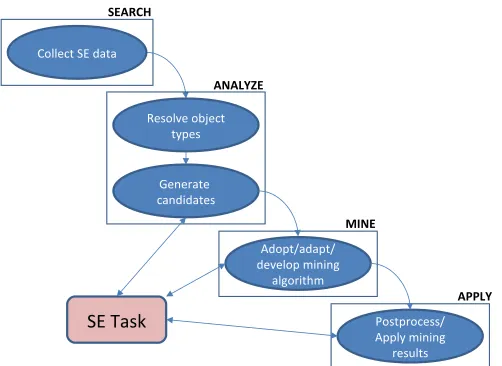
Figure 2.1 Four major phases of our WebMiner framework. . . 9
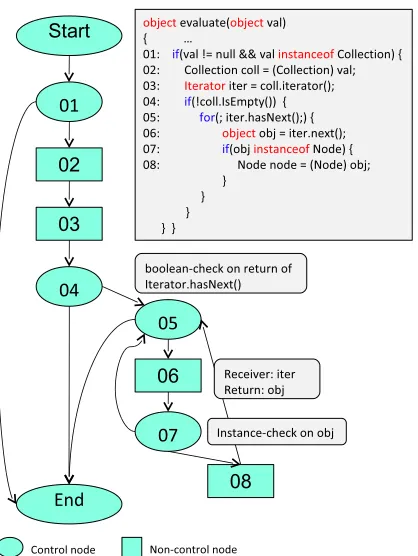
Figure 2.2 A sample code example collected from Google code search and its con-structed CFG. . . 13
Figure 3.1 Method sequence suggested by PARSEWeb. . . 19
Figure 3.2 Equivalent Java code for the method sequence suggested by PARSEWeb. 19 Figure 3.3 Overview of our PARSEWeb approach . . . 20
Figure 3.4 A snapshot of PARSEWeb plugin interface. . . 24
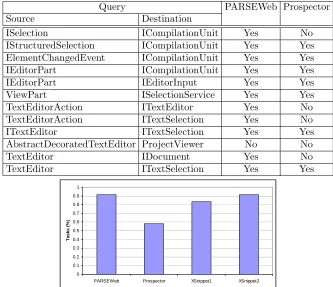
Figure 3.5 Percentage of tasks completed by PARSEWeb, Prospector, and XSnippet. 30 Figure 3.6 Hotspot hierarchies identified for the JUnit library. . . 34
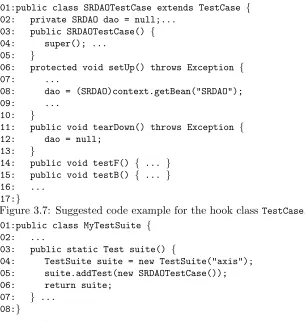
Figure 3.7 Suggested code example for the hook classTestCase. . . 35
Figure 3.8 Suggested code example for the template classTestSuite. . . 35
Figure 3.9 Overview of the SpotWeb approach . . . 36
Figure 3.10 Example classes of a sample library . . . 39
Figure 3.11 Distribution of hotspot and coldspot percentages in all subject libraries. . 43
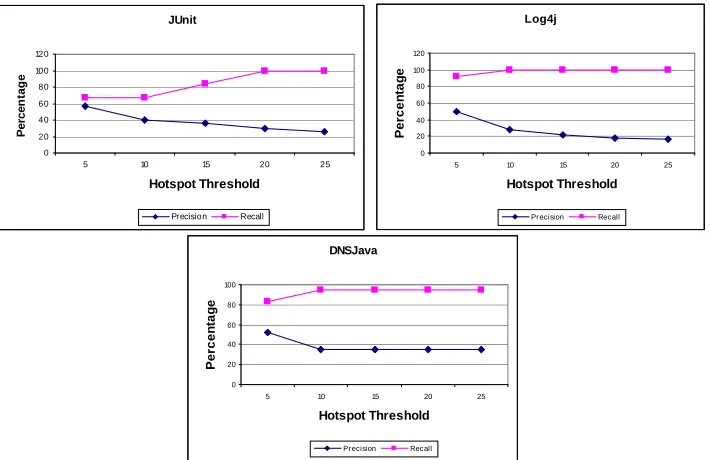
Figure 3.12 Precision and Recall for five𝐻𝑇 values with JUnit, Log4j, and DNSJava. 46 Figure 4.1 Two example scenarios from real applications. . . 52
Figure 4.2 Illustrative examples of general algorithm. . . 54
Figure 4.3 Illustrative examples of CAR-Miner approach. . . 56
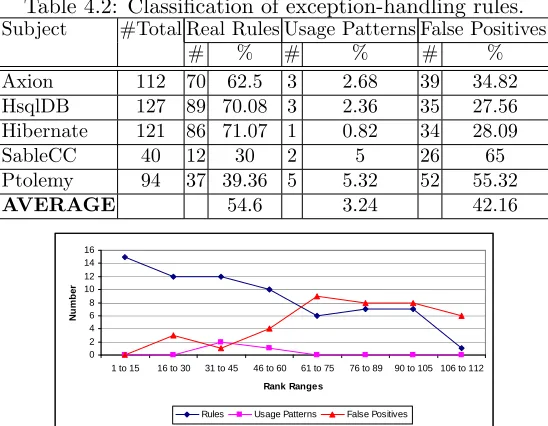
Figure 4.4 Distribution of classification categories with ranks for the Axion application. 62 Figure 4.5 A fixed defect in the Hibernate application. . . 64
Figure 4.6 Comparison of real rules mined by CAR-Miner and WN-miner. . . 65
Figure 4.7 Percentage of sequence association rules. . . 66
Figure 4.8 Percentage of rules mined only from code examples. . . 66
Figure 4.9 Two code examples using thenextmethod of the Iteratorclass. . . 69
Figure 4.10 A code example usingIterator.nextcollected from Google code search. . 71
Figure 4.11 An example input database𝐼𝑆𝐷. . . 71
Figure 4.12 All possible itemsets with four distinct items. . . 77
Figure 4.13 MiningXor patterns. . . 77
Figure 4.14 MiningOr patterns. . . 78
Figure 4.15 Phase 1 of miningCombo patterns. . . 80
Figure 4.16 Phase 2 of miningCombo patterns. . . 80
Figure 4.17 Classification of mined patterns . . . 85
Figure 4.18 Alternative patterns mined for the read method of the JarInputStream class. . . 86
Figure 4.19 Alternative patterns mined for the read method of the JarInputStream class. . . 87
Figure 4.20 Real defects and false negatives among detected violations. . . 88
Figure 4.22 False positives among detected violations of API methods withAnd
pat-terns. . . 89
Figure 4.23 False positives among detected violations of API methods without And patterns. . . 90
Figure 5.1 An implementation of binary search tree. . . 95
Figure 5.2 A method under test from the QuickGraph library [100]. . . 96
Figure 5.3 A unit test and a parameterized unit test. . . 98
Figure 5.4 A class sequence (CCS) for producing an AdjacencyGraph object with vertices and edges. . . 104
Figure 5.5 A class sequence (CCS) for producing anIVertexobject. . . 104
Figure 5.6 Overview of our MSeqGen approach. . . 105
Figure 5.7 A relevant method body for classesAdjacencyGraph,VertexAndEdgeProvider, Hashtable, and TopologicalSortAlgorithm. . . 105
Figure 5.8 An illustrative example for method sequence generalization. . . 108
Figure 5.9 A MUTAddEdgein theBidirectionalGraph class of QuickGraph. . . 113
Figure 5.10 A high-level overview of DyGen. . . 117
Figure 5.11 A dynamic trace and generated PUT and CUT from the trace. . . 118
Figure 5.12 Two PUTs and associated seed tests generated by the capture phase. . . . 119
Figure 5.13 Regression tests generated by Pex by exploring the PUT shown in Fig-ure 5.11(2). . . 121
Figure 5.14 (a) Three categories of machine configurations used in our evaluations. (b) Generated regression tests. . . 123
Figure 5.15 Comparison of coverage achieved by Mode “WithSeeds Iteration 2” and Mode “WithoutSeeds Iteration 2”. . . 126
Figure 5.16 Comparison of code coverage achieved by Modes “WithoutSeeds Iteration 1” and “WithoutSeeds Iteration 2”. . . 126
Figure 5.17 Comparison of code coverage achieved by Modes “WithSeeds Iteration 1” and “Withseeds Iteration 2”. . . 127
Figure 5.18 A class under test from C# QuickGraph library [100]. . . 128
Figure 5.19 Another class under test and an MUT from C# QuickGraph library [100]. 129 Figure 5.20 A test input generated by Seeker. . . 131
Figure 5.21 A sample method-call graph. . . 136
Figure 5.22 TheDeque class from Dsa. . . 143
Figure 5.23 A test (generated by Seeker) that detected infinite loop in QuickGraph. . 145
Figure 6.1 Two method sequences that produce the same object state [137]. . . 152
Figure 6.2 A code example from the Columba application with a potential defect. . . 153
Figure 6.3 Modified code example with additional condition check. . . 153
Figure 6.4 Modified code example with a new condition check. . . 154
Chapter 1
Introduction
1.1
Motivation
The major goal of software development is to deliver high-quality software efficiently. To achieve this goal of delivering software efficiently, programmers often reuse existing frameworks or libraries, hereby referred to as libraries, instead of developing similar code artifacts from the scratch. These libraries could be proprietary libraries such as the .NET library of C# or open source libraries such as Eclipse [35].
During the past decade, there has been an exponential growth of open source libraries [32]. For example, sourceforge.net, the most popular website for open source software development, hosts about 230,000 projects1
with two million registered users and a large number of anony-mous users. Along with the exponential growth of open source libraries, reuse of these open source libraries has also been increasing rapidly [19, 52]. Recently, Mockus [90] conducted an empirical study to identify large-scale reuse of open source libraries. Their study shows that more than 50% of source files among their projects under analysis include code from other open source libraries. Furthermore, recent trends in reusing libraries also led to a new programming paradigm, called Opportunistic Software Systems Development (OSSD) [93]. In OSSD, pro-grammers develop systems from readily available components by melding the software pieces together. The key insight of OSSD is to advance the state of the art by making most of the existing artifacts, rather than recreating similar artifacts from the scratch [20]. Along with improving software productivity, reuse of existing libraries also helps in reducing effort during software maintenance [33, 91]. For example, libraries that are highly reused tend to have better quality and require less effort in maintenance of applications reusing those libraries.
In this dissertation, we focus on object-oriented libraries, where reuse is one of the major objectives. In general, object-oriented libraries expose their functionality through an interface,
1
called Application Programming Interface (API), that programmers can reuse for various tasks. In object-oriented languages, API is an abstract term used to represent a group of classes and methods provided by libraries. We use notations API class and API method to refer to an individual class and method, respectively. To effectively reuse existing libraries, programmers require the knowledge of how to use the APIs exposed by those libraries. However, in practice, programmers often face challenges in understanding the usage of the APIs due to two major factors [26, 115], which are described next.
First, many existing libraries are not well-documented [1, 21]. Even when such documenta-tions exist, they are often outdated [73]. To illustrate the challenges faced by programmers in the absence of documentation, consider that a programmer is reusing the Eclipse library [35]. Consider that the programming task at hand is to write code for parsing code in a dirty editor (an editor whose content is not yet saved) of the Eclipse IDE framework. Since a dirty editor is represented as an object of the IEditorPart class and the programmer needs an object of ICompilationUnit for parsing, the programmer has to identify a method sequence that accepts theIEditorPartobject as input and results in an object ofICompilationUnit. One such possible method sequence is shown below:
IEditorPart iep = ...
IEditorInput editorInp = iep.getEditorInput();
IWorkingCopyManager wcm = JavaUI.getWorkingCopyManager(); ICompilationUnit icu = wcm.getWorkingCopy(editorInp);
The preceding code example exhibits the challenges faced by programmers in reusing the existing libraries. A programmer unfamiliar to Eclipse may take long time to identify that an IWorkingCopyManagerobject is needed for getting theICompilationUnitobject from an object of theIEditorInputclass. Furthermore, it is not trivial to find an appropriate way of instantiating theIWorkingCopyManagerobject as the instantiation requires a static method call on theJavaUI class.
1.2
Problems
There are three major problems (described next) that affect both software productivity and quality while reusing existing libraries due to the preceding two factors.
∙ Programmers spend more effort in understanding APIs, thereby reducing software pro-ductivity [103]. In a recent empirical study [103], Robillard shows that lack of documen-tation or insufficient examples is the major obstacle in understanding APIs. Therefore, for example, if a programmer is not aware of which APIs of a library to use to achieve a programming task at hand, the programmer spends effort in searching for relevant code examples (on the web) that show similar usage of APIs, increasing the amount of time required to finish the programming task at hand.
∙ Programmers introduce defects while using APIs due to lack of proper knowledge on how to reuse those APIs [24, 38, 75]. The primary reason for such defects is that often APIs require programmers to follow implicit programming rules. Failing to follow such programming rules introduces defects in the client code that reuses those APIs. For example, consider thenextmethod of theIteratorclass in the Java Util package [60]. The nextmethod throwsNoSuchElementExceptionwhen invoked on an emptycollection. This exception can be avoided through abooleancondition check on thehasNextmethod before invoking thenextmethod. This relation between thenextandhasNextmethods forms an implicit programming rule as “boolean-check on the return of Iterator.hasNext before Iterator.next”. However, programmers unfamiliar with this rule may not perform the booleancheck on thehasNextmethod, thereby introducing defects in the client code. It is quite challenging for static or dynamic verification techniques to detect such defects in the client code, since these techniques require those implicit programming rules, which often do exist in practice [1]. Without such programming rules, existing verification techniques can detect only robustness-related defects such as division by zero or dereferencing anull pointer.
branch coverage by covering thetrue orfalsebranches in the code under test. However, sequences involving existing libraries often include multiple classes. It is quite challenging to automatically generate desirable method sequences with multiple classes due to a large search space of possible method sequences, and the valid sequences constitute only a small portion of the entire search space.
1.3
Solution
To address these preceding issues and thereby improve both software productivity and quality, in this dissertation, we propose a novel general framework, called WebMiner. Our WebMiner framework includes new techniques developed from four major research areas: information retrieval, program analysis, data mining, and software testing. The key insight of our WebMiner framework is that the existing API usage knowledge available in the open source code can be effectively leveraged to address these three preceding problems described in Section 1.2. In particular, WebMiner automatically infers usage specifications for APIs under analysis by automatically collecting relevant code examples from the open source code available on the web and by applying data mining techniques on those collected code examples, also referred to as a methodology, called mining software engineering data. WebMiner is a general framework and can be easily extended based on the software engineering task (SE task) at hand. We next present an overview of the general framework that includes four major phases and describe how the general framework can be extended for achieving an SE task under analysis in subsequent chapters.
First, given an API method under analysis, WebMiner automatically collects relevant code examples of that API among open source code available on the web. These code examples help infer usage specifications of the API under analysis. To collect relevant code examples, WebMiner interacts with code search engines (CSE) such as Google Code Search [48]. CSEs accept queries such as the names of API classes or methods and return relevant code examples from the CVS or SVN repositories of existing open source projects available on the web. The primary reason for leveraging CSEs is that, while applying data mining techniques, along with the mining techniques, the data on which the techniques are applied is also important. In previous work [24, 38, 75], mining techniques are applied on limited data scope, i.e., only a few example applications. Therefore, those approaches may not be able to mine patterns that do not have enough supporting samples in those example applications. To address this issue, in this dissertation, we expand the data scope to a large amount of open source code available on the web via leveraging code search engines.
since often the code examples collected from CSEs cannot be compiled due to lack of other source files that the current code example is dependent upon. Being light-weight, our analysis is highly scalable and can handle a large number of code examples, as shown in our evaluations. Third, WebMiner transforms analyzed code examples into pattern candidates suitable for applying data mining techniques such as Frequent Itemset Mining [22]. These mining techniques help identify common patterns, which represent likely usage of APIs, among all patterns can-didates. The primary reason for identifying common patterns is based on the observation that majority of the programmers correctly adhere to API usage specifications and those common patterns are likely to represent the correct usage of APIs.
Finally, WebMiner uses mined API usage specifications for increasing software productivity and quality. In particular, WebMiner assists programmers in understanding how to use APIs by suggesting related API usage specifications, thereby improving productivity. Similarly, Web-Miner uses API usage specifications to detect violations in the client code as deviations from the mined specifications. These mined API usage specifications can also be used to assist state-of-the-art test-generation approaches in generating test inputs that can achieve high structural coverage such as branch coverage of the applications under analysis using those APIs under analysis.
1.4
Contributions
In summary, this dissertation makes the following major contributions.
∙ Data-scope expansion. A technique for expanding the data scope to the large amount of open source code available on the web. Our technique leverages code search engines to collect relevant code examples of APIs under analysis.
∙ Partial-program analysis. A light-weight heuristic-based analysis for analyzing code examples collected from a code search engine. Our analysis does not require building symbol tables or resolving method calls. Furthermore, it is simple and highly scalable, enabling analysis of a large number of code examples.
evaluations, we show that the suggestions (in the form of API classes) given by SpotWeb are the same as API classes reused by a real application and show that SpotWeb performs better than a related approach [64].
∙ Approaches for improving quality via static verification. Two approaches, called CAR-Miner [122] and Alattin [121, 123], that mine API patterns and detect defects in client code as deviations from mined patterns. CAR-Miner focuses on reducing false negatives by detecting new defects, whereas Alattin focuses on reducing false positives among detected violations. CAR-Miner and Alattin also include two new data mining algorithms, respectively, that mine patterns in desired formats required for addressing the SE task under analyses. In our evaluations, we show that CAR-Miner mines 294 real programming rules in five real-world applications (including 285 KLOC) and also detects 160 defects, where 87 defects are new defects that are not found by a related approach [133]. Similarly, in Alattin approach, we show how different new pattern formats such as Or or Xor patterns help reduce false positives among detected violations. We also suggest best pattern-mining and violation-detection techniques.
1.5
Scope
The approaches presented in this dissertation focus on two major research areas: mining soft-ware engineering data (MSED) and softsoft-ware testing. In the MSED research area, unlike a few existing approaches [7, 55, 134] that focus on API implementation information, our ap-proaches [119–122] primarily focus on API usage information, complementing those apap-proaches. Furthermore, unlike existing approaches [24,38,75,133] that focus on a few example code bases, our approaches leverage the large amount of open source code available on the web. On the other hand, in the software testing research area, unlike existing approaches [49,70,97,126,129] that primarily focus on API implementation information, our approaches [118, 124, 125] focus on both API usage and implementation information.
Although a majority of our approaches focus on open source code available on the web, our approaches are general and can be applied on proprietary code bases as well, as shown in the evaluation results of our DyGen approach [118]. Finally, all our approaches focus on source code. However, there exist various other SE artifacts such as bug reports or programmer forums on the web that can be leveraged for addressing various other problems in software engineering. Chapter 6 discusses our new approaches that target at leveraging those other SE artifacts beyond the source code.
1.6
Outline
Chapter 2
WebMiner Framework
2.1
Introduction
We next describe our WebMiner framework that leverages the knowledge available in open source code available on the web. The key insight of our WebMiner framework is that the large amount of open source code available on the web includes API usage knowledge that can be effectively leveraged for improving both software productivity and quality. However, a major issue with handling open source code is that the amount of existing open source code is quite large and complete analysis is not possible. To address this issue, WebMiner leverages code search engines such as Google code search [48], Krugle [71], Koders [69], and Codase [27] to collect relevant code examples for APIs under analysis and analyzes those relevant code examples. Although we focus on open source code, our techniques are general and can be applicable to large proprietary code bases such as Microsoft code bases. We next present the four major phases of our WebMiner framework.
Figure 2.1: Four major phases of our WebMiner framework.
The mine phase applies data mining algorithms to identify frequent patterns among all pattern candidates. The key insight behind theminephase is that majority of the programmers correctly adhere to API specifications and those frequent patterns are likely to represent the correct usage of APIs. Based on the SE task under analysis, the mine phase either uses an existing off-the-shelf mining algorithm such as frequent itemset mining [22] or a new mining algorithm developed based on the requirements unique to the SE task under analysis.
The apply phase transforms frequent patterns identified by the mine phase into a format required to achieve the SE task. The apply phase next uses mining results for achieving the SE task. For example, the apply phase detects defects in API client code by using a static-verification tool using mined API specifications. Among these four phases, the search and analyze phases are general and the remaining two phases need to be customized based on the SE task under analysis. We next explain each phase in detail.
2.2
Search Phase
and present additional techniques that help address the challenges faced while collecting those code examples.
To search and collect SE data such as code examples relevant to APIs whose specifications need to be mined, the search phase constructs queries to CSEs. We consider that a code example is relevant to an API method, if the code example includes call sites of that API method. These constructed queries include key words derived based on the names of API methods. CSEs also provide additional options such as the language of the API class or method for further filtering out the code examples during the search. For example, the search phase constructs the query “lang:java org.apache.regexp RE” to collect relevant code examples of theREclass provided by the Apache library [11] via GCSE. In the preceding query, the option “lang:java” describes that the language under consideration is Java. GCSE returns around 2,000 code examples for this query. These code examples include information that helps in mining API usage specifications for theREclass.
A major issue with the code examples collected from CSEs is that these code examples often include duplicates. We consider a code example 𝑐𝑒𝑖 as a duplicate of another code
ex-ample 𝑐𝑒𝑗, if both 𝑐𝑒𝑖 and 𝑐𝑒𝑗 belong to the same project and the same source file in that
project. For example, among 2,000 code examples returned by GCSE for the query “lang:java org.apache.regexp RE”, the source file JakartaRegexpRegexp.java is found 13 times. Among these 13 copies, there are 5 different versions of the source file and the remaining 8 copies are duplicates of these 5 versions. There are both desirable and undesirable consequences with du-plicates or multiple versions of source files among code examples. For example, code examples that are duplicate of the same source file, such as those belonging to a particular jar file, can be found to be used in various projects. The existence of duplicate or multiple copies for a code example can indicate that the code example is widely used and therefore the code example can be trusted more than those code examples that do not have duplicate or multiple versions. On the other hand, duplicate or multiple copies can bias the results of mining approaches that try to mine common patterns. To mine unbiased patterns used across a large number of code bases, in our WebMiner framework, we identify and filter out duplicate code examples.
2.3
Analyze Phase
We next explain how the analyze phase analyzes SE data collected in the form of code examples. The analyze phase includes two major tasks: resolve object types and generate candidates. Since these code examples are collected from a CSE, traditional program analysis techniques cannot be used for analyzing these code examples. The primary reason is that CSEs often return only individual source files (i.e., code examples) that include the search term, and these code examples are often partial and not compilable. In our context, a partial code example indicates that the code example is complete; however, the other source files on which the code example is dependent upon are not available. Therefore, to analyze these code examples, we propose partial-program analysis for resolving object types based on heuristics. These heuristics are contrary to type checking done by a compiler. In particular, our heuristics are based on simple language semantics like object types of left and right hand expressions of an assignment statement are either the same or related to each other through inheritance.
A primary advantage of our partial-program analysis is that it does not require building symbol tables or resolving method calls to their declaring method bodies. Furthermore, it is simple and highly scalable, enabling analysis of a large number of code examples. Our heuristics are not complete, since our heuristics cannot resolve the entire type information. However, the evaluation results of our approaches [119–123] developed based on our WebMiner framework show that these heuristics are often effective in resolving required object type information. We first present the heuristics used by our partial-program analysis for resolving object types and next describe how we generate pattern candidates from collected code examples.
2.3.1 Resolve object types
We use 16 heuristics for resolving object types such as receiver or argument object types of an API method call in collected code examples. We next explain two of our major heuristics used for identifying the return type of an API method call.
Heuristic 1: The return type of an API method call contained in an initialization expression is the same as the type or a subtype of the declared variable.
Consider the code example shown below:
QueueConnection connect;
QueueSession session = connect.createQueueSession(false,int)
lack of access to method declarations. However, the return type can be inferred from the type of variablesessionon the left hand side of the assignment statement. Since the type of variable session isQueueSession, we can infer that the return type of the method createQueueSession isQueueSession or its subtype.
Heuristic 2: The return type of an outermost API method call contained in a return statement is the same (or a subtype) as the return type of the enclosing method declaration.
Consider the code example shown below:
public QueueSession test() { ...
return connect.createQueueSession (false,int); }
In the preceding code example, the createQueueSession method is a part of the return statement of the method declaration. In this scenario, we can infer the return type of this method from the return type of the methodtest. Since the methodtest returnsQueueSession, we can infer that the return type of the createQueueSession method is also QueueSession or its subtype. We next present a scenario, where our partial-program analysis cannot identify necessary object types due to lack of additional information.
Consider the code example shown below:
QueueConnectionFactory factory = jndiContext.lookup("t"); QueueSession session = factory.createQueueConnection()
.createQueueSession(false, Session.AUTOACKNOWLEDGE);
In the second statement of the preceding code example, our heuristics cannot infer the re-ceiver type of thecreateQueueSessionmethod and the return type of thecreateQueueConnection method. The reason is due to lack of information regarding the intermediate object returned by thecreateQueueConnectionmethod. However, we identify that such scenarios happen rarely based on our empirical evidence shown in our evaluation results [119–123].
2.3.2 Generate candidates
After type resolution based on preceding heuristics, the analyze phase generates pattern can-didates suitable for applying mining algorithms in the mine phase. In general, these pattern candidates are based on the SE task under analysis. For example, consider the SE task as suggesting method sequences to programmers for achieving a particular programming task at hand (recall the code example shown in Section 1). For this SE task, the pattern candidates are in the form of sequences of method calls.
Figure 2.2: A sample code example collected from Google code search and its constructed CFG. traversing constructed CFGs. The traversal of CFG is primarily based on the SE task under analysis. We next explain how theanalyze phase constructs CFGs using the illustrative example shown in Figure 2.2. The figure also shows the constructed CFG for the code example. First, theanalyze phase creates an Abstract Syntax Tree (AST) for each code example. the analyze phase uses the created AST to build a CFG. A node in the constructed CFG contains a single statement and an edge represents the control flow between the two statements. Our constructed CFGs include two kinds of nodes: control (𝐶𝑇) and non-control (𝑁 𝑇) nodes. Control nodes represent control-flow statements such asif,while, andfor, which control the flow of the program execution. Non-control nodes represent other statements such as method calls or type casts. For example, Statement 5 in the code example (Figure 2.2) is a control node and Statement 6 is a non-control node. When encountering a control node, say𝐶𝑇𝑖 (𝑖indicates the statement id),
our WebMiner framework also extracts all variables, say{𝑉1,𝑉2, ...,𝑉𝑛}, that participate in the
conditional expression of that node and the condition checks on those variables. For example, Control node 𝐶𝑇1 includes the {(val,null-check), (val,instance-check)} pairs. Here, “(val, null-check)” indicates that there is a null-check on the variable var in Control node 𝐶𝑇1. If the control node includes comparisons with expressions such as method calls, theanalyze phase stores those method calls also as additional information within the control node.
type to another and are required for achieving SE tasks such as suggesting method sequences to programmers.
∙ Method call: Generally, a method call with a non-void return type can be considered as a statement that transforms either the receiver type or argument types to the return type. For example, the method call ReturnObj obj1 = RefObj.method(Arg1, Arg2) can be considered as a statement that transforms objects of type RefObj, Arg1 or Arg2 to ReturnObj. However, we consider method calls with void return types also, since those method calls can modify the state of its receiver or arguments.
∙ Constructor: Since a constructor generally takes some arguments, it can be considered as a statement that transforms objects of its argument types to the newly created object type.
∙ Typecast: A typecast can be considered as a transformation statement, because it per-forms an explicit transformation from one object type to another.
While constructing CFGs, the analyze phase performs method inlining by replacing the method calls of the class under analysis with the body of the corresponding method declarations. The analyze phase cannot perform method inlining if the corresponding method declaration is abstract. This method inlining process helps identify pattern candidates that are split among methods of the class under analysis. Theanalyze phase next transforms extracted SE data into pattern candidates suitable for applying mining algorithms. For example, for the SE task of suggesting method sequences to programmers, theanalyze phase replaces each distinct method call among pattern candidates (in the form of method sequences) with a unique id. The primary reason is that data mining algorithms used in themine phase cannot understand data such as method sequences and handles pattern candidates such as sequence of integers.
2.4
Mine Phase
We next describe the mine phase of our WebMiner framework. The mine phase applies data mining algorithms to identify frequent patterns among all pattern candidates. In our WebMiner framework, the mining algorithm used in the mine phase is specific to the SE task under analysis. The primary reason is that different SE tasks require different pattern types. For example, if the SE task is to suggest method sequences, the preferred mining algorithm is frequent subsequence mining algorithm [130], since this algorithm identifies subsequences among pattern candidates in the form of sequences.
and are not detected by those approaches. On the other hand, false positives indicate those violations that do not represent real defects. The primary reason for such false negatives and false positives is that these approaches attempt to directly reuse existing off-the-shelf mining algorithms such as a frequent itemset miner [22]. Such direct reuse of existing off-the-shelf mining algorithms often generates patterns that do not describe the nearly complete behavior among data points used as inputs to mining algorithms. Therefore, using such patterns for SE tasks such as detecting defects in applications under analysis results in both false negatives and false positives among detected violations. To address these issues, we adapt or develop new mining algorithms for the approaches (presented in the subsequent chapters) developed based on our WebMiner framework.
2.5
Apply Phase
We next describe the last phase, theapply phase, of our WebMiner framework. Theapply phase transforms frequent patterns identified by themine phase into a format required to achieve the SE task under analysis. The apply phase next uses mining results for achieving the SE task. For example, for the SE task of suggesting method sequences, the apply phase transforms the frequent patterns in the form of integers to method sequences suitable for suggesting to programmers.
2.6
Chapter Summary
Chapter 3
Improving Software Productivity
3.1
Introduction
Programmers often spend more efforts in reusing existing libraries due to various factors such as their complexity or lack of documentation. Therefore, to assist programmers in effectively reusing existing libraries, and thereby to increase programmer’s productivity, we developed two approaches, called PARSEWeb [119] and SpotWeb [120], based on our general WebMiner framework. These two approaches address two specific problems, respectively, in reusing li-braries. However, our WebMiner framework is general and can be easily extended to address other problems as well.
3.2
PARSEWeb: Assisting programmers in writing method
se-quences
3.2.1 Motivation
In general, reuse of existing libraries involve instantiation of several object types of those li-braries. For example, consider the programming task of parsing code in a dirty editor (an editor whose content is not yet saved) of the Eclipse IDE framework. Since a dirty editor is represented as an object of theIEditorPart type and the programmer needs an object ofICompilationUnit for parsing, the programmer has to identify a method sequence that takes the IEditorPart ob-ject as input and results in an obob-ject of ICompilationUnit. One such possible method sequence is shown below:
IEditorPart iep = ...
IEditorInput editorInp = iep.getEditorInput();
IWorkingCopyManager wcm = JavaUI.getWorkingCopyManager(); ICompilationUnit icu = wcm.getWorkingCopy(editorInp);
The code example shown above exhibits the difficulties faced by programmers in reusing existing libraries. A programmer unfamiliar to Eclipse may take long time to identify that an IWorkingCopyManagerobject is needed for getting theICompilationUnitobject from an object of theIEditorInputtype. Furthermore, it is not trivial to find an appropriate way of instantiating theIWorkingCopyManagerobject as the instantiation requires a static method call on theJavaUI class.
In many such situations, programmers know what type of object that they need to instanti-ate (likeICompilationUnit), but do not know how to write code to get that object from a known object type (like IEditorPart). For simplicity, we refer the known object type as Source and the required object type as Destination. Therefore, the proposed problem can be translated to a query of the form “Source → Destination”.
In this chapter, we propose an approach, called PARSEWeb (based on our WebMiner frame-work), that addresses the preceding problem by accepting queries of the form “Source→ Desti-nation” and suggests frequently used method sequences (MIS) that can transform an object of theSource type to an object of theDestinationtype. Our approach also suggests relevant code examples that are extracted from a large number of publicly accessible source code repositories. These suggested MISs along with the code examples can help programmers in addressing the preceding problem and thereby help reduce programmers’ effort in reusing existing libraries.
In particular, PARSEWeb interacts with GCSE [48] to search for code examples with the usages of the givenSourceandDestinationobject types, and downloads those examples to form a local source code repository. PARSEWeb analyzes the local source code repository to extract different MISs and clusters similar MISs (Section 3.2.3). These extracted MISs can serve as a solution for the given query. PARSEWeb also sorts the final set of MISs using several ranking heuristics. PARSEWeb uses an additional phase called query splitter that helps address the problem where code examples for the given query are split among different source files.
PARSEWeb makes the following major contributions:
∙ An approach for reducing programmers’ effort while reusing existing libraries by providing frequently used MISs and relevant code examples.
∙ A technique for clustering similar MISs and two ranking heuristics for sorting the final set of MISs.
∙ A technique, called query splitter, that splits a query into multiple sub-queries for ad-dressing the issue of relevant code examples being split among different source files or different projects.
∙ An Eclipse plugin tool implemented for the proposed approach and several evaluations to assess the effectiveness of the tool.
3.2.2 Example
We next use an example to illustrate PARSEWeb and how PARSEWeb can help in reducing pro-grammers’ effort when reusing existing libraries. We use object typesQueueConnectionFactory andQueueSender from the OpenJMS library1
, which is an open source implementation of Sun’s Java Message Service API 1.1 Specification, as illustrative examples. Consider that a program-mer has an object of typeQueueConnectionFactoryand does not know how to write code to get a QueueSenderobject, which is required for sending messages.
To address this problem, the programmer can use our PARSEWeb approach as follows. The programmer first translates the problem into a “QueueConnectionFactory→ QueueSender”
1
01:FileName:0 UserBean.java MethodName:ingest Rank:1 NumberOfOccurrences:6 02:QueueConnectionFactory,createQueueConnection() ReturnType:QueueConnection 03:QueueConnection,createQueueSession(boolean,Session.AUTO
ACKNOWLEDGE) ReturnType:QueueSession 04:QueueSession,createSender(Queue) ReturnType:QueueSender
Figure 3.1: Method sequence suggested by PARSEWeb. 01:QueueConnectionFactory qcf;
02:QueueConnection queueConn = qcf.createQueueConnection();
03:QueueSession qs = queueConn.createQueueSession(true,Session.AUTO ACKNOWLEDGE); 04:QueueSender queueSender = qs.createSender(new Queue());
Figure 3.2: Equivalent Java code for the method sequence suggested by PARSEWeb. query. Given this query, PARSEWeb interacts with GCSE for relevant code examples with usages of the givenSource andDestination object types (Search phase of our WebMiner frame-work). PARSEWeb next downloads the code examples to form a local source code repository. The downloaded code examples are often partial and not compilable, since GCSE retrieves (and subsequently PARSEWeb downloads) only source files with usages of the given object types instead of entire projects. PARSEWeb analyzes each partial code example using an Abstract Syntax Tree (AST) and builds a CFG that represents each given code example in order to capture control-flow information in the code example (Analyze phase of our WebMiner frame-work). PARSEWeb traverses this CFG to extract MISs that take QueueConnectionFactoryas input and result in an object of QueueSender. The output of PARSEWeb for the given query is shown in Figure 3.1. The sequence starts with the invocation of thecreateQueueConnection method that results in an instance of the QueueConnection type. Similarly, by following other methods, the method sequence finally results in the QueueSender object, which is the desired destination object of the given query.
Figure 3.3: Overview of our PARSEWeb approach
required intermediate variables. The code example suggested along with the MIS can assist programmers in gathering this additional information regarding the intermediate variables. Figure 3.2 shows equivalent Java code for the suggested MIS.
3.2.3 Approach
PARSEWeb, developed based on our WebMiner framework, includes an additional phase, called query splitter, along with the four major phases of the WebMiner framework: search,analyze, mine, andapply. Figure 3.3 shows an overview of all phases of PARSEWeb. Unlike WebMiner, in PARSEWeb, the three phases search, analyze, and mine may be iterated more than once. In particular, in the search phase, the code downloader component accepts a query from the programmer and forms a local source code repository with the code examples collected through CSE. The analyze phase analyzes the code examples stored in the repository and generates MISs that serve as pattern candidates for the next phase. The mine phase clusters similar MISs and ranks the clustered MISs. If the result of the mine phase consists of any MISs that can serve as a solution for the given query,query splitter simply outputs the result. If there are no solution MISs in the result generated by the mine phase, query splitter instead splits the given query into different queries and iterates all the preceding three phases for each sub-query. Finally, query splitter gathers results of all sub-queries and generates the final output. In PARSEWeb, the apply phase simply includes suggesting final output to the programmer. We next present more details about all phases except the search phase, since the search phase is the same as our WebMiner framework.
Analyze Phase
matches with the given Source object type, PARSEWeb marks the corresponding node as a Sourcenode. On the other hand, when the return type of any non-control node in CFG matches with the requiredDestinationtype, PARSEWeb marks the corresponding node as aDestination node.
PARSEWeb extracts a MIS from constructed CFG by calculating the shortest path from a Source node to aDestination node. The shortest path is sufficient as every path from Source toDestination nodes contain a desired method sequence. Once a possible sequence is identified from the CFG, the minimization process of PARSEWeb extracts a minimal MIS from the possible sequence by eliminating the extra methods that are not related to the given query. This minimal MIS is identified by traversing the sequence in the reverse direction from the Destination node to theSource node by continuously matching the receiver type and argument types of each statement with the return type of the preceding statements. For example, consider a possible sequence for the query “IEditorPart → ICompilationUnit” (where each statement consists of the receiver type, method name, arguments, and return type) as follows:
01:IEditorPart,getEditorInput() : IEditorInput 02:CONSTRUCTOR,Shell() : Shell
03:Shell,setText(String) : void
04:JavaUI,getWorkingCopyManager() : IWorkingCopyManager 05:IWorkingCopyManager,connect(IEditorInput) : void
06:IWorkingCopyManager,getWorkingCopy(IEditorInput) : ICompilationUnit
The minimization process maintains a special set called a look-up set that initially con-tains only the required Destination object. For the given possible sequence, the process starts from Statement 6 and adds the receiver type IWorkingCopyManager and the argument type IEditorInput to the look-up set, and removes ICompilationUnit from the look-up set. The minimization process retains Statement 5 in the minimal MIS as its receiver type matches with one of the types in the look-up set. In Statement 4, the minimization process adds JavaUI to the look-up set and removes IWorkingCopyManager. The process ignores Statements 3 and 2 as none of its object types match with the object types in the look-up set. The minimization process ends with Statement 1 and generates the minimal MIS as “1,4,5,6”. These minimal MISs serve as pattern candidates for the mine phase.
Mine Phase
These sorted results can help programmers identify sequences that are more frequently used for addressing the given query.
Sequence Clustering. We next describe the heuristic used by PARSEWeb for identifying and clustering similar MISs. To identify similar MISs, PARSEWeb ignores the order of state-ments in the extracted MISs. PARSEWeb considers MISs with the same set of statestate-ments and with a different order as similar. For example, consider MISs “2,3,4,5” and “2,4,3,5” where each number indicates a single statement associated with the node in the constructed CFG. PARSEWeb considers these sequences as similar because different programmers may write in-termediate statements in different orders and these statements may be independent from one another.
To further cluster the identified MISs, PARSEWeb identifies MISs with minor differences and clusters those identified MISs. We introduce an attribute, called cluster precision, which defines the number of statements by which two given MISs differ each other. This attribute is configurable and helps PARSEWeb in further clustering the identified MISs. PARSEWeb considers MISs that differ by the givencluster precisionvalue as similar, irrespective of the order of statements in those MISs. For example, consider MISs “8,9,6,7” and “8,6,10,7”. These two sequences have three common statements (8,6,7) and differ by a single statement. PARSEWeb considers these two MISs as similar under acluster precision valueof one, as both the sequences differ by only one method. This heuristic is based on the observation that different MISs in the final set of sequences often contain overloaded forms of the same method.
Sequence Ranking. In general, many queries result in more than one possible solution, and not all solutions are of the same importance to the programmer. To assist the programmer in quickly identifying the desired MISs, PARSEWeb uses two ranking heuristics and sorts the final set of MISs.
Ranking Heuristic 3.2.1 Frequency. Higher the frequency⇒ Higher the rank
This heuristic is based on the observation that more-used MISs might be more likely to be used compared to less-used MISs. Therefore, MISs with higher frequencies are given higher preference compared to MISs with lower frequencies.
Ranking Heuristic 3.2.2 Length. Shorter the length⇒ Higher the rank
Algorithm 1 Pseudocode of the PARSEWeb algorithm with the query splitter phase Require: Source and Destination object types.
Ensure: Method Sequences
1: Extract 𝑀 𝐼𝑆𝑠for the Query “Source →Destination”
2: if 𝑀 𝐼𝑆𝑠 are not empty then
3: return 𝑀 𝐼𝑆
4: end if
5: //Query Splitting
6: Extract 𝐷𝑒𝑠𝑡𝑂𝑛𝑙𝑦𝑀 𝐼𝑆𝑠for the Query “Destination”
7: for all𝑀 𝐼𝑆 in𝐷𝑒𝑠𝑡𝑂𝑛𝑙𝑦𝑀 𝐼𝑆𝑠do
8: 𝑙𝑎𝑠𝑡𝑀 𝐼 =𝑀 𝐼𝑆.lastMethodInvocation()
9: 𝐴𝑙𝑡𝐷𝑒𝑠𝑡𝑆𝑒𝑡=𝑅𝑒𝑐𝑒𝑖𝑣𝑒𝑟𝑇 𝑦𝑝𝑒 and𝐴𝑟𝑔𝑇 𝑦𝑝𝑒𝑠 of 𝑙𝑎𝑠𝑡𝑀 𝐼
10: Intialize𝐹 𝑖𝑛𝑎𝑙𝑀 𝐼𝑆𝑠
11: for all𝐴𝑙𝑡𝐷𝑒𝑠𝑡in𝐴𝑙𝑡𝐷𝑒𝑠𝑡𝑆𝑒𝑡do
12: Extract 𝐴𝑙𝑡𝑀 𝐼𝑆 for the Query “Source → AltDest”
13: Append 𝑙𝑎𝑠𝑡𝑀 𝐼 to𝐴𝑙𝑡𝑀 𝐼𝑆
14: Add 𝐴𝑙𝑡𝑀 𝐼𝑆 to𝐹 𝑖𝑛𝑎𝑙𝑀 𝐼𝑆𝑠
15: end for
16: end for
17: if 𝐹 𝑖𝑛𝑎𝑙𝑀 𝐼𝑆𝑠are not empty then
18: return 𝐹 𝑖𝑛𝑎𝑙𝑀 𝐼𝑆𝑠
19: else
20: return 𝐷𝑒𝑠𝑡𝑂𝑛𝑙𝑦𝑀 𝐼𝑆𝑠
21: end if
22: return 𝐺𝑙𝑜𝑏𝑂𝑆𝑆
Query Splitter
Query splitter is an additional phase used by PARSEWeb to address the problem of lack of code examples in the results of CSE. We observed that a code example for some of the queries is split among different files instead of having the entire example in the same file. This phase helps to address this problem by splitting the given query into multiple sub-queries. The algorithm of PARSEWeb including the query splitter phase is described in Algorithm 1.
Figure 3.4: A snapshot of PARSEWeb plugin interface.
For each of the AltDest, new MISs are generated by constructing queries of the form “Source → AltDest”. The lastMI of the earlier sequence is appended to the new set of sequences to generate a complete MIS. In case if PARSEWeb including the query splitter phase is not able to suggest any MISs, PARSEWeb simply returns the DestOnlyMISs, hoping that these MISs can provide hints to programmers in constructing new queries.
Implementation
We developed an Eclipse plugin2
for our PARSEWeb approach. We used Google Code Search Engine (GCSE) [48] as an underlying CSE. To improve performance, PARSEWeb uses the multi-threading feature of the Java programming language, and invokes a post processor written in the Perl language to transform the source files returned by GCSE from HTML to Java. Eclipse JDT Compiler [10] is used for building ASTs from Java files. We used Dijkstra’s shortest path algorithm from the Jung [65] library to gather the required path from Source to Destination object types.
PARSEWeb displays the suggested MISs for the given query in a tree-structured tabular form. A snapshot of our PARSEWeb output is shown in Figure 3.4. Each MIS is associated with additional information like rank, frequency, and length. Programmers can browse the relevant code sample of the suggested MIS by double clicking on the corresponding entry.
The current implementation of PARSEWeb shows only the first ten MISs that can serve as a solution for the given query. Furthermore, the query splitter is configured to iterate all three main phases for only the first five elements inDestOnlyMISs (shown in Algorithm 1). However, both these parameters are configurable through a property file.
2
3.2.4 Evaluation
We conducted four different evaluations to show that PARSEWeb is effective in solving pro-grammers’ queries. In the first evaluation, we showed that PARSEWeb is able to solve program-ming problems posted in developer forums of existing libraries. In the second evaluation, we showed that PARSEWeb-suggested solutions are available in a real project. We also compared our results with the results of two related approaches: Prospector3
[80] and Strathcona4 [56]. Prospector tries to solve the queries related to a specific set of libraries by using API signa-tures. Strathcona tries to suggest similar code examples stored in an example repository by matching the context of the code under development with the examples stored in the example repository. In the third evaluation, we compared PARSEWeb with Prospector. We showed that PARSEWeb performs better than Prospector. Moreover, PARSEWeb is not limited to the queries of any specific set of libraries as Prospector is. In the fourth evaluation, we showed the significance of different techniques used in PARSEWeb.
Programming Problems
The purpose of this evaluation is to show that PARSEWeb is not limited to the queries of any specific set of libraries. We collected two programming problems that were posted in developer forums of existing open source libraries and checked whether PARSEWeb is able to suggest solutions for those problems. Existing approaches such as Prospector and Strathcona cannot address these problems, since the queries for these problems fall out of the scope of these two tools: J2SE, Eclipse, and Eclipse GEF (Graphical Editing Framework). The results indicate that PARSEWeb is able to solve these real programming problems.
Jakarta BCEL User Forum. The Byte Code Engineering Library (BCEL) provides the ability to analyze, create, and manipulate Java bytecode files. We collected the programming problem “How to disassemble Java byte code” posted in the BCEL forum [16]. The program-ming problem describes that the programmer is using the BCEL library and has Java byte code under analysis. In the BCEL library, Java byte code is represented through theCodeclass. The programmer wants to obtain a Java assembler command list, which is represented in the form of instructions in the BCEL library. Therefore, we identified the relevant query for the given problem description as “Code →Instruction”. PARSEWeb suggested a solution for the query as shown below:
3
http://snobol.cs.berkeley.edu/prospector/ 4
01:FileName:2 RepMIStubGenerator.java MethodName: isWriteMethod
Rank:1 NumberOfOccurrences:1 02:Code,getCode() ReturnType:#UNKNOWN#
03:CONSTRUCTOR,InstructionList(#UNKNOWN#) ReturnType:InstructionList 04:InstructionList,getInstructions() ReturnType:Instruction
The suggested solution is the same as the response posted in the forum. The programmer can refer to a related code example by browsing the isWriteMethod method in the file 2 -RepMIStubGenerator.java. The original code example collected from the preceding method is as follows:
Code code;
InstructionList il = new InstructionList(code.getCode()); Instruction[] ins = il.getInstructions();
In the preceding code example suggested by PARSEWeb, the return type of getCodemethod is described asUNKNOWN. The keywordUNKNOWNdenotes that PARSEWeb is not able to infer the return type through its partial-program analysis, since the return type of getCode method is not explicitly specified in the code example. However, PARSEWeb still correctly suggested to pass the return type directly to the constructor of InstructionList.
Dev2Dev Newsgroups. We applied PARSEWeb on another problem “how to connect db by sessionBean” posted in the Dev2Dev Newsgroups [17]. We transformed the question into the query “InitialContext → Connection” and used PARSEWeb. PARSEWeb suggested the following solution, which is the same as the one described in the forum.
01:FileName:3 AddrBean.java MethodName:getNextUniqueKey
Rank:1 NumberOfOccurrences:34 02:InitialContext,lookup(String) ReturnType:DataSource
03:DataSource,getConnection() ReturnType:Connection
Real Project
To avoid bias in our evaluation results, we chose all queries from the largest source file (“LogicEditor.java”) of the subject project. By choosing the largest file, we can also find many queries that can be used to evaluate all three tools. Within the source file, we picked the first ten available queries of the form “Source →Destination” from the beginning of the class, and used all three tools to suggest solutions for each query. The query selection process is based on two criteria: a new object type is instantiated from one of the known object types and the selected query is the maximal possible query, which we shall explain next through the code example extracted from the source file used in the evaluation:
01:public void createControl(Composite parent) {
02: PageBook pageBook = new PageBook(parent, SWT.NONE); 03: Control outline = getViewer().createControl(pageBook); 04: Canvas overview = new Canvas(pageBook, SWT.NONE); 05: pageBook.showPage(outline);
06: configureOutlineViewer(); 07: hookOutlineViewer(); 08: initializeOutlineViewer(); 09:}
The possible queries that can be extracted from the preceding code example are “Composite → PageBook”, “Composite → Control”, and “Composite → Canvas”. However, the maximal possible query among these three queries is “Composite→Canvas”, since this query subsumes the other two queries. We consider a task as successful only when the suggested code example is the same as the code snippet in the corresponding subject project. Since PARSEWeb tries to suggest solutions from available open source repositories, which may include the subject project under consideration, we excluded the results of PARSEWeb that are suggested from the subject project under consideration.
Since both PARSEWeb and Prospector accept the query of the preceding form, we gave constructed queries directly as input. Strathcona compares the context of code given as input and suggests relevant code examples. Therefore, for each evaluation, we built separate driver code that can convey the context of the query. In the driver code, we declared two local variables with theSource and Destination object types, respectively.
Table 3.1: Evaluation results of programming tasks from the Logic Project. Query PARSEWeb Prospector Strathcona GCSE Source Destination # Rank # Rank # Rank
IPageSite IActionBars 1 1 3 1 10 7 1 ActionRegistry IAction 3 1 4 1 10 3 2 ActionRegistry ContextMenuProvider Nil Nil 2 2 10 3 NA IPageSite ISelectionProvider 1 1 12 1 10 Nil 5 IPageSite IToolBarManager 2 1 12 1 10 6 9 String ImageDescriptor 10 6 12 Nil 10 Nil 28 Composite Control 10 2 12 Nil 10 Nil 72 Composite Canvas 10 5 12 Nil 10 Nil 28 GraphicalViewer ScrollableThumbnail 2 1 12 8 10 7 2 GraphicalViewer IFigure 1 Nil 12 Nil 10 Nil NA
the results by GCSE. This index information is extracted by identifying the first source file in which the resultant MIS is found. We found that both PARSEWeb and Prospector performed better than Strathcona. Between PARSEWeb and Prospector, PARSEWeb performed better than Prospector. We next discuss the results of each tool individually.
From the results, we observed that PARSEWeb suggested solutions for all queries except for two. The reason behind the better performance of PARSEWeb is that PARSEWeb suggests solutions from reusable code examples. We inspected queries for which PARSEWeb could not suggest any solution and found the reason is a limitation of our approach in analyzing partial code examples (discussed in Section 2.3). Prospector tries to solve the given query using API signatures. Therefore, it can often find some feasible solution for a given query, as it can find a path from the given Source toDestination. One reason for not getting complete results with Prospector in our evaluation could be that Prospector shows only first twelve results of the given query. Due to this limitation, the required solution might not have shown in the suggested set of solutions. Prospector solves the queries through API signatures and has no knowledge of which MISs are often used compared to other MISs that can also serve as a solution for the given query. PARSEWeb performs better in this scenario, since PARSEWeb tries to suggest solutions from reusable code examples and is able to identify MISs that are often used for solving a given query. For example, for query “Composite→Canvas”, the solution is through an additional class calledPageBook. Although this solution is often used, Prospector is not able to identify the solution, since this solution can be a less favorable solution from the API signature point-of-view.
returned by Strathcona contain both Source and Destination object types in either import statements or in different method declarations. Therefore, those code examples cannot address our query, since no MIS can be derived to lead from Source toDestination object types.
The results shown in Column “GCSE” indicate the problems that may be faced by pro-grammers in using CSEs directly. For example, to find the solution for the seventh task, the programmer has to check 72 source files in the results of GCSE.
Comparison of PARSEWeb and Prospector
We next present the evaluation results of PARSEWeb and Prospector5
for 12 specific program-ming tasks. These tasks are based on Eclipse plugin examples from theJava Developer’s Guide to Eclipse [10] and are the same as the first 12 tasks used by Sahavechaphan and Claypool [108] in evaluating their XSnippet tool. We have not chosen the remaining five tasks used in eval-uating the XSnippet tool as they are the same as some previous tasks, but differ in the code context where the tasks are executed. Since neither PARSEWeb nor Prospector considers the code context, these five tasks are redundant to use in our evaluation.
The primary reason for selecting these tasks is their characteristics that include different Java programming aspects like object instantiation via a constructor, a static method, and a non-static method from a parent class. These tasks also require downcasts and have reasonable difficulty levels. For each task, all necessary Java source files and Jar files are provided and code for getting the Destination object from the Source object is left incomplete. We used open source projects such asorg.eclipse.jdt.ui, and examples from Eclipse corner articles6
for creating the necessary environment. We used PARSEWeb and Prospector to suggest solutions for each query. A task is considered as successful if the final code can be compiled and executed, and the required functionality is enabled with at least one suggested solution. The task is also considered as successful if the suggested solution acts as a starting point and the final code could be compiled with some additional code. Prospector can generate compilable code for its suggested solutions, but the current implementation of PARSEWeb suggests only the frequent MISs and code examples, but cannot directly generate compilable code. Therefore, we manually transformed the suggested sequences into appropriate code snippets.
Table 3.2 shows the results of 12 programming tasks. PARSEWeb is not able to suggest solution for only one query, whereas Prospector failed to suggest solutions for five queries. This result demonstrates the strength of PARSEWeb, since PARSEWeb suggests solutions from reusable code examples gathered from publicly available source code repositories. Figure 3.5 shows a summary of percentage of tasks successfully completed by each tool along with the
5
We chose only Prospector for detailed comparison, since another related tool XSnippet [108] was not available and Strathcona did not perform well in addressing the described problem based on the previous evaluation.
6