ISSN(Online): 2319-8753 ISSN (Print): 2347-6710
International Journal of Innovative Research in Science,
Engineering and Technology
(A High Impact Factor, Monthly, Peer Reviewed Journal) Visit: www.ijirset.com
Vol. 6, Issue 11, November 2017
Bandwidth Efficient Aggregation through
Concurrent Multipath Transfer Protocol for
Quality-Guaranteed Real Time Video over
Heterogeneous WSN
Prof.Kantilal Shamlal Chandre
Master of Technology, Department of Computer Science and Engineering, Matsyodari College of engineering and
Technology, Jalna, Dr.B.A.M.University, Aurngabad, India
ABSTRACT: Recent technological advancements in wireless infrastructures and handheld devices enable mobile users to concurrently receive multimedia contents with different radio interfaces (e.g., cellular and Wi-Fi). However, multipath video transport over the resource-limited and error-prone wireless networks is challenged with key technical issues: 1) conventional multipath protocols are throughput-oriented, and video data are scheduled in a content-agnostic fashion and 2) high-quality real-time video is bandwidth-intensive and delay-sensitive. To address these critical problems, this paper proposes a bandwidth-efficient multipath streaming (BEMA) protocol featured by the priority -aware data scheduling and forward error correction-based reliable transmission. First, we present a mathematical framework to formulate the delay-constrained distortion minimization problem for concurrent video transmission over multiple wireless access networks. Second, we develop a joint Raptor coding and data distribution framework to achieve target video quality with minimum bandwidth consumption. Wireless communication networks are featured with heterogeneity where multiplewireless technologies exist together. In the intersection of coverage areas of these different technologies, receiver having multiple interfaces can access them concurrently so as to improve the performance and this prompts bandwidth aggregation. A larger logical link can be created by aggregating low bandwidth links. The same link can be used by a multimode terminal for applications that are demanding high-bandwidth. Advantages of bandwidth aggregation and the challenges that are faced in attaining bandwidth aggregation are discussed in this paper. An overview of the architecture, different approaches and bandwidth aggregation techniques employed in various layers of network are highlighted. In proposed work will work on Certificate less Key Management concept for maintain privacy and security to maintain the video aggregation stability.
KEYWORDS: Bandwidth aggregation; concurrent multi path transfer; heterogeneous wireless network
I. INTRODUCTION
Recently handheld devices (e.g., smartphone and iPad) is explosive increasing, on the other hand, mobile video streaming (e.g., Hollywood [1] and Metacafe [2]) has become one of the most popular portion of network flow.
ISSN(Online): 2319-8753 ISSN (Print): 2347-6710
International Journal of Innovative Research in Science,
Engineering and Technology
(A High Impact Factor, Monthly, Peer Reviewed Journal) Visit: www.ijirset.com
Vol. 6, Issue 11, November 2017
they are not widelyapplied and bandwidth limitation also existing as the numberof mobile users increases. Above all, the limitation of singlewireless network turn research attentions to multi-path videotransmission With the rapid growth of Internet, the advancement of technology and reduced cost of electronic components, more and more number of users are using the mobile data access and data transfer by using various network interfaces for the devices like laptop, notebook, tablet and smart-phone using various wireless technologies like 802.11, Bluetooth, GSM,3G, WiMax etc.[7][8] The existing wireless technologies differ in terms of services provided like bandwidth, coverage, price, quality of service support. If there is a restriction on the usage of these available resources with interfaces on the user device as one interface at a time, then imposes limitation on the flexibility and better utilization. So by using multiple interfaces simultaneously, can improve quality and provide support for applications requiring high bandwidth [8]. Further delay can be reduced when alternate path of communications are kept alive enhancing the reliability of data. Heterogeneous Wireless Network (HWN) is a wireless communication network where Internet services can be accessed through multiple wireless technologies like WiFi, WiMAX, GSM etc[5][6][9]. Nowadays many of the Internet applications are demanding high bandwidth. The bandwidth of an individual technology is not sufficient to meet the current demand. Hence by aggregating the individual low bandwidth links form a high speedy larger logical link. Bandwidth aggregation in heterogeneous wireless network will provide many of benefits for real time applications.Many internet applications like video streaming services (example: YouTube, teleconferencing, online gaming etc) demand high bandwidth. The bandwidth of existing individual technologies is inadequate to support throughput demanding video applications. Hence bandwidth aggregation provides the increased transmission throughput to meet the requirement. A multimode device can use various wireless technologies simultaneously to provide different range of bandwidths and each technology is being operated independently. Thus bandwidth aggregation increases resource sharing by integration of the limited channel resources available.
Attaining bandwidth aggregation through concurrent multipath transfer of data provides greater reliability. Multiple paths or channels are available for the transmission. At any instance, if any path fails, then there is availability of other path for the transmission. Thus bandwidth aggregation can bring in increase in reliability of communication system. The bandwidth aggregation in wireless networks can be defined as the aggregation of bandwidth offered by individual links of multiple technologies to form a high speedy larger logical link. The accumulated bandwidth from multiple wireless interfaces can create a high bandwidth larger logical link. This has several performance benefits [5] as described below.
II. BANDWIDTHAGGREGATION APPROACHES
Bandwidth aggregation approaches are classified as dynamic or static depending on their adaptively to network traffic flow as shown here.
Fig 1: Classification of Bandwidth aggregation approaches
1. Dynamic Configuration / Adaptive approach:
ISSN(Online): 2319-8753 ISSN (Print): 2347-6710
International Journal of Innovative Research in Science,
Engineering and Technology
(A High Impact Factor, Monthly, Peer Reviewed Journal) Visit: www.ijirset.com
Vol. 6, Issue 11, November 2017
traffic are considered and dynamic configuration of interface selection is carried out.
2. Static Configuration / Non adaptive approach:
The bandwidth aggregation approaches in which the network dynamics are not considered and assume non-varying network traffic are known to be static configuration approach or non-adaptive approach. The scheduling decision of packets is done based on static load balancing and does not take into consideration about network traffic conditions. Implementation of such approaches is easier and contributes for improved throughput and reliability. However performance degrades when paths have different network traffic conditions.
III. REVIEW OF LITERATURE
A survey of bandwidth aggregation solutions addressed at various layers of network protocol stack such as Application layer, Transport layer, Network layer and Link layer is discussed in [4]. Here is a brief look at bandwidth aggregation techniques employed in various layers of network.[6]An application layer protocol for bandwidth aggregation in mobile devices is suggested in [2]. In this paper, a protocol for aggregating WiFi and 3G wireless links on mobile devices is suggested. An algorithm is proposed that can transfer wireless data over both WiFi and 3G interfaces with the aim of minimum battery energy consumption. This service is made simple by providing a mobile application in the mobile devices that is independent of operating system and network protocol stack. In general, application layer bandwidth aggregation mechanism use a middleware for sending packets over multiple interfaces at sender as well as for collecting the received packets in proper sequence at receiver side. Thus a middleware mechanism to be deployed at both sender and receiver side for optimal operation, this limits the widespread uses of application layer bandwidth aggregation approach. [7]
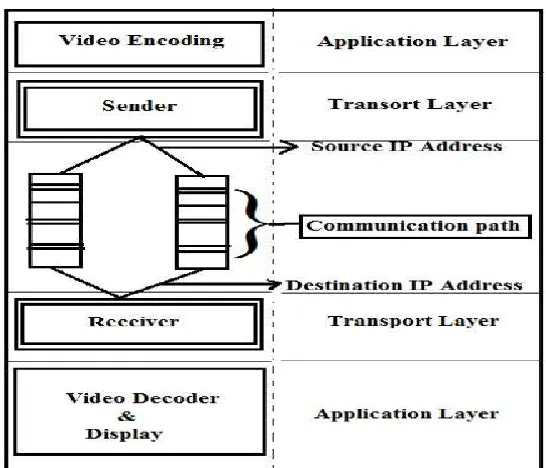
Stream Control Transmission Protocol (SCTP) is the standard protocol at transport layer of network to enable concurrent multipath transfer (CMT) in heterogeneous access network. A distortion aware CMT solution (CMT-DA) for video streaming is provided in [1]. The CMT-DA solution uses estimating path status, allocating flow rate also delay and loss controlled retransmission to have quality of service (QoS) in real time video streaming in multiple wireless interfaces [14]. In this paper, transmission of video streaming is done using the SCTP association from source to a destination node. SCTP transmission involves the sockets. [1] The video is encoded and further encoded data is then divided into several chunks and sent over multipaths. The receiver receives the packets in a receiving buffer and reorders to restore the original video to be given to the upper layer applications. The transport layer mechanisms for bandwidth aggregation require adaptations at node as well as remote server; this limits deployment to specific applications [5].
An important aspect of bandwidth aggregation mechanism is scheduling of data packets onto different interfaces. A network layer solution for bandwidth aggregation is given by proposing a well-known Earliest Delivery Path First (EDPF) scheduling algorithm [5]. A packet-pair scheduling for TCP application was also proposed [7]. Both the approaches involve a network proxy, providing various services like bandwidth aggregation, resource sharing and mobility support to client by accessing multiple network interfaces. Network proxy is responsible for concurrent transmission of data over multi paths and also assembling the packets received at receiver. A mobile host (MH) connected to network via multiple interfaces acquires a fixed IP address from network proxy and uses it to directly communicate with the remote server. The network proxy works based on IP-within-IP encapsulation. This mechanism is similar to the mechanism used in Mobile – IP, but with extension to support multiple interfaces. The network layer solution overcomes the limitations of solutions provided at other layers of network but is always not an efficient approach as it operates at lower layer of the network protocol stack.
ISSN(Online): 2319-8753 ISSN (Print): 2347-6710
International Journal of Innovative Research in Science,
Engineering and Technology
(A High Impact Factor, Monthly, Peer Reviewed Journal) Visit: www.ijirset.com
Vol. 6, Issue 11, November 2017
(CCL) [9] which synchronizes the various functions of link layer and create a unique virtual link layer interface between upper and lower layers of network interfaces. The CCL performs traffic distribution at sender and reordering of packets at receiver. Some more link layer approaches have been proposed. [2] However, link layer bandwidth aggregation solution require specific hardware or software, this limits the deployment of this approach to local domains under the control of same operator [3].
IV. CHALLENGES IN BANDWIDTH AGGREGATION
1) Stringent QoS requirements. High-quality live videostreaming is bandwidth-intensive and delay-sensitive.The throughput demand for high-definition video distribution mainly ranges from 2−6 Mbps. Besides, the one-way delay is limited to be less than 150 ms to achieveexcellent real-time video quality [5].
2) Network bandwidth limitation. The radio resources inwireless platforms are scarce and time-varying. Recentstudies [4], [6] reveal that the available bandwidth forindividual mobile users in 4G LTE networks generallyranges from 1.5to2.5 Mbps.
3) Path asymmetry. The different physical properties andtime-varying network status result in the path asymmetryof heterogeneous access networks [4]. The involvementof an unreliable communication path in multipath videotransport only degrades the average quality.
4) TCP (MPTCP) [7] and Stream Control TransmissionProtocol (SCTP) [8] are the transport-layer proto-cols recommended by IETF (Internet Engineering Tas Force) to enable parallel data transfer over multiple communication paths. However, both MPTCP and SCTP areineffective for real-time video delivery since the packetretransmission mechanism incurs large end-to-end delay.
IV. SYSTEM ARCHITECTURE
ISSN(Online): 2319-8753 ISSN (Print): 2347-6710
International Journal of Innovative Research in Science,
Engineering and Technology
(A High Impact Factor, Monthly, Peer Reviewed Journal) Visit: www.ijirset.com
Vol. 6, Issue 11, November 2017
Fig 2 shows high-level overview of architecture to support bandwidth aggregation through concurrent multipath transfer. The figure depicts heterogeneous wireless network with two wireless interfaces say (WiMax and GSM). When the coverage areas of these wireless technologies overlap, a multimode device in this area can use them simultaneously [5]. When a client requests for a media stream, proxy server fetches it from Media stream server. A proxy server is connected to multiple paths in network. Each path in network is independent and has specific transmission speed being characterized by following properties [1].
The available bandwidth – the number of bits transferred in unit time
The round trip time – the total amount of time for sending the data packet and the time for receiving the acknowledgement of that packet
The path loss rate – the probability that the packet gets lost in that path
Based on the above mentioned factors, transmission capacity for each path is assigned so as to obtain a total optimum throughput. However end-to-end delay of each path varies. While transferring of packets in concurrent multipath, there are more chances of packets arriving as out of order. Therefore the packet scheduling scheme [5] is suggested to arrange the transmission sequence so as to minimize the delay caused due to reordering of packets at the receiver. The output at the receiver is generated by reordering of packets received through multi paths. This not only aggregates the available bandwidth of multi paths, but also reduces the delay due to reordering of packets at the receiver.
V. MATHEMATICAL MODEL
Let us consider S as a system for Bandwidth aggregation analysis in WSN:
Assume that node j is in the small region of Ax with the width of ε. Denote x as the distance between Ax and the sink, and θ as the angle formed by Ax and the sink. If each node generates one data packet per round, the average data amount sent by j in a round at S0 is,
( )
=
( + 1) + ( )
( + 2) + ( + 1)r , otherwise
Where,
=∟(R-x)/r⏌and =∟(R- )/r⏌
Since node j is in the small region of , its traffic load can be calculated as the average traffic load in Ax according to our analytic model. Therefore, we first calculate the average traffic load in . εis the width of Ax and θ denotes the angle formed by Ax and the sink; thus, we can obtain the number of nodes in Ax As these nodes receive and forward the data from theupstream regions, the number of sensor nodes in the upstreamregions ,
=
( + ) |0 < ≤ ,
+ |0 < ≤
Where,
=∟(R-x)/r⏌and =∟(R- )/r⏌
Since each node only generates a data packet per round, the number of data packets equals to the number of the involved nodes. Thus, the number of data packets sent by Ax is,
= + +…………+
We have the average traffic load of Ax as .Since the traffic load of the node j approximately equals the average
ISSN(Online): 2319-8753 ISSN (Print): 2347-6710
International Journal of Innovative Research in Science,
Engineering and Technology
(A High Impact Factor, Monthly, Peer Reviewed Journal) Visit: www.ijirset.com
Vol. 6, Issue 11, November 2017
S= {……
INPUT:
Identify the inputs
F= {f1, f2, f3 ...,fn| ‘F’ as set of functions to execute commands.}
I= {i1, i2, i3…|’I’ sets of inputs to the function set}
O= {o1, o2, o3….|’O’ Set of outputs from the function sets}
S = {I, F, O}
I = {Number of sensor node, sink node, nearest nodes, data packet size, transmission rate} O = {Bandwidth Aggregation.}
F = {Functions implemented to get the output} Shortest Path Problem:-
Input: a weighted graph G= (V, E)
The edges can be directed or not
Sometimes, we allow negative edge weights
ISSN(Online): 2319-8753 ISSN (Print): 2347-6710
International Journal of Innovative Research in Science,
Engineering and Technology
(A High Impact Factor, Monthly, Peer Reviewed Journal) Visit: www.ijirset.com
ISSN(Online): 2319-8753 ISSN (Print): 2347-6710
International Journal of Innovative Research in Science,
Engineering and Technology
(A High Impact Factor, Monthly, Peer Reviewed Journal) Visit: www.ijirset.com
Vol. 6, Issue 11, November 2017
Implementation Status (Module Details) 1) Network Configuration
The Network Configuration Module is very first step while Design heterogeneous network, we need to configure and setup for WIFI and WIMAX network and their Specifications.
2) Network Communication
Communication between two Parties (Sender and Receiver) need to establish on Network Layer and Transport Layer so user able to send multimedia data over the network.
3) Video Processing
Video processing module work on both Sender and Receiver side, at client side video encoded to extract frames and stored to the buffer , with the help of scheduling frame will transported to Receiver and the Receiver Side video get prepared from frames by decode process.
VII. SYSTEM ANALYSIS
A. Result Table
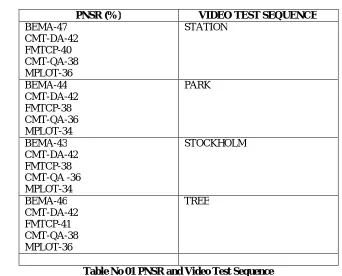
PNSR (%) VIDEO TEST SEQUENCE
BEMA-47 CMT-DA-42 FMTCP-40 CMT-QA-38 MPLOT-36 STATION BEMA-44 CMT-DA-42 FMTCP-38 CMT-QA-36 MPLOT-34 PARK BEMA-43 CMT-DA-42 FMTCP-38 CMT-QA -36 MPLOT-34 STOCKHOLM BEMA-46 CMT-DA-42 FMTCP-41 CMT-QA-38 MPLOT-36 TREE
Table No 01 PNSR and Video Test Sequence
The average PSNR results and confidence intervals for all the evaluated multipath protocols along different mobile
ISSN(Online): 2319-8753 ISSN (Print): 2347-6710
International Journal of Innovative Research in Science,
Engineering and Technology
(A High Impact Factor, Monthly, Peer Reviewed Journal) Visit: www.ijirset.com
Vol. 6, Issue 11, November 2017
transmission. The superiority of BEMA and CMT-DA over the other schemes indicates the importance of video quality model in multipath data transfer to enhance streaming quality. It shows the average PSNR values measured from the different video sequences while the terminal is moving along the fourth trajectory. The differences in measured quality results are caused by the video content complexity, motion level, spatial features, etc. To have a microscopic view of the PSNR results, It shows the evolutions of the instantaneous values for video frames indexed from 1500 to 2500 measured from the Stock-holm sequence (in Trajectory). BEMA achieves apparently higher PSNR values with lower variations.
B. PERFORMANCE MEASURE USED
Performance Metrics: The following metrics are evalu-ated to reflect the user-perceived streaming video quality. 1. PSNR (Peak Signal-to-Noise Ratio)- The standard para-meter to measure objective video quality and this metric
is expressed as a function of the Mean Squared Error (MSE) between the original and the reconstructed video frames. If a video frame is dropped during transmission or past the deadline, it will be concealed by copying the content from the previously received frame. Specifically, thePSNR values are measure with the EvalVid toolset [61]in the emulations.
2. End-to-end delay- The transmission delay and holding time of a video frame at both sender and receiver sides. This duration is counted from the generation of a frame to the point when it can be decoded. The ratio of overdue video frames is also measured to reflect the level of playback fluency.
3. Good put - This metric represents the amount of video data traffic successfully delivered to the receiver side
within the imposed deadline T.
ISSN(Online): 2319-8753 ISSN (Print): 2347-6710
International Journal of Innovative Research in Science,
Engineering and Technology
(A High Impact Factor, Monthly, Peer Reviewed Journal) Visit: www.ijirset.com
Vol. 6, Issue 11, November 2017
VIII. CONCLUSION
From the consideration of all the above points we conclude that supported by the technological progresses in wireless communication systems and mobile devices, there are increasedopportunities for multipath data transfer over heterogeneousaccess networks. Developing an effective multipath transportprotocol is critical to enhance the data transmission performance and network utilization. Motivated by the surprisingproliferation of mobile multimedia services, this paperproposes a bandwidth-efficient multipath streaming (BEMA)protocol to enable quality-guaranteed real-time videostreaming over heterogeneous wireless networks. Bandwidth aggregation approaches are proposed so that a multimode terminal equipped with multiple network interfaces can access through concurrent multi paths [2]. Bandwidth aggregation services can bring in significant improvements in performance over conventional single interface use by providing increased throughput, resource sharing and reliability. By the aggregation of existing lower bandwidth links so as to create a larger logical link, can serve the applications demanding high bandwidth. This paper presents a survey of bandwidth aggregation approaches developed to have concurrent multipath transfer across multiple wireless technologies simultaneously. In future, the wireless communication networks would be the convergent of various access networks, incorporating diverse transmission features and capabilities. Bandwidth aggregation is facilitated in multihomed mobile terminals for increased transmission throughput and enhanced reliability.
REFERENCES
[1] Samsung Galaxy S5, accessed on 2015. [Online]. Available:
http://galaxys5guide.com/samsung-galaxy-s5-features-explained/galaxy-s5-download-booster/ [2] Mushroom Networks Inc., accessed on 2015. [Online]. Available:
http://www.mushroomnetworks.com/
[3] N. M. Freris, C.-H. Hsu, J. P. Singh, and X. Zhu, “Distortion-awarescalable video streamingto multinetwork clients,” IEEE/ACM Trans.Netw., vol. 21, no. 2, pp. 469–481, Apr. 2013.
[4] J. Wu, B. Cheng, C. Yuen, Y. Shang, and J. Chen, “Distortion-awareconcurrent multipath transfer for mobile video streaming in heteroge-neous wireless networks,” IEEE Trans. Mobile Comput., vol. 14, no. 4,pp. 688–701, Apr. 2015.
[5] S. Han, H. Joo, D. Lee, and H. Song, “An end-to-end virtual pathconstruction system for stable live video streaming over heterogeneouswireless networks,” IEEE J. Sel. Areas Commun., vol. 29, no. 5,pp. 1032–1041, May 2011.
[6] M. Xing, S. Xiang, and L. Cai, “A real-time adaptive algorithm for videostreaming over multiple wireless access networks,” IEEE J. Sel. AreasCommun., vol. 32, no. 4, pp. 795–805, Apr. 2014.
ISSN(Online): 2319-8753 ISSN (Print): 2347-6710
International Journal of Innovative Research in Science,
Engineering and Technology
(A High Impact Factor, Monthly, Peer Reviewed Journal) Visit: www.ijirset.com
Vol. 6, Issue 11, November 2017
networks,” IEEE J. Sel. Areas Commun., to be published, doi:10.1109/JSAC.2016.2551483.
[8] Cisco Visual Networking Index: Global Mobile Data Traffic Fore-cast Update, 2014–2019, Cisco Systems, San Francisco, CA, USA,Feb. 2015. [9] C. Xu, T. Liu, J. Guan, H. Zhang, and G.-M.Muntean, “CMT-QA:Quality-aware adaptive concurrent multipath data transfer in heteroge-neous wireless networks,” IEEE Trans. Mobile Comput., vol. 12, no. 11,pp. 2193–2205, Nov. 2013.
[10] J. Wu, X. Qiao, Y. Xia, C. Yuen, and J. Chen, “A low-latency schedulingapproach for high-definition video streaming in a heterogeneous wirelessnetwork with multihomed clients,” Multimedia Syst., vol. 21, no. 4,pp. 411–425, Jul. 2015.
[11] J. Wu, Y. Shang, B. Cheng, B. Wu, and J. Chen, “Loss tolerantbandwidth aggregation for multihomed video streaming over hetero-geneous wireless networks,” Wireless Pers. Commun., vol. 75, no. 2,pp. 1265–1282, Mar. 2014.