FIELD-PROGRAMMABLE GATE ARRAY IMPLEMENTATION OF EMPIRICAL MODE
DECOMPOSITION ALGORITHM FOR ELECTROCARDIOGRAM PROCESSING
ABSTRACT
The electrocardiogram (ECG) signal contains important information that is utilized by physicians for the diagnosis and analysis of heart diseases. Therefore, good quality ECG signal is required. Hilbert-Huang transform (HHT) is a method to analyze non-stationary and non-linear signals. Empirical mode decomposition (EMD) is the core of HHT. EMD breaks down signals into smaller number of components. These components form a complete and nearly orthogonal basis for the original signal. This algorithm is implemented on field-programmable gate array using the process of extrema generation, envelope generation, and stopping criterion.
Keywords: Hilbert-Huang transform, Electrocardiogram, Empirical mode decomposition, Field-programmable gate array.
INTRODUCTION
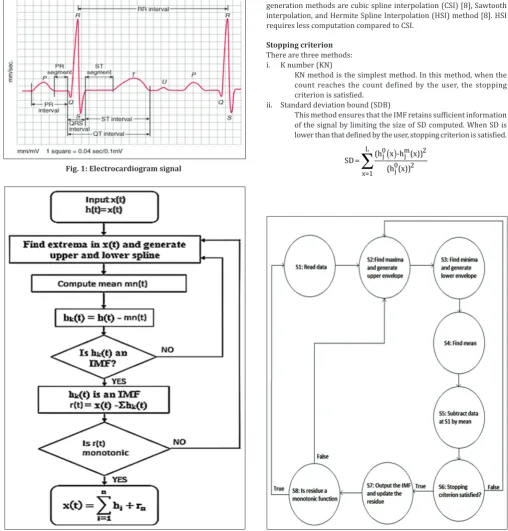
Electrocardiogram (ECG) is the recording of electrical activity of the heart. Fig. 1 shows the normal ECG without any kind of interferences. In clinical practice, ECG is the most commonly used cardiovascular signal because it gives us plenty of diagnostic information. Doctors use ECG to find heart-related problems. ECG from healthy hearts has a characteristic shape. Any damage to heart muscles can change the electrical activity of heart causing change in the characteristic shape of ECG. While recording, ECG contains different types of noises such as power-line interferences, baseline wandering, motion artifacts, electrosurgical noise, and EMG noise which need to be filtered. An ECG contains three main parts: p-wave which denotes atrial depolarization, the QRS complex which denotes ventricular depolarization, and T-wave that represents ventricular repolarization [1]. The most important part in ECG processing is the detection of QRS complex which has an essential role in the diagnosis of heart rhythm irregularities [1,2].
Many methods exist to detect QRS complex that are based on standardized filtering and wavelet transform. Each technique has its own advantages and drawbacks. One of the influential signal detection technique considered in literature is adaptive filtering method. One of the most widely used algorithms is least mean square algorithm introduced by Widrow and Hoff in adaptive filtering. It is very simple in structure and is easy to compute [3]. Geophysicist Morlet put forward the concept of wavelet transform in analysis and processing geophysical data in France in 1984. Wavelet transform has the advantage that the windows will adapt, and thus, it is possible to generate an infinite set of possible basis functions [4].
This paper concentrates on the implementation of Empirical mode decomposition (EMD) using field-programmable gate array (FPGA) for denoising of ECG [5,6]. EMD is widely used for non-stationary and non-linear signal analysis procedures. The decomposition method that is used in the EMD algorithm is called shifting process. It has proved versatile in a wide range of applications for signal extraction from non-linear and non-stationary processes. It is an iterative algorithm which computes the maximum and minimum extreme. Main advantage of the EMD is that the basis functions are derived from the signal itself. Hence, the analysis is adaptive as compared to the traditional methods where the basis functions are fixed. The EMD is based on the sequential extraction of energy linked to various intrinsic time scales of the signal,
starting from finer temporal scales (high-frequency modes) to coarser ones (low-frequency modes). Thus, according to this, decomposition of any signal can be represented as the sum of intrinsic mode functions (IMFs) and a residue. An IMF is defined as a function with equal number of extreme and zero crossings with its envelopes, as defined by all the local maxima and minima [7].
Different EMD applications require different precision, data lengths, extrema extraction method, envelope generation method, and stopping criterion. The proposed algorithm is evaluated using MIT-BIH arrhythmia database.
EMD ALGORITHM
EMD breaks down ECG signal into various data sequences and a final residue. Each data sequence is called as an IMF, which must fulfill the given conditions [7,8].
i. The number of extrema points should be equivalent to the number of zero-crossing points in the signal.
ii. The mean values of upper envelope and lower envelope of local extrema should be equal to zero at all points in the signal.
In EMD, the input signal x (t) can be decomposed as
x(t)= c t d(t) final residue. The following are steps of EMD:
i. Find the local maxima and minima of signal x (t).
ii. Obtain the upper envelope eupper (t) and lower envelope elower (t) from local maxima and local minima, respectively.
iii. Calculate the local mean:
mn(t)=e t +e (t) 2 upper
( )
loweriv. Do subtraction, d(t) = x(t) - mn(t).
v. If d(t) satisfies the stopping criterion, then d(t) is defined as an IMF. Otherwise if
© 2017 The Authors. Published by Innovare Academic Sciences Pvt Ltd. This is an open access article under the CC BY license (http://creativecommons. org/licenses/by/4. 0/) DOI: http://dx.doi.org/10.22159/ajpcr.2017.v10s1.19569
DYLAN ROYCE FERNANDES, SUCHETHA M
Department of CSE, School of Electronics Engineering (SENSE), VIT University, Chennai, Tamil Nadu, India. Email:[email protected]
Received: 23 January 2017, Revised and Accepted: 03 March 2017
vi. d(t) does not satisfy the stopping criterion then set x(t) to d(t) and repeat process from step (i).
vii. Update the residue by subtracting obtained IMF from the previous value.
The signal x(t) can be decomposed into different frequency bands using EMD technique. The resultant decomposed waveform showed variations in the IMFs mainly due to extrema extraction, envelope generation, and stopping criterion. These variations are due to different methods used in extrema extraction, envelope generation, and stopping criterion.
Fig. 2 shows flow chart of EMD algorithm which is used to decompose the signal into various components.
Extrema extraction
The first process in EMD is to extract local maxima and local minima points (local extrema points). The extraction method is based on the neighboring points given by [7]:
i. Local minima: hj[x]<hj[x−1] and hj[x]<hj[x+1]. ii. Local maxima: hj[x]>hj[x−1] and hj[x]>hj[x+1].
Where x is the position index of a current sample which has to be evaluated, hj [x−1] and hj [x+1] are the neighboring signal values of hj[x].
Envelope generation
Envelope generation is a very difficult process in EMD process. An appropriate interpolation method must be used to connect the local maxima and local minima points, respectively. Three envelope generation methods are cubic spline interpolation (CSI) [8], Sawtooth interpolation, and Hermite Spline Interpolation (HSI) method [8]. HSI requires less computation compared to CSI.
Stopping criterion There are three methods: i. K number (KN)
KN method is the simplest method. In this method, when the count reaches the count defined by the user, the stopping criterion is satisfied.
ii. Standard deviation bound (SDB)
This method ensures that the IMF retains sufficient information of the signal by limiting the size of SD computed. When SD is lower than that defined by the user, stopping criterion is satisfied.
SD (h x -h (x)) (h (x)) x=1
L j 0
j
m 2
j
0 2
=
∑
( )
Fig. 1: Electrocardiogram signalWhere L is the length of the signal. iii. Energy difference tracking (EDT)
EDT determines stopping criterion depending on the integrity and orthogonality of IMFs [9]. Equations used are:
Ex= rsj 12
( )
t dt−∞ ∞
−
∫
Etot= h (t)] dtjm 2 + rsj 1
( )
t −h (t)] dtjm 2−∞ ∞
−∞ ∞
−
∫
[∫
[ Eerr = Etot-ExWhere Ex is the energy of residue rsj−1(1) and Etot is the energy sum of h (t)mj and rsj-1
( )
t -h (t)jm .PROPOSED WORK
Envelope generation
In the proposed work, the technique used for envelope generation of the signal from local maxima and local minima is CSI. CSI generates smooth upper and lower envelopes but requires complex computation.
Stopping criterion
The stopping criterion used in the proposed work is SD bound. In SDB, the user will set a threshold, and if SD of the signal goes below the threshold, then the process stops.
HARDWARE IMPLEMENTATION
The hardware architecture of CA used for extrema extraction is shown in Fig. 4.
Fig. 4: Hardware architecture of comparator array
Fig. 5: Overall system architecture of empirical mode decomposition algorithm
Fig. 6: Input electrocardiogram signal with noise
Fig. 7: Upper envelope of input signal Extrema extraction
In the proposed work, the extrema extraction module used is done using a comparator array (CA). In CA technique, if evaluated sample within the search window is maxima or minima then the sample is treated as an extrema.
To implement EMD, each module, that is extrema (local maxima and local minima) extraction, envelope generation, and stopping criterion, was programmed using Matlab then it is converted to Verilog HDL using HDL Coder from Matlab tool. Fig. 3 shows the developed state diagram of EMD algorithm for hardware implementation.
HDL coder
CA technique is used for extrema extraction. In this hardware architecture of CA, the search window size is chosen as 5.
Fig. 5 shows overall system architecture of EMD algorithm implemented in FPGA. The input signal is given as x(t), and the output is a set of IMFs and a residue.
RESULTS AND DISCUSSION
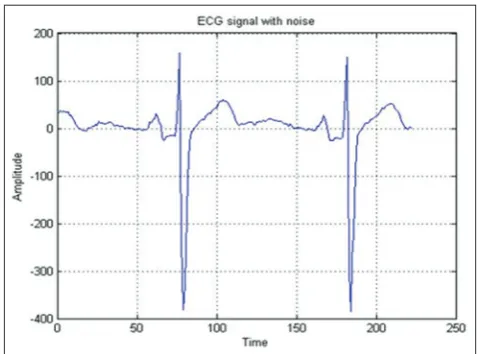
ECG signal is obtained from MIT-BIH arrhythmia database. This database is a real-time record of ECG with more than 4000 samples. In this work, ECG is downloaded from PhysioBank of MIT-BIH arrhythmia database which has a sampling rate of 360 Hz. The study was conducted on 8 ECG signals in normal and also 12 ECG signals in abnormal conditions. This database contains 48 records, each containing two-channel ECG signals of 30 minutes duration selected from 24 hrs recordings of 47 individuals. There are 116,136 numbers of QRS complexes in the database. It is given as an input as shown in Fig. 6. Using interpolation method, the upper envelope and the lower envelope of the input signal are generated as shown in Figs. 7 and 8, respectively. Fig. 9 shows calculated local mean of upper and lower envelope.
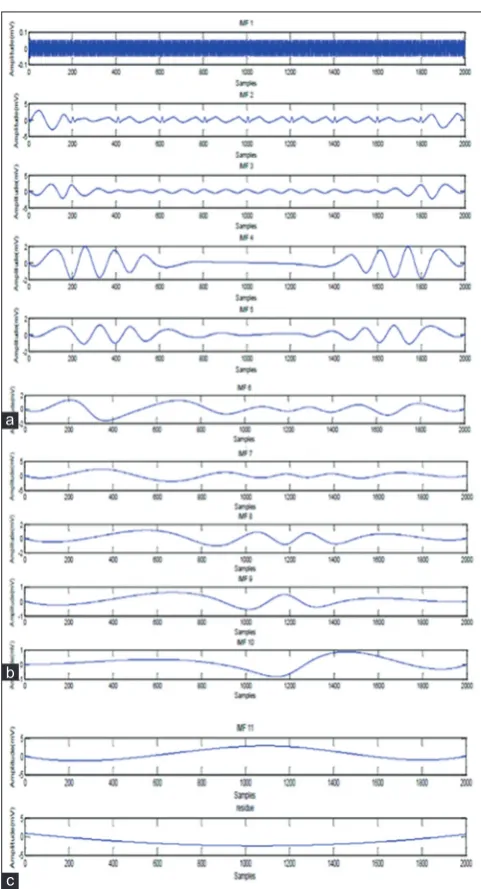
The results obtained for the EMD for 200 samples of ECG signal in MIT-BIH database. Fig. 10 shows the IMF levels for a 50 Hz noisy ECG signal from 1 to 11 and the final residue.
This algorithm is implemented using FPGA using the process of extrema generation, envelope generation, and stopping criterion.
CONCLUSION
This paper has discussed in detail the implementation of EMD algorithm using VLSI for extraction of original ECG signal from 50 Hz noisy ECG signal with the aim of conserving the highest attainable precision in the hardware module. This hardware helps to utilize the design for diagnostics and it has less complexity.
REFERENCES
1. Jambukia SH, Dabhi VK, Prajapati HR. Classification of ECG signals using machine learning techniques: A survey. International Conference on Advances in Computer Engineering and Applications (ICACEA); 2015.
2. Mabrouki R, Khaddoumi B, Sayadi M. R peak detection in electrocardiogram signal based on a combination between empirical mode decomposition and Hilbert transformation. 1st International
Conference on Advanced Technologies for Signal and Image Processing. March, 17-19; 2014.
3. Haykin S. Adaptive Filter Theory. 3rd ed. Englewood Cliffs, NJ:
Prentice-Hall Inc.; 1996.
4. Poornachandra S. Wavelet-based denoising using subband dependent threshold for ECG signals. J Digital Signal Process 2008;18:49-55. 5. Chou CC, Lin KC, Fang WC. An advanced hardware design based on Fig. 9: Local mean
Fig. 10: (a-c) Intrinsic mode functions 1-11 and residue Fig. 8: Lower envelope of input signal
ensemble empirical mode decomposition algorithm for heart sound signal processing. IEEE 17th International Symposium on Consumer
Electronics (ISCE); 2013.
6. Lee MH, Shyu KK, Lee PL, Huang CM, Chiu YJ. Hardware implementation of EMD using DSP and FPGA for online signal processing. IEEE Trans Ind Electron 2011;58(6):2473-81.
7. Huang NE, Shen Z, Long SR, Wu MC, Shih HH, Zheng Q, et al. The empirical mode decomposition and the Hilbert spectrum for non-linear and non-stationary time series analysis. Proc R Soc London A Math
Phys Eng Sci 1998;454(1971):903-95.
8. Shen Z, Feng N, Shen Y, Lee CH. A ridge ensemble empirical mode decomposition approach to clutter rejection for ultrasound color flow imaging. IEEE Trans Biomed Eng 2013;60(6):1477-87.
9. Chen PY, Lai YC, Zheng JY. Hardware design and implementation for empirical mode decomposition. IEEE Trans Ind Electron 2016;63F(6):3686-94.