Identification of Influential Parameters for NTRU
Decryption Failure and Recommendation of
Extended Parameter Selection Criteria for
Elimination of Decryption Failure
Juliet Nyokabi Gaithuru, Mazleena Salleh,
Member, IAENG,
and Majid Bakhtiari
Abstract—NTRU is the leading alternative to ECC and RSA in the post-quantum era. However, it has a probability of decryption failure of 2−k (with k being the security level) according to Philip S. Hirschhorn, Jeffrey Hoffstein, Nick Howgrave-Graham and William Whyte, 2009. This probability was provided for parameters selected using an algorithm which provides security against lattice reduction and MITM attacks, with particular emphasis on parameter size and coefficients of the private key. The recommendations for selection of polyno-mials in NTRU described by Hoffstein, Jeff Howgrave-Graham, Nick Pipher, Jill Whyte and William in 2010 prescribed that for polynomialf of binary form. In this paper, we re-evaluate the prescribed parameter selection criteria by rigorous testing of different polynomial combinations off,g, mandϕas well as
q for varied security levels. The testing experimentally verifies the influential parameters for NTRU operation whose results are used to propose an extended correlated parameter selection criteria for the private key, which ensures that a randomly selected polynomialfis invertible and that an accurate selection of the minimum size ofq required for successful decryption is made.
Index Terms—Cryptography, NTRU, decryption failure, lat-tices, private key, binary polynomials.
I. INTRODUCTION
Lattice-based cryptosystems are resistant to quantum algo-rithm attacks [1], [2] thus providing assurance of security in the post-quantum era. The security of information, in terms of integrity and authenticity, is ensured through the use of encryption [3] which involves the application of a series of computations(employing confusion and diffusion attributes [4]) so as to encrypt the data [5] thereby safeguarding it. One such algorithm is the NTRU (Nth Degree Truncated Polynomial Ring) cryptosystem. It is an asymmetric key cryptosystem whose security is based on the difficulty in solving the approximate closest vector problem [6]. It has two varieties: NTRUEncrypt and NTRUSign. It is mostly implemented in the financial services industry and has been standardized by IEEE P1363.1, ANSI X9.98 [7], EESS1v2 [8] and EESS1v3 [9]. It has been projected as the leading contender for replacing ECC and RSA [10] in the post-quantum era because these algorithms are vulnerable to quantum algorithm attacks, specifically Shor‘s algorithm.
In comparison to ECC and RSA, NTRU has a small foot-print of approximately 8kB, is faster and has a smaller key size than RSA [11]. NTRU has been improved progressively
Manuscript received October 17, 2016; revised August 08, 2017. J. Gaithuru is with the Faculty of Computing, Universiti Teknologi Malaysia, 81310, Skudai, Malaysia e-mail: [email protected].
M. Salleh and M. Bakhtiari are with Universiti Teknologi Malaysia.
since its release in 1998 in terms of recommendation of parameter sets that can withstand various attacks such as the lattice reduction and Meet-in-the-middle(MITM) attacks and the recommendation of parameters that increase the combi-national search space so as to enhance security. Research has also been conducted on variants of NTRU, in which the polynomial ring of integers is replaced with the Eisenstein integers [11], Gaussian ring of integers, integer matrices [12] as well as quarternion algebra which has a non-commutative structure thus making it more resistant to lattice-based attacks [13]. Despite NTRU’s superior performance and security, it has one drawback in that, there is a probability of decryption failure which makes it impossible to recover the plain text from a validly created cipher text.
This study seeks to answer the following questions: does any randomly selected NTRU parameter from the range of all possible polynomial combinations off,g,ϕandmresult in successful NTRU operation in terms of key generation, encryption and decryption and if not, which parameter(s) is most influential and what is the criteria for selecting this parameter(s), in addition to the published criteria, so as to ensure successful operation. In order to answer these questions, this study discusses an experimental study of the most influential parameters for NTRU operation and uses the derived nature of the NTRU parameters to propose an extended parameter selection criteria to ensure invertibility of a randomly selected private key and propose a correlated criteria for parameter selection. This extended criteria will help to further narrow down the range of acceptable param-eters and thus reduce the number of errors occurring due to erroneous selection of non-invertible polynomialf and also providing a range for selection of the corresponding public parameterqthat will further ensure there is a high probability of successful message decryption.
an extended private key selection criteria is recommended in Section VII. Finally, a conclusion of the study is provided in Section VIII.
II. NTRU
NTRU is based on the polynomial convolution ring R=
Z[X]
(XN−1) which implies that all computations are modulus (XN −1) and that there are convolution multiplications.
All polynomials in the ring have integer coefficients and a maximum degree of(N−1). In the ringR, addition of two polynomials refers to the pairwise addition of coefficients of the same degree while multiplication is referred to as con-volution multiplication. The parameters used in the NTRU cryptosystem are:
1) The parameter sizeN
2) A large modulusq
3) A small modulusp
4) Polynomial f which should be invertible modulus p
and modulusq
5) A polynomialgwhich does not require to be invertible 6) A blinding value ϕ
7) Plain text message expressed as the polynomialm. The parameter selection criteria for the NTRU parameters listed above is as described in the subsequent section as published in [14], [15].
A. Degree parameter N
The degree parameterN is a positive integer and specifies that the ring R consists of truncated polynomials of degree (N−1) with integer coefficients a=a0+a1X+a2X2+
a3X3+. . .+aN−2XN−2+aN−1XN−1. It determines the maximum degree (N−1)for the polynomialsf andg.
B. Parameters pandq
q is the large modulus while p is the small modulus, both of which should be relatively prime to each other. The polynomials in NTRU are either of binary, ternary or product form, depending on whether p is selected as 2, 3 or 2 +xrespectively. Binary polynomials allow for a small parameterq to be used [16]. Ternary polynomials provide a balance between security and efficiency in that there is an increased number of combinations and the size of qcan be kept as small as possible while ensuring a low probability of decryption failure [14]. The use of product form polynomials originated from the need to provide efficiency [14] given that it eliminates the need to calculate the polynomial inverses. The corresponding values of q are: when p = 2 then q is selected as a prime number and whenp= 3or forp= 2 +x
thenqis selected as an integral power of 2 (that is2mwhere
m is an integer).
C. Polynomialsf and g
The small polynomials f and g are secret polynomials which are selected by uniform sampling from a set of binary or ternary polynomials whereby a predetermined number of -1 , 1 and 0 coefficients have been set [16]. For binary polynomials, the polynomial f has df of the coefficients
equal to 1 while (N −df) coefficients are 0. For ternary
polynomials, the polynomial f has df of the coefficients
equal to 1 while(df−1)coefficients are -1 and the rest are 0
coefficients. For ternary polynomials,p= 3, the polynomial
g has dg coefficients equal to 1,dg coefficients equal to -1
and the rest of the coefficients are 0.
The slight difference between the polynomials f and g
is because f has to be invertible while g does not need to be invertible. There is a greater probability off having an inverse provided that the GCD off(1)withpand withqis 1 and the sum of the coefficients of f is 1 upon evaluation off(1).
D. Lf,Lg,Lmand Lϕ
Lf and Lg represent private key spaces which are given
by a set of small polynomials from which the private keys will be selected. The polynomials f and g are randomly generated inLf andLgrespectively.Lmrepresents the plain
text space, which is given by a set of polynomials which represent the encryptable message. Lϕ represents a set of
polynomials from which the blinding value will be selected [15].
E. Blinding valueϕ
ϕis a blinding value (which is temporary), used to obscure or hide the message which is different for each transaction. It has dϕ coefficients equal to 1, dϕ coefficients equal
to -1 and the rest of the coefficients are 0. The blinding polynomial is generated from the padded message using the standard polynomial convolution method or by the use of the optimized polynomial convolution method [9].
F. Plaintext message m
The messagemis expressed in the form of a polynomial whose coefficients are modulo p so that its coefficients lie between −2p and p2.
If a user desires ak-bit security level, then 2k bits of a message can be transported at a time. For example, for 112-bit security, then 224 112-bits of a message can be transported at a time thus the message has to be split into2k bits blocks. The random padding lengthl should be such that l≥k.
The value ofN is set such that it is the first prime number that is greater than 3k [15], [17], for instance if desired security level k is 80-bits, then N can be selected as 243. If a message padding scheme is used, such as the SVES-3 padding scheme which utilizes 8 bits to encode the length of the transported message, the length ofN should be at least 3k+8[18]. A smaller value ofNimplies that the bandwidth utilized will be lower and operations will be faster.
G. NTRU Operation
NTRU operation begins with the establishment of the integers N, p, q and the polynomials f, g, ϕ and m. The public and private keys are then generated by obtaining the multiplicative inverse off modpandf modq such that:
Fq∗f ≡1(mod q) (1)
The private key is given by f, Fp and the public key h is
obtained by computing:
h=p Fq∗g(mod q) (3)
The message m is encrypted using the public key, h by computing:
e=ϕ∗h+m(mod q) (4)
The ciphertext is decrypted using the private key by comput-ing:
a≡f∗e(mod q) (5)
After which adjustment is done by ensuring that the coef-ficients of a are in the range of q2 and −2q. This is then followed by retrieving the decrypted message by computing
C=Fp∗a(mod p) (6)
[21] provides a simplified implementation of NTRU in the form of mini-NTRU. Decryption is made possible because the polynomials p, ϕ, g and m are chosen to have small values in the polynomial convolution ringRthus ensuring the polynomialpϕg+f mhas a high probability of having width
b(which representspϕg+f m) less thanq. In other words, the coefficients of these terms are selected in a way that ensures that they have an absolute value that does not exceed q2 [22]. Therefore, the proof of decryption is as follows:
Since the ciphertext is obtained by computinge≡ϕ∗h+ m(mod q)then
a≡f∗e(mod q) =f ∗(ϕ∗h+m)mod q (7)
= (f∗ϕ∗h+f∗m)mod q (8)
Since h≡p Fq∗g(mod q)then
a = [(f ∗ϕ∗(p∗Fq∗g)) + (f ∗m)]modq (9)
Since Fq∗f ≡1(mod q)then
a= [(p∗ϕ∗g) + (f ∗m)]mod q (10)
This implies that since C=Fp∗a(mod p)then
C=Fp∗a(mod p) =p∗(Fp∗ϕ∗g) +Fp∗f∗m (11)
= 0 + 1∗m=m mod p (12)
The productp∗(Fp∗ϕ∗g)is a small value close to zero. In
the real sense, it is observed that this product is a multiple of pthus reductionmod p results in a zero. Thus retrieving the value of the plain text m.
In the case where the width of(p∗ϕ∗g+f∗m)is greater than or equal toq, then a gap failure occurs but if the range of of (p∗ϕ∗g+f ∗m) is less than q but reduced into the wrong interval, then this is referred to as a wrap failure. A wrap failure can be adjusted by reducing a to the range
[A, A+q−1] in which A 6= −2q and the mod q equality from the equationa≡p∗ϕ∗g mod q is an exact equality inZ[X] (meaning that the product is not greater than q2 or less than −2q) [23].
On the other hand, when a gap failure occurs, it will result in decryption failure since the range of a is exceeded thus resulting in the inability to correctly recover(p∗ϕ∗g+f∗m) . The use of the range [A.A+q−1] serves as a partial solution to the problem of decryption failures. This process of increasing the chances of a correct decryption is called re-centering [24], [25].
III. PREVIOUSRECOMMENDEDPARAMETERS
Since the invention of NTRU in 1998, several parameter sets have been recommended and revised for binary, ternary and product-form polynomials. The Table I shows the some of the previously recommended parameter sets forp= 2and
p= 3, on which we base our study.
The parameter sets ees251ep4 and ees251ep5 use product form polynomial (f = 1 +pF) because it results in an inverse of 1 therefore eliminating the need for calculating the inverse [8]. ees251ep4 stands for efficient embedded security encryption parameters with degree 251 set 4.
The parameter sets NTRU167.2, NTRU263.2 and NTRU503.3 were recommended following the establishment of the probability of wrap failure and gap failure in NTRU. These parameter sets were meant to provide a balance between security and decryption levels [20].
IV. METHODOLOGY
The methodology used in this study involved carrying out tests on NTRU parameters in order to answer the following questions: does any randomly selected NTRU parameter from the range of all possible polynomial combinations of
f,g,ϕandmresult in successful NTRU operation in terms of key generation, encryption and decryption and if not, which parameter(s) is most influential and what is the criteria for selecting this parameter(s), in addition to the published cri-teria, so as to ensure successful operation. This was done by evaluating how varying any of the NTRU parameters affects its successful key generation, encryption and subsequently successful message decryption. This was followed by an analysis of the test results to identify the most influential parameters. The most influential parameters were then used to conduct further tests to identify a selection criteria that is bound to ensure a higher probability of successful operation and subsequently successful message decryption.
Previous research works on NTRU do not discuss the methodology used in deriving the recommended parameter sets and parameter selection criteria, including publications
TABLE I: Previously Recommended NTRU parameters forp= 2andp= 3
Parameter set Security level (k) N p q df dg dϕ Reference
ees251ep4 80 251 2 239 72 72 72 [8], [19]
ees251ep5 80 251 2 239 72 72 72
NTRU167.2 Low 167 2 127 45 35 18 [20]
NTRU263.2 Moderate 263 2 127 35 35 22
NTRU503.3 High 503 2 253 100 100 65
NTRU 167 49 167 3 128 61 20 18 [6]
on variants of NTRU. This study delves into a description of the methodology used to arrive at an extended parameter selection criteria which further narrows down the margin for erroneous parameter selection in NTRU which will affect its successful operation and subsequent key generation, encryp-tion and decrypencryp-tion.
A. Evaluating Effect of NTRU Parameter Variation
An experimental analysis of the NTRU parameters was done, beginning with low security levels to identify the most influential parameters in the occurrence of decryption failure. The results of the analysis at low security levels were then used to obtain the proportions for estimating sample sizes to be used for testing higher security levels. The testing began by varying each of the parameters f,g,
ϕ and m one at a time for possible values of polynomials for N = 11. The proportions obtained for successful key generation, encryption and decryption from the analysis done at low security levels (N = 11 and N = 53) were used as input in determining appropriate sample sizes for testing higher security levels, including the previously proposed recommended NTRU parameters.
B. Uniform Sampling without Replacement
The sample sizes were obtained by using uniform random sampling where the samples were selected by using a ran-dom number generator without replacement. First, an initial sample sizen0 was obtained by computing:
n0=
z2×p(1−p)
e2 (13)
where z is the critical value for the confidence level c, p
is the proportion or distribution andeis the sampling error. Since n0 is at least 5% of the population N and sampling is without replacement, the sample size is more accurately estimated by reducing the error in the previous computation of n0 by applying the Finite Population Correction Factor (FPC). This was done by computing [26]–[29]:
n= n0·N n0+ (N−1)
(14)
Uniform random sampling was used, with a 99% confi-dence interval and 5% margin of error. The proportion, p
used is based on the results obtained from the test results for low security levels. The uniform sampling method is used in this study because it is the documented sampling method used to select secret polynomialsfandg[14], [16], [18]. The method of sampling from a discrete Gaussian distribution as proposed by [30] in 2014 can also be used for selecting f
andg. However, Gaussian sampling results in a large public key size of 378353 for N= 256, 1511821 forN = 512for instance, in comparison to public keyq= 2048for uniform sampling [16]. For this reason, uniform sampling method was used in this study as opposed to sampling from a discrete Gaussian distribution.
C. Test Parameters
Tests were conducted for binary polynomials at N = 11,
N = 53 andN = 251 for 3-bit, 16-bit and 80-bit security
levels respectively. Testing at 32-bit security levels and beyond took a significant amount of time on the available processing resources owing to the sequential nature of the task execution for the tests in this study. Therefore, the obtained results for low security levels were used as input for proportions used for sampling to be used for high-security level testing. The test parameters used in this study are as shown in the Table II. The base test parameters used to conduct this study are appended in Appendix A. These base test parameters were selected following the existing parameter selection criteria.
The initial sample size tested forN = 11was 28 out of the211possible combinations for each of the polynomialsf,
g,ϕandm. The value of parameterqwas varied by testing the range of prime numbers starting from 1 to 203. Once proportions were obtained from the initial tests onN = 11, the sample sizes were computed after which the sample size of N = 11, eesTest1 was adjusted to the computed sample size (501 combinations) and more polynomial combinations tested as illustrated in the Table II. The proportions obtained from the initial tests were 0.4922:0.5078 which stand for the ratio of successful key generation to unsuccessful key generation. The sample sizes for eesTest1, eesTest2 and ees251ep4 were obtained by computation using the Equation 13 and Equation 14. The outcome of the tests is provided in Section V.
D. Testing Environment and Sequence
The testing sequence for this study was conducted as follows:
1) Input test parametersN, p, f, g, r, mfor eesTest1. 2) Generate a range of prime numbers from 1 to a random
large prime, for instance 700.
3) Vary q in the test parameter set using the generated primes in step 2.
4) Generate all possible polynomial combinations with maximum degree N−1(that is2N polynomial com-binations).
5) Varyg by replacing it with the polynomial combina-tions generated in step 4, one at a time, and record the result.
6) Repeat step 5 forf,r andm.
7) In the case of non-invertible polynomialf, discard the polynomial and move onto the next polynomial in the sequence.
a) If f is invertible and has successful message decryption, record the result.
b) Iff is invertible but has decryption failure, repeat steps 3 and 4 and record the result.
c) If f is invertible but still has decryption failure after repeating steps 3 to 6, varyq by repeating step 3 and record the result. This is done to evaluate if the variation of parametersg,randm
could switch the result from ‘decryption failure‘ to ‘successful decryption‘.
8) Repeat steps 1 to 7 for eesTest2, ees251ep4, NTRU167 and ees401ep1.
TABLE II: Test parameters for binary and ternary NTRU polynomials
Parameter set k N p q df dg dϕ dm Population Sample size Actual
Sample Tested
eesTest1 3 11 2 37 4 5 4 6 211 501 1000
eesTest2 16 53 2 67 7 27 40 35 253 663 1000
eesTest3 3 11 3 32 4 5 4 6 311 501 1000
eesTest4 16 53 3 64 7 27 40 35 353 663 1000
ees251ep4 [8], [19] 80 251 2 239 72 72 72 35 3251 663 1000
NTRU 167 [6] 49 167 3 128 61 20 18 70 3167 663 1000
ees401ep1 [7] 112 401 3 2048 113 113 113 70 3401 663 1000
forN = 251for binary polynomials as well as product-form polynomials.
The testing was carried out on a Windows 8.1 64-bit operating system with Intel core i5 processor and 4GB RAM computer running the Magma computational algebra system. The Magma computational algebra system was used following precedence of other research studies conducted in the same environment, namely; the study conducted on speed records for NTRU when run on a graphical processing unit (GPU) by Hermans in 2010 [31] and in a cryptanalysis study on a revised NTRUSign scheme conducted by Geiler and Smart [32].
A discussion of the observations made from the test results for binary polynomials at various security levels is provided in the subsequent section.
V. RESULTS-IDENTIFYING THEINFLUENTIALNTRU PARAMETERS
The results of tests for the parameter sets with binary, product- form and ternary coefficients are described in the subsequent section.
A. Binary and Product-Form Polynomials
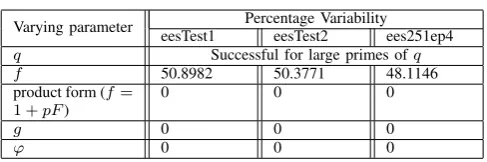
The results of varying NTRU binary and product form parameters is depicted in Table IV. The Table III shows the parameter being varied one at a time, in the left-most column, while all other parameters are kept constant. This is followed by the next three columns showing percentage variability for test parameters sets for 3-bit, 16-bit and 80-bit security respectively. The percentage variability stands for the number of polynomials which showed unsuccessful key generation. This occurs as a result of the selection of non-invertible polynomials of f which results in the key generation algorithm going into an infinite loop of trying to find the inverse and when no inverse is found then no key is generated.
TABLE III: Test Results for binary NTRU polynomials
Varying parameter Percentage Variability eesTest1 eesTest2 ees251ep4
q Successful for large primes ofq
f 50.8982 50.3771 48.1146
product form (f= 1 +pF)
0 0 0
g 0 0 0
ϕ 0 0 0
The variation of polynomial q revealed that decryption was successful for large values of the primeq. Prime values
greater than 29 resulted in successful decryption for eesTest1, while prime values greater than 101 resulted in successful decryption for eesTest2. This drew attention to the existence of a relationship between the value of prime q and the selected polynomialf.
The variation of polynomialgresulted in 100% successful decryption regardless of the binary polynomial of g chosen from the range of possible combinations of polynomials at the corresponding security levels.The variation of polynomial
ϕalso resulted in 100% successful decryption regardless of the random polynomial ofϕchosen.
The variation of polynomial f resulted in 50.8982% of the tested polynomial combinations having no multiplicative inverse mod p and mod q thus resulting in no key being generated and therefore no encryption and decryption for
N = 11. For N = 53, 50.3771% of the polynomial combinations had no multiplicative inverse while 48.1146% had no multiplicative inverse forN= 251.
It was also observed from the results that the variation of the product form polynomial f also resulted in 100% successful key generation, and subsequent encryption and decryption regardless of the random polynomial of f cho-sen. This means that choosing the product form f means there is assurance of finding a multiplicative inverse modp
and mod q. These results point to the significance of the polynomialf chosen, on whether key generation is possible and subsequently on whether encryption and decryption is possible. This confirms the assertion that decryption failures are predominantly key-dependent [14].
B. Ternary Polynomials
The results of varying NTRU ternary form parameters is depicted in Table IV.
TABLE IV: Test Results for ternary NTRU polynomials
Varying parameter eesTest3 eesTest4Percentage VariabilityNTRU
167
ees401ep1
q Successful for large powers of 2 (largeq)
f 27.06 26.36 27.06 26.34
g 98.491 98.63 98.491 97.51
ϕ 97.577 97.010 98.491 97.872
(a) Graph of f(1) against q for eesTest2
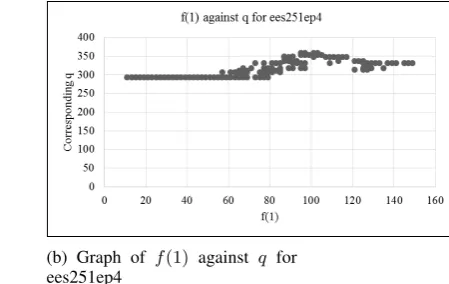
(b) Graph of f(1) against q for ees251ep4
Fig. 1: Evaluation of the relationship between f(1)andqfor NTRU binary polynomials
successful decryption for large powers of 2. The variation of
f revealed that 72.94% of the polynomials tested for 8-bit ternary combinations have no multiplicative inverse mod p
andmod q thus resulting in no key generation.
Further examination of the invertible polynomials of f
revealed that the number of 1’s were either one more than the number of -1 coefficients or one less than the number of 1 coefficients. This leads to the conclusion that in order to have a ternary polynomial off that has an inversemod pand
mod q then the value of f(1) when the sum of coefficients is computed should either be 1 or -1. This increases the range of possible polynomial combinations of f, since the previous parameter selection criteria prescribes thatf should be selected such thatf(1) = 1.
VI. ANALYSIS OF THE RELATIONSHIP BETWEENf ANDq
This study revealed that some polynomials of f do not have a multiplicative inverse. Therefore, when these polyno-mials go through the process of finding a multiplicative in-verse (which can be computed using the Extended Euclidean algorithm), the process results in an infinite loop which does not terminate and neither does it print out the inverseFpand Fq thus no private key is generated thus resulting in an error.
Further evaluation of the invertible polynomials shows that
f(1)when the sum of coefficients was computed, is an odd number for all the invertible polynomials off. In addition, it was observed that the value of f(1) had a relationship with the size ofq. ForN = 11, the polynomial combinations that were invertible and had successful decryption had q = 37 andf(1) = 3,5 and7. For the higher security levels, some of the polynomial combinations with an odd value of f(1) did not have successful decryption (due to the size ofqupon evaluation) while others were successful forN = 53,q= 37 and N = 251, q = 239. The size of q was then varied upwards to a larger prime till decryption was successful and the corresponding values recorded.
In addition, it was observed that all the invertible polyno-mials off haveGCD(f(1), p) = 1andGCD(f(1), q) = 1. This is in line with the recommended condition in [14] in the determination of whether a set of values have a multiplicative inverse such that(a∗b)mod n≡1.
A graphical representation of the relationship between
f(1) and q for eesTest2 is shown in the Figure 1a. The test results for eesTest2 show a correlation coefficient of 0.93109468 between the values of f(1) and q and a
cor-responding equation of regression line was derived given by:
y= 72 + 4.429x (15)
The results for ees251ep4 for binary form of f show a correlation coefficient of0.7004between the values off(1) andq and a corresponding equation of regression line was derived given by:
y= 281.586 + 0.442x (16)
The graphical representation of this relationship is shown in the Figure 1b.
The NTRU parameter selection criteria recommended by [14], [15] for polynomial f ensured that there was a high probability of the polynomial having a multiplicative inverse therefore making it possible to generate a private key and eventually encrypt and decrypt messages correctly. Based on the results of this study, it has been established that the criteria set does not conclusively cover all possibilities for the selection of private keys that would result in successful decryption of messages encrypted using the NTRU cryp-tosystem.
A. Identification of the Selection Criteria forq for Elimina-tion of DecrypElimina-tion Failure
The study proceeded to establish an additional selection criteria which will provide for the selection of the mini-mum size of q required for successful message decryption, as opposed to just selecting an upper limit. The existing recommended criteria on binary polynomials in [14], [22] is that in order to avoid decryption failure, the size of q
should be large enough whereby c should be selected such that3c+ 1> q2. The value ofc is given byc= q2−p2.
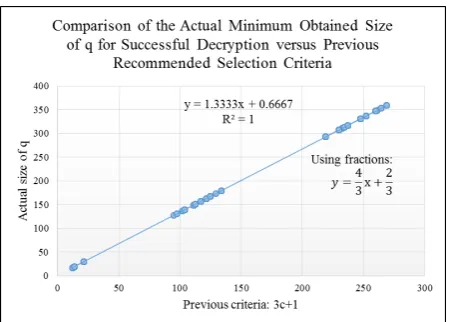
In order to establish the criteria that will ensure the selection of the minimum size ofq required for successful decryption, an evaluation of the relationship between the previous criteria (3c+ 1 > q/2) and the actual minimum size of q that resulted in successful message decryption was carried out in this study. The observed results are as illustrated in the Figure 2.
Fig. 2: Comparison of the previous selection criteria for size of q against the new recommended criteria and actual minimum size of qfor successful decryption.
Expressing the relationship between the previous criteria
q
2 = 3c+ 1which translates toq= 6c+ 2and the observed sizes of q given by y = 1.3333x+ 0.6667 in terms of fractions results in
y=4 3x+
2
3 (17)
Replacingxwith3c+ 1 andy withq results in
q=4
3(3c+ 1) + 2 3
q=12c+ 4
3 +
2 3 =
12c+ 6 3 q= 4c+ 2 q
2 = 2c+ 1
Therefore, this implies that in order to ensure successful message decryption at varied security levels, the size of public parameterqshould be selected to be an appropriately large value which satisfies the condition that
q= 2c+ 1or q
2 = 2c+ 1 (18)
for binary polynomials.
In comparison to the existing published criteria, it is the observation of this study that the size of q required for successful message decryption is smaller than the previously published criteria, which gives an upper limit. A comparison of public parameter sizeqselected using the previous criteria compared to the newly recommended criteria as well as the actual size of q that results in successful decryption is as shown in the Figure 3.
It can be observed from the Figure 3 that the actual min-imum size of q required for successful message decryption matches with the predicted size of q using the new recom-mended criteria q = 4c+ 2. The predicted size of q using the previous criteria is much larger than the actual minimum size of q required for successful message decryption. The recommended criteria in this study results in a 33.050% reduction in the predicted size of q required for successful message decryption. This study proves that selecting the size of qsuch thatq= 4c+ 2will result in a predicted size ofq
which exactly matches the actual minimum size ofqrequired for successful message decryption.
This study has shown that the previous criteria set an upper limit for the size ofqwhich would result in successful decryption. In the next section, we outline an extended pa-rameter selection criteria which ensures successful message decryption.
VII. RECOMMENDEDEXTENDEDPARAMETER SELECTIONCRITERIA FOR THEPRIVATEKEY AND
PUBLICPARAMETERq
The observations made in this study as described in the previous sections and the conclusions drawn led to the recommendation of an extended NTRU parameter selection criteria. The emphasis of this study is on the private key polynomialf and public parameterq(which directly affects the public key size) since it has been proven in Section V above, that these are the most influential parameters for successful NTRU operation. The polynomial f shows variability of 50.8982% in comparison to the 0% variability of polynomialsm,g andϕ.
The recommended general parameter selection algorithm which is a combination of previous work [14], [16], [22] and the findings of this study is as follows: i
1) Takep= 2.
2) SetN to be the first prime greater than3k+ 1. 3) Selectq to be a prime integer. Selectq such thatq=
2c+ 1 where c = q2−p2 in order to ensure successful decryption.
4) Select binary polynomialsg,ϕandmwithdg,dϕ,dm
number of 1‘s respectively. The number of coefficients
dg,dϕ,dm lie in the range1≤dg, dϕ, dm≥N.
5) Select binary polynomial f with df number of 1‘s
wheredf is an odd integer so as to ensure it has a
mul-tiplicative inverse mod p and mod q. GCD(f(1), p) andGCD(f(1), q)should be 1.
6) Select ternary polynomialf withdf number of 1‘s and df −1 number of -1‘s (that is f(1) = 1) or df −1
number of 1‘s and df number of -1‘s (that isf(1) =
−1) so as to ensure it has a multiplicative inverse mod
pand modq
This extended parameter selection criteria ensures that the chosen polynomial of f is invertible modulus p and modulusqand that the exact size ofqrequired for successful
decryption is selected so as to ensure there is no decryption failure. A tabular comparison of the extended parameter selection criteria in comparison to the existing selection criteria is depicted in Table V.
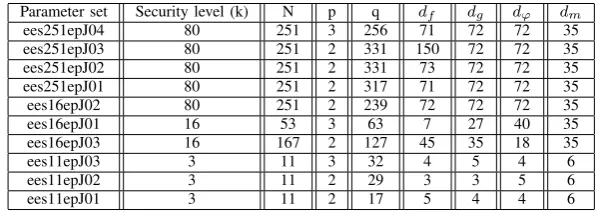
The Table VI provides a list of recommended parameter sets which ensure no decryption failure.
These parameters are derived from experimentation con-ducted in this study which follows the extended recom-mended parameter selection criteria proposed in this study. We leave to future work the evaluation of these recommended parameter sets against practical lattice reduction attacks. This will provide confirmation of these security levels in practical application where the parameters are prone to attacks.
VIII. CONCLUSION
The study shows that in order to ensure successful de-cryption and increase the range of polynomials of private keyf which result in successful decryption, some additional parameter selection criteria should be included. The private key, for binary polynomials, should be selected such that in addition to havingGCD(f(1), p) = 1andGCD(f(1), q) = 1, the number of 1‘s inf(df) should be an odd integer which
lies in the range1< df ≤N, whereN is the parameter size
of the integer ring R. For ternary polynomials, the private key polynomial f should be selected such that the number of 1’s in f are one more than -1’s or the number of 1’s are one less than the number of -1’s (f(1) = 1or -1) The use of this criteria ensures that the polynomial of f selected is invertible modulus pand modulus q and also increases the range of invertible polynomials of f.
In order to reduce the probability of decryption failure, the study revealed that it is imperative that parametersf and
q are selected with consideration. This study revealed the existence of a high correlation between the size off(1)and
q. The value ofqshould be selected to be appropriately large so as to ensure successful decryption.
This study provides a parameter selection criteria for the value of q which ensures no decryption failure at varied security levels. This can be achieved by selectingqsuch that
q
2= 2c+ 1. This extended parameter selection criteria helps to ensure no decryption failure in the NTRU cryptosystem thus providing a greater assurance of security.
The use of this recommended parameter selection criteria helps to accurately predict the public parameterqthat ensures successful message decryption. This eliminates the need to select an upper limit ofq, which provides efficiency in terms of memory requirements and thus subsequently reducing public key size. Therefore, there is memory efficiency and provision of assurance that the selected size ofqwill ensure successful message decryption.
Future work could be carried out to ascertain whether the recommended size of q selected using the criteria recom-mended in this study provides the same security level when the parameters are subjected to practical lattice reduction attacks.
APPENDIX BASETESTPARAMETERS
N = 11
p= 2
q= 37
f = 1 +x4+x7+x8+x9 df = 5
g= 1 +x+x4+x6+x10 dg= 5
m=x+x3+x5+x8+x9+x10 dm= 6
ϕ= 1 +x3+x4+x8 dϕ= 4
TABLE V: Comparison of the previous and recommended extended parameter selection criteria
Coefficients previous selection criteria proposed revised criteria Coefficients in binaryf,df - odd integer
Coefficients in ternaryf,df f(1)=1 f(1)=1 or -1
GCD(f(1), p) 1 1
GCD(f(1), q) 1 1
Size ofq (3c+ 1)>q2 2c+ 1 = q2
TABLE VI: Recommended parameter sets
Parameter set Security level (k) N p q df dg dϕ dm
ees251epJ04 80 251 3 256 71 72 72 35
ees251epJ03 80 251 2 331 150 72 72 35
ees251epJ02 80 251 2 331 73 72 72 35
ees251epJ01 80 251 2 317 71 72 72 35
ees16epJ02 80 251 2 239 72 72 72 35
ees16epJ01 16 53 3 63 7 27 40 35
ees16epJ03 16 167 2 127 45 35 18 35
ees11epJ03 3 11 3 32 4 5 4 6
ees11epJ02 3 11 2 29 3 3 5 6
N = 53
p= 2
q= 67
f =x39+x38+x37+x36+x35+x34+x33
+x32+x31+x30+x29+x28+x27+x26+x25
+x24+x13+x12+x11+x10+x9+x8+x7
+x6+x5+x4+x
df= 27
g=x29+x28+x27+x26+x25+x24+x23+x22+x21
+x20+x19+x18+x17+x16+x15+x14+x13+x12
+x11+x10+x9+x8+x7+x6+x5+x4+x
dg= 27
m=x37+x36+x35+x34+x33+x32+x31+x30+x29
+x28+x27+x26+x25+x24+x23+x22+x21+x20+
x19+x18+x17+x16+x15+x14+x13+x12+x11+
x10+x9+x8+x7+x6+x5+x4+x
dm= 35
ϕ=x42+x41+x40+x39+x38+x37+x36+x35
+x34+x33+x32+x31+x30+x29+x28+x27+x26
+x25+x24+x23+x22+x21+x20+x19+x18+x17
+x16+x15+x14+x13+x12+x11+x10+x9+x8
+x7+x6+x5+x4+x
dϕ= 40
N = 251
p= 2
q= 239
f =x71+x70+x69+x68+x67+x66+x65+x64
+x63+x62+x61+x60+x59+x58+x57+x56+x55
+x54+x53+x52+x51+x50+x49+x48+x47+x46
+x45+x44+x43+x42+x41+x40+x39+x38+x37
+x36+x35+x34+x33+x32+x31+x30+x29+x28
+x27+x26+x25+x24+x23+x22+x21+x20+x19
+x18+x17+x16+x15+x14+x13+x12+x11+x10
+x9+x8+x7+x6+x5+x4+x3+x2+x+ 1
df= 73
g=x71+x70+x69+x68+x67+x66+x65+x64
+x63+x62+x61+x60+x59+x58+x57+x56+x55
+x54+x53+x52+x51+x50+x49+x48+x47+x46
+x45+x44+x43+x42+x41+x40+x39+x38+x37
+x36+x35+x34+x33+x32+x31+x30+x29+x28
+x27+x26+x25+x24+x23+x22+x21+x20+x19
+x18+x17+x16+x15+x14+x13+x12+x11+x10
+x9+x8+x7+x6+x5+x4+x3+x2+x+ 1
dg= 72
m=x37+x36+x35+x34+x33+x32+x31+x30
+x29+x28+x27+x26+x25+x24+x23+x22+x21
+x20+x19+x18+x17+x16+x15+x14+x13+x12
+x11+x10+x9+x8+x7+x6+x5+x4+x
dm= 35
ϕ=x139+x138+x137+x136+x135+x134+x133
+x132+x131+x130+x129+x128+x127+x126+x125
+x124+x123+x122+x121+x120+x119+x118+x117
+x116+x115+x114+x113+x112+x111+x110+x109
+x108+x107+x106+x105+x104+x103+x102+x101
+x100+x99+x98+x97+x96+x95+x94+x93+x92
+x91+x90+x89+x88+x87+x86+x85+x84+x83
+x82+x81+x80+x79+x78+x77+x76+x75+x74
+x73+x72+x71+x70+x69+x67
dϕ= 72
REFERENCES
[1] R. Lai, H. Cheung, and S. Chow, “Trapdoors for ideal lattices with applications,” in Information Security and Cryptology, ser. Lecture Notes in Computer Science, D. Lin, M. Yung, and J. Zhou, Eds. Springer International Publishing, 2015, vol. 8957, pp. 239–256. [Online]. Available: http://dx.doi.org/10.1007/978-3-319-16745-9-14 [2] D. Micciancio and O. Regev, “Lattice-based cryptography,” in
Post-Quantum Cryptography, D. Bernstein, J. Buchmann, and E. Dahmen, Eds. Springer Berlin Heidelberg, 2009, pp. 147–191. [Online]. Available: http://dx.doi.org/10.1007/978-3-540-88702-7-5
[3] N. Kishore and B. Kapoor, “Attacks on and advances in secure hash algorithms,”IAENG International Journal of Computer Science, vol. 43, no. 3, pp. 326–335, 2016.
[4] R. E. Boriga, A. C. D˘asc˘alescu, and A. V. Diaconu, “A new fast image encryption scheme based on 2d chaotic maps,”IAENG International Journal of Computer Science, vol. 41, no. 4, pp. 249–258, 2014. [5] H. Miyajima, N. Shigei, H. Miyajima, Y. Miyanishi, S. Kitagami,
and N. Shiratori, “New privacy preserving back propagation learning for secure multiparty computation.”IAENG International Journal of Computer Science, vol. 43, no. 3, pp. 270–276, 2016.
[6] J. Hoffstein, J. Pipher, and J. H. Silverman, “Ntru: A ring-based public key cryptosystem,” inAlgorithmic number theory. Springer, 1998, pp. 267–288.
[7] “Ieee standard specification for public key cryptographic techniques based on hard problems over lattices,” IEEE Std 1363.1-2008, pp. C1–69, March 2009.
[8] EESS, “Efficient embedded security standards (eess),” 2003. [9] W. Whyte, “Efficient embedded security standards (eess) 1:
Imple-mentation aspects of ntruencrypt,” 2015.
[10] B.-Y. Yang, C.-M. Cheng, B.-R. Chen, and J.-M. Chen, “Implementing minimized multivariate pkc on low-resource embedded systems,” in
Security in Pervasive Computing, ser. Lecture Notes in Computer Science, J. Clark, R. Paige, F. Polack, and P. Brooke, Eds. Springer Berlin Heidelberg, 2006, vol. 3934, pp. 73–88. [Online]. Available: http://dx.doi.org/10.1007/11734666-7
[11] K. Jarvis and M. Nevins, “Etru: Ntru over the eisenstein integers,”
Designs, Codes and Cryptography, vol. 74, no. 1, pp. 219–242, 2015. [12] M. Coglianese and B.-M. Goi, “Matru: A new ntru-based cryptosys-tem,” inProgress in Cryptology-INDOCRYPT 2005. Springer, 2005, pp. 232–243.
[13] E. Malekian, A. Zakerolhosseini, and A. Mashatan, “Qtru: quaternionic version of the ntru public-key cryptosystems,”The ISC International Journal of Information Security, vol. 3, no. 1, 2015.
[14] P. S. Hirschhorn, J. Hoffstein, N. Howgrave-Graham, and W. Whyte, “Choosing ntruencrypt parameters in light of combined lattice reduction and mitm approaches,” in Applied Cryptography and Network Security, ser. Lecture Notes in Computer Science, M. Abdalla, D. Pointcheval, P.-A. Fouque, and D. Vergnaud, Eds. Springer Berlin Heidelberg, 2009, vol. 5536, pp. 437–455. [Online]. Available: http://dx.doi.org/10.1007/978-3-642-01957-9-27 [15] J. Hoffstein, N. Howgrave-Graham, J. Pipher, and W. Whyte,
“Practical lattice-based cryptography: Ntruencrypt and ntrusign,” in
pp. 349–390. [Online]. Available: http://dx.doi.org/10.1007/978-3-642-02295-1-11
[16] J. Hoffstein, J. Pipher, J. M. Schanck, J. H. Silverman, W. Whyte, and Z. Zhang, “Choosing parameters for ntruencrypt,” 2015. [Online]. Available: http://eprint.iacr.org/2015/708.pdf
[17] A. S. B. S. K. Ranjeet Ranjan, “Improvement of ntru cryptosystem,” 2012.
[18] N. Howgrave-Graham, J. Silverman, and W. Whyte, “Choosing parameter sets for ntruencrypt with naep and sves-3,” inTopics in Cryptology CT-RSA 2005, ser. Lecture Notes in Computer Science, A. Menezes, Ed. Springer Berlin Heidelberg, 2005, vol. 3376, pp. 118–135. [Online]. Available: http://dx.doi.org/10.1007/978-3-540-30574-3-10
[19] J. Hoffstein, J. H. Silverman, and W. Whyte, “Ntru cryptosystems technical report# 012, version 2: Estimated breaking times for ntru lattices,”NTRU Cryptosystems, Inc, 2003.
[20] J. H. Silverman, “Wraps, gaps, and lattice constants,”NTRU Report, vol. 11, 2001.
[21] J. N. Gaithuru, M. Salleh, and I. Mohamad, “Mini n-th degree truncated polynomial ring (mini-ntru): A simplified implementation using binary polynomials,” in2016 IEEE 8th International Conference on Engineering Education (ICEED), Dec 2016, pp. 270–275. [22] J. P. Jeffrey Hoffstein and W. Whyte,More Efficient parameters, keys
and encoding for hybrid-resistant NTRUEncrypt and NTRUSign, 2009. [23] J. Hoffstein, Silverman, and W. Whyte, “Ntru cryptosystems technical report# 018, version 1: Estimating decryption failures of ntruencrypt,”
NTRU Cryptosystems, Inc, 2003.
[24] N. Howgrave-Graham, P. Nguyen, D. Pointcheval, J. Proos, J. Silverman, A. Singer, and W. Whyte, “The impact of decryption failures on the security of ntru encryption,” inAdvances in Cryptology - CRYPTO 2003, ser. Lecture Notes in Computer Science, D. Boneh, Ed. Springer Berlin Heidelberg, 2003, vol. 2729, pp. 226–246. [Online]. Available: http://dx.doi.org/10.1007/978-3-540-45146-4-14 [25] J. Scholten and F. Vercauteren, “An introduction to elliptic and
hyperelliptic curve cryptography and the ntru cryptosystem,” 2003. [26] L. University. (2006) Sample size. [Online]. Available:
http://library.lincoln.ac.nz/global/library/learning/maths and stats/qmet 103/sample-size.pdf
[27] M. Desu,Sample size methodology. Elsevier, 2012.
[28] P. J. Lavrakas, Encyclopedia of survey research methods. Sage Publications, 2008.
[29] P. S. Levy and S. Lemeshow,Sampling of populations: methods and applications. John Wiley and Sons, 2013.
[30] D. Cabarcas, P. Weiden, and J. Buchmann, “On the efficiency of provably secure ntru,” in Post-Quantum Cryptography. Springer, 2014, pp. 22–39.
[31] J. Hermans, F. Vercauteren, and B. Preneel, “Speed records for ntru,” in Topics in Cryptology - CT-RSA 2010, ser. Lecture Notes in Computer Science, J. Pieprzyk, Ed. Springer Berlin Heidelberg, 2010, vol. 5985, pp. 73–88. [Online]. Available: http://dx.doi.org/10.1007/978-3-642-11925-5-6
[32] C. Gentry and M. Szydlo, “Cryptanalysis of the revised ntru signature scheme,” inAdvances in Cryptology EUROCRYPT 2002, ser. Lecture Notes in Computer Science, L. Knudsen, Ed. Springer Berlin Heidelberg, 2002, vol. 2332, pp. 299–320. [Online]. Available: http://dx.doi.org/10.1007/3-540-46035-7-20
Juliet N. Gaithuru was born in Thika, Kenya on the 15th of November 1985. This author at-tained a BSc. in Computer Information Systems from Kenya Methodist University in 2011. The author also holds a Master of Computer Science in Information Security from Universiti Teknologi Malaysia, 2013, where she carried out research on the S-Box in the Advanced Encryption Standard (AES) Algorithm. The author is currently pursuing a PhD degree in computer science specializing in the field of information security at Universiti Teknologi Malaysia. Her research interests are in the field of symmetric and asymmetric cryptography with particular interest in post-quantum cryptography.
Mazleena Salleh is an Associate Professor at the Faculty of Computing, Universiti Teknologi Malaysia. The author holds a PhD in Computer Science from Universiti Teknologi Malaysia. The author holds an MSc in Electrical Engineering from Virginia Polytechnic and State University in USA. The author attained a BSc in Electrical Engineering from University of Southern Cali-fornia, USA as well as a Diploma in Electrical Engineering from Universiti Teknologi Malaysia.
Majid M. Bakhtiari is a Senior Lecturer in the Faculty of Computing,Univesity Technology Malaysia (UTM). He holds a BSc in electronics, MSc in information security and PhD in computer science (cryptography). His research interests cen-ter around the area of cryptography and cryptanal-ysis.