KIRCHHOFF PLATE MODELLING USING FINITE ELEMENT METHOD
NAZIHAH BINTI ISMAIL
KIRCHHOFF PLATE MODELLING USING FINITE ELEMENT METHOD
NAZIHAH BINTI ISMAIL
A dissertation submitted in partial fulfillment of the requirements for the award of the degree of
Master of Science (Mathematics)
Faculty of Science Universiti Teknologi Malaysia
iii
Dedicated to my beloved, Abang,
dearest Mak and Ayah,
my brothers, Abe Yie, Abe We, Abe Pan, Ran, Acah and Aqil,
&
my supervisor,
iv
ACKNOWLEDGEMENT
In the name of Allah S.W.T, The Most Merciful and Beneficent, Syukur and Alhamdulillah that I have finally succeeded to complete this dissertation. In preparing this dissertation, I was in contact with many individuals, who have contributed to the accomplishment of this dissertation. Without their helps and guidance, I would have never achieved this level. Specifically, I wish to recognize the very helpful insights provided by my supervisor, Prof. Dr. Shaharuddin Salleh, who has generously provided ideas, valuable advice, motivation, patient guidance, and great encouragement throughout the duration of the attachment. Without his continued support and interest, this thesis would not have attained its scope.
I am also indebted to Universiti Teknologi Mara (UiTM) for funding my M.Sc
study. My special thank also dedicated to my dear husband, Rosnaidi Deris for his
unconditional loving support, understanding and encouragement. Not forgotten to my
parents, Ismail Harun and Aripah Hassan. My thesis would not have proceeded smoothly
without their blessing and support.
v
ABSTRACT
The Kirchhoff plate theory works well for thin plates where the real shear strains are small. In this study, the development of Kirchhoff plate theory using FEM is presented. The equilibrium condition of the problem defined as
0 2 2 2 2 2 2 q y M y x M x
Mxx xy yy is investigated in providing the appropriate boundary
conditions, hence to the establishment of the FE formulation of the problem. The plate elements developed are the two-dimensional triangular element. To meet the convergence criteria, the quadratic interpolation function is adopted and the six nodes triangular element is developed. The deflection w takes the form of
. ,y 1 2x 3y 4x2 5xy 6y2 x
w The numerical results of two neighbouring six nodes triangular elements are studied. These elements are considered to be interconnected at specified nodes which lie on the element boundaries where adjacent elements are considered to be connected. In each piece or element, the element shape function Ni, the stiffness matrix K, and the load vector fl are derived. The assemblage
of these matrices together with the derivation of boundary vector fb will yield to an
vi
ABSTRAK
Teori plat Kirchhoff berjalan dengan baiknya untuk plat-plat nipis di mana ricihan ketegangan sebenar adalah kecil. Dalam kajian ini, pembangunan teori plat Kirchhoff menggunakan FEM dibentangkan. Keadaan keseimbangan masalah yang
didefinisikan sebagai 2 2 0
2 2 2 2 q y M y x M x
Mxx xy yy diselidiki dalam menyediakan
syarat-syarat sempadan yang bersesuaian , seterusnya untuk penubuhan perumusan FE masalah tersebut. Elemen-elemen plat yang dikaji adalah berunsurkan segitiga dua dimensi. Dalam menepati kriteria penumpuan, fungsi interpolasi kuadratik dipilih dan unsur segitiga enam nodus dibangunkan. Pesongan w mengambil bentuk sebagaiwx,y 12x3y4x2 5xy6y2. Penyelesaian berangka dua segitiga enam nodus yang berjiran adalah dikaji. Unsur-unsur ini dianggap saling berkait pada nodus-nodus yang ditetapkan yang mana nodus-nodus ini berada di garisan sempadan unsur-unsur berjiran tersebut. Dalam setiap bahagian atau unsur tersebut, fungsi bentuk unsur Ni, matriks kekukuhan K , dan vektor beban flditerbitkan.
Himpunan matrik-matrik ini bersama dengan penerbitan vektor sempadan fbakan
vii
TABLE OF CONTENTS
CHAPTER TITLE PAGE
DECLARATION ii
DEDICATION iii
ACKNOWLEDGEMENT iv
ABSTRACT v
ABSTRAK vi
TABLE OF CONTENTS vii
LIST OF TABLES x
LIST OF FIGURES xi
LIST OF SYMBOLS xiii
LIST OF APPENDICES xv
1 RESEARCH FRAMEWORK
1.1 Introduction 1
1.2 Problem Statement 4
1.3 Objectives of the Study 4
1.4 Scope of the Study 5
1.5 Significance of the Study 5
1.6 Research Methodology 6
viii
2 LITERATURE REVIEW
2.1 Introduction 8
2.2 Review on the Development of Plate Theory 9
2.3 Plate Theory 11
2.3.1 Equilibrium Conditions 12
2.3.2 Kinematic Relations 16
2.3.3 Constitutive Relations 18
2.4 Further Derivations 19
2.5 Differential Equations for Plate Theory 22 2.6 Moments and Shear Forces Acting on an Arbitrary
Plane
24
2.7 Boundary Conditions 29
3 FINITE ELEMENT FORMULATION OF KIRCHHOFF PLATE
3.1 Introduction 32
3.2 Strong Form and Weak Form 32
3.3 Green-Gauss Theorem 33
3.4 Weak Formulation – Proper Static Boundary Conditions
36
3.5 Advantages of the Weak Form Compared to the Strong Form
39
3.6 FE Formulation 41
4 NUMERICAL RESULTS
4.1 Introduction 45
ix
4.2.2 Interpolation Polynomials 47
4.2.3 Derivation of Element Stiffness Matrices and Vectors
56
4.2.4 Assemblage of Element Matrices and Vectors and Derivation of System Equations
57
4.2.5 Solution of the Finite Element System Equations
58
4.3 Test Example of the Problem 59
5 COMPUTATIONAL RESULTS
5.1 Introduction 70
5.2 Features of an FE Computer Program 70
5.3 The Program Code 72
6 CONCLUSIONS AND SUGGESTIONS
6.1 Introduction 75
6.2 Summary of the Work 75
6.3 Suggestions for Future Study 77
REFERENCES 78
x
LIST OF TABLES
TABLE NO. TITLE PAGE
5.1 The declaration of the variables 72
5.2 The derivation of stiffness matrix and load vector for element 1
73
5.3 The expanded matrix of stiffness matrix and load vector for element 1
74
xi
LIST OF FIGURES
FIGURE NO. TITLE PAGE
1.1 Steps in engineering mechanic analysis 1
1.2 Illustration of modelling steps 2
1.3 Finite element mesh of the structural part of a car 3 1.4 A thin plate subdivided into finite elements 3
2.1 Configuration and loading of plate 11
2.2 Illustration ofMxx, Mxyand Vxz 13
2.3 Illustration ofMyy, Myx, and Vyz 13
2.4 Illustration of horizontal forcesNxx,Nyy, and Nxy 14
2.5 Vertical shear forces and moments acting on an infinitesimally small part of the plate
15
2.6 Illustration of stressesxx, yyand xy 18
2.7 Illustration of stress components nn,nm, and nz in a
plane defined by the unit normal vector n
24
2.8 Two-dimensional problem formulation of plate theory 29 2.9 Kinematics quantitiesw, nand malong the boundary 30
4.1 Two neighbouring triangular elements 47
4.2 Quadratic triangular element with six nodes wi, at corners i1,2,3 and midpoints i4,5,6
xii
4.3 Area coordinates for a triangular element 49
4.4 Simply supported square plate 60
4.5 Finite element mesh of the problem 60
4.6 Global and local nodal points for element 1 and 2 60 5.1 The program flow of the FE numerical simulation of
the problem
xiii
LIST OF SYMBOLS
D - flexural rigidity of a plate t - plate thickness
q - transverse loading of the plate w - deflection of the plate
ij
- stress component
ij
M - moment component
ij
V - vertical force component
ij
N - horizontal force component
0
u - displacement of the mid-plane in the x-directions
0
- displacement of the mid-plane in the y-directions
ij
- strain component
ij
- shear strain component - stress components matrix - strain components matrix D - plane stress constitutive matrix E - Young’s modulus coefficient
v - Poisson’s ratio coefficient
- curvature matrix
M - moments matrix
xiv
n - a unit normal vector located in the xy-plane m - a unit vector that is orthogonal to n
t - traction vector R - square matrix
r - unit vector defined in the xy-plane
- Parameter
- Parameter
- the gradient of
- two-dimensional quantity [ x,y ]
A - region on mid-plane at two-dimensional problem
L - boundary of A
n - slope of a straight line normal to L m - slope of a straight line tangential to L
y x,
- weight function
i
N - the element shape function
i
u - nodal values
c - parameter
K - the stiffness matrix
b
f - the boundary vector
l
f - the load vector f - the force vector
i
L - triangular coordinate system
i1,2,3 A - area of the trianglexv
LIST OF APPENDICES
APPENDIX TITLE PAGE
CHAPTER I
RESEARCH FRAMEWORK
1.1 Introduction
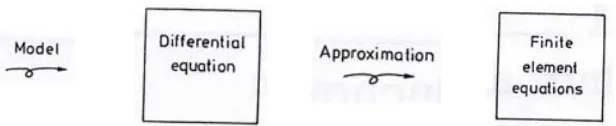
A variety of specializations under the umbrella of the mechanical engineering discipline such as aeronautical, biomechanical, and automotive industries are modelled by differential equations. Usually, the problem addressed is too complicated to be solved by classical analytical methods. The finite element method (FEM) is a numerical approach by which general differential equations can be solved in an approximate manner. In other words, FEM is an approximate numerical procedure for analyzing large structures and continua (Cook et al., 1989). Figure 1.1 illustrates generally how the physical phenomenon encountered in engineering mechanics is modelled.
2
As the FEM is a numerical, means of solving general differential equations, it can be applied to various physical phenomena. Furthermore, FEM became popular with the advancements in digital computers since they allow engineers to solve large systems of equations quickly and efficiently. The method becomes a very useful tool for the solution of many types of engineering problems such as the analysis of the plate and beam structures, heat transfer and fluid flow. The method is also widely used in the design of air frames, ships, electric motors, heat engines and spacecraft.
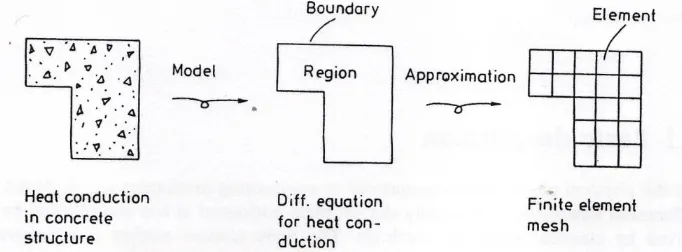
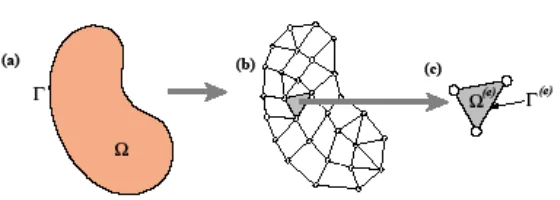
Although the finite element model does not behave exactly like the actual physical structure, to obtain sufficiently accurate results for most practical applications become possible. In FEM, the finite element model is created by dividing the structure into smaller parts, called finite elements. Each element is interconnected by nodes and the selection of elements for modelling the structure depends upon the behavior and geometry of the structure being analyzed. The modelling pattern, which is generally called mesh, is a very important part of the modelling process. This is because; the results obtained depend upon the selection of the finite elements a nd the mesh size. After having determined the behavior of all elements, these elements are then patched together to form the entire region, which enable to obtain an approximate solution for the behavior of the entire body. The situation discussed is shown in Figure 1.2 while Figure 1.3 shows the finite element mesh of the structural part of a car.
3
Figure 1.3 Finite element mesh of the structural part of a car
As mentioned in the second paragraph before, one of the applications of FEM is the formulation of plate elements. Plate elements can be formulated and modelled mathematically based on the Kirchhoff plate theory. The focus of this dissertation is to develop the triangular elements for the finite element analysis of Kirchhoff plate problem. An important aspect of the work is to implement the problem on the computer using Matlab programming language. Figure 1.4 shows a region of thin plate is divided into finite elements.
4
1.2 Problem Statement
The subject of plates was one of the first to which the finite element method was
applied in the early of 1960’s. At that time the various difficulties that were to be encountered were not fully appreciated and the topic remains one in which research is active to the present day. The first convincing plate theory was established by Kirchhoff which therefore also termed Kirchhoff plate theory as described by Boresi et al. (1978) and Timoshenko and Woinowsky-Krieger (1959). In this study, it will be concentrated in deriving a numerical solution for plate problem (for triangular elements), given their boundary conditions by using finite element method. Great effort also will be concentrated in developing the computational scheme of the problem by using Matlab programming language.
1.3 Objectives of the Study
The objectives of this study are:
1. To study the various aspects of plate theory and its finite element (FE) formulation.
2. To set up a numerical scheme by using FEM in solving the Kirchhoff plate problem.
5
1.4 Scope of the Study
The dissertation will be focusing on the formulation by using FEM for 2-dimensional problem. The simplest plate element for the analysis of plates of arbitrary shape which is the six nodes triangular element mesh with quadratic interpolation functions is considered in this study. Both numerical and the computational scheme of the problem then will be carried out. Effort will be concentrated on developing the computational scheme/simulation of the problem by using Matlab programming language.
1.5 Significance of the Study
The significance of the study is stated as follows:
1. The derivation of numerical codes and efficient algorithms of the Kirchhoff plate problem help to solve the related problems in the future. The results hence will contribute towards an enhanced understanding of the problem.
6
1.6 Research Methodology
In this study, there are five steps that will be concentrated in order to get the computational scheme for six nodes triangular Kirchhoff plate problem. The steps are:
1. Literature review on the Kirchhoff plate theory.
2. Comprehend the various aspects of plate theory. This covers equilibrium conditions, kinematic relations, constitutive relation, differential equations, and boundary conditions.
3. Next, the derivation of the differential equations of plate theory will be conducted. Hence to the establishment of the FE formulation of the Kirchhoff plate theory.
4. Then, the numerical solution of the problem is carried out.
5. Lastly, the simulation of the problem is presented. The computational code is developed by using Matlab programming language and running on the windows environment.
1.7 Thesis Organization
7
study, a description of the problem, the objectives of the study, scope of the study, significance of the study, research methodology, and chapter organization.
Chapter II starts with a brief literature review on the development of plate theory. This chapter also contains a review and discussion the various aspects of plate theory. The establishment of the differential equations of the problem is also presented in this chapter.
Chapter III discusses in detail the FE formulation of the Kirchhoff plate theory. It starts with the derivation of the weak form of the problem, and followed with the establishment of stiffness matrix, the boundary vector, and the load vector.
Chapter IV presents the numerical results of the Kirchhoff plate problem. The process of the FEM in obtaining the numerical scheme is outlined in detail in this chapter.
In Chapter V, the computational scheme of the problem is presented. This chapter also highlights on the analysis and discussion of the simulation model developed with Matlab programming language.