INFLUENCE OF CORE SELF-EVALUATIONS ON KNOWLEDGE SHARING BEHAVIOUR WITH EVALUATION APPREHENSION AS A MEDIATOR
KHAIRULBAHIYAH BT YAAKUB
A thesis submitted in fulfilment of the
requirements for the award of the degree of Master of Science in Human Resource Development
Faculty of Management Universiti Teknologi Malaysia
Specially dedicated to My Family… Faith…makes all things possible
ACKNOWLEDGEMENT
In the name of Allah, the Most Gracious and the Most Merciful.
Alhamdulillah, all praises to Allah for the strengths and His blessing in completing this thesis. My sincere appreciation goes to Dr Roziana Bt Shaari, for her guidance dan supervision. Not forgotten, my appreciation to my co-supervisor, Dr Siti Aisyah Bt Abdul Rahman for her constant support and constructive comments.
Special thanks to the Dean, Faculty of Management, Professor Dr. Zainab Khalifah for her support towards my postgraduate affairs. My acknowledgement goes to all faculty staffs especially Puan Salida Bt Bahari for their help and co-operations.
This journey would not have been possible without the constant support of my husband, Muhammad Hazril, my lovely children, Nurin, Nabil, Hasya and Hayyan. Their support has been unconditional all these years; they have given up many things for me; they have cherished with me every great moment and supported me whenever I needed it. Also, thanks to mak and ayah, you made me into who I am. To all my friends, thank you for accompanying me on this adventure.
ABSTRACT
Knowledge sharing among individuals is a crucial aspect for the success of knowledge management. Behaviour of individuals in an organisation plays an important role in ensuring its success and their behaviour differences are assumed to be influenced by personality traits. Based on the literature reviewed, there are limited studies on the relationship between personality traits and knowledge sharing behaviour. Therefore, this study examined the effect of core self-evaluations comprising broad personality traits represented by two dimensions: self-conscientiousness (positive dimension) and self-negligence (negative dimension) on knowledge sharing behaviour. Prior literature argued that evaluation apprehension is anxiety based on fear of negative evaluation and feedback and one of the obstacles in knowledge sharing. Thus, the study has extended previous research by examining the effect of evaluation apprehension on knowledge sharing behaviour. Individuals with a positive personality are able to face criticism and accept feedback more effectively but there has yet to be an attempt to draw a distinction between the effect of core self-evaluations and evaluation apprehension. Furthermore, based on the literature reviewed, studies on the role of evaluation apprehension as a mediator between core self-evaluations and knowledge sharing behaviour are scarce. In this quantitative study, 128 academic librarians from five public research universities in Malaysia participated in the survey. Multiple regression was used to analyze the data. The results show that self-conscientiousness had a positive relationship on knowledge sharing behaviour. However and surprisingly, self-negligence influence on knowledge sharing behaviour was not supported. The results indicated that a librarian with self-conscientiousness would have the intensity to cope with evaluation apprehension and share knowledge as compared to those with self-negligence. As predicted, evaluation apprehension has been confirmed as the barrier in knowledge sharing behaviour. Finally, evaluation apprehension partially mediated the relationship between self-conscientiousness, self-negligence, and knowledge sharing behaviour. To sum up, findings of the study will add to the growing body of literature on knowledge sharing and librarianship research.
ABSTRAK
TABLE OF CONTENTS
CHAPTER TITLE PAGE
ACKNOWLEDGEMENT ABSTRACT
ABSTRAK
iv v vi
TABLE OF CONTENTS vii
LIST OF TABLES xi
LIST OF FIGURES xiii
LIST OF APENDICES xv
1 INTRODUCTION 1
1.1 Introduction 1
1.2 Research Background 2
1.3 Problems Statement 5
1.4 Research Questions 8
1.6 Research Hypotheses 9
1.7 Significance of the Study 10
1.8 Scope of the Study 11
1.9 Definition of Terms 11
1.10 Chapter Summary 16
1.11 Thesis Organisation 16
2 LITERATURE REVIEW 17
2.1 Introduction 17
2.2 Knowledge 18
2.3 Personality Traits 39
2.4 Evaluation Apprehension 47
2.5 Knowledge Sharing Behaviour among Academic Librarians
50
2.6 Previous Studies Related to this Research
53
2.7 Theoretical Background 58
2.8 The Development of Hypotheses 60
2.9 Conceptual Framework 64
3.3 Research Strategy 71
3.4 Sampling Frame 73
3.5 Data Collection 76
3.6 Research Instrument 77
3.7 Reliability and Validity Analysis 79
3.8 Data Analysis 80
3.9 Pilot Study 83
3.10 Chapter Summary 85
4 DATA ANALYSIS 86
4.1 Introduction 86
4.2 Demographic Background and the Level of Knowledge Sharing Behaviour
86
4.3 Normality Test 91
4.4 Construct Validity Analysis 92
4.5 Reliability Analysis 97
4.6 Descriptive Analysis 98
4.7 Correlations Analysis 105
4.8 Multiple Regressions Analysis 107
4.10 Summary of Results 113
5 DISCUSSION 115
5.1 Introduction 115
5.2 Discussions of the Findings 116
5.3 Contributions 124
5.4 Limitations 127
5.5 Recommendations for Future Research 128
5.6 Conclusions 129
REFERENCES 130
LIST OF TABLES TABLE NO. 1.1 1.2 2.1 2.2 2.3 2.4 2.5 3.1 3.2 3.3 3.4 3.5 4.1 4.2 4.3 4.4 4.5 TITLE
Conceptual and Operational Definitions Thesis Organization
Distinction between Data, Information and Knowledge Descriptors of what Constitutes Tacit Knowledge Literature on Individual Factors as Predictors to Knowledge Sharing
Dimension of Personality
Previous Studies Related to this Research Based on Previous Literature
Quantitative and qualitative based on methodological assumption
Research Strategies and its Viable Situations
Total Population of Academic Librarian in Public Research Universities in Malaysia 2011
The Categorization of Level Used in this Study Reliability Analysis
Demographic of the Respondents
Factor Loadings for the Rotated Factors of Knowledge Sharing Behaviour
Factor Loadings for the Rotated Factors of Core Self-Evaluation
Factor Loadings for the Unrotated Factors of Evaluation Apprehension
Cronbach’s Alpha Reliability Test
4.6
4.7
4.8 4.9
4.10 4.11
4.12 4.13 4.14 4.15
The Overall Level of Knowledge Sharing Behaviour among Academic Librarians
Comparison of Knowledge Sharing Behaviour Between Gender
The Description on Core Self-evaluations Level The Overall Level of Core Self-Evaluations Among Academic Librarians
The Description on Evaluation Apprehension Level The Overall Level of Evaluation Apprehension Among Academic Librarians
Correlations Between Constructs Multiple Regression Analysis The Result For Mediation Analysis Summary on Hypotheses Testing
99
101
101 102
104 105
LIST OF FIGURES FIGURE NO. 2.1 2.2 2.3 2.4 2.5 2.6 2.7 2.8 3.1 3.2 3.3 4.1 4.2 4.3 TITLE
Venn Diagram - Relationship Between Information and Knowledge
Knowledge Conversion Process Building Blocks of Knowledge
Individual Behaviour: Key Influential Factors
Presence of others Causes Evaluation Apprehension and Distraction Conflict Resulting in Arousal
Social Cognitive Theory : B Represents Behaviour, P Represents Personal Factors in the Form of Cognitive, Affective, and Biological Events, and E Represents the External Environment.
Cognitive Dissonance Theory Conceptual Framework Operational Framework Methods of Data Collection Mediation Model
Histogram and Normal Q-Q Plot of Knowledge Sharing Behaviour
Histogram and Normal Q-Q Plot of Core Self-Evaluation
4.4 Path Coefficients for the Self-Conscientiousness/Self-Negligence/Evaluation Apprehension/Knowledge Sharing Behaviour Mediation Analysis
LIST OF APPENDICES
APPENDIX
A B C
TITLE
Survey Questionnaire
Letter of Acceptance from Conference Organizer Article Journal Publication
PAGE
CHAPTER 1
INTRODUCTION
1.1 Introduction
1.2 Research Background
The journey to inculcate and establish knowledge sharing behaviour in the organisation remains unresolved due to the involvement of human as the key factor in knowledge sharing success (Yang and Wu, 2008). Individuals are known to have own uniqueness and speciality from one another. Since knowledge resides in the minds of individuals, the readiness and willingness to share with others are crucial (Bordia et al., 2006; Jeon et al., 2011). Personality is one of the major psychological aspects which guides behaviour (Halder and Chakraborty, 2010). Besides, it permits a prediction of what a person will do in a given situation (Cattell, 1950). Therefore, personality traits are possibly related to knowledge sharing behaviour. Yu et al. (2010) revealed that a single personality trait, openness, is one of the factors associated with facilitating the voluntary knowledge sharing in virtual communities. Meanwhile, a person with negative personality will remain insecure, doubtful, self-conscious, and anxious as he or she tends to withdraw from knowledge sharing activities (Halder, et al., 2010). Few studies examined the relationship of personality in the context of knowledge sharing such as Big Five Personality (Angle et al., 2006; Matzler et al., 2008; Teh et al., 2011) and self-esteem (Lee and Jang, 2010). Therefore, this study investigates the relationship of core self-evaluations and knowledge sharing behaviour among librarians in the academic libraries.
between two variables X and Y. Mediators are variables that act as an in-between step when looking at the effect of X on Y, where X causes a mediator M, and M is actually the cause of Y. MacKinnon et al. (2007) mentioned that it is not necessary to establish an overall effect to be mediated as long the predictor is related to the mediator and the mediator is related to the outcome. In this study, the motivation to share knowledge depends on the level of evaluation apprehension. Self-conscientiousness is expected to reduce the level of evaluation apprehension that would leads to the enhancement of knowledge sharing behaviour. Meanwhile, self-negligence is predicted to increase the level of evaluation apprehension and inhibit knowledge sharing behaviour.
The next sections will provide an overview of knowledge sharing behaviour from the academic librarians’ perspectives in different contexts – academic libraries overseas and Malaysia.
1.2.1 Knowledge Sharing from the Academic Librarians’ Perspectives: International Overview
1.2.2 Knowledge Sharing from the Academic Librarians’ Perspectives: Malaysian Overview
The globalisation and the internationalisation of higher education have exerted different pressures and demands on Malaysia’s higher education system. The National Higher Education Strategic Plan 2020 and the National Higher Education Action Plan 2007-2010 were launched in August 2007 to strengthen up the vision to face the global challenges in international higher education. The aim is to establish a world-class university system that allows Malaysia to become a regional education hub and transform it into a knowledge-based economy. As of 2012, there are 20 public universities in Malaysia whereby five of the universities have been designated as research universities, namely Universiti Sains Malaysia (USM), Universiti Teknologi Malaysia (UTM), Universiti Pertanian Malaysia (UPM), Universiti Malaya (UM), and Universiti Kebangsaan Malaysia (UKM). As a result, these university libraries may have to espouse a more strategic direction to understand and satisfy the users’ information and research needs in order to support the ongoing learning activities.
critically important and have been particularly influential in contributing insights into the library institutions (Liu, 2010).
Academic libraries have been the heart of the universities by supporting the preservation and the development of knowledge (Liu, 2008). Academic librarian is known to possess the preeminent disciplines and skills in collecting, organising, and disseminating information. A new role of a modern academic librarian has evolved into performing information work in a different context and setting. As a result, academic librarians of the new era have to compete with the challenges and demands set by the management of the universities. It is good news for academic librarians that they need to play the central role in promoting their skills in knowledge sharing (Stoddart, 2001).
1.3 Problem Statement
Swift, Balkin, and Matusik, 2010; Wang and Noe, 2010). Humans are not born to share knowledge and the behaviour needs to be nurtured (Yu et al., 2010). Moreover, human behaviours are based on self-interest and each person has different capabilities which make the knowledge sharing activities hard to analyse (Yang and Wu, 2008). Clearly, the behaviour still remains as an important variable in knowledge sharing (Bordia et al., 2006; Jeon et al., 2011; Tsai and Cheng, 2010; Yu et al., 2010) for future research.
Individuals are different from one another in terms of skills, abilities, personalities, perceptions, attitudes, emotions, and ethics (Quick and Nelson, 2009). Behavioural differences among individuals were said to be influenced by the personality traits and the situation (Chamorro-Premuzic and Furnham, 2010). Cattel (1950) mentioned that personality traits allow prediction of what a person will do when faced with a defined situation. Therefore, personality traits are expected to be useful for making predictions of behavioural outcomes in knowledge sharing. Previous research has proven positive personality traits may influence the intention to share (Lee and Jang, 2010; Tsai and Cheng, 2010). Big Five Personality Model has also been studied in relation to knowledge sharing behaviour (Angle, William, and Jesús, 2006; Matzler and Mueller, 2011; Matzler et al., 2008; Teh et al., 2011). Lee and Jang (2010) found that a person with higher self-esteem is more likely to contribute to the open information repository. Meanwhile, self-efficacy was found to have a positive effect on the intention to share knowledge (Tsai and Cheng, 2010). However, only a few studies have empirically examined the role of personality traits in knowledge sharing.
tended to be better performers than those with negative core self-evaluations (Erez and Judge, 2001). However, core self-evaluations research thus far is only pertaining to be useful in organisational behaviour research. To our knowledge, there has not been an integrative effort to examine if core self-evaluations influence knowledge sharing behaviour. Therefore, the scenarios have provided the needs to investigate core self-evaluations in the context of knowledge sharing behaviour.
In a number of studies, Judge and colleagues have found that the core self-evaluations load on a single factor in Western cultures (Erez and Judge, 2001; Judge, Erez, and Bono, 1998; Judge, Bono, and Locke, 2000; Judge et al., 1998). However, Guven (2007) and Sang and Chathoth (2013) revealed that the factor analysis for the eastern context did not show a single factor structure. Those differences revealed a distinct in the Eastern and Western contexts. Therefore, it is interesting to adopt core self-evaluation concept using two (2) dimensions: positive and negative. In earlier research, Judge et al. (1998) discussed the possibility that other traits might be considered as indicators of core self-evaluations. Judge, Van Vianen, and De Pater (2004) mentioned that there seems to be a connection between core self-evaluations and conscientiousness. Therefore, it is interesting to examine core self-evaluations via self-conscientiousness that represents positive dimension and self-negligence represents negative dimension.
knowledge sharing (Bordia et al., 2006). However, the findings indicated that evaluation apprehension is only greatest when sharing through databases compared to interpersonal (Bordia et al., 2006). Thus, it would be interesting to replenish the gap to understand if evaluation apprehension inhibits knowledge sharing behaviour in general.
The questions remain on how evaluation apprehension can be reduced in order to establish a positive knowledge sharing behaviour (Wang and Noe, 2010). It has been claimed that trust (Argote, McEvily, and Reagans, 2003) and openness (Yu et al., 2010) are able to help in reducing apprehension. However, there is no further research that links personality with evaluation apprehension. Does core self-evaluation help in reducing the level of apprehension? Logically, individuals with a positive outlook will perform confidently, believe in their capabilities to face any obstacles, and eliminate defensive behaviours. Thus, it would be interesting to investigate if self-conscientiousness could overcome evaluation apprehension.
In other perspective, if self-conscientiousness managed to reduce the level of apprehension, would it help to boost up knowledge sharing behaviour? Hence, evaluation apprehension will act as the mediating variable in an effort to understand what leads to the enhancement of knowledge sharing behaviour.
1.4 Research Questions
1. What is the relationship between core self-evaluations and knowledge sharing behaviour?
3. What is the relationship between evaluation apprehension and knowledge sharing behaviour?
4. Does evaluation apprehension mediate the relationship between core self-evaluations and knowledge sharing behaviour?
1.5 Research Objectives
1. To examine the effect of core self-evaluations on knowledge sharing behaviour.
2. To examine the effect of core self-evaluations on evaluation apprehension. 3. To examine the effect of evaluation apprehension on knowledge sharing
behaviour.
4. To examine the mediation effect of evaluation apprehension in the relationship between core self-evaluations and knowledge sharing behaviour.
1.6 Research Hypotheses
The following hypotheses are formulated based on literature support and will be elaborated in Chapter 2.
H1a: Self-conscientiousness will be positively related to knowledge sharing behaviour.
H1b: Self-negligence will be negatively related to knowledge sharing behaviour.
H3: Evaluation apprehension will be negatively related to knowledge sharing behaviour.
H4a: Evaluation apprehension will mediate the relationship between self-conscientiousness and knowledge sharing behaviour.
H4b: Evaluation apprehension will mediate the relationship between self-negligence and knowledge sharing behaviour.
1.7 Significance of the Study
Unlike most prior studies focusing on the external motivators such as technology, organisational culture, and rewards, this study seeks to contribute to an understanding of how personality influences knowledge sharing behaviour. The relationship between core self-evaluation and knowledge sharing behaviour is literally explored and has appended new knowledge of both fields. Furthermore, this research would disclose and understand the function of evaluation apprehension as a barrier that inhibits knowledge sharing behaviour.
From the perspective of the librarian, it would respond to the lack of study on knowledge sharing behaviour among academic librarians in Malaysia. The research would highlight new findings that would enhance knowledge sharing activities among academic librarians and strengthen their professionalism.
personal development in each of their employees by organising workshops or programmes oriented around positive personality traits. Besides, it may also change the perception of some knowledge-based organisations that value their investment in technology more than developing their own people.
1.8 Scope of the Study
The scope of this study is limited to the public research universities in Malaysia which encompasses five universities, namely Universiti Teknologi Malaysia (UTM), Universiti Sains Malaysia (USM), Universiti Kebangsaan Malaysia (UKM), Universiti Malaya (UM), and Universiti Pertanian Malaysia (UPM). The respondents in this study were librarians from these libraries. Questionnaires were distributed to the professional academic librarians from grades S41 to JUSA. These librarians were chosen since they are the focal persons in preserving and developing knowledge in sustaining research activities for the university (Liu, 2008). A drastic change in their role required a strong connection and collaboration among team members directly or indirectly. In order to support each other in facing challenges, the sharing of both tacit and explicit knowledge of other librarians are essential.
The study focused on the integration of social cognitive model and cognitive dissonance model as a theoretical foundation to determine the relationship between core self-evaluations personality traits, evaluation apprehension, and knowledge sharing behaviour.
1.9 Definition of Terms
Variables Conceptual Definitions References Operational Definitions
Knowledge Knowledge as a mixture of
information, documentation, technical reports, professionalism,
know-where, know-how, and distributed across the continuous spectrum from purely tacit to totally explicit.
Knowledge as information processed and distributed across individual, including ideas, facts, expertise in the form of tacit and explicit that is
Lin et al. (2012)
Wang and Noe (2010)
Knowledge in this study refers to tacit and explicit that is related to academic library setting. Tacit knowledge includes
relevant for individual, teams, and organisational performance.
Knowledge Sharing
Knowledge Sharing Behaviour
The process of exchange,
disseminating, donating and collecting knowledge, information and
experiences which involve
interpersonal relationships and social interactions aiming to help others, to solve problems, develop new ideas, expand the value of knowledge, and to create a synthesis.
The act of making knowledge available to others within the organisation.
Wang and Noe (2010)
Matzler and Mueller (2011)
The study examines the practice of exchange, disseminating, donating, and collecting knowledge among academic librarians within the organisation via all sorts of channels; face-to-face communication or written correspondence.
Core self-evaluations
intention and the behavioural criterion correspond with respect to their level of specificity
Apersonality constructswhich refer to fundamental, subconscious conclusions individuals reach about themselves, other people, and the world.
The degree to which an individual believes him or herself to be capable, significant, and worthy as an
organisational member.
Judge et al. (1998)
Wang and Noe (2010)
Core self-evaluations in this study refer to two dimensions, namely
self-conscientiousness (positive dimension) and self-negligence (negative dimension). Conscientious librarian is hardworking, responsible, organised, ambitious,
competent, and reliable. Self-negligence is referred to as irresponsible, disorganized, lazy, and ignorant librarian. A librarian with self-conscientiousness is assumed to
Evaluation Apprehension A state of fear or anxiety that one’s knowledge or idea may be evaluated or critiqued by others.
A person’s active anxiety-toned
concern that he or she may be evaluated
Bordia et al. (2006)
Rosenberg (1969)
Evaluation apprehension refers to a situation where academic librarians feel anxious or uncomfortable of their ideas being evaluated or judged by others either in written or oral communication. It will then inhibit the behaviour of sharing among librarians.
background of the problem which directs to the research questions, objectives, and hypotheses. The scope of the research is presented with brief discussions on the significance of the study.
1.11 Thesis Organisation
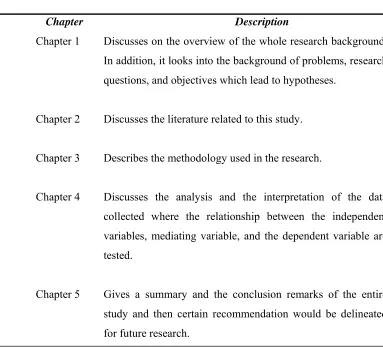
This research is organised into five chapters as shown in Table 1.2.
Table 1.2: Thesis Organisation
Chapter Description
Chapter 1 Discusses on the overview of the whole research background. In addition, it looks into the background of problems, research questions, and objectives which lead to hypotheses.
Chapter 2
Chapter 3
Chapter 4
Chapter 5
Discusses the literature related to this study.
Describes the methodology used in the research.
Discusses the analysis and the interpretation of the data collected where the relationship between the independent variables, mediating variable, and the dependent variable are tested.
REFERENCES
Agnihotri, R., and Troutt, M. D. (2009). The Effective Use of Technology in Personal Knowledge Management : a Framework of Skills, Tools and User Context. Online Information Review, 33(2), 329-342.
Ahmed, Pervaiz K. (2002). Learning Through Knowledge Management Retrieved from Books 24 X 7 database Available from http://library.books24x7.com.ezproxy.psz.utm.my/toc.aspx?bookid=28118
Angle, C., William, C., and Jesús, F. S. (2006). Determinants of Individual Engagement in Knowledge Sharing. International Journal of Human Resource Management, 17(2), 245-264.
Ardichvili, A., Page, V., and Wentling, T. (2003). Motivation and Barriers Participation in Virtual Knowledge-Sharing Communities of Practice. Journal of Knowledge Management, 7(1), 64 – 77.
Argote, L., McEvily, B., and Reagans, R. (2003). Managing Knowledge in Organizations: an Integrative Framework and Review of Emerging Themes. Management Science, 49(4), 571-582.
Baker, M. K., Kennedy, D. J., Bohle, P. L., Campbell, D., Wiltshired, J. H., and Fiatarone Singha, M. A. (2011). Core Self-Evaluation as a Predictor of Strength Training Adoption in Older Adults. Maturitas 68, 88-93.
Bandura, A. (1977). Self-Efficacy : Toward a Unifying Theory of Behavioral Change. Psychological Review, 84(2), 1977.
Bandura, A. (1999). A Social Cognitive Theory of Personality (2nd ed. Ed.). New York: Guilford Publications.
Bandura, A., and Adams, N. E. (1977). Analysis of Self-Efficacy Theory of Behavioral Change. Cognitive Therapy and Research, 1(4), 287-310.
Bandura, A., and Cervone, D. (1983). Self-Evaluative and Self-Efficacy Mechanisms Governing the Motivational Effects of Goals Systems. Journal of Personality and Social Psychology, 45, 1017-1028.
Bawden, D., and Robinson, L. (2011). Individual Differences in Information-Related Behaviour: What Do We Know about Information Styles?. New Directions in Information Behaviour : Library and Information Science (pp. 127-158): Emerald Group Publishing.
Bellaver, R. F., and Lusa, J. M. (Eds.). (2002). Knowledge Management Strategy and Ttechnology. Boston: Artech House.
Bennett, E. E. (2009). Virtual HRD: The Intersection of Knowledge Management, Culture, and Intranets. Advances in Developing Human Resources 11(3), 362-374.
Bhatt, G. D. (2001). Knowledge Management in Organizations. Journal of Knowledge Management, 5(1), 68-75.
Bono, J. E., and Colbert, A. E. (2005). Understanding Responses to Multi-Source Feedback : the Role of Core Self-Evaluations. Personnel Psychology, 58, 171-203.
Bordia, P., Irmer, B. E., and Abusah, D. (2006). Differences in Sharing Knowledge Interpersonally and via Databases : the Role of Evaluation Apprehension and Perceived Benefits. European Journal of Work and Organizational Psychology, 15(3), 262-280.
Branin, J. J. (2003). Knowledge Management in Academic Libraries: Building the Knowledge Bank at the Ohio State University. Journal of Library Administration, 39(4), 41-56.
Cabrera, E. F., and Cabrera, A. (2005). Fostering Knowledge Sharing through People Management Practices. International Journal of Human Resource Management, 16(5), 720–735.
Cairncross, F. (2002). The Company of the Future: How the Communications Revolution is Changing Management. Boston, Mass: Harvard Business School Press.
Conrad, L., and Darren L. R. (2003). Individuals in Organizations: Personality, Perceptions and Learning. In Organization Behaviour for Leisure Services. Oxford: Butterworth-Heinemann.
Chen, I. Y. L., Chen, N. S., and Kinshuk. (2009). Examining the Factors Influencing Participants’ Knowledge Sharing Behavior in Virtual Learning Communities. Educational Technology & Society, 12(1), 134-148.
Chiu, C. M., Hsu, M. H., and Wang, E. T. G. (2006). Understanding Knowledge Sharing in Virtual Communities: an Integration on Social Capital and Social Cognitive Theories. Decision Support Systems, 42(3), 1872-1888.
Coakes, E., Amar, A. D., and Granados, M. L. (2010). Knowledge Management, Strategy, and Technology : a Global Snapshot. Journal of Enterprise Information Management, 23(3), 282-304.
Costa F. T. Jr., McCrae R. R., and Dye D. A. (1991). Facet Scales for Agreeableness and Conscientiousness: a revision of the NEO Personality Inventory. Personality and Individual Differences, 12, 887-898.
Creswell, J. W. (1994). Research Design : Qualitative and Quantitative Approaches. London: Sage Publications, Inc.
Dalkir, K. (2005). Knowledge Management in Theory and Practice. United States: Elsevier Inc.
Daly, J. A., and Miller, M. (1975). Further Studies in Writing Apprehension: SAT Scores, Success Expectations, Willingness to Take Advanced Courses, and Sex Differences. Research in the Teaching of English, 9, 255.
Dasgupta, M., and Gupta, R. K. (2009). Innovation in Organizations : a Review of the Role of Organizational Learning and Knowledge Management. Global Business Review, 10(2), 203-224.
Daud, S., and Yusuf, W. F. W. (2008). An Empirical Study of Knowledge on Management Processes in Small and Medium Enterprises. Communications of the IBIMA, 4, 169-177.
Davenport, T. H., and Prusak, L. (1998). Working Knowledge : How Organizations Manage What They Know. Boston: Harvard Business School Press.
Systems : Finding Way with Technology. Journal of Knowledge Management, 9(1), 113-125.
Eftekharzade, S. F., and Mohammadi, B. (2011). The Presentation of a Suitable Model for Creating Knowledge Management in Educational Institutes (Higher Education). Procedia – Social and Behavioral Sciences, 29 (0), 1001-1011. Endres, M. L., Endres, S. P., Chowdhury, S. K., and Alam, I. (2007). Tacit
Knowledge Sharing, Self-Efficacy Theory and Application to the Open Source Community. Journal of Knowledge Management, 11(3), 92-103.
Erden, Z., Krogh, G. V., and Nonaka, I. (2008). The Quality of Group Tacit Knowledge. Journal of Strategic Information Systems, 17, 4-18.
Erez, A., and Judge, T. A. (2001). Relationship of Core Self-Evaluations to Goal Setting, Motivation and Performance. Journal of Applied Psychology, 86(6), 10. Fey, C. F., and Furu, P. (2008). Top Management Incentive Compensation and
Knowledge Sharing in Multinational Corporations. Strategic Management Journal, 29, 1301-1323.
Fong, C.Y., Ooi, K. B., Tan, B. I., Lee, V. H., and Chong, A. Y. (2011). HRM Practices and Knowledge Sharing: an Empirical Study. International Journal of Manpower, 32(5/6), 704-723.
Geen, R. G. (1983). Evaluation Apprehension and the Social Facilitation/Inhibition of Learning. Motivation and Emotion, 7(2), 203-212.
Geisler, E., and Wickramasinghe, N. (2009). Principles of Knowledge Management. Retrieved from Books 24 X 7 database available from <http://common.books24x7.com.ezproxy.psz.utm.my /toc.aspx? bookid=34109 Goldberg, L. R. (1990). An Alternative “Description Of Personality”: the Big Five
Factor Structure. Journal of Personality and Social Psychology, 59, 1216-1229. Groff, T. R., and Jones, T. P. (2003). Introduction to Knowledge Management: KM
Halder, S., Roy, A., and Chakraborty, P. K. (2010). The Influence of Personality Traits on Information Seeking Behaviour of Students. Malaysian Journal of Library & Information Science, Vol.15, no.1, April 2010: 41-53, 15(1), 41-53. Hansen, M. T., Nohria, N., and Tierney, T. (1999). What’s Your Strategy for
Managing Knowledge. Harvard Business Review, 77(2), 106-116.
Harris, K., Harvey, P., and Kacmar, K. (2009). Do Social Stressors Impact Everyone Equally? An Examination of the Moderating Impact of Core Self-Evaluations. Journal of Business and Psychology, 24(2), 153-164.
Hough, L. M. and Schneider, R.J. (1996). Personality Traits, Taxanomies and Applications in Organizations. San Francisco : Jossey-Bass.
Hsiu-Fen, L. (2007). Knowledge Sharing and Firm Innovation Capability : an Empirical Study. International Journal of Manpower, 28(3/4), 315-332.
Hsu, M. H., Ju, T. L., Yen, C. H., and Chang, C. M. (2007). Knowledge Sharing Behavior in Virtual Communities: the Relationship between Trust, Self-Efficacy, and Outcome Expectations. International Journal of Human-Computer Studies, 65(2), 153-169.
Hu, J., Wang, Z., Liden, R. C., and Sun, J. (2012). The Influence of Leader Core Self-Evaluation on Follower Reports of Transformational Leadership. The Leadership Quarterly.
Hung, S. Y., Durcikova, A., Lai, H. M., and Lin, W. M. (2011). The Influence of Intrinsic and Extrinsic Motivation in Individuals’ Knowledge Sharing Behavior. International Journal of Human-Computer Studies, 69, 415-427.
Hutchings, K., and Michailova, S. (2006). The Impact of Group Membership on Knowledge Sharing in Russia and China. International Journal of Emerging Markets, 1(1), 21-34.
I-Chieh, H. (2006). Enhancing Employee Tendencies to Share Knowledge – Case Studies of Nine Companies in Taiwan. International Journal of Information Management, 26(4), 326-338.
Issa, R. R. A., and Haddad, J. (2008). Perceptions of the Impacts of Organizational Culture and Information Technology on Knowledge Sharing in Construction. Construction Innovation, 8(3), 182-201.
London: Cambridge Univ Press.
Judge, T. A. (2009). Core Self-Evaluations and Work Success. Curent Directions in Psychological Science, 18(1), 58-62.
Judge, T. A., and Bono, J. E. (2001). Relationship of Core Self-Evaluations Traits – Self Esteem, Generalized Self-Efficacy, Locus Of Control and Emotional Stability – with Job Satisfaction and Job Performance : a Meta Analysis. Journal of Applied Psychology, 86(1), 12.
Judge, T. A., Bono, J. E., Erez, A., and Locke, E. A. (2005). Core Self-Evaluations and Job and Life Satisfaction : The Role of Self-Concordance and Goal Attainment. Journal of Applied Psychology, 90(2), 257-268.
Judge, T. A., Erez, A., and Bono, J. E. (1998). The Power of Being Positive : The Relation between Positive Self-Concept and Job Performance. Human Performance, 11(2/3), 167-187.
Judge, T. A., Higgins, C. A., Thoresen, C. J., and Barrick, M. R. (1999). The Big Five Personality Traits, General Mental Ability, and Career Success Across the Life Span. Personnel Psychology, (52), 621-652.
Judge, T. A., Erez, A., Bono, J. E., and Thoresen, C. J. (2003). The Core Self-Evaluations Scale : Development of a Measure. Personnel Psychology, 56, 303-332.
Judge, T. A., and Hurst, C. (2007). Capitalizing on One’s Advantages: Role of Core Self-Evaluations. Journal of Applied Psychology, 92(5), 1212-1227.
Judge, T. A., Ilies, R., and Zhang, Z. (2011). Genetic Influences on Core Self-Evaluations, Job Satisfaction, and Work Stress: a Behavioral Genetics Mediated Model. Organizational Behavior and Human Decision Processes.
Judge, T. A., and Kammeyer-Mueller, J. D. (2011a). Implications of Core Self-Evaluations for a Changing Organizational Context. Human Resource Management Review, 21(4), 331-341.
Judge, T. A., Locke, E. A., Durham, C. C., and Kluger, A. N. (1998). Dispositional Effects on Job and Life Satisfaction : The Role of Core Evaluations. Journal of Applied Psychology, 83(1), 17-34.
Judge, T. A., Vianen, A. E. M. V., and Pater, I. E. D. (2004). Emotional Stability, Core Self-Evaluations, and Job Outcomes: A Review of the Evidence and an Agenda for Future Research. Human Performance, 17(3), 325-346.
Kammeyer-Mueller, J. D., Judge, T. A., and Scott, B. A. (2009). The Role of Core Self-Evaluations in the Coping Process. Journal of Applied Psychology, 94(1), 177-195.
Kankanhalli, A., Tan, B. C. Y., and Wei, K. K. (2005). Contributing Knowledge to Electronic Knowledge Repositories: An Empirical Investigation. MIS Quarterly, 29(1), 113-143.
Kassim, N. A. (2009). Evaluating Users’ Satisfaction on Academic Library Performance. Malaysian Journal of Library & Information Science, 14(2), 101-115.
Krejcie, R. V., and Morgan, D. W. (1970). Determining Sample Size for Research Activities. Educational and Psychological Measurement, 30, 607-610.
Krogh, G. v., Ichijo, K., and Nonaka, I. (2000). Enabling Knowledge Creation : How to Unlock the Mystery of Tacit Knowledge and Release the Power of Innovation. Oxford: Oxford University Press.
Kuang-Liang Liu, C., and In-Lin Hu. (2010). Exploring the Effects of Task Characteristics on Knowledge Sharing in Libraries. Library Review 59(6), 14. Kumar, J. A., and Ganesh, L. S. (2011). Balancing Knowledge Strategy:
Codification and Personalization during Product Development. Journal of Knowledge Management 15(1), 18.
Kumar, R. (2005). Research Methodology : a Step-by-Step Guide for Beginners (2nd ed. Ed.). London: Sage Publications.
Lashley, C., and Lee-Ross, D. (2003). Organization Behaviour for Leirsure Services. United Kingdom: Routledge.
Lau, V. P., and Shaffer, M. A. (1999). Career Success : the Effects of Personality. Career Development International, 4(4), 225-230.
Power Game. European Journal of Marketing, 37(11/12), 1575-1598.
Li, Y. H., Huang, J. W., & Tsai, M. T. (2009). Entrepreneurial Orientation and Firm Performance: the Role of Knowledge Creation Process. Industrial Marketing Management 38, 440-449.
Lin, H. F. (2007). A Stage Model of Knowledge Management: an Empirical Investigation of Process and Effectiveness. Journal of Information Science, 33(6), 643-659.
Liu, A. M. M. (2008). Wa! The Wu´ We´ i Academic Librarian. Library Management, 29(1/2), 104-115.
MacKinnon, D. P., Fairchild, A. J., and Fritz, M. S. (2007). Mediation Analysis. Annual Review Psychology, 58(593).
Matzler, K., and Mueller, J. (2011). Antecedents of Knowledge Sharing – Examining the Influence of Learning and Performance Orientation. Journal of Economic Psychology, 32(3), 317-329.
Matzler, K., Renzl, B., Müller, J., Herting, S., and Mooradian, T. A. (2008). Personality Traits and Knowledge Sharing. Journal of Economic Psychology, 29(3), 301-313.
Mavodza, J. (2011). The Academic Librarian and the Academe. New Library World, 112(9/10), 446-451.
McCroskey, J. C., Beatty, M. J., Kearney, P., and Plax, T. G. (1985). The Content Validity of the PRCA-24 as a Measure of Communication Apprehension across Communication Contexts. Communication Quarterly, 33(3), 165-173.
McCroskey, J. C., Richmond, V. P., John, A. D., and Falcione, R. L. (1977). Studies of the Relationship between Communication Aprehension and Self-esteem. Human Communication Research, 3(3), 269-277.
McKenzie, J., and Winkelen, C. V. (2004). Understanding the Knowledgeable Organization : Nurturing Knowledge Competence. London: Thomson.
Nonaka, I., and Konno, N. (1998). The Concept of Ba : Building a Foundation for Knowledge Creation. California Management Review, 40(3), 40-54.
Nonaka, I., and Takeuchi, H. (1995). The Knowledge-Creating Company : How Japanese Creating Companies Create the Dynamics of Innovation. New York: Oxford University Press.
Nonaka, I., and Takeuchi, H. (2004). Hitotsubashi on Knowledge Management Singapore : Singapore: John Wiley & Sons (Asia) Pte Ltd.
Nonaka, I., and Toyama, R. (2002). A Firm as a Dialectical Being : towards a Dynamic Theory of a Firm. Industrial and Corporate Change, 11(15), 995-1009.
Nonaka, I., Toyama, R., and Konno, N. (2000). SECI, Ba and Leadership: a Unified Model of Dynamic Knowledge Creation. Long Range Planning, 33(1), 5-34.
Nunnally, J. (1978). Psychometric Theory. New York: McGraw-Hill. OECD. (2000). Knowledge Management in the Learning Society Retrieved from
OECD Database
Oxoby, R. J. (2004). Cognitive Dissonance, Status and Growth of the Underclass. The Economic Journal, 114(7), 727-749.
Pallant, J. (2007). SPSS : Survival Manual. New York: Open University Press. Panayiotou, G., and Vrana, S. R. (2004). The Role of Self-Focus, Task Difficulty,
Task Self-Relevance, and Evaluation Anxiety in Reaction Time Performance. Motivation and Emotion, 28(2), 171-196.
Parirokh, M., Daneshgar, F., and Fattahi, R. (2008). Identifying Knowledge-Sharing Requirements in Academic Libraries. Library Review, 57(2), 107-122.
Pennington, D. C., Gillen, K., and Hill, P. (1999). Social Psychology. London: Arnold.
Porumbeanu, O.L. (2010). Implementing Knowledge Management in Romanian Academic Libraries : Identifying the Elements that Characterize their Organizational Culture. The Journal of Academic Librarianship, 36(6), 549-552.
Probst. (1998). Practical Knowledge Management :a Model that Works. Prism, 2, 17-29.
240-267.
Reige, Andreas. (2005). Three-Dozen Knowledge –Sharing Barriers Managers Must Consider. Journal of Knowledge Management, 9(3), 18-35.
Revilla, E., and Prieto, B. R. (2009). Information Technology as Knowledge Management Enabler in Product Development : Empirical Evidence. European Journal of Innovation Management, 12(3), 346-363.
Revilla, E., Rodriguez-Prado, B., and Prieto, I. (2009). Information Technology as Knowledge Management Enabler in Product Development : Empirical Evidence. European Journal of Innovation Management, 12(3), 346-363.
Rey, L., Extremera, N., and Durán, M. A. (2012). Core Self-Evaluations, Meta-Mood Experience, and Happiness: Tests of Direct and Moderating Effects. Personality and Individual Differences(0).
Rosenberg, M. J. (1969). The Conditions of Evaluation Apprehension. New York: Academic Press.
Rosopa, P. J., and Schroeder, A. N. (2009). Core Self-Evaluations Interact with Cognitive Ability to Predict Academic Achievement. Personality and Individual Differences, 47(8), 1003-1006.
Shaari, R. (2009). Human Resource Development and Knowledge Sharing Practices among Academicians in Malaysian Public Universities. Universiti Teknologi Malaysia, Malaysia.
Shuhuai, R., Xingjun, S., Haiqing, L., and Jialin, C. (2009). From Information Commons to Knowledge Commons: Building a Collaborative Knowledge Sharing Environment for Innovative Communities. The Electronic Library, 27(2), 247-257.
Sohail, M. S., and Daud, S. (2009). Knowledge Sharing in Higher Education Institutions: Perspectives from Malaysia. The Journal Of Information And Knowledge Management Systems, 39(2), 125-142.
Stoddart, L. (2001). Managing Intranets to Encourage Knowledge Sharing: Opportunities and Constraints. Online Information Review, 25(1), 19-28.
Stone, R. C. (2010). Industry Culture Influences Pseudo-Knowledge Sharing: A Multiple Mediation Analysis. Journal of Knowledge Management, 14(6), 17. Suppiah, Visvalingam (2011). Organisational Culture’s Influence on Tacit
Knowledge-Sharing Behaviour. Journal of Knowledge Management, 15(3), 462-477.
Swider, B. W., and Zimmerman, R. D. (2010). Born to Burnout: A Meta-Analytic Path Model of Personality, Job Burnout, and Work Outcomes. Journal of Vocational Behavior, 76(3), 487-506.
Swift, M., Balkin, D. B., and Matusik, S. F. (2010). Goal Orientations and the Motivation to Share Knowledge. Matusik, 14(3), 16.
Tabachnick, B. G., and Fidell, L. S. (2007). Using Multivariate Statistics. Boston: Pearson Education, Inc.
Teh, P. L., Yong, C. C., Chong, C. W., and Yew, S. Y. (2011). Do the Big Five Personality Factors Affect Knowledge Sharing Behaviour? A Study of Malaysian Universities. Malaysian Journal of Library & Information Science, 16(1), 47-62.
Telci, E. E., Maden, C., and Kantur, D. (2011). The Theory of Cognitive Dissonance: a Marketing and Management Perspective. Procedia Social and Behavioral Sciences 24, 378-386.
Tienne, K. B. D., Dyer, G., Hoopes, C. O., and Harris, S. (2004). Toward a Model of Effective Knowledge Management and Directions for Future Research : Culture, Leadership and CKOs. Journal of Leadership and Organizational Studies, 10(4), 27-43.
Tohidinia, Z., and Mosakhani, M. (2009). Knowledge Sharing Behaviour and its Predictors. Industrial Management & Data Systems 110(4), 21.
Tsai, M. T., and Cheng, N. C. (2010). Programmer Perceptions of Knowledge-Sharing Behavior Under Social Cognitive Theory. Expert Systems with Applications, 37(12), 8479-8485.
Walumbwa, F. O., Mayer, D. M., Wang, P., Wang, H., Workman, K., and Christensen, A. L. (2011). Linking Ethical Leadership to Employee Performance: the Roles of Leader–Member Exchange, Self-Efficacy, and Organizational Identification. Organizational Behavior and Human Decision Processes 115, 204-213.
Wang, S., and Noe, R. A. (2010). Knowledge Sharing: a Review and Directions for Future Research. Human Resource Management Review, 20(2), 115-131.
Wellington, J., and Szczerbinski, M. (2007). Research Methods for the Social Sciences. London: Continuum International Publishing Group.
Wichardt, P. C. (2012). Norms, Cognitive Dissonance, and Cooperative Behaviour in Laboratory Experiments. International Journal of Social Economics, 39(5), 342-356.
Williamson, J. M., Pemberton, A. E., and Lounsbury, J. W. (2008). Personality Traits of Individuals in Different Specialties of Librarianship. Journal of Documentation, 64(2).
Withers, L. A., and Vernon, L. L. (2006). To Err is Human: Embarrassment, Attachment and Communication Apprehension. Personality and Individual Differences, 40, 99-110.
Yang, H. L., and Wu, T. C. T. (2008). Knowledge Sharing in an Organization. Technological Forecasting and Social Change, 75, 1128-1156.
Yao, L. J., Kam, T. H. Y., and Chan, S. H. (2007). Knowledge Sharing in Asian Public Administration Sector: The Case of Hong Kong. Journal of Enterprise Information Management, 21(1), 51-69.
Yavas, U., Karatepe, O. M., and Babakus, E. (2010). Relative Efficacy of Organizational Support and Personality Traits in Predicting Service Recovery and Job Performances: a Study of Frontline Employees in Turkey. Tourism Review, 65(3), 70-83.