Comparative Parser Performance Analysis across Grammar Frameworks
through Automatic Tree Conversion using Synchronous Grammars
Takuya Matsuzaki1 Jun’ichi Tsujii1,2,3
1. Department of Computer Science, University of Tokyo, Japan 2. School of Computer Science, University of Manchester, UK
3. National Center for Text Mining, UK
{matuzaki, tsujii}@is.s.u-tokyo.ac.jp
Abstract
This paper presents a methodology for the comparative performance analysis of the parsers developed for different grammar frameworks. For such a comparison, we need a common representation format of the parsing results since the representation of the parsing results depends on the gram-mar frameworks; hence they are not di-rectly comparable to each other. We first convert the parsing result to a shallow CFG analysis by using an automatic tree con-verter based on synchronous grammars. The use of such a shallow representation as a common format has the advantage of re-duced noise introre-duced by the conversion in comparison with the noise produced by the conversion to deeper representations. We compared an HPSG parser with sev-eral CFG parsers in our experiment and found that meaningful differences among the parsers’ performance can still be ob-served by such a shallow representation.
1 Introduction
Recently, there have been advancement made in the parsing techniques for large-scale lexicalized grammars (Clark and Curran, 2004; Ninomiya et al., 2005; Ninomiya et al., 2007), and it have presumably been accelerated by the development of the semi-automatic acquisition techniques of large-scale lexicalized grammars from parsed cor-pora (Hockenmaier and Steedman, 2007; Miyao
c
2008. Licensed under the Creative Commons Attribution-Noncommercial-Share Alike 3.0 Unported li-cense (http://creativecommons.org/licenses/by-nc-sa/3.0/). Some rights reserved.
et al., 2005). In many of the studies on lexical-ized grammar parsing, the accuracy of the pars-ing results is evaluated in terms of the accuracy of the semantic representations output by the parsers. Since the formalisms for the semantic representa-tion are different across the grammar frameworks, it has been difficult to directly compare the perfor-mance of the parsers developed for different gram-mar frameworks.
Several researchers in the field of lexicalized grammar parsing have recently started to seek a common representation of parsing results across different grammar frameworks (Clark and Curran, 2007; Miyao et al., 2007). For example, Clark and Curran (2007) developed a set of mapping rules from the output of a Combinatorial Catego-rial grammar parser to the Grammatical Relations (GR) (Carroll et al., 1998). They found that the manual development of such mapping rules is not a trivial task; their mapping rules covered only 85% of the GRs in a GR-annotated corpus; i.e., 15% of the GRs in the corpus could not be covered by the mapping from the gold-standard CCG analyses of those sentences.
We propose another method for the cross-framework performance analysis of the parsers wherein the output of parsers are first converted to a CFG tree. Specifically, we use CFG trees of the style used in the Penn Treebank (PTB) (Mar-cus et al., 1994), in which the non-terminal labels are simple phrasal categories (i.e., we do not use function-tags, empty nodes, and co-indexing). We hereafter name such CFG trees, ‘PTB-CFG trees.’ We use an automatic tree converter based on a stochastic synchronous grammar in order to make the PTB-CFG trees from the analyses based on a lexicalized grammar.
In such a shallow representation, some
mation given by the lexicalized parsers is lost. For instance, long-distance dependency and con-trol/raising distinction cannot be directly repre-sented in the PTB-CFG tree. From the viewpoint of NLP-application developer, the parser evalua-tion based on such a shallow representaevalua-tion may be not very informative because performance met-rics based on the shallow representation, e.g., la-beled bracketing accuracy, do not serve as a direct indicator of the usefulness of the parser in their applications. Nevertheless, we consider the parser performance analysis based on the shallow repre-sentation is still very useful from the viewpoint of parser developers because the accuracy of the structure of the CFG-trees is, though not an ideal one, a good indicator of the parsers’ structural dis-ambiguation performance.
In addition, there are at least two advantages in using the CFG-trees as the common representation for the evaluation. The first advantage is that the conversion from the parser’s output to the CFG-trees can be achieved with much higher accuracy than to deeper representations like GRs; we ob-tained a conversion accuracy of around 98% in our experiments using an HPSG grammar. The accu-racy of the conversion is critical in the quantita-tive comparison of parsers that have similar per-formances because the difference in the parsers’ ability would soon be masked by the errors intro-duced in the conversion process. The second ad-vantage is that we can compare the converted out-put directly against the outout-puts of the well-studied CFG-parsers derived from PTB.
In the experiments, we applied the conversion to an HPSG parser, and compared the results against several CFG parsers. We found that the parsing accuracy of the HPSG parser is a few points lower than state-of-the-art CFG parsers in terms of the labeled bracketing accuracy. By further investi-gating the parsing results, we have identified a portion of the reason for the discrepancy, which comes from the difference in the architecture of the parsers.
2 Background
In this section, we first give a brief overview of the semi-automatic acquisition framework of lex-icalized grammars. Although our methodology is also applicable to manually developed grammars, in this paper, we concentrate on the evaluation of the parsers developed for lexicalized grammars
de-rived from a CFG treebank. Next, we introduce a specific instance of the treebank-derived lexical-ized grammars used in our experiment: the Enju English HPSG grammar. Using the Enju grammar as a concrete example, we present the motivations for our tree conversion method based on a stochas-tic synchronous grammar. We also provide a sum-mary of the basic concepts and terminologies of the stochastic synchronous grammar.
2.1 Semi-automatic Acquisition of Lexicalized Grammars
A lexicalized grammar generally has two compo-nents: a small set of grammar rules and a large set of lexical items. The grammar rules represent generic grammatical constraints while the lexical items represent word-specific characteristics. An analysis of a sentence is created by iteratively com-bining lexical items assigned to to the words in the sentence by applying the grammar rules.
Several researchers have suggested to extract the lexicon; i.e., the set of lexical items, from a tree-bank such as PTB. Most of the lexicon acquisition methods proceed as follows:
1. Fix the the grammar rules and the basic de-sign of the lexical items.
2. Re-analyse the sentences in terms of the tar-get grammar framework, exploiting the anal-ysis given in the source treebank. A re-analysis is generally represented as a deriva-tion of the sentence; i.e., a history of rule ap-plications.
3. Find a lexical item for each word in the sen-tences so that it matches the re-analysis of the sentence, and extract it.
We used the pairs of the original trees and the re-analyses of the same sentence as a parallel tree-bank, from which we extract a synchronous gram-mar.
2.2 The Enju HPSG Grammar
We used the Enju English HPSG grammar (Miyao et al., 2005) 1 in the experiments. The design of
used to make the HPSG treebank (i.e., a set of re-analyses based on the HPSG grammar) from PTB; the lexicon was extracted from the HPSG treebank. We reproduced the HPSG treebank using the pro-gram.
An analysis of a sentence in the HPSG for-malism is represented by a phrasal tree, in which each node is assigned a data structure called typed feature structure (TFS). The TFS represents syntactic/semantic structures of the corresponding phrase. To convert an HPSG analysis to a corre-sponding PTB-CFG trees, we first map the TFSs to atomic symbols like PP, NP, NX, etc. (33 symbols in total). We hereafter name such HPSG trees af-ter the TFS-to-symbol mapping, ‘simplified HPSG trees.’ Similarly to the PTB-CFG trees, the simpli-fied HPSG trees do not include empty categories, co-indexing, and function-tags. However, we can-not attain a PTB-CFG tree by simply mapping those atomic symbols to the corresponding PTB non-terminal symbols, because the analyses by the PTB-CFG and the HPSG yield different tree struc-tures for the same sentence.
The conversion of the tree structure from HPSG trees to PTB-CFG trees can be regarded as the inverse-mapping of the transformation from PTB trees to HPSG trees implemented in the Mayz pro-gram. A most notable transformation is the bina-rization of the PTB trees; all the branches in the HPSG treebank are unary or binary. The binariza-tion scheme used in Mayz is similar to the head-centered binarization, which is often used for the extraction of ‘Markovised’ PCFGs from the tree-bank. Mayz identifies the head daughters by using a modified version of Collins’ head finding rules (Collins, 1999). It is also notable that the PTB-to-HPSG transformation by Mayz often makes a bracketing in the HPSG analyses that crosses with the original bracketing in the PTB. Such a trans-formation is used, for instance, to change the at-tachment level of an article to a noun phrase with a post-modifier (Figure 1).
The tree transformation by Mayz is achieved by sequentially applying many tree transformation rules to an input PTB tree. Although each of the rules operates on a relatively small region of the tree, the net result can be a very complex transfor-mation. It is thus very difficult, if not impossible, to invert the transformation programmatically.
NP
Figure 1: Different attachment level of the arti-cles: HPSG analysis (left) and PTB-CFG analysis (right).
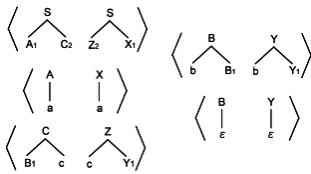
Figure 2: An example of synchronous CFG
2.3 Stochastic Synchronous Tree-Substitution Grammar for Tree Conversion
For the purpose of the inverted transformation of simplified HPSG trees to PTB-CFG trees, we use a statistical approach based on the stochastic synchronous grammars. Stochastic synchronous grammars are a family of probabilistic models that generate a pair of trees by recursively applying synchronous productions, starting with a pair of initial symbols. See e.g., Eisner (2003) for a more formal definition. Figure 2 shows an example of synchronous CFG, which generates the pairs of strings of the form (abmc,cbma). Each
non-terminal symbol on the yields of the synchronous production is linked to a non-terminal symbol on the other rule’s yield. In the figure, the links are represented by subscripts. A linked pair of the non-terminal symbols is simultaneously expanded by another synchronous production.
The probability of a derivationD of a tree pair hS, Ti is defined as the product of the probability of the pair of initial symbols (i.e., the root nodes of
SandT), and the probabilities of the synchronous productions used in the derivation:
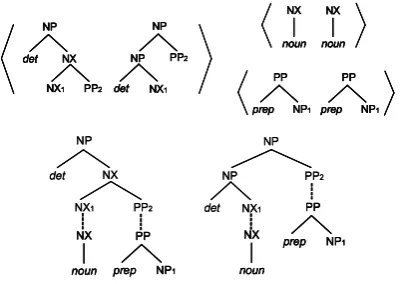
Figure 3: An example of synchronous TSG: syn-chronous productions (top) and a synsyn-chronous derivation (bottom).
Stochastic synchronous grammars have been used in several machine-translation systems to serve as a model of tree-to-tree translation (e.g., (Eisner, 2003; Chiang, 2007)). Our objective of automatic conversion between syntactic anal-yses is similar to the tree-to-tree machine trans-lation. An important difference is that, for our purpose, the generated tree pair should have the same yields since they are two analyses of the same sentence. We also want the synchronous gram-mar to be able to generate a pair of trees wherein some constituents in one tree cross with the con-stituents in the other tree; for example, such a tree-transformation is necessary to change the article-attachment levels.
We show below that, by means of a simple algorithm, we can obtain a synchronous tree-substitution grammar (STSG) that meets the above two requirements. Synchronous productions in STSGs may include a local tree of depth greater than one. Figure 3 shows a tiny STSG that gener-ates two different analyses for PP-modified NPs. Furthermore, a part of the derivation of the two analyses is presented; the dotted-lines indicate ap-plications of the synchronous productions.
3 Tree Transformation Based on a Stochastic Synchronous Grammar
3.1 Extraction of Synchronous Grammars
We created an STSG from a parallel treebank, in which a sentence is assigned with a PTB-CFG tree and a simplified HPSG tree. The synchronous pro-ductions were obtained by splitting the tree pairs at several pairs of non-terminal nodes. Specifically, for a tree pair(T1, T2)for a sentences,
1. we select a set of ‘common-span node pairs’ {(N1
i, Ni2)|Ni1 ∈T1, Ni2 ∈T2, i= 1, . . . k},
which is a set of pairs of non-terminal nodes that dominate the same span ofs, and then 2. split (T1, T2) at each (Ni1, Ni2) for i =
1, . . . , k.
For tree pairs that do not include unary produc-tions, the above procedure uniquely determines a collection of pairs of tree-fragments (t1
i, t2i) by
splitting the tree pair at all the common-span node pairs. For tree pairs including unary productions, we chose the split points{(Ni1, Ni2)}so that they yield a pair of the longest unary chains as a tree-fragment pair when both T1 and T2 include one or more unary production dominating a common span. When onlyT1 (orT2) includes one or more
unary productions on a common span, we selected the upper-most node of the chain of the unary pro-ductions in T1, and the corresponding node inT2
as the split points.
A node on the yields of the resulting tree-fragments is either a terminal node or a node in a common-span node pair that is selected as a split node. We make the synchronous productions by placing links between the common-span node pairs on the yields of the tree-fragment pairs. We can show that the grammar obtained as above only gen-erates pairs of identical sentences by noting that the terminal symbols on the yields of two local trees in a synchronous production, if any, are al-ways identical.
By regarding the division of tree-pairs into the tree-fragment pairs as a synchronous derivation, we get the maximum-likelihood estimates of the probabilities of the synchronous productions:
P(ht1, t2i) = Count(ht1, t2i)
Count(hroot of(t1),root of(t2)i, where Count(·) represents the number of the syn-chronous productions or the pair of their root sym-bols observed in the derivations.
3.2 Tree Conversion Algorithm
We can define a conversion function f(S), which takes a treeSand returns the converted treeT, as:
f(S) = argmax
T P(T|S) = argmaxT P(S, T),
where P(S, T) is the marginal probability of the tree pair hS, Ti. The marginal probability is the sum of the probabilities of all the derivations that generate the tree pair hS, Ti. Since the syn-chronous productions in a STSG may include a lo-cal tree of any depth, there are exponentially many derivations that generate the same tree pair. To our knowledge, no polynomial time algorithm is known for the above optimization problem.
We have instead searched the max-probability synchronous derivation of the tree pair of the form hS,·iand taken the opponent tree as the conversion result of the input treeS:
f(S) = argmax
T D:derivargmax.ofhS,TiP(D).
We used Eisner’s decoding algorithm (Eisner, 2003), which is similar to the Viterbi algorithm for HMMs, to obtain the max-probability derivation.
3.3 A Back-off Mechanism for the Conversion
In our preliminary experiment, a certain number of source trees were not covered by the synchronous grammar. For the trees that are not covered by the synchronous grammar, we used a set of “back-off rules,” which are synchronous productions consist-ing of two 1-level local trees:
{hX →α, Y →βi | X ∈N1, α∈(N1∪Σ)∗, Y ∈N2, β∈(N2∪Σ)∗}, whereN1andN2are the sets of non-terminal sym-bols used in the two treebanks, andΣis the set of terminal symbols. We assign small scores to the back-off rules as:
scorehX→α,Y→βi=P(X→α) Y
P(Bi|Ai),
where is a small constant, P(X → α) is the maximum-likelihood estimate of the PCFG rule probability ofX → αin the source treebank, and
Q
P(Bi|Ai) is the product of ‘re-labeling
proba-bilities’ for the pairs of linked non-terminal sym-bols inαandβ, defined as:
P(B|A) = PCount(hA, Bi) B0Count(hA, B0i),
where Count(·) represents the number of common-span node pairs used as the split points.
When a source tree is not covered by the origi-nal synchronous productions, we add the back-off rules to the synchronous productions, and search for the highest-scored derivation. The score of a derivation including the back-off rules is defined as the product of the probabilities of the original syn-chronous productions, and the scores of the back-off rules. We set the value of to be sufficiently small so that the highest-scored derivation includes a minimum number of back-off rules.
4 Experiments
4.1 Experiment Setting
We compared the performance of an HPSG parser with several CFG parsers. The HPSG parser is the Enju parser (Ninomiya et al., 2007), which has been developed for parsing with the Enju HPSG grammar. A disambiguation module based on a discriminative maximum-entropy model is used in the Enju parser. We compared the Enju parser with four CFG parsers: Stanford’s lexical-ized parser (Klein and Manning, 2003), Collins’ parser (Collins, 1999), Charniak’s parser (Char-niak, 2000), and Charniak and Johnson’s rerank-ing parser (Charniak and Johnson, 2005). The first three parsers are based on treebank PCFGs de-rived from PTB. The last parser is a combination of Charniak’s parser and a reranking module based on a maximum-entropy model. The Enju parser and Collins’ parser require POS-tagged sentences as the input. A POS tagger distributed with the Enju parser was used for the POS-tagging.
We used a standard split of PTB for the train-ing/development/test data: sections 02-21 for the extraction of the synchronous grammar, section 22 for the development, and section 23 for the evalu-ation of the parsers. Some of the trees in PTB are missing in the HPSG treebank because the Enju grammar does not cover all sentences in PTB. Sec-tion 23 of the HPSG treebank, which was used as the gold-standard of the HPSG analyses in the experiments, thus contains fewer sentences (2,278 sentences) than the original PTB section 23 (2,416 sentences). We use a notation, “section 23∗,” to
indicate the portion of PTB section 23 covered by the Enju grammar.
Each parser’s output was evaluated in the fol-lowing three representations:
parser’s output to PTB-CFG trees by using a synchronous grammar. For the CFG parsers, we used their output as is.
• Simplified HPSG trees: We converted the CFG parsers’ output to simplified HPSG trees by using another synchronous grammar. The Enju parser’s output was mapped to simpli-fied HPSG trees. This was achieved by sim-ply mapping the TFSs assigned to the non-terminal nodes to atomic symbols.
• Unlabeled word-word dependency: We ex-tracted head-modifier dependencies from the PTB-CFG trees by using Collins’ head find-ing rules.
The evaluation in the unlabeled word-word depen-dency is motivated by the expectation that, by con-verting PTB-CFG trees to an even simpler repre-sentation, we can reduce the effect of the noise introduced in the conversion of the Enju parser’s output to the PTB-CFG trees.
4.2 Extraction of Synchronous grammars
The stochastic synchronous grammars used for the tree-to-tree conversion were extracted from a par-allel treebank consisting of the PTB-CFG trees in sections 02-21 of PTB and the simplified HPSG trees mapped from the HPSG treebank created by the Mayz. We treated the POS tags, which are common to the PTB-CFG grammar and the Enju HPSG grammar, as the terminal symbols.
Although we can use a single synchronous grammar for the conversion of both directions (i.e., from PTB-CFG trees to simplified HPSG trees, and the opposite), we used two different synchronous grammars to achieve better conver-sion accuracies. The two synchronous grammars were created by applying different pre-processing to the parallel treebank. Specifically, for the HPSG→PTB-CFG direction, 1) the PTB-CFG trees in the parallel treebank were binarized in such a way that maximized the number of common-span node pairs;22) commas in the PTB-CFG trees
were raised as high as possible, approximating the change of the position of commas by the Mayz program; 3) the POS tags for ‘not’ are changed from ‘RB’ to ‘RB-not,’ because in PTB, ‘not’ is treated differently from other adverbs; 4) base 2The non-terminal nodes artificially introduced in the bi-narization process were labeled as ‘A∗’, where ‘A’ is the label of the nearest ‘non-artificial’ ancestor node.
NPs in PTB-CFG trees are marked as ‘NP-B.’ The PTB-CFG trees converted from the Enju parser’s output were post-processed so that the effect of the pre-processing was removed; i.e., artificially cre-ated non-terminal nodes like ‘A∗’ were removed, ‘RB-not’ was changed to ‘RB’, and ‘NP-B’ was changed to ‘NP.’3
For the PTB-CFG→HPSG direction, 1) PTB-CFG trees in the parallel treebank are head-centered-binarized by using Collins’ head find-ing rules; 2) the same pre-processfind-ing as for the comma-raising, ‘not’ adverbs, and base NPs was applied to the PTB-CFG trees. The same pre-processing was applied to the CFG parsers’ output before the conversion to simplified HPSG trees.
4.3 Accuracy of the Tree Conversion
To evaluate the accuracy of the tree conver-sion, we converted the trees in section 23∗ of
the HPSG/PTB treebank into the other format (target format) and compared the conversion re-sults against the corresponding trees in the gold-standard treebank of the target format. Table 1 presents the result of the evaluation. With the ex-ception of the last column, the columns list the PARSEVAL metrics of the converted trees. The last column headed ‘back-off%’ shows the per-centages of the trees for which the back-off mech-anism described in Section 3 were used. The ac-curacy of the word-word dependencies extracted from the PTB-CFG trees converted from the HPSG treebank was 98.76%.4
On average, a tree in section 23∗ of the HPSG
treebank includes 0.89 brackets that cross with the brackets in the corresponding tree in the PTB-CFG treebank, and a tree in the PTB-CFG treebank in-cludes 0.78 brackets that cross with the brackets in the corresponding tree in the HPSG treebank. The figures in the column headed CBs (average number of crossing brackets) show that most of such cross-ing brackets are ‘corrected’ by the conversion.
4.4 Comparative Parser Evaluation using Common Representations
We measured the labeled bracketing accuracy of the parsers’ output in the PTB-CFG tree represen-tation (on section 23), and in the simplified HPSG 3The positions of commas were left unchanged, because we ignored commas in the evaluation, just as in the standard way of evaluating CFG parsers based on the PARSEVAL met-rics.
Conversion direction LP LR F1 CBs 0 CBs ≤2 CBs back-off%
HPSG→PTB-CFG 98.41 98.08 98.24 0.01 99.34 100.00 2.59 PTB-CFG→HPSG 97.54 97.45 97.49 0.13 93.99 98.33 10.80
Table 1: Accuracy of the tree conversion
Parser LP LR F1
Charniak and Johnson 91.79 90.88 91.33 Charniak 89.49 88.78 89.13 Collins (model 3) 88.62 88.28 88.45 Collins (model 2) 88.48 88.15 88.31 Collins (model 1) 87.94 87.51 87.72 Stanford lexicalized 86.36 86.47 86.41 Enju + tree conv. 87.18 86.47 86.82
Table 2: PTB-CFG tree evaluation
Parser (+ tree conv.) LP LR F1
Charniak and Johnson 91.44 91.31 91.37 Charniak 90.07 89.97 90.02 Collins (model 3) 88.79 88.38 88.58 Collins (model 2) 88.74 88.33 88.53 Collins (model 1) 88.62 88.48 88.54 Stanford lexicalized 88.04 88.12 88.08 Enju 90.79 90.30 90.54
Table 3: Simplified HPSG tree Evaluation
tree representation (on section 23∗). The results
are shown in Table 2 and Table 3. The accu-racy of word-word dependencies extracted from the PTB-CFG representation is shown in Table 4. As shown in the previous section, approximately 2% of the brackets are wrong and approximately 1% of the word-word dependencies are wrong af-ter the conversion in both direction even if a parser gives 100% correct output. Taking this into con-sideration, we might conclude, utilizing the results shown in the three tables, that the performance of the Enju parser is roughly the same level as Collins’ parser and Stanford’s lexicalized parser. Another notable fact depicted in the tables is that Charniak and Johnson’s reranking parser outper-forms the Enju parser even in the simplified HPSG tree representation.
4.5 Comparative Error Analysis
To closely examine the difference in the parsers’ performances, we conducted a comparative error analysis using the word-word dependency repre-sentation of the parsing results. Specifically, we tested the difference in the ability of resolving spe-cific types of syntactic ambiguities between two parsers by using McNemar’s test. To make the samples for the McNemar’s test, we identified a subset of tokens of typetmin the test set that have
Parser accuracy Charniak and Johnson 93.66 Charniak 92.50 Collins (model 3) 91.15 Collins (model 2) 91.12 Collins (model 1) 90.66 Stanford lexicalized 90.91 Enju + tree conv. 90.77
Table 4: Unlabeled dependency evaluation
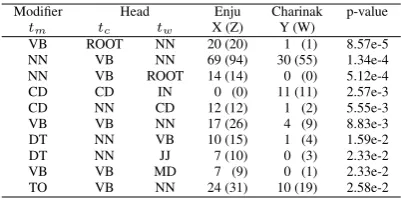
Modifier Head Enju Charinak p-value
tm tc tw X (Z) Y (W)
VB ROOT NN 20 (20) 1 (1) 8.57e-5 NN VB NN 69 (94) 30 (55) 1.34e-4 NN VB ROOT 14 (14) 0 (0) 5.12e-4 CD CD IN 0 (0) 11 (11) 2.57e-3 CD NN CD 12 (12) 1 (2) 5.55e-3 VB VB NN 17 (26) 4 (9) 8.83e-3 DT NN VB 10 (15) 1 (4) 1.59e-2
DT NN JJ 7 (10) 0 (3) 2.33e-2
VB VB MD 7 (9) 0 (1) 2.33e-2
TO VB NN 24 (31) 10 (19) 2.58e-2
Table 5: Error types with smallest p-values
a true head of type tc and another word of type
tw that is confusable as the head. For example, a
subset of tokens where(tm, tc, tw)= (preposition,
noun, verb) can be used to test the difference in the parsers’ ability to resolve PP-attachment am-biguities, by extracting the pairs of the predicted head words for the prepositions from two parsers’ output, and using them as the sample set for the McNemar’s test. When comparing two parsers A and B, we approximated such a subset of tokens by collecting the tokens of type tm, which have true
head of typetc, and for which either A or B
pre-dicted a wrong head of typetw.
We show the results of the comparison between the Enju parser and the Charinak’s parser in Ta-ble 5. We used section 22 of PTB for this ex-periment. The table lists the type of the ambigu-ities (tm, tc, tw) for which the accuracies by the
two parsers differ with the smallest p-values. Note that the POS typestm, tc, and tw are determined
from the gold-standard POS tags, not the POS tags given by parsers or the POS tagger. In the table,X
is the number of the tokens of type (tm, tc, tw)for
which only the Enju parser outputs wrong heads;
de-fined similarly for the Charinak’s parser.
The results indicate, for example, that there is a significant difference between the two parsers in the ability to identify the root of a sentence (the first and third row). Investigation of the Enju parser’s output including the root identification er-rors revealed that almost all of the erer-rors of this type were caused by POS-tagging error; for ex-ample, when the matrix verb of a sentence, like ‘costs,’ is mistakenly tagged as a noun, the matrix verb is not identified as the root (as in the case with the first row), and the subject is often mistakenly identified as the root (as in the case with the third row). This weak-point of the Enju parser is a con-sequence of the architecture of the parser, wherein the POS-tagging phase is completely separated from the parsing phase. Although this weak-point has already been pointed out (Yoshida et al., 2007), we expect that we can identify other reasons for the difference in the parsers’ performances by investi-gating the other types of errors with small p-values as well.
5 Conclusion
We have proposed the use of shallow CFG analy-ses as the common representation for the compar-ative performance analysis of parsers based on dif-ferent grammar frameworks. We have presented a method to convert the parsers’ output to the shal-low CFG analyses that is based on synchronous grammars. The experimental results showed that our method gave a conversion accuracy of around 98% in terms of the labeled bracketing accuracy, which was sufficiently high for extracting a mean-ingful conclusion from a quantitative comparison of the parsers’ performance. Furthermore, we con-ducted a comparative analysis of the parsing re-sults represented in word-word dependencies ex-tracted from the shallow CFG analyses. As a re-sult, we could identified a weak-point of the HPSG parser that comes from the parser’s architecture. Acknowledgements
This work was partially supported by Grant-in-Aid for Specially Promoted Research (MEXT, Japan).
References
Carroll, J., T. Briscoe, and A. Sanlippo. 1998. Parser evaluation : A survey and a new proposal. InIn
Pro-ceedings First Conference on Linguistic Resources,
pages 447–455.
Charniak, E. and M. Johnson. 2005. Coarse-to-fine n-best parsing and maxent discriminative reranking. In
Proc. ACL, pages 173–180.
Charniak, E. 2000. A maximum-entropy-inspired parser. InProc. NAACL, pages 132–139.
Chiang, D. 2007. Hierarchical phrase-based transla-tion. Comput. Linguist., 33(2):201–228.
Clark, S. and J. R. Curran. 2004. The importance of su-pertagging for wide-coverage ccg parsing. InProc.
COLING, pages 282–288.
Clark, S. and J. Curran. 2007. Formalism-independent parser evaluation with ccg and depbank. In Proc. ACL, pages 248–255.
Collins, M. 1999. Head-driven statistical models for
natural language parsing. Ph.D. thesis, University
of Pennsylvania.
Eisner, J. 2003. Learning non-isomorphic tree map-pings for machine translation. InProc. ACL,
Com-panion Volume, pages 205–208.
Hockenmaier, J. and M. Steedman. 2007. Ccgbank: A corpus of ccg derivations and dependency struc-tures extracted from the penn treebank.
Computa-tional Linguistics, 33(3):355–396.
Klein, D. and C. D. Manning. 2003. A parsing: fast exact viterbi parse selection. InProc. NAACL, pages 40–47.
Marcus, M. P., B. Santorini, and M. A. Marcinkiewicz. 1994. Building a large annotated corpus of en-glish: The Penn Treebank. Computational Linguis-tics, 19(2):313–330.
Miyao, Y., T. Ninomiya, and J. Tsujii. 2005. Corpus-oriented grammar development for acquir-ing a Head-driven Phrase Structure Grammar from the Penn Treebank. InNatural Language Processing
- IJCNLP 2004, volume 3248 ofLNAI, pages 684–
693. Springer-Verlag.
Miyao, Y., K. Sagae, and J. Tsujii. 2007. Towards framework-independent evaluation of deep linguistic parsers. InProc. GEAF, pages 238–258.
Ninomiya, T., Y. Tsuruoka, Y. Miyao, and J. Tsujii. 2005. Efficacy of beam thresholding, unification fil-tering and hybrid parsing in probabilistic hpsg pars-ing. InProc. IWPT, pages 103–114.
Ninomiya, T., T. Matsuzaki, Y. Miyao, and J. Tsujii. 2007. A log-linear model with an n-gram refer-ence distribution for accurate hpsg parsing. InProc. IWPT, pages 60–68.
Pollard, C. and I. A. Sag. 1994. Head-Driven Phrase
Structure Grammar. University of Chicago Press.