A NEW SEARCH AND EXTRACTION TECHNIQUE FOR MOTION CAPTURE DATA
RAFIDEI BIN MOHAMAD
A thesis submitted in fulfillment of the requirements for the award of the degree of
Master of Science (Computer Science)
Facultyof Computer Science and Information y em Univers
s it
t i Teknologi Malaysia
NOVEMBER 2008
iv
ABSTRACT
Motion capture is defined as measuring the position and orientation of an object in physical space by triangulating information from multiple cameras which tracks and estimate a number of retro reflective markers over time. This information is later translated into a 3 dimensional digital representation. Motion capture is applied in a wide range of field such as biomechanics, athletic analysis/training, gait analysis, computer animations, gesture recognition, sign language, music and also fine art dance/ performance. In sport science, motion capture data is used for analyzing and perfecting the sequencing mechanics of premiere athletes, as well as monitoring the recovery progress of physical therapies. Existing indexing and extraction technique for motion capture files are based on the whole body motion, where-by motion analysis in sport generally focuses on repeated movements made by specific part of limb such as the arms and legs to measure the effects of a training program. In this research, “Silat Olahraga” movements were used as a case study to
apply a new technique for searching and extraction of motion capture files based on different human body segments.“Silat Olahraga” is a type of sport based on “Silat”, a
combative art of Malay fighting and survival. A total of sixteen “Silat Olahraga”
motion samples simulating four different motion categories were collected and stored as a motion capture database. The process of identification and extraction of logically related motions scattered within the data set called content-based retrieval method was performed to return results to the user. Results from the experiments show that matching motion files were successfully extracted from the motion capture library using the new algorithm based on different human body segments.
v
ABSTRAK
Definisi perakam pergerakan adalah mengukur kedudukan dan orientasi sesuatu objek di dalam ruang fizikal dan kemudian merakamkan maklumat tersebut ke dalam bentuk gunaan computer. Kegunaan perakam pergerakan meliputi bidang yang luas seperti biomekanik, analisa/latihan ahli sukan, analisa gaya jalan, animasi komputer, pengecaman gerak isyarat, bahasa isyarat, muzik serta seni tarian/persembahan. Masalah yang lazimnya timbul adalah dalam penyimpanan dan kemudianya mengekstrak fail perakam pergerakan di dalam pangkalan data perkam pergerakan. Pengguna biasanya terpaksa melakukan turutan klip pergerakan secara manual atau membuat carian berdasarkan kata kunci yang memerihal perlakuan sesuatu pergerakan. Penyelidik terdahulu telah memfokuskan terhadap mengindeks dan pertanyaan pangkalan data ini berdasarkan kepada seluruh pergerakan badan. Di dalam penyelidikan ini, pergerakan Silat Olahraga telah digunakan sebagai kajian kes untuk menerapkan sebuah teknik baru di dalam pencarian dan mengekstrak fail perkam pergerakan berdasarkan segmen badan manusia yang berlainan. Silat Olahraga adalah sejenis sukan berdasarkan Silat iaitu satu bentuk seni mempertahankan dan kemandirian Melayu. Pergerakan di dalam bidang sukan biasanya tertumpu kepada gerakan yang dilakukan oleh bahagian-bahagian tertentu tubuh seperti tangan atau kaki. Sebanyak enam belas sampel pergerakan Silat Olahraga yang mewakili empat kategori pergerakan telah dirakam dan disimpan sebagai pangkalan data perakam pergerakan. Kaedah pengekstrakan berdasarkan kandungan telah diterapkan bagi memaparkan hasil pencarian. Hasil daripada uji kaji yang dijalankan menunjukan fail-fail sepadan telah berjaya diekstrak daripada pangkalan data perakam pergerakan dengan menggunakan sebuah algoritma baru berdasakan segmen tubuh manusia yang belainan.
vi
TABLE OF CONTENTS
CHAPTER TITLE PAGE
1 INTRODUCTION
1.1 Background. 1
1.2 Problem Statement 4
1.3 Research Objectives 6
1.4 Scope of Research 7
1.5 Research Contribution 8
1.6 Thesis Structure 9
2 INTRODUCTION
2.1 Introduction 11
2.2 Motion Capture File Formats 12
2.3 Motion Capture Data Extraction Techniques 13
2.3.1 XML Based Approach 13
2.3.2 MCML Based Approach 14
2.3.3 Motion Normalization Approach 15
2.3.4 Motion Data Indexing 16
2.3.5 Cluster Graph Approach 17
2.3.6 Content-based Motion Retrieval Approach 17
2.4 Content-based Retrieval 18
2.5 TRC Data Format 19
vii
3 RESEARCH METHODOLOGY
3.1 Introduction 22
3.2 MocapXtractPro System Flow 23
3.3 Sample Collection 24
3.4 Center of Motion 29
3.5 Motion Search 31
3.5.1 Feature Extraction 32
3.6 The Extraction Process Flow 33
3.6.1 Further Extraction 35
3.7 TRC Data Format 37
3.8 Principle Marker Selection 40
3.9 Summary 43
4 IMPLEMENTATION AND RESULTS
4.1 Development of Prototype 44
4.2 User Interface 45
4.3 Implementation of the Biomechanics Data Extraction 47
4.3.1 Motion Example 47
4.3.2 Principle Marker Selection 47
4.3.3 Enter Threshold Value 47
4.3.4 Compute Distance of Mocap Files 48
4.3.5 Display Mocap Files Within Threshold Value 50
4.3.6 Extract Features 50
4.4 Implementation Summary 50
4.5 Experimental testing 51
4.6 Preparation for Data Testing 51
4.7 The Results of Experimental Data Extraction 53
5 CONCLUSION
5.1 Introduction 57
5.2 A Summary of Work 58
5.3 Future Works 58
BIBLIOGRAPHY 60
Appendices A – D 64 - 119
CHAPTER 1
INTRODUCTION
1.1 Background
2
mentioned the co-ordinate analyzer (motion capture device) as a significant advance in movement analysis.
According to Maureen (2000) Motion capture or also known as mocap was originally created for military use before it was adapted into the entertainment industry since the mid 1980’s. Dyer, Martin and Zulauf (1995) define motion capture as
measuring an objects position and orientation in physical space, then recording that information into a computer usable form. According to Kovar and Gleicher, 2003; Suddha, Shrinath and Sharat, 2005 motion capture is the fastest way to generate rich, realistic animation data. James et al. (2000) describes that Mocap can also be applied in several other fields such as music, fine art dance/performance, sign language, gesture recognition, rehabilitation/medicine, biomechanics, special effects for live-action films and computer animation of all types as well as in defense and athletic analysis/training.
3
INPUT PROCESS OUTPUT
Figure 1.1 Basic Motion Capture Process.
Training or coaching sport activities such as martial art have been traditionally exercised by means of observations and visual assessment. This trend however is fast becoming obsolete with the rapid growth of research and developments in sports science. According to Atha (1984) visual assessment is commonly practiced because of the fact that it is low cost but not without its significant drawbacks. It is relatively slow, it has to sort what it wants from a great variety of visual information, and its usefulness is limited by the small capacity short term memory to which it has access.
Scientists at National Geographic employ state of the art mocap system to measure and map the speed, force, range and impact of martial art fighter techniques (Yancey, 2006). This is a practical step to take martial art to the next level since most of the popular self-defense techniques such as Tae Kwon Do, Karate and also ‘Silat
Olahraga’ have been adapted to become a new form of sport which raises the issue of
safety and competitiveness in term of training and coaching. The goal of this research is to apply scientific method towards ‘silat olahraga’ training and coaching technique.
Capturing video from live actors
Video/image processed to
identify corresponding
markers
4
1.2 Problem Statement
1.2.1 Even though motion capture is applied into so many fields by creating physically perfect motions, it has a few significant weaknesses. According to Hyun-Sook & Yilbyung (2004) firstly, it has low flexibility, secondly the captured data can have different data formats depending on the motion capture system which was employed and thirdly, commercially available motion capture libraries are difficult to use as they often include hundreds of examples. Shih-Pin et al. (2003), states that motion capture sessions are not only costly but also a labor intensive process thus, promotes the usability of the motion data.
1.2.2 In the field of animation and gaming industry, it is common that motion clips are captured to be used for a particular project or stored in a mocap library. These clips can either be used as the whole range of motion sequence or as part of a motion synthesis. In sport science, mocap data is used for analyzing and perfecting the sequencing mechanics of premier athletes, as well as monitoring the recovery progress of physical
5
1.2.3 During a biomechanics study for the purpose of performance
improvements among athletes such as the one done by Gregory et al. (2005), a controlled cohort repeated-measures experimental method was used to study the effects of a specific training program. This involves measuring the before and after effects of such training program and also comparisons among the athletes who participated in the experiment. With a collection of motion sequence in hand, according to 0X OOHU5R der, & Clausen (2005) one has to solve the fundamental problem of
identifying and extracting suitable motion clips from the database on
hand. The user usually resorts to describing the motion clips to be retrieved in various ways at different semantic levels. One possible specification could be a rough textual description such as “a kick of the right followed by a punch”. Another query mode would involve a short query motion clip, the task being to retrieve all clips in the database containing parts or aspects similar to the query. Muller, Roder, & Clausen (2005) refer this problem as content-based retrieval. This research will attempt to apply automatic searching and extraction of matching human motion data based on statistical properties as an alternative to hand sequencing.
1.2.4 Due to the success of motion capture, many organizations developed their own motion capture file formats which were designed for specific
6
1.2.5 Most of the motion capture file search and retrieval research sited in this research including Kovar and Gliecher (2004) are concerned with character animation and motion synthesis where-by according to Bobby et al. (1997), in the field of animation, highly abstracted applications of
motion capture data, analogous to puppetry, are primarily concerned with
motion character, and only secondarily concerned with fidelity or accuracy where by additionally, accurate motion analysis is important to the biomechanics community.
1.3 Research Objectives
The research objectives are as follows:-
1.3.1 To study and identify a suitable search and extraction method for biomechanics motion sequence.
1.3.2 To develop and to test a motion search and extraction system for biomechanics data.
7
1.4 Scope of Research
In order to achieve the best possible result from this research, we need to identify the scope in which the research will focus on. The scopes identified are concerning the software, types of data, techniques to be applied and the main topics to be covered related to the research area are as follows:-
1. This research will use the Tracked Row Column (TRC) file format for the system development and sample collection of motion capture files based on Motion Analysis Corporation motion capture System employed by Universiti Putra Malaysia where the motion data/samples were collected. The reason for using the TRC file format is explained on the problem statement 1.2.4.
2. Samples collected on basic ‘silat’ movements such as punching, kicking and elbowing will be manually segmented to simulate the motion library
environment where motion sequences are usually named based on the behavior or the performers.
8
1.4 Research Contribution
The result of this research has generated two main contributions as far as knowledge is concerned:-
1. In this research, a content-based retrieval method for search and motion data extraction has been identified and applied for sequencing/identifying
biomechanics data in a motion capture library or mocap database.
9
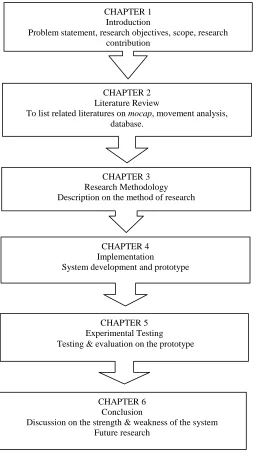
1.6 Thesis Structure
10
Figure 1.2 Thesis Structure
CHAPTER 1 Introduction
Problem statement, research objectives, scope, research contribution
CHAPTER 2 Literature Review
To list related literatures on mocap, movement analysis, database.
CHAPTER 3 Research Methodology Description on the method of research
CHAPTER 4 Implementation
System development and prototype
CHAPTER 5 Experimental Testing Testing & evaluation on the prototype
CHAPTER 6 Conclusion
60
BIBLIOGRAPHY
Alexander Refsum Jensenius, Antonio Camurri, Nicolas Castagne, Esteban Maestre, Joseph Malloch, Douglas McGilvray, Diemo Schwartz, Matthew Wright (2007). Panel: The Need of Formats For Streaming And Storing Music-Related
Movement And Gesture Data. International Computer Music Conference (ICMC 2007). August 27-31, Copenhagen.
Atha J. (1984). Applied Ergonomics. Current techniques for measuring motion.15.4: 245 –257.
Bobby Bodenheimer, Chuck Rose, Seth Rosenthal, John Pella (1997). The Process of Motion Capture: Dealing with the Data. Computer Animation and Simulation '97, Eurographics Animation Workshop. Sept. 1997. Springer-Verlag, Wien. 3-18.
Carlos R. Morales (2001). Development of an XML Web based motion capture data warehousing and translation system for collaborative animation projects.
Proceedings of the 9th International Conference in Central Europe on Computer
Graphics, Visualization and Computer Vision. February 5 - 9, 2001. Plzen, Czech
Republic. 168.
Conley R., Tulchin, K., Harris, G., Smith, P., Humm, J., Hassani, S. Pediatric Sports Medicine: An Evolution of Applications of Motion Analysis. Pediatric Gait, 2000. A
new Millennium in Clinical Care and Motion Analysis Technology. 116-123. Cerveri P., Pedotti A., Ferrigno G. (2003). Robust Recovery of Human Motion From
Video Using Kalman Filters and Virtual Humans. Human Movement Science. 22:
377-404
Dyer, S., Martin, J. and Zulauf J (1995). Motion Capture White Paper. Technical Report. Silicon Graphics, December 12, 1995.
61
Feng Liu, Yueting Zhuang, Fei Wu and Yunhe Pan (2003). 3D Motion Retrieval with Motion Index Tree. Computer Vision and Image Understanding 92, 265-284.
Gregory D. Myer, Kevin R. Ford, Joseph P. Palumbo Timothy E. Hewett (2005). Neuromuscular Training Improves Performance and Lower-Extremity
Biomechanics in Female Athletes. Journal of Strength and Conditioning Research,
2005, 19(1), 51–60.
Guodong Liu, Jingdan Zhang, Wei Wang, Leonard McMillan (2005). A System for Analyzing and Indexing Human-Motion Databases. SIGMOD 2005 June 14-16,
Baltimore, Maryland, USA.
Heather Kenyon (1999). .ILM’s Seth Rosenthal on motion Capture. ANIMATION
WORLD MAGAZINE. February 1999. ISSUE 3.11
Herda L., Fua P., Plaሷnkers R., Boulic R. & Thalmann D. (2000). Skeleton-based motion capture for robust reconstruction of human motion. Proc. Computer Animation, , 77-83. Retrieved July 1st, 2008 from www.scopus.com.
Hyun-Sook Chung & Yilbyung Lee (2004). MCML: motion capture markup language for integration of heterogeneous motion capture data. Computer Standards &
Interfaces, 26. 113-130.
Ina Hunger & Jorg Thiele (2000). Qualitative Research in Sport Science. Forum. Qualitative Social Research. 2000. 1-2000.
James F O’Brien, Robert E. Bodenheimer Jr., Gabriel J. Brostow, Jessica K. Hodgins (2000). Automatic Joint Parameter Estimation from Magnetic Motion Capture Data.Graphics Interface 2000, Montréal, Québec, Canada: BibTex. 53-60. Jernej Barbic, Alla Safonova, Jia-Yu Pan, Christos Faloutsos, Jessica K. Hodgins,
Namcy S. Pollard (2004). Segmenting Motion Capture Data into Distinct
Bahaviors. Proceedings of Graphics Interface 2004, May 17-19, London, Ontario.
Jie Yang, Qiang Huang, Zhaoqin Peng, Lige Zhang, You Shi and Xiaojun Zhao. Capturing and Analyzing of Human Motion for Designing Humanoid Motion. Proceeding of the 2005 IEEE International Conference on Information Acquisition
June 27 – July 3, 2005, Hong Kong and Macau, China: IEEE. 332-337.
62
Klempous, R. (2007). Movement identification analysis based on motion capture Retrieved July 21, 2008 from www.scopus.com.
Kovar Lucas and Gleicher Micheal (2003). Flexible Automatic Motion Blending with Registration Curves. Eurographics/SIGGRAPH Symposium on Computer
Animation. July 26 - 27, 2003. San Diego, California. 214 – 224.
Kovar Lucas and Gleicher Micheal (2004). Automated Extraction and Parameterization of Motions in Large Data Sets. ACM SIGGRAPH 2004 Papers. 559 - 568.
Lakany, H. M., Hayes, G. M., Hazlewood, M. E., & Hillman, S. J. (1999). Human walking: Tracking and analysis. IEE Colloquium (Digest), (103), 25-38. Retrieved August 12, 2008 from www.scopus.com.
Margaret S. Geroch (2004). Motion Capture for the Rest of Us. Journal of Computing Sciences in Colleges. Volume 19, Issue 3: 157 - 164
Maureen Furniss (2000). Motion Capture: An Overview. Animation Journal. Spring 2000: 68-82
Muሷller, M., Roሷder, T., & Clausen, M. (2005). Efficient content-based retrieval of motion capture data. Paper presented at the , 24(3) 677-685. Retrieved 25 June, 2005 from
www.scopus.com.
Meredith M., & Maddock, S. (2005). Motion Capture File Formats Explained, Retrieved July 1st 2008 from www.scopus.com.
Michail Vlachos, Marios Hadjieleftheriou, Dimitrios Gunopulos and Eamonn Keogh (2005). Indexing Multidimensional Time-Series. The VLDB Journal, 15(1), 1-20. Springer-Verlag.
Niemann H., (1990). Pattern Analysis and Understanding (2nd Edition). Berlin: Springer-Verlag.
Ryszard Klempous, Movement Identification Analysis Based on Motion Capture. In: Computer Aided Systems Theory – EUROCAST 2007 . Berlin / Heidelberg:
Springer. 629-637; 2007.
Scott L. Delp, J. Peter Loan (2000). A Computational Framework for Simulating and Analyzing Human and Animal Movement. Computing in Science And Engineering.
63
Shih-Pin Chao, Chih-Yi Chiu, Jui-Hsiang Chao Yil-Cheng Ruan, Shi-Nine Yang (2003). Motion Retrieval and Synthesis Based on Posture Feature Indexing. ICCIMA’03.
27-30 Sept. 2003: 266 – 271.
Suddha Basu, Shrinath Shanbhag and Sharat Chandran, (2005). Search and Transisioning for Motion Captured Sequences. VRST’05, November 7-9,
Monterey, California, USA.
Susan J. Hall (1991). Basic Biomechanics. (3rd ed.) Boston: WCB/McGraw-Hill. Tanco L. M., Hilton A. (2000). Realistic Synthesis of Novel Human Movements from
Database of Motion. Proceedings of the IEEE Workshop on Human Motion HUMO. 7-8 December, 2000, Austin, Texas.137-142.
Tapas Kanungo, David M. Mount, Nathan S. Netanyahu, Christine D. Piatko, Ruth Silverman, Angela Y. Wu. A Local Search Approximation Algorithm for k-Means Clustering. Proceedings of The Eighteenth Annual Symposium on Computational Geometry .June 5-7, 2002. Barcelona, Spain. 10 – 18.
Thomas B. Moeslund and Erik Granum. A Survey of Computer Vision-Based Human Motion Capture. Computer Vision and Image Understanding 81 (3). 231-268.
Thomas P. Andriacchi*, Eugene J. Alexander (2000). Studies of human locomotion: past, present and future. Journal of Biomechanics. 33: 1217-1224.
Yancey Hall (2006). Martial Artists’ Moves Revealed in “Fight Science” Lab. National
Geographic news. Retrieved: 25, June,2006 from
http://news.nationalgeographic.com/news/2006/08/060814-fight-science.html Yan Gao, Lizhuang Ma, Zhihua Chen, Xiaomao Wu (2005). Motion Normalization: the
Preprocess of motion Data. VRST’05, November 7-9, Monterey, California, USA,