1260
Agrivigilance: A Security System For Intrusion
Detection In Agriculture Using Raspberry Pi And
Opencv
Shanmukhappa Angadi, Raghavendra Katagall
Abstract: India is mainly an agriculture based country. Agricultural farm security is important to protect the agricultural produce. Valuable investments can be ruined intentionally or unintentionally by a person who intends to rob or destroy the property or by animals. Introduction of modern technology into agriculture has enabled a view to think about building security systems for the farm lands. IoT technology helps in building various applications for Smart Agriculture. When Vision is embedded to IoT, the possibilities are endless. A new proposal for agricultural farmland vigilance is proposed in this paper. The proposed system employs Raspberry Pi board to detect any malicious activities or motion in the farm land and triggers the PiCam to take picture of the scene image. The object in the image is identified by the image processing module through Single Shot detectors and Mobilenets technique of Deep Learning using OpenCv installed in the Raspberry Pi board. This message is sent to the farmer as notification in email and telegram tool. The experiments are carried out on a farm land and the accuracy and consistency of the system are measured and tabulated. The results show that the system is 92% accurate and 100 % consistent for detecting malicious activity.
Keywords : Motion detection, OpenCV, PIR Sensor, Raspberry Pi, Smart Agriculture, Telegram Bot, Vision based IoT. —————————— ——————————
1.
INTRODUCTION
Agriculture is the backbone of our country. Agriculture provides food, raw materials and also occupation to a large portion of the Indian population. It plays vital role in the growth of country’s economy. The World Bank estimates around 50% of the Indian population will be in urban areas by 2050. In 2050 the percentage of agriculture labours and workers is estimated to be around 26%, which was once around 60% in 2001. Therefore, there is a need of farm mechanization in the country (Snowber Mushtaq et.al, 2018). Productivity of crops in agriculture is in great demand. For decades, agriculture had been connected with the generation of improvements in the farming technology. In this regard making agriculture smart, important contributions can be made by using emerging technologies like Vision Based IoT, which inculcates image processing techniques in IoT. The Internet of things (IoT) is the most efficient and innovative technique for developing solutions to problems in various human endeavours. IoT consists of different building blocks which include sensors, network components, software and many other electronic devices. Internet of Things (IoT) technology is expected to play a significant role in enhancing agricultural productivity to meet food demand and also to overcome shortage in agriculture labour. Smart agriculture incorporates IoT based techniques and solutions to enhance efficiency of agricultural operations, maximization of yield, and minimization of agricultural waste through real-time collection of field data, analysis of data, and deployment of control and monitor mechanisms. Many IoT-based applications such as precision farming, variable rate technology, smart irrigation, and smart security system will be instrumental to the enhancement of agricultural processes. IoT can address agriculture-based problems and can enhance the quantity and quality of agricultural production, and hence making agricultural lands
more intelligent and more connected. One such broad category of IoT, is Vision IoT.
Vision Based IoT focuses on combining image processing techniques with IoT technology, which can bring Smart security systems, in Agriculture into reality. Vision IoT helps the farmers to monitor and control the activities in the farm. Introduction of vision technique in IoT, has given rise to a wide range of products, which are new and enhanced, which are becoming more responsive and intelligent than ever before, hence making them more useful to the user. One of the richest sensor modalities is Vision. When vision technology is coupled with Agriculture and IoT, there can be endless possibilities in terms of detection of malicious activities, surveillance, controlling of agriculture environment etc. One of the important application segments in Vision IoT technology is in the Sector of security and surveillance in Agriculture. Nowadays, security is becoming a matter of great significance for farmers, despite that the threat of a violence on farm is marginal, criminal deeds such as robbery of farm equipment or crops, wild animal intrusion, criminal disruption involving unsecured equipment and machinery, destruction of bioengineered plants etc pose some serious problems to farmers. It is the need of the hour to arrive at a unique less costlier solution to detect malicious activities in the farm, identify the object causing malicious activity and notify the same to the farmers. This paper aims at devising a security system using IoT which detects motion in the farm environment, triggers PiCam to capture the scene information in the form of an image, identifies the object like animal, person or the thing causing motion using deep learning using MobileNets and Single shot detectors. These methods can be combined and can be used for real-time and super-fast object detection, on the devices which are resource constrained such as Smartphones, Raspberry Pi etc. Deep Neural Network(DNN) module of OpenCV is used in loading a pre trained object detection network. An output bounding box (x, y)-coordinates of each object in the image is obtained when the input images are made to pass through this network. The object detection results are sent through notification to the farmer which has motion information in scene image through email and SMS. The significance of this system is notification of real time information of the identified object to the user ————————————————
Author: Professor and Chairman, Department of CSE, VTU Belagavi, India. E-mail: [email protected]
1261
through email and sms. The experiments carried out on the system have given satisfactory results with high accuracy which is defined as number of objects correctly detected to number of total objects intruded the farm in a stipulated time, The accuracy of the system is 92% with respect to detection and identification of objects. The consistency of the system which is defined as number of user notifications sent to number of intrusions in the farm is found to be 100%. The detailed description the system proposed is given in this paper. The paper is organised into five sections, Section 2 gives the literature review, which deals with the contributions done in Security System in Smart Agriculture using IoT and image processing. Section 3 covers Computer Vision aided Security System for Smart Agriculture, especially to detect motion and Malicious Activities in Farm and identifying the object causing motion and also further presents the Hardware and software components used in the framework and the image processing mechanism to identify the object in an image. Section 4 deals with Experiments and result analysis and Section 5 concludes the work.
2 LITERATURE REVIEW
To develop an intelligent security system using IoT and image processing: database management systems, sensor networks and OpenCV modules are the foundation. Pattern matching and Data analytics fields also influences security devices. Various IoT based security devices have been developing by researchers, but very little work is reported in connection with agricultural farm land security. Among the limited reported works, the following are some of the prominent works available in literature. A smart farm security system built using image processing technique with alarm mechanism is described in Ronnel Kylon A et.al, (2016), through Arduino micro-controller, to detect motion in farmland and capture the scene image. The processing of the image for detection of malicious activity is not done in Arduino micro-controller, instead the captured image is sent to a server, wherein matlab is installed and the processed results are sent back to the arduino. The results include switching on the alarm for alerting the farmer. The process of sending image to server is time consuming and unreliable since there is no provision to do image processing at the source side because the system has noIn Rangel Daroya et.al, (2017), An autonomous Quadcopter which has filter modification camera and is used for image extraction of agricultural land is designed. It provides the estimations regarding the conditions of crops in contrast with the observations actually made and the care taken by local farmers. As a platform, a quadcopter which is equipped with flight controller and raspberry Pi which has robot operating system running on it is used for data acquisition. Further the images taken in farmland are transferred for the offline processing. In automatic irrigation system described in B.Nagarasu et.al, (2016), A Web camera is used to monitor the status of peanut leaves, which if dried will turn upside down and gets shrink if the leaves are half dried. These captured images of leaves are compared to the images in the database by making use of edge and color histogram correlation method. If dry leaves are found then the system designed here will turn on the motor. By this system manpower can be reduced for continuous monitoring. Worm detection in leaves is also done using edge detection method, which make farmer cautious about the further preventive measures to be taken at the earliest. This increases crop yield
1262
crop conditions to be monitored within long distances using cloud services. In Vinita Tyagi et.al, (2017), A survey is presented which has applications of image processing techniques applied to agriculture field such as imaging techniques, weed detection and fruit grading. This analysis has proved to be less time consuming and accurate as compared to other traditional methods practised in agriculture. Image processing helps to improve decision making for irrigation, vegetation measurement, fruit sorting etc. Weed classification can also be done using image processing techniques. Classification accuracy varies from 85% to 96% and it depends on algorithms and image acquisition methodsAll the works described above have overlooked the issue of security in agricultural field due to unauthorized intruders and the process of identifying the object(s) causing malicious activities. This serves as a motivation for us to design a prototype of the intrusion detection and object identification system.
3 AGRIVIGILANCE: A COMPUTER VISION
AIDED SECURITY SYSTEM FOR SMART
AGRICULTURE
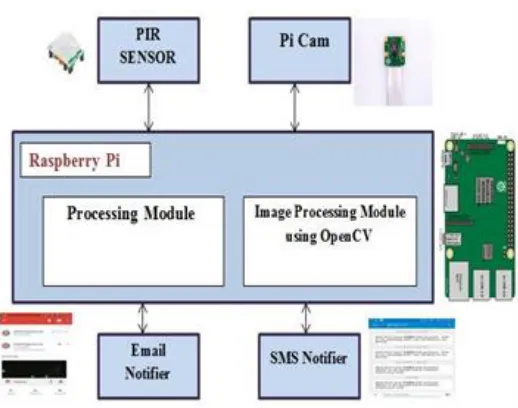
A Smart security system for agriculture using Raspberry Pi, integrated with OpenCv which detects movements inside the farm, takes a snapshot of the environment upon detecting the motion, processes the captured image using OpenCv inside the Raspberry Pi, determines the object such as animal, person or any other that is causing the intrusion in the scene and trigger the notification to the farmer is described in this section. The proposed system, "AgriVigilance: A Security system for Intrusion detection in Agriculture using Raspberry Pi and OpenCV for Smart Agriculture", consists of Sensor module, deep learning module which processes the acquired image using OpenCv, PiCam module, e-mail notifier module and SMS notifier module as shown in Figure 1The sensor module has PIR sensor which is used to detect motion of the intruders and malicious activities in the farm. The PIR sensor consists of two slots in it. These slots are built using a special material which detects Infrared rays. The slots detect same amount of Infrared rays when the sensor is idle. When a warm body like animal or human being passes by, the IR rays emitted by the body in the form of heat energy intercepts one half of PIR sensor. This causes a change in positive differential between two halves. The vice versa happens when the warm body leaves the sensing area, creating a negative differential change. (Raj G Anvekar, 2017). These changes in pulses confirm the detection of motion.
Figure 1. Computer Vision aided Security System for Smart
Agriculture.
1263 A. Architecture
The designed framework uses three layers for data transmission, data analysis and data collection. IoT architecture presented here can be viewed as 3-layer architecture as shown in Figure 2, these layers are,
1. The perception layer: The main aim of perception layer is to perceive the properties of the environment and the things present around the agriculture farmland. The process of perception is achieved through many of the well-known sensing technologies (e.g RFID, GPS, WSN, NFC etc). This layer converts information to digital signals, that are essential for network transmission. The PIR sensor and camera, in the designed system works in perception layer. These sensors acquire real time information from the farm environment and send it to the processing unit namely Raspberry Pi. The sensors are programmatically controlled and the values are monitored through Raspberry Pi. The inbuilt gateway in Raspberry Pi provides interface to connect perception layer to network layer.
2. The network layer: processes the data received from perception layer. The data is transmitted to the application layer through various networking technologies, namely local area network, wireless/ wired networks. The transmission modes like FTTx, wifi, 3G/4G, Zigbee, bluetoothand infrared technologies are used for data transmission. Network Layer communicates between sensors and processes in Raspberry Pi.
3. The application layer: makes use of processed data from the previous layer. This layer acts like front end of the whole IoT architecture, through which the potential of IoT can be exploited. In our system the scene image is captured in perception layer by the PiCamera and the object in the scene image is identified in application layer and email notification and messaging notification is sent to the user through Telegram. Application layer. All these three layers are built in Raspberry Pi and are used accordingly.
Figure 2. Layered Architecture of the system.
The proposed system works in four phases namely, motion detection phase, Event capture Phase, Object Identification Phase and Event Notification Phase. 1.Motion Detection Phase: The motion detection phase involves the detection of any malicious activities in the farm land using the PIR sensor deployed in the farm environment. This PIR sensor sends the signal information to the Raspberry Pi for further processing.
2. Event Capture Phase: In capture phase the signal received by PIR sensor is processed and camera is made to capture the scene image when motion is detected. The captured image will be stored in Raspberry Pi and is used to detect object in the image in next phase.
3. Object Identification Phase: The captured image is sent to image processing module of Raspberry Pi. This module identifies the object(s) in the image. Through deep learning, object detection can be done using MobileNets and Single ShotDetectors. which are preferred object detectors as described in Snowber Mushtaq et.al, (2018). These methods are combined together for real time, fast object detection on resource constrained devices (including the Raspberry Pi, smartphones, etc.). OpenCv has a module named DNN, from which a pre trained object detection network can be loaded. This will enable to pass input images through the network and obtain the output bounding box (x, y)-coordinates of each identified object in the image.
4. Event Notification Phase: The email and sms notification consisting of captured image is notified to the user regarding the detected motion in this phase. The email is sent to registered email id and sms is sent to the Telegram account of the user to the registered number.
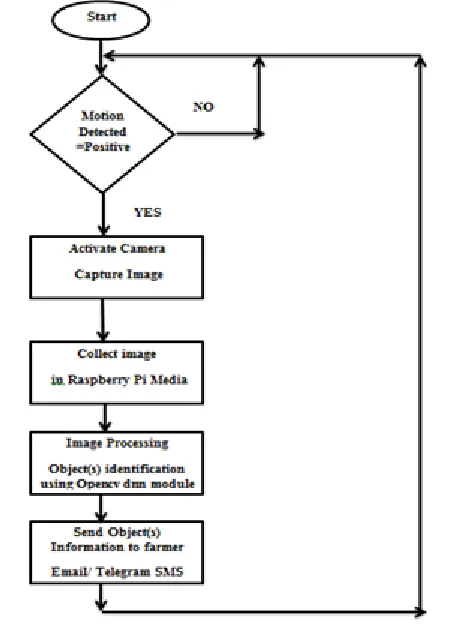
The proposed system can be depicted using flowchart as shown in the Figure 3.
Figure 3. Flowchart of the proposed methodology.
The four phases are briefly discussed in this section. The algorithm for the proposed methodology is as discussed below,
Algorithm: Working of AgriVigilance Step 1: Start and wait for motion detection
1264
Step 3: Activate Camera and capture scene image. Step 4: Collect image in Raspberry Pi Media.
Step 5: Perform image processing to identify objects in the image.
Step 6: Send object information to user through email and message.
Step 7: Stop
Object identification is the major part of the system that is implemented here. A thorough discussion on Object detection with the algorithm used to implement the system is made in next section.
A. Object Identification using OpenCV in Raspberry Pi OpenCv can be installed in Raspberry Pi so that the object identification can be done in the source system rather than sending it to some remote server and processing it there. The latter process is time consuming and also not so effective. Object detection using Deep Learning can be done using single Shot detectors and mobile nets as discussed in Wilson Feipeng Abaya (2018). The SSD object detections consists of two parts 1) Extracting feature maps, and 2) Applying convolution filters to detect objects. SSD detects multiple objects within the image in one single shot in contrast to regional proposal networks (RPN) based approaches like R-CNN, which needs two shots, one to generate regional proposals, and one to detect object that exist in each proposal. SSD is faster as compared with two shot RPN- based approaches. Whereas, streamlined architecture based Mobilenets uses depth-wise separate convolutions in building light weight deep neural networks. The steps employed by the proposed system are described in the algorithm below,
A pre-trained Classes is built, which has training samples for Cat, horse, dog, cow, person, bird, sheep, pig, elephant, monkey, bear, motorbike, bicycle, goat, bus, train, car is used in the process. A query image is passed through the network and a blob is created. A list is created to monitor the objects that are detected. An object is said to be detected when the confidence value is greater than 40% which is set as threshold value. This threshold value is set after evaluating the training network for some known object detection results.
Algorithm: Object Identification using SSD and MobileNets. Input: Scene image captured by PiCamera Module when motion is detected
Output: Objects identified that are present in the input image and bounding box are marked over each object in the image
Step 1: A list of pre trained CLASSES is built first which contain the labels such as person, animal, vehicles which can possibly intrude the agriculture farm land
Step 2: A query image is then passed to the network, and blob is created for feeding to the network. Blob is the entire image pre-processed and prepared for classification/training.
Step 3: Compute the forward pass by setting the input to the network and store the result as detection.
Step 4: Compute the (x, y)-coordinates of the bounding box for the object by extracting the index of the class label from the `detections`, then using
for i in range(0,detections)
confidence=detection[0,0,i,2] if confidence>min threshold(40%):
box=detection[0,0,i,2]
Step 5: Perform Step 4 iteratively until all the detections are computed in the similar way, this is needed to detect more than one object if it is present in the captured image.
Step 6: The confidence value will be extracted when each detection is made, and if this confidence value is greater than some minimum threshold value (>40%), the class label index is extracted and a bounding box is put to the object around it. Step 7: The final object and its value are printed.
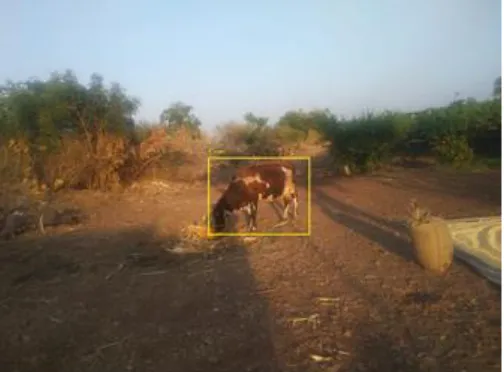
Deep neural network and MobileNet SSD module in OpenCV are used to build object detector. Class labels and bounding box colors for different objects are initialised in the beginning. After this the data from Caffe model is loaded which has structures of objects. A query image is loaded and blob is prepared, which will be feed forwarded through deep neural network. An input image will be loaded and an input blob will be constructed for the image by resizing to a fixed 300x300 pixels and then normalising it. The blob is passed through the network, detections and predictions are obtained. The process is carried out several time and thus all the objects in the image are detected. The processed image is stored in Raspberry Pi and in standard encryption format. After detection results are finalised the results with the image in the same standard encryption format is sent to user/farmer through his email and message. As described earlier in the section Cat, horse, dog, cow, person, bird, sheep, pig, elephant, monkey, bear, motorbike, bicycle, goat, bus, train, car are the several objects that can be detected using this system. All these objects have been detected in the experiments conducted and one such sample output is shown in figure 4, for which object identification is done.
Figure 4. Cow has been detected and identified using
OpenCv module for making intrusion
The required hardware and software components and description of each component of the proposed system is discussed in the next section.
B. Hardware and Software Components
This section discusses about the hardware and software components in the proposed system.
Raspberry Pi Board
1265
The Raspberry Pi has the ability to interact with the outside world, and has been used in a wide array of projects.
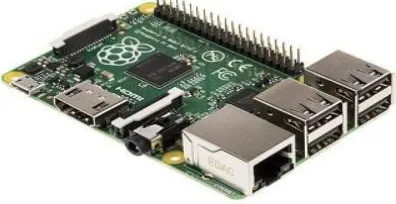
Figure 5. Raspberry Pi Board
Raspberry pi Model 3 as shown in figure 5 has 40 pins which also includes 5v, GND, 3.3v and 26 GPIO pins and 2 ID-EEPROM pins to provide connectivity to I/O devices. In the proposed frame the PIR sensor and camera sensor are connected to Raspberry Pi and all the modules are governed by Raspberry Pi. PIR sensorThe infrared light radiating from object is measured by PIR sensor. The PIR sensor is hermetically sealed to improve noise/ temperature/ humidity immunity.
Figure 6. PIR Sensor
A window of IR-transmissive material that protects the element that is sensing is present in the sensor. Behind the window there are two balanced sensors. PIR sensor as shown in figure 6 has three pins namely Ground, Out and Vcc. PIR sensor detects the motion in farm environment and sends the information to processing module to trigger camera to take picture of the scene environment.
A. PiCam
Raspberry Pi Camera Module acts as a custom desinged add-on for Raspberry Pi. PiCam as shown in figure 7 can be attached to Raspberry Pi through one of the sockets on the board upper surface.
Figure 7. PiCam
The PIR sensor and camera are connected to GPIO (general-purpose input/output pins) header. The connections are as shown in Table I.
TABLE I. SENSOR CONNECTION OF GPIO HEADERS
Device Port GPIO
PIR sensor
Vcc Out Gnd
Pin 2 GPIO 4
Pin 6
Camera Camera/ CSI port
PiCam interface uses the dedicated CSI interface, which is specifically designed for interfacing cameras to Raspberry Pi. The CSI interfaces have the capability to handle high data rates that carries pixel data. The notifications are sent to the user/farmer through telegram Messenger Service which is discussed in the next sub section. Telegram Messenger ServiceTelegram-send is a command-line tool to send messages and files over Telegram to user account, to a group or to a channel. It provides a simple interface that can be easily called from other programs. PIR sensor is connected to Raspberry Pi board and is used to detect the motion of the intruder and triggers the PiCam to capture the image of the scene environment. And the captured picture or video will be transmitted to the authorised user through sms and email. The components are made to interact through the program modules written in python programming platform.
4. EXPERIMENTS AND ANALYSIS ON AN AGRICULTURE
FIELDThe four phases discussed above in AgriVigilance system are implemented and tested on an agricultural field and this section discusses about how the four phases namely, Motion Detection Phase, Event Capture Phase, Object Identification Phase, Event Notification Phase, are set up on an agriculture field and how all the phases interact together in order to build a Computer Vision aided Security System for Smart Agriculture. This system detects any malicious activities and motion that happens in the farm environment, captures the image, identifies the object(s) causing the motion using the image processing module present in the Raspberry Pi and notifies the same to the farmer/user about the motion through email and telegram message.
Figure 8. System setup in the Agriculture field
1266
The setup of the system is as shown in the Figure 9. Figure 9a shows how all the hardware components of the system are setup, figure 9b shows the captured image when motion is detected in the farm land and figure 9c and 9d shows the sample email and telegram sms alerts.A PIR sensor can detect motion in the range of around 50 meters. The motion in farm environment is detected by PIR sensors embedded in the system. The PIR sensor triggers the camera to capture the image of the scene environment. The accuracy factor of the system determines the performance of the system. Accuracy can be defined as the number of intruders detected by system, in percentage, over the total number of intruders who actually enter into the field.
Mathematically:
A= ( ND/NE ) *100
ND : Total number of intruders detected by the system.
NE : Total number of entered intruders into the field.
The experimentation is carried out for 5 hours in day light; the system can be run in night time also using an InfraRed PiCamera. The following observations are made. For ease of calculating the accuracy, every 60 minutes time span was taken as time unit. The results are tabulated in Table II,
TABLE II. ACCURACY OF THE SYSTEM THROUGHOUT
THE EXPERIMENT Time
(mins) 0-60
61-120
121- 180
181- 240
241- 300
Total 300 ND 10 15 17 15 9 66
NE 11 15 18 18 10 72
A (%) 91 100 95 84 90 92
The results from Table II show that the system devised has an overall accuracy of 92% in detecting the intrusions into the farm. The graph is plotted for Number of intrusions detected(ND) to Number of intruders entered(Ns)field v/s time
and is given in fig 10. Table III provides summary of consistency of the system.
Fig 10. Graph showing the plots of Number of intrusions
detected to Number of intruders entered field v/s time
TABLE III. CONSISTENCY OF THE SYSTEM
Time (mins) 0-60 61- 120 121- 180 181- 240 241- 300 Total 300
ND 10 15 17 15 9 66
Ns 10 15 17 15 9 66
Consistency
(%) 100 100 100 100 100 100
The graph for Number of intrusions detected (ND) to Number of
notifications sent(Ns) by the system v/s time is plotted and is
shown in fig 11.
Error!
Fig 10. Graph showing the plots of Number of intrusions
detected v/s Number of notifications sent by the system v/s time
1267
Arduino board. Image processing is done at the server side there, so the total time consumed will be essentially higher. And also an alarm is set in the farm, the sound of which can be heard few meters in the farm, but the system designed here will send notifications to farmer/user to take immediate actions regarding the malicious activity detected.
5
CONCLUSION
Agricultural farm security is widely needed technology nowadays. In order to accomplish this, a vision based IoT system is proposed and implemented using Raspberry Pi and OpenCv. The architecture consists of Raspberry Pi as processing module which takes information from the sensors deployed in the farm land in Perception Layer. The layered architecture consisting of perception layer, network layer, and application layer provides a systematic way to build the system. The sensor data is processed and the captured image is sent to image processing module, where in the object present in the image which is causing motion is identified through deep learning DNN module of OpenCV. A blob is created around the object to highlight it. The same information is given to user as notification through SMS and mail. The framework designed can be used in Smart Agricultural applications such as detecting malicious activities in the farmland, preventing intrusion of wild animals and protecting crop from fire accidents. The results show that the system is 92% accurate and 100 % consistent for detecting malicious activity. Thermal Imaging can be used for night view in order to run the system in night light in the farm land. The system uses jpeg format to send images to user through email and telegram message which requires high amount of data about hundreds of KBs to be sent over the network to get notifications. Further in the proposed architecture, some image compression techniques can be developed to reduce the time taken for notification to reach user as described above.
ACKNOWLEDGMENT
The authors wish to thank the Visvesvaraya Technological University, Jnana Sangama, Belagavi for financial support extended to this research work.
REFERENCES
[1] Amogh Jayaraj Rau, Jimson Mathew, Ashok R Mohan, Jairam Sankar, Deepti Das Krishna, ,2017, ‖ IoT Based Smart Irrigation System and Nutrient Detection with Disease Analysis‖,2017, 2017 IEEE Region 10 Symposium (TENSYMP),978-1-5090-6255-3/17/$31.00©2017 IEEE
[2] B.Nagarasu , M.Manimegalai, 2016, ‖Automatie Irrigation And Worm Deteetion For Field of Peanut Using Raspberry Pi With OpenCV‖, 2016 Online International Conference on Green Engineering and Technologies (IC-GET), 978-1-5090-4556-3/16/$31.00 ©2016 IEEE
[3] Jo˜ao Natividade, Jos´e Prado, Lino Marques, 2017, ‖ Low-cost Multi-spectral Vegetation Classification using an Unmanned Aerial Vehicle‖, ICARSC April26-
28,Coimbra,Portugal,978-1-5090-6234-8/17/$31.00©2017 IEEE
[4] Kala HS, Mr. Ramachandra Hebbar, Anjali singh S, Amrutha R, Deepak Kamble, Amith R Patil, P V Vinod, 2018, ‖AgRobots‖, 2018 International Conference on Design Innovations for 3Cs Compute
Communicate Control, 978-1-5386-7523-6/18/$31.00 ©2018 IEEE DOI 10.1109/ICDI3C.2018.00020 [5] K.Lakshmi, S.Gayathri, ―Implementation of IoT with
Image processing in plant growth monitoring system‖,2017, JSIR 2017; 6(2): 80-83, ISSN 2320-4818 JSIR 2017; 6(2): 80-83 © 2017]Raj G Anvekar, Dr. Rajeshwari M Banakar,‖ 2017, IoT Application Development: Home Security System‖, 2017 TIAR 2017 , 978-1- 5090-4437- 5/17/$31.00 ©2017 IEEE [6] Rajendra Akhil Kumar, Gone Sri Vaishnavi, Pilli