Article
Human Attribute Recognition: A Comprehensive
Survey
Ehsan Yaghoubi1,†,* , Farhad Khezeli2, Diana Borza3, SV Aruna Kumar4, João Neves5, and Hugo Proença1,*
1 IT: Instituto de Telecomunicações, University of Beira Interior; [email protected]; [email protected] 2 Science and Research Branch, Islamic Azad University; [email protected]
3 Technical University of Cluj-Napoca; [email protected] 4 University of Beira Interior; [email protected] 5 TomiWorld; [email protected]
* Correspondence: [email protected]; Tel.: (+351-915840758); [email protected]
† Current address: SOCIA Lab., Computer Science Faculty, University of Beira Interior, Portugal.
Abstract:Over the last decade, the field of Human Attribute Recognition (HAR) has dramatically changed, mainly due to the improvements brought by deep learning solutions. This survey reviews the progress obtained in HAR, considering the transition from the traditional hand-crafted to deep-learning approaches. The most relevant works on the field are analyzed concerning the advances proposed to address the HAR’s typical challenges. Furthermore, we outline the applications and typical evaluation metrics used in the HAR context. Finally, we provide a comprehensive review of the publicly available datasets for the development and evaluation of novel HAR approaches.
Keywords: Human Attribute Recognition; Imbalanced Learning; Pedestrian Recognition; Privacy Concerns; Clothing Attributes; Soft Biometrics; Appearance-Based Learning; Deep Learning.
1. Introduction
Over the recent years, the increasing amounts of multimedia data collected from the internet or by cameras deployed in public/private environments has been raising the requirements for solutions able to automatically analyse human appearance, features and behavior. Hence, human attribute analysis (HAR) has been attracting increasing attentions in the computer vision/pattern recognition domains, mainly due to its potential usability for a wide range of applications (e.g., crowd analysis, person search, detection, tracking, and re-identification). Human attribute analysis aims at describing and understanding the subjects’ traits (such as their hair color, clothing style, age, etc.) either from full-body or facial data. Generally, there are four main sub-categories in the area of human attribute analysis:
• Facial attribute analysis. Facial attribute analysis aims at is at estimating the facial attributes or manipulating the desired attributes. The former is usually carried out by extracting a comprehensive feature representation of the face image, followed by a classifier to predict the face attributes. On the other hand, in manipulation works, face images are modified (e.g., glasses are removed or added) using generative models.
• Full-body attribute recognition. Full-body attribute recognition regards the task of inferring the soft-biometric labels of the subject, including clothing style, head-region attributes, recurring actions (talking to the phone) and role (cleaning lady, policeman), regardless of the location or body position (eating in a restaurant).
• Pedestrian attribute recognition. As an emerging research sub-field of HAR, it focuses on the full-body human data that have been exclusively collected from video surveillance cameras or panels, where persons are captured while walking, standing, or running.
• Clothing attribute analysis. Another sub-field of human attribute analysis that is exclusively focused on clothing style and type. It comprises several sub-categories such as in-shop retrieval, costumer-to-shop retrieval, fashion landmark detection, fashion analysis, and cloth attribute recognition, each of which requires specific solutions to handle the challenges in the field. Among these sub-categories, cloth attribute recognition is similar to pedestrian and full-body attribute recognition and studies the clothing types (e.g., texture, category, shape, style).
Regarding the previously published surveys that addressed similar topics, we particularly mention Zheng et al. [1], where the facial attribute manipulation and estimation methods have been reviewed. However, to date, there is no solid survey on the recent advances in other sub-categories of human attribute analysis. As the essence of full-body, pedestrian, and cloth attribute recognition methods are similar to each other; in this paper, we cover all of them with a particular focus on the pedestrian attribute recognition methods. Meanwhile, [2] is the only work similar to our survey that is about pedestrian attribute recognition. Several points distinguish our work from [2]:
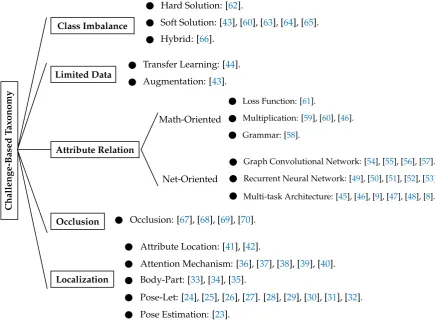
• The recent literature on HAR has been mostly focused in addressing some particular challenges of this problem (such as class imbalance, attribute localization, etc.) rather devising a general HAR system. Therefore, instead of providing a methodological categorization of the literature as in [2], our survey proposes a challenge-based taxonomy, discussing the state-of-the-art solutions and the rationale behind them;
• Contrary to [2], we analyze the motivation of each work and the intuitive reason for its superior performance;
• The datasets main features, statistics and kinds of annotation are compared and discussed in detail;
• Beside the motivations, we discuss HAR applications, divided into three main categories: security, commercial, and related research directions.
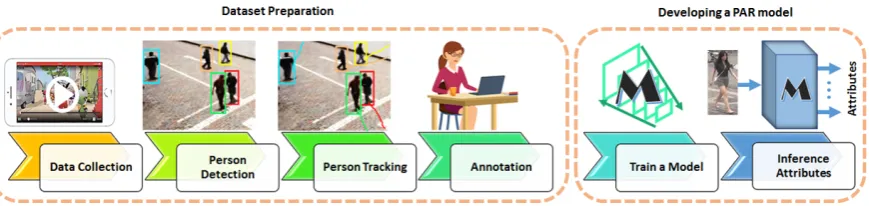
The typical pipeline of the HAR systems is given in Fig.1, which indicates the requirement of a dataset preparation prior to designing a model. As shown in Fig.1, preparing a dataset for this poblem typically comprises four steps:
1. Capturing raw data, which can be accomplished using mobile cameras (e.g., drone) or stationary cameras (e.g., CCTV). Also, the raw data might even be collected from images/videos publicly available (e.g.,Youtube, or similar sources).
2. In most supervised training approaches, HAR models consider one person at a time (instead of analyzing a full-frame with multiple persons). Therefore, detecting the bounding boxes of each subject is essential and can be done by state-of-the-art object detection solutions (i.e., MaskRCNN, YOLO, SSD, etc.)
3. If the raw data is in video format, spatio-temporal information should be kept. in such cases, the accurate tracking of each object (subject) in the scene can significantly ease the annotation process.
4. Finally, in order to label the data with semantic attributes, all the bounding boxes of each individual are displaced to human annotators. based on human perception, the desired labels (e.g., ’gender’ or ’age’) are then associated to each instance of the dataset.
Figure 1.Typical pipeline to develop a HAR model.
not suitable for estimating several attributes. For instance, descriptors suitable for gender recognition could not be effective enough to recognize the hairstyle. Therefore, conventional methods focused on constructing independent feature extractors for each attribute. After the advent of convolutional neural networks(CNNs) and using it as a holistic feature extractor, a growing number of methods focused on models that can estimate multiple attributes at once. Earlier deep-based methods used shallow networks (e.g., 8-layer AlexNet [3]), while later models moved towards deeper architectures (e.g., residual network(ResNet)) [4]. Several major advantages of deep learning approaches moved the main research trend towards the deep neural network methods. First, CNNs are end-to-end (i.e., both the feature extraction and classification layers are trained simultaneously). Second, the deep neural networks’ high generalization ability has provided the possibility of transferring the knowledge of other similar fields to scenarios with limited data. As an example, applying the weights of a model that has been trained on a large dataset (e.g., ImageNet) not only has shown positive effects on the accuracy of the model but also has decreased the convergence time and over-fitting problem [5], [6], [7]. Thirdly, CNNs could be designed to handle multiple tasks and labels in a unified model [8], [9].
Despite the large advances, HAR is still an open problem, mainly due to the high-variability in appearance that intra-class examples possess. Nevertheless, the following factors have been identified as the basis for the development of robust HAR systems:
• learn in an end-to-end manner and yield multiple attributes at once;
• extract a discriminative and comprehensive feature representation from the input data;
• leverage the intrinsic correlations between attributes;
• consider the location of each attribute in a weakly supervised manner;
• are robust to primary challenges such as low-resolution data, pose variation, occlusion, illumination variation, and cluttered background;
• handle the classes imbalance;
• manage the limited-data problem effectively.
1.1. Motivation And Applications
Human attribute recognition methods extract semantic features that describe human-understandable characteristics of the individuals in a scene, either from images or video sequences, ranging from demographic information (gender, age, race/ethnicity), appearance attributes (body weight, face shape, hairstyle and color etc.), emotional state, to the motivation and attention of people (head pose, gaze direction). As they provide vital information about humans, such systems have already been integrated into numerous real-world applications, and are entwined with many technologies across the globe.
not sufficient to uniquely differentiate between individuals. Instead, they are descriptors used by humans to categorize their peers into several classes.
On a top level, HAR applications can be divided into three main categories:security and safety, researchdirections, andcommercial applications.
Yielding high-level semantic information, HAR could provide auxiliary information for different computer vision tasks, such as person re-identification ([16], [17]), human action recognition [18], scene understanding, advanced driving assistance systems, and event detection ([19]).
Another fertile field where HAR could be applied is in human drone surveillance. Drones or Unmanned Aerial Vehicles (UAV), although initially designed for military applications, are rapidly extending to various other application domains, due to their reduced size, swiftness, and ability to navigate through remote and dangerous environments. Researchers in multiple fields have started to use UAVs drones in their research work, and, as a result, the Scopus database has shown an increase in the papers related to UAVs, from 11 (4.7×10⁶of total papers) papers published in 2009 to 851 (270.0×10⁶of total articles) published in 2018 [20]. In terms of human surveillance, drones have been successfully used in various scenarios, ranging from rescue operations and victim identification, people counting and crowd detection, to police activities. All these applications require information about human attributes.
Nowadays, researchers in universities and major car industries work together to design and build the self-driving cars of the future. HAR methods have important implications in such systems as well. Although numerous papers addressed the problem of pedestrian detection, pedestrian attribute recognition is one of the keys to future improvements. Cues about the pedestrians’ body and head orientation provide insights about their intent, and thus avoiding collisions. The pedestrians’ age is another aspect that should be analyzed by advanced driving assistance systems to decrease vehicle speed when children are on the sidewalk. Finally, other works suggest that even pedestrians’ accessories could be used to avoid collisions: starting from the statistical evidence that collisions between pedestrians and vehicles are more frequent on rainy days, in [21] authors suggest that detecting whether a pedestrian has on open umbrella could reduce traffic incidences.
As mentioned above, the applications of biometric cues are not limited to surveillance systems. Such traits have necessary implications also in commercial applications (logins, medical records management) and government applications (ID cards, border, and passport control) [22]. Also, a recent trend is to have advertisement displays in malls and stores equipped with cameras and HAR systems to extract socio-demographic attributes of the audience and present appropriate and targeted ads based on the audience’s gender, generation or age.
Of course, this application list is not exhaustive, and numerous other practical uses of HAR can be envisioned, as this task has implications in all fields interested in and requiring (detailed) human description.
2. Discussion of Sources
Localization Limited Data
Attribute Relation
Occlusion Class Imbalance
Pose Estimation: [23].
Pose-Let: [24], [25], [26], [27]. [28], [29], [30], [31], [32]. Body-Part: [33], [34], [35].
Attention Mechanism: [36], [37], [38], [39], [40]. Attribute Location: [41], [42].
Augmentation: [43]. Transfer Learning: [44].
Multi-task Architecture: [45], [46], [9], [47], [48], [8]. Recurrent Neural Network: [49], [50], [51], [52], [53]. Graph Convolutional Network: [54], [55], [56], [57]. Grammar: [58].
Multiplication: [59], [60], [46]. Loss Function: [61].
Net-Oriented Math-Oriented
Hard Solution: [62].
Soft Solution: [43], [60], [63], [64], [65].
Hybrid: [66].
Challenge-Based
T
axonomy
Occlusion: [67], [68], [69], [70].
Figure 2.Proposed Taxonomy for main challenges in HAR.
2.1. Localization Methods
Analyzing human full-body images only yields the global features; therefore, to extract distinct features from each identity, analyzing local regions of the image becomes important [71]. To capture the human fine-grained features, typical methods divide the person’s image into several strides or patches and aggregate all the decisions on parts to yield the final decision. Further, decomposition of human-body and comparing it with others is intuitively similar to localizing the semantic body-parts and then describing them. Although the extracted localized features create a detailed feature representation of the image, dividing the image to several pieces has several drawbacks:
• the expressiveness of the data is lost (e.g., when processing a jacket only by several parts, some global features that encode the jacket’s shape and structure are ignored).
• as the person detector cannot always provide aligned and accurate bounding boxes, rigid partitioning methods are prone to error in body-part captioning, mainly when the input data includes a wide background.
• different from gender and age, most human attributes (such as glasses, hat, scarf, shoes, etc.) belong to small regions of the image; therefore, analyzing other parts of the image is unnecessary and may add irrelevant features to the final feature representation of the image.
• some attributes are view-dependent and highly changeable due to human body-pose, and ignoring them reduces the model performance; for example, glasses recognition in the side-view images is more laborious than front-view, while it may be impossible in back-view images.
view-specific attributes. Some methods develop attention modules to find the relevant body parts, while some approaches extract various pose-lets[73] of the image by slicing-window detectors. Using the semantic attributes as a constraint for extracting the relevant regions is another solution to look for localized attributes [42]. Moreover, developing accurate body-part detectors and introducing datasets with part annotations are two strategies that can help the localization methods. In the following, we review the literature of HAR methods based on parts-localization and discuss their effectiveness in improving the baseline performance.
2.1.1. Pose Estimation-Based Methods
Considering the effect of the body-pose variation of the feature representation, [72] proposes to learn multiple attribute classifiers so that each of them is suitable for a specific body-pose. Therefore, authors use the Inception architecture [74] as the backbone feature extractor, followed by three branches to capture the specific features of the front, back, and side views of the individuals. Simultaneously, a view-sensitive module analyzes the extracted features from the backbone to refine each branch’s scores. The final results are the concatenation of all the scores. Ablation studies on the PETA dataset show that a plain Inception model achieves an 84.4F1-score, while for the model with a pose-sensitive module, this metric increases to 85.5.
[23] is another research that takes advantage of pose estimation for improving the performance of pedestrian attribute recognition. In this work, Li et al. suggested a two-stream model whose results are fused, allowing the model to benefit from both regular global and pose-sensitive features. Given an input image, the first stream extracts the regular global features. The pose-sensitive branch comprises three steps: 1) coarse pose estimator (body-joint coordinates predictor) by applying the approach proposed in [75], 2) region localization that uses the body-pose information to spatially transform the desired region, originally proposed in [76], 3) fusion layer that concatenates the features of each region. In the first step, pose coordinates are extracted to be shared with the second module, in which body parts are localized by using spatial transformer networks [77]. A specific classifier is then trained for each region. Finally, the extracted features from both streams are concatenated to return a comprehensive feature representation of the given input data.
2.1.2. Pose-Let-Based Methods
The main idea of pose-let based methods is to provide a bag-of-features from the input data using different patching technique. As earlier methods lacked accurate body part detectors, overlapping patches of the input images were used to extract local features.
[27] is one of the first techniques in this group that uses Spatial Pyramid Representation (SPR) [78] to divide the images into grids. Unlike a standard bag-of-features method that extracts the features from a uniform patching distribution, they suggest a recursive splitting technique, in which each grid has a parameter that is jointly learned with the weight vector. Intuitively, the spatial grids are varying for each class, which leads to better feature extraction.
In [24], hundreds of pose-lets are detected from the input data; a classifier is trained for each pose-let and semantic attribute. Then, another classifier aggregates the body-part information, with emphasis on the pose-lets taken from usual viewpoints that have discriminative features. A third classifier is then used to consider the relationship between the attributes. This way, by using the obtained feature representation, the body pose and viewpoint are implicitly decomposed.
In [28], the authors targeted the human attributes and action recognition from still images. To this end, supposing that the available human bounding boxes are located in the center of the image, the model learns the scale and positions of a series of image partitions. Later, the model predicts the labels based on the reconstructed image from the learned partitions.
To address the large variation in articulation, angle, and body-pose [30] proposes a CNN-based features extractor, in which each pose-let is fed to an independent CNN. Then, a linear SVM classifier learns to distinguish the human attributes based on the aggregation between the full-body and pose-let features.
[31] and [32] showed that not only CNNs can yield a high-quality feature representation from the input, but also they are better at classification than SVM classifiers. In this context, Zhu et al. propose to predict multiple attributes at-once, by implicit regard to the attribute dependencies. Therefore, the authors divide the image into 15 static patches and analyze each one with a separate CNN. To consider the relationship between attributes and patches, they connect the output of some specific CNNs to the relevant static patches. For example, the upper splits of the images are connected to the head and shoulder’s attributes.
[29] claims that in previous pose-let works, the location information of the attributes is ignored. For example, to recognize whether a person wears a hat or not, knowing that this feature is related to the upper regions of the image can guide the model to extract more relevant features. To implement this idea, the authors used an Inception [74] structure, in which the features of three different levels (low, middle, and high levels) are fed to three identical modules. These modules extract different patches from the whole and part of the input feature maps. The aggregation of the three branches constructs the final feature representation. By following this architectural design, the model implicitly learns the regions related to each attribute in a weakly supervised method. Surprisingly, the baseline (the same implementation without the proposed module) achieves better results on the PETA dataset (84.9 vs. 83.4 ofF1), while on RAP dataset, the results of the model equipped with their proposed module (F168.6) is better with a margin of 2.
[26] receives the full frames and uses the scene features (i.e., hierarchical contexts) to help the model learn the attributes of the targeted person. For example, in a sports scene, it is expected that people have sporty style clothing. Using Fast R-CNN [79], the bounding box of each individual is detected, and several pose-let are extracted. After feeding the input frame and its Gaussian pyramids into several convolutional layers, four fully connected branches are added to the top of the network to yield four scores (from human bounding box, pose-lets, nearest neighbors of the selected parts, and full-frame) for a final concatenation.
2.1.3. Part-Based Methods
Extracting discriminative fine-grained features often requires first to localize patches of the relevant regions in the input data. Unlike pose-let-based methods that detect the patches from the entire image, part-based methods aim to learn based on accurate body parts (i.e., head, torso, arms, and legs). Optimal part-based models are 1) pose sensitive (i.e., for similar poses, shows strong activations), 2) extendable to all samples, 3) discriminative on extracting features. CNNs can handle all these factors to some extend, and [33] empirical experiments confirm that for deeper networks, accurate body-parts are less significant.
Later, in this context [33] proposes a model composed of a CNN-based body-part detector, including an SVM classifier (trained on the full-body and body parts, i.e., head, torso, and legs) to predict the human attributes and action. Given an input image, a Gaussian pyramid is constructed, each level is fed to several convolutional layers to produce pyramids of feature maps. The convolution of each feature-level with each body-part produces scores correspond to that body-part. Therefore, the final output is a pyramid of part model scores suitable for learning an SVM classifier. The experiments indicate that using body-part analysis and making the network deeper improve the results.
As earlier part-based methods used separate feature extractors and classifiers, the parts could not be optimized for recognizing the semantic attributes. Moreover, the detectors, at that time, were inaccurate in detection. Therefore, [34] proposed an end-to-end model, in which the body partitions are generated based on the skeleton information. As authors augment a large skeleton estimation dataset (MPII[81]) for human skeleton information (which is less prone to error for annotation in comparison with bounding box annotations for body parts), their body detector is more accurate in detecting the relevant partitions, leading to better performance.
To encode both global and fine-grained features and implicitly relate them to the specific attributes, [82] proposes to add several branches on top of a ResNet50 network, such that each branch explores particular regions of the input data and learns an exclusive classifier. Meanwhile, before the classifier stage, all branches share a layer, which passes the 6 static regions of features to the attribute classifiers. For example, the head attribute classifier is fed only with the two upper strips of the feature maps. Experimental results on the Market-1501 dataset [17] show that applying a layer that feeds regional features to the related classifiers can improve the mAfrom 85.0 to 86.2. Further, repeating the experiments while adding a branch to the architecture of the model for predicting the person ID (as an extra-label) improves themAresult from 84.9 to 86.1. These experiments show that simultaneous ID prediction without any purpose could slightly diminish the accuracy.
2.1.4. Attention Based Methods
By focusing on the most relevant regions of the input data, human beings recognize the objects and their attributes without the background’s interference. For example, when recognizing the head-accessories attributes of an individual, special attention is given to the facial region. Therefore, many HAR methods have attempted to implement an attention module to be inserted at multiple levels of CNN. Attention heat maps are colorful localization score maps that make the model interpretable and are usually faded over the original image to show the model’s ability to focus on the relevant regions.
In order to eliminate the need for body-part detection and prior correspondence among the patches, [36] proposed to refine the Class Activation Map network [83], in which the relevant regions of the image to each attribute are highlighted. The model comprises a CNN feature extraction backbone with several branches on its top, which yield the scores for all the attributes and their regional heat maps. The fitness of the attention heat maps is measured using an exponential loss function, while the score of the attributes is derived from a classification loss function. The evaluation of the model is performed using two different convolutional backbones (i.e., VGG16 [84] and AlexNet [3]), and the result for the deeper network (VGG16) is better than the other one.
To extract more distinctive global and local features, Liu et al. [37] propose an attention module that fuses several feature layers of the relevant regions and yields attention maps. To take full advantage of the attention mechanism, they apply the attention module to different model levels. Obtaining the attentive feature maps from various layers of the network means that the model has captured multiple levels of the input sample’s visual patterns so that the attention maps from higher blocks can cover more extensive regions, and the lower blocks focus on smaller regions of the input data.
using the ground truth landmarks to learn the functional parts of the clothes and 2) use a bottom-up, top-down network [85], in which a successive down and up-sampling are performed on the attention maps to learn the global attention. The evaluation results of their model for clothing attribute prediction improved the counterpart methods by a large margin (30% to 60% top-5 accuracy on the DeepFashoin-C dataset [86]).
With a view to select the discriminative regions of the input data, [38] proposes a model considering three aspects: 1) Using the parsing technique [87], they split features of each body-part and help the model learns the location-oriented features by pixel-to-pixel supervision. 2) Multiple attention maps are assigned to each label due to empowering the features from the relevant regions to that label and suppressing the other features. Different from the previous step, the supervision in this module is performed on the image-level. 3) Another module learns the relevant regions for all the attributes and learns from a global perspective. The quantitative results on several datasets show that the full version of the model improves the plain model’s performance slightly (e.g., for the RAP dataset, the F1 metric improves from 79.15 to 79.98).
[40] is another research that has focused on localizing the human attributes engaging multi-level attention mechanisms in full-frame images. First, supervised coarse learning is performed on the target person, in which the extracted features of each residual block is multiplied by the ground truth mask. Then, inspired by [88], to further boost the attribute-based localization, an attention module uses the labels to refine the aggregated features of multiple levels of the model.
To alleviate the complex background and occlusion challenges in HAR, [89] introduces a coarse attention layer that uses the multiplication between the output of the CNN backbone and ground truth human masks. Further, to guide the model to consider the semantic relationships among the attributes, authors use a multi-task architecture with a weighted loss function. This way, the CNN learns to find the relevant regions to the attributes in the foreground regions. Their ablation studies show that considering the correlation between attributes (multi-task learning) is more effective than coarse attention on the foreground region, although both improve the model performance.
2.1.5. Attribute Based Methods
Noticing the effectiveness of the additional information (e.g., pose, body-part and viewpoint) in the global feature representation, [41] introduces a method that improves the localization ability of the model by locating the attributes’ regions in the images. The model comprises two branches, one of them extracts the global features and provides the CAMs [90] (attention heat-maps), and the other one uses [91] to produce some regions of interests (RoI) for extracting the local features. To localize each attribute, the authors consider regions with high overlap between the CAMs and RoIs as the attribute location. Finally, the local and global features are aggregated using an element-wise sum. Their ablation studies on the RAP dataset show that for the model without localizationF1 metric is about 77%, while the full-version model improves the results to about 80%.
As a weakly supervised method, [42] aims to learn the regions in the input data related to the specific attributes. Thereby, the input image is fed into a BN-Inception model [92], and the features from three levels of the model (low, mid, and high) are concatenated together to be ready for three separate localization process. The localization module is built from a SE-Net [93] (that considers the channel relationships) proceeded with a Spatial Transformer Network (STN) (that performs conditional transformations on the feature maps) [77]. The training is weakly supervised because instead of using the ground truth coordinates of the attribute region, the STN is treated as a differentiable RoI pooling layer that is learned without box annotations. TheF1 metric on the RAP dataset for BN-Inception plain model is around 78.2 while this number fro the full version of the model is 80.2.
to the final classification layers) to capture both the low-level and high-level features. Intuitively, the implicit location of each attribute is learned in a weakly supervised manner.
2.2. Limited Data
Although deep neural networks are powerful in the attribute recognition task, an insufficient amount of data causes an early overfitting problem and hinders them from extracting a generalized feature representation from the input data. Meanwhile, the deeper the networks are, the more data are required to learn a wide range of layer weight parameters. The primary solutions for solving the problem fo limited data are synthesizing artificial samples or augmenting the original data. One of the popular approaches for increasing the size of the dataset is to use generative models (i.e., Generative Adversarial Network(GAN)[94], Variational Auto-Encoders (VAE) [95], or a combination of both [96]). These models are powerful tools for producing new samples, but are not widely used for extending human full-body datasets for three reasons: 1) Performance of the generative models is still unsatisfactory, 2) The generated data is unlabelled, 3) Not only learning high-quality generative models for human full-body takes too much time, but it also requires large amount of high-resolution learning data, which is yet not available. Therefore, researchers [97], [64], [98], [99], [100], [82], [30] mostly either perform transfer learning to capture the useful knowledge of large datasets or resort to the simple yet useful label-persevering augmentation techniques from basic data augmentation (flipping, shifting, scaling, cropping, resizing, rotating, shearing, zooming, etc.) to more sophisticated methods such as random erasing [101] and foreground augmentation [102].
Data Augmentation. In this context, Bekele et al. [97] studied the effectiveness of 3 basic data augmentation techniques on their proposed solution and observed that theF1 score is improved from 85.7 to 86.4 for an experiment on the PETA dataset. Further, [43] discussed that ResNets could take advantage of the skipped connections to avoid overfitting. Their experimental results on the PETA dataset confirm the superiority of ResNets without augmentation over the SVM-based and plain CNN models.
Transfer Learning. In clothing attribute recognition, some works may deal with two domains (types of images): 1) in shop images that are high-quality in specific poses; 2) in-the-wild images that vary in the pose, illumination, and resolution. To address the problem of limited labeled data, we can transfer the knowledge of one domain to the other domain. In this context, inspired by curriculum learning, Dong et al. [44] suggest a two-step framework for curriculum transfer of knowledge from shop clothing images to in-the-wildsimilarclothing images. To this end, they train a multi-task network with easy samples (in-shop) and copy its weights to a triplet-branch curriculum transfer network. At first, these branches have identical weights; however, in the second training stage (with harder examples), the feature similarity values between the target and the positive branches become larger than between the target and negative branches. The ablation studies confirm the effectiveness of the authors’ idea and show that the mean average (mA) improved from 51.4 to 58.8 for plain multi-task and proposed model, respectively, on the Cross-Domain clothing dataset [103]. Moreover, this work indicates that curriculum learning versus end-to-end learning achieves better results, with 62.3 and 64.4 ofmA, respectively.
2.3. Attributes Relationship
the correlation among the attributes there are several possibilities such as using multi-task architecture [89], multi-label classification with weighted loss function [104], Recurrent Neural Networks (RNN) [51], Graph Convolutional Network (GCN) [56]. We have classified them into two main groups:
• Network-Oriented methods that take advantage of the various implementation of convolutional layers/blocks to discover the relation between attributes,
• math-oriented methods that may or may not extract the features using CNNs, but perform some mathematical operations on the features to modify them regarding the existing intrinsic correlations among the attributes.
In the following, we discuss the literature of both categories.
2.3.1. Network-Oriented Attribute Correlation Consideration
A) Multi-task Learning. Network-Oriented Attribute Correlation ConsiderationIn [9], Lu et al. discuss that the intuition-based design of multi-task models is not an optimal solution for sharing the relevant information over multiple tasks, and they propose to gradually widen the structure of the model (add new branches) using an iterative algorithm. Consequently, in the final architecture, correlated tasks share most of the convolutional blocks together, while uncorrelated tasks will use different branches. Evaluation of the model on the fashion dataset [86] shows that by widening the network to 32 branches, the accuracy of the model cannot compete with other counterparts; however, the speed increases (from 34msto 10ms) and the number of parameters decreases from 134 million to 10.5 million.
In a multi-task attribute recognition problem, each task may have a different convergence rate. To alleviate this problem and jointly learn multiple tasks, [45] proposes a weighted loss function that updates the weights for each task in the course of learning. The experimental evaluation on the Market-1501 dataset [17] shows an improvement in accuracy from 86.8% to 88.5%.
In [47] and [48], the authors study the multi-task nature of PAR and attempt to build an optimal grouping of the correlated tasks, based on which they share the knowledge between tasks. The intuition is that, similar to the human brain, the model should learn more manageable tasks first and then uses them for solving more complex tasks. The authors claim that learning correlated tasks needs less effort, while uncorrelated tasks require specific feature representations. Therefore, they apply a curriculum learning schedule to transfer the knowledge of the easier tasks (strongly correlated) to the harder ones (weakly correlated). The baseline results show that learning the tasks individually yields 71.0% accuracy on the SoBiR dataset [105], while this number for learning multiple tasks at once is 71.3% and for a curriculum-based multi-task model is 74.2%.
Considering HAR as a multi-task problem, [8] proposes to improve the model architecture in terms of feature sharing between tasks. Authors claim that by learning a linear combination of features, the inter-dependency of the channels is ignored, and the model cannot exchange spatial information. Therefore, after each convolutional block in the model, they insert a shared module between tasks to share the information. This module considers three aspects: 1) fusing the features of each two tasks together, 2) generating attention maps regarding the location of the attributes [106], and 3) keeping the effect of the original features of each task. Ablation studies over this module’s positioning indicate that adding it at the end of the convolutional blocks yields the best results. However, the performance is approximately stable when different branches of the module (one at a time) are ablated.
B) RNN.In [50], authors discuss that person re-id focuses on the global features, while attribute recognition relies on local aspects of individuals. Therefore, Liu et al. [50] propose a network consisted of three parts that work together to learn the person’s attributes and re-identification (re-id). Further, to capture the contextual spatial relationships and focus to the location of each attribute, they use the RNN-CNN backbone feature extractor followed by an attention model.
pipeline and forgets the uncorrelated features. In this work, the authors first detect three-body pose-lets based on the skeleton information. They consider the full-body as another pose-let followed by several fully connected layers to produce several groups of features (for each attribute, one group of features). Each group of features is passed to an LSTM block, followed by a fully-connected layer. Finally, the concatenation of all features is considered as the final feature representation of the input image. Considering that LSTM blocks are successively connected to each other, they carry the useful information of previous groups of features to the next LSTM. The ablation study in this work shows that the plain Inception-v3 on PETA dataset attains 85.7 ofF1 metric, and adding LSTM blocks on top of the baseline improves its performance to 86.0, while the full version of the model that processes the body-parts achieves toF1 86.5.
Regarding the functionality of RNN in contextual combinations in the sequenced data, [53] introduces two different methods to localize the semantic attributes and capture their correlations implicitly. In the first method, the input image’s extracted features are divided into several groups; then, each group of features is given to an LSTM layer followed by a regular convolution block and a fully connected layer, while all the LSTM layers are connected together successively. In the second method, all the extracted features from the backbone are multiplied (spatial point-wise multiplication) by the last convolution block’s output to provide global attention. The experiments show that dividing the features into groups from global to local features yields better results than random selection.
Inspired by image-captioning methods, [49] introduced a Neural PAR that converts attributes recognition to the image-captioning task. To this end, they generated sentence vectors to describe each pedestrian image using a random combination of attribute-words. However, there are two major disruptions in designing an image-caption architecture for attribute classification: 1) variable length of sentences (attribute-words) for different pedestrians and 2) finding relevance between attributes vectors and spatial space. To address these challenges, the authors used RNNs units and lookup-table, respectively. how much they improved the results in comparison with a plain network? how they implemented this idea?
To deal with low-resolution images, Wang et al. [51] formulated the PAR task as a sequential prediction problem, in which a two-step model is used to encode and decode the attributes for discovering both the context of intra-individual attributes and the inter-attribute relation. To this end, Wang et al. took advantage of LSTMs in both encode and decode steps for different purposes, such that in the encoding step the context of the intra-person attributes is learned, while in the decoding step, LSTMs is utilized to learn the inter-attributes correlation and predict the attributes as a sequence prediction problem. how much they improved the results in comparison with a plain network?
C) GCN.In [56], Li et al. introduce a sequential-based model that relies on two graph convolutional networks, in which the semantic attributes are used as the nodes of the first graph, and patches of the input image are used as the nodes of the second graph. To discover the correlation between regions and semantic attributes, they embedded the output of the first graph as the extra inputs into the second graph and vise versa (the output of the second graph is embedded as the extra inputs into the first graph). To avoid a closed loop in the architecture, they defined two separate feed-forward branches, such that the first branch receives the image patches and presents the spatial context representation of them. This representation is then mapped into the semantic space to produce the features that capture the similarity between regions. The second branch input is semantic attributes that are processed using a graph network and mapped into spatial graphs to capture the semantic-aware features. The output of both branches is fused to let and end-to-end learning. The ablation studies show that in comparison with a plain ResNet50 network, theF1 results could improve by margins of 3.5 and 1.3 for the PETA and RAP datasets, respectively.
the attributes. To produce the human parsing results, they apply a residual block that uses both the original features and the output of the graph convolution in the previous branch. Based on the ablation study, a plain ResNet50 on the PETA dataset achieves aF1 score of 85.0, while a model based on body parts yields aF1 score of 84.4, and this number for the model equipped with the above-mentioned idea is 87.9.
Tan et al. [57] observed the close relationship between some of the human attributes and claimed that in multi-task architectures, the final loss function layer is the critical point of learning, which may not have sufficient influence for obtaining a comprehensive representation for explaining the attribute correlations. Moreover, the limitation in receptive fields of CNNs [107] hinders the model’s ability to effectively learn the contextual relations in the data. Therefore, to capture the structural connections among attributes and contextual information, the authors use two Graph Convolutional Networks (GCN) [108]. However, as image data is not originally structured as graphs, they use the extracted attribute-specific features (each feature corresponds to one attribute) from a ResNet backbone to construct the first graph. For the second graph, clusters of regions (pixels) in the input image are considered as the network nodes. The clusters are learned using the share ResNet backbone –with the previous graph). Finally, the outputs of both graph-based branches are averaged. As LSTM also considers the relationship between parts, authors have replaced their proposed GCNs with LSTMs in the model and observed a slight drop in the model’s performance. The ablation strides on three pedestrian datasets show that theF1 metric performance of a vanilla model improves with a margin of 2.
[54] recognized the clothing style by mixing extracted features from the body parts. They applied a graph-based model with Conditional Random Fields (CRFs) to explore the correlation between clothes attributes. Specifically, using the weighted sum of body-part features, they trained an SVM for each of the attributes and used CRF to learn the relationships between attributes. By training the CRF with output probability scores from SVM classifiers, the attributes’ relationship is explored. Although using CRFs was successful in this work, there are yet some disadvantages: a) due to extensive computational cost, CRFs is not an appropriate solution when a broad set of attributes are considered, and b) CRFs cannot capture the spatial relation between attributes[56] c) models can not simultaneously optimize classifiers and CRFs [56], so it is not useful in an end-to-end model.
2.3.2. Math-Oriented Attribute Correlation Consideration
A) Grammar. In [58], Park et al. addressed the need for an interpretable model that can jointly yield the body-pose information (body joints coordinates) and human semantic attributes. To this end, authors implemented an and-or grammar model, in which they integrated three types of grammars: 1) simple grammars that break down the full-body into smaller nodes; 2) dependency grammar that indicates which nodes (body parts) are connected to each other and models the geometric articulations; 3) attribute grammar that assigns the attributes to each node. The ablation studies for attribute prediction showed that the performance is better if the best pose estimation for each attribute is used for predicting the corresponding attribute score.
In order to mitigate the correlation between the visual appearance and the semantic attributes, [60] uses a fusion attention mechanism and provides a balanced-weight between the image-guided and attribute-guided features. First, attributes are embedded in a latent space with the same dimension of the image features. Next, a nonlinear function is applied to the image features to obtain its feature distribution. Then, the image-guided features are obtained via an element-wise multiplication between the feature distribution of the image and the embedded attribute features. To obtain the attribute-guided features, they embed the attributes to a new latent space; next, the results of the element-wise multiplication between image features and embedded attribute features are considered as the input of a nonlinear function, for which its output provides attribute-guided features. Meanwhile, to consider the class imbalance, authors use the focal loss function to train the model. The ablation study shows that theF1 metric performance of the baseline on the PETA dataset is 85.6, which improves to 85.9 when the model is equipped with the above-mentioned idea.
In [46], authors propose a multi-task architecture, in which each attribute corresponds to one separate task. However, to consider the relationship between attributes, both the input image and category information are projected into another space, where the latent factors are disentangled. By applying the element-wise multiplication between the feature representation of the image and its class information, the authors define a discriminant function. When using it, a logistic regression model can learn all the attributes simultaneously. To show the efficiency of the methods, authors evaluate their proposed approach in several attribute datasets of animals, objects, and birds.
C) Loss Function.Li et al. [61] discussed the attribute relationships and introduced two models to demonstrate the effectiveness of their idea. Considering HAR as a binary classification problem, the authors constructed a plain multi-label CNN that predicts all the attributes at-once. They also equipped the previous model with a weighted-loss function (cross-entropy), in which each attribute classifier has a specific weight to update the network weights for the next epoch. The experimental results on the PETA dataset with 35 attributes indicated that weighted cross-entropy loss function could improve the accuracy prediction in 28 attributes and increase themAby 1.3 percent.
2.4. Occlusion
In HAR, occlusion is a primary challenge, in which parts of the useful information of the input data may be covered with other subjects/objects. As this situation is likely to occur in real-world scenarios, it is necessary to be handled. In the context of person re-id, [109] claims that constructing the occluded body parts could improve the results, and in the HAR context, [69] suggests that using sequences of pedestrian images somehow alleviates the occlusion problem.
Considering the low-resolution images and partial occlusion of the pedestrian’s body, [68] proposed to manipulate the dataset with occurring frequent partial occlusions and degraded the resolution of the data. Then, the authors trained a model to reconstruct the images with high resolution and do not suffer from occlusion. This way, the reconstruction model will help to manipulate the original dataset before training a classification model. As reconstruction is performed with a GAN, the generated images are different from the original annotated dataset and somehow lost part of the annotations, which degrade the overall performance of the system compared to when one uses the original dataset for training. However, the ablation study in this paper shows that if two identical classification networks are separately trained on corrupted and reconstructed data, the performance of the model that learns from the reconstructed data is better with a high margin.
To address the challenge of partial occlusion, [98] and [69] adopted video datasets for attributes recognition as often occlusions are a temporary situation. [98] divided each video clip to several pieces and extracted a random frame from each piece to create a new video clip with a few frame length. The final recognition confidence of each attribute is obtained by aggregating the recognition probability on the selected frames.
2.5. Classes Imbalance
The existence of large differences between the number of samples for each attribute (class) is known as data class imbalance. Generally, in multi-class classification problems, the ideal scenario would be to use the same amount of data for each class, in order to preserve the learning importance of all the classes at the same level. However, the classes in HAR datasets are naturally imbalanced since the number of samples of some attributes (e.g., wearing skirts) are lower than others (e.g., wearing jeans). Large class imbalance causes over-fitting in classes with limited data, while classes with a large number of samples need more training epochs to converge. To address this challenge, some methods attempt to balance the number of samples in each class as a pre-processing step [111], [112], [113], which are calledhard solutions. Hard solutions are classified into three groups: 1) up-sampling the minority classes, 2) down-sampling the large classes, and 3) generating new samples. On the other hand,soft solutionsare interested in handling the data class imbalance by introducing new training methods [65] or novel loss functions, in which the importance of each class is weighted based on the frequencies of the data [114], [115], [116]. Furthermore, the combination of both solutions has been the subject of some studies [66].
2.5.1.HardSolutions
The earlier hard solutions are focused either on interpolation between the samples [117], [118], or clustering the dataset and oversampling by cluster-based methods [119]. The primary way of up-sampling in deep learning is to augment the existing samples –as discussed in section2.2. However, excessive up-sampling may lead to over-fitting when the classes are highly imbalanced. Therefore, some works down-sample the majority classes [120]. Random down-sampling may be an easy choice, but [121] proposes to use the boundaries among the classes to remove redundant samples. However, loss of information is an inevitable part of down-sampling, as some samples are removed, which may carry useful information.
To address these problems, Fukui et al. [62] designed a multi-task CNN, in which classes (attributes) with fewer samples are given more importance in the learning phase. The batch of samples in conventional learning methods are selected randomly; therefore, the rare examples are less likely to be in the mini-batch. Meanwhile, data augmentation cannot be sufficient for balancing the dataset as ordinary data augmentation techniques generate new samples regardless of their rarity. Therefore, Fukui et al. [62] defines a rarity rate for each sample in the dataset and perform the augmentation for rare samples. Later, from the created mini-batches, those with appropriate sample balance are selected for training the model. The experimental results on a dataset with four attributes show a slight improvement in the average recognition rate, though the superiority is not consistent for all the attributes.
2.5.2. Soft Solutions
As previously mentioned, soft solutions focus on boosting the learning methods’ performance, rather than merely increasing/decreasing the number of samples. Designing loss functions is a popular approach for guiding the model to take full advantage of the minority samples. For instance, [60] proposes the combination of focal loss [122] and cross-entropy loss functions to introduce a focal cross-entropy loss function (see section2.3.2for the analytical review over [60]).
sampling strategy and loss weights. It was argued that providing balanced distribution from a highly imbalanced dataset (using sampling strategies) for the whole learning process may cause the model to disregard the samples with most variations (i.e., classes with majority samples) and only emphasizes on the minority class. Moreover, the weighted terms in loss functions play an essential role in the learning process. Therefore, both the classification loss (often cross-entropy) and metric learning loss (which aims to learn feature embedding for distinguishing between samples) should be handled based on their importance. To consider these aspects, authors defined two schedules, one for adjusting the sampling strategy by re-ordering the data from imbalanced to balanced and easy to hard; and the other curriculum schedule handles the loss importance between classification and distance metric learning. The ablation study in this work showed that the sampling scheduler could increase the results of a baseline model form 81.17 to 86.58, and adding loss scheduler to it could improve the results to 89.05.
To handle the class imbalance problem, [63] modifies the focal loss function [122] and apply it for an attention-based model to focus on the hard samples. The main idea is to add a scaling factor to the binary cross-entropy loss function to down-weight the effect of easy samples with high confidence. Therefore, the hard misclassified samples of each attribute (class) add larger values to the loss function and become more critical. Considering the usual weakness of attention mechanism that does not consider the location of an attribute, the authors modified the attention masks in multiple levels of the model using attribute confidence weighting. Their ablation studies on the WIDER dataset [26] with ResNet-101 backbone feature extractor [110] showed the plain model achieves mA 83.7 and applying the weighted focal loss function improve the results to 84.4 while adding the multi-scale attention increased it to 85.9.
2.5.3. Hybrid Solutions
Hybrid approaches use the combination of the above-mentioned techniques. Performing data augmentation over the minority classes and applying a weighted loss function or a curriculum learning strategy are examples of hybrid solutions for handling the class data imbalance. In [66], the authors discuss that learning from an unbalanced dataset leads to biased classification, with higher classification accuracy over the majority classes and lower performance over the minority classes. To address this issue, Chawla et al. [66] proposed an algorithm that focuses on difficult samples (misclassified). To implement this strategy, the authors took advantage of [117], which generates new synthetic instances in each training iteration from the minority classes. Consequently, the weights for the minority samples (false negatives) are increased, which improves the model’s performance.
2.6. Part-Based And Attribute Correlation-Based Methods
"Whether considering a group of attributes together improve the results of an attribute recognition model or not?" is the question that [124] tries to answer by addressing the correlation between attributes using a Conditional Random Field (CRF) strategy. Concerning the calculated probability distribution over each attribute, all the Maximum A Posterioris (MAPs) are estimated, and then, the model searches for the most probable mixture in the input image. To also consider the location of each attribute, authors extract the part patches based on the bounding box around the full-body, as in fashion datasets pose variations are not significant. A comparison between several simple baselines shows that the CRF-based method (0.516F1 score) works slightly better than a localization-based CNN (0.512F1 score) on the Chictopia dataset [125], while a global-based CNNF1 performance is 0.464.
2.7. Category-Based Performance Comparison
recent years, which indicates that extracting distinctive fine-grained features from relevant locations of the given input images is the most important aspect of HAR models.
Despite the early works that analyzed the human full-body data in different locations and situations, recent works have focused on attribute recognition from surveillance data, which arouses some privacy issues.
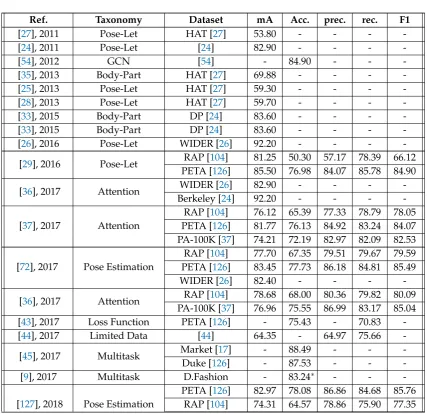
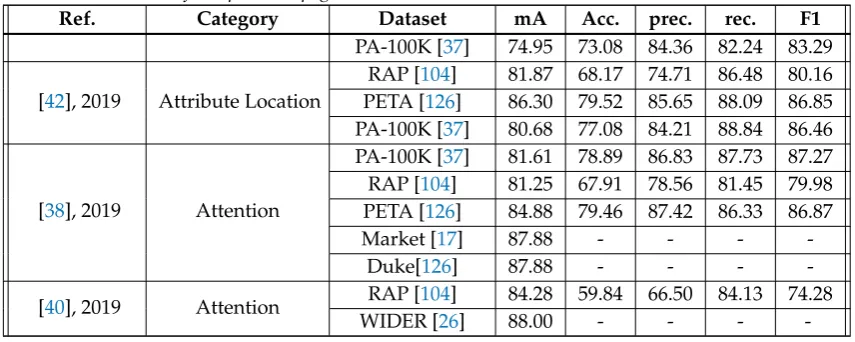
Appearing comprehensive evaluation metrics is another noticeable change over the last decade. Due to the intrinsic, large class imbalance in the HAR datasets,mAcannot provide a comprehensive performance evaluation over different methods. Suppose that in a binary classification situation, if 99% of the samples belong to persons with glasses and 1% of samples belong to persons without glasses, the model can recognize all the test samples as persons with glasses and still has 99% of accuracy in recognition. Therefore, for a fair performance comparison with the state of the arts, it is necessary to consider metrics such asPrec,Rec,Acc, andF1 – which are discussed in section4.
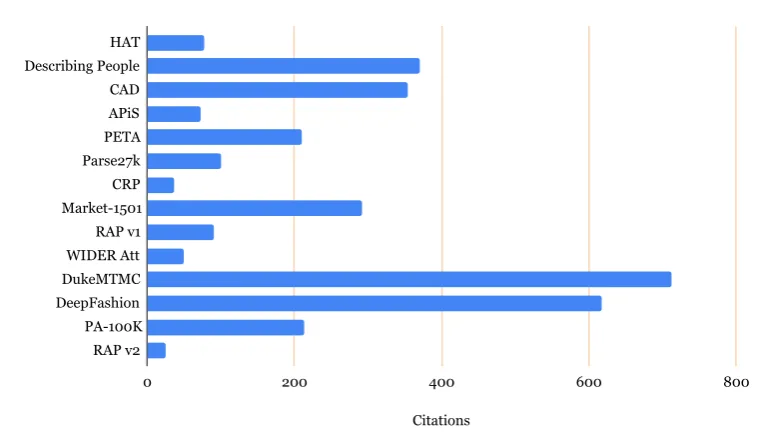
Table1also shows that RAP and PETA datasets have attracted the most attention in the context of attribute recognition –which excludes person re-id.
Last but not least, we observe that the performance of the state of the arts is yet far from the reliable range to be used in forensic affairs and enterprises, and it requires more attention in both introducing novel datasets and proposing robust methods.
Table 1.Performance comparison of HAR approaches over the last decade for different benchmarks.
Ref. Taxonomy Dataset mA Acc. prec. rec. F1
[27], 2011 Pose-Let HAT [27] 53.80 - - -
-[24], 2011 Pose-Let [24] 82.90 - - -
-[54], 2012 GCN [54] - 84.90 - -
-[35], 2013 Body-Part HAT [27] 69.88 - - -
-[25], 2013 Pose-Let HAT [27] 59.30 - - -
-[28], 2013 Pose-Let HAT [27] 59.70 - - -
-[33], 2015 Body-Part DP [24] 83.60 - - -
-[33], 2015 Body-Part DP [24] 83.60 - - -
-[26], 2016 Pose-Let WIDER [26] 92.20 - - -
-[29], 2016 Pose-Let RAP [104] 81.25 50.30 57.17 78.39 66.12 PETA [126] 85.50 76.98 84.07 85.78 84.90
[36], 2017 Attention WIDER [26] 82.90 - - -
-Berkeley [24] 92.20 - - -
-[37], 2017 Attention
RAP [104] 76.12 65.39 77.33 78.79 78.05 PETA [126] 81.77 76.13 84.92 83.24 84.07 PA-100K [37] 74.21 72.19 82.97 82.09 82.53
[72], 2017 Pose Estimation
RAP [104] 77.70 67.35 79.51 79.67 79.59 PETA [126] 83.45 77.73 86.18 84.81 85.49
WIDER [26] 82.40 - - -
-[36], 2017 Attention RAP [104] 78.68 68.00 80.36 79.82 80.09 PA-100K [37] 76.96 75.55 86.99 83.17 85.04 [43], 2017 Loss Function PETA [126] - 75.43 - 70.83 -[44], 2017 Limited Data [44] 64.35 - 64.97 75.66
-[45], 2017 Multitask Market [17] - 88.49 - -
-Duke [126] - 87.53 - -
-[9], 2017 Multitask D.Fashion - 83.24∗ - -
-[127], 2018 Pose Estimation
Table 1 –Continued from previous page
Ref. Category Dataset mA Acc. prec. rec. F1
PA-100K [37] 74.95 73.08 84.36 82.24 83.29
[42], 2019 Attribute Location
RAP [104] 81.87 68.17 74.71 86.48 80.16 PETA [126] 86.30 79.52 85.65 88.09 86.85 PA-100K [37] 80.68 77.08 84.21 88.84 86.46
[38], 2019 Attention
PA-100K [37] 81.61 78.89 86.83 87.73 87.27 RAP [104] 81.25 67.91 78.56 81.45 79.98 PETA [126] 84.88 79.46 87.42 86.33 86.87
Market [17] 87.88 - - -
-Duke[126] 87.88 - - -
-[40], 2019 Attention RAP [104] 84.28 59.84 66.50 84.13 74.28
WIDER [26] 88.00 - - -
-3. Datasets
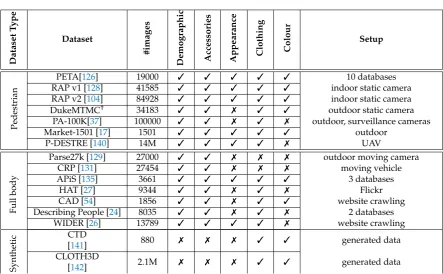
As opposed to other surveys, instead of merely enumerating the datasets, in this manuscript, we discuss the advantages and drawbacks of each dataset, with emphasis on data collection methods/software. Finally, we discuss the intrinsically imbalanced nature of HAR datasets and other challenges that arise when gathering data.
PETA dataset
PEdesTrianAttribute (PETA) [126] dataset combines 19000 pedestrian images gathered from 10 publicly available datasets; therefore the images present large variations in terms of scene, lighting conditions and image resolution. The resolution of the images varies from 17×39 to 169×365 pixels. The dataset provides rich annotations: the images are manually labeled with 61 binary and 4 multi-class attributes. The binary attributes include information about demographics (gender:Male, age:Age16-30, Age31-45,Age46-60, AgeAbove61), appearance (long hair), clothing (T-shirt, Trousersetc.) and accessories (Sunglasses, Hat, Backpacketc.). The multi-class attributes are related to (eleven basic) color(s) for the upper-body and lower-body clothing, shoe-wear, and hair of the subject. When gathering the dataset, the authors tried to balance the binary attributes; in their convention, a binary class is considered balanced if the maximal and minimal class ratio is less than 20:1. In the final version of the dataset, more than half of the binary attributes (31 attributes) have a balanced distribution.
RAP dataset
Currently, there are two versions of the RAP (RichlyAnnotatedPedestrian) dataset. The first version, RAP-v1 v1 [128] was collected from a surveillance camera in shopping malls over a period of three months; next, 17 hours of video footage were manually selected for attribute annotation. In total, the dataset comprises 41585 annotated human silhouettes. The 72 attributes labeled in this dataset include demographic information (genderandage), accessories (backpack, single shoulder bag, handbag, plastic bag, paper bagetc.), human appearance (hair style, hair color, body shape) and clothing information (clothes style, clothes color, footware style, footware coloretc.). In addition, the dataset provides annotations about occlusions, viewpoints and body-parts information.
Parse27k dataset
Pedestrian attribute recognition in sequences (Parse27k) dataset [129] contains over 27000 pedestrian images, annotated with 10 attributes. The images were captured by a moving camera across a city environment; every 15thvideo frame was fed to the Deformable Part Model(DPM) pedestrian detector [130] and the resulting bounding boxes were annotated with the 10 attributes based on binary or multinomial propositions. As opposed to other datasets, the authors also included an N/A state (i.e. the labeler cannot decide on that attribute). The attributes from this dataset include gender information (3 categories:male, female, N/A), accessories (Bag on Left Shoulder, Bag on Right Shoulder Bag in Left Hand, Bag in Right Hand, Backpack; each with three possible states:yes, no, N/A), orientation (with4 + N/Aor8 + N/Adiscretizations) and action attributes:posture(standing, walking, sittingandN/A) andisPushing (yes, no, N/A). As the images were initially processed by a pedestrian detector, the images of this dataset consist of a fixed-size bounding region of interest, and thus are strongly aligned and contain only a subset of possible human poses.
CRP dataset
CRP (CaltechRoadsidePedestrians) [131] dataset was captured in real world conditions, from a moving vehicle. The position (bounding-box) of each pedestrian, together with 14 body joints are annotated in each video frame. CRP comprises 4222 video tracks, with 27454 pedestrian bounding boxes. The following attributes are annotated for each pedestrian: age ( 5 categories:child,teen,young adult,middle agedandsenior), gender (2 categories:femaleandmale), weight (3 categories:Under,Healthy andOver), and clothing style (4 categories: casual,light athletic, workoutanddressy). The original, un-cropped videos together with the annotations are publicly available.
Describing People dataset
Describing People dataset [24] comprises 8035 images from the H3D [73] and the PASCAL VOC 2010 [132] datasets. The images from this database are aligned, in the sense that for each person, the image is cropped (by leaving some margin) and then scaled so that the distance between the hips and the shoulders is 200 pixels. The dataset features 9 binary (True/False) attributes, as follows: gender (is male), appearance (long hair), accessories (glasses) and several clothing attributes (has hat, has t-shirt, has shorts, has jeans, long sleeves, long pants). The dataset was annotated on Amazon Mechanical Turk by five independent labelers; the authors considered a valid label if at least four of the five annotators agreed on its value.
HAT dataset
HumanATtributes (HAT) [27,80] contains 9344 images gathered from Flickr; for this purpose, the authors used more than 320 manually specified queries to retrieve images related to people and then, employed an off-the-shelf person detector to crop the humans in the images. The false positives were manually removed. Next, the images were labeled with 27 binary attributes; these attributes incorporate information about the gender (Female), age (Small baby, Small kid, Teen aged, Young (college), Middle Aged, Elderly), clothing (Wearing tank top, Wearing tee shirt, Wearing casual jacket, Formal men suit, Female long skirt, Female short skirt, Wearing short shorts, Low cut top, Female in swim suit, Female wedding dress, Bermuda/beach shorts), pose (Frontal pose, Side pose, Turned Back), Action (Standing Straight, Sitting, Running/Walking, Crouching/bent, Arms bent/crossed) and occlusions (Upper body). The images have high variations both in image size and in the subject’s position.
WIDER dataset
attributes are indistinguishable; the human bounding boxes from these images are annotated with 14 attributes. The images contain multiple humans under different and complex variations. For each image, the authors selected a maximum of 20 bounding boxes (based on their resolution), so in total, there are more than 57524 annotated individuals. The attributes follow a ternary taxonomy: positive, negative and unspecified, and include information about age (Male), clothing (Tshirt, longSleeve, Formal, Shorts, Jeans, Long Pants, Skirt), accessories (Sunglasses, Hat, Face Mask, Logo), appearance (Long Hair). In addition, each image is annotated into one of 30 event classes (meeting, picnic, parade, etc.), thus allowing to correlate the human attributes with the context they were perceived in.
CAD dataset
ClothingAttributesDataset [54] uses images gathered from the website Sartorialist1and Flikcr. The authors downloaded several images, mostly of pedestrians, and applied an upper-body detector to detect humans; they ended up with 1856 images. Next, the ground truth was established by labelers from Amazon Mechanical Turk. Each image was annotated by 6 independent individuals, and a label was accepted as ground truth if it has at least 5 agreements. The dataset is annotated with the gender of the wearer, information about the accessories (Wearing scarf, Collar presence, Placket presence) and with several attributes regarding the clothing appearance (clothing pattern, major color, clothing category, neckline shapeetc.)
DukeMTMC dataset
DukeMTMC-reid (Multi-Target,Multi-Camera) dataset [134] was collected in Duke’s university campus and contains more than 14 hours of video sequences gathered from 8 cameras, positioned such that they capture crowded scenes. The main purpose of this dataset was person re-identification and multi-camera tracking; however, a subset of this dataset was annotated with human attributes. The annotations were provided at the identity level, and they included 23 attributes, regarding the gender (male, female), accessories: wearing hat (yes, no), carrying a backpack (yes, no), carrying a handbag (yes, no), carrying other types of the bag (yes, no), and clothing style: shoe type (boots, other shoes), the color of shoes (dark, bright), length of upper-body clothing (long, short), 8 colors of upper-body clothing (black, white, red, purple, gray, blue, green, brown) and 7 colors of lower-body clothing (black, white, red, gray, blue, green, brown). Due to violation of civil and human rights, as well as privacy issues, since June 2019, Duke University has terminated the DukeMTMC dataset page.
PA-100K dataset
PA-100k dataset [37] was developed with the intention to surpass the existing HAR datasets both in quantity and in diversity; the dataset contains more than 100000 images captured in 598 different scenarios. The dataset was captured by outdoor surveillance cameras; therefore, the images provide large variance in image resolution, lighting conditions, and environment. The dataset is annotated with 26 attributes, including demographic (age, gender), accessories (handbag, phone) and clothing information.
APiS dataset
TheAttributedPedestrians inSurveillance dataset [135] gathers images from four different sources: KITTI database [136], CBCL Street Scenes [137]2, INRIA database [138] and some video sequences collected by the authors at a train station; in total APiS comprises 3661 images. The human bounding boxes are detected using an off-the-shelf pedestrian detector, and the results are manually processed by the authors: the false positives and the low-resolution images (smaller than
1 https://www.thesartorialist.com/
90 pixels in height and 35 pixels in width) are discarded. Finally, all the images of the dataset are normalized in the sense that the cropped pedestrian images are scaled to 128×48 pixels. These cropped images are annotated with 11 ternary attributes (positive, negative, and ambiguous) and 2 multi-class attributes. These annotations include demographic (gender) and appearance attributes (long hair), as well as information about accessories (back bag, S-S (Single Shoulder) bag, hand carrying) and clothing (shirt, T-shirt, long pants, M-S (Medium and Short) pants, long jeans, skirt, upper-body clothing color, lower-body clothing color). The multi-class attributes are the two attributes related to the clothing color. The annotation process is performed manually and divided into two stages: annotation stage (the independent labeling of each attribute) and validation stage (which exploits the relationship between the attributes to check the annotation; also, in this stage, the controversial attributes are marked as ambiguous).
Market-1501. dataset
Market-1501 attribute [17,139] dataset is a version of the Market-1501 dataset augmented with the annotation of 27 attributes. Market-1501 was initially intended for cross camera person re-identification, and it was collected outdoor in front of a supermarket using 6 cameras (5 high-resolution cameras and one low resolution). The attributes are provided at the identity level, and in total, there are 1501 annotated identities. In total, the dataset has 32668 bounding boxes for these 1501 identities. The attributes annotated inMarket-1501 attributeinclude demographic information (gender and age), information about accessories (wearing hat, carrying backpack, carrying bag, carrying handbag), appearance (hair length) and clothing type and color (sleeve length, length of lower-body clothing, type of lower-body clothing, 8 color of upper-body clothing, 9 color of lower-body clothing).
3.1. Fashion Datasets
DeepFashion dataset
[86] The dataset was gathered from shopping websites, as well as image search engines (blogs, forums, user-generated content). In the first stage, the authors downloaded 1320078 images from shopping websites and 1273150 images from Google images. After a data cleaning process, in which duplicate, out-of-scope, and low-quality images were removed, 800000 clothing images remained to construct the DeepFashion dataset. The images are annotated solely with clothing information; these annotations are divided into categories (50 labels: dress, blouse, etc.) and attributes (1000 labels: adjectives describing the categories). The categories were annotated by expert labelers, while for the attributes, due to their huge number, the authors resorted to meta-data annotation (provided by Google search engine or by the shopping website). In addition, a set of clothing landmarks, as well as their visibility, are provided for each image.
DeepFashion is split into several benchmarks for different purposes: category and attribute prediction (classification of the categories and the attributes), in-shop clothes retrieval (determine if two images belong to the same clothing item), consumer-to-shop clothes retrieval (matching consumer images to their shop counterparts) and fashion landmark detection.
3.2. Aerial Datasets
Over recent years, as their cost has diminished considerably, UAVs applications extended rapidly in various surveillance scenarios. As a response, several UAVs datasets have been collected and made publicly available to the scientific community. Most of them are intended for human detection [143,144], action recognition [145] or re-identification [146].