IJEDR
1401054
International Journal of Engineering Development and Research ( www.ijedr.org)313
Embedded Car Security System
1
M.Sunitha,
2V.Vinay kumar,
3G.Raghu
1M.Tech (Embedded systems), 2Associate.Proffesor, 3M.Tech, Department of ECE, CVSR College of Engineering,JNTU Hyderabad.
___________________________________________________________________________________________________________________
Abstract—Main aim of the system is to provide the security to vehicle. If the vehicle is stolen, this system is designed to retrieve the
position of the vehicle and the vehicle thief. There are two types of security systems are using 1) Face recognition using MAT Lab 2) Radio frequency identification (RFID). The proposed Embedded Car Security System captures the image using a camera which will be hidden in the dash board. Face Detection Algorithm is used to detect the face. A database is created by taking the pictures of all the family members. A minimum of ten photos of each family member is taken. This captured image is compared with the already present database using PCA algorithm. Once the captured face matches with the already present database Micro controller will allow user to swipe the RFID card, after swiping if the card matches it will display a message on the LCD saying that person is recognized, it is clear that the vehicle is not stolen and one of the family members is using the vehicle. A message is sent to the owner of the vehicle stating “Match Found”. Otherwise, if the captured face and RFID card does not match with the database then the processor activates the GPS module and the GSM module. Using the GPS module the location of the vehicle is found out. This location is sent through the GSM module to the owner of the vehicle. Also along with the location, the image of the driver is sent through MMS to the owner.
Keywords - Face Detection System(FDS), Principle Component Analysis(PCA), RFID, Short Message Service(SMS), Global System for Mobile(GSM)
I. INTRODUCTION
With the development and applications of many embedded techniques, car security system design and analyses are constantly improving. Many new techniques, such as biometric recognition technique, image processing technique, communication technique and so on, have been integrated into car security systems. At the same time, the amount of accident of cars still remains high, specially, lost. So, one practicable car security system should be efficient, robust and reliable.
So in this paper, security system involves face recognition using PCA algorithm which is cost effective. Database consists of several images of the user. PCA algorithm compares the new image with the pre-defined images in the database. If the new image matches with any of the image in the database then the car remains running. But if the image mismatch occurs, then the car will get stopped immediately. The microcontroller module can stop the car once it gets information that the car is being driven by an unauthenticated person.The GSM module can send the information out to the user by SMS.
All processes are controlled by “8051” controller central module including face recognition, making the car to stop, sending SMS, communicating with subsystems.
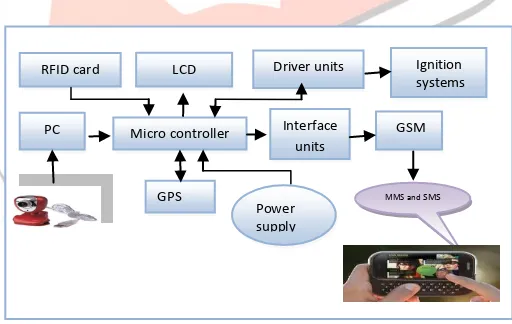
Figure 1 Configuration of Embedded Smart Car Security System
Fig1. Show the block diagram representation of the embedded smart car security system. The central module is microcontroller. It controls GSM module through PC and Motor through relay. Motor will be running until the relay is closed circuit. When face recognition algorithm results in unauthorized image then information is sent to the controller through RS232 cable. Controller makes the relay as open circuit and motor will get stopped. GSM module sends a message to user to indicate that the car has been stopped.
II. EXISTING SYSTEM
Traditional car security systems rely on many sensors. Door sensor senses the locking and unlocking of the door. If any duplicate key is used, it sends the appropriate signal to the controller. But if the key is designed in similar to that of the original key, then the sensor fails to differentiate. Engine sensor senses the start and stop of the engine. Surveillance pad is carried by the owner to monitor the car which consists of RF receiver, processing unit, alarm and display. But, the surveillance pad should be carried by the owner wherever he goes.
The use of engine sensor and door sensor make the system more complicated which costs high. When one car is really lost, no more feedback could be valid to help people to find it back. Other existing technologies do not guarantee a 100% recovery rate.
Interface units GSM Ignition systems GPS Driver units Power supply Micro controller
MMS and SMS
LCD RFID card
IJEDR
1401054
International Journal of Engineering Development and Research ( www.ijedr.org)313
In the earlier systems alarms were used where if the intruder enters the car, the alarm produces sound but the car safety is not assured and also once the car is lost it cannot be assured that we can get back the car. The alarm made by the car remains unnoticed and this is major cause for the car theft.III. FACE RECOGNITION ALGORITHM
A facial recognition system is a computer application for automatically identifying or verifying a person from a digital image or a video frame from a video source. One of the ways to do this is by comparing selected facial features from the image and facial database. Face recognition has become a popular area of research in computer vision and one of the most successful applications of image analysis and understanding. Facial recognition algorithms identify faces by extracting features from an image of the person. For example, an algorithm may analyse the relative position, size, and/or shape of the eyes, nose, cheekbones, and jaw. These features are then used to search for other images with matching features. Earlier Face Recognition Algorithms used simple geometric models but the face recognition process has now matured into a science of sophisticated mathematical representations and matching processes.
Face recognition systems have been grabbing high attention from Commercial market point of view as well as pattern recognition field. Face recognition has received substantial attention from researches in Biometrics, pattern recognition field and computer vision communities. The face recognition systems can extract the features of face and compare this with the existing database. The faces considered here for comparison are still faces. Machine recognition of faces from still and video images is emerging as an active research area. The Face recognition system detects only the faces from the image scene, extracts the descriptive features. It later compares with the database of faces, which is collection of faces in different poses.
IV. PCA ALGORITHM
The Principal Component Analysis (PCA) is one of the most successful techniques that have been used in image recognition and compression. PCA is a statistical method under the broad title of factor analysis. The purpose of PCA is to reduce the large dimensionality of the data space (observed variables) to the smaller intrinsic dimensionality of feature space (independent variables), which are needed to describe the data economically. This is the case when there is a strong correlation between observed variables.
The functions of PCA are prediction, redundancy removal, feature extraction, data compression, etc. Because PCA is a classical technique which can do something in the linear domain, applications having linear models are suitable, such as signal processing, image processing, system and control theory, communications, etc.
Principal component analysis or simply “PCA”, is a method used for the statistical pattern analysis in data, and expressing the data in such a way as to highlight the similarities and dissimilarities. Since patterns in the data can be hard to find in data of high dimensions, where the luxury of the graphical representation is not available, PCA is a powerful tool for analyzing the data. The other main advantage of the PCA is that, the data can be compressed without much loss of information by reducing the dimensions and identifying the patterns in the data. This technique is used in the image compression and image recognition.
V. MATHEMATICAL ANALYSIS FOR PCA
Create Eigen face Eigenspace is calculated by identifying the eigenvectors of the covariance matrix derived from a set of training images. The eigenvectors corresponding to non-zero eigen values of the covariance matrix form an orthonormal basis that rotates and/or reflects the images in the N-dimensional space. Specifically, each image is stored in a vector of size N.
(1)
1. Center data: Each of the training images must be centered. Subtracting the mean image from each of the training images centers the training images as shown in
equation (2). The mean image is a column vector such that each entry is the mean of all corresponding pixels of the training images.
Where
2. Create data matrix: Once the training images are centered, they are combined into a data matrix of size NxP, where P is the number of training images and each Column is a single image as shown in (3).
3. Create covariance matrix: The data matrix is multiplied by its transpose to create a covariance matrix as shown in (4).
4. Compute the eigenvalues and eigenvectors: The eigenvalues and corresponding eigenvectors are computed for the covariance matrix.
Here V is the set of eigenvectors associated with the eigenvalues.
5. Order eigenvectors: Order the eigenvectors according to their corresponding eigenvalues from high to low. Keep only the eigenvectors associated with non-zero eigenvalues. This matrix of eigenvectors is the
Eigenspace V, where each column of V is an eigenvector.
IJEDR
1401054
International Journal of Engineering Development and Research ( www.ijedr.org)314
VI. HARDWARE SPECIFICATIONA. Microcontroller
Micro controller Based Circuitry is the BRAIN in our system. This is a circuitry which contains a microcontroller. This microcontroller is fed with the program containing the logic required to control motor of the car. The microcontroller we have implied here is Atmel’s 89C51.
AT89C51 microcontroller is selected because it is a powerful microcomputer which has low power consumption and provides a highly flexible and cost-effective solution to many embedded control applications. It has 8K bytes of in-system reprogrammable flash memory, 256 bytes of internal RAM, 32 programmable I/O lines, three 16 bit timers/counters, eight interrupt sources and a programmable serial channel.
B. Motor
The motor used here is DC brushless motor of model AF B0612EH with the rating of DC-12v, 0.48A.
Since brushless DC motor is used some of the problems of the brushed DC motor are eliminated in the brushless design. In this motor, the mechanical "rotating switch" or commutator/brush gear assembly is replaced by an external electronic switch synchronised to the rotor's position. Brushless motors are typically 85–90% efficient or more, efficiency for a brushless electric motor, of up to 96.5% was reported whereas DC motors with brush gear are typically 75–80% efficient. The DC motor is connected to write pin (P3.6) at port 3 of MCU.
C. GSM Modem
Images is Unauthorised
Read N images from database
I=1
Start
Convert 2D into 3D Image
i=i+1
Images is authorised Is i<N?
Is Eu< Threshold Mean is calculated
Standard deviation is calculated
Covariance Matrix is Computed
Eigen value and Eigen vector are computed
Euclidean distance (Eu) is calculated
Stop
Yes No
Yes
IJEDR
1401054
International Journal of Engineering Development and Research ( www.ijedr.org)315
A wireless link between the FDS and MCU is provided with Nokia 12i GSM module. Nokia 12i offers advance GSM connectivity and supports EDGE/GPRS and HSCSD with automated GSM connection establishment It is equipped to provide reliable remote connections and offers application level watchdogs, inbuilt self check mechanisms and a reliable Virtual Machine (VM) for JAVATM. Nokia 12i also supports reliable inbuilt internet protocols: TCP/IP for reliable data transfer, UDP/IP for audio and video streaming and HTTP for accessing web pages. The module can also be connected to an external GPS device that supports National Marine Electronics Association (NMEA) standard. The inbuilt NMEA parser can parse the location data from the output that it receives from the GPS device. External microcontroller can use AT commands to communicate with Nokia 12i and simple remote I/O applications can easily be controlled via text messages.VII. RESULTS
Experimental results of PCA are shown in Fig 4&5 and Fig 5 depicts the authentication of the user. Fig 4.a depicts GUI (Graphical User Interface) where input image loaded is shown here.
VIII. CONCLUSION
The image-recognition technique that can provide the important functions required by advanced intelligent Car Security, to avoid vehicle theft and protect the usage of unauthenticated users was implemented. Thus if an unauthenticated person tries to steal the car, the embedded controller platform stops the car immediately. GSM module will send the intimation to the user as soon as the car gets stopped.
REFERENCES
[1] Jian Xiao and Haidong Feng, “A Low-Cost Extendable Framework For Embedded Smart Car Security System,” proceedings of 2009 IEEE International Conference on Networking, Sensing and Control, Okayama, Japan, March 26-29,2009.
[2] Joseph A. O'Sullivan, Robert Pless, “Advances in Security Technologies: Imaging, Anomaly Detection, and Target and Biometric Recognition”, Microwave Symposium IEEE/MTT-S International Volume, pp.761 – 764, 2007.
[3] M.Turk and A.Pentland, “Face Recognition using Eigen Faces,” in proc. Cvpr, 1991, pp. 586-591
[4] S. Ajaz, M. Asim, M. Ozair, M. Ahmed, M. Siddiqui, Z. Mushtaq, “Autonomous Vehicle Monitoring & Tracking System,” SCONEST 2005, pp. 1 – 4, 2005.
IJEDR
1401054
International Journal of Engineering Development and Research ( www.ijedr.org)316
[7] Available [online] : www.8051projects.com[8] Available [online] : www.keil.com/uvision [9] Available [online] : www.alldatasheets.co
BIOGRAPHIE