O R I G I N A L R E S E A R C H
The Long Noncoding RNA Blnc1 Protects Against
Diet-Induced Obesity by Promoting Mitochondrial
Function in White Fat
This article was published in the following Dove Press journal: Diabetes, Metabolic Syndrome and Obesity: Targets and Therapy
Shengjie Tang Weifen Zhu Fenping Zheng Weiwei Gui Wenjing Zhang Xihua Lin Hong Li
Department of Endocrinology, The Affiliated Sir Run Run Shaw Hospital, Zhejiang University, School of Medicine, Hangzhou 310016, Zhejiang, People’s Republic of China
Introduction:Long noncoding RNAs (lncRNAs) play critical regulatory roles in metabolic disorder. Whereas, the regulatory role of lncRNAs in mitochondrial function of white adipose tissue (WAT) is unknown.
Materials and Methods:We investigated the role of Blnc1 in metabolic homeostasis and mitochondrial function of C57BL/6 mice fed a high-fat diet (HFD) for 12 weeks, followed by multi-point injection of adenovirus carrying Blnc1 into epididymal fat (eWAT). In vitro, mitochondrial biogenesis and function were analyzed in 3T3-L1 pre-adipocytes with Blnc1 overexpression or knockdown. Mechanically, RNA immunoprecipitation (RIP) and chroma-tin immunoprecipitation (ChIP) were used to highlight the molecular mechanism of Blnc1 in pre-adipocytes.
Results: Gross eWAT weight was significantly decreased and insulin resistance was improved in HFD-Ad-Blnc1 mice. Mitochondrial biosynthesis was induced by Blnc1 in eWAT, as evidenced by an increased mitochondrial DNA and enhanced Mito-tracker stain-ing. The expression of mitochondria-related genes was increased in eWAT, hepatic fatty acid oxidation was upregulated, and lipid deposition was reduced in HFD-Ad-Blnc1 mice. Knockdown of Blnc1 in 3T3-L1 pre-adipocytes resulted in mitochondrial dysfunction. The mechanistic investigation indicated that Blnc1 stimulated the transcription of Pgc1β via decoying hnRNPA1.
Conclusion: Therefore, eWAT-specific overexpression of Blnc1 improves hepatic steatosis and systemic insulin sensitivity, likely by enhancing mitochondrial biogenesis and function. Keywords:lncRNA-Blnc1, mitochondria, white adipose tissue, obesity, ribonucleoprotein,
Pgc1β
Introduction
Obesity is a global public health issue and acts as an important risk factor for chronic diseases such as type 2 diabetes, non-alcoholic fatty liver disease
(NAFLD), cardiovascular disease, and cancer.1 Indeed, the global prevalence of
obesity has almost tripled since 1975. In 2016, more than 1.9 billion adults were
overweight; of them, over 650 million were obese.2
Long noncoding RNA (lncRNAs), as non-protein coding transcripts of >200
nucleo-tides, are key regulators of gene expression and cellular physiology.3LncRNAs can be
found in the nucleus or cytosol. LncRNAs play important roles in chromatin modifi
ca-tion, transcriptional regulaca-tion, ribonucleoproteins, microRNA sponges, and mRNA stability.4
Correspondence: Xihua Lin; Hong Li Email [email protected];
Diabetes, Metabolic Syndrome and Obesity: Targets and Therapy
Dove
press
open access to scientific and medical research
Open Access Full Text Article
Diabetes, Metabolic Syndrome and Obesity: Targets and Therapy downloaded from https://www.dovepress.com/ by 118.70.13.36 on 24-Aug-2020
Recent studies have focused on lncRNAs as regula-tors of the endocrine system. Brown fat lncRNA1 (Blnc1) was discovered in a study of the role of
lncRNAs in thermogenic adipocyte differentiation.5
Zbtb7b recruits the Blnc1/heterogeneous nuclear ribonu-cleoprotein U (hnRNPU) complex to activate the
ther-mogenic program in brown adipocytes.6 Blnc1 also
orchestrates adipocyte adaptation to obesity and
main-tains systemic metabolic health.7 In liver tissue, Blnc1
acts as a transcriptional checkpoint to exacerbate insulin
resistance and NAFLD.8
Mitochondria play a vital role in maintaining metabolic
homeostasis in white and brown adipocytes.9 White
adi-pocytes contain fewer and smaller mitochondria than those of brown adipocytes, but they are important in adipogen-esis, adipokine secretion, lipogenadipogen-esis, lipolysis, and other
functions.10 Mitochondrial dysfunction in white
adipo-cytes is associated with metabolic disorders, including
obesity and type 2 diabetes.11Obesity suppresses the
oxi-dative capacity, enhances the production of reactive oxy-gen species, and reduces the amount of mitochondrial
DNA.12
Peroxisome proliferator-activated receptor gamma
coactivator 1 (PGC1) family of transcriptional coactivators
includes Pgc1αand Pgc1β, plays a central role in
regulat-ing mitochondrial biogenesis and function.13 In cardiac
cells, the PGC-1 coactivators interact with nuclear respira-tory factor 1 (NRF1), estrogen-related receptor a(ERRa) and peroxisome proliferator-activated receptor a(PPARa),
leading to stimulate mitochondrial biogenesis.14 In both
white and brown adipocyte differentiation, the expression
of Pgc1αand Pgc1βwas significantly increased along with
the progress.15
Heterogeneous nuclear ribonucleoproteins (hnRNPs) are a large number of RNA-binding proteins associated
with complex and diverse biological processes.16,17 It has
been widely reported that hnRNPA1 is the most abundant and acts as an important modulator in various gene
reg-ulatory networks.18 Moreover, hnRNPA1 regulates the
gene expression and translation of several key factors associated with cell proliferation, metabolism, adaptation to stress.19,20
However, few studies have investigated the regulatory
role of lncRNAs in mitochondrial function in WAT.21We
evaluated the role of lncRNA-Blnc1 in metabolic home-ostasis and its association with mitochondrial function in white fat.
Materials and Methods
Animal Studies and Adenovirus
Administration
Five-week-old male C57BL/6 mice were purchased from the Slack Experimental Animal Center of the Chinese Academy of Sciences. Mice were maintained at 22°C under a 12/12 h light/dark cycle, with ad libitum access to water and stan-dard rodent chow (63.92% carbohydrate, 26.18% protein, and 9.9% fat) or a high-fat diet (HFD; 35% carbohydrate, 20% protein, and 60% fat) for 12 weeks. After 12weeks of
HFD feeding, 2 × 10¹⁰purified adenovirus particles (control
or Blnc1) were multi-point injected into eWAT on both sides.
After 5 weeks, mice were euthanized by CO2asphyxiation
and the injected eWAT was subjected to assay of the expres-sion of Blnc1 and mitochondria-related genes by quantitative real-time PCR (qRT-PCR) and Western blotting. The eWAT, perirenal WAT (prWAT), inguinal subcutaneous WAT (ingWAT), brown adipose tissue (BAT), and liver were
iso-lated, weighed, and stored at−80°C until use. All protocols
for animal use and maintenance were approved by Zhejiang University Animal Care and Use Committee.
In vivo imaging of treated mice was performed using the Xenogen IVIS Lumina imaging system (Caliper). Mice
were anesthetized by isoflurane inhalation for 10 to 15 min
and imaged in an imaging chamber. The photo images were analyzed using Living Image 4.3 software.
Cell Culture
Mouse 3T3-L1 pre-adipocytes were purchased from ATCC
and cultured in Dulbecco’s modified Eagle’s medium
(DMEM) supplemented with 10% fetal bovine serum and penicillin-streptomycin at 37°C in an atmosphere
contain-ing 5% CO2. Pre-adipocytes were plated onto six-well
plates 1 day before transduction with over-Blnc1 adeno-virus or knockdown (KD)-Blnc1 lentiadeno-virus in medium
containing 5μg/mL Polybrene. After 72 h, the cells were
harvested and processed for mitochondrial content and gene expression analysis.
Metabolic Analysis
Intraperitoneal glucose tolerance tests (IPGTTs) and insulin tolerance tests (ITTs) were performed at the end of 5 weeks after adenovirus particles injection, as described previously. For IPGTTs, mice were fasted for 6 h and injected IP with
glucose solution at 2.0 g/kg body weight.22For ITTs, mice
were fasted for 4 h and insulin was administered IP at 1 U/kg
Diabetes, Metabolic Syndrome and Obesity: Targets and Therapy downloaded from https://www.dovepress.com/ by 118.70.13.36 on 24-Aug-2020
body weight. The plasma glucose level was measured at 0, 15, 30, 60, and 120 min after injection.
Assays of Blood Biochemical Parameters
and Serum Insulin and Adiponectin Levels
At the end of 5 weeks after adenovirus particles injection, mice were fasted for 12 h. Blood samples were obtained, allowed to stand at room temperature for 30 min, and centrifuged at 3000 rpm for 10 min at 4°C to obtain serum. The total cholesterol (TC), triglyceride (TG), low-density lipoprotein cholesterol (LDL-c), high-low-density lipo-protein cholesterol (HDL-c), and free fatty acid (FFA) levels were determined using an automatic analyzer (Hitachi 7020, Japan). The non-HDL-c level was
calcu-lated as: non-HDL-c = TC–(HDL-c). The plasma
adipo-nectin level was measured using an enzyme-linked immunosorbent assay kit (FT102, EZassay, China)
accord-ing to the manufacturer’s protocol.
Histological Analysis of eWAT and Liver
Tissue
The eWAT and liver tissue was weighed, fixed, and
sec-tioned at 6 μm thickness. The sections were stained with
hematoxylin and eosin (H&E) and inspected under a light microscope.
Measurement of Hepatic TG and TC
Levels
Hepatic TG and TC levels were measured in frozen liver samples (100 mg). Tissue was mixed with 1 mL of
phos-phate-buffered saline (PBS) and homogenized at
2500 rpm. The supernatant was assayed using a TG and TC kit (Nanjing JianCheng, China) according to the man-ufacturer’s protocol.
Assay of Mitochondrial Function
Mitochondria were assayed in terms of DNA copy number, Mito-tracker staining, and ATP production. For Mito-tracker staining, 3T3-L1 preadipocytes were incubated in
Mito-tracker Red CMXRos solution (final concentration, 25 nM)
for 30 min. The cells were visualized under an inverted
fluorescence microscope (Zeiss, Germany). The eWAT
weighed to a certain weight and fully ground with liquid nitrogen. And pre-adipocytes were collected by trypsin digestion. Then, the eWAT and the pre-adipocytes of total
DNA was isolated according to the manufacturer’s protocol
(QIAamp DNA Mini Kit, Qiagen, Germany). The qRT-PCR
was performed to measure the mitochondrial DNA (mtDNA) copy number by assessing the ratio of mitochondrial to nuclear DNA. The ATP concentration was measured using an ATP Assay Kit (Beyotime Biotechnology, China).
Measurement of the Mitochondrial
Oxygen Consumption Rate
The oxygen consumption rate (OCR) of 3T3-L1 pre-adipocytes was measured using a Seahorse Bioscience
XF-96 extracellular flux analyzer (Seahorse Bioscience,
Billerica, MA, USA), as detailed previously.23,24
Transmission Electron Microscopy (TEM)
3T3-L1 pre-adipocytes (3 × 10⁶) were digested with
tryp-sin, centrifuged at 1000 rpm for 5 min. After washing with
PBS, the cells were fixed in 2.5% glutaraldehyde at 4°C
for 4 h and post-fixed in 1% osmic acid at room
tempera-ture for 1 h. The samples were dehydrated in increasing concentrations of ethanol for 15 min and transferred to absolute acetone for 20 min. After placing in a 1:1 mixture of absolute acetone and embedding agent for 2 h at room temperature, the samples were cut into 70 nm sections using a microtome. Finally, the cellular ultrastructure was visualized by transmission electron microscopy (FEI TecnaiT10).
Quantitative Real-Time PCR
Total RNA was extracted using RNAiso Plus (TaKaRa)
according to the manufacturer’s instructions. Total RNA (1
μg) was reversed-transcribed using the First-Chain cDNA
Synthesis Kit (TaKaRa). Real-time PCR was carried out on a Roche LightCycler 480 PCR System using SYBR Green
Master Mix and gene-specific primers. The 2−ΔΔCT method
was used to analyze relative changes in gene expression normalized to b-actin as the internal control.
Western Blotting
Total protein was isolated from eWAT in lysis buffer for 30 min at 4°C. Protein concentrations were measured using BCA Protein Assay Reagent (P0011, Beyotime Biotechnology,
China). Proteins were transferred to a polyvinylidene difl
uor-ide membrane, blocked with 5% nonfat dry milk in PBS with 0.02% (v/v) Tween-20, and incubated with the primary anti-bodies at 4°C overnight. Next, the membrane was washed and incubated for 1 h at room temperature with a peroxidase-labeled secondary antibody. After washing, protein bands were visualized by electrochemiluminescence (FD8030,
Diabetes, Metabolic Syndrome and Obesity: Targets and Therapy downloaded from https://www.dovepress.com/ by 118.70.13.36 on 24-Aug-2020
FDBio Science, China). The anti-mitochondrial oxidative complex cocktail antibody (ab110413, 1:200 dilution) and anti-hnRNPA1 antibody (sc365486) were obtained from Abcam (Cambridge, UK) and Santa Cruz (USA), respectively. The mouse anti-b-actin antibody (A5441) was purchased from Sigma-Aldrich (St. Louis, MO, USA).
RNA Pulldown Assay
RNA pulldown was performed as described previously.25
The RNA-protein complexes were eluted, resolved by sodium dodecyl sulfate-polyacrylamide gel electrophoresis, and stained with Silver Stain Plus (P0017S, Beyotime
Biotechnology, China). Bands specifically pulled down by
biotinylated Blnc1 were excised from the gel, digested.
RNA Immunoprecipitation
RNA immunoprecipitation (RIP) was performed with a RIP
kit (Millipore, USA) as described previously.26 For
endo-genous RIP assay, anti-hnRNPA1 antibody (sc365486, Santa Cruz, USA) or normal mouse IgG was incubated with magnetic beads for 30 min at room temperature, total cell lysate was added, and the samples were incubated at 4°
C overnight. RNA was extracted, purified using an organic
solvent, and assayed by qRT-PCR using mBlnc1 primers
(forward, 5ʹ-CAAGGAAGTCATGAGCCCAATG-3ʹ and
reverse, 5ʹ-TAAAGGCTTCAACGGTGGCTG-3ʹ).
ChIP Assay
ChIP assay was performed using Simple ChIPTM Enzymatic Chromatin IP Kit (Magnetic Beads) (Cell Signaling
Technology, USA) as previously reported.27In brief, 3T3-L1
pre-adipocytes were cross-link with 1% formaldehyde for 10 min, which was then stopped by incubation with 10 X glycine at room temperature for 5 min. The cell suspension was incubated by Micrococcal nuclease in order to digest the DNA chains into small fragments and sonicated to break the nuclei. The DNA fragments were then incubated with rabbit monoclonal antibody to rabbit polyclonal antibodies to hnRNPA1 (sc365486, Santa Cruz Biotechnology, USA), or control rabbit IgG 4 h to overnight for immunoprecipitation. Chromatin association was measured using qPCR, the forward
and reverse primers were: 5ʹ- CAAGGTACAAGGGAGGCT
GAGAC −3ʹ and 5ʹ- CCCATTGGCCTCCCTTTTCTT −3ʹ
for mouse Pgc1βpromoter.
Statistical Analysis
Data are expressed as means ± standard error of the mean. Statistical analysis was conducted with SPSS version 20.0
software, using one-way analysis of variance (ANOVA) for
multiple group comparisons or Student’st-test for two-group
comparisons. A value of P < 0.05 was taken to indicate statistical significance.
Results
Overexpression of lncRNA-Blnc1 in
eWAT Ameliorates Obesity-Induced
Insulin Resistance
To assess the role of Blnc1 in eWAT in metabolic health, adenovirus particles carrying Blnc1 were multi-point-injected into eWAT on both sides of HFD-induced obese mice. The qRT-PCR and in vivo imaging showed that Blnc1 was overexpressed in eWAT of HFD-Ad-Blnc1-treated mice (Figure 1A and B). Overexpression of Blnc1 tended to
decrease the rate of increase in body weight (Figure S1A)
and the gross eWAT mass (Figure 1C) in HFD-induced
obese mice. The expression of Blnc1 was slightly upregulated
in BAT but was not significantly changed in ingWAT of
HFD-Ad-Blnc1 mice (Figure S1B and C), and the other three
adipose tissues were unchanged (Figure S1D and F). The
blood glucose level was similar in HFD-Ad-Blnc1 mice (Figure 1D). Surprisingly, HFD-Ad-Blnc1 mice exhibited
a significant increase in the plasma adiponectin concentration
(Figure 1E), which is closely related to insulin resistance and crosstalk between WAT and the liver. Furthermore, IPGTTs and ITTs revealed that overexpression of Blnc1 ameliorated obesity-induced glucose tolerance and insulin sensitivity (Figure 1F1,F2,G1,G2).
Meanwhile, Blnc1 activation in eWAT had a slight impact on dyslipidemia in HFD-induced obese mice. Consistent with HFD feeding, the plasma TC and
non-HDL-c levels were significantly lower in HFD-Ad-Blnc1
mice (Figure S2AandB). However, the plasma TG, FFA,
LDL-c, and HDL-c concentrations were not significantly
different between HFD-Ad-GFP and HFD-Ad-Blnc1 mice (Figure S2C–F).
The eWAT-Speci
fi
c Overexpression of
Blnc1 Alleviates the Hepatic Damage
Induced by HFD
We next determined whether eWAT-specific activation of
Blnc1 influenced HFD-induced hepatic steatosis. The liver
mass had a slight difference between Ad-GFP and
HFD-Ad-Blnc1 groups (Figure 2A). However, H&E staining
showed that hepatocytes of HFD-Ad-GFP group contained
Diabetes, Metabolic Syndrome and Obesity: Targets and Therapy downloaded from https://www.dovepress.com/ by 118.70.13.36 on 24-Aug-2020
Figure 1(A) Blnc1 expression in eWAT following infection with Ad-GFP or Ad-Blnc1 adenovirus; (B) tissue distribution of GFP expression; (C) eWAT/body weight (%); (D) blood glucose level; (E) plasma adiponectin concentration; (F1, F2) IPGTTs and AUC of plasma glucose; (G1, G2) ITT and AUC of plasma glucose, IPGTT and ITT were measured in mice fed a HFD for 17 weeks. *p < 0.05, **p < 0.01, ***p < 0.001, NCD vs. HFD-Ad-GFP groups; #p < 0.05, ###p < 0.001, HFD-Ad-GFP vs. HFD-Ad-Blnc1 groups (n = 5).
Diabetes, Metabolic Syndrome and Obesity: Targets and Therapy downloaded from https://www.dovepress.com/ by 118.70.13.36 on 24-Aug-2020
more lipid droplets and exhibited more ballooning-induced
degeneration than those of the NCD group (Figure 2B). The
eWAT-specific activation of Blnc1 alleviated HFD-induced
pathological hepatic steatosis (Figure 2B). The hepatic
trigly-ceride content was significantly reduced in HFD-Ad-Blnc1
mice (Figure 2C), whereas the hepatic TC content was not
different between HFD-Ad-GFP and HFD-Ad-Blnc1 groups (Figure 2D). The hepatic mRNA levels of genes in
adiponec-tin-related pathway—AdipoR2, APPL1, and PPARα were
increased in the liver of HFD-Ad-Blnc1 mice (Figure 2E).
Furthermore, the hepatic mRNA levels of key genes in
fatty-acid oxidation—CPT1α, Acadl, Aox, and Ehhadh—were
sig-nificantly upregulated (Figure 2F).
Overexpression of Blnc1 Reverses
Mitochondrial Dysfunction in Obese Mice
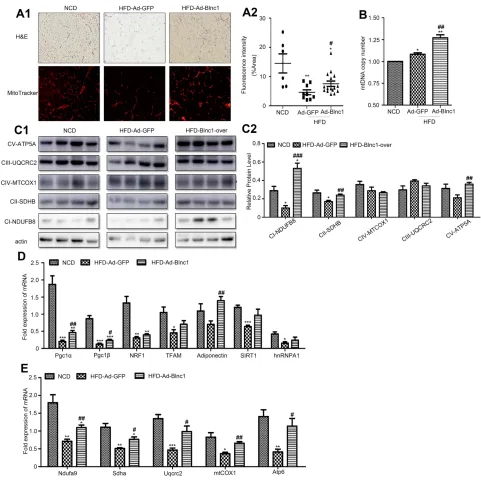
To clarify the mechanism by which overexpression of Blnc1 in eWAT resulted in improvement of systemic metabolic homeostasis, we investigated the structure and function of eWAT. H&E staining suggested that Blnc1 overexpression decreased the size of adipocytes compared with those of
HFD-Ad-GFP mice (Figure 3A1, upper). Mitochondrial
mass was markedly induced by Blnc1 overexpression in eWAT, as determined by increased Mito-tracker staining
and mtDNA content (Figure 3A1 lower, A2, B).
Mitochondrial protein complexes (I–V) of the electron
transport chain (ETC) mediate oxidative phosphorylation.
The expression of genes related to mitochondrial
biosynthesis and function (Pgc1α, Pgc1β, adiponectinand
ETC complexes) was increased in eWAT of HFD-Ad-Blnc1
mice (Figure 3C1,Figure 3C2–E).
Role of Blnc1 in Mitochondrial Biogenesis
and Function in Pre-Adipocytes
Blnc1 overexpression in vivo suggested that Blnc1 of eWAT plays an important role in metabolic homeostasis. Accordingly, the improvement of metabolic health is dependent on WAT mitochondria and its remodeling. To test this hypothesis, we analyzed mitochondrial biogenesis and function in 3T3-L1 pre-adipocytes with Blnc1 over-expression or knockdown.
The mtDNA content was significantly increased in
Blnc1-overexpressing pre-adipocytes (Figure 4A and B).
Consistently, Blnc1 activation upregulated the expression
of mitochondrial biogenesis-related genes, including
Pgc1β, NRF1, hnRNPA1 and adiponectin (Figure 4C).
Furthermore, the mRNA levels of ETC complexes were
increased by Blnc1 overexpression (Figure 4D). To
exam-ine whether Blnc1 affected mitochondrial function in pre-adipocytes, we assayed the ATP level and OCR assay in Blnc1-overexpressing cells. The Blnc1- overexpressing
pre-adipocytes presented a higher ATP level (Figure 4E)
and OCR (Figure 4F), particularly in maximal and spare
respiration capacity (Figure 4G–I).
TEM at magnifications of 2500× and 8300× showed
that Blnc1-overexpressing cells had a greater number of
Figure 2(A) Liver weight (g); (B) H&E staining of liver sections (scale bar = 100μm); (C,F,D) hepatic triglyceride level; (D) hepatic total cholesterol level; and (E,F) hepatic gene expression by qRT-PCR. *p < 0.05, **p < 0.01, ***p < 0.001, NCD vs. HFD-Ad-GFP groups; #p < 0.05, ##p < 0.01, HFD-Ad-GFP vs. HFD-Ad-Blnc1 groups (n = 5).
Diabetes, Metabolic Syndrome and Obesity: Targets and Therapy downloaded from https://www.dovepress.com/ by 118.70.13.36 on 24-Aug-2020
mitochondria, which were elongated and exhibited an increased number of cristae and increased matrix electron
density, compared to Ad-GFP cells (Figure 4J).
Blnc1 knockdown markedly decreased the mtDNA
content (Figure S3AandB) and downregulated the
expres-sion of genes involved in mitochondrial biogenesis (Figure
S3C). Moreover, the expression of genes encoding the
mitochondrial ETC complexes was decreased in the
Blnc1-KD group (Figure S3D). Also, the
Blnc1-knockdown pre-adipocytes exhibited a lower ATP content (Figure S3E). Assay of the OCR (Figure S3F–I) and the
expression of ETC complexes (Figure S3D) showed that
Blnc1 knockdown restored oxygen consumption. By TEM, structural enlargement of the mitochondrial matrix and deformation of cristae were observed in Blnc1-KD
com-pared with KD-NC cells (Figure S3J). Therefore, Blnc1 is
involved in the regulation of mitochondrial biogenesis and function in 3T3-L1 pre-adipocytes.
Figure 3(A1) H&E staining (upper) and mitochondrial staining (Mito-tracker) (lower), 200.; (A2)fluorescence intensity (%); (B) mtDNA content; (C1) protein levels of ETC complexes (ATP5A, UQCRC2, MTCOX1, SDHB, and NDUFB8) and (C2) its semi-quantitative analysis(n = 4); and (D,E) eWAT gene expression by qRT-PCR. *p < 0.05, **p < 0.01, ***p < 0.001, NCD vs. HFD-Ad-GFP groups; #p < 0.05, ##p < 0.01, ###p < 0.001, HFD-Ad-GFP vs. HFD-Ad-Blnc1 groups (n = 5).
Diabetes, Metabolic Syndrome and Obesity: Targets and Therapy downloaded from https://www.dovepress.com/ by 118.70.13.36 on 24-Aug-2020
Figure 4(A) mRNA level of Blnc1 following treatment with Ad-GFP or Ad-Blnc1 adenovirus; (B) mtDNA content of 3T3-L1 pre-adipocytes; (C, D) expression of genes related to mitochondrial biogenesis and function by qRT-PCR; (E) ATP content; and (F–I) OCR. Dotted lines indicate injection of the respiratory inhibitors oligomycin (Oligo), FCCP, and rotenone and antimycin (R&A). (J) Representative TEM images of the mitochondrial ultrastructure of Ad-GFP and Blnc1-overpressing cells. Arrows and squares indicate mitochondria. Scale bars = 2, 1μm. *p < 0.05, **p < 0.01, ***p < 0.001, Ad-GFP vs. Blnc1-over groups.
Diabetes, Metabolic Syndrome and Obesity: Targets and Therapy downloaded from https://www.dovepress.com/ by 118.70.13.36 on 24-Aug-2020
hnRNPA1 Is the Binding Partner of Blnc1
in 3T3-L1 Pre-Adipocytes
RNA pulldown assay was performed to identify the potential mechanism in 3T3-L1 pre-adipocytes. The results of silver-stained gel and Western blotting revealed that Blnc1
inter-acted with hnRNPA1 in pre-adipocytes (Figure 5AandB).
RIP using antibody against hnRNPA1 was performed, indi-cating that Blnc1 was enriched combined with hnRNPA1
comparing with IgG (Figure 5C).
Blnc1 Facilitates Pgc1
β
Transcription via
Decoying hnRNPA1 in 3T3-L1
Pre-Adipocytes
Furthermore, data of qRT-PCR illustrated that Pgc1βmRNA
level was dramatically increased in the Blnc1-overexpression
of eWAT and 3T3-L1 pre-adipocytes (Figures 3Dand4D).
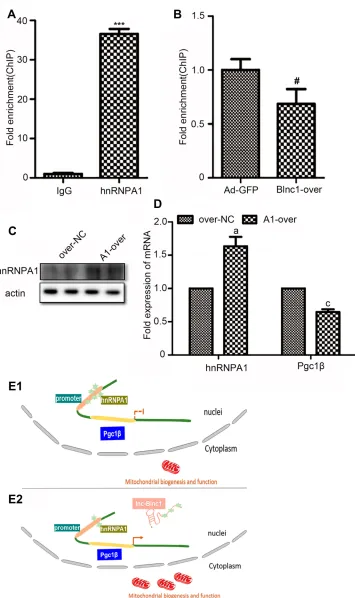
To accurately confirm whether Blnc1 activated the Pgc1β
expression, ChIP of hnRNPA1 protein, followed by
qRT-PCR analysis, revealed substantial enrichment of the Pgc1β
promoter element in pre-adipocytes (Figure 6A). Moreover,
this enrichment was decreased in Blnc1-over 3T3-L1
pre-adipocytes (Figure 6B). And the mRNA expression of Pgc1β
was downregulated in pre-adipocytes of overexpression
hnRNPA1 (Figure 6CandD). Taken together, thesefindings
indicated that Blnc1 activates Pgc1β transcription through
decoying hnRNPA1 (Figure 6E1andE2).
Discussion
Collectively, our results indicated that eWAT-specific
over-expression of Blnc1 ameliorated obesity-induced insulin resistance, partially attenuated systemic dyslipidemia, and markedly improved hepatic steatosis. These results suggested that Blnc1 activation in eWAT may protect against diet-induced obesity by remodeling mitochondrial biogenesis and function in WAT.
While the body weight of GFP and
HFD-Ad-Blnc1 mice was similar (Figure S1A), the eWAT mass was
significantly lower in HFD-Ad-Blnc1 mice (Figure 1C).
Moreover, H&E staining of eWAT and hepatic tissue revealed that cell size and fat accumulation were decreased
in HFD-Ad-Blnc1 mice (Figure 3A1and2B). However, our
findings on the weight and morphology of eWAT were not
consistent with a previous report, in which eWAT mass was
significantly larger in Tg-fat-Blnc1 mice after HFD feeding
Figure 5Silver-stained gel (A) and western blot (B) analysis of 3T3-L1 pre-adipocyte lysate incubated with control and biotinylated Blnc1 samples, which were from the RNA pull down experiment, red arrow indicates Bio-Blnc1 band and molecular weight of hnRNPA1, western blot analysis using the anti-hnRNPA1 antibody; (C) RIP was measured using antibody hnRNPA1 comparing with IgG; *p < 0.05, IgG vs. hnRNPA1 groups.
Diabetes, Metabolic Syndrome and Obesity: Targets and Therapy downloaded from https://www.dovepress.com/ by 118.70.13.36 on 24-Aug-2020
Figure 6(A) ChIP assay was performed to validate the binding with hnRNPA1 at the promoter of Pgc1; (B) ChIP-qPCR analysis of hnRNPA1 in Ad-GFP and Blnc1-over cells; (C)Western blot analysis of pre-adipocytes overexpression hnRNPA1; (D) The mRNA expression of hnRNPA1 and Pgc1β; (E1,E2) Proposed model for the Blnc1 mediated enhancement of Pgc1 transcription. ***p < 0.001, IgG vs. hnRNPA1 groups; #p < 0.05, Ad-GFP vs. Blnc1-over groups;a
p < 0.05,c
p < 0.01, over-nc vs. A1-over groups.
Diabetes, Metabolic Syndrome and Obesity: Targets and Therapy downloaded from https://www.dovepress.com/ by 118.70.13.36 on 24-Aug-2020
for 3 months.7The following may explain the differences. First, different methods were used to overexpress Blnc1 in the target tissue. Second, in the prior study, the HFD feeding was started after Tg-Blnc1 injection and continued for 3 months; here, we injected Ad-Blnc1 adenovirus into obese mice after 12 weeks of HFD feeding.
In our study, obesity-induced hepatic steatosis was
sig-nificantly attenuated in the HFD-Ad-Blnc1 mice (Figure 2).
On this basis, we hypothesized crosstalk between eWAT and
the liver. The eWAT-specific overexpression of Blnc1
increased the plasma adiponectin level (Figure 1E). To
assess the effect on the liver, we assayed the expression of components of the hepatic AdipoR2/PPARa signaling
pathway.28The mRNA levels ofAdipoR2, APPL1, PPARa,
CPT1a, Acadl, Aox, andEhhadhwere significantly
upregu-lated (Figure 2E and F). Thus, amelioration of
obesity-induced hepatic damage was likely related to activation of adiponectin-mediated fatty acid oxidation.
Then, IPGTT and ITT results in this study indicated
that eWAT-specific activation of Blnc1 improved systemic
insulin resistance (Figure 1F and G). Among the serum
lipid parameters, only the plasma TC and non-HDL-c
concentrations were significantly decreased (Figure S2A
and B). The different effects between glucose and lipid
metabolism were likely to relate to the way that Ad-Blnc1 adenovirus infected mice by multi-point injection in eWAT. The method of overexpression of adenovirus lim-ited the higher expression of Blnc1.
A variety of functions have been attributed to mito-chondria, including cytosolic processes, the urea cycle and
regulation of a variety of cell signaling pathways.9
Knockdown of Blnc1 in the 3T3-L1 pre-adipocytes
reduced the mtDNA copy number (Figure S3B), which
was accompanied by decreased expression of
mitochon-dria-related genes (Figure S3CandD); Blnc1
overexpres-sion exerted the opposite effects. Moreover, the changes in
the OCR (Figure S3F–I) suggested that Blnc1 is required
for mitochondrial biogenesis and function.
The potential mechanism of lncRNAs are dependent on the subcellular localization. In general, nuclear localized lncRNAs act their regulatory roles through the formation of
functional lncRNA-protein complexes.29 Previous study
reported that lncRNA-Blnc1 is primarily located in the
nucleus,5and requires hnRNPU for induction of the
thermo-genic program.30 The hnRNPs, a large family of
RNA-binding proteins, are composed of at least 20 abundant.31
They control and regulate the multiple aspects of nucleic acid
metabolism.16 Our data of RIP and ChIP assay (Figures
5Cand6) revealed that Blnc1 decoyed hnRNPA1 from the
promoter of Pgc1βto activate its expression. However, the
specific mechanism underlying this interaction is unclear.
Conclusion
In summary, specific overexpression of Blnc1 in eWAT
improved hepatic lipid accumulation, whole body insu-lin sensitivity and glucose metabolism, likely by enhan-cing mitochondrial biogenesis and function in eWAT.
Abbreviations
lncRNA, long non-coding RNAs; Blnc1, brown fat lncRNA-1; HFD, High-fat diet; eWAT, epididymal white adipose tissue; prWAT, perirenal white adipose tissue; ingWAT, inguinal sub-cutaneous adipose tissue; BAT, brown fat tissue; NAFLD, non-alcoholic fatty liver disease; hnRNP, heterogeneous
nuclear ribonucleoprotein; ERRα, estrogen-related
receptor-α; IPGTT, intraperitoneal injection glucose tolerance test; ITT, insulin tolerance test; IP, intraperitoneal injection; TC, total cholesterol; TG, triglyceride; HDL-c, high-density lipoprotein cholesterol; LDL-c, low-density lipoprotein cholesterol; nonHDL-c, non-high-density lipoprotein cholesterol; H&E, hematoxylin and eosin; PBS, phosphate buffer saline; OCR, oxygen consumption rate; qRT-PCR, quantitative real-time PCR; RIP, RNA immunoprecipitation; ChIP, chromatin immunoprecipitation; CPT-1, carnitine palmitoyltransfer-ase-1; Acadl, acyl-coenzyme A dehydrogenase, long chain; Acadm, acyl-coenzyme A dehydrogenase; Aox, Acyl-CoA oxidase; Ehhadh, enoyl-CoA, hydratase/3-hydroxyacyl CoA dehydrogenase; AdipoR2, adiponectin receptor 2; APPL1, adaptor protein, phosphotyrosine interaction, PH domain and leucine zipper containing 1; PGC1, peroxisome
proliferator-activated receptor gamma coactivator 1; PPARα, peroxisome
proliferator-activated receptor α; ETC, electron transport
chain; NRF1, nuclear respiratory factor 1; Oligo, oligomycin;
FCCP, carbonyl cyanide 4-(trifluoromethoxy)
phenylhydra-zone; R&A, rotenone & antimycin; TEM, transmission elec-tron microscopy.
Ethics and Consent Statement
All Institutional and National Guidelines for the care and use of animals were followed.
Acknowledgments
We are deeply indebted to the Center for Cryo-Electron Microscopy of Zhejiang University for their assistance
Diabetes, Metabolic Syndrome and Obesity: Targets and Therapy downloaded from https://www.dovepress.com/ by 118.70.13.36 on 24-Aug-2020
with TEM. The abstract of this paper was presented at the Conference name 55th Annual Meeting of the European-Association-for-the-study-of-Diabetes (EASD)
as a conference talk with interim findings. The poster’s
abstract was published in “Poster Abstracts” in the
Journal name Diabetologia. 2019. 62: p. S105–S106.
Funding
This work was supported by the National Natural Science Foundation of China (grant number: 81873653) and the Zhejiang Provincial Medical Science and Technology Program (grant number: 2018KY484).
Disclosure
The authors have declared no conflicts of interest in this
work.
References
1. Lee SJ, Shin SW. Mechanisms, pathophysiology, and management of
obesity.N Engl J Med.2017;376(15):1491–1492.
2. WHO. Obesity and overweight 2018; [cited 2018 February 16].
Available from: https://www.who.int/news-room/fact-sheets/detail/
obesity-and-overweight. Accessed February 31, 2018.
3. Li P, Chen X, Chang X, Tang T, Qi K. A preliminary study on the differential expression of long noncoding RNAs and messenger RNAs
in obese and control mice.J Cell Biochem.2020;121(2):1126–1143.
4. Knoll M, Lodish HF, Sun L. Long non-coding RNAs as regulators of
the endocrine system. Nat Rev Endocrinol. 2015;11(3):151–160.
doi:10.1038/nrendo.2014.229
5. Zhao XY, Li S, Wang GX, Yu Q, Lin JD. A long noncoding RNA transcriptional regulatory circuit drives thermogenic adipocyte
differentiation.Mol Cell.2014;55(3):372–382. doi:10.1016/j.molcel.
2014.06.004
6. Li S, Mi L, Yu L, et al. Zbtb7b engages the long noncoding RNA Blnc1 to drive brown and beige fat development and thermogenesis.
Proc Natl Acad Sci U S A.2017;114(34):E7111–E7120. doi:10.1073/ pnas.1703494114
7. Zhao XY, Li S, DelProposto JL, et al. The long noncoding RNA Blnc1 orchestrates homeostatic adipose tissue remodeling to preserve
metabolic health. Mol Metab. 2018;14:60–70. doi:10.1016/j.
molmet.2018.06.005
8. Zhao XY, Xiong X, Liu T, et al. Long noncoding RNA licensing of
obesity-linked hepatic lipogenesis and NAFLD pathogenesis. Nat
Commun.2018;9(1):2986. doi:10.1038/s41467-018-05383-2 9. De Pauw A, Tejerina S, Raes M, Keijer J, Arnould T. Mitochondrial
(dys)function in adipocyte (de)differentiation and systemic metabolic
alterations.Am J Pathol.2009;175(3):927–939. doi:10.2353/ajpath.
2009.081155
10. Tormos KV, Anso E, Hamanaka RB, et al. Mitochondrial complex III
ROS regulate adipocyte differentiation. Cell Metab. 2011;14
(4):537–544. doi:10.1016/j.cmet.2011.08.007
11. Huh JY, Kim Y, Jeong J, et al. Peroxiredoxin 3 is a key molecule regulating adipocyte oxidative stress, mitochondrial biogenesis, and
adipokine expression. Antioxid Redox Sign. 2012;16(3):229–243.
doi:10.1089/ars.2010.3766
12. Patti ME, Corvera S. The role of mitochondria in the pathogenesis of
type 2 diabetes. Endocr Rev. 2010;31(3):364–395. doi:10.1210/
er.2009-0027
13. Mouchiroud L, Eichner LJ, Shaw RJ, Auwerx J. Transcriptional
coregulators: fine-tuning metabolism. Cell Metab. 2014;20
(1):26–40. doi:10.1016/j.cmet.2014.03.027
14. Huss JM, Torra IP, Staels B, Giguere V, Kelly DP. Estrogen-related receptor alpha directs peroxisome proliferator-activated receptor alpha signaling in the transcriptional control of energy metabolism
in cardiac and skeletal muscle. Mol Cell Biol. 2004;24
(20):9079–9091. doi:10.1128/MCB.24.20.9079-9091.2004
15. Finck BN, Kelly DP. PGC-1 coactivators: inducible regulators of
energy metabolism in health and disease.J Clin Invest. 2006;116
(3):615–622. doi:10.1172/JCI27794
16. Sun X, Haider Ali MSS, Moran M. The role of interactions of long non-coding RNAs and heterogeneous nuclear ribonucleoproteins in
regulating cellular functions. Biochem J.2017;474(17):2925–2935.
doi:10.1042/BCJ20170280
17. Dreyfuss G, Philipson L, Mattaj IW. Ribonucleoprotein particles in
cellular processes.J Cell Biol.1988;106(5):1419–1425. doi:10.1083/
jcb.106.5.1419
18. Jean-Philippe J, Paz S, Caputi M. hnRNP A1: the Swiss army knife of
gene expression. Int J Mol Sci. 2013;14(9):18999–19024.
doi:10.3390/ijms140918999
19. Guil S, Long JC, Caceres JF. hnRNP A1 relocalization to the stress granules reflects a role in the stress response.Mol Cell Biol.2006;26
(15):5744–5758. doi:10.1128/MCB.00224-06
20. Roy R, Durie D, Li H, et al. hnRNPA1 couples nuclear export and
translation of specific mRNAs downstream of FGF-2/S6K2
signalling. Nucleic Acids Res. 2014;42(20):12483–12497. doi:10.
1093/nar/gku953
21. Xiong Y, Yue F, Jia ZH, et al. A novel brown adipocyte-enriched long non-coding RNA that is required for brown adipocyte differentiation
and sufficient to drive thermogenic gene program in white adipocytes.
Bba Mol Cell Biol L. 2018;1863(4):409–419. doi:10.1016/j.bbalip. 2018.01.008
22. Andrikopoulos S, Blair AR, Deluca N, Fam BC, Proietto J.
Evaluating the glucose tolerance test in mice. Am J Physiol
Endocrinol Metab.2008;295(6):E1323–E1332. doi:10.1152/ajpendo. 90617.2008
23. Gong S, Peng Y, Jiang P, et al. A deafness-associated tRNAHis mutation alters the mitochondrial function, ROS production and
membrane potential. Nucleic Acids Res. 2014;42(12):8039–8048.
doi:10.1093/nar/gku466
24. Yau WW, Singh BK, Lesmana R, et al. Thyroid hormone (T3) stimulates brown adipose tissue activation via mitochondrial biogenesis and
MTOR-mediated mitophagy.Autophagy.2019;15(1):131–150. doi:10.
1080/15548627.2018.1511263
25. Rinn JL, Kertesz M, Wang JK, et al. Functional demarcation of active and silent chromatin domains in human HOX loci by
non-coding RNAs. Cell. 2007;129(7):1311–1323. doi:10.1016/j.cell.
2007.05.022
26. Kallen AN, Zhou XB, Xu J, et al. The imprinted H19 lncRNA
antagonizes let-7 microRNAs. Mol Cell. 2013;52(1):101–112.
doi:10.1016/j.molcel.2013.08.027
27. Pu J, Wang J, Wei H, et al. lncRNA MAGI2-AS3 prevents the devel-opment of HCC via recruiting KDM1A and promoting H3K4me2
demethylation of the RACGAP1 promoter.Mol Ther Nucleic Acids.
2019;18:351–362. doi:10.1016/j.omtn.2019.08.020
28. Ahmad A, Ali T, Kim MW, et al. Adiponectin homolog novel osmotin protects obesity/diabetes-induced NAFLD by upregulating AdipoRs/PPARalpha signaling in ob/ob and db/db transgenic mouse
models. Metabolism. 2019;90:31–43. doi:10.1016/j.metabol.2018.
10.004
Diabetes, Metabolic Syndrome and Obesity: Targets and Therapy downloaded from https://www.dovepress.com/ by 118.70.13.36 on 24-Aug-2020
29. Chen LL. Linking long noncoding RNA localization and function.Trends Biochem Sci.2016;41(9):761–772. doi:10.1016/j.tibs.2016.07.003 30. Mi L, Zhao XY, Li S, Yang G, Lin JD. Conserved function of the
long noncoding RNA Blnc1 in brown adipocyte differentiation.Mol
Metab.2017;6(1):101–110. doi:10.1016/j.molmet.2016.10.010
31. Dreyfuss G, Matunis MJ, Pinol-Roma S, Burd CG. hnRNP proteins
and the biogenesis of mRNA. Annu Rev Biochem. 1993;62
(1):289–321. doi:10.1146/annurev.bi.62.070193.001445
Diabetes, Metabolic Syndrome and Obesity: Targets and Therapy
Dove
press
Publish your work in this journal
Diabetes, Metabolic Syndrome and Obesity: Targets and Therapy is an international, peer-reviewed open-access journal committed to the
rapid publication of the latest laboratory and clinicalfindings in the
fields of diabetes, metabolic syndrome and obesity research. Original
research, review, case reports, hypothesis formation, expert opinion
and commentaries are all considered for publication. The manu-script management system is completely online and includes a very quick and fair peer-review system, which is all easy to use. Visit http://www.dovepress.com/testimonials.php to read real quotes from published authors.
Submit your manuscript here:https://www.dovepress.com/diabetes-metabolic-syndrome-and-obesity-targets-and-therapy-journal
Diabetes, Metabolic Syndrome and Obesity: Targets and Therapy downloaded from https://www.dovepress.com/ by 118.70.13.36 on 24-Aug-2020