1
Article1
A Study on the Determinants of Eco-Innovation of
2
Korean Manufacturing Firms
3
Cheon Yu and Yun Seop Hwang *
4
1 Trade Research Institute, Kyung Hee University, Seoul 02447, Korea; [email protected]
5
2 Department of International Business and Trade, Kyung Hee University, Seoul 02447, Korea;
6
7
* Correspondence: [email protected];
8
9
10
Abstract: The move to a low carbon economy is very important for enhancing international
11
competitiveness. The eco-innovation is the critical factor of the green paradigm. This study is
12
designed to investigate deeply the determinants of eco-innovation of manufacturing firms in Korea
13
by suggesting anticipated regulations, self-regulations, and industry-specific characteristics as
14
external factors and open information sources as internal factors. The data used in the analysis is
15
1,946 sample firms from Korean Innovation Survey 2010 based on the Oslo Manual. Using the
multi-16
variate probit analysis and the zero-inflated negative binomial (ZINB) regression analysis, we have
17
found out that the anticipated regulations and self-regulations have significant influences both on
18
eco-process innovation and eco-product innovation, while industrial characteristics have no effects.
19
The empirical results also show that the breadth of information sources has a positive effect on
20
businesses in implementing eco-innovations. Our findings show that the Korean government should
21
provide a good platform where firms can better understand the future trends of environmental
22
policies, particularly policies on anticipated and self-regulations. At the same time, Korean firms
23
should establish a voluntary system to control environmental activities so that they can improve
eco-24
innovations through integrating external information.
25
Keywords: eco-innovation; anticipated regulation; self-regulation; industry-specific characteristics;
26
information sourcing openness; multivariate probit model; zero inflated negative binomial model
27
1. Introduction
28
As the Paris Convention concludes, greenhouse gas reductions are becoming a global obligation,
29
and eco-innovation pressures are increasing for firms. Since securing low-carbon capabilities of firms
30
is a very important factor in strengthening international competitiveness, governments in each
31
country are encouraging firms’ eco-innovation through not only regulation but also support [1]. The
32
transition to a low-carbon economy is a big challenge for highly carbon-dependent manufacturing
33
companies. Large-scale investment is needed in new facilities and technology development, and it is
34
difficult to create competitive advantage with existing technologies, production methods and
35
products due to changes in consumer awareness and preference [2]. Many studies have been
36
conducted on the factors that determine the eco-innovation of firms.
37
Previous studies on the determinants of eco-innovation have been limited in geographically and
38
scholarly concerns. From the geographical point of view, much of the research is focused largely on
39
the developed countries such as Germany [3], Britain [4], Spain [5], and overall European countries
40
[6]. Asian countries, such as China [7] and Taiwan [8], have recently been studied, but there is little
41
research conducted on Korea.
42
From the scholarly concerns, firm size, industry characteristics, and market pressure are typical
43
and most discussed determinants of eco-innovation. However, in order to more efficiently estimate
44
the factors that determine the eco-innovation of firms, it is necessary to consider self-regulation
45
activities, industry-specific factors, anticipated-regulations, and information sourcing openness.
46
2
Information sourcing openness is newly suggested for eco-innovation. This is related to open
47
innovation framework [9] and sheds new light on that firm’s effort for open information encourages
48
eco-innovation and consequently it endows the competitiveness of a firm. Although some of the
49
mentioned determinants have been suggested by a few studies [3], they lack an explanation of logic
50
and causation for eco-innovation activities of firms.
51
The purpose of this study is to identify the determinants of eco-innovations of Korean
52
manufacturing firms. Compared to previous research, we concentrate more on the factors that have
53
not been scrupulously treated before. Anticipated-regulations, self-regulations, and industry-specific
54
characteristics are introduced as external determinants, and information sourcing openness is
55
introduced as an internal determinant with logic and causation derived from various theories. These
56
variables, together with regulatory pull/push and market pull, also play an important role in
57
determining eco-innovation activities of a firm. More importantly, if the determinants proved to be
58
powerful driving forces of eco-innovation, then it contributes to fill the research gap between general
59
innovation and eco-innovation. Besides, Korean manufacturing firms’ characteristics can be shown
60
and compare our results with those of previous research done in other countries.
61
The remainder of the paper is organized as follows: Section 2 reviews the relevant literature and
62
the hypotheses are proposed. Section 3 the research model and estimation method is presented.
63
Section 4 illustrates the empirical and measurement results. Section 5 provides the conclusions and
64
implications and the future research direction.
65
2. Literature review and Hypotheses
66
2.1 Concepts of Eco-innovation
67
Eco-innovation is not limited to innovations in products, processes, marketing methods, and
68
organizational methods, but also includes innovations in social and institutional structures [10]. Most
69
of researches, however, focus on products and processes related innovation activities of firms and
70
are so in eco-innovation researches. According to Negny et al. [11], eco-process innovation is defined
71
as a newly-introduced elements on the production process of eco-friendly products. And eco-product
72
innovation is defined as an introduction of new or ground-breaking eco-friendly products. These two
73
types of eco-innovations will be treated as dependent variables in representing eco-innovation
74
outcomes. Eco-process innovation is measured in terms of consumed material per output unit in the
75
process, emitted carbon-dioxide, contaminated material, reduction of harmful and wasted material
76
and water, and recycle of material. Eco-product innovation is measured in terms of energy
77
consumption reduction from using concerned products, reduction of water and air pollutants, and
78
improvement of recyclability after use. In the research eco-process and product innovations are
79
separately discussed and measured on Korean manufacturing firms.
80
2.2 Determinants of eco-innovation and its effect on performance
81
Scholars discussed about the determinants of eco-innovation in various ways. Horbach [12]
82
grouped them into supply, demand, and environmental policy, and Horbach et al. [3] grouped into
83
regulation (Pull/Push), market factors (Pull), technological factors (Push), and firm-specific factors.
84
Cai and Zhou [7] divided the determinants into internal drivers such as technological capability,
85
organizational capability, and CSR, and external drivers such as regulation, customers, and
86
competition, and took integrating capability as an mediating variable and then analyzed the
87
relationship with eco-innovation. Following Cai and Zhou [7], in our study, external and internal
88
factors are analyzed. The external factors include anticipated regulations, self-regulations,
industry-89
specific factors and other control variables. In dealing with internal factors, the focus is placed on
90
external information openness, and other factors (technology, organizational capability, etc.) are used
91
3
Contingency theory explains the mechanism of the influence of outer circumstances on firm’s
93
internal organization activities and decision making. It seems adequate for explaining the influence
94
of anticipated regulation, self-regulation, and industry-specific factors on eco-innovation
95
performance. One of the issues we are interested in is whether the regulation, including anticipated
96
and self, has some influence on corporate eco-innovation activity. From the view point of contingency
97
theory, anticipated- and self-regulation is outside circumstances which have direct effect on firm
98
activity. Traditionally scholars insisted that regulations have negative influence on corporate
99
innovation activities and its performance [13]. Contrary to this view, Porter and van der Linde [14]
100
argued that companies would carry out more innovations to prevent environmental pollution under
101
stricter future regulations. Industry specific factors also are external environment that has direct
102
influence on firm activities. In this paper, we focus on energy consumption of an industry which
103
consequently incurs more regulation of the industry.
104
2.2.1 External determinants of eco-innovation
105
Anticipated regulation
106
Preemptive responses for anticipated regulations can save costs that are possibly incurred in the
107
future, by applying the technologies related to the anticipated future regulations in advance to their
108
production processes and products [15]. The firms that succeeded in innovation beforehand can
109
prevent their current or potential competitors from easily entering the market by utilizing their own
110
competitive superiority, for example, by setting the environmental regulation standards in the
111
industry [16]. Although there still exist organizational coordination problems [17], a company will
112
collect information about the anticipated regulations and take strategic actions if it is aware of these
113
advantages.
114
Recent empirical results have proved that anticipated regulations spur eco-innovation [3,18].
115
The path of its impact can be explained by two ways. One is firm’s recognition path. If a firm
116
anticipates that there will be new regulations in the future and recognizes them as threat, it will take
117
various actions in response to the regulations. They can reset its strategic direction and make new
118
frames according to new conditions [19]. The second path is from learning effect of late-movers. The
119
first-movers’ response to the regulation can encourage late-movers’ participation in eco-innovation
120
activities. Under some circumstances late-movers can respond more actively than first-movers [20].
121
Through these two paths the anticipated regulation can accelerate the eco-innovation activities.
122
Furthermore, first-movers’ response to the regulation will encourage late-movers’ participation, so
123
late-movers can respond more actively than first-movers [20].
124
The Korean government has introduced various ways such as public hearing or prior notice
125
system to help companies adapt to new regulations. As a member of the Paris Convention in 2016,
126
Korea has an obligation to largely reduce its CO2 emissions. Under these circumstances, firms make
127
endeavors to come up with sustainable and active measures to respond to anticipated regulations.
128
Based on the discussion above, we propose the following hypothesis.
129
130
H1. The anticipated regulations will positively affect Korean firms’ eco-innovation performance.
131
132
Self-regulations
133
Another external factor that influences eco-innovation is self-regulations within industry.
134
Regulations are generally imposed by the government. On the contrary, the stakeholders, as
135
themselves are the object of regulation, regulate their own activities and advancing information
136
technologies also encourage self-regulation. Advanced information technologies, however, also
137
encourage self-regulation, leading stakeholders to autonomously control their practices.
Self-138
regulation includes establishing financial exchanges, licensing professionals, setting safety standards,
139
controlling entertainment content, advertising restrictions, and voluntarily reducing pollution, etc.
140
4
Self-regulations are formed under the following conditions — 1) when there is market failure, 2)
142
when it is hard to adjust the market failure or the failure accompanies huge costs, and 3) when
self-143
regulations are more efficient than public (governmental) regulations [22,23]. Among these
144
conditions, the third one is relevant to benefit-costs and differences between public regulations and
145
self-regulations. Ogus [23] explains that self-regulation is advantageous from the following
146
perspectives: First, self-regulation agencies have many experts and experiences of technological
147
innovation trials in certain areas. They can also establish standards with less information costs, so
148
firms under self-regulation have greater innovation potential; Secondly, companies can reduce costs
149
in monitoring and enforcement through creating reliability among stakeholders. Lastly, relatively
150
less formal nature of self-regulation enables lower costs for enforcement and standard revision.
151
Self-regulation has both positive and negative effects. From the legislative view, self-regulation
152
is a type of contemporary ‘corporatism’ which is empowered not ty the formal institutional process,
153
but by the informal interest groups. Such groups have the potential to abuse the power or tendency
154
to administer not in right way. Potential abuse/misuse of the power, in virtual, is activated when the
155
third parties experience with negative effect [22]. Furthermore, self-regulation related groups are
156
tend to be very generous to illegal actions of the group members [24]. Rent-seeking hypothesis
157
explains that the establishment of self-regulation agency, by itself, hinders or making barriers in
158
voluntary establishment of self-regulate organizations. Since established self-regulation agency feels
159
that it owns vested rights in this field and does not want to share the rights with other interest groups.
160
This situation itself creates the inefficiency.
161
This gives important implications to both the government and firms. If it is more efficient for
162
firms to do voluntary environmental regulations, there is no reason for the government to set rules
163
on the industry while incurring social costs. Self-regulation is also beneficial because unintended
164
negative effects caused by government regulations will not be a problem anymore. Voluntary
165
regulation also enables firms to reduce burden from forceful government regulations, boost
166
environmental competitiveness, and appeal to the market more effectively with their
167
environmentally responsible behaviors [25].
168
It can be expected that firms can benefit from self-regulation thanks to regulatory flexibility,
169
preemption of existing regulations, and improved anticipation of future regulations. Firms are also
170
expected to actively engage in eco-innovation and achieve better performance. In Korea, corporate
171
social responsibility (CSR) is regarded very important for firms, and eco-friendly corporate image is
172
a valuable asset for corporate performance. Based on the discussion so far, the following hypothesis
173
can be established:
174
175
H2. Self-regulations will positively affect Korean firms’ eco-innovation performance.
176
177
Industry-specific factors
178
Most eco-innovation related research empirically analyzed the determinants of eco-innovation
179
activities of firms [6]. However, few studies considered industry-specific characteristics, which can
180
also influence eco-innovation activities. According to Horbach [12], high energy-consuming
181
industries, such as automobile and machinery, show a positive relationship with eco-innovation, but
182
industries which consume less amounts of energy do not show any significant relationship. Machiba
183
[26] chooses three sectors such as the automotive and transport industry, the iron and steel industry,
184
and the electronics industry as examples and analyze the application of eco-innovation. And the
185
result indicates that eco-innovations in these industries are more active because energy-intensive
186
industries are more likely to pursue eco-innovation to increase energy efficiency.
187
Regarding industry-specific factors, few studies regarded these factors as the determinants of
188
eco-innovation. Most Korean studies about the relationship between industry-specific factors and
189
eco-innovation assert that there is a positive relationship between them. When treating climate
190
5
specific factors. In this paper, we expect that energy consumption of an industry has a positive
192
relationship with eco-innovation activities of Korean manufacturing firms.
193
194
H3. Energy consumption as an industry-specific factor will positively affect Korean firms’
eco-195
innovation performance.
196
2.2.2 Internal determinants of eco-innovation
197
Information sourcing openness for eco-innovation
198
Chesbrough [9] argued that innovation outcomes can improve through greater openness to
199
obtaining and using external information. When a firm becomes more open to the use of external
200
information, it can achieve eco-innovation and higher performance. Firms should not only become
201
more open to external information, but also consider the importance of such information. Companies
202
with more sources of gathering helpful and important information can have more opportunities to
203
achieve higher performance. De Marchi and Grandineti [27] argued that the information obtained
204
from external partners such as research institutions, colleges, or competitor firms is more important
205
to eco-innovation than to other types of innovations.
206
Laursen and Salter [28] categorized external information collected for innovation activities in
207
terms of breadth and depth. For the breadth of sourcing, Ghisetti et al. [29] suggested two reasons
208
why firms need a broader source of external information. Firstly, it is difficult to respond to various
209
changes only with their own internal resources and capabilities, especially under the global climate
210
change situation. Secondly, eco-innovation requires a huge volume of information in achieving
211
multiple objects, not only improving the productivity and quality of common innovation but also
212
reaching environmental targets. Rennings and Rammer [30] proved that the German firms use
213
relatively more diverse sources of information to obtain innovative outcomes, and Horbach et al. [31]
214
argued that eco-innovation needs more external information sources.
215
Meanwhile, firms need more professional and in-depth information guides in order to carry out
216
innovative activities. In this study, we use the importance of information, instead of using the concept
217
of depth. It seems that importance is similar to depth in that it is understood as usefulness and
218
sincerity of outsourced information. However, the importance evaluates the importance level of
219
external information to the firm, while the depth of information evaluates the degree of specialty and
220
cooperation of partner companies. Resource-based view (hereinafter referred to as RBV) insists that
221
the way a firm keeps its competitive advantage depends on the uniqueness, rarity, and worthiness of
222
its resources, and on whether it is difficult to imitate its resources or not [32]. Capabilities based on
223
accumulated information can be one of the key resources that cannot be easily imitated by
224
competitors. The complexity and rapid changes of the recent external circumstances urge firms to
225
gather important information from outside as well as inside the organization [9].
226
It is expected that a company will be more likely to achieve innovation, including
eco-227
innovation, when it acquires greater amount of important information from various external sources.
228
Korean firms are making efforts to strengthen their competitiveness by introducing information from
229
various external sources. In a study on the effects of external information search on the Korean ICT
230
sector, Hwang and Lee [33] found that external information search is relevant to incremental
231
innovation and productivity. From the point of supply chain management, Woo et al. [34]
232
investigated communication capability and external green integration for the financial and green
233
performance of construction providers in Korea. Their results show that the greater capability a firm
234
shows in sharing information with other organizations, the more likely it is for the firm to acquire
235
superior positions in taking environmentally cooperative actions, in making green cost reduction,
236
and in securing higher competitiveness. It means that the efforts to get valuable information from
237
external organizations can lead to better performance of Korean manufacturing firms. According to
238
these discussions, the following hypotheses are proposed.
239
6
H4. Information sourcing openness have a positive influence on eco-innovation performance of
241
Korean manufacturing firms.
242
H4a. When information sourcing becomes broader, the performances of eco-innovation by
243
Korean manufacturing firms increase.
244
H4b. When information sourcing is more important to receiving firms, the performances of
eco-245
innovation by Korean firms increase.
246
2.2.3. Control variables
247
This study sets the control variables as follows. The control variables as external factors are
248
market pull, regulatory pull and push. Following the demand pull hypothesis, the market demands
249
or needs promote technological innovations [35,36]. Firms prefer to take competitive advantages
250
through eco-innovation as they are aware of the market demands for eco-friendly goods triggered by
251
the need for energy saving and environmental preservation [18,37-39]. Regulatory push and pull are
252
also important influential factors for eco-innovation. There is a conventional view that governmental
253
mandatory regulations (regulatory push) hamper economic growth by aggravating cost loads
[13,40-254
42]. On this account, firms try to avoid cost increase and reduce innovative actions which require
255
capital expenditure. Conversely, there are also cases where the government’s environmental
256
regulation is an important factor in driving firms to pursue eco-innovation [3,43]. Stricter regulations
257
drive firms to lead innovations to reduce environmental pollutants, which enable profits to exceed
258
costs [14]. On the other hand, Governmental supporting policies (regulation pull factor) have a
259
positive influence on firms’ eco-innovation [12,44,45].
260
The control variables as internal factors are innovative capability, technology push, firm size and
261
age. Eco-innovation requires more professional knowledge compared to general innovation [46,47].
262
It means that general innovation capability is necessary in successfully accomplishing
eco-263
innovation. General innovation capability includes technological innovation capability for products
264
and processes and non-technological innovative capability for markets and organizations. Generally,
265
higher general innovation capability leads to higher outcomes of eco-innovation. Technology push
266
like R&D investment is also important determinants for eco-innovation. Firms’ investments into R&D
267
produce new technological information and promote technological innovation by strengthening
268
internal capability of assimilation and exploitation [48]. R&D investment refers to technological and
269
absorbing capabilities, a determinant of internal technological level of a firm [49]. It is also true for
270
eco-innovation [12].
271
3. Research Model and Data
272
3.1 Research Model
273
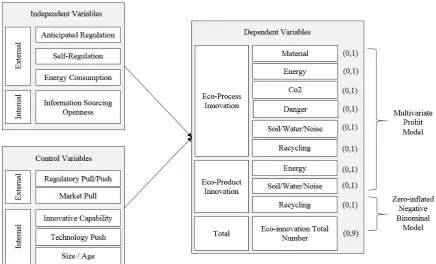
The research model of this study is presented in <Figure 1>. The dependent variables are divided
274
into eco-process innovation and eco-product innovation. Eco-process innovation consists of six items
275
and eco-product innovation consists of three items. Whether eco-innovation is executed or not is
276
analyzed by using the binary dependent variables, and the sum of all areas, from 0 to 9, is used as the
277
aggregated variable for eco-innovation performance.
278
7
280
Figure 1. Research Model
281
282
283
284
3.2 Definition of the data and the variables
285
The data used in this study is “Korean Innovation Survey 2010: Manufacturing sector.” The
286
statistics come from Science and Technology Policy Institute (STEPI)’s investigation into firms’
287
innovation activities from 2007-2009 based on the Oslo Manual developed by OECD and Eurostat
288
Community Innovation Survey (CIS). The survey is approved by Statistics Korea (KOSTAT) and
289
recognized to have high reliability, validity, and international comparability. The size of the
290
population is 41,485, and the samples of 3,925 firms were selected by using the stratified sampling
291
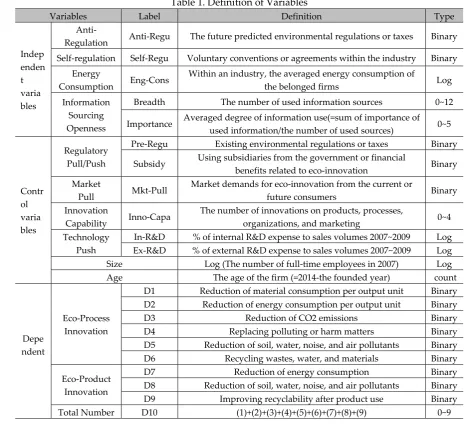
method, and 1,964 firms remained after the deletion of missing data. The definitions of the variables
292
are summarized in <Table 1>.
293
8
Table 1. Definition of Variables
309
Variables Label Definition Type
Indep enden t varia bles
Anti-Regulation Anti-Regu The future predicted environmental regulations or taxes Binary Self-regulation Self-Regu Voluntary conventions or agreements within the industry Binary
Energy
Consumption Eng-Cons
Within an industry, the averaged energy consumption of
the belonged firms Log
Information Sourcing Openness
Breadth The number of used information sources 0~12
Importance Averaged degree of information use(=sum of importance of used information/the number of used sources) 0~5
Contr ol varia bles
Regulatory Pull/Push
Pre-Regu Existing environmental regulations or taxes Binary
Subsidy Using subsidiaries from the government or financial
benefits related to eco-innovation Binary Market
Pull Mkt-Pull
Market demands for eco-innovation from the current or
future consumers Binary
Innovation
Capability Inno-Capa
The number of innovations on products, processes,
organizations, and marketing 0~4
Technology Push
In-R&D % of internal R&D expense to sales volumes 2007~2009 Log Ex-R&D % of external R&D expense to sales volumes 2007~2009 Log Size Log (The number of full-time employees in 2007) Log Age The age of the firm (=2014-the founded year) count
Depe ndent
Eco-Process Innovation
D1 Reduction of material consumption per output unit Binary D2 Reduction of energy consumption per output unit Binary
D3 Reduction of CO2 emissions Binary
D4 Replacing polluting or harm matters Binary
D5 Reduction of soil, water, noise, and air pollutants Binary D6 Recycling wastes, water, and materials Binary
Eco-Product Innovation
D7 Reduction of energy consumption Binary
D8 Reduction of soil, water, noise, and air pollutants Binary D9 Improving recyclability after product use Binary
Total Number D10 (1)+(2)+(3)+(4)+(5)+(6)+(7)+(8)+(9) 0~9
310
3.3 Analysis Model
311
As mentioned before, there are two special kinds of dependent variables in our research model.
312
One is binary (0, 1) variable, and another is count variable. The former is on whether a firm engages
313
in eco-innovative actions, including six eco-process innovative actions and three eco-product
314
innovative actions. The latter is the overall number (count number) of the innovative actions.
315
Considering the special data types, we estimate multivariate probit models addressing the nine
316
innovative actions at the same time. In our research, the dependent variables will be 0 if the firm does
317
not engage in eco-innovative action, and will be 1 if the firm engages in eco-innovative action. And
318
the multivariate probit model is a generalization of the probit model used to estimate several
319
correlated binary outcomes jointly. In this research, the multivariate probit model allows a
320
simultaneous estimation of the nine types of eco-innovation. The existing evidence about the
321
likelihood of complementarities between different types of innovative activity makes us consider that
322
unobserved firms’ characteristics may jointly influence the nine types of eco-innovation [50]. If these
323
correlations were neglected, parameter estimates would be biased and inconsistent. The multivariate
324
probit models can be written as:
325
9
𝑦∗ = 𝛽 + 𝛽 𝑥 + 𝛽 𝑥 + ⋯ + 𝛽 𝑥 + 𝜀
327
𝑦 = 1 𝑖𝑓 𝑦∗ > 0 𝑎𝑛𝑑 0 𝑜𝑡ℎ𝑒𝑟𝑤𝑖𝑠𝑒.
328
329
Where i represents individual firms; 𝑦 are nine binary eco-innovation dependent variables
330
(m= 1, 2, …, 9); 𝑥 are indepent variables and control variables (p= 1, 2, …, 12); and 𝜀 are error
331
terms distributed as multivariate normal, each with a mean of zero, and variance-covariance matrix
332
V, where V has values of 1 on the leading diagonal and correlations 𝜌 = 𝜌 as off-diagonal
333
elements. Also, we estimate the zero-inflated negative binomial regression model for the overall
334
number of eco-innovation activities. There are two basic methods for modeling count variables with
335
excessive zeros, zero-inflated poison (ZIP) regression and ZINB regression. There is an issue that
336
should be considered when using Poisson models which are a Poisson distribution and constrain the
337
variance to be equal to the sample mean. This is a problem in our case given that the sample is much
338
skewed. In contrast, ZIP does not have this constraint. By testing, we ultimately estimate zero-inflated
339
negative binomial models in recognition of the high number of “zero” responses in the dependent
340
variables. According to Table 2, the ZINB is preferred over ZIP. Thus, ZINB models are used to
341
estimate the determinants of the total number of eco-innovations.
342
Table 2. Tests and Fit Statistics
343
ZIP BIC= -7962.343 AIC= 3.425 Prefer Over Evidence
vs. ZINB BIC= -8053.391 dif= 91.048 ZINB ZIP Very strong
AIC= 3.375 dif= 0.050 ZINB ZIP
LRX2= 98.622 prob= 0.000 ZINB ZIP p=0.000
344
The ZINB regression model assumes that there are two distinct data generation processes. The
345
results of a Bernoulli trial are used to determine which of the two processes. For observation 𝑖, with
346
probability 𝜋, the only possible response of the first process is zero counts, and with the probability
347
of (1 - 𝜋), the response of the second process is governed by a negative binomial with mean 𝜇. The
348
zero counts are generated from both the first and second processes, where a probability is estimated
349
for whether zero counts are from the first or the second process. The overall probability of zero counts
350
is the combined probability of zeros from the two processes. A ZINB model for response 𝑌 can be
351
written as:
352
⎩ ⎪ ⎨ ⎪
⎧ 𝑃(𝑌 = 0) = 𝜋 + (1 − 𝜋 ) · 𝑘
𝜇 + 𝑘
𝑃(𝑌 = 𝑛) = (1 − 𝜋 ) · Γ(𝑌 + 𝑘)
Γ(𝑘)Γ(𝑌 + 1)·
𝑘
𝜇 + 𝑘 · 1 −
𝑘 𝜇 + 𝑘
353
354
Where k is the over dispersion parameter; Γ is the gamma distribution, and n is a natural
355
number larger than 0. We can model 𝜋 and 𝜇 as a function of a set of explanatory variables. For
356
𝜋, it is common to use a logistic regression with a logit link function, as it describes a binomial
357
process:
358
359
𝑙𝑜𝑔𝑖𝑡(𝜋 ) = 𝑒 ⋯
360
361
Where α is the intercept, 𝛽 … 𝛽 are the model parameters to estimate, and 𝑋 … 𝑋 are a
362
set of independent variables. We can also model the dependence of 𝜇 on a different (or same) set of
363
explanatory variables with the aid of a log link function:
364
365
𝑙𝑜𝑔(𝜇 ) = 𝜆 + 𝛿 𝑍 + 𝛿 𝑍 + ⋯ + 𝛿 𝑍
366
10
Where 𝜆 is the intercept, 𝛿 … 𝜹𝒏 are the model parameters to estimate, and 𝑧 … 𝑧 are a
368
set of independent variables.
369
4. Results of the Empirical Analyses
370
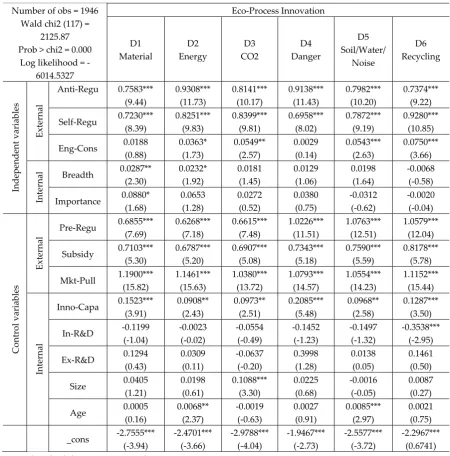
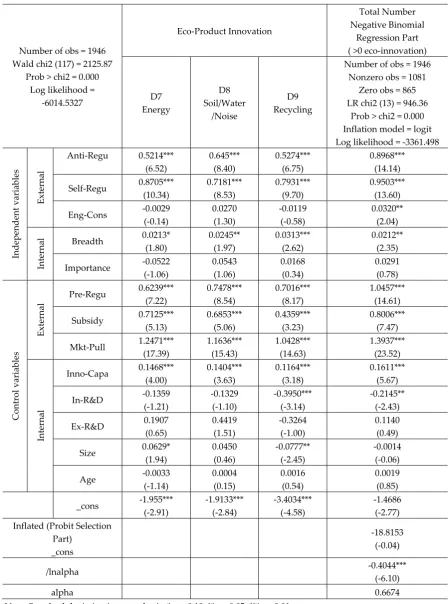
<Table 3> shows the results of multivariate probit models, which analyzed the effects of
371
determinate factors on the nine types of eco-innovation of the 1,964 manufacturing firms in Korea.
372
The corresponding Wald tests analyzing the explanatory power of the entire model indicate that the
373
null hypothesis that all parameters of the explanatory variables are zero can be clearly rejected at all
374
common levels of significance for all probit models. The last column in the <table 3> reports the
375
determinants on the extent to which firms engage in eco-innovation which can be seen as outcome of
376
eco-innovation.
377
4.1. The Results of Empirical Analyses of external factors
378
Among the external factors, the future anticipated regulations have positive influences on
eco-379
process and eco-product innovation at the 1% significant level. Also for the eco-innovation outcome
380
performance by how many kinds of innovation activities are enacted, there is a significant positive
381
influence. Therefore, the hypothesis 1 is supported. This result shows that firms make efforts to win
382
competitive superiority by differentiating their products and cutting down expenses by
383
implementing environment-related innovation activities preemptively in response to the future
384
predicted regulations [15, 16]. It means that the argument by Porter and Van der Linder [14] can also
385
apply to Korea. Also in Khanna et al. [46], current and anticipated regulatory pressures, as proxied
386
by penalties, inspections, hazardous air pollutants and non-attainment have a statistically positive
387
impact on an adoption of a new pollution prevention measure. But, due to data limitation, it is
388
difficult to figure out whether companies regard future predicted regulations as an opportunity or a
389
threat.
390
Not only the governmental regulations, but also firms’ voluntarily engaged conventions
(self-391
regulation) have influence on their eco-innovation activities. According to the results of analyses,
392
firms which are voluntarily engaged in conventions show higher possibilities of innovation in all
393
activities which belong to eco-process and eco-product innovations. Such firms also have higher
394
numbers of eco-innovation activities than others. From this result, hypothesis 2 is adopted. It means
395
that, as in the argument of Nash and Ehrenfeld [51], eco-innovation activities are also realized under
396
non-public control in Korea, and that voluntarily engaging firms are more likely to use
eco-397
innovation than non-voluntary firms. Despite the vulnerability of voluntary conventions being
398
loosely operated compared to the government regulations without explicit punishment on free-ride
399
or opportunistic behaviors, voluntary conventions promote eco-innovations of Korean firms.
400
11
Table 3. Determinants of Eco-innovation by different environmental types & Total Number of Eco-innovation
416
Number of obs = 1946 Wald chi2 (117) =
2125.87 Prob > chi2 = 0.000
Log likelihood = -6014.5327 Eco-Process Innovation D1 Material D2 Energy D3 CO2 D4 Danger D5 Soil/Water/ Noise D6 Recycling In depen d en t v ariables External
Anti-Regu 0.7583*** (9.44) 0.9308*** (11.73) 0.8141*** (10.17) 0.9138*** (11.43) 0.7982*** (10.20) 0.7374*** (9.22)
Self-Regu 0.7230*** (8.39) 0.8251*** (9.83) 0.8399*** (9.81) 0.6958*** (8.02) 0.7872*** (9.19) 0.9280*** (10.85)
Eng-Cons 0.0188 (0.88) 0.0363* (1.73) 0.0549** (2.57) 0.0029 (0.14) 0.0543*** (2.63) 0.0750*** (3.66) Internal
Breadth 0.0287** (2.30) 0.0232* (1.92) 0.0181 (1.45) 0.0129 (1.06) 0.0198 (1.64) -0.0068 (-0.58)
Importance 0.0880* (1.68) 0.0653 (1.28) 0.0272 (0.52) 0.0380 (0.75) -0.0312 (-0.62) -0.0020 (-0.04) Control variables External
Pre-Regu 0.6855*** (7.69) 0.6268*** (7.18) 0.6615*** (7.48) 1.0226*** (11.51) 1.0763*** (12.51) 1.0579*** (12.04)
Subsidy 0.7103*** (5.30) 0.6787*** (5.20) 0.6907*** (5.08) 0.7343*** (5.18) 0.7590*** (5.59) 0.8178*** (5.78)
Mkt-Pull 1.1900*** (15.82) 1.1461*** (15.63) 1.0380*** (13.72) 1.0793*** (14.57) 1.0554*** (14.23) 1.1152*** (15.44) Internal
Inno-Capa 0.1523*** (3.91) 0.0908** (2.43) 0.0973** (2.51) 0.2085*** (5.48) 0.0968** (2.58) 0.1287*** (3.50)
In-R&D -0.1199 (-1.04) -0.0023 (-0.02) -0.0554 (-0.49) -0.1452 (-1.23) -0.1497 (-1.32) -0.3538*** (-2.95)
Ex-R&D 0.1294 (0.43) 0.0309 (0.11) -0.0637 (-0.20) 0.3998 (1.28) 0.0138 (0.05) 0.1461 (0.50)
Size 0.0405 (1.21) 0.0198 (0.61) 0.1088*** (3.30) 0.0225 (0.68) -0.0016 (-0.05) 0.0087 (0.27)
Age 0.0005
(0.16) 0.0068** (2.37) -0.0019 (-0.63) 0.0027 (0.91) 0.0085*** (2.97) 0.0021 (0.75)
_cons -2.7555*** (-3.94) -2.4701*** (-3.66) -2.9788*** (-4.04) -1.9467*** (-2.73) -2.5577*** (-3.72) -2.2967*** (0.6741) Note. Standard deviation in parenthesis. * p < 0.10; **p < 0.05; ***p < 0.01.
Table 3. Determinants of Eco-innovation by different environmental types & Total Number of Eco-innovation
418
(continued)
419
Number of obs = 1946 Wald chi2 (117) = 2125.87
Prob > chi2 = 0.000 Log likelihood =
-6014.5327
Eco-Product Innovation
Total Number Negative Binomial
Regression Part ( >0 eco-innovation)
D7 Energy D8 Soil/Water /Noise D9 Recycling
Number of obs = 1946 Nonzero obs = 1081
Zero obs = 865 LR chi2 (13) = 946.36
Prob > chi2 = 0.000 Inflation model = logit Log likelihood = -3361.498
In depen d en t v ariables External
Anti-Regu 0.5214*** (6.52) 0.645*** (8.40) 0.5274*** (6.75) 0.8968*** (14.14)
Self-Regu 0.8705*** (10.34) 0.7181*** (8.53) 0.7931*** (9.70) 0.9503*** (13.60)
Eng-Cons -0.0029 (-0.14) 0.0270 (1.30) -0.0119 (-0.58) 0.0320** (2.04) Internal
Breadth 0.0213* (1.80) 0.0245** (1.97) 0.0313*** (2.62) 0.0212** (2.35)
Importance -0.0522 (-1.06) 0.0543 (1.06) 0.0168 (0.34) 0.0291 (0.78) Control variables External
Pre-Regu 0.6239*** (7.22) 0.7478*** (8.54) 0.7016*** (8.17) 1.0457*** (14.61)
Subsidy 0.7125*** (5.13) 0.6853*** (5.06) 0.4359*** (3.23) 0.8006*** (7.47)
Mkt-Pull 1.2471*** (17.39) 1.1636*** (15.43) 1.0428*** (14.63) 1.3937*** (23.52) Internal
Inno-Capa 0.1468*** (4.00) 0.1404*** (3.63) 0.1164*** (3.18) 0.1611*** (5.67)
In-R&D -0.1359 (-1.21) -0.1329 (-1.10) -0.3950*** (-3.14) -0.2145** (-2.43)
Ex-R&D 0.1907 (0.65) 0.4419 (1.51) -0.3264 (-1.00) 0.1140 (0.49)
Size 0.0629*
(1.94) 0.0450 (0.46) -0.0777** (-2.45) -0.0014 (-0.06)
Age -0.0033
(-1.14) 0.0004 (0.15) 0.0016 (0.54) 0.0019 (0.85)
_cons -1.955***
(-2.91) -1.9133*** (-2.84) -3.4034*** (-4.58) -1.4686 (-2.77) Inflated (Probit Selection
Part) _cons
-18.8153 (-0.04)
/lnalpha -0.4044***
(-6.10)
alpha 0.6674
Note. Standard deviation in parenthesis. * p < 0.10; **p < 0.05; ***p < 0.01.
420
13
Regarding industry-specific factors, there are interesting results. Industry-specific factors
423
positively influence eco-process innovations, but influence eco-product innovations insignificantly.
424
Among eco-process innovations, when average energy consumption in an industry is higher,
425
possibility of innovation is higher in areas including (2) reducing energy consumption per output
426
unit, (3) reducing carbon dioxide emission, (5) reducing soil, water, noise, and air pollution, and (6)
427
recycling of wastes, water, and materials. This means that firms in a high energy consumption
428
industry are focusing more on the benefit from cutting down their energy consumption rather than
429
consumers’ energy consumption in product use. Also in manufacturing processes, they concentrate
430
more on the innovative actions which bring reduction outcomes in a relatively short period of time.
431
But in the processes which need investment and research for a relatively longer period of time, such
432
as replacement of pollutants or harm matters, innovative actions are less likely to happen at least in
433
short term. Industry-specific factors have influences on eco-innovation possibilities of companies, but
434
not on eco-innovation outcomes.
435
4.2. The Results of Empirical Analyses of Internal Factors
436
As one of our focusing variables, let us see how openness to information affects eco-innovation.
437
First, when the scope of obtaining information is broader and more diverse, the diversity of
eco-438
innovation improves. This result is consistent with Laursen and Salter [28] which studied general
439
technology innovation. Hypothesis 4-1, therefore, is supported. In Korea, as many researchers
440
suggest, eco-innovation requires capabilities to deal with different dimensions, which can be
441
acquired from diverse external information sources [27,29,31]. So, the firms with broader information
442
sources can be said to get higher outcomes of eco-innovation than those with narrower sources.
443
Also in eco-process and eco-product innovation activities, it has a significantly positive influence
444
on the activities of (1) material, (2) energy, and all activities in eco-product. From this result, firms
445
obtaining information from broader and more diverse sources are more likely to take actions on
eco-446
innovation. This result has great implications on both policy and academic study. In terms of
447
academic study, it suggests the necessity of expense-related studies, as it is possible that more diverse
448
sources of external information accompany higher costs in their handling and management. In terms
449
of policy, the method to raise diversity of external information should be proposed.
450
The importance of openness to information has not showed any significant results in the
451
outcomes and individual items of innovation activity, which is far from the expectations of this study.
452
Therefore, hypothesis 4-2 is not supported. It is probably because of firms’ lack of absorbing
453
capability, which refers to firms’ ability to effectively use outside information [52,53]. The value of
454
external information depends on firms’ potential absorptive capabilities [53-55]. But this result should
455
be strengthened by empirical analyses.
456
4.3. The Results of Empirical Analyses of Control Factors
457
Regarding the results about regulatory pull/push, Korean firms show the same results as the
458
previous studies [3,43]. The present regulations positively affect eco-innovation at 1% significance
459
level. Also, governmental subsidiaries show the same results as the present regulations. Both
460
regulatory push and pull have a significantly positive influence on each dimension of eco-process
461
and eco-product innovation. The existences of the present regulations and governmental support
462
have significantly positive relationships with all activities of eco-process and eco-product innovation.
463
Also in the market-pull factors, higher demands on eco-friendly products have greater positive
464
influences not only on eco-process and eco-process innovation, but also on eco-innovation outcome
465
performance. This is consistent with the empirical research results of Kammerer [18]. Next, let us see
466
how influential internal factors are on eco-innovation of Korean firms. First, innovation capability
467
has a significant effect at 1% level. It means that for Korean firms, higher innovation capability
468
promotes eco-innovation. When seeing technology push factors, internal R&D investments have
469
14
has a negative effect on productivity growth in short run, as Guellec and Potterie [56] argued. They
471
presented that it takes some time for those outcomes to have relationships each other, and before they
472
do, they can show negative relationships. In Seop et al. [57], R&D intensity has a negative relationship
473
with firms’ revenues in short run. Meanwhile, external investment is not in significant relationships.
474
The size of firms, which is represented by the number of employees, has a significant effect only
475
partly on eco-innovation. Only eco-innovation activities for carbon dioxide reduction have been
476
proportionally influenced by firm size. In eco-product innovation, the activities regarding energy use
477
reduction have been positively influenced by the size of firms at 10% significance level, though firms’
478
size negatively affects recycling of products. Firm's age, which represents firm's experience, has a
479
positive relationship with the overall outcomes of eco-innovation.
480
5. Conclusions
481
This study has empirically proved the determinant factors of the eco-innovation of Korean
482
manufacturing firms, divided into external and internal factors, mainly by using the variables that
483
have not been much proved. Both anticipated regulations and self-regulations, which are external
484
factors, promote eco-innovation. On the dimension of industry-specific characteristics, firms which
485
belong to a more energy-consuming industry are more concentrated on eco-process innovation. In
486
information sourcing openness, which is an internal factor, breadth is a factor with a more significant
487
influence on eco-innovation than importance is. It means that the capability of a firm to make
488
connections with diverse bodies (businesses, colleges, research institutions, etc.) and apply their
489
information itself has an influence on its choice of eco-innovation. The three variables, anticipated
490
regulations, self-regulations, and the breadth of information sourcing, also have significantly strong
491
influences on firms’ eco-innovation outcomes, which are represented by how frequently they engage
492
in eco-innovation activities.
493
According to the empirical results, the following academic and policy implications can be
494
provided. First, it has been already confirmed by a lot of researchers that the government’s
495
environmental regulations promote eco-innovations [14,58,59]. This study analyzes how firms react
496
to anticipated environmental regulations imposed by the government, which has not been much
497
addressed in previous studies. As shown in the results, firms take positive response strategies rather
498
than passive defending actions, as anticipated regulations imply that their future competition
499
circumstances will be different. Particularly, the argument that late comers take anticipated
500
regulations as an opportunity to secure competitive advantages and become leading firms, and take
501
more vigorous actions for technological innovations strengthens the validity of the results of this
502
study [60].
503
When firms clearly see the direction of environmental policies, they decide on their strategies
504
and respond to anticipated circumstantial changes. The consistency and continuation of the
505
government’s environment policies, therefore, are important. But even when firms are aware of
506
external circumstantial changes, they cannot be immune from the problem of uncertainty. Firms are
507
more likely to take passive actions when uncertainty is high, while they are more likely to take active
508
actions when uncertainty is low and there is improved predictability. When it comes to activities
509
related to eco-innovation, the predictability of future regulations can be explained by the same theory.
510
Due to the limitations of our data, however, future studies should be conducted based on related
511
studies.
512
Second, apart from governmental regulations, self-regulations have a positive influence on
513
firms’ engagement in eco-innovation activities and their performance. There is a lack of concrete
514
discussion about the mechanism through which self-regulations have such influences. In this study,
515
negative and positive influences of self-regulations are presented, and the empirical analyses are
516
carried out to prove them. As shown from the results, the positive relationship of self-regulation with
517
eco-innovation suggests that self-regulations have positive effects in Korea, and firms should be
518
induced to take voluntary actions on environment-related innovation activities by themselves
519
15
effective methods to replace non-elastic governmental regulations [23]. From the government’s
521
perspective, self-regulations can reduce external effects from the establishment of rules and cut down
522
the costs on persuading various interest groups. For these purposes, it is important to prepare a
523
foundation on which sound self-regulations can be established, and the government and firms should
524
make joint efforts to do so. Third, concrete identify of the relationship between industry-specific
525
factors and eco-innovation. Although the results of some studies have presented that firms which
526
belong to a high energy-consuming industry are active for eco-innovation, they might be missing a
527
concrete influential relationship. As the result of this study shows, industry-specific factors do not
528
have a significant influence on product innovation, but have a significant influence on
eco-529
process innovation. Particularly, it is significant in some kinds of eco-innovation, such as energy
530
consumption reduction, carbon dioxide reduction, soil/water/noise/air pollutants reduction, and
531
wastes/water/material recycling. It suggests that firms that consume a lot of energy practice more
532
process-centered eco-innovation policies. Fourth, the major contribution of this study is that it has
533
figured out that various information sources could help firms win a competitive advantage through
534
eco-innovation. Since eco-innovation intrinsically has a complex development process and multiple
535
purposes, using diverse external information is important [27,29]. Also, multiple dimensions such as
536
design, user involvement, product and service, or governance should be taken into consideration in
537
the process of eco-innovation [27]. It is also well explained in this study as it presents the positive
538
relationship between the breadth of information sources and eco-innovation. In particular, the
539
positive relationship with overall eco-innovation suggests that firms which want to win competitive
540
superiority through product differentiation need to actively use external resources. Meanwhile, from
541
firms’ point of view, the importance of external information does not influence eco-innovation
542
engagement and outcomes. It seems to have something to do with absorbing capability, though there
543
should be related further studies in the future.
544
Despite the implications presented above, this study has several limitations. First, it could not
545
fully take into consideration the temporal effect of each factor considered in the analyses on
eco-546
innovation. In future studies, temporal research should be done on the same firms analyzed in this
547
study. Second, since it could not figure out whether firms take predicted regulations as opportunities
548
or threats due to the limit of data, the changes of firms’ behaviors were not explained either. If more
549
research is done on this issue, it could provide important implications on how the strategy
550
formations, actions, and outcomes of companies will change depending on their awareness of
551
anticipated regulations.
552
553
554
Author Contributions: Conceptualization: C.Y. and Y.S.H.; Formal analysis: C.Y.; Project administration: Y.S.H.;
555
Supervision: Y.S.H.; Writing original draft: C.Y.; Writing—review and editing: Y.S.H.
556
Funding: This study received no external funding.
557
Acknowledgments: This work was supported by the Ministry of Education of Korea and the National Research
558
Foundation of Korea (NRF-2016S1A5B6925462)
559
Conflicts of Interest: The authors declare no conflicts of interest.
560
561
Reference
562
563
1. Hart, S. L.; Dowell, G. Invited editorial: a natural-resource-based view of the firm: fifteen years after. Journal
564
of management2011, 37(5), 1464-1479.
565
2. Porter, M. E.; Reinhardt, F.L. A strategic approach to climate. Harvard Business Review2007, 85(10), 22-26.
566
3. Horbach, J.; Rammer, C.; Rennings, K. Determinants of eco-innovations by type of environmental impact-
567
16
4. Kesidou, E.; Demirel, P. On the drivers of eco-innovations: Empirical evidence from the UK. Research Policy
569
2012, 41, 862-870.
570
5. Cuerva, M.C.; Triguero-Cano, A.; Corcoles, D. Drivers of green and non-green innovation: empirical
571
evidence in Low-Tech SMEs. Journal of Cleaner Production2014, 68, 104-113.
572
6. Triguero, A.; Moreno-Mondejar, L.; Davia, M.A. Drivers of different types of eco-innovation in European
573
SMEs. Ecological Economics2013, 92, 25-33.
574
7. Cai, W.; Zhou, X. On the drivers of eco-innovation: empirical evidence from China. Journal of Cleaner
575
Production 2014, 79, 239-248.
576
8. Cheng, C.C.; Yang, C.; Sheu, C. The link between eco-innovation and business performance: a Taiwanses
577
industry context. Journal of Cleaner Production2014, 64, 81-90.
578
9. Chesbrough H. The Era of Open Innovation. MIT Sloan Management Review2003, 44(3), pp. 35-41
579
10. Rennings, K. Redefining innovation—eco-innovation research and the contribution from ecological
580
economics. Ecological economics2000, 32(2), 319-332.
581
11. Negny, S.; Belaud, J.; Robles, C.; Reyes, R.; Ferrer, B. Toward an eco-innovative method based on a better
582
use of resources: application to chemical process preliminary design. Journal of Cleaner Production2012, 32,
583
101-113.
584
12. Horbach, J. Determinants of environmental innovation – new evidence from German panel data sources.
585
Research Policy2008, 37, 163-173.
586
13. Iraldo, F.; Testa, F.; Melis, M.; Frey, M. A literature review on the links between environmental regulation
587
and competitiveness. Environmental Policy and Governance2011, 21(3), 210-222.
588
14. Porter, M.E.; Van der Linde, C. Green and competitive: ending the stalemate. Harvard Business Review1995,
589
73 (5), 120-134.
590
15. Christmann, P. Effects of “best practices” of environmental management on cost advantage: The role of
591
complementary assets. Academy of Management Journal2000, 43(4), 663-680.
592
16. Dean, T.J.; Brown, R.L. Pollution regulation as a barrier to new firm entry: Initial evidence and implications
593
for future research. Academy of Management Journal1995, 38(1), 288-303.
594
17. Russo, M.V.; Harrison, N.S. Organizational design and environmental performance: Clues from the
595
electronics industry. Academy of Management Journal2005, 48(4), 582-593.
596
18. Kammerer, D. The effects of customer benefit and regulation on environmental product innovation.
597
Empirical evidence from appliance manufacturers in Germany. Ecological Economics2009, 68, 2285-2295.
598
19. Reid, E.M.; Toffel, M.W. Responding to public and private politics: Corporate disclosure of climate change
599
strategies. Strategic Management Journal2009, 30(11), 1157-1178.
600
20. Cohen, P. The regulation of protein function by multisite phosphorylation–a 25 year update. Trends in
601
biochemical sciences2000, 25(12), 596-601.
602
21. Maxwell, J.W.; Lyon, T.P.; Hackett, S.C. Self-Regulation and Social Welfare: The Political Economy of
603
Corporate Environmentalism. The Journal of Law and Economics2000, 43(2), 583-618.
604
22. Cane, P. Self regulation and judicial review, Civil Justice Quarterly1987, 6, 324-347.
605
23. Ogus, A. Rethinking self-regulation. Oxford Journal of Legal Studies1995, 15(1), 97-108.
606
24. Scott, C.; Black, J.; Cranston, R. Cranston's Consumers and the Law, 3rd ed.; Cambridge University Press:
607
Cambridge, U.K., 2000; ISBN 10 0521605970.
608
25. Delmas, M.A.; Terlaak, A.K. A framework for analyzing environmental voluntary agreements. California
609
Management Review 2001, 43(3), 44-63.
610
26. Machiba, T. Eco-innovation for enabling resource efficiency and green growth: development of an
611
analytical framework and preliminary analysis of industry and policy practices. International Economics and
612
Economic Policy2010, 7(2-3), 357-370.
613
27. De Marchi, V.; Grandinetti, R. Knowledge strategies for environmental innovations: the case of Italian
614
manufacturing firms. Journal of Knowledge Management2013, 17(4), 569-582.
615
28. Laursen, K.; Salter, A. Open for innovation: the role of openness in explaining innovation performance
616
among U.K. manufacturing firms. Strategic Management Journal 2006, 27, 131-150.
617
29. Ghisetti, C.; Marzucchi, A.; Montresor, S. The open eco-innovation mode, An empirical investigation of
618
eleven European countries. Research Policy2015, 44, 1080-1093.
619
30. Rennings, K.; Rammer, C. Increasing energy and resource efficiency through innovation – an explorative
620
17
31. Horbach, J.; Oltra, V.; Belin, J. Determinants and specificities of eco-innovations. An econometric analysis
622
for the French and German industry based on the Community Innovation Survey. Industry and Innovation
623
2013, 20 (6), 523-543.
624
32. Penrose, E. The theory of the Growth of the firm, 4th ed.; Oxford University Press: NY, USA, 2009; ISBN
625
9780199573844.
626
33. Hwang, J.; Lee, Y.; External knowledge search, innovative performance and productivity in the Korean ICT
627
sector. Telecommunications Policy2010, 34(10), 562-571.
628
34. Woo, Y.B.; Cho, S.; Kim, J.; Kim, B.S. Optimization-based approach for strategic design and operation of a
629
biomass-to-hydrogen supply chain. International Journal of Hydrogen Energy2016, 41(12), 5405-5418.
630
35. Schmookler, J. Invention and economic growth. Harvard University Press. Cambridge, Mass., USA, 1996; ISBN
631
9780674432833.
632
36. Rosenberg, N. Science, invention and economic growth. The Economic Journal1974, 84, 90-108.
633
37. Cleff, T.; Rennings, K. Determinants of environmental product and process innovation. European
634
environment1999, 9(5), 191-201.
635
38. Hicks, C.; Dietmar, R. Improving cleaner production through the application of environmental
636
management tools in China. J. Clean. Prod.2007, 15, 395-408.
637
39. Pujari, D. Eco-innovation and new product development: understanding the influences on market
638
performance. Technovation2006, 26, 76-85.
639
40. Gray, W.B. The cost of regulation: OSHA, EPA and the productivity slowdown, The American Economic
640
Review1987, 77(5), 998-1006.
641
41. Jenkins, R., 1998. Environmental regulation and international competitiveness: a review of literature and
642
some European evidence. Discussion Paper Series #9801. United Nations University. Institute for New
643
Technologies: Maastricht, Netherlands, 1998.
644
42. Smith, J.B.; Sims, W.A. The impact of pollution charges on productivity growth in Canadian brewing. The
645
RAND Journal of Economics1985, 16(3), 410-423.
646
43. Del Rio Gonzalez, P. The empirical analysis of the determinants for environmental technological change: a
647
research agenda. Ecological Economics2009, 68, 861-878.
648
44. Arranz, N.; Fdez de Arroyabe, J.C. The choice of partners in R&D cooperation: An empirical analysis of
649
Spanish firms. Technovation2008, 28 (1), 88-100.
650
45. Lerner, J.S.; Tetlock, P.E. Accounting for the effects of accountability. Psychological bulletin1999, 125(2), 255.
651
46. Khanna, M.; Deltas, G.; Harrington, D.R. Adoption of pollution prevention techniques: the role of
652
management systems and regulatory pressures. Environmental and Resource Economics2009, 44(1), 85-106.
653
47. De Marchi, V. Environmental innovation and R&D cooperation: Empirical evidence from Spanish
654
manufacturing firms. Research Policy2012, 41, 614-623.
655
48. Cohen, W.M.; Levinthal, D.A. Innovation and learning: the two faces of R & D. The economic journal1989,
656
99(397), 569-596.
657
49. Cohen, W.M.; Levinthal, D.A. Fortune favors the prepared firm. Management science1994, 40(2), 227-251.
658
50. Reichstein, T.; Salter, A. Investigating the sources of process innovation among UK manufacturing
659
firms. Industrial and Corporate Change2006, 15(4), 653-682.
660
51. Nash, J.; Ehrenfeld, J. Codes of environmental management practice: Assessing their potential as a tool for
661
change. Annual Review of Energy and the Environment1997, 22(1), 487-535.
662
52. Fabrizio, K.R. Absorptive capacity and the search for innovation. Research Policy2009, 38(2), 255-267.
663
53. Koza, M.P.; Lewin, A.Y. The co-evolution of strategic alliances. Organization science1998, 9(3), 255-264.
664
54. Xia, T.; Roper, S. From capability to connectivity—Absorptive capacity and exploratory alliances in
665
biopharmaceutical firms: A US–Europe comparison. Technovation2008, 28(11), 776-785.
666
55. Xia, T.; Roper, S. Unpacking Open Innovation: Absorptive Capacity, Exploratory and Exploitative
667
Openness, and the Growth of Entrepreneurial Biopharmaceutical Firms. Journal of Small Business
668
Management2016, 54(3), 931-952.
669
56. Guellec, D.; De la Potterie, B.V.P. The internationalisation of technology analysed with patent data. Research
670
Policy2001, 30(8), 1253-1266.
671
57. Seop, H. Y.; Min, K. H.; Sik, K. H. Industry openness, firm capacity, and performance of Korean
672
18
58. Palmer, K.; Oates, W.E.; Portney, P.R. Tightening environmental standards: The benefit-cost or the no-cost
674
paradigm? The Journal of Economic Perspectives1995, 9(4), 119-132.
675
59. Wagner, B.A. Learning and knowledge transfer in partnering: an empirical case study. Journal of Knowledge
676
Management 2003, 7(2), 97-113.
677
60. Sharma, S.; Pablo, A.L.; Vredenburg, H. Corporate environmental responsiveness strategies the importance
678
of issue interpretation and organizational context. The Journal of Applied Behavioral Science1999, 35(1),