Death happy: Adaptive ageing and its evolution by kin selection in
organisms with colonial ecology
Evgeniy R. Galimov and David Gems
Institute of Healthy Ageing, and Research Department of Genetics, Evolution and
Environment, University College London, London WC1E 6BT, UK.
Author for correspondence: David Gems
e-mail: [email protected]
Abstract
Standard evolutionary theory, supported by mathematical modelling of outbred, dispersed
populations predicts that ageing is not an adaptation. We recently argued that in clonal,
viscous populations, programmed organismal death could promote fitness through social
benefits and has, in some organisms (e.g. Caenorhabditis elegans), evolved to shorten lifespan. Here we review previous adaptive death theory, including consumer sacrifice,
biomass sacrifice, and defensive sacrifice types of altruistic adaptive death. In addition we
discuss possible adaptive death in semelparous fish, coevolution of reproductive and adaptive
death, and adaptive reproductive senescence in C. elegans. We also describe findings from recent tests for the existence of adaptive death in C. elegans using computer modelling. Such models have provided new insights into how trade-offs between fitness at the individual and
colony levels mean that senescent changes can be selected traits. Exploring further the
relationship between adaptive death and social interactions, we consider examples where
adaptive death results more from action of kin than from self-destructive mechanisms and, to
describe this, introduce the term adaptive killing of kin.
Introduction
Is ageing an adaptation? An early idea was that ageing benefits the species by removing worn
out, old individuals, thereby increasing resource availability for those still able to reproduce.
However, today the consensus among evolutionary biologists is that senescence is not
adaptive (Rose, 1991), but rather has evolved as the result of the decline in purifying selection
with increasing age. Two plausible theories describe how this happens. First, the mutation
accumulation theory reasons that the age decline in selection leads to accumulation of
mutations with little effect on fitness earlier in life, but with detrimental effects in old age
(Medawar, 1952). Second, the antagonistic pleiotropy theory proposes that ageing evolves
due to positive selection for gene variants with pleiotropic effects at different ages: promoting
early-life fitness and but also with late-life detrimental effects (Williams, 1957). Importantly,
neither theory predicts that ageing per se evolves because it provides a selective advantage.
From a population genetic perspective, the impact of the decline in the force of natural
selection on the evolution of ageing has been described mathematically (Charlesworth, 1994;
Hamilton, 1966). Notably, these analyses were based on idealized Wright-Fisher populations
(i.e. dispersed and out-crossing), and did not include social and ecological factors, including
spatial structure, access to resources or dispersal. Also, the theory considers only the effect of
natural selection, and does not account for other evolutionary mechanisms such as genetic
drift, gene flow and mutation bias.
The mutation accumulation and antagonistic pleiotropy theories predict that ageing
should be a result of action of many genes with small effects. However, the existence of
mutations that dramatically extend lifespan in the nematode C. elegans presented a challenge to the classic evolutionary theory. For example mutation of the daf-2 insulin/IGF-1 receptor gene can more than double C. elegans lifespan (Kenyon et al., 1993). This led to renewed speculation about possible adaptive benefits of ageing (Lohr et al., 2019). For example, it was
suggested that the wild-type daf-2 allele “may have been selected because of its effects on aging if, for example, species whose members have short life spans prospered from increased
genetic diversity or decreased competition between parents and offspring” (Kenyon, 2005).
Can organismal death ever promote fitness?
Could the existence of mutations that dramatically increase lifespan really reflect the presence
of programmed ageing? To avoid the ambiguity in meaning of both the terms “ageing” and
emphasize the proposal that death itself increases inclusive fitness for the focal individual
(Lohr et al., 2019).
In classical evolutionary theory, kin selection was incorporated into the model of
age-structured populations (Charlesworth and Charnov, 1981), though it was not actually explored
as a possible mechanism that could affect ageing. However, it was concluded that altruistic
behaviour is more likely to evolve where social interactions involve a donor of low
reproductive value and a recipient with a high one. Thus, where resources are limited (as they
often are in nature), altruistic behaviour can evolve by kin selection to transfer resources from
parents to offspring. Where social interactions occur, the fitness of an individual includes not
only the number of its progeny, but also the reproductive success of its closer relatives or kin
(inclusive fitness). In principle, adaptive death could occur as an extreme form of altruism
where parents sacrifice themselves to increase their inclusive fitness.
But is adaptive death a real thing? The behaviour of several computer models provided
evidence that ageing can evolve through kin selection when dispersal is limited and
reproductive capacity declines with age (Dytham and Travis, 2006; Markov, 2012; Travis,
2004). Thus, while classical theory predicts that ageing per se is a non-adaptive by-product of
evolution, it does not rule out the possibility that ageing can be adaptive in some ecological
conditions.
We recently elaborated a theory of adaptive death based on evolutionary theory,
earlier discussion of the topic (Bourke, 2007) and a survey of organisms in which adaptive
death may occur. This has been described elsewhere (Galimov et al., 2019; Lohr et al., 2019)
but, briefly, it argues that conditions exist for the emergence of adaptive death where closely
related individuals dwell in discrete, viscous (non-dispersed) populations or colonies, such
that colony level (or inter-demic) selection can occur. Importantly, in viscous populations
greater levels of altruism can evolve due to reduced risk of exploitation by altruist,
non-kin cheaters. Adaptive death is expected to occur particularly in microorganisms that exist as
clonal colonies, such as bacteria, yeast and some small metazoans such as free-living
nematodes. We previously discussed in detail evidence for adaptive death in Saccharomyces cerevisiae and C. elegans (Galimov et al., 2019; Lohr et al., 2019). In this essay we explore further the biology of adaptive death in a wider range of highly social organisms, and develop
further the adaptive death theory.
Fitness benefits from adaptive death are only expected to exist where a significant proportion
of a population is older (Zhao and Promislow, 2019). The proportion of old individuals is
predicted to be low in exponentially growing populations, but to increase in populations
whose growth rate has stalled, e.g. due to nutrient depletion, pathogens or other insults. Thus,
an expectation is that adaptive death is more beneficial in stressed populations. Molecular
damage accumulation can contribute to ageing, including reproductive decline (Ogrodnik et
al., 2019). Thus, stressful conditions may both accelerate ageing and increase the benefits of
adaptive death in a colonial milieu (figure 1a).
Adaptive death in colonial unicells
Many unicellular organisms grow as clonal colonies in which individual cells have limited
motility. In some species colonies exhibit properties of primitive multicellular organisms,
where some cells differentiate and perform altruistic functions. For example, S. cerevisiae
exhibit programmed cell death driven by molecular mechanisms similar to those in
multicellular organisms (Fröhlich and Madeo, 2000). As nutrient availability declines in
ageing yeast colonies, some cells in the centre of the colony undergo programmed cell death
triggered by an ammonia signalling gradient, apparently to supply nutrients to the younger kin
growing at the colony's edge (Váchová et al., 2012; Váchová and Palková, 2005). We have
defined this form of adaptive death as biomass sacrifice since the altruists feed their kin with their own biomass (Lohr et al., 2019). However, it is also possible in principle that consumer sacrifice is operative, where older individuals die in order to cease consumption, thereby increasing nutrient availability for kin. Consumer sacrifice is similar to the adaptive value attributed to ageing by August Weismann in the 19th century (Rose, 1991).
Adaptive death occurs in a number of bacterial species, for example in the social
predator Myxococcus xantis (Muñoz-Dorado et al., 2016). Upon nutrient depletion these bacteria aggregate to form a fruiting body, which can contain up to 100,000 cells. During
fruiting body development ~80% of cells die due to altruistic lysis, providing nutrients by
biomass sacrifice to the remaining 20% of cells, which develop into spores (Nariya and
Inouye, 2008).
In Escherichia coli toxin-antitoxin systems can be activated in response to nutrient depletion or other stressors, and promote biomass sacrifice adaptive death that increases
colony fitness (Allocati et al., 2015). Toxin-antitoxin systems are also employed by many
example of defensive sacrifice (Galimov et al., 2019; Lohr et al., 2019); thus, adaptive death benefits do not only stem from nutritional improvements.
Quorum sensing communication can also coordinate adaptive death in bacterial
populations and biofilms. In this context, action of various signalling molecules have been
described, including extracellular death factors in E. coli (Popp and Mascher, 2019); Spo0A-P factor during sporulation in B. subtilis (Veening et al., 2008); and competence-stimulating peptide in Streptococcus pneumoniae (Guiral et al., 2005).
(a) Adaptive altruistic death and adaptive killing of kin: two ends of a spectrum
The behaviour of the bacterium Bacillus subtilis provides an interesting perspective on the adaptive death concept. Something akin to adaptive death occurs as a mechanism by which B. subtilis delays the resource-intensive process of sporulation in biofilms facing a lack of nutrients (González-Pastor et al., 2003). In response to starvation, B. subtilis adopts a bet-hedging strategy in which cells differentiate in one of two ways: either they sporulate or they
continue growth by subsisting on alternative metabolites (López and Kolter, 2010).
Interestingly, sporulating cells can produce so-called cannibalism toxins that kill their
non-sporulating kin, thereby providing sporulators with nutrients that enable them either to survive
until conditions improve or commit to spore maturation if they worsen.
Here the B. subtilis cells that die likely experience inclusive fitness benefits through adaptive death. However, this differs from adaptive death as previously conceived (Lohr et
al., 2019), where individuals undergo programmed death altruistically to benefit their kin. By
contrast, in B. subtilis the dying cell is not so much an altruist as a victim of fratricide (or cannibalism). In The Voyage of the Beagle Darwin describes how, in times of food scarcity, Fuegian indians would sometimes hunt down and eat their elderly relatives (usually women)
(Darwin, 1860), an example of senicide. This we would describe as predation (or murder)
rather than adaptive altruistic death. Yet by being murdered and eaten the unfortunate old
women could have experienced inclusive fitness benefits, as shown in spider matriphagy
(Evans et al., 1995).
Here one can, in theoretical terms, broadly define a continuum of adaptive death
between two extreme cases. At one extreme, an individual within a community self-destructs
to benefit their kin (adaptive altruistic death); at the other, an individual is killed by their kin
for their benefit. In both cases death increases the inclusive fitness of the deceased. As one
harmful social cues and signals, and eventually through weapons (e.g. toxins). According to
this account, to be defined as such, adaptive altruistic death must entail a substantial element
of agency by the one that dies, i.e. it must result predominantly from self destruction. By
contrast in adaptive killing of kin death is largely caused by action of others (figure 1b). But both are forms of adaptive death.
Distinguishing adaptive death from adaptive killing of kin is easy in some cases but
difficult in others. For example, in S. cerevisiae the ammonia gradient that provides a social cue for the decision by individual cells to undergo adaptive death is a property of the overall
colony (Váchová and Palková, 2005). This appears not to be a case of one group of cells
killing another, and so may be defined as altruistic, adaptive death. By contrast, in B. subtilis
the toxins produced by sporulating cells (SKF peptide and SdpC protein) appear to be
relatively non-specific in their action, inducing leakage in cellular membranes. SdpC also acts
as a signaling protein increasing susceptibility of non-sporulating cells to toxins
(González-Pastor et al., 2003). Resistance to toxin in sporulating cells is, at least partly, determined by
pumping toxins outside the cell (Ellermeier et al., 2006; Meade et al., 2020). Thus, this
appears to be an example of adaptive killing of kin, though it remains possible that death in
the victims involves as yet undiscovered mechanisms of self destruction.
(b) Enhancing adaptability of kin: heterogenetic adaptive death
A different mode of adaptive death is seen among Streptococcus and Vibrio species (Veening and Blokesch, 2017). For example, during exponential growth in S. pneumoniae accumulation of competence-stimulating peptide causes a sub-population of cells to acquire competence
(ability to uptake exogenous DNA), and also causes them to produce bacteriocins that
selectively kill non-competent cells (Guiral et al., 2005). The death of the latter provides
competent kin with new genetic material (new due to earlier mutagenesis) which is thought to
improve survival in a changing environment (Wei and Håvarstein, 2012). Given the type of
benefit provided by such adaptive killing of kin, it may be described as heterogenetic adaptive death. Heterogenic adaptive death also appears to occur in other bacterial species capable of
natural competence (Blokesch, 2016; López and Kolter, 2010).
Adaptive death in colonial metazoans
Adaptive death appears to be relatively common in colonial unicellular organisms, but does it
sacrifice (Lohr et al., 2019). In its boom-and-bust ecology (figure 1c), a food source (typically a rotten plant stem) is encountered by dauer larva propagules (typically 3-7)(Richaud et al.,
2018). These then develop into adults, reproduce and generate new dauers for dispersal and
further colony establishment (Schulenburg and Félix, 2017). C. elegans populations are largely clonal, consisting of self-fertilizing hermaphrodites. An important detail is that C. elegans hermaphrodites are protandrous (generating first sperm and then oocytes); the resulting limitation to sperm number leads to cessation of reproduction only 2-3 days after
sexual maturity, potentially favouring adaptive death (Lohr et al., 2019).
To probe further the plausibility of adaptive death in C. elegans, we recently created a computer model based on an approximation of C. elegans life history (Galimov and Gems, 2020). This involved colonization and consumption of a food patch, with colony fitness
measured as dauer yield. The behaviour of simulations showed that, as predicted, colony
fitness was increased by shorter life when reproductive span was short (c.f. protandry).
Moreover, shorter life was more beneficial when adult food consumption was higher, i.e.
death is more adaptive when parents are greedier (Galimov and Gems, 2020).
(a) Minimising futile food consumption to maximise C. elegans colony fitness
C. elegans adults show a marked age decline in feeding rate that begins within days of sexual maturation (Huang et al., 2004). In model simulations a sharp age decline in feeding rate
increased colony fitness (Galimov and Gems, 2020). This suggests that the age decline in
feeding rate in C. elegans may represent adaptive ageing, i.e. a functional decline that may decrease individual fitness but enhances colony fitness by increasing food availability for kin.
This illustrates how consumer sacrifice can be effected by adaptive behavioural ageing as well
as adaptive death.
This and other properties of the model draw attention to a previously little-considered
feature of C. elegans ecology: how colony fitness is increased by maximizing efficiency of conversion of food into dauers. This requires minimization of non-productive food
consumption, which can be achieved in a variety of ways: not only by killing off
post-reproductive adults, but also by tuning down their food consumption, and by optimising
population structure to avoid an excess of larvae that will starve before reaching the dauer
stage. Thus, optimization of fitness involves trade-offs between individual fitness and colony
fitness: if the latter is increased by reducing the former, then reduced individual fitness may
consumer sacrifice type of adaptive death at least partly accounts for the very short lifespan of
C. elegans.
(b) Programmed reproductive senescence in Caenorhabditis to increase colony fitness?
One unexpected behaviour of the model was that where fecundity was high, shorter
reproductive span could increase colony fitness, apparently because it results in a population
structure that reduces futile food consumption (Galimov and Gems, 2020). This could explain
paradoxical findings reported more than a decade ago, as follows. In selfing hermaphrodites,
reproduction ceases after only 2-3 days due to sperm depletion, but mating with males can
provide sufficient sperm to sustain reproduction for many more days. One would therefore
expect that mating would result in sustained progeny production rate, but in fact it shows a
rapid age decline (Hughes et al., 2007) (figure 1d). This is also true for females from the gonochoristic species C. remanei (Zwoinska et al., 2013). This reproductive decline in C. elegans is accompanied by visible deterioration and atrophy of the gonad (de la Guardia et al., 2016; Hughes et al., 2007). Thus natural selection appears to have favoured early reproductive
senescence; as put by Hughes et al. (2007): “C. elegans is not engineered to generate the
maximum possible number of progeny. We speculate that there is an optimal number of F1 progeny, and reproductive aging contributes to the ability of the animal to generate the
optimal progeny number” (Hughes et al., 2007). Consistent with this, the behaviour of our in
silico model suggests that early reproductive senescence shapes colony population structure in order to minimize futile food consumption, thereby maximising colony fitness.
Does adaptive death occur in semelparous fish?
Is adaptive death restricted to colonial microorganisms or could it evolve in more complex
taxa, such as vertebrates? It has been suggested that adaptive death occurs in some species of
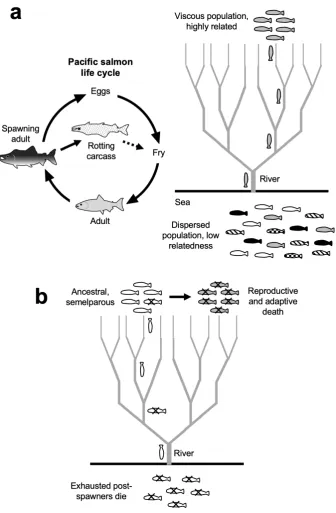
salmon (Bilby et al., 1998; Cederholm et al., 1999). Rapid death following reproduction is
well documented as part of the semelparous life history of Pacific salmon such as
Oncorhynchus nerka, and is usually interpreted as a non-adaptive by-product of massive reproductive effort (reproductive death) (Finch, 1990). However, it has also been suggested
that the presence of large numbers of decomposing salmon carcasses in the nutrient-poor
upper reaches of rivers and streams provides nutrients, particularly nitrogen and phosphorus,
that can support growth of phytoplankton and zooplankton upon which salmon fry feed
starvation in salmon fry can reach 90%, underscoring the potential benefits from carcasses
(Jonsson and Jonsson, 2011). Thus, adult salmon could exhibit biomass sacrifice adaptive
death.
The possibility of adaptive death in semelparous fish was proposed by ichthyologists
but appears to have passed below the radar of evolutionary biologists. Is adaptive death in
salmon plausible from an evolutionary perspective? We have argued that adaptive death can
evolve in clonal, viscous populations, but salmon are dioecious and do not exist as clonal
populations. However, at the time of putative adaptive death, large numbers of closely related
individuals do form relatively viscous populations.
Most salmon hatch and develop in streams, and then migrate to the sea where they
hunt and grow for up to several years before returning to fresh water to spawn (Willson,
1997). Salmon are famous for their ability to return to the streams of their birth, apparently
using magnetoreceptive navigation to locate their home coastal area, and then olfactory cues
to locate their natal stream (Lohmann and Lohmann, 2019). The proportion of returning adults
that correctly locate the stream of their birth varies between species, from 73 to 98% (Quinn
et al., 2001; Shapovalov and Taft, 1954). The rates of successful homing and selection on the
one side (isolation) and straying (homogenisation) determine genetic structure and evolution
of salmon. The fact that the strays are less fit at their new locations is further evidence of
reproductive isolation (Hendry et al., 2000). The presence in different rivers of distinct
salmon sub-populations with unique local adaptations is taken into account in salmon
conservation strategy (Ricker, 1972). For example, steelhead salmon from the Columbia
River in Oregon are resistant to the cnidarian parasite Ceratonova shasta, whereas steelhead from the Siletz River experience up to 98% mortality from the parasite (Buchanan et al.,
1983). Relative gene diversity within populations between years is almost negligible
(0.03-0.2%) consistent with enduring existence of distinct local populations (Ryman, 1983).
Moreover, there is evidence that even local salmon populations are not panmictic (all can
mate with all), but exist as metapopulations with hierarchical structure (Altukhov and
Salmenkova, 1994; Dionne et al., 2009). Taken together, these findings imply that adult
Pacific salmon returning to spawn in their streams of origin are highly related to one another.
Moreover, the decreasing volume of streams as salmon swim up river cause populations to
become increasingly viscous. We suggest that high relatedness and population viscosity in
spawning salmon populations help ensure that benefits from parental biomass sacrifice are
immediately after spawning and carcasses bring nutrients to the streams in which they have
spawned (Weaver et al., 2015).
Co-evolution of reproductive death and adaptive death: double death.
Recent work from our research group suggests that, like salmon, C. elegans hermaphrodites exhibit semelparous reproductive death as well as adaptive death (Galimov and Gems, 2020;
Lohr et al., 2019)(C.C. Kern, D. Gems, in preparation). This could either be a remarkable
coincidence, or it could reflect co-evolution of the two traits. One possibility is that adaptive
death more readily evolves in organisms that undergo reproductive death (Lohr et al., 2019).
According to Hamilton’s rule an altruistic behaviour can be favoured by natural selection
when rB>C, where r is the relatedness, B is the benefit to the recipient, and C is the cost to the donor (Hamilton, 1964). After reproduction in semelparous organisms, their individual fitness
becomes very small or negligible, and therefore so does C. This means that adaptive death involves little or no individual fitness cost, but only potential inclusive fitness benefits;
similar reasoning was used recently to account for the evolution of mass cell suicide in E. coli
(Granato and Foster, 2020), an example of defensive sacrifice false adaptive death (Lohr et
al., 2019). In the case of Pacific salmon this suggests that their ancestors will have reproduced
and then swum away to gradually die down river, but natural selection favoured demes where
death occurred rapidly at the site of spawning (figure 2b). These arguments predict that adaptive death is likely to occur in other semelparous organisms that are clonal and
non-colonial, and that other examples of such double death (reproductive and adaptive death) exist in nature.
Adaptive death: theoretical approaches
The existence of adaptive death in clonal populations can be explained by kin selection since
clonal colonies can be considered as “super-organisms”. Here, because relatedness r = 1, Hamilton's rule rB > C becomes B > C and is more easily satisfied, and the cost C of the focal individual's death is outweighed by the benefit B of many kin. As shown by Travis (2004) using computer models, this can also be true in spatially and age-structured populations
(individuals were stratified by age as their reproductive value decreased with age)(Travis,
2004). The main condition for kin selection to operate in Travis's model was low dispersal as
a way for a focal individual to pass resources (a cell in the grid) to their relatives.
An alternative and complementary approach to kin selection to address the
conventionally in the 1970-80s, this approach is developing and has received more support
recently (Goodnight, 2015). The condition for multilevel selection can be deduced from the
Price equation as ŵΔĝ = cov(W, G) + cov(ΔW, ΔG) > 0, where ŵ is the mean fitness of the
parent population (here the circumflex [or hat] denotes the mean), Δĝ is the change in mean
gene frequency between offspring and parental populations, cov(W, G) is the term in the
equation responsible for between-group selection, and cov(ΔW, ΔG) is the term in the
equation responsible for within-group selection. The mathematical equivalency of multilevel
selection and kin selection was recently demonstrated (Lehtonen, 2016).
The two approaches are complementary in the sense that kin selection is more
convenient when trying to establish a phenotype optimum, whereas multilevel selection
shows more clearly the strength of selection (Kramer and Meunier, 2016). The MLS approach
can be difficult to interpret as the benefit at the group level can be diminished by within-group
selection. This is why group adaptation is more difficult to prove and one of the requirements
for its justification is the absence of selection within the group (Gardner and Grafen, 2009).
Where it is possible is in clonal populations e.g. colonies of bacteria, yeast and even
multicellular C. elegans, as described in this review.
Most biological populations are structured by class (e.g. sex, age, caste), so the fitness
of a social group can be changed due to rearrangement of classes which is not relevant for
genes and natural selection. A recent approach makes it possible to account for the difference
in social group members’ reproductive quality and considers covariates between classes of
different groups rather than groups themselves (Gardner, 2015). While considering adaptive
death in clonal populations is relatively straightforward, application of MLS to populations
with class structure and lower level of relatedness might be useful. Gardner (2015) also makes
a distinction between ‘aggregate’ (where group value is the mean of individuals’ values in the
group) and ‘emergent’ (where group values, such as sex ratio, or food source size in the case
of C. elegans, are difficult to define at the individual level) features of groups, and argues that the genetic theory of multilevel selection can account for ‘emergent’ traits (Gardner, 2015).
Kin selection and multilevel selection are complementary approaches. However, kin
selection is currently the better developed and more widely used approach for which the focal
individuals can be defined. It is more general than multilevel selection as it does not need
group selection to operate; also, when groups exist they can overlap in the kin selection
approach, which is not true for multilevel selection. Both approaches could potentially be
there is a population structure, lack of resources and opportunities for transfer of resources
from parents to their kin.
Conclusions
This essay illustrates how high levels of social interaction can lead to suicide and murder that
promotes inclusive fitness. Adaptive death is a form of extreme altruism that currently
appears to be largely restricted to organisms showing a level of relatedness, social
organization and physical association so high that they possess features of higher order
individuals: forming colonies of unicells with some metazoan features, or colonies of
metazoans with some super-organismal features. It is part of a broader phenomenon, where
colony level fitness is enhanced by loss of fitness at the individual level. The apparent
presence of adaptive death in semelparous fish suggests that there may be other interesting
examples of such socially-mediated, indirect fitness benefits of ageing or death in the animal
and plant kingdoms.
Authors’ contributions. E.R.G. and D.G. wrote the manuscript, and D.G. created the figures.
Competing interests. We declare we have no competing interests.
Funding. This work was supported by a Wellcome Trust Strategic Award (098565/Z/12/Z),
and a Wellcome Trust Investigator Award (215574/Z/19/Z).
Acknowledgements. We thank J. Bähler, N. Baiioud, A.F.G. Bourke, H. Chapman, C.C.
Kern, C.R.L. Thompson and Y. Zhao for useful discussion and critical comments on the
manuscript.
References
Allocati, N., Masulli, M., Di Ilio, C. and De Laurenzi, V., 2015. Die for the community: an overview of programmed cell death in bacteria. Cell Death & Disease. 6, e1609. Altukhov, Y.P. and Salmenkova, E., 1994. Straying intensity and genetic differentiation in
salmon populations. Aquaculture Res. 25, 99-120.
Bilby, R., Fransen, B., Bisson, P. and Walter, J., 1998. Response of juvenile coho salmon (Oncorhynchus kisutch) and steelhead (Oncorhynchus mykiss) to the addition of salmon carcasses to two streams in southwestern Washington, U.S.A. Can. J. Fish. Aquat. Sci. 55, 1909–1918.
Bourke, A.F.G., 2007. Kin Selection and the evolutionary theory of aging. Ann. Rev. Ecol. Evol. Syst. 38, 103–128.
Buchanan, D., Sanders, J., Zinn, J. and Fryer, J., 1983. Relative susceptibility of four strains of summer steelhead to infection by Ceratomyxa shasta. Trans. Am. Fisheries Soc. 112, 541-543.
Cederholm, C.J., Kunze, M.D., Murota, T. and Sibatani, A., 1999. Pacific salmon carcasses: essential contributions of nutrients and energy for aquatic and terrestrial ecosystems. Fisheries. 24, 6-15.
Charlesworth, B., 1994. Evolution in Age-Structured Populations. Cambridge Univ. Press, Cambridge.
Charlesworth, B. and Charnov, E., 1981. Kin selection in age-structured populations. J. Theor. Biol. 88, 103–119.
Darwin, C., 1860. The Voyage of the Beagle, Wordsworth, Ware.
de la Guardia, Y., Gilliat, A.F., Hellberg, J., Rennert, P., Cabreiro, F. and Gems, D., 2016. Run-on of germline apoptosis promotes gonad senescence in C. elegans. Oncotarget. 7, 39082.
Dionne, M., Caron, F., Dodson, J.J. and Bernatchez, L., 2009. Comparative survey of within-river genetic structure in Atlantic salmon; relevance for management and
conservation. Conservation Genetics. 10, 869-879.
Dytham, C. and Travis, J.M.J., 2006. Evolving dispersal and age at death. Oikos. 113, 530– 538.
Ellermeier, C.D., Hobbs, E.C., Gonzalez-Pastor, J.E. and Losick, R., 2006. A three-protein signaling pathway governing immunity to a bacterial cannibalism toxin. Cell. 124, 549-559.
Evans, T., Wallis, E. and Elgar, M., 1995. Making a meal of mother. Nature. 376, 299. Finch, C.E., 1990. Rapid senescence and sudden death, Longevity, Senescence and the
Genome. University of Chicago Press, Chicago, pp. 43-119.
Fineran, P.C., Blower, T.R., Foulds, I.J., Humphreys, D.P., Lilley, K.S. and Salmond, G.P., 2009. The phage abortive infection system, ToxIN, functions as a protein–RNA toxin–antitoxin pair. Proc. Natl. Acad. Sci. U.S.A. 106, 894-899.
Fröhlich, K.-U. and Madeo, F., 2000. Apoptosis in yeast–a monocellular organism exhibits altruistic behaviour. FEBS Letters. 473, 6-9.
Galimov, E. and Gems, D., 2020. Shorter life and reduced fecundity can increase colony fitness in virtual C. elegans. Aging Cell. 19, e13141.
Galimov, E.R., Lohr, J.N. and Gems, D., 2019. When and how can death be an adaptation? Biochemistry (Moscow). 84, 1433-1437.
Gardner, A., 2015. The genetical theory of multilevel selection. J. Evol. Biol. 28, 305-319. Gardner, A. and Grafen, A., 2009. Capturing the superorganism: a formal theory of group
adaptation. J. Evol. Biol. 22, 659-671.
González-Pastor, J.E., Hobbs, E.C. and Losick, R., 2003. Cannibalism by sporulating bacteria. Science. 301, 510-513.
Goodnight, C., 2015. Multilevel selection theory and evidence: a critique of Gardner, 2015. J. Evol. Biol. 28, 1734-1746.
Granato, E.T. and Foster, K.R., 2020. The evolution of mass cell suicide in bacterial warfare. Curr. Biol. 30, 2836-2843.
Guiral, S., Mitchell, T.J., Martin, B. and Claverys, J.-P., 2005. Competence-programmed predation of noncompetent cells in the human pathogen Streptococcus pneumoniae: genetic requirements. Proc. Natl. Acad. Sci. U.S.A. 102, 8710-8715.
Hamilton, W.D., 1966. The moulding of senescence by natural selection. J. Theor. Biol. 12, 12-45.
Hendry, A.P., Wenburg, J.K., Bentzen, P., Volk, E.C. and Quinn, T.P., 2000. Rapid evolution of reproductive isolation in the wild: evidence from introduced salmon. Science. 290, 516-518.
Huang, C., Xiong, C. and Kornfeld, K., 2004. Measurements of age-related changes of physiological processes that predict lifespan of Caenorhabditis elegans. Proc. Natl. Acad. Sci. U.S.A. 101, 8084-8089.
Hughes, S.E., Evason, K., Xiong, C. and Kornfeld, K., 2007. Genetic and pharmacological factors that influence reproductive aging in nematodes. PLoS Genet. 3, e25.
Jonsson, B. and Jonsson, N., 2011. Habitats as template for life histories, in: Jonsson, B. and Jonsson, N. Eds.), Ecology of Atlantic Salmon and Brown Trout. Springer, pp. 1-21. Kenyon, C., 2005. The plasticity of aging: insights from long-lived mutants. Cell. 120,
449-60.
Kenyon, C., Chang, J., Gensch, E., Rudener, A. and Tabtiang, R., 1993. A C. elegans mutant that lives twice as long as wild type. Nature. 366, 461-464.
Kramer, J. and Meunier, J., 2016. Kin and multilevel selection in social evolution: a never-ending controversy? F1000Res. 5, 776.
Lehtonen, J., 2016. Multilevel selection in kin selection language. Trends Ecol. Evol. 31, 752-762.
Lohmann, K. and Lohmann, C., 2019. There and back again: natal homing by magnetic navigation in sea turtles and salmon. J. Exp. Biol. 222, jeb184077.
Lohr, J., Galimov, E. and Gems, D., 2019. Does senescence promote fitness in
Caenorhabditis elegans by causing death? Ageing Res. Rev. 50, 58-71.
López, D. and Kolter, R., 2010. Extracellular signals that define distinct and coexisting cell fates in Bacillus subtilis. FEMS Microbiol. Rev. 34, 134-149.
Markov, A., 2012. Can kin selection facilitate the evolution of the genetic program of senescence? Biochemistry (Moscow). 77, 733-741.
Meade, E., Slattery, M.A. and Garvey, M., 2020. Bacteriocins, potent antimicrobial peptides and the fight against multi drug resistant species: resistance is futile? Antibiotics. 9, 32.
Medawar, P.B., 1952. An Unsolved Problem Of Biology, H.K. Lewis, London.
Muñoz-Dorado, J., Marcos-Torres, F.J., García-Bravo, E., Moraleda-Muñoz, A. and Pérez, J., 2016. Myxobacteria: moving, killing, feeding, and surviving together. Frontiers Microbiol. 7, 781.
Nariya, H. and Inouye, M., 2008. MazF, an mRNA interferase, mediates programmed cell death during multicellular Myxococcus development. Cell. 132, 55-66.
Ogrodnik, M., Salmonowicz, H. and Gladyshev, V.N., 2019. Integrating cellular senescence with the concept of damage accumulation in aging: Relevance for clearance of senescent cells. Aging Cell. 18, e12841.
Piorkowski, R., 1995. Ecological effects of spawning salmon on several southcentral Alaskan streams. University of Alaska, Fairbanks, Alaska, USA.
Popp, P.F. and Mascher, T., 2019. Coordinated cell death in isogenic bacterial populations: sacrificing some for the benefit of many? J. Mol. Biol.
Quinn, T.P., Kinnison, M.T. and Unwin, M.J., 2001. Evolution of chinook salmon
(Oncorhynchus tshawytscha) populations in New Zealand: pattern, rate, and process. Genetica. 112-113, 493-513.
Ricker, W., 1972. Hereditary and environmental factors affecting certain salmonid
populations, in: Simon, C. and Larkin, P. Eds.), The stock concept in Pacific salmon. University of British Columbia, Vancouver, pp. 19-160.
Rose, M., 1991. Evolutionary Biology of Aging. Oxford University Press, Oxford. Ryman, N., 1983. Patterns of distribution of biochemical genetic variation in salmonids:
differences between species. Aquaculture. 33, 1-21.
Schulenburg, H. and Félix, M., 2017. The natural biotic environment of Caenorhabditis elegans. Genetics. 206, 55-86.
Shapovalov, L. and Taft, A.C., 1954. The life histories of the steelhead rainbow trout (Salmo gairdneri gairdneri) and silver salmon (Oncorhynchus kisutch): with special reference to Waddell Creek, California, and recommendations regarding their management, California Department of Fish and Game Sacramento, California, USA.
Travis, J.M.J., 2004. The evolution of programmed death in a spatially structured population. J. Gerontol. 59A, 301–305.
Váchová, L., Čáp, M. and Palková, Z., 2012. Yeast colonies: a model for studies of aging, environmental adaptation, and longevity. Oxid. Med. Cell. Longev. 2012, 601836. Váchová, L. and Palková, Z., 2005. Physiological regulation of yeast cell death in
multicellular colonies is triggered by ammonia. J. Cell Biol. 169, 711–717. Veening, J.-W. and Blokesch, M., 2017. Interbacterial predation as a strategy for DNA
acquisition in naturally competent bacteria. Nature Rev. Microbiol. 15, 621. Veening, J.-W., Smits, W.K. and Kuipers, O.P., 2008. Bistability, epigenetics, and
bet-hedging in bacteria. Ann. Rev. Microbiol. 62, 193-210.
Weaver, D.M., Coghlan, S.M., Zydlewski, J., Hogg, R.S. and Canton, M., 2015.
Decomposition of sea lamprey Petromyzon marinus carcasses: temperature effects, nutrient dynamics, and implications for stream food webs. Hydrobiologia. 760, 57– 67.
Wei, H. and Håvarstein, L.S., 2012. Fratricide is essential for efficient gene transfer between pneumococci in biofilms. Appl. Environ. Microbiol. 78, 5897-5905.
Williams, G.C., 1957. Pleiotropy, natural selection and the evolution of senescence. Evolution. 11, 398-411.
Willson, M., 1997. Variation in salmonid life histories: patterns and perspectives. US Department of Agriculture, Forest Service.
Zhao, X. and Promislow, D., 2019. Senescence and ageing, in: Brüne, M. and Schiefenhövel, W. Eds.), The Oxford Handbook of Evolutionary Medicine. Oxford University Press, Oxford, UK, pp. 167-208.
Figure 1. How reduction of individual fitness can increase colony level fitness
(a) The fitness benefits of adaptive death are expected to be greater in populations with less reproduction and more stress. (b) Adaptive altruistic death and adaptive killing of kin. Adaptive death can be triggered by social interactions with kin. There exists a graded spectrum between adaptive altruistic death resulting from self-destruction, and adaptive killing of kin caused entirely by others. This spectrum ranges from subtle social cues to trigger death, through cannibalism toxins, to murder and predation.
(c) Trade-offs between fitness traits at the level of the individual and the colony: reduction of individual fitness traits (including adaptive death) can increase colony fitness, particularly by reducing futile food consumption (that which does not increase dauer yield) (Galimov and Gems, 2020).
Figure 2. Hypothesis: Evolution of adaptive death in Pacific salmon.
(a) Left: Pacific salmon life cycle, including hypothetical biomass sacrifice adaptive death (Cederholm et al., 1999). Dotted arrow: post-mortem resource transfer from post-spawning adult to fry (juvenile fish). Right: How Pacific salmon could meet the conditions for evolution of adaptive death: viscous populations of closely related individuals. Thanks to their homing capacity, closely-related groups of salmon leave the dispersed, outbred population in the sea, and concentrate within their natal streams.