Glass Technology Vol. 43C 2002 Proc. XIX Int. Congr. Glass, Edinburgh, 1–6 July 2001 It has been observed that the composition of the vast
majority of Late Bronze Age (Egyptian and Mesopota-mian) glass is closely related to the cotectic trough lead-ing from the eutectic region of the soda–lime–silica system towards more calcium rich compositions. Similarly, Ro-man glass typically falls into the more silica rich cotectic trough of the system. It is argued that these correlations between glass compositions and the liquidus surface mor-phology of the relevant phase diagrams is too close to be coincidental, and that the observed scatter or variation in chemical composition is too narrow to result primarily from raw material control. Instead we propose a smelting model for glass making that includes the formation of a cotectic glass melt in the presence of a considerable amount of crystalline material that acts as a buffer or reservoir material from which the melt draws upon as it forms. Such a partial melting model can explain very closely control-led glass compositions deriving from far more variable batch compositions. A programme of experimental melts to simulate and explore this partial melting model was performed and some initial results of this programme are presented and discussed.
For more than two thousand years, two compositional groups of soda–lime–silica glass have dominated the large scale production of glass, namely the high mag-nesium and high potassium, plant ash based, Late Bronze Age glass of Egypt and Mesopotamia, and the low magnesium and low potassium, mineral natron based, Hellenistic and Roman glass. The remarkable homogeneity of these two groups of glasses over vast geographical regions and across chronological periods was recognised from the beginning of systematic chemi-cal studies.(1,2) Chemical compositions have mainly been used as a descriptive tool to characterise different groups of glasses. While successful attempts have been made to provenance Medieval and post-Medieval pot-ash based glasses based on chemical composition (e.g. Ref. 3) the more ancient soda–lime–silica based glasses have proven more difficult to provenance, probably due to the fact that their base glass compositions as de-fined(4)
are so tightly grouped. Several explanations for this homogeneity have been proposed so far but ulti-mately none has been confirmed. For instance, it has been suggested that very few glass making centres
ex-isted in ancient times and/or a strict formula for glass production was adhered to. On this assumption it fol-lows that supposedly across the entire eastern Medi-terranean and into Mesopotamia, an extremely conservative technology was used to produce glass, with raw materials and methods unchanged for over 500 years in two separate periods to produce ‘Egyptian’ (high MgO) and ‘Roman’ (low MgO) type glass, re-spectively. Only during the last decade did minor compositional differences within each group become more obvious, probably reflecting the use of slightly different local raw materials (for Egyptian glass see e.g. Refs 4–6 and for Roman glass, e.g. Ref. 7). More recently, it has been observed that the composition of the vast majority of Late Bronze Age Egyptian and Mesopotamian glass is closely related to the cotectic trough leading from the eutectic region of the soda– lime–silica system towards more calcium rich compo-sitions.(8) Similarly, Roman glass typically falls into the more silica rich cotectic trough of the system.(9,10)
Although the traditional model of a conservative and closely guarded technology does provide a plausi-ble explanation for the witnessed compositional pat-tern seen in ancient glasses, the compositional variance in the raw materials, such as mineral natron, plant ash soda, sand and particularly their contents of calcium oxide and reactive soda compounds, could not possi-bly have been within the control of the ancient glass makers. Analyses of Near Eastern sands, natron from the Wadi Natrun and various plant ashes(11)
show this raw material variance in composition to be at least one order of magnitude greater than the variance in the final glass compositions for the major components of silica, soda and lime, indicating that some other mecha-nism significantly contributed to this homogeneity.
In this paper, we present some initial results from an ongoing project aimed to explore the correlation wit-nessed between glass compositions and the liquidus sur-face morphology of the relevant phase diagrams, by a series of closely controlled experimental melts. This re-search is based on the assumption that the observed scatter, or variance, in chemical composition is too nar-row to result solely from raw material control. Instead we propose a smelting model for glass making that in-cludes the formation of a cotectic glass melt in the pres-ence of a considerable amount of crystalline material that acts as a buffer or reservoir material from which the melt draws upon as it forms.(10)
This model is rooted 1 Author to whom correspondence should be addressed. (e-mail:
Formation and composition of glass as a function
of firing temperature
A. Shugar & Th. Rehren
1Glass Technology Vol. 43C 2002 Proc. XIX Int. Congr. Glass, Edinburgh, 1–6 July 2001
in the petrological model for the formation of well de-fined, compositionally selective liquid phases during incomplete melting of a range of parental petrologies (e.g. magma generation in subduction zones or during anatexis) at given temperatures (and pressures).
A series of experimental melts was carried out to test this hypothesis of system controlled glass forming behaviour. As part of this series, the relationship be-tween glass melting temperature and chlorine content in the forming glass was investigated, following an ear-lier hypothesis(10) that the chlorine content could serve as a thermometer to determine the original glass melt-ing temperature.
Methodology
Different batch compositions covering the range of Egyptian and Roman glasses were melted in crucibles at temperatures varying between 900 and 1150°C heated in an electric furnace. Batches were limited to their pri-mary base glasses, i.e. pure soda as alkali without K2O, pure silica without Al2O3 and pure lime with a fixed level of MgO of either 0 or 5 wt%, in order to reduce the number of variables in the experiments during the investigation. Batch compositions were selected on the basis of specific points and regions of interest in the soda–lime–silica ternary system.(12,13)
Batches were se-lected at various isotherm temperatures mainly across the soda rich and the silica rich cotectic troughs. Thus each batch composition had an ‘ideal’ or set melting temperature as taken from the liquidus surface of the ternary system. The batches were then fired at this set temperature, or at lower or higher temperatures from the set batch temperature, i.e. a batch situated at the 1000°C isotherm would be under-fired to only 980°C, or fired at the set temperature of 1000°C, or over fired at a higher temperature such as 1050°C. For primarily technical reasons, a typical melting time of 16 h was chosen enabling us to prepare a series of batches during the day, to start the firing in the afternoon and to re-move the crucibles the next morning. In some experi-ments, extended firing times of up to 40 h were chosen using identical batch compositions to check whether these would have a significant effect on the resulting glass; no such effect was observed reflecting the small batch sizes. The raw materials were oven dried at 110°C for 2 h to remove any moisture and subsequently stored in a desiccator with silica gel. Batches were weighed in to achieve 100 g of final glass. All measurements were made to 100th of a gram and the raw materials thor-oughly mixed in a polyethylene bag. Mullite crucibles from the Department of Engineering Materials in Shef-field (MARCUS) were used to reduce the interaction between the vessel and the formed glass. Previous ex-periments with silica crucibles showed a relatively high interaction between the vessel and the formed glass, particularly for soda rich batch compositions (own un-published results), while un-published data from experi-ments using alumina crucibles(14)
also indicate significant interaction between the melt and vessel ceramic(10) even at the relatively low temperatures of pre-modern glass making. To monitor the extent of interaction between the mullite crucibles and the formed glass, the potash
and alumina content in the glass was routinely meas-ured during analysis. There was only very limited inter-action between the crucible fabric and the forming glass, identified by an increased alumina content in the melt, which was only detectable within 50 µm of the crucible wall. Potash, detected by XRF analysis as a minor com-ponent in the mullite fabric, was consistently below de-tection limit in the glass.
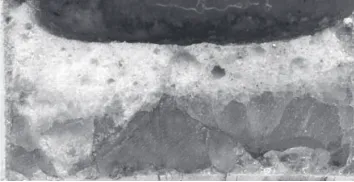
The filled crucibles were heated in an electrical fur-nace with heating filaments in the side walls at a rate of 3°C a minute from cold to the selected melt tem-perature to avoid the possibility of the crucible frac-turing during heating. For most experiments, three crucibles were placed in a single row inside the furnace allowing even heating from all sides. Once the melting schedule was complete the furnace was allowed to cool to annealing temperature, with the crucibles still in-side the furnace for a further 2 h to reduce mechanical stress in the glass. The cooled vessels were cut open using a standard petrological saw to study the degree of separation of the glass phase and any residue, and the volume proportion of glass to crystalline phases, Figure 1. Samples were initially investigated qualita-tively to inspect visually the level of crystallisation and the spatial distribution of glass and crystalline phases. Samples were then cut and mounted in epoxy resin and ground down on silicon carbide paper before they were polished with diamond paste to 0·25 µm in prepa-ration for further analysis.
Compositional analysis
Glass Technology Vol. 43C 2002 Proc. XIX Int. Congr. Glass, Edinburgh, 1–6 July 2001
ing approximately 280 µm2.At this magnification so-dium counts stayed stable over time, Figure 2. Area analysis was performed on all the glassy regions while crystal identification was done by spot analysis. Ele-ments searched for included SiO2, Na2O, CaO, Cl, MgO, K2O and Al2O3 with K2O and Al2O3 measured only to monitor interaction between the glass and the crucible (see above, Methodology).
Results
Initial findings indicate that the time and temperature required to form a glass are very different for the two major glass compositions studied here and that the melting temperature directly controls the content of calcium oxide in the glass melt. The general relation-ship between melting time and temperature is by no means new.(15) However, the strong dependency of the extent of this relationship upon the overall composi-tion and the implicacomposi-tions of this for early glassmakers is highly relevant to the compositions witnessed and the preference for ‘Egyptian’ compositions during the Late Bronze Age. The crystalline residue comprises not only silica but a range of other binary and ternary oxide compounds; a full presentation of this is, however, be-yond the remit of this current paper and will be dis-cussed elsewhere in the context of identifying such residue in the archaeological record. Ongoing work by one of the authors involves LBA material from Qantir-Piramesses in Egypt and Hellenistic debris from a glass factory in Rhodes(16,17)
both exhibiting textures and phase assemblages very similar to those produced dur-ing our experiments.
Partial melting
The formation of glass occurs, as expected, much more rapidly near the soda rich trough than near the silica rich trough, even for compositions of identical liquidus temperatures. Furthermore, reasonable glass formation with less than about 10% residual crystalline matter al-ready occurs in the ‘Egyptian’ trough at the theoretical, or set, batch melting temperature while the same glass quality in the ‘Roman’ trough requires over-firing by at
least 50°C. This is obviously due to the increased amount of soda acting as a flux in the glass. When melting glass batches based in the silica rich cotectic trough, a full melt will not occur without over-firing and in many cases a much longer melt time is required.
The spatial separation of glass and residual crystal-line matter was typically good enough to allow mechani-cal separation when about half the total material appeared glassy after firing. Separation by simple hand picking after crushing gave a clean glass fraction and a residual frac-tion rich in crystalline matter. Upon re-firing at the same temperature as the initial firing, the former fused to a perfectly clear glass ingot, while the latter separated again into a glassy region and residual crystalline material, i.e. more glass was drained from the residual crystalline ma-terial without increasing the firing temperature.
With the batch composition in the soda-rich trough melting faster and more completely, it is not surpris-ing that early glassmakers used this general composi-tion for their glassmaking. As typical Late Bronze Age Egyptian glass tends to form around the soda rich cotectic trough, as opposed to Roman glass which forms around the silica rich cotectic trough, this ob-served phenomenon is clear evidence for the preferred choice of earlier glass makers for batch compositions closer to the soda rich cotectic trough for production. This is probably not due to conscious choice but rather determined by the limitations in contemporary furnace design and refractories available. The use of a soda rich batch enabled a suitable melt to occur using less time and/or less overheat(15) to achieve a good quality glass than was necessary for a ‘Roman’ glass composi-tion with limited fuel requirements and a furnace de-sign within the existing technological reach as defined by ceramic firing and metal melting.
The experiments revealed that the concept of par-tial melts is feasible and probable. Melts under-fired from their intended batch firing temperature showed clear evidence of partial melting with clear glassy sec-tion forming under a crystalline cap holding the re-mainder of the partially reacted batch material. This phenomenon varied in proportion with different batch compositions and with the melt temperature but is clearly visible in all samples. It is now necessary to iden-tify evidence for its existence in the archaeological record before one can discuss its relevance for ancient glassmaking practice.
Partial melt compositions
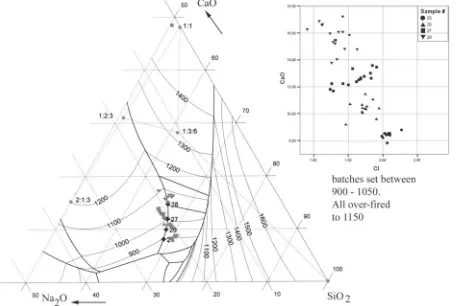
The composition of the glass produced regularly matched the composition of the melting temperature rather then the initial or set batch temperature/com-position with only slight shifts depending on the amount and types of crystals present. An example given is melt numbers 06 and 10, situated in the silica rich trough, Figure 3. Melt 06 had its batch composi-tion set at 1000°C and was fired at 1000°C. Melt 10 had a batch composition set at 1100°C and was also fired at 1000°C. The resulting products were visibly different with melt 10 being much more crystalline and frothy than melt 06 which showed some clear partial melt of glass forming. Typically for the silica rich Figure 2. Peak intensities for sodium and silicon, respectively in
glass. Measured at an area of ca. 280 µm2 (800× magnification)
Glass Technology Vol. 43C 2002 Proc. XIX Int. Congr. Glass, Edinburgh, 1–6 July 2001
trough, the total amount of glass phase visible when fired at the set temperature was far from impressive but enough to form pockets in the residual crystalline matter. While the amounts of glass differed, the com-positions of the glass phase of both, as determined by microprobe analysis, were identical. This demonstrates that the composition of the forming glass within a batch is predetermined by the batch composition but ultimately controlled by the firing temperature. The forming melt uses the batch material, or rather crys-talline material newly formed from reactions within the initial batch material, as a buffer or reservoir to draw on as the temperature allows.
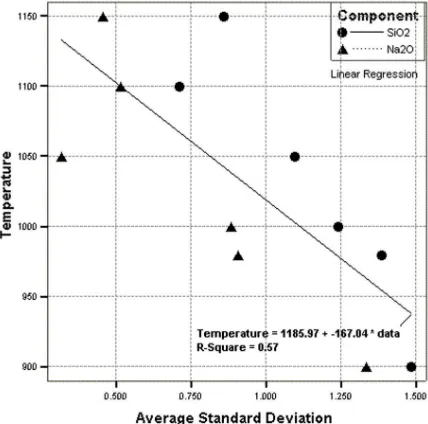
With increased temperature, but maintaining the dif-ference between set batch composition temperature and actual firing temperature, there was clear improvement in the glass that formed as well as a more defined sepa-ration between the glassy region and the crystalline phase. In addition, the measured composition of the glasses melted at lower temperatures has a wider spread of values than the measured composition of the glasses melted at higher temperatures. There is an inverse cor-relation between the temperature of the melt and the average standard deviation of the measured values for the glassy phases, Table 1 and Figure 4. The average standard deviation of the spread at batches melted at 900°C were 1·488, 0·743 and 1·336 for SiO2, CaO and Na2O, respectively, while the average standard devia-tion of the spread of values at batches melted at 1150°C were 0·860, 0·374 and 0·456 for SiO2, CaO and Na2O, respectively. The reason for this tightening of glass phase composition is not fully understood but may have some-thing to do with the cotectic trough that runs parallel to the 900°C isotherm, allowing for a wider spread of com-positions to form as the glass approaches 900°C, or more generally with increasing diffusion rates with increasing temperatures and hence increasing homogeneity of the forming melt at a microscale.
This phenomenon is not an isolated incident but mirrors the variability in real Egyptian glass composi-tions as reported.(4,11)
The plotted values for Egyptian
glass fall within a temperature range of approximately 990–1080°C and show a tighter concentration at higher temperatures and a wider spread of values at lower temperatures. It is noted that the phenomenon reported here is of standard deviations within glass samples, while variability between glass samples was reported(4) but the general trend is the same.
Chlorine
Part of this experimental study was intended to ex-plore the dependency of chlorine content in the form-ing glass upon meltform-ing temperature and melt composition. An approximate inverse correlation of calcium oxide and chlorine content has been found for ancient Egyptian glasses(10)
and it was intended to test whether the chlorine content represents a possible ther-mometer or just a compositional preference of chlo-rine for low CaO glasses. To investigate this, 2 wt% chlorine was added as NaCl to batch compositions along the soda rich cotectic trough from 900 to 1050°C at 50°C intervals, reducing the sodium carbonate in the batch to account for the contribution of sodium from the salt. Due to the direction of the trough, the
Table 1. Average standard deviations for glass melts at various temperatures. Note the inverse correlation between temperature and the concentration of standard deviation for the base glass components from 900 to 1050°C. Glass homogeneity does not improve much between 1050 and 1150°C indicating that an upper limit in homogeneity has been reached
Temperature Avg std SiO2 Avg std CaO Avg std Na2O
900 1·488 0·743 1·336
980 1·388 0·588 0·909
1000 1·242 0·518 0·883
1050 1·098 0·397 0·318
1100 0·712 0·519 0·515
1150 0·860 0·374 0·456
Figure 3. Juxtaposition of glass formation and composition for melts 6 (bottom) and 10 (top), fired at 1000°C. While melt 6 produced a higher proportion of glass, the glass composition of both melts is identical within analytical error (spot cluster near batch position 6 in the phase diagram). The position of glass melt away from the batch composition is due to residual crystalline phases rich in silica and lime
Glass Technology Vol. 43C 2002 Proc. XIX Int. Congr. Glass, Edinburgh, 1–6 July 2001
main compositional difference of these batches was in the lime content. All were over fired to the same tem-perature of 1150°C to ensure a complete melt was achieved. A clear inverse correlation was found in the experimental glasses with chlorine levels being reduced from an average of 2·0 wt% in glass batches set at 900°C to an average of 1·3 wt% in glass batches set at 1050°C (Figure 5; in some cases the measured values were higher than the added amounts would allow; this is probably due to a slight systematic offset of the chlo-rine calibration of the microprobe). A second series of melts was carried out across the cotectic trough, i.e. with compositional differences primarily in the soda content, and fired at the same temperature of 1150°C. Here there was no detectable trend in chlorine content of the forming glass, indicating that the soda content has little if any influence on the chlorine uptake of the melt. The results indicate that the chlorine content in these glasses is primarily controlled by their calcium oxide content but is affected neither by the soda con-tent nor the actual melting temperature. Thus it is not possible to use chlorine as a thermometer. It was be-yond the aim of this project to study the exact mecha-nisms controlling chlorine content in glass melts but work published(14) shows that the vapour pressure for NaCl, or at least Cl from NaCl, at 1150°C is far too low to be of major effect. Very recently, matching re-sults have been reported(18) stating that the solubility of halides in glasses does not depend on temperature but rather on the type of halide and the composition of the glass; again, lime rather than soda was found to be the critical oxide.
Discussion
This study was carried out as part of a pilot study into the melting behaviour of LBA to Roman glass composi-tions under archaeologically relevant parameters, in or-der to explore potential factors controlling the observed tight chemical clustering of these glasses. In the almost complete absence of archaeological or textual evidence concerning the selection and properties of raw materials and the practicalities of the actual melting schedules, it
was decided to use relatively simple modern raw materi-als namely silica, calcium carbonate and sodium carbon-ate. The use of very similar compounds is widely accepted for Roman glass, generally believed to be made from quartz sand (silica) containing marine shells (calcium carbonate), and mineral natron (sodium carbonate) as main compounds of the batch.(7) For Egyptian glass, the use of crushed quartz as silica source and plant ash is generally accepted containing predominantly sodium carbonate and calcium carbonate together with minor amounts of other salts.(11) Little information is available concerning the exact nature and grain size of the com-pounds introduced with the plant ash. Based on ethno-graphic and emerging archaeological evidence we can only assume that both the plant ash and quartz were ground to a ‘flower-like’ grain size. Obviously further research will also specifically address this plant ash problem and attempt to identify and characterise this raw material more closely than has yet been done. For the time being the intention was to keep matters as comparable between the two groups of glasses as possible.
The general trend of the results is not in itself neces-sarily new, in particular concerning the much slower re-action of silica rich batches and the need to overfire them to obtain a clear glass. We feel, however, that it has for the first time been demonstrated and argued in an ar-chaeological context that the Egyptian glass formulation does melt without the need to overfire and at a much faster rate. This goes a long way towards explaining the different technical requirements to produce glass with regard to the two main compositional groups studied here. While it was certainly possible to reach a temperature of up to 1200°C as early as the Early Bronze Age, it was a serious problem to apply such a temperature indirectly, i.e. without the material to be heated being in direct con-tact with (and in the case of glass potentially contami-nated by) the fuel. This is not the place to discuss the development of refractory materials; it may suffice to mention that the LBA glass melting crucibles from Egypt are the earliest known melting vessels to be heated from the outside, i.e. without direct contact between fuel and charge, by a margin of around half a millennium.(19) The clay used for their manufacture starts to melt at around 1100°C(20)
limiting the applicable temperature to a maxi-mum of around 1050°C; thus, melting temperature was clearly a concern! Only the progress in furnace design and the development of thermally and chemically more refractory materials from the Iron Age onwards allowed the change to the more silica-rich ‘Roman’ glass formu-lation.(21)
Establishing the temperature range necessary to make and work glass of a specific composition is thus just one aspect of tracing the development of high tem-perature industries and clearly many such aspects have to be seen together to understand the wider picture.
So far we have restricted this research to the pure soda–lime–silica system; it is expected that the addition of magnesia and potash, and possibly even alumina, in the concentration range typically found in LBA glasses, will further promote the ease of glass formation.(22,23) Experimental work in this direction is planned together with further work concerning the influence of raw ma-terial compounds on the melting behaviour. A further Figure 5. Relationship of batch composition containing 2 wt% Cl
Glass Technology Vol. 43C 2002 Proc. XIX Int. Congr. Glass, Edinburgh, 1–6 July 2001
issue to be addressed in future work is the exact nature and fate of the proposed residue rich in crystalline ma-terial. While some of it is probably present in the ar-chaeological record(24)
much will have been reworked in the next melting rather than discarded.
Conclusions
The primary aim of this project was to investigate the possible archaeological relevance of the proposed par-tial melting model. We have shown here that the pro-duction of glass from incomplete melts of batches is feasible within the technical constraints of ancient glass making practice. The evidence for this is shown on a macro scale with either a crystalline ‘cap’ above the glass proper or a top layer of crystalline material within the glassy product, acting as a buffer or reservoir for forming glass to draw upon during the melt. Depend-ing on the proportion of glass phase formDepend-ing, the re-sulting clear glass can then be separated from the more crystalline residue by simple crushing and hand pick-ing. Subsequently, remelting the clear glass fraction at the same melting temperature at which the initial batch was fired produces a good quality glass ready for col-oration or working. In addition to being simply an in-complete melt it has also been shown that the melt phase is compositionally different from the batch, its calcium oxide content primarily beeing controlled by the melting temperature (‘partial melting’).
In particular, it has been shown here that a batch set within the soda-rich cotectic trough melts faster and produces a more complete glass then a batch set within the silica rich cotectic trough. In order to obtain a glass product of similar quality in the silica rich trough, the batch must be over fired by at least 50 to 100°C as com-pared to the ‘Egyptian’ batch situated at the same iso-therm. This observation is particularly relevant in the absence of suitable refractory materials in the LBA which would allow the overfiring necessary for Hellen-istic/Roman glass, stressing the importance of furnace and melting pot design in glass making practice.
The ‘partial melting’ model is a first step towards explaining the compositional homogeneity of ancient glass as being in part technologically controlled rather than exclusively determined by the batch recipe and composition. This opens the possibility that glass pro-duction in the Late Bronze Age and up to the late Ro-man period was not, as previously thought, restricted to very few glass production centres, each of which followed an identical batch composition. Instead, a relatively wide range of batch compositions within a given cotectic trough clearly produces compositionally similar, even identical, glass when fired at similar or identical temperatures, allowing a more flexible and realistic provision of raw materials. As a result, the importance of minor component heterogeneity in grouping and ultimately provenancing Egyptian and Roman glass, as currently attempted by I. Freestone for Roman glass and by A. Shortland & Th. Rehren for Egyptian glass, becomes more obvious.
In addition, and contrary to what has been previ-ously suggested by one of us,(10) it was demonstrated that the chlorine content of ancient glass cannot be
used as a thermometer; it has been shown that the chlo-rine uptake of the melt is inversely correlated with the lime content of the glass phase rather than with the melting temperature.
Acknowledgements
The authors would like to thank NERC for funding this research as part of the small research grant NER/B/S/ 2000/00142. We would also like to thank Professor Michael Cable for providing raw materials and moral support for the project. Thorough comments by two ref-erees greatly helped us to express our ideas more clearly and hopefully also more convincingly. Th. Rehren grate-fully acknowledges receipt of the 1998 Rakow Grant for Glass Research which allowed him to develop the initial idea for this project at the Juliette K. and Leonard S. Rakow Research Library at The Corning Museum of Glass, and the help of Dr Robert Brill in arranging for a series of initial melts to be done at the laboratories of Corning Inc. Dr Claire Seymour is warmly thanked for improving our use of the English language in this text.
References
1. Caley, E.Analyses of ancient glasses 1790–1957. 1962. Corning Mu-seum of Glass, Corning, New York.
2. Sayre, E. Summary of the Brookhaven Program of analysis of ancient glass. In Application of science in examination of works of art, Bos-ton, 1965. Pp 145–54.
3. Henderson, J. The science and archaeology of materials. 2000. Routledge, London and New York.
4. Lilyquist, C. & Brill, R. Studies in early Egyptian glass. 1993. The Met-ropolitan Museum of Art, New York.
5. Shortland, A. & Tite, M. Raw materials of glass from Amarna and implica-tions for the origins of Egyptian glass.Archaeometry, 2000, 42, 141–51. 6. Rehren, Th. Aspects of the production of cobalt-blue glass in Egypt.
Archaeometry, 2001, 43, 483–9.
7. Freestone, I., Gorin-Rosen, Y. & Hughes, M. Primary glass from Israel and the production of glass in Late Antiquity and the Early Islamic Period. In Le Route du Verre. 2000. Maison de l’Orient, Lyon. Pp 65–83. 8. Rehren, Th., Pusch, E. & Herold, A. Glass coloring works within a cop-per-centered industrial complex in Late Bronze Age Egypt. In
Prehis-tory and hisPrehis-tory of glassmaking technology. 1998. American Ceramic
Society, Westerville. Pp 227–50.
9. Wedepohl, K.H.Die Herstellung mittelalterlicher und antiker Gläser. 1993. Mainz, Stuttgart.
10. Rehren, Th. Rationales in Old World base glass compositions. J. Archaeolog. Sci., 2000, 27, 1225–34.
11. Brill, R. Chemical analyses of early glass. 1999. Corning, New York. 12. Roth, R., Dennis, J. & McMurdie, H. Phase diagrams for ceramists VI.
1987. American Ceramic Society, Westerville.
13. Shahid, K & Glasser, F. Phase equilibria in the glass forming region of the system Na2O–CaO–MgO–SiO2.Phys. Chem. Glasses, 1972, 13, 27–42.
14. Gerth, K., Wedepohl, K. & Heide, K. Experimental melts to explore the technique of medieval woodash glass production and the chlorine content of medieval glass types.Chemie der Erde, 1998, 58, 219–32. 15. Cable, M. The operation of wood fired glass melting furnaces. In
Pre-history and Pre-history of glassmaking technology. 1998. American Ceramic Society, Westerville. Pp 315–29.
16. Weinberg, G. Glass manufacture in Hellenistic Rhodes.Archaeologicon Deltion, Meletai, 1969, 24, 143–51.
17. Triantafyllidis, P. New evidence of the glass manufacture in Classical and Hellenistic Rhodes.Ann. AIHV, 1999, 14, 30–4.
18. Köpsel, D. Solubility and vaporization of halides. In Proc. Int. Congr. Glass, Volume 2. Extended Abstracts, Edinburgh, 2001. Society of Glass Technology, Sheffield. P 330.
19. Rehren, Th. Tiegelmetallurgie.Habilitation thesis. Technical Univer-sity Freiberg.
20. Turner, W. E. S. Studies of ancient glass and glassmaking processes. Part 1. Crucibles and melting temperatures employed in ancient Egypt at about 1370 BC.J. Soc. Glass Technol., 1954, 38, 436–44T. 21. Rehren, Th. Forthcoming.
22. Swift, H. R. Effect of magnesia and alumina on rate of crystal growth in some soda-lime-silica glasses. J. Am. Ceram. Soc.,1947, 30, 170–4. 23. Silverman, W. B. Effect of alumina on devitrification of sodium oxide-dolomite-lime-silica glasses. J. Am. Ceram. Soc., 1940, 23, 274–81. 24. Rehren, Th. & Pusch, E. Glass and glassmaking at Qantir-Piramesses