Preprocessing-Based Verification of Multiparty Protocols with
Honest Majority
Roman Jagom¨agis1, Peeter Laud1, and Alisa Pankova1,2,3 1
Cybernetica AS
2 Software Technologies and Applications Competence Centre (STACC) 3
University of Tartu
{peeter.laud|alisa.pankova|roman.jagomagis}@cyber.ee
Abstract. This paper presents a generic “GMW-style” method for turning passively secure protocols into protocols secure against covert attacks, adding relatively cheap offline preprocessing and post-execution verification phases. In the preprocessing phase, each party generates and shares a sufficient amount of verified multiplication triples that will be later used to assist that party’s proof. The execution phase, after which the computed result is already available to the parties, has only negligible overhead that comes from signatures on sent messages. In the postprocessing phase, the verifiers repeat the computation of the prover in secret-shared manner, checking that they obtain the same messages that the prover sent out during execution. The verification preserves the privacy guarantees of the original protocol. It is applicable to protocols doing computations over finite rings, even if the same protocol performs its computation over several distinct rings. We apply our verification method to the Sharemind platform for secure multiparty computations (SMC), evaluate its performance and compare it to other existing SMC platforms offering security against stronger than passive attackers.
1
Introduction
Suppose that mutually distrustful parties communicating over a network want to solve a common compu-tational problem. It is known that such a computation can be performed in a manner that the participants only learn their own outputs and nothing else [36], regardless of the functionality that the parties actually compute. This general result is based on a construction expensive in both computation and communication, but now there exist more efficient general secure multiparty computation (SMC) platforms [10, 14, 20, 25], as well as various protocols optimized to solve concrete problems [13, 17, 19, 31].
Two main kinds of adversaries against SMC protocols are typically considered: passive and active. The highest performance and greatest variety is achieved for protocols secure against passive adversaries. In practice one would like to achieve stronger security guarantees (see e.g. [48]). Achieving security against active adversaries may be expensive, hence intermediate classes (between passive and active) have been introduced.
In practical settings, it is often sufficient that the active adversary is detected not immediately after the malicious act, but at some point later. Hence ideas from verifiable computation (VC) [34] are applicable to SMC. In general, VC allows a weak client to outsource a computation to a more powerful server that accompanies the computed result with a proof of correct computation that is relatively easy for the weak client to verify. Similar ideas can be used to strengthen protocols secure against passive adversaries: after execution, each party will prove to others that it has correctly followed the protocol.
In this work we propose a distributed verification mechanism allowing one party (the prover) to convince others (the verifiers) that it followed the protocol correctly. All the inputs and the incoming/outgoing mes-sages of the prover are secret-shared (using a threshold linear secret-sharing scheme) among all the other parties. The verifiers repeat the prover’s computations, using verifiable hints from the prover. The verification is zero-knowledge to any minority coalition of parties.
are generated and shared correctly. During verification, the correctness of precomputed triples implies the correctness of prover’s computations.
The entire construction constitutes a variant of the GMW compiler [16, 36] from passively to actively secure protocols, showing that this technique can be highly efficient. Our verification phase can be seen as an interactive proof, where the prover uses correlated randomness to make the proof, and the verifier has been implemented using SMC to ensure its correct behaviour and prover’s privacy.
Applying this verification mechanism n times to any n-party computation protocol, with each party acting as the prover in one instance, gives us a protocol secure against covert (if verification is performed at the end) or fully malicious (if each protocol round is immediately verified) adversaries corrupting a minority of parties. In this work we apply that mechanism to the SMC protocol set [10] employed in the Sharemind platform [9], demonstrating for the first time a method to achieve security against active adversaries for Sharemind. We note that the protocol set of Sharemind is very efficient [39], and its deployments [11, 37, 60] include the largest SMC applications ever [6, 7]. We discuss the difficulties with previous methods in Sec. 2.
From covert to active security. The verification step converts a protocol secure against a passive ad-versary to a protocol secure againstcovertadversary [2] that is prevented from deviating from the prescribed protocol by a non-negligible chance of getting caught. In our case, the probability of not being caught is neg-ligible, based on the properties of underlying message transmission functionality (signatures), hash functions, and the protocols that generate offline preshared randomness.
In general, we believe that in most situations, where sufficiently strong legal or contractual frameworks are in place, providing protection against covert adversaries is sufficient to cover possible active corruptions. The computing parties should have a contract describing their duties in place anyway [28], this contract can also specify appropriate punishments for being caught deviating from the protocol.
Moreover, the protocol set [10] is private against active adversaries, as long as no values are declassi-fied [52]. If declassification is applied only to computation results at the end of the protocol, then prepending it with our verification step gives us an actively secure protocol [43].
Hence in this paper, our stated goal is to achieve a strong form of covert security, where any deviations from the protocol will remain undetected with only negligible probability. But we keep in mind that it is only a small step from this security property to fully active security.
Cost of precomputation. There exist other protocols for SMC secure against active adversaries (see Sec. 2) where the additional verification of the behaviour of parties causes only very modest overheads. Our verification phase, even while having a reasonable cost of its own, is not competitive with these approaches. However, the efficiency of the verification of these other approaches comes at the expense of very costly precomputation (see Sec. 2), significantly hampering the deployment. Our approach also has the precompu-tation phase, which is still the most expensive part of the protocol, but it is orders of magnitude faster than previous methods (see Sec. 6) and may actually serve as a partial replacement for them (see Sec. 7).
The reduction of the total cost of actively secure computation is the main benefit of our work. We achieve this through novel constructions of verifiable computing, reducing the correctness of computations to the correctness of pre-generated multiplication triples and tuples for other operations. An important difference of our triple generation from the other works is that the prover is allowed to know the values of the triples, which makes the triple generation significantly more efficient.
2
Related Work
frameworks, including SPDZ [25] or ABY [30]. Differing from them, we use the triples not for performing computations, but for verifying them. This is a new idea that allows us to sidestep the most significant difficulties in pre-generating the tuples.
The difficulty is, that the precomputed tuples for secure computation must be private. Heavyweight cryptographic tools are used to generate them under the same privacy constraints as obeyed by the main phase of the protocol. Existing frameworks utilize homomorphic [30,51,53] or somewhat (fully) homomorphic encryption systems [12, 23] or oblivious transfer [49]. For ensuring the correctness of tuples, the generation is followed by a much cheaper correctness check [23]. Our approach keeps the correctness check, but the generation can be done “in the open” by the party whose behaviour is going to be checked.
While these methods can be secure for dishonest majority, they lead to protocols that are in some sense weaker than ours — they do not allow the identification of a misbehaving party. Recently, an identification mechanism for SPDZ-like protocols has been proposed [59], but the complexity of determining the identity of a misbehaving party may be too high for being a sufficient deterrent.
For honest majority and three parties, a recent method [33] proposes the use of a highly efficient passively secure protocol for precomputing multiplication triples. Again, this method only allows the detection of misbehaviour, but no identification of the guilty party.
Previously, methods for post-execution verification of the correct behaviour of protocol participants have been presented in [3,21,42]. We note that the general outline of our verification scheme is similar to [3] — we both commit to certain values during protocol execution and perform computations with them afterwards. However, the committed values and the underlying commitment scheme are very different. One important resulting difference is that our work can be straightforwardly applied to computation over rings.
We apply our verification to the protocol set of Sharemind [9], which is based on additive sharing over finite rings among threecomputing parties. The number of parties providing inputs or receiving outputs may be much larger. Typically, the rings represent integers of certain length. The protocol set tolerates one passive corruption. Existing MAC-based methods for ensuring the correct behaviour of parties are not applicable to this protocol set, because these methods presume the sharing to be done over a finite field. Also, these methods can protect only a limited set of operations that the computing parties may do, namely the linear combinations and declassification. Sharemind derives its efficiency from the great variety of protocols it has and from the various operations that may be performed with the shares.
Complexity of actively secure integer multiplication and AES
We are interested in bringing security against active adversaries to integer and floating-point operations, to be used in secure statistical analyses [7], scientific computations [37] or risk analysis [6]. Such applications use protocols for different operations on private data, but an important subprotocol in all of them is the multiplication of private integers. Hence, let us study the state of the art in performing integer multiplica-tions in actively secure computation protocol sets. All times reported below are amortized over the parallel execution of many protocol instances. All reported tests have used modern (at the time of the test) servers (one per party), connected to each other over a local-area network.
Such protocol sets are based either on garbled circuits or secret sharing (over various fields). Lindell and Riva [46] have recently measured the performance of maliciously secure garbled circuits using state-of-the-art optimizations. Their total execution time for a single AES circuit is around 80ms, when doing 1024 executions in parallel and using the security parameter η = 80 (bits). The size of their AES circuit is 6800 non-XOR gates. According to [29], a 32-bit multiplier can be built with ca. 1700 non-XOR gates. Hence we extrapolate that such multiplication may take ca. 20ms under the same conditions. Our extrapolation cannot be very precise due to the very different shape of the circuits computing AES or multiplication, but it should be valid at least as an order-of-magnitude approximation.
Recent estimations of the costs of somewhat homomorphic encryption based preprocessing for maliciously secure multiparty computation protocols based on additively secret sharing over Zp are hard to come by. In [22], the time to produce a multiplication triple for p≈264 is estimated as 2ms for covert security and 6ms for fully malicious security (with two parties, with η = 40). We presume that the cost is smaller for smallerp, but forp≈232, it should not be more than twice as fast. On the other hand, the increase ofη to 80 would double the costs [22]. In [23], the time to produce a multiplication triple forp≈232 is measured to be 1.4ms (two parties,η= 40, escape probability of a cheating adversary bounded by 20%).
The running time for actively secure multiplication protocol for 32-bit numbers shared using Shamir’s sharing has been reported as 9ms in [20] (with four parties, tolerating a single malicious party). We are not aware of any more modern investigations into Shamir’s secret sharing based SMC.
A more efficientN-bit multiplication circuit is proposed in [26], making use computations inZ2and inZp forp≈N. Using this circuit instead of the one reported in [29] might improve the running times of certain integer multiplication protocols. But it is unclear, what is the cost of obtaining multiplication triples forZp. In this work, we present a set of protocols that is capable of performing a 32-bit integer multiplication with covert security (on a 1Gbps LAN, with three parties, tolerating a single actively corrupted party,η= 80, negligible escape probability for a cheating adversary) in 15µs. This is around two orders of magnitude faster than the performance reported above.
In concurrent work [38], the oblivious transfer methods of [32] have been extended to construct SPDZ multiplication triples overZp. They report amortized timings of ca. 200µs for a single triple with two parties on a 1Gbps network, wherep≈2128andη= 64. Reducing the size of integers would probably also reduce the timings, perhaps even bringing them to the same order of magnitude with our results. But their techniques (as well as most others described here) only work for finite fields, not rings. For fields, there exist methods to reduce the number of discarded triples during triple verification, which also apply for us.
Recently [24], amortized time 0.5µs was reported for computing a single AES block. However, it takes into account only the online phase. The authors do not provide benchmarks for preprocessing, but they estimate that using recent mechanisms for doing preprocessing, up to 105AND gates could be computed per second. Assuming that a single AES block contains ca 6400 AND gates (as in our benchmarks), this would suffice for around 16 AES blocks per second, or 63ms per AES block. In this work, we compute a 128-bit AES block with covert security in 2.9ms, including the preprocessing.
3
Ideal Functionality
Notation. Throughout this work, we use x to denote vectors, where xi is thei-th coordinate ofx. All operations on vectors are defined elementwise. We denote [n] ={1, . . . , n}.
Circuits. Anarithmetic circuit over ringsZn1, . . . ,ZnK consists of gates performing arithmetic oper-ations, and connections between them. An operation may be either an addition, constant multiplication, or multiplication in one of the rings Znk. It may also be “x=trunc(y)” or “y =zext(x)” for x∈Znx and y ∈Zny, wherenx < ny. The first of them computes x=ymodnx, while the second liftsx∈Znx to the
larger ringZny. Finally, there is an operation (z1, . . . , zdlognxe) =bd(x) that decomposesx∈Znx into bits.
This operation could be implemented through other listed operations, but it occurs so often in Sharemind [10] protocols, and can be verified much more efficiently, so it makes sense to consider it separately.
This set of gates is sufficient to represent any computation. Any gates with other operations can be expressed as a composition of the available ones. Nevertheless, the verifications designed for special gates may be more efficient. The protocol set of Sharemind also contains some other operations, and all of them can be handled by our verification method.
Execution Functionality. We specify our verifiable execution functionality in the universal compos-ability (UC) framework [15]. Such specification allows us to precisely state the security properties of the execution.
•In the beginning,Fvmpcgets fromZ for each partyPithe message (circuits, i,(Cij`) n,n,r
i,j,`=1,1,1) and forwards them all toAS. For eachi∈[n],Fvmpc randomly generatesri. For eachi∈ C, it sends (randomness, i,ri) toAS. At this
point,ASmay stopthe functionality. If it continues, then for eachi∈ H[respi∈ C],Fvmpc gets (input,xi) fromZ
[resp.AS].
•For each round `∈[r],i∈ Handj ∈[n],Fvmpc usesC`ijto compute the messagem`ij. For allj∈ C, it sends
m`ij toAS. For eachj∈ C andi∈ H, it receivesm`jifromAS.
•Afterr rounds,Fvmpc sends (output,mr1i, . . . ,mrni) to each partyPiwithi∈ H. Letr
0
=r andB0 =∅.
Alternatively,at any timebefore outputs are delivered to parties,AS may send (stop,B0) toFvmpc, withB0 ⊆ C.
In this case the outputs are not sent. Letr0∈ {0, . . . , r−1}be the last completed round. •Afterr0 rounds,AS sends toFvmpc the messagesm`ij for`∈[r0] andi, j∈ C.
Fvmpc definesM=B0∪ {i∈ C | ∃j∈[n], `∈[r0] :m`ij6=C `
ij(xi,ri,m
1 1i, . . . ,m
`−1
ni )}.
•Finally, for eachi∈ H,AS sends (blame, i,Bi) toFvmpc, withM ⊆ Bi⊆ C.Fvmpc forwards this message toPi. Fig. 1:The ideal functionalityFvmpc for verifiable computations
publicly known arithmetic circuitCij` over ringsZn1, . . . ,ZnK. The honest parties are using these circuits to
compute their outgoing messages, while the corrupted parties can send anything.
The circuitCij` computes the`-th round messagesm`ij to the partyj∈[n] from the inputxi, randomness riand the messagesmkj0i(k < `) thatPihas received before. All valuesxi,ri,m`ij are vectors over ringsZN.
We define that the messages received during the r-th round comprise the output of the protocol. The ideal functionalityFvmpc, running in parallel with the environmentZ (specifying the computations of all parties in the form of circuits and the inputs of honest parties), as well as the adversaryAS, is given on Fig. 1.
In addition to the computation results, Fvmpc outputs to each party a set Mof parties deviating from the protocol. Our verifiability property is very strong, asall of them will be reported toall honest parties. Even if only some rounds of the protocol are computed, all the parties that deviated from the protocol in completed rounds will be detected. Also, no honest parties (inH) can be falsely blamed. We also note that ifM=∅, thenAS does not learn anything that a semi-honest adversary could not learn.
The aim of this paper is to construct an efficient protocolΠvmpc and to prove the following theorem.
Theorem 1. LetC be the set of corrupted parties. If |C|< n/2 and there is a PKI that fixes the public keys of all parties, thenΠvmpc UC-emulatesFvmpc.
The following section gives the construction of the protocol and outlines its security proof. The full proof of security is deferred to App. C.
4
The Real Protocol
Before going to the details, let us give a general look of transforming a protocol, defined by circuits C` ij, to a verifiable one. The general idea is that, after the protocol execution ends, each party (the Prover P) has to prove that it followed the protocol to the set of other n−1 parties (the VerifiersV1, . . . , Vn−1). All ninteractive proofs of the n provers may take place in parallel. In the rest of Sec. 4, we describe one such proof.
We assume that the majority of parties is honest. We show that this allows us to use linear threshold secret sharing to make P and V1, . . . , Vn−1 (some of which may be corrupted) together collaborate as an honest verifier.
Fpre works with unique identifiersid, encoding a ring sizem(id) in which the tuples are shared, the partyp(id) that
gets all the shares, and the numbern(id) of tuples to be generated. It stores a vectortripleof precomputed triples, and a vectorbitof trusted bits. LetASdenote the ideal adversary.
Initialization:On input (init,m,˜ n,˜ p˜) from each (honest) party, initializetripleandbit to empty arrays. Assign the functionsm←m˜,n←˜n,p←p˜.
Multiplication triple generation: On input (triple, id) from Pi, check if triple[id] exists. If it does, take (rkx,rky,rkxy)k∈[n]←triple[id]. Otherwise, generaterx
$
←Znm((idid)),ry $
←Znm((idid)), and computerxy ←rx·ry. Compute the shares (rkx)k∈[n], (rky)k∈[n], and (rkxy)k∈[n] ofrx,ry, andrxyrespectively. Assigntriple[id]←(rx,k rky,rkxy)k∈[n]. If
p(id)6=i, send (ri
x,riy,rixy) toPi. Otherwise, send (rkx,rky,rkxy)k∈[n] to Pi. For allk ∈ C, send (rkx,rky,rkxy) also to
AS. Ifi∈ C, send all shares (rkx,rky,rkxy)k∈[n]toAS.
Trusted bit generation: On input (bit, id) from Pi, check if bit[id] exists. If it does, take (rk)
k∈[n] ← bit[id]. Otherwise, generate a vector of random bits r ←$ Zn2(id). Compute the shares (r
k
)k∈[n] of r over Znm((idid)). Assign
bit[id]←(rk)k∈[n]. Handle (rk)k∈[n] similarly to the multiplication triple shares. Stopping:On input (stop) fromAS, stop the functionality and output⊥to all parties.
Fig. 2:Ideal functionality Fpre
At the beginning of the execution phase, P commits to its inputs and randomness by secret-sharing them among verifiers. During that phase, the parties run the protocol as usual, but they sign the messages they send out, so that the receiver may later prove which message it has got from the sender. This adds some overhead to the protocol run, but it is negligible — not many signatures are needed [47], and these can also be largely precomputed [56].
The preprocessed multiplication triples and trusted bits are not used in the execution phase. They will be needed to check the behaviour of the prover later, after the execution ends. Still, execution may not start before a sufficient number of verified triples and bits have been generated, since otherwise it will be impossible to check later if the party has cheated. Also, a party may not continue with the execution of the protocol if a signature it has received does not pass verification.
At the beginning of the post-execution phase, the prover commits to the messages it has sent and received during the execution phase by secret sharing them among the verifiers. The signatures generated during the execution phase do not allow the sender to deny the transmitted message without the receiver’s agreement. The verifiers then repeat the computations of the prover in secret-shared manner. For additions and multiplications with constants, they use the homomorphic properties of the secret-sharing scheme. For any other operation, they use verified triples or bits to linearize it. This linearization needs the opening of some secret-shared values. The prover knows all these values and can broadcast all of them in a single round. Hence, after the commitment transformation and broadcast by prover, each verifier can compute the shares of prover’s messages without further interaction.
The verification ends with the verifiers executing a protocol to check that the secret-shared messages of the prover they just computed are equal to the messages that the prover committed. At the same time, they also verify that the prover broadcast correct values. The prover sees all messages in this protocol and can complain if any verifier misbehaves. Assuming that the prover has signed all the shares that it has issued to the verifiers, the complaint can be justified. The honest majority assumption ensures that a corrupted prover cannot collaborate with the corrupted verifiers to cheat. We formalize the verification phase as a functionalityFverify given in Fig. 3.
In the rest of this section, we describe the building blocks used by Fpre and Fverify, and the protocols implementing them.
4.1 Building Blocks
Fverifyworks with unique identifiersid, encoding the party indicesp(id) andp0(id) (the latter is used only for message
commitments), the compound operation f(id) to verify (a composition of basic operations of Sec. 4.3), the input indicesxid(id), and the output indicesyid(id) on whichf(id) should be verified. The committed values are stored in an arraycomm. The messages are first stored in an arraysent before they are finally committed. LetAS denote
the ideal adversary.
Initialization: On input (init,f ,˜xid˜ ,yid˜ ,p,˜p˜0) from all the (honest) parties, initialize comm and sent to empty
arrays. Assign the functionsf←f˜,xid←xid,˜ yid←yid,˜ p←p˜,p0← ˜
p0.
Input Commitment:On input (commit input,x, id) fromPp(id), and (commit input, id) from all honest parties, if
comm[id] exists, then do nothing. Otherwise, assigncomm[id]←x. Ifp(id)∈ C, thenxis chosen byAS.
Message Commitment:On input (send msg,m, id) fromPp(id), outputmtoPp0(id). Ifp(id)∈ C, thenmis chosen
byAS. Ifp0(id)∈ C, outputmtoAS. Assignsent[id]←m.
On input (commit msg, id) from all honest parties, check ifsent[id] and comm[id] are defined. If eithercomm[id] is defined, orsent[id] is not defined, then do nothing. Otherwise, assigncomm[id]←sent[id]. If bothp(id), p0(id)∈ C, assigncomm[id]←m∗, wherem∗is chosen byAS.
Randomness Commitment:On input (commit rnd, id) fromPp(id), and (commit rnd, id) from all honest parties, ifcomm[id] exists. If it does, then do nothing. Otherwise, generate a randomr, and assigncomm[id]←r. Outputr toPp(id). Ifp(id)∈ C, outputralso toAS.
Verification:On input (verify, id) from all honest parties, takex←(comm[i])i∈xid(id) andy←(comm[i])i∈yid(id). For f ←f(id), compute y0 ←f(x). Ify0−y =0, output 1 to each party. Otherwise, output (corrupt, k) to each party. Output the differencey0−y, toAS. Output the differencey0−ytoAS.
Stopping:On input (stop, k) fromAS fork∈ C, output (corrupt, k) to each party. Do not accept any inputs from p(id) =kanymore. Assignp(id)←p0(id) forp(id) =k, andp0(id)←p(id) forp0(id) =k(in order to make the proofs of the other parties possible to finish).
Fig. 3:Ideal functionality Fverify
It would be especially sad to allow a corrupted party stop the verification phase in this way, so that the misbehaved parties will not be pinpointed.
To solve this problem, we use the transmission functionality proposed in [21]. If the receiver claims that the sender has not sent the message, then the sender has to broadcast the message, so that each party is now convinced that the message has been delivered. If the sender refuses to broadcast, it will be publicly blamed. In the optimistic setting, as far as all the parties follow the protocol, this broadcast will not be needed at all. In a single adversary model (like UC), such a broadcast does not leak any data, since if there is a conflict, then either the sender or the receiver is corrupted, and hence the adversary knows the broadcast value anyway.
We use this solution not only in the execution, but also in the preprocessing and the verification phases, in order to ensure that all the shares are delivered and all the proofs terminate.
Sharing Based Commitments The commitment of the inputs, the randomness, the messages, and also the precomputed values, is based on a linearly homomorphic (n, t)-threshold sharing scheme with signatures. It ensures consistency of the shared value and allows to prove later what exactly has been shared. We emphasize that the initial protocol that is being verified does not have to be based on some linear sharing. Our verification is very generic and can verify any multiparty computation, including the ones that do not use any sharing at all. Linear sharing is needed only for the verification.
Shamir’s sharing is an example of (n, t)-threshold sharing that works over any finite field. We could verify ring operations also in a finite field, but the solution would be cumbersome. An (n, t)-threshold sharing can be constructed on the basis of additive sharing. Let a∈R for some ring R. Let V1, . . . ,V(n
t) be all subsets
of [n] of sizet. The share of each partyPk is a vectorak ∈R(nt), such that for eachj ∈[ n
t
], the equation
P
k∈Vja
k
j =aholds. Also,akj = 0 wheneverk6∈ Vj.
In other words, the same valueais additively shared in nt
different ways, each time issuing some shares a1, . . . , atsuch thata1+. . .+at=ato a certain subset oftparties. All these nt
In this way, anytparties are able to reconstruct the secret, but less thantare not. We writeJaK= (a k)k
∈[n] to denote the sharing ofa.
Under the honest majority assumption, any (n, t)-threshold secret sharing scheme witht=bn/2c+ 1 can be used as a commitment [18]. Namely, the committed value is shared among thenparties, and each share is signed (we assume the availability of a PKI). The commitment can be opened by revealing the shares and verifying their signatures. If the number of honest parties is also at leastt, then there is an indexj, such that
Vj lists only honest parties. In this case, a set of shares can be reconstructed to at most one value, even if corrupted parties tamper with their shares (tampering may only lead to inconsistency of shares, and failure to open the commitment). The signatures on shares prevent corrupted parties from causing an inconsistent opening. Availability of at leastt honest parties allows to open the commitment even if all the corrupted parties refuse to participate.
Throughout this paper, by commitment we mean sharing the value among the n parties using a linear (n, t)-threshold sharing. In order to avoid ambiguity, no other definition of commitment is used.
4.2 Protocol ImplementingFpre
In the preprocessing phase, the parties have to produce a sufficient number of multiplication triples and trusted bits over each ring that is used in the main protocol. The prover, allowed to know the sharings, simply generates the values itself, and commits to them by (n, t)-threshold sharing. The prover is interested in generating the tuples randomly, because his (and only his) privacy depends on it. The parties will then check whether the prover generated the tuples correctly. If the check fails, the parties will not run the execution phase.
In order to perform the check, the parties first agree on a joint random seed. They will then perform two sub-checks: cut-and-choose and pairwise verification. In the cut-and-choose step, the parties randomly select ktuples and open them. This phase fails if any of the opened tuples are wrong. If cut-and-choose succeeds, only a negligible amount of the remaining tuples may be wrong. The parties then randomly partition the remaining tuples into groups ofm. In each group, they use each of the first (m−1) tuples to verify them-th one. This check fails if any of the pairwise checks fail. As analyzed below, it fails unless all tuples in a group are valid or all are invalid. After the check, the first (m−1) tuples in each group are discarded and only the last one is used. The preceding cut-and-choose step ensures that all the finally used tuples are correct, except with negligible probability.
Hence, to finish the preprocessing withutuples of certain kind, (m·u+k) tuples have to be generated and shared in the beginning. A combinatorial analysis (omitted due to space constraints, and its results are quite similar to [33]) shows that values m and k do not need to be large. For example, if u = 220, then it is sufficient to take m = 5 andk = 1300. If u = 230 then m = 4 and k = 14500 are sufficient. These choices guarantee that if the prover aims to have an invalid tuple among the finaluones, then no strategy of generating the initial tuples makes the probability of the check succeeding greater than 2−80. At the other extreme, ifu= 10, thenm= 26 andk= 168 are sufficient for the same security level.
The pairwise verification, applied to two multiplication triples, or to two trusted bits, works as follows. Note that it is certain to fail if exactly one of the tuples is a correct one.
Multiplication triples. These are triples of shared values (JaK,JbK,JcK) in a ringZn, whereaandbare random andc=a·b. Let the triple (Ja0K,Jb0K,Jc0K) be used to verify the correctness of the triple (JaK,JbK,JcK). The parties computeJˆaK=JaK−Ja0KandJˆbK=JbK−Jb0K, and declassify ˆa,ˆb(the check fails if reconstruction is impossible). They will then computeJzK= ˆa·JbK+ ˆb·Ja0K+Jc0K−JcK, declassify it and check that it is 0. The check succeeds if both tuples are correct and declassifications do not fail. If one of the tuples is correct but in the other one, the third component differs from the product of the first two components byδc, then z=±δc6= 0.
Trusted bits. These are shared valuesJbKin a ringZn, whereb∈ {0,1}is random. Let the bitJb0Kin a ringZn be used to verify thatJbKis a bit. The prover broadcasts a bit indicating whetherb=b
In a finite field, more efficient methods than pairwise verification are available. For example, we can replace the cut-and-choose and pairwise verification steps with an application of linear error correcting codes [4]. This technique allows the construction ofnverified triples from onlyn+kinitial ones, wherekis proportional toη. Hence for large values of n, the communication cost due to verification is negligible.
The discussion of this section can be seen as a proof sketch for the following lemma:
Lemma 1. LetC be the set of corrupted parties. Assuming the existence of PKI and |C|< n/2, there exists a protocolΠpre UC-realizingFpre.
The cut-and-choose with pairwise verification works similarly to [25] and [33], so we refer to [33] for a more formal proof of Lemma 1.
4.3 Protocol ImplementingFverify
The initialization ofFverify triggers initialization ofFpre that reserves the identifiers and the corresponding types of tuples that will be later used to verify the functionsf(id) with whichFverify is initialized.
One by one, we now describe how different functionalities of Fverify are implemented.
Commitment to randomness Before the execution phase starts and inputs are given to the parties, the prover P must fairly choose the randomness it is going to use during the protocol, and commit to it. For this purpose, theverifiers jointly generate this randomness. Each verifierVj sends a sufficiently long random vectorrj to the proverP and commits both herself and the prover to it. More precisely,Vjsecret-shares the vectorrj, signs the shares, and sends them all to P. The proverP checks for the correctness of sharing and the signatures, and forwards a signed share to each verifier. The proverP usesP
jrjas its randomness. The sharing of this sum can be computed as the sum of the shares of allrj.
This method works as far as the protocol rounds are synchronous, so that a corrupted prover cannot collaborate with some corrupted verifier to tamper with the randomness share after all the shares of the honest verifiers get known to P. In this particular case, synchronicity can be enforced by requiring each verifier to send first to each other party the hash of the shares that it will obtain fromPafter one round, and only then transmit toP the actual shares. In this way, the prover is bound to thetshares of eachrj issued to the honest parties already before anyrj is revealed toP. We get a subprotocol implementingcommit rnd.
Commitments to inputs and messages Before the execution phase starts, the proverP commits to its inputxby secret-sharing it. This implementscommit input.
During the execution phase, the prover P signs the outgoing messages; each message m to someP0 is signed together with the identity of the protocol run it is participating in, as well as its position in this run. In protocols spanning many rounds, many signatures are necessary. To reduce the effort, methods for signing digital streams [35] may be useful. This implements the functionsend msgthat is a prerequisite for
commit msg.
After the execution phase ends, the proverP secret-shares the messagemit had sent to someP0 during the execution, separately signs all shares, and sends them all to P0. Party P0 (one of the verifiers) makes sure that the sharing was done correctly, and sends to each party its share, in turn signing it, so that it can be seen that bothP andP0 agree on the samem. If the sharing was incorrect,P0 publishes the message, its shares, and allP’s signatures, demonstrating thatP has misbehaved. Requiring signatures on shares from both the sender and the receiver ensures that P andP0 agree on the same committed message m. SinceP0 holds the signature ofP onm, even ifP does not sharemcorrectly,P0 may commitmitself by publishing it, so that the parties may share the published m themselves in an arbitrary pre-agreed way. In the latter case, publishingmdoes not leak anything, since if at least one ofP andP0is corrupted, then the adversary has already seenm.
the sharingJmKdoes not correspond to themthat was transmitted in the execution phase only ifP andP 0
both are corrupted. In this case, the actual value ofmduring the execution phase is meaningless anyway, as it can be viewed as an inner value of the joint circuit ofP andP0, and it is only important that P andP0 are committed to the same value.
We get a subprotocol implementing commit msg.
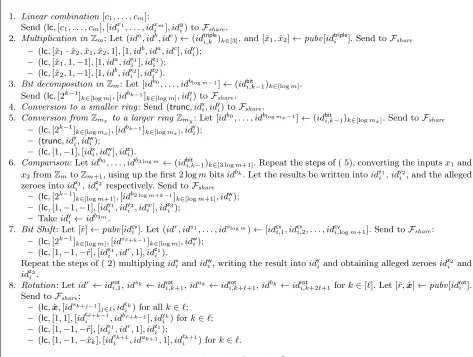
Verification Verification of basic operations. A circuit (defined in Sec. 3) is composed of addition, multiplication, bit decomposition (bd), and ring transition gates (zextandtrunc). We now describe how each of these gates is verified.
We have the following setup. There is an operationop that takeskinputs inZmand producesloutputs in Zm0. The prover knows values x1, . . . , xk, these have been shared as
Jx1K, . . . ,JxkK among then parties (the prover and (n−1) verifiers). Moreover, the prover knows the shares of all parties. During the execution of the protocol the prover was expected to apply op to x1, . . . , xk and obtain the outputs y1, . . . , yl. The verifiers are sure that the shares they have indeed correspond tox1, . . . , xk(subject to some deferred checks). A verification step gives us Jy1K, . . . ,JylK, where the prover again knows the shares of all verifiers, but no coalition of up to (t−1) verifiers has learned anything new. It also gives us a number ofalleged zeroes — shared valuesJz1K, . . . ,JzsK(all known to prover). Ifz1=· · ·=zs= 0 then the verifiers are sure that their shares of y1, . . . , yl indeed correspond to these values. All these equality checks are deferred to be verified (possibly succinctly) one round later.
Verifying linear combinations. The verifiers compute locally the linear combination of their shares. No alleged zeroes are created.
Verifying multiplications. The parties want to compute JyKfrom Jx1K and Jx2K, such that y =x1x2 in some ringZn. They pick a precomputed multiplication triple (JaK,JbK,JcK) overZn. The prover broadcasts ˆ
x1=x1−a and ˆx2 =x2−b. For an honest prover, this is the first time the values aand b are used, and since these values are uniformly distributed overZn, they serve as masks forx1 andx2.
The parties compute JyK = ˆx1·Jx2K+ ˆx2·JaK+JcK using the homomorphic properties of the sharing scheme. Similarly, they compute the alleged zeroesJz1K=Jx1K−JaK−xˆ1andJz2K=Jx2K−JbK−xˆ2.
Verifying bit decomposition. The parties want to compute Jy0K, . . . ,Jyn−1K from JxK, where x ∈ Z2n, yi ∈ {0,1}, x=Pn−1
i=0 2
iyi and all sharings are over
Z2n. They pickn trusted bits
Jb0K, . . . ,Jbn−1K, shared overZ2n. The prover broadcasts bitsc0, . . . , cn−1. The parties take
JyiK=JbiKifci = 0, andJyiK= 1−JbiK, ifci= 1 (this explains how the prover computesc0, . . . , cn−1). The parties compute the alleged zeroJzK= JxK−
Pn−1
i=0 2 i·
JyiK. Similarly to the multiplication case, this is the first time trusted bitsbi are used, and henceci are distributed uniformly over{0,1}in Z2n.
Verifying conversions between rings. The parties want to compute JyK from JxK, such that y = x, but while the sharing of x, is over Z2n, the sharing of y is over Z2m. If m < n, then the parties simply drop
n−mhighest bits from all shares ofx, resulting in shares ofy. We denote this operation byJyK=trunc(JxK). Otherwise, the parties perform the bit decomposition ofJxKas in previous paragraph, obtaining the shared bits Jy0
0K, . . . ,Jy 0
n−1K; the bits are shared over the ring Z2m. They will then compute JyK =Pin=0−12i·Jyi0K
and the alleged zeroJzK=JxK−Pn−1
i=1 2
i·trunc( Jy
0
iK). All the published values are distributed uniformly, by reasoning similar to the previous cases.
Verifying outputs of circuits.By composing the steps described above, the parties obtain a sharingJyKof some output of the circuit from the commitments to its inputs. The prover has previously committed that output asJy0K. To verify the correctness of prover’s commitment, the parties simply produce an alleged zero JzK=JyK−Jy
0 K.
In the verification of operations, the communication between parties (if any) only originated from the prover. Thus the verification of a circuit can be performed by the prover first broadcasting a single long message, followed by all parties performing local computations.
The opening is simplified by the prover knowing all shares ofJzK. He broadcasts all shares to all verifiers (signed). A verifier complains if the received shares do not combine to 0, or if its own share inJzKis different from the one received from the prover. In both cases, the verifier publishes the shares signed by the prover. In the former case, the prover’s maliciousness is immediately demonstrated. In the latter case, note that an alleged zeroJzKis a linear combination (with public coefficients) of secret-shared values, where all shares are signed by the prover. The complaining verifier also publishes its shares of all values from which it computed its share in JzK. All other verifiers can now repeat the computation and check whether it was correctly performed.
Similarly to Sec. 4.3, all communication in the checking step also originates from the prover, unless there are complaints. Hence the messages in these two steps can be transmitted in the same round, and the whole post-execution phase, in the case of no complaints, only requires two rounds of communication. The transformation of commitments takes place in both rounds, while the messages required for verifying basic operations and checking alleged zeroes are broadcast during the second round.
Putting the subprotocols ofFverify together Putting together the subprotocols of Sec. 4.3, and assuming
identifiable abort (ensured by the message transmission of Sec. 4.1 that we use for sending all messages), we get a method that allows to blame any party that deviated from the protocol in any of its three phases. It may be less clear at this point whether the real protocol allows blaming more parties, that have not misbehaved during the execution phase.
The function stop of Fverify allows to blame any party Pk for k ∈ C, so it is not a problem if any corrupted party is blamed due to deviating from the additional verification-related steps. Note that, in our implementation ofFverify, the accusations may take place in the following two cases:
1. The partyPifailed in proving its honestness in the execution phase. IfPiis honest, then it has honestly followed the execution phase, and it always committed only the values that lead to successful alleged zero check. Under honest majority assumption, using threshold secret sharing with signatures ensures that the corrupted parties cannot tamper with their shares and force the proofs of Pi to fail.
2. Some other party presents a signature, proving that Pi has generated a set of shares that does not correspond to the previously signed message (during commitments), or that Pi generated a share that does not correspond to the shares it has committed before (during the verification). An honest party never signs a value that does not correspond to its previous signatures.
The discussion above gives us a proof sketch for the following lemma.
Lemma 2. LetC be the set of corrupted parties. Assuming the existence of PKI and |C|< n/2, there exists a protocolΠverify UC-realizingFverify in Fpre-hybrid model.
UsingFverify for commitments of all the input, randomness, and communication; and to later verify the computation on this values, we get an implementation ofFvmpc, thus proving Theorem. 1.
5
Extensions
In this section, we describe possible optimizations and extensions of the protocol described in Sec. 4.
5.1 Optimizations
Our protocols allow a general optimization: in a secret sharingJaK= (ak)
k∈[n]we can delete from the vectors ak (of length n
t
SM virtual machine
SM networking Primitive protocols Protocol
descriptions
Application bytecode
message
signing messagesigning Verified tuple
generation
lo
gg
in
g
Post-processing virtual machine
PP networking Protocol
compiler
Preprocessing phase Execution phase Post-execution phase
Fig. 4:Components of Sharemind with verification
in some ringR andai is held by the i-th verifier. This simplification enables many more optimizations for n= 3, as described below.
Sharing the messages. At the beginning of the post-execution phase, to share the messages it had sent or received during the execution phase, the prover does not have to do anything: the messages are already shared. Indeed, one of the verifiers, being the recipient or the sender of that message, already knows it. The other verifier’s share of that message will be 0.
Committing to randomness. For the prover to commit to its randomness at the beginning of the execution phase, he receives a signed random seedsi from the i-th verifier. He will then useG(s1) +G(s2) (for the PRGG) as its randomness.
In case of Sharemind, the commitment is even simpler. In all protocols currently in use, any random value is known by exactly two parties out of three (each pair of parties has a common random seed). Hence any random valuerused by the prover is already shared in the same manner as the messages.
Checking alleged zeroes. To check if Jz1
K, . . . ,Jz s
K are all equal to 0, the first verifier computes H(z1
1, z12,· · · , z1s) and the second verifier computes H((−z12),(−z22),· · ·,(−z2s)), whereH is a hash function and zi
1, z2i are the shares of Jz i
K held by the first and second verifier, respectively. They sign and send the computed shares to each other and to the prover, and check that they are equal.
5.2 Auditability
If a party P has deviated from the protocol, then all honest parties will learn its identity during the post-execution phase. In this case, assuming that P does not drop out from the verification process at all, the honest parties are going to have a set of statements signed byP, pertaining to the values of various messages during the preprocessing, execution, and post-execution phases, from which the contradiction can be derived. These statements may be presented to a judge that is trusted to preserve the privacy of honest parties.
6
Evaluation
6.1 Implementation
Sharemind has a large protocol set for integer, fix- and floating point operations, as well as for shuffling the arrays, that can be used by a privacy-preserving application. Almost all these protocols are generated from a clear description of how messages are computed and exchanged between parties [44]. The application itself is described in a high-level language that is compiled into bytecode [8], instructing the Sharemind virtual machine to call the lower-level protocols in certain order with certain arguments. Both descriptions are used in the post-execution phase.
Preprocessing phase. The verified tuple generator has been implemented in C, compiled with gcc ver. 4.8.4, using-O3optimization level, and linking against the cryptographic library of OpenSSL 1.0.1k. We have tried to simplify the communication pattern of the tuple generator as much as possible, believing it to maximize performance. On the other hand, we have not tried to parallelize the generator, neither its com-putation, nor the interplay of computation and communication. Hence we believe that further optimizations are possible.
The generator works as follows. If the parties want to producenverified tuples, then (i) they will select mandkappropriately for the desired security level (Sec. 4.2); (ii) the prover sends shares of (mn+k) tuples to verifiers; (iii) verifiers agree on a random seed (used to determine, which tuples are opened and which are grouped together) and send it back to the prover; (iv) prover sends to the verifiersktuples that were to be opened, as well as the differences between components of tuples that are needed for pairwise verification; (v) verifiers check the well-formedness of opened tuples and check the alleged zeroes stating that they received from the prover the same values, these values match the tuples, and the pairwise checks go through. Steps (ii) and (iv) are communication intensive. In step (iii), each verifier generates a short random vector and sends it to both the prover and the other verifier. The concatenation of these vectors is used as the random seed for step (iv). Step (v) involves the verifiers comparing that they’ve computed the same hash value (Sec. 5.1). We use SHA-1 as the hash function. After the tuples have been generated, the prover signs the shares that the verifiers have.
To reduce the communication in step (ii) above, we let the prover share a common random seed with each of the verifiers. In this manner, the random values do not have to be sent. E.g. for a multiplication triple (JaK,JbK,JcK), both shares ofJaK, both shares ofJbKand one share ofJcKare random. The prover only has to send one of the shares ofJcKto one of the verifiers.
Execution phase. A Sharemind computation server consists of several subsystems on top of each other. Central of those is the virtual machine (VM). This component reads the description of the privacy-preserving application and executes it. The description is stated in the form of a bytecode (compiled from a high-level language) which specifies the operations with public data, as well as the protocols to be called on private data. There is a large number (over 100) of compiled primitive protocols that may be called by the VM. These protocols are compiled from higher-level descriptions with one of the intermediate formats being very close to circuits in Fig. 1. The protocols call the networking methods in order to send a sequence of values to one of the other two computation servers, or to receive messages from them.
In order to support verification, a computation server of Sharemind must log the randomness the server is using, as well as the messages that it has sent or received. Using these logs, the descriptions of the privacy-preserving application and the primitive protocols, it is possible to restore the execution of the server.
We have modified the network layer of Sharemind, making it sign each message it sends, and verify the signature of each message it receives. We have not added the logic to detect whether two outgoing messages belong to the same round or not (in the former case, they could be signed together), but this would not have been necessary, because our compiled protocols produce only a single message for each round. We have used GNU Nettle for the cryptographic operations. For signing, we use 2 kbit RSA and SHA-256. Beside message signing and verification, we have also added the logging of all outgoing and incoming messages.
Table 1.Time to generaten= 108 verified tuples for security parameterη= 80 (m= 4,k= 15000)
Tuple width time
Multiplication triples 32 bits 217 s 64 bits 313 s Trusted bits 32 bits 68 s 64 bits 93 s xor-shared AND triples 32 bits 217 s
been implemented in Java, translated with the OpenJDK 6 compiler and run in the OpenJDK 7 runtime environment. The verification phase requires parties to sign their messages, we have used 2 kbit RSA with SHA-1 for that purpose.
6.2 The Total Cost of Covertly Secure Protocols
For benchmarking, we have chosen the most general protocols of Sharemind overZ232: bitwise conjunction (AND32), multiplication (MULT32), 128-bit AES (AES128), conversion from additive sharing (i.e. overZ232) to xor sharing (i.e. overZ32
2 ) (A2X32) and vice versa (X2A32). We have measured the total cost of covert security of these protocols, using the tools that we have implemented. Our tests make use of three 2×Intel Xeon E5-2640 v3 2.6 GHz/8GT/20M servers, with 125GB RAM running on a 1Gbps LAN, similarly to the benchmarks reported in Sec. 2. We run a large number of protocol instances in parallel, and report the amortized execution time for a single protocol.
Preprocessing. In the described set-up, we are able to generate 100 million verification triples for 32-bit multiplication in ca. 217 seconds (Table 1). To verify a single multiplication protocol, we need 6 such triples (we use Sharemind protocol [10, Alg. 2] that formally has 3 multiplications per party, but all of them are of the formx1y1+x1y2+x2y1and can be trivially rewritten tox1(y1+y2) +x2y1). Hence the amortized preprocessing effort to verify a single 32-bit multiplication is ca. 13µs.
Sharemind uses 6400 AND gates per AES128 block. Each AND gate is just a multiplication, and it requires 6 one-bit triples. The time of generating 108 xor-shared 32-bit AND triples is 217 s. Hence the amortized preprocessing effort to verify a single 128-bit AES block is ca. 2.6 ms.
The A2X [resp. X2A] protocol requires 96 xor-shared AND triples [resp. 64 additively shared 32-bit multiplication triples], and 64 [resp. 96] 32-bit trusted bits. The amortized effort of these protocols is ca. 252µs for A2X, and 204µs for X2A.
Execution. We have measured runtimes of passively secure Sharemind with and without signing and logging. The execution times in milliseconds are given in Table 2. If a large number of these operations are computed in parallel, the amortized time (including all necessary signing and logging) is ca 0.16µs for AND32 and MULT32, 0.04 ms for one AES128 block, 2.3µs for A2X, and 5.1µs for X2A. In general, for sufficiently large inputs, the signing and logging appears to reduce the performance of the current implementation of Sharemind up to three times. It is likely that a more careful parallelization of the networking layer would eliminate most of that overhead, by performing the signature creations and verifications on currently idling processor cores.
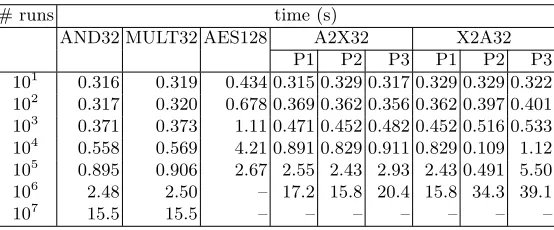
Verification. Assuming that all the inputs and the communication have already been committed, and the beaver triples precomputed, we run the verification phase in parallel for all 3 provers, and measure the total execution time (for asymmetric protocols, we report the times of all 3 provers). We consider the optimistic setting, where the prover only signs the broadcast message, and the verifiers exchange the hash of the message to ensure that they got the same message. The results are given in Table 3. When performing 10 million verifications in parallel, the cost of verification is ca. 1.6µs for MULT32 (or AND32), 0.27 ms for a single AES128 block, 21µs for A2X32, and 39µs for X2A32.
Table 2.Times of the execution phase with and without signing and logging (ms)
# runs AND32 MULT32 AES128 A2X32 X2A32 w/o w/ w/o w/ w/o w/ w/o w/ w/o w/ 101 0.362 4.75 0.349 3.96 11.3 485 0.785 38.8 0.19 8.75 102 0.345 4.42 0.237 3.84 13.4 496 0.928 38.7 1.05 8.59 103 0.147 4.58 0.282 4.04 33.0 600 1.73 45.0 2.28 12.8 104 0.668 6.37 0.733 5.40 214 726 8.44 55.6 27.3 60.4 105 7.46 15.1 8.13 15.1 2090 3740 98.4 227 252 481 106 73.9 166 73.8 184 – – 909 2290 2690 5050 107 683 1550 717 1630 – – – – – –
Table 3.Time and communication of the verification phase
# runs time (s)
AND32 MULT32 AES128 A2X32 X2A32 P1 P2 P3 P1 P2 P3 101 0.316 0.319 0.434 0.315 0.329 0.317 0.329 0.329 0.322 102 0.317 0.320 0.678 0.369 0.362 0.356 0.362 0.397 0.401 103 0.371 0.373 1.11 0.471 0.452 0.482 0.452 0.516 0.533 104 0.558 0.569 4.21 0.891 0.829 0.911 0.829 0.109 1.12 105 0.895 0.906 2.67 2.55 2.43 2.93 2.43 0.491 5.50 106 2.48 2.50 – 17.2 15.8 20.4 15.8 34.3 39.1
107 15.5 15.5 – – – – – – –
The total cost of evaluating a 128-bit AES block is ca 2.9 ms, which is at least one order of magnitude faster than the existing solutions. The total cost of conversions between additive and bitwise sharing is ca. 275µs for A2X32 and 248µs for X2A32, and we could not find similar results in related works, with whom we could compare ourselves.
The recent result of computing AND gates [33] does not report times, but uses total number of commu-nicated bits per AND gate instead. Their reported number is 30 bits per AND gate for 3 parties. Using the same security parameter η = 40 (taking m = 3), and making use of shared randomness, we get that the generation one 1-bit multiplication triple requires 1 bit of communication and each pairwise verification 4 bits (opening the 2 masked values by 2 verifiers to each other), adding up to 1 + 4·(m−1) = 9 bits for a single verified triple. Since we require a triple for each of the 6 local multiplications of Sharemind protocol, we already get 54 bits. The execution phase requires 6 bits of communication, and the verification phase 24 bits (8 for each party). This is 84 bits in total, or almost three times more. Some additional overhead may come from signatures (their cost becomes negligible as the communication grows). But our security property is stronger, allowing to pinpoint the cheating party and make the protocol aborting identifiable. Our method is also more generic and allows to easily generate preprocessed tuples other than multiplication triples, that are very useful in verifying protocols other than multiplication.
Instead of Sharemind multiplication, we could apply our verification to the protocol of [1]. This would reduce the execution phase time, but complexities of the preprocessing and the verification phases remain the same. It is not clear how well that protocol could be integrated with the other Sharemind protocols, so it becomes more interesting when more various protocols composable with [1] will be developed.
7
Conclusions and Further Work
at the end of the execution phase will increase only slightly. We evaluated the verification on top of the Sharemind SMC framework and found its overhead to be of acceptable size, roughly an order of magnitude larger than the complexity of the SMC protocols themselves included in the framework (which are already practicable).
The notion of verifiability that we achieve in this paper is very strong — a misbehaving party will remain undetected with only a negligible probability. The original notion of covert security [2] only required a malicious party to be caught with non-negligible probability. By randomly deciding (with probability p) after a protocol run whether it should be verified, our method still achieves covert security, but theaverage
overhead of verification is reduced by 1/ptimes. It is likely that overheads smaller than the execution time of the original passively secure protocol may be achieved in this manner, while keeping the consequences of misbehaving sufficiently severe. Auditability (Sec. 5.2) helps in setting up the contractual environment that establishes the consequences.
We could use the verification procedure after each protocol round, thereby obtaining a fully actively secure SMC protocol. While the communication overhead of such solution would be the same, its total overhead will probably be larger than for the verification after the computation, because of a more complex communication pattern. Also, verification after the protocol run may allow further optimizations for such computations, where the effort to check its correctness is smaller than the effort to actually perform it [57]. Such optimizations are applicable if the original SMC protocol set preserves privacy (but not necessarily
correctness) against active adversaries [52]. The extent of their applicability is a subject of future work. For three-party protocols, we see the combination of Sharemind’s multiplication protocol (or the protocol of [1]) with our verification mechanism as a suitable method for performing the precomputations of SPDZ-like SMC protocol sets. Even though we would in this manner only get security against a malicious minority, we still consider the outcome interesting, because the online phase of SPDZ is hard to beat even in this case. Also, the online phase would still be secure even against all-but-one malicious parties. There may be use cases where the number of corrupted parties increases between the precomputation phase and the actual protocol run. Again, the investigation of this use case, together with the optimizations to our scheme that may be possible due to working over fields, is a subject of future work.
References
1. Araki, T., Furukawa, J., Lindell, Y., Nof, A., and Ohara, K.High-throughput semi-honest secure three-party computation with an honest majority. InProceedings of the 2016 ACM SIGSAC Conference on Computer
and Communications Security (New York, NY, USA, 2016), CCS ’16, ACM, pp. 805–817.
2. Aumann, Y., and Lindell, Y. Security against covert adversaries: Efficient protocols for realistic adversaries.
J. Cryptology 23, 2 (2010), 281–343.
3. Baum, C., Damg˚ard, I., and Orlandi, C. Publicly auditable secure multi-party computation. In Security and Cryptography for Networks - 9th International Conference, SCN 2014, Amalfi, Italy, September 3-5, 2014.
Proceedings(2014), M. Abdalla and R. D. Prisco, Eds., vol. 8642 ofLecture Notes in Computer Science, Springer,
pp. 175–196.
4. Baum, C., Damg˚ard, I., Toft, T., and Zakarias, R.Better preprocessing for secure multiparty computation.
InApplied Cryptography and Network Security: 14th International Conference, ACNS 2016, Guildford, UK, June
19-22, 2016. Proceedings (2016), M. Manulis, A.-R. Sadeghi, and S. Schneider, Eds., Springer International
Publishing, pp. 327–345.
5. Beaver, D.Efficient multiparty protocols using circuit randomization. InCRYPTO(1991), J. Feigenbaum, Ed., vol. 576 ofLecture Notes in Computer Science, Springer, pp. 420–432.
6. Bogdanov, D., J˜oemets, M., Siim, S., and Vaht, M.How the estonian tax and customs board evaluated a tax fraud detection system based on secure multi-party computation. InFinancial Cryptography and Data Security -19th International Conference, FC 2015, San Juan, Puerto Rico, January 26-30, 2015, Revised Selected Papers
8. Bogdanov, D., Laud, P., and Randmets, J. Domain-polymorphic programming of privacy-preserving ap-plications. In Proceedings of the Ninth Workshop on Programming Languages and Analysis for Security,
PLAS@ECOOP 2014, Uppsala, Sweden, July 29, 2014 (2014), A. Russo and O. Tripp, Eds., ACM, p. 53.
9. Bogdanov, D., Laur, S., and Willemson, J. Sharemind: A framework for fast privacy-preserving compu-tations. InESORICS (2008), S. Jajodia and J. L´opez, Eds., vol. 5283 ofLecture Notes in Computer Science, Springer, pp. 192–206.
10. Bogdanov, D., Niitsoo, M., Toft, T., and Willemson, J.High-performance secure multi-party computation for data mining applications. Int. J. Inf. Sec. 11, 6 (2012), 403–418.
11. Bogdanov, D., Talviste, R., and Willemson, J.Deploying secure multi-party computation for financial data analysis - (short paper). InFinancial Cryptography (2012), A. D. Keromytis, Ed., vol. 7397 ofLecture Notes in
Computer Science, Springer, pp. 57–64.
12. Brakerski, Z., Gentry, C., and Vaikuntanathan, V.(leveled) fully homomorphic encryption without boot-strapping. In Innovations in Theoretical Computer Science 2012, Cambridge, MA, USA, January 8-10, 2012
(2012), S. Goldwasser, Ed., ACM, pp. 309–325.
13. Brickell, J., and Shmatikov, V. Privacy-preserving graph algorithms in the semi-honest model. In
ASI-ACRYPT (2005), B. K. Roy, Ed., vol. 3788 ofLecture Notes in Computer Science, Springer, pp. 236–252.
14. Burkhart, M., Strasser, M., Many, D., and Dimitropoulos, X. SEPIA: Privacy-preserving aggregation of multi-domain network events and statistics. InUSENIX Security Symposium (Washington, DC, USA, 2010), pp. 223–239.
15. Canetti, R. Universally composable security: A new paradigm for cryptographic protocols. InFOCS (2001), IEEE Computer Society, pp. 136–145.
16. Canetti, R., Lindell, Y., Ostrovsky, R., and Sahai, A. Universally composable two-party and multi-party secure computation. InProceedings on 34th Annual ACM Symposium on Theory of Computing, May 19-21, 2002,
Montr´eal, Qu´ebec, Canada(2002), J. H. Reif, Ed., ACM, pp. 494–503.
17. Catrina, O., and de Hoogh, S. Secure multiparty linear programming using fixed-point arithmetic. In
ESORICS (2010), D. Gritzalis, B. Preneel, and M. Theoharidou, Eds., vol. 6345 ofLecture Notes in Computer
Science, Springer, pp. 134–150.
18. Cramer, R., Damg˚ard, I., and Maurer, U. M. General secure multi-party computation from any linear secret-sharing scheme. InEUROCRYPT (2000), B. Preneel, Ed., vol. 1807 ofLecture Notes in Computer Science, Springer, pp. 316–334.
19. Damg˚ard, I., Fitzi, M., Kiltz, E., Nielsen, J. B., and Toft, T. Unconditionally secure constant-rounds multi-party computation for equality, comparison, bits and exponentiation. InTCC(2006), S. Halevi and T. Ra-bin, Eds., vol. 3876 ofLecture Notes in Computer Science, Springer, pp. 285–304.
20. Damg˚ard, I., Geisler, M., Krøigaard, M., and Nielsen, J. B. Asynchronous Multiparty Computation: Theory and Implementation. In Public Key Cryptography (2009), S. Jarecki and G. Tsudik, Eds., vol. 5443 of
Lecture Notes in Computer Science, Springer, pp. 160–179.
21. Damg˚ard, I., Geisler, M., and Nielsen, J. B. From passive to covert security at low cost. InTCC (2010), D. Micciancio, Ed., vol. 5978 ofLecture Notes in Computer Science, Springer, pp. 128–145.
22. Damg˚ard, I., Keller, M., Larraia, E., Miles, C., and Smart, N. P. Implementing AES via an actively/-covertly secure dishonest-majority MPC protocol. InSecurity and Cryptography for Networks - 8th International
Conference, SCN 2012, Amalfi, Italy, September 5-7, 2012. Proceedings(2012), I. Visconti and R. D. Prisco, Eds.,
vol. 7485 ofLecture Notes in Computer Science, Springer, pp. 241–263.
23. Damg˚ard, I., Keller, M., Larraia, E., Pastro, V., Scholl, P., and Smart, N. P.Practical Covertly Secure MPC for Dishonest Majority - Or: Breaking the SPDZ Limits. InESORICS (2013), J. Crampton, S. Jajodia, and K. Mayes, Eds., vol. 8134 ofLecture Notes in Computer Science, Springer, pp. 1–18.
24. Damg˚ard, I., Nielsen, J. B., Nielsen, M., and Ranellucci, S.Gate-scrambling revisited - or: The tinytable protocol for 2-party secure computation. Cryptology ePrint Archive, Report 2016/695, 2016. http://eprint. iacr.org/2016/695.
25. Damg˚ard, I., Pastro, V., Smart, N. P., and Zakarias, S. Multiparty computation from somewhat homo-morphic encryption. In Safavi-Naini and Canetti [55], pp. 643–662.
26. Damg˚ard, I., Toft, T., and Zakarias, R. W. Fast multiparty multiplications from shared bits. Cryptology ePrint Archive, Report 2016/109, 2016. http://eprint.iacr.org/.
27. Damg˚ard, I., and Zakarias, S.Constant-overhead secure computation of boolean circuits using preprocessing. InTCC (2013), pp. 621–641.
28. Damiani, E., Bellandi, V., Cimato, S., Gianini, G., Spindler, G., Grenzer, M., Heitm¨uller, N., and Schmechel, P. PRACTICE Deliverable D31.2: risk-aware deployment and intermediate report on status of
29. Demmler, D., Dessouky, G., Koushanfar, F., Sadeghi, A., Schneider, T., and Zeitouni, S. Automated synthesis of optimized circuits for secure computation. In Ray et al. [54], pp. 1504–1517.
30. Demmler, D., Schneider, T., and Zohner, M. ABY - A framework for efficient mixed-protocol secure two-party computation. In 22nd Annual Network and Distributed System Security Symposium, NDSS 2015, San
Diego, California, USA, February 8-11, 2014 (2015), The Internet Society.
31. Franklin, M. K., Gondree, M., and Mohassel, P. Communication-efficient private protocols for longest common subsequence. In CT-RSA (2009), M. Fischlin, Ed., vol. 5473 of Lecture Notes in Computer Science, Springer, pp. 265–278.
32. Frederiksen, T. K., Keller, M., Orsini, E., and Scholl, P.A Unified Approach to MPC with Preprocessing Using OT. InAdvances in Cryptology - ASIACRYPT 2015 - 21st International Conference on the Theory and Application of Cryptology and Information Security, Auckland, New Zealand, November 29 - December 3, 2015,
Proceedings, Part I (2015), T. Iwata and J. H. Cheon, Eds., vol. 9452 of Lecture Notes in Computer Science,
Springer, pp. 711–735.
33. Furukawa, J., Lindell, Y., Nof, A., and Weinstein, O. High-throughput secure three-party computation for malicious adversaries and an honest majority. Cryptology ePrint Archive, Report 2016/944, 2016. http: //eprint.iacr.org/2016/944.
34. Gennaro, R., Gentry, C., and Parno, B. Non-interactive verifiable computing: Outsourcing computation to untrusted workers. InCRYPTO(2010), T. Rabin, Ed., vol. 6223 ofLecture Notes in Computer Science, Springer, pp. 465–482.
35. Gennaro, R., and Rohatgi, P. How to sign digital streams. InAdvances in Cryptology - CRYPTO ’97, 17th Annual International Cryptology Conference, Santa Barbara, California, USA, August 17-21, 1997, Proceedings
(1997), B. S. Kaliski, Jr., Ed., vol. 1294 ofLecture Notes in Computer Science, Springer, pp. 180–197.
36. Goldreich, O., Micali, S., and Wigderson, A. How to Play any Mental Game or A Completeness Theorem for Protocols with Honest Majority. InSTOC (1987), ACM, pp. 218–229.
37. Kamm, L., and Willemson, J. Secure floating point arithmetic and private satellite collision analysis.
Inter-national Journal of Information Security (2014), 1–18.
38. Keller, M., Orsini, E., and Scholl, P.Mascot: Faster malicious arithmetic secure computation with oblivious transfer. Cryptology ePrint Archive, Report 2016/505, 2016. http://eprint.iacr.org/2016/505, to appear in CCS 2016.
39. Kerik, L., Laud, P., and Randmets, J. Optimizing MPC for robust and scalable integer and floating-point arithmetic. In Proceedings of WAHC’16 - 4th Workshop on Encrypted Computing and Applied Homomorphic
Cryptography (2016), M. Brenner and K. Rohloff, Eds.
40. Kreuter, B., Shelat, A., and Shen, C. Billion-gate secure computation with malicious adversaries. In
Proceedings of the 21th USENIX Security Symposium, Bellevue, WA, USA, August 8-10, 2012(2012), T. Kohno,
Ed., USENIX Association, pp. 285–300.
41. Krips, T., and Willemson, J. Hybrid model of fixed and floating point numbers in secure multiparty compu-tations. InInformation Security - 17th International Conference, ISC 2014, Hong Kong, China, October 12-14,
2014. Proceedings(2014), S. S. M. Chow, J. Camenisch, L. C. K. Hui, and S. Yiu, Eds., vol. 8783 ofLecture Notes
in Computer Science, Springer, pp. 179–197.
42. Laud, P., and Pankova, A.Verifiable Computation in Multiparty Protocols with Honest Majority. InProvable Security - 8th International Conference, ProvSec 2014, Hong Kong, China, October 9-10, 2014. Proceedings
(2014), S. S. M. Chow, J. K. Liu, L. C. K. Hui, and S. Yiu, Eds., vol. 8782 ofLecture Notes in Computer Science, Springer, pp. 146–161.
43. Laud, P., and Pettai, M. Secure multiparty sorting protocols with covert privacy. In Proceedings of Nordsec 2016 (2016).
44. Laud, P., and Randmets, J.A domain-specific language for low-level secure multiparty computation protocols.
InProceedings of the 22nd ACM SIGSAC Conference on Computer and Communications Security, Denver, CO,
USA, October 12-6, 2015 (2015), ACM, pp. 1492–1503.
45. Laur, S., Willemson, J., and Zhang, B. Round-Efficient Oblivious Database Manipulation. InProceedings
of the 14th International Conference on Information Security. ISC’11 (2011), pp. 262–277.
46. Lindell, Y., and Riva, B. Blazing Fast 2PC in the Offline/Online Setting with Security for Malicious Adver-saries. In Ray et al. [54], pp. 579–590.
47. Merkle, R. C. Secrecy, authentication, and public key systems. PhD thesis, Stanford University, 1979. 48. Mohassel, P., Orobets, O., and Riva, B. Efficient Server-Aided 2PC for Mobile Phones. Proceedings of
Privacy Enhancing Technologies 2016, 2 (2016), 82–99.