Single Image Fog Removal Using Depth Estimation
Based on Blur Estimation
Mr. Anwar hussain1, Mr.Shriniwas Singh2, Mr. Amit Asthana3
1
Department of Computer Science & Engineering, S.V.S.U India 2
Meerut, India
Abstract- Visibility in poor weather condition is severely degraded by scattering of light due to suspended particles in the atmosphere such as haze and fog. In this paper, we propose defogging method from a single image based on depth estimation using blur. Formation of fog is the function of the depth. Estimation of depth information is under constraint problem if single image is available. Hence, removal of fog requires assumptions or prior information. The accurate thickness of haze or fog from a single image in these bad weather environments is still a challenging task In this paper a method is proposed to estimate the depth of the image based on blur estimation. In an image that includes objects in focus and out of focus are perceived with various blur. Measure of blur can be used for segmentation of image in terms of depth.
Index Terms- Blur, Depth, Fog, Image.
I. INTRODUCTION
A
tmospheric visibility reduces in bad weather due to fog present in the atmosphere. Under such situation, light reaching the human eye is awfully scattered byconstituents of atmosphere like fog, haze and aerosols and the image is severely degraded[1][2].
Images taken under such bad weather conditions suffer from degradation and severe contrast loss. This results in the lowering the performance of the computer vision algorithms such as surveillance, tracking, and navigation [3]. This is also one of the major reasons for accidents in air, on sea and on the road. Thus, it is very necessary to make these vision algorithms free from weather changes.
In foggy weather degradation, invisibility is caused by attenuation and airlight. A light beam travels from a scene point through the atmosphere, the light intensity gets attenuated due to the atmospheric particles, and this phenomenon is called attenuation which decreases the contrast in the scene as well as variation of scene color, which finally leads to a poor visual perception of the image. Light coming from the source is scattered by fog and part of it travels toward the camera and the remaining part is scattered in different direction. This phenomenon is called airlight. Airlight adds whiteness into the scene.
It is noted that effect of fog is the function of the distance between the camera and the scene [4]. If input is only a single foggy image, then estimation of the depth information is under constrained. Generally, estimation of depth requires two images. Therefore, many methods have been proposed which use multiple images [5]. But these methods cannot be applied on a single image system. There are many algorithms which remove fog using single image. To refine the estimation of depth information, these algorithms use some assumptions or prior knowledge. Removal of fog requires the estimation of image depth information.
There are several method proposed for fog removal based on contrast enhancement [6] [7] .Few method analyze and process the image based solely on the information from the image. The most commonly used non-model-based methods are histogram equalization and its variations. For color images, histogram equalization can be applied to R, G, B color channels separately but this leads to unwanted change in hue. This method does not fully maintain color fidelity. There are other methods like unsharp masking [8], approaches based on the Retinex theory [9], and wavelet-based methods. Generally, all algorithms have a problem with preserving color fidelity. [10] John P Oakley and Hong Bu have suggested a method of enhancement by correcting contrast loss by maintaining the color fidelity. This method gives good contrast restoration but does not provide much visibility enhancement. To enhance the visibility Robby.T.Tan et.al [11] have proposed a visibility enhancement method which makes use of color and intensity information.
II. FOG MODEL
Two noticeable fundamental facts which cause loss of visibility are attenuation and airlight . Light beam coming from a object point gets attenuated due to scattering by atmospheric particles. This phenomenon is termed as attenuation which reduces contrast in the scene. Light coming from the source is scattered toward camera and leads to the change in color. This phenomenon is termed as airlight. Airlight increases with the distance from the object. In fog, attenuation is represented as
I
att
(x, y)
=
I
0
(x, y)e
−
kd(x,y)
(1)Where, Iatt(x, y) is the attenuated image intensity (gray level or RGB) at pixel (x, y) in presence of fog and I0 (x, y) is the image
intensity in absence of fog (i.e., fog-free image or scene radiance). k is the attenuation coefficient and d is the distance of the object from the viewer or camera.
Airlight is represented as
A(x, y) = I
∞
(1 − e−
kd(x,y)
) (2)Where, I∞ is the global atmospheric constant. It is also called sky intensity. According to the Koschmieder law , the effect of fog on pixel intensity is represented as
I(x, y) = I
att
(x, y) + A(x, y) (3)Where, I(x,y) is the observed image intensity at pixel (x, y). The Koschmieder law may be represented as
I(x, y) = I
0
(x, y)e−
kd(x,y)
+ I∞
(1 − e−
kd(x,y)
)(4)
Where in the first term on right hand side is the direct attenuation and second term is the airlight [15] . When atmosphere is homogenous, then transmission map can be expressed as
t(x, y) = e
−
kd(x,y)
(5)Hence, a fog model can be described as
I(x, y) = I
0
(x, y).t(x, y) +A(1− t(x, y)) (6)If depth‘d’ and Airlight ‘A’ is estimated transmission map t(x,y) can be estimated and hence scene irradiance I0 can be estimated as
given below
I(x, y) + A (7)
I0 (x, y) = t(x, y) + A
It is shown in eqn. (4) that visibility of fog depends on the depth. Multiple images are required for depth estimation. Hence, earlier methods used multiple images for restoration. Because of handiness of use, many algorithms are proposed using single image. In this paper we have proposed a method of estimating the depth based on blur estimation.
Value of airlight A is estimated by dark channel prior method proposed by He et al[12]. Dark channel prior is based on a key observation that most local patches in foggy outdoor images contain pixels which have low intensities in at least one color component. Thus, for an image, dark channel image is defined as
I
dark(x, y)= min (x,y)min∈Ω (Ic(Ω)) (8)c∈
{
r,g,b}
where, Ω is a local patch in image.
III. DEPTH ESTIMATION
The main origins of blur are objects being out of focus, shadows casted by objects, or objects having a physical surface that is perceived as blur. An object out of focus will produce a blur because it is too far away from the focal plane. This already hints to distance or depth. The amount of blur that is in a part of such an image increases with depth. Therefore, if we can estimate the amount of blur, we can estimate the relative depth.
A straightforward method for blur estimation has been proposed by Hu and Haan (13). In their approach, they reblur the signal to be
determined twice with Gaussian kernels σaand σbto determine the local blur σ of the signal The signal is convolved with a Gaussian
kernel with different standard deviations σaand σb leading to two signals ba(x) and bb(x). To make the blur independent of amplitude
and offset, ratio r(x) is computed.
r(x)=
b(x)− ba(x) (9)
ba(x)− bb(x)
The difference ratio will now peak where the difference between b(x) and the reblurred versions is large. This will happen at points where the signal changes significantly in amplitude, exactly the points where the blurring has the most impact. In this local signal, only the point where r(x) is largest is of interest, because it will define σ of the entire area. This is because we assume t hat locally the blur is the same for that area. Therefore we will apply a maximum filter with a certain window which results in rmax(x). This
maximum ratio can mathematically be solved using σ, σaand σb. If we assume:
σa,σb >> σ
Then we can fill in and write out the Gaussian functions in (9) for their maximum peak location, we can rewrite the equation to solve for our blur estimation:
σ ≈ σ a −σ b (10)
(
σa−σb)
.rmax (x) +σbWe can see that it computes the smallest blur size locally around the edge as σ ≈ 1. We can see that the rest of the signal contains little
information. Therefore, the ratio is low. This will lead to a blur size close to that when rmax(x) → 0, which shows the largest distinguishable blur of the signal. we can estimate the relative depth from the blur. The depth is given by
D ≈
F.v0 (11)
v0− F −σ. f
Where D is the distance from the lens to the point of interest, v0 the distance between lens and focal plane, F is the focal length, f the
aperture number of the lens and σ the Gaussian standard deviation or blur size. So equation (11) directly relates the estimated blur the to a absolute depth estimation.
IV. PERFORMANCE EVALUATION PARAMETER
In Removal of fog is analyzed qualitatively. A Haze-removed image has additional contrast in comparison with the foggy image. Hence, contrast gain can be a parameter for the quantitative analysis of haze removal algorithms. Contrast gain can be described as [27],[28]
mean contrast difference between de-foggy and foggy image. Contrast gain for all fog removal algorithms should be positive. High contrast gain indicates better performance of the algorithm If CIdef and CIfog are mean contrast of de-foggy and foggy image
respectively, then contrast gain is defined as
C
gain
=
C
Idef−
C
Ifog (12)Let an image of size M×N be denoted by X(x, y). Then, mean contrast is expressed as
1 N−1M−1 (13)
CI = ∑ ∑ C(x, y)
MxN y=0 x=0
Where
C(x, y) =S(x, y) (14)
m(x, y)
Where
1 p p
m(x, y) = ∑ ∑ X(x + k, y + l) (2p +1)
2
k=−p l=−p1
p p
X
(
x + k, y + l)
− m(x, y)S(x, y) = ∑ ∑
(
2p +1)
2
k=−p l=−p(15)
(16)
Contrast gain should not be so high that the pixels of the output image become saturated. Hence, along with the high contrast gain, it is also required to measure the number of saturated pixels. Percentage of the saturated pixels [29]σ is denoted as
n (17)
σ =
(
M × N)
×100where n is the number of pixels which are saturated (either completely black or white) after the restoration but were not before. Low
value of σ indicates better performance of the algorithms.
V. RESULT AND DISCUSSION
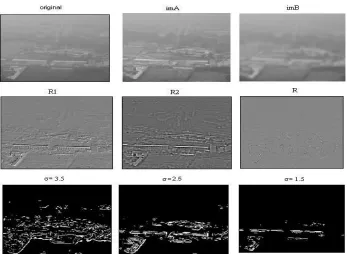
Simulation was carried out on various images of different depth level. By varying the value of σ, depth at various locations in an images can be estimated and hence fog can be removed from the image. It is found that the time taken to remove the fog from the images was very less as compare to other algorithm. For the better performance of the fog removal algorithm, contrast gain (Cgain) should be high and percentage of saturated pixels (σ) should be low at the same time. For the image given the contrast ratio is found to
be 0.05 before restoration and after restoration it is 0.35 and percentage of saturated pixel σ is found to be 0.0002. Results indicate that algorithm proposed has high contrast gain and low value of percentage of saturated pixels results in the restored image. Result shows that the proposed method restores the foggy images with good perceptual quality.
Figure 1: Depth segmentation using blur estimation by using the Hu and Haan method. imA and imB are the two
blurred images with σa = 6 and σb = 2. Middle row shows the maps of R1=imorig - imA , R2=imA-imB and
Rmax. The three images on the bottom row indicate segmented thresholded depths in the image for σ =
Figure 2: (a) Original foggy image (b). Restored Image
REFERENCES
[1] K. Garg, and S.K. Nayar, "Vision and Rain", International Journal of Computer Vision, Vol. 75, no. 1, pp. 3-27, 2007.
[2] S.G. Narasimhan, and S.K. Nayar, "Chromatic Framework for Vision in Bad Weather", IEEE Conference on Computer Vision and Pattern Recognition,
Vol. 1, , 2000 ,pp. 598-605.
[3] S.K. Nayar, and S.G. Narasimhan, "Vision in bad weather", IEEE International Conference on Computer Vision (ICCV), Vol. 2, 1999, pp.820-7.
[4] S G. Narasimhan, and S.K. Nayar, "Vision and the Atmosphere", International Journal of Computer Vision, Vol. 48, no. 3, pp. 233-54, 2002.
[5] S.G. Narasimhan, and S.K. Nayar, "Contrast restoration of weather degraded images", IEEE transaction on pattern analysis and machine intelligence,
Vol. 25, no. 6, June. 2003, pp. 713-24.
[6] Y.Y. Schechner, S.G. Narasimhan, and S.K. Nayar, "Instant dehazing of images using polarization", IEEE Computer Society Conference on Computer
Vision and Pattern Recognition, pp. 325-32, 2001
[7] J. Zhang, L. Li, G. Yang, Y. Zhang, and J. Sun, "Local albedo-insensitive single image dehazing" The Visual Computer, 2010, pp. 761-8.
[8] J.P. Oakley, and B.L. Satherley, "Improving image quality in poor visibility conditions using a physical model for contrast degradation", IEEE
transaction on image processing, Vol. 7, no. 2, pp. 167-79, 1998.
[9] J.P. Tarel, and N. Hautiere, "Fast visibility restoration from a single color or gray level image", IEEE International Conference on Computer Vision,
2009, pp. 2201-2208.
[10] J.P. Oakley, and H. Bu, "Correction of simple contrast loss in color images", IEEE transaction on image processing, Vol. 16, vo. 2, 2007, pp. 511-22.
[11] R.T. Tan, "Visibility in bad weather from a single image", IEEE conference on Computer Vision and Pattern Recognition, 2008, pp. 18.
[12] K. He, J. Sun, and X. Tang, "Single image haze removal using dark channel prior", IEEE International Conference on Computer Vision and Pattern
Recognition, 2009, pp. 1956-63
[13] H. Hu and G. de Haan: Low Cost Robust Blur Estimator, Proceedings ICIP 2006,Atlanta.
[14] J.H. Elder and S.W. Zucker: Local Scale Control for Edge Detection and Blur Estimation, IEEE Transaction on Pattern Analysis and Machine
Intelligence, Vol 20, No 7, 1998
[15] S.G. Narasimhan, and S.K. Nayar, "Removing weather effects from monochrome images", International conference on computer vision and pattern
recognition, 2001, pp. 186-93.
[16] J. Kopf, B. Neubert, B. Chen, M. Cohen, D. Cohen-Or, O. Deussen, et al., "Deep photo: Model-based photograph enhancement and viewing", ACM
Transactions on Graphics, Vol. 27, no. 5, 2008, pp. 116:1-116.
[17] .G. Narasimhan, and S.K. Nayar, "Interactive (De) weathering of an image using physical models", IEEE Workshop on color and photometric methods
in computer vision, In conjunction with ICCV, Oct. 2003.
[18] D. Kim, C. Jeon, B. Kang, and H. Ko, "Enhancement of image degraded by fog using cost function based on human visual model", IEEE International
Conference on Multisensor Fusion and Integration for Intelligent Systems, 2008, pp. 163-71.
[19] R. Fattal, "Single image dehazing", International Conference on Computer Graphics and Interactive Techniques archive ACM SIGGRAPH, 2008, pp.
1-9.
[20] A. Levin, D. Lischinski, and Y. Weiss, "A closed form solution to natural image matting", CVPR, Vol. 1, 2006, pp. 61-9.
[21] S. Fang, J. Zhan, Y. Cao, and R. Rao, "Improved Single Image De- hazing Using Segmentation", IEEE International Conference on Image Processing
(ICIP), 2010, pp. 3589-92.
[22] A.K. Tripathi, and S. Mukhopadhyay, "Single Image Fog Removal Using Anisotropic Diffusion" (Paper communicated to IET Image processing).
AUTHORS
First Author –Mr.Anwar Hussain, Researh Scholor , Second Author –Mr.Shriniwas Singh,
Third Author: Mr Amit Asthana 6