A Controller Based Approach for Web Services
Virtualized Instance Allocation
Sandesh Tripathi , S Q Abbas , Rizwan Beg 1,2,3
CSE Department, Integral university, Lucknow
Abstract— Few Service providers provide compute intensive
and data intensive services over web platform; where in applications can be deployed on demand. These service providers usually employ machine virtualization for providing cost effective solution. At the time of infrastructure purchase, one may opt for a particular instance, assuming that this will satisfy the computational needs. Whereas considering the case when no of service request increases, the more robust instance may be needed.
In this paper, we present a mechanism which provides optimal instance allocation satisfying the computational needs. Results show that this approach utilizes the infrastructure in more optimal manner.
Keywords— Web Service, Allocating Services, Controller
I. INTRODUCTION
Amazon web services (AWS) is a collection of remote computing services (also called web services) that together make a cloud computing environment. Few famous services are Amazon Elastic Compute Cloud (EC2) ,Amazon Simple DB, Amazon Simple Queue Service(SQS), Amazon Simple Storage service (S3) and many more. Launched in July 2002, Amazon Web Services provides on line services for the web sites or client side services. The services are not directly exposed to the end user but instead offer functionality that developers can use.AWS offerings are accessed over HTTP, using Representational State Transfer (REST) and SOAP protocols. These services are billed as per usages, but the usages are measured for billing varies from service to service. AWS allows obtaining a configurable capacity with minimal friction. It allows scaling the capacity quickly up and down. Hence changes the economics involved for computing and allow one to pay only for the capacity of actual use.
In this approach analytic performance models are combined with QCAC ( QoS Computation and Configuration algorithm) , to design a controller mechanism, which runs periodically to determine the best possible instance type satisfying QoS parameters under present load, and choose the same. Such systems will encourage users to use controller based systems. Due to the dynamic instance shifting such systems are easily scalable.
II. UNDERSTANDING INSTANCE
BASED SERVICES
A. Need of Utility Computing
Utility computing is a service provisioning model in which a service provider makes computing resources and Infrastructure management available to the customer as needed, and charges for specific usages rather than flat rate. Utility computing promises to cut costs. AWS was the first, who offered this model. Among few examples are, A) 6 waves limited a leading international publisher and developer of gaming applications on the Facebook platform, uses Amazon EC2 and Amazon S3 to host its social games with an audience of more than 50 million players per month, B) 99designs’ massive design marketplace has received over 3.1 Million unique design submissions from over 53,000 designers around the world and runs entirely on AWS, C) YouOS uses S3 to allow 60,000 customers to store 12 GB of storage for its collaborative web operating system, are among few examples. Amazon says its services are designed to be scalable, fast, secure and simple.
B. Virtualization used in AWS
by the driver domain first, and then transferred to the guest domain.
III.RELATED WORK
Few studies have evaluated the performance of cloud services, where as little work has been done in the area of dynamic instance allocation. Guohui [12], studied the impact of virtualization on network performance of Amazon EC2 data centre. They presented a measurement study to characterize the impact of virtualization on networking performance of the Amazon Elastic Cloud Computing data centre. They measured the processor sharing, packet delay, TCP/UDP throughput and packet loss among Amazon EC2 virtual machines. Simson L. Garfinkel [20] evaluated and fined out in their study that Amazon Services have great promise but they lack service layer agreement. E. Walker[12] benchmarked Amazon EC2 for high performance scientific computing. The author evaluated how Amazon EC2 can be used for scientific computing. Our work signifies how dynamic allocation can be done for instances in agreement to QoS.
IV.ESTIMATION OF QOS
This metric combines the relative deviations of the average response time , average throughput, and probability of rejection with respect to the desired goals.
The relative deviation of the average response time is defined as
(1)
is the maximum average response time, which can be tolerated and is the measured response time. The properties of the above definition can be given as:
= 0 if the response time exactly meets
its SLA i.e., = .
if the response time exceeds its
SLA i.e., . Given that the
measured response time is at least equal to the sum of the service demands
for all K resources [2], then by using eq. 1 ,it can be concluded that
( )/
0 if the response time does not
meet its SLA i.e., . Then
from eq. 1 it follows that /
Taking an example if the measured response time is 6 sec and the maximum response time is 9 sec, then
indicating that there is a 33% loss with respect to the measured response time. For meeting the SLA it would be necessary to cut down 33% of the measured response time to meet the SLA.
The relative deviation of the probability of rejection is similarly as
= (2)
Where is the maximum probability of rejection tolerated and is the measured probability of rejection.
The properties of the above definition can be given as: if the probability of rejection exactly
meets its SLA i.e., = .
if the probability of rejection exceeds its SLA.
if the probability of rejection does not meet its SLA i.e., .
The relative deviation of the average throughput is defined as
= (3)
Where is the measured throughput,
λ , ) is the minimal value between the arrival rate and the minimum required throughput .
The properties of the above definition can be given as: if the throughput meet its SLA i.e.,
.
if the throughput exceeds its
SLA i.e., .
if the throughput does not
meet its SLA i.e., ., .
A single metric QoS can now be defined as a weighted sum of the three QoS deviations defined above. Thus, Qos =
Where = are weights, in the interval
[0,1], determined by the management, to indicate the relative importance of response time, throughput and probability of rejection. QoS is a dimension less number between -1 and 1. If all three metrics meet or exceed their SLA, QoS ≥0. If QoS 1 , then at least one of the metrics does not meet its SLA.
V. SYSTEM DESCRIPTION
that arrive and find n requests in the system are rejected. When a thread is executing a request, it is using physical resource such as CPU or disk. So, the response time of a request can be broken into the following components: waiting for a thread (i.e software contention), waiting for a physical resource, and using a physical resource.
. The Approach for this self configuring web service compute cloud is assisted by the configuration controller mechanism that monitors the AWS Cloud, monitors various resources utilizing content, execute the QCAC ( QoS Computation and Configuration Analysis Component) at regular interval, computes the best configuration for AWCC ( Amazon web service Compute Cloud). As a result of this controller mechanism running continuously at regular intervals generates the reconfiguration commands to instruct the AWS to adapt the best configuration under present circumstances also satisfying the QoS.
The Architecture of the configuration controller mechanism has three main components: Request Capacity Analysing Component known as RCAC, Resource Utilization Analysing Component known as RUAC, and QoS Computation and Configuration Analysis Component known as QCAC. RCAC analyses the number of arriving requests from different service requesting computers, and computes parameters like the load intensity, arrival rate of requests and uses these statistical parameters for forecasting the load conditions in next interval. This data is used by QCAC as the input parameters of the Queuing Model solved by QCAC. The RUAC component collects the data from various resource s (e.g CPU, Disks) and also has a count on various completing request. This parameter helps in computing throughput. The average service time of a request at a resource can be computed as the ratio between the resource utilization and the system throughput. The QCAC generates the best possible configuration for AWS cloud considering the QoS inputs, the arriving requests and departing requests.
In the general approach for designing self managing / self organizing computer system [12], a system is subject to a work load. There are many factors of parameters and settings that may affect the performance of such systems. The set of parameters can be divided into uncontrolled parameters and controlled parameters. Uncontrolled parameters are that are not changed dynamically by controller. These parameters are those that have relatively little impact on performance or that require a system restart or reboot in order to take effect to take place. Controlled parameters are those whose settings are changed dynamically by the controller QCAC, by executing controller algorithm. The goal of this algorithm is to find optimized instance under present load, satisfying QoS values. A set of responses are generated as the result of service request load and setting of controlled and uncontrolled parameters. These responses can be divided into primary and secondary responses. The former are those whose values must be kept within desired range as specified by Service Layer Agreement (SLAs) or QoS goals
QCAC Algorithm:
QCAC algorithm for finding close to optimal configuration for instance allotment-
Step 1 If Service Requests in a particular interval is greater than > No of requests (n): go to Step 16 , else step 2
Step 2 Check WSDL for incoming service requests i.e., if P 1 :Go to step13 , if P 2 :Go to step10, if P 3:Go to step 7, if P 4 :Go to step 3,
Step 3 If P 4 , Check for any other type of instance is
being served presently, if yes, go to step 5, else Step 4
Step 4 Check QoS fitness satisfaction under present load, if satisfied choose P40 instance , else
choose P33 instance
Step 5 Choose highest priority instance running at primary level, Check QoS fitness under present load is satisfied, If yes, choose the nearest matching priority instance, allot & continue , else go to Step 6
Step 6 Go to step 16
Step 7 If P 3, Check if any higher priority instance is
running, If yes, go to step 5, else step 8
Step 8 Check QoS fitness satisfaction under present load is satisfied, if yes, choose P33,else step 9
Step 9 Choose the nearest matching instance i.e. P31
or P32
Step 10 If P 2,check if any highest priority instance is
running, if yes, go to step 5 ,else step 11
Step 11 Check QoS fitness satisfaction under present load is satisfied, if yes, choose P22 ,else step 12
Step 12 Choose the nearest matching instance i.e. P22
or P21
Step 13 If P 1 , check if P 11 type request is running, if
yes, go to step15, else step 14
Step 14 Check for QoS fitness satisfaction under present load, if satisfied choose P12, else Step 16
Step 15 Check for QoS fitness satisfaction under present load is satisfied, if yes continue with P11 ,else step 16
Step 16 Discard this request
Choose Micro Instance (MI), P40
Choose Standard Small Instance (SSI), P33
Choose Standard Large Instance (SLI), P32
Choose Standard Extra Large Instance (SELI), P31
Choose High Memory Extra Large Instance (HMELI), P23
Choose High Memory Double Extra Large Instance (HMDELI), P22
Choose High Memory Quadruple Extra Large Instance (HMQELI), P21
P12
Choose High CPU Extra large Instance (HCELI), P11
VI.EXPERIMENTAL RESULTS
Since EC2’s servers are Linux based virtual machines running on top of the Zen Virtualization Engine [14]. A Linux machine having 1.7 GHz x 86 processor, 1.75 GB of RAM, 160 GB of local disk is used for experiments. The virtualization is implemented on this machine as Amazon web Services are implementing, using Xen based Virtualization Environment. This virtual environment is also used by Amazon. This environment uses Xen hypervisor, the Domain 0, and 9 VM guests. These nine VM guests implemented nine instances under consideration. The system consists of one CPU and one disk. The workload is being driven by another machine using proxy-sniffer (a workload generator), which can also be used for Amazon EC2. The service demands at the CPU and disks are 0.03 sec and 0.05 sec, respectively. The SLA and the respective weights are:
=0.25,
= 0.30, and
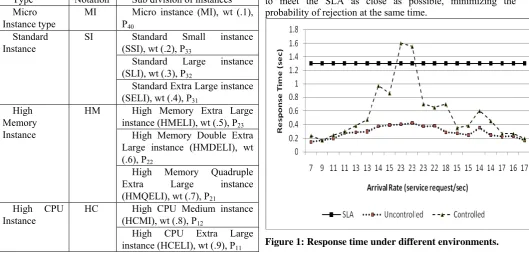
Table 1 details the instances with their respective weight. The QCAC algorithm is implemented periodically, for each interval. QCAC chooses the most optimum instance, satisfying the QoS, no of service request, workload conditions etc.
Table 1: Instances and their respective weights
Type Notation Sub division of instances Micro
Instance type
MI Micro instance (MI), wt (.1), P40
Standard Instance
SI Standard Small instance
(SSI), wt (.2), P33
Standard Large instance (SLI), wt (.3), P32
Standard Extra Large instance (SELI), wt (.4), P31
High Memory Instance
HM High Memory Extra Large instance (HMELI), wt (.5), P23
High Memory Double Extra Large instance (HMDELI), wt (.6), P22
High Memory Quadruple Extra Large instance (HMQELI), wt (.7), P21
High CPU Instance
HC High CPU Medium instance (HCMI), wt (.8), P12
High CPU Extra Large instance (HCELI), wt (.9), P11
During experiments, the arrival rate of requests started from a low of 7 service requests per second and the load was increased up to a maximum of 23 service requests per second, during a period of 1 hr and 40 min. The controller interval is of 300 seconds. During any interval with peak average loads of 23 service requests per second, 6900 requests arrive. At the maximum load of 23 service request per second, the resource bottleneck reaches close to 100 %, after this load was not increased further otherwise the probability of rejection would be turning up too high.
After the arrival rate reaches to its maximum value of 23 service request per second, the disk utilization reaches to its max of 99% approx, where as for the uncontrolled case the peak disk utilization value is only of max 83%. When the controller is disabled not all the system resources are being utilized optimally. Due to the controller action the system resources are better utilized, furnishing required QoS. The controlled system adjusts itself to keep controlled even at higher loads, where as the uncontrolled system violates the SLA as soon as the service request reaches to value of 15 requests per second. Hence the controlled system satisfies the QoS also and gives proper computational facility while saving cost.
Fig. 1 explains the variation of average response time versus the arrival of number of requests per second.
It can be seen that as the number of service request per second reaches to its peak, the response time for controlled system moves to a value of 1.6 sec and even it violates the SLA for a very short duration. Whereas the response time for the uncontrolled system is lower than in comparison to the controlled system response time. The reason for this is that at high loads, even 22% of the service requests are rejected and are kept out of the queue. The controlled system adjusts itself to meet the SLA as close as possible, minimizing the probability of rejection at the same time.
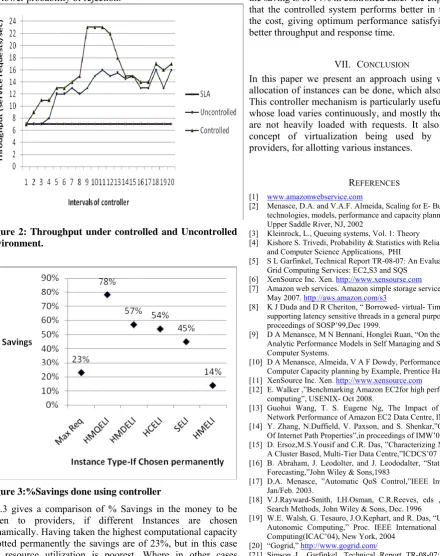
This provides higher throughput (Fig.2). The throughput of the controlled system is better than the uncontrolled one, due the lower probability of rejection.
Figure 2: Throughput under controlled and Uncontrolled environment.
Figure 3:%Savings done using controller
Fig.3 gives a comparison of % Savings in the money to be given to providers, if different Instances are chosen dynamically. Having taken the highest computational capacity allotted permanently the savings are of 23%, but in this case the resource utilization is poorest. Where in other cases considering, allotting P21 permanently the saving is of 78% in controlled case, allotting P22 permanently the saving is of 57% in controlled case, allotting P11 permanently the saving
is of 54% in controlled case, allotting P31 permanently the saving is of 45% in controlled case, allotting P21 permanently the saving is of 14% in controlled case. The experiments show that the controlled system performs better in term of saving the cost, giving optimum performance satisfying QoS, gives better throughput and response time.
VII. CONCLUSION
In this paper we present an approach using which dynamic allocation of instances can be done, which also satisfies QoS. This controller mechanism is particularly useful for consumer whose load varies continuously, and mostly their applications are not heavily loaded with requests. It also illustrates the concept of virtualization being used by large solution providers, for allotting various instances.
REFERENCES [1] www.amazonwebservice.com
[2] Menasce, D.A. and V.A.F. Almeida, Scaling for E- Business:
technologies, models, performance and capacity planning, Prentice Hall, Upper Saddle River, NJ, 2002
[3] Kleinrock, L., Queuing systems, Vol. 1: Theory
[4] Kishore S. Trivedi, Probability & Statistics with Reliability, Queuing and Computer Science Applications, PHI
[5] S L Garfinkel, Technical Report TR-08-07: An Evaluation of Amazon’s Grid Computing Services: EC2,S3 and SQS
[6] XenSource Inc. Xen. http://www.xensourse.com
[7] Amazon web services. Amazon simple storage service (amazon s3), May 2007. http://aws.amazon.com/s3
[8] K J Duda and D R Cheriton, “ Borrowed- virtual- Time(bvt) scheduling: supporting latency sensitive threads in a general purpose scheduler” In proceedings of SOSP’99,Dec 1999.
[9] D A Menansce, M N Bennani, Honglei Ruan, “On the Use of Online Analytic Performance Models in Self Managing and Self-Organizing Computer Systems.
[10] D A Menansce, Almeida, V A F Dowdy, Performance by Design: Computer Capacity planning by Example, Prentice Hall, 2004 [11] XenSource Inc. Xen. http://www.xensource.com
[12] E. Walker ,”Benchmarking Amazon EC2for high performance scientific computing”, USENIX- Oct 2008.
[13] Guohui Wang, T. S. Eugene Ng, The Impact of Virtualization on Network Performance of Amazon EC2 Data Centre, INFOCOM2010 [14] Y. Zhang, N.Duffield, V. Paxson, and S. Shenkar,”On The Constancy
Of Internet Path Properties”,in proceedings of IMW’01,Nov.2001 [15] D. Ersoz,M.S.Yousif and C.R. Das, ”Characterizing Network Traffic In
A Cluster Based, Multi-Tier Data Centre,”ICDCS’07
[16] B. Abraham, J. Leodolter, and J. Leododalter, “Statistical Methods of Forecasting,”John Wiley & Sons,1983
[17] D.A. Menasce, ”Automatic QoS Control,”IEEE Internet Computing, Jan/Feb. 2003.
[18] V.J.Rayward-Smith, I.H.Osman, C.R.Reeves, eds ,Modern Heuristic Search Methods, John Wiley & Sons, Dec. 1996
[19] W.E. Walsh, G. Tesauro, J.O.Kephart, and R. Das, “Utility Functions in Autonomic Computing,” Proc. IEEE International Conf. Autonomic Computing(ICAC’04), New York, 2004
[20] “Gogrid,” http://www.gogrid.com/