
to speed up PBKDF2
Andrea Visconti and Federico Gorla
Department of Computer Science Giovanni degli Antoni, Università degli Studi di Milano
[email protected] [email protected]
http://www.di.unimi.it/visconti
Abstract. PBKDF2 [27] is a well-known password-based key derivation function. In order to slow attackers down, PBKDF2 introduces CPU-intensive operations based on an iterated pseudorandom function (in our case HMAC-SHA-1). If we are able to speed up a SHA-1 or an HMAC implementation, we are able to speed up PBKDF2-HMAC-SHA-1. This means that a performance improvement might be exploited by regular users and attackers. Interestingly, FIPS 198-1 [31] suggests that it is possible to precompute rst message block of a keyed hash function only once, store such a value and use it each time is needed [43]. Therefore the computation of rst message block does not contribute to slowing attackers down, thus making the computation of second message block crucial. In this paper we focus on the latter, investigating the possibil-ity to avoid part of the HMAC-SHA-1 operations. We show that some CPU-intensive operations may be replaced with a set of equivalent, but less onerous, instructions. We identify useless XOR operations exploiting and extending Intel optimizations [26], and applying the Boyar-Peralta heuristic [12]. In addition, we provide an alternative method to compute the SHA-1 message scheduling function and explain why attackers might exploit these ndings to speed up a brute force attack.
Keywords: HMAC-SHA-1, Password-Based Key Derivation Function 2, PKCS#5, Intel optimizations, Boyar-Peralta heuristic
1 Introduction
In order to avoid the use of user-chosen passwords as a key to cryptographic systems, a number of approaches have been developed. In particular, we are in-terested in password-based Key Derivation Functions, a set of algorithms which input a user-chosen password and provide a stream of pseudorandom bits pre-senting enough entropy and an adequate length to be used as key in real-world applications.
Password-based KDFs introduce CPU/memory intensive operations which avoid, or make dictionary and brute force attacks less feasible. At the same time, such operations are not so expensive to become a burden for a regular user.
In 2013, a Password Hashing Competition (PHC) [1] was held to develop a number of resistant password-based key derivation functions. PHC selected a winner (Argon2 [6]) and gave a special recognition to four algorithms (Catena [18], Lyra2 [40], yescrypt [34] and Makwa [35]). Although Argon2 is expected to be the password-based KDF of the next years, currently one of the most widely used functions is PBKDF2 [37]. Described by RSA Labs in PKCS#5 [37], PBKDF2 has been implemented in several real-world applications such as WPA/WPA2 [25], 1Password [2], Keeper [28], LUKS [20] [9], LassPass [30], Codebook [16], GRUB2[24], RAR archive format [36], FileVault Mac OS X [3], [15], Android's full disk encryption (since version 3.0 Honeycomb to 4.3 Jelly Bean), and many others. PBKDF2 uses a salt to prevent the construction of universal dictionaries and an iteration count to accurately tune the tradeo between user perceived slowness of the key derivation process and bruteforce attack resistance [42].
Most of the PBKDF2 computations are performed by a pseudorandom func-tion, and in this paper we focus on HMAC-SHA-1. Notice that not all the appli-cations previously mentioned use PBKDF2-HMAC-SHA1 by default. For exam-ple, 1Password (Agile Keychain format) [23]) does, while 1Password (OPVault format) [22] does not. Cryptsetup version 1.6.8 (and above) does, while versions 1.7.01.7.5 do not and the hash function used is SHA-256 [13]. RAR (previous to version 5) does, while versions 5.005.50 do not and the pseudorandom func-tion is HMAC-SHA-256 [36]. GRUB2 [24] implements PBKDF2-HMAC-SHA512 while Codebook [16] uses PBKDF2-HMAC-SHA-1.
If we are able to speed up SHA-1 or HMAC-SHA-1, we are able to speed up PBKDF2. Interestingly, when the HMAC function is implemented without following the performance improvement described in [29] and [31], it is possible to avoid 50% of PBKDF2's CPU intensive operations involved in the key derivation process. Moreover, as described in [41], [43] and [38], other critical aws might be exploited, thus reducing the total number of CPU-intensive operations to be performed for computing a key. Therefore, the only requirement to maintain security is to increase the number of computations through the iteration count parameter of PBKDF2.
In this paper, we describe an HMAC-SHA-1 optimization which can be used to speed up PBKDF2. Focusing on the computation of second message block of HMAC-SHA-1, we investigate the possibility to avoid part of the CPU-intensive operations by executing a set of equivalent, but less onerous, instructions. By doing so, we identify useless XOR operations exploiting and extending Intel optimizations [26] and applying the Boyar-Peralta heuristic [12]. In addition, we provide an alternative method to compute the SHA-1 message scheduling function and explain why attackers might exploit these ndings to speed up a brute force attack against PBKDF2-HMAC-SHA-1.
The remainder of this paper is organized as follows. In Section 2 we briey introduce the Hash-based Message Authentication Code (HMAC) algorithm, re-ferring in particular to HMAC-SHA-1. Password-based Key Derivation Function version 2 (PKBDF2) is described in Section 3. In Section 4 we present the origi-nal contribution of this paper, showing how performance improvements of SHA-1 and HMAC-SHA-1 might be exploited to speed up PBKDF2-HMAC-SHA-1. Fi-nally, discussion and concluding remarks are drawn in Section 5.
2 HMAC-SHA-1
A Hash-based Message Authentication Code is an algorithm for computing a message authentication code based on any iterated cryptographic hash function. The denition of HMAC [29] requires
H: a cryptographic hash function; K: the secret key;
text: the message to be authenticated.
As described in RFC 2104 [29], an HMAC can be dened as follows:
HM AC=H(K⊕opad ||H(K⊕ipad ||text)) (1)
where H is the chosen hash function, K is the secret key, ⊕ is the exclusive OR symbol, || is the concatenation symbol and ipad, opad are constant values respectively, the byte 0x36 and 0x5C repeated 64 times. In order to better understand Equation 1, we can expand it in the form:
HM AC=H(K⊕opad|| h)
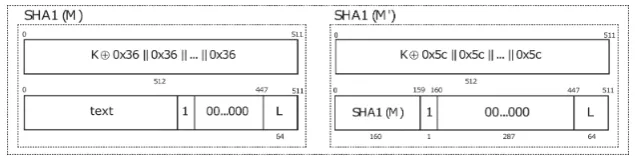
In this paper we will refer to HMAC-SHA-1 which is the default as per [37]. Therefore Equation 1 can be graphically represented as in Figure 1.
Readers who are not familiar with SHA-1 may nd a detailed description of the cryptographic algorithm in [32] and [17]. However, it is worth recalling some basic concepts:
SHA-1 [32] processes blocks of the size of 512 bits i.e., sixteen 32-bit words W0, . . . , W15,
it iterates for 80 rounds in order to produce a 160-bit message digest, the original message is padded with one bit 1 rst then, zero or more bits 0
so that its length is congruent to 448, modulo 512, and
the last 64 bits of the last 512-bit block represent the message lengthL. In addition, the SHA-1 algorithm uses the following message scheduling function to expandW0, . . . , W15 into eighty words:
W[i] =ROT L1(W[i−3]⊕W[i−8]⊕W[i−14]⊕W[i−16]) i∈[16. . .79]
(2) This function requires to store eighty 32-bit words, therefore if memory is lim-ited an alternative method should be adopted. In [32], NIST suggests to regard W0, . . . , W15as a circular queue and substitute the Equation 2 with the following:
s←i∧M ASK i∈[16. . .79]
W[s]←ROT L1(W[s]⊕W[(s+ 2)∧M ASK]⊕W[(s+ 8)∧M ASK]⊕W[(s+ 13)∧M ASK])
(3) whereM ASKis set to the value 0000000f (in hex), thus performing arithmetic modulo16. This new equation requires only sixteen words, thus saving sixty-four
32-bit words of storage.
3 PBKDF version 2
Password Based Key Derivation Function version 2, PBKDF2 for short, is a key derivation function published by RSA Laboratories in PKCS #5 [37]. In order to face brute force attacks based on weak user passwords, PBKDF2 introduces CPU-intensive operations. Such operations are based on an iterated pseudoran-dom function which maps input values to a derived key. PBKDF2 is fully dened by the following parameters:
a pseudorandom function (PRF) e.g. a hash function, cipher, or HMAC; an iteration countc;
a desired output lengthdkLen. and outputs a derived keyDK.
PBKDF2 can derive keys of arbitrary length. More precisely, PBKDF2 gen-erates as many blocksTias needed to cover the desired key length. Each blockTi
is computed iterating the PRF as many times as specied by an iteration count c. NIST suggests to select the iteration count as large as possible, however a min-imum of 1,000 iterations is recommended for general purpose applications while 10,000,000 may be appropriate for protecting very critical keys [42]. The length of each blockTi is bounded byhLen, which is the length of the underlying PRF
output. This PRF can be a hash function [32], cipher, or HMAC [4], [5], [29]. Since the optimizations described in this paper only applies to HMAC-SHA-1, we use this HMAC as PRF.
PBKDF2 inputs a user password/passphrasep, a random salts, an iteration counterc, and derived key lengthdkLen. It outputs a derived keyDK.
DK =P BKDF2(p, s, c, dkLen)
The derived key is dened as the concatenation ofddkLen/hLene-blocks: DK=T1||T2||. . .||TddkLen/hLene
where
T1=F unction(p, s, c,1)
T2=F unction(p, s, c,2)
...
Ti=F unction(p, s, c, i)
...
TddkLen/hLene =F unction(p, s, c,ddkLen/hLene).
Each single blockTi i.e.,Ti=F unction(p, s, c, i) is computed as
Ti=U1⊕U2⊕...⊕Uc
where (see Figure 2)
U1=P RF(p, s||i)
U2=P RF(p, U1)
...
Fig. 2. A real-world implementation [19][20] of PBKDF2 based on HMAC-SHA-1
4 Avoiding useless XOR operations
As shown in [41], [43] and [38], several performance improvements can be ex-ploited to speed up the computation of PBKDF2 e.g., precomputing the rst message block of a keyed hash function, avoiding constant additions modulo232
in the rst three rounds, avoiding SHA-1 length checks of input parameters, avoiding SHA-1 chunk splitting operations during the computation ofU2,. . . ,Uc,
and so on. In this section we present a new improvement. In particular, we show how useless operations, computed by HMAC-SHA-1 and repeated c times by PBKDF2, might be exploited by users (regular or malicious).
of RFC 2104 [29] and FIPS 198-1 [31] attackers can precompute rst message block of a keyed hash function only once (green and orange rectangles in Figure 2), store such a value and use it each time is needed. This suggests that com-putation of the rst message block does not contribute to slowing down a brute force attack, thus the computation of second message block is crucial.
Therefore we focus on the second message block with the aim to show how users might avoid part of CPU-intensive operations involved in the key derivation process. Doing so, we will exploit and extend Intel optimizations [26] and the Boyar-Peralta heuristic [12].
4.1 Exploiting Intel optimizations
As shown in [8], the SHA-1 algorithm is a vastly parallel algorithm in terms of instruction level parallelism allowing it to fully employ several ALU pipelines but it seems like it is not well suited to work with Single Instruction Multiple Data (SIMD) instructions.
One of the most interesting optimizations to SHA-1 has been described by Max Locktyukhin in [26]. Improving an idea by Dean Gaudet [21], the Intel researcher [26] shows how the SHA-1 hash algorithm can be implemented in order to take full advantage of SIMD instructions, providing a new equation to expand the sixteen 32-bit words W[0], . . . , W[15] into eighty words. More
precisely, he suggests to replace the well-known Equation 2 with the following:
W[i] = (
ROT L1(W[i−3]⊕W[i−8]⊕W[i−14]⊕W[i−16]) i∈[16. . .31]
ROT L2(W[i−6]⊕W[i−16]⊕W[i−28]⊕W[i−32]) i∈[32. . .79]
(4) As discussed in [43], the second message block of a keyed hash function has a run of several consecutive zeros (red rectangle in Figure 2) i.e., 287 zeros in the padding scheme and other 54 zeros in 64-bit message length hence nine (out of sixteen) 32-bit wordsW[i]are set to zero W[6] =W[7] =· · ·=W[14] = 0.
Therefore, 27 out of 192 XOR operations in Equation 2 are involved in zero based operations and can be easily omitted.
Making the expansion of Equation 4, it is easy to observe that wordsW[6], . . . , W[14]
are presented in a greater number of times than in Equation 2. By simply replac-ing the original SHA-1 message schedulreplac-ing function with Equation 4, we increase the number of useless XOR operations from 27 to 45.
4.2 Extending Intel optimizations
To improve the performance of the message schedulingW[i], we extend the idea
suggested by Max Locktyukhin [26] as follows: Firstly, deneW[i]as a generic function
Secondly, seti=i−Aand computeW[i−A]:
W[i−A] =ROT LE(W[(i−A)−A]⊕W[(i−A)−B]⊕W[(i−A)−C]⊕W[(i−A)−D]) =ROT LE(W[i−2A]⊕W[i−A−B]⊕W[i−A−C]⊕W[i−A−D])
(6) Then repeat the same toi=i−B,i=i−C, andi=i−D getting:
W[i−B] =ROT LE(W[(i−B)−A]⊕W[i−2B]⊕W[(i−B)−C]⊕W[(i−B)−D])
(7)
W[i−C] =ROT LE(W[(i−C)−A]⊕W[(i−C)−B]⊕W[i−2C]⊕W[(i−C)−D])
(8)
W[i−D] =ROT LE(W[(i−D)−A]⊕W[(i−D)−B]⊕W[(i−D)−C]⊕W[i−2D])
(9) Thirdly, substitute Equations 6, 7, 8, 9, in 5 obtaining:
W[i] =ROT LE(ROT LE(W[i−2A]⊕W[i−A−B]⊕W[i−A−C]⊕W[i−A−D])
⊕ROT LE(W[i−B−A]⊕W[i−2B]⊕W[i−B−C]⊕W[i−B−D])
⊕ROT LE(W[i−C−A]⊕W[i−C−B]⊕W[i−2C]⊕W[i−C−D])
⊕ROT LE(W[i−D−A]⊕W[i−D−B]⊕W[i−D−C]⊕W[i−2D]))
(10) Recalling that
ROT LX(Y ⊕Z) =ROT LX(Y)⊕ROT LX(Z) (11)
and
ROT LX(ROT LX(Y)) =ROT L2X(Y) (12)
apply Equation 11 to 10, then remove the values XORed twice and nally, apply Equation 12 getting:
W[i] =ROT L2E(W[i−2A])⊕ROT L2E(W[i−2B])⊕ROT L2E(W[i−2C])⊕ROT L2E(W[i−2D])
(13) Equation 13 can be applied to 32-bit wordsW[i]withi >63of the Equation 4,
generating a new SHA-1 message scheduling function:
W[i] =
ROT L1(W[i−3]⊕W[i−8]⊕W[i−14]⊕W[i−16]) i∈[16. . .31]
ROT L2(W[i−6]⊕W[i−16]⊕W[i−28]⊕W[i−32]) i∈[32. . .63]
ROT L4(W[i−12]⊕W[i−32]⊕W[i−56]⊕W[i−64]) i∈[64. . .79]
(14) Again, in Equation 14 wordsW[6], . . . , W[14]are presented a greater number of
4.3 Exploiting Boyar-Peralta heuristic
In Sections 4.1 and 4.2 we described how to speed up the computation of the SHA-1 message scheduling function. The approach adopted iteratively computes 32-bit wordsW[i], 16≤i ≤79, as a function of the previous thirty-two words
(see Equation 4) or sixty-four words (see Equation 14), but none of them compute suchW[i]by using only wordsW[0], . . . ,W[15]. In this section, we (a) provide an
alternative method to compute the SHA-1 message scheduling function that may be adopted in systems with strong memory constraints and then, exploiting this alternative method, (b) investigate the possibility to further reduce the number of XORs used in Equation 14. More precisely, we:
1. dene W[16],. . . ,W[79]as a function ofW[0], . . . , W[15];
2. write 32-bit wordsW[i]as a linear system of sixty four equations overGF(2);
3. reduce the size of such a linear system;
4. apply heuristics for minimizing the total number of XORs of a given function; 5. identify a subset of 32-bit wordsW[i]that are computed with a small number
of XORs.
Let us explain such ve steps in details.
Firstly, unfold Equation 14, dening it as a function ofW[0], . . . , W[15]
W[16] =W[0]1⊕W[2]1⊕W[8]1⊕W[13]1
W[17] =W[1]1⊕W[3]1⊕W[9]1⊕W[14]1
W[18] =W[2]1⊕W[4]1⊕W[10]1⊕W[15]1
W[19] =W[0]2⊕W[2]2⊕W[3]1⊕W[5]1⊕W[8]2⊕W[11]1⊕W[13]2
W[20] =W[1]2⊕W[3]2⊕W[4]1⊕W[6]1⊕W[9]2⊕W[12]1⊕W[14]2
W[21] =W[2]2⊕W[4]2⊕W[5]1⊕W[7]1⊕W[10]2⊕W[13]1⊕W[15]2
W[22] =W[0]3⊕W[2]3⊕W[3]2⊕W[5]2⊕ · · · ⊕W[8]3⊕W[11]2⊕W[13]3⊕W[14]1
W[23] =W[1]3⊕W[3]3⊕W[4]2⊕W[6]2⊕ · · · ⊕W[9]3⊕W[12]2⊕W[14]3⊕W[15]1
. . .
W[79] =W[0]8⊕W[0]22⊕W[1]7⊕ · · · ⊕W[15]13⊕W[15]14⊕W[15]17⊕W[15]18
where ROT LX(W[i]) is denoted, for short, as W[i]X. Then, we delete 32-bit
wordsW[i]equal to zero i.e,W[6]X, . . . , W[14]X getting:
W[16] =W[0]1⊕W[2]1
W[17] =W[1]1⊕W[3]1
W[18] =W[2]1⊕W[4]1⊕W[15]1
W[19] =W[0]2⊕W[2]2⊕W[3]1⊕W[5]1
W[20] =W[1]2⊕W[3]2⊕W[4]1
W[21] =W[2]2⊕W[4]2⊕W[5]1⊕W[15]2
W[22] =W[0]3⊕W[2]3⊕W[3]2⊕W[5]2
W[23] =W[1]3⊕W[3]3⊕W[4]2⊕W[15]1
W[24] =W[0]2⊕W[2]2⊕W[2]3⊕W[4]3⊕W[5]2⊕W[15]3
W[25] =W[0]4⊕W[1]2⊕W[2]4⊕W[3]2⊕W[3]3⊕W[5]3
. . .
W[79] =W[0]8⊕W[0]22⊕W[1]7⊕W[1]8⊕ · · · ⊕W[15]18
(16)
Secondly, we write the 64 rows of Equation 16 as am×n matrix M over GF(2), wheremis the number of rows i.e., 64, one for each equationW[i]
andnis the number of columns i.e.,224 = 7×32, seven 32-bit wordsW[0],
. . . , W[5], W[15] which can be left-rotated 32 times,W[i], ROT L1(W[i]), . . . ,
ROT L31(W[i]). For the sake of simplicity, we denoteW[0]asj= 0,ROT L1(W[0])
asj= 1, . . . ,W[1]asj= 32,ROT L1(W[1])asj= 33, and so on. For each rowi
of the matrixM, we place 1 in positioni, jif a 32-bit wordjappears in equation W[i]. Therefore, we represent the linear system 16 with a64×224 matrix M with coecients overGF(2), and each row of such a matrix is interpreted as the
XOR of words (columns) containing 1. Then, we reduce the size of M deleting the columns which do not provide any contribution i.e., columns lled with zeros. We get a sparse64×149matrix M.
Thirdly, in Equation 16, we substitute all occurrences ofROT LX(W[5])and
ROT LX(W[15]), 0 ≤ X ≤ 31, with constant values notice that W[5] and
and can be computed in advance. We call such values const[i] and substitute
them in each rowiof the linear system 16, obtaining:
W[16] =W[0]1⊕W[2]1
W[17] =W[1]1⊕W[3]1
W[18] =W[2]1⊕W[4]1⊕const[18]
W[19] =W[0]2⊕W[2]2⊕W[3]1⊕const[19]
W[20] =W[1]2⊕W[3]2⊕W[4]1
W[21] =W[2]2⊕W[4]2⊕const[21]
W[22] =W[0]3⊕W[2]3⊕W[3]2⊕const[22]
W[23] =W[1]3⊕W[3]3⊕W[4]2⊕const[23]
W[24] =W[0]2⊕W[2]2⊕W[2]3⊕W[4]3⊕const[24]
W[25] =W[0]4⊕W[1]2⊕W[2]4⊕ · · · ⊕const[25]
. . .
W[79] =W[0]8⊕W[0]22⊕W[1]7⊕ · · · ⊕const[79]
(17)
whereconst[18] =ROT L1(W[15]),const[19] =const[18],const[21] =ROT L1(W[5])⊕ ROT L2(W[15]), and so on. Again, we write the 64 rows of Equation 17 as a
m×nmatrixM0 overGF(2)and delete the columns which do not provide any
contribution, thus getting a new sparse64×107 matrixM0.
Fourthly, nding the minimum number of XORs necessary to compute Equa-tion 14 corresponds to the problem of nding a gate-optimal Boolean circuit that computes the linear systems 16 or 17. This problem is known to be a hard prob-lem [10] [11], thus sub-optimal solutions can be computed applying polynomial-or exponential-time heuristics e.g., [33],[12], and [44]. The Paar heuristic [33] usually performs well on large matrices but does not consider cancellation1over GF(2). The Visconti-Schiavo-Peralta heuristic [44] considers cancellation over GF(2) but performs well on dense matrices. The Boyar-Peralta (BP) heuristic [12] considers cancellation over GF(2) and works well with sparse matrices. Since bothM andM0 are sparse, we can apply theBP heuristic to nd a small circuit that implements Equations 16 and 17. Unfortunately, we are not able to solve a large linear system due to the exponential time complexity ofBP, thus applying BP to several sub-matrices of M and M0 with size smaller than 64×39 (that
is the maximum allowed by our hardware). We repeat this point many times, choosing dierent sub-matrices and obtaining several circuits that implement the linear systems 16 and 17. Of course, at a cost of tripling the running time, one can also run [33] [44] heuristics and then pick the best circuit. We did this, but with the same or worse results.
Fifthly, since W[16],. . . ,W[79] are computed in Equation 14 using at most
three XOR operations, we try to identify a subset of 32-bit words W[i]
BP heuristic, we note that W[29], W[30], W[31], W[60], and W[62]dened in
Equation 14 as
W[29] =ROT L1(W[26]⊕W[21]⊕W[15])
W[30] =ROT L1(W[27]⊕W[22]⊕W[16])
W[31] =ROT L1(W[28]⊕W[23]⊕W[17]⊕W[15])
W[60] =ROT L2(W[54]⊕W[44]⊕W[32]⊕W[28])
W[62] =ROT L2(W[56]⊕W[46]⊕W[34]⊕W[30])
can be replaced with the following, and less expensive, equations: W[29] =ROT L2(W[23])⊕k[29]
W[30] =ROT L2(W[24]⊕k[16])
W[31] =ROT L2(W[25]⊕k[17])⊕k[31]
W[60] =ROT L4(W[48]⊕W[28]⊕W[0])
W[62] =ROT L4(W[50]⊕W[30]⊕W[0])
where k[29] is set to constant value ROT L2(W(5))⊕ROT L1(W(15)), k[16]
is equal to W(0)⊕W(2) that is a value computed in W[16], W[16] =
ROT L1(W(0)⊕W(2)) =ROT L1(k[16])k[17]is equal toW(1)⊕W(3)
(previ-ously computed inW[17]), and nallyk[31]is set to constant valueROT L1(W(15))⊕ ROT L2(W(15)).
The nal SHA-1 message scheduling function will be computed using Equa-tion 14 in which W[29], W[30], W[31], W[60], and W[62] are replaced with
those presented in this Section. Therefore, we further increase the total number of useless XORs from 61 to 66 (out of 192).
Notice that although Equation 15 increases the total number of XOR oper-ations, it requires to store (in the worst case) sixteen 32-bit words. This value can be largely reduced in specic cases. For example, when we compute HMAC-SHA-1, it requires to store only ve words i.e.,W[0], . . . , W[4](see Equation
17). Therefore, this approach can be considered a valid alternative method for computing the SHA-1 message scheduling function in systems with tight memory constraints.
5 Discussion and concluding remarks
real-world applications to benchmark the userâs system and provide an ap-propriate level of security (e.g. LUKS), users can benet from such performance improvements. Therefore, it is important that these ndings are implemented in crypto libraries.
Moreover, there is a second way to gauge how interesting these results are. The SHA-1 message scheduling function presented in Equation 14 (with or with-out the improvements of W[29], W[30], W[31], W[60], and W[62] described in
Section 4.3) is ecient from the standpoint of execution time, but it is not from the memory usage. In the worst case scenario it requires to store eighty 32-bit words. Adopting the idea of the circular queue [32] mentioned in Section 2, Equa-tions 14 requires to store sixty-four words. The latter are far from the sixteen used in Equation 3, hence they cannot be used if the memory is limited. For this reason, we suggest to adopt the unfolded SHA-1 message scheduling func-tion described in Equafunc-tion 17 for computing HMAC-SHA-1 under tight memory constraints e.g. embedded systems. This approach requires to store only ve words i.e., W[0], . . . , W[4] compared with sixteen (at least) of the other
equivalent functions described in the literature. The only drawback of this sec-ond approach is the lengthening of the execution time of a single HMAC-SHA-1 due to the increased number of XOR operations in Equation 17.
It might seem counterintuitive, but also attackers might exploit this approach to speed up a GPU-based brute force attack against PBKDF2. Indeed, the lengthening of the execution time of a single HMAC-SHA-1 and the overall per-formance of an attack are not actually at odds. Since each GPU thread has only a small amount of fast memory available and, cache misses drastically aect the performance due to data swapping and loading, the eciency of a GPU-based attack strongly depends on the compact design of the HMAC-SHA-1 processing function. Therefore, attackers might adopt Equation 17 to generate a compact HMAC-SHA-1 function, that means saving fast GPU memory. In this way, the drawbacks of the lengthening of the execution time of a single HMAC-SHA-1 will be oset by the reduced number of cache misses which negatively aect the performance and the overall execution time of a brute force attack might be improved.
References
1. Password hashing competition (2015), https://password-hashing.net/, [Online, accessed 10-October-2016]
2. AgileBits: How PBKDF2 strengthens your Master Password ([Online, accessed 30-January-2017]), https://support.1password.com/pbkdf2/
3. Apple Inc.: Best Practices for Deploying FileVault 2 ([Online, accessed 21-October-2016]), http://training.apple.com/pdf/WP_FileVault2.pdf
4. Bellare, M., Canetti, R., Krawczyk, H.: Keying hash functions for message authen-tication. In: Proceedings of Advances in CryptologyCRYPTOâ96. pp. 115. Springer (1996)
6. Biryukov, A., Dinu, D., , Khovratovich, D.: Argon2 (version 1.2). Univer-sity of Luxembourg, Luxembourg (July 2015), https://password-hashing.net/ submissions/specs/Argon-v3.pdf
7. Bonneau, J.: Guessing human-chosen secrets. Tech. rep., University of Cambridge, Computer Laboratory (2012)
8. Bosselaers, A., Govaerts, R., Vandewalle, J.: Sha: a design for parallel architec-tures? In: International Conference on the Theory and Applications of Crypto-graphic Techniques. pp. 348362. Springer (1997)
9. Bossi, S., Visconti, A.: What users should know about full disk encryption based on luks. In: International Conference on Cryptology and Network Security. pp. 225237. Springer (2015)
10. Boyar, J., Matthews, P., Peralta, R.: On the shortest linear straight-line program for computing linear forms. Lecture Notes in Computer Science 5162, 168179 (2008)
11. Boyar, J., Matthews, P., Peralta, R.: Logic minimization techniques with applica-tions to cryptology. Journal of Cryptology pp. 133 (2012), http://dx.doi.org/ 10.1007/s00145-012-9124-7
12. Boyar, J., Peralta, R.: A new combinational logic minimization technique with applications to cryptology. In: Festa, P. (ed.) Experimental Algorithms, Lecture Notes in Computer Science, vol. 6049, pp. 178189. Springer Berlin Heidelberg (2010), http://dx.doi.org/10.1007/978-3-642-13193-6_16
13. Broº, M.: Cryptsetup 1.7.5 Release Notes (2017), https://www.kernel.org/pub/ linux/utils/cryptsetup/v1.7/v1.7.5-ReleaseNotes
14. Burr, W.E., Dodson, D.F., Newton, E.M., Perlner, R.A., Polk, W.T., Gupta, S., Nabbus, E.A.: SP 800-63-2. Electronic Authentication Guideline (Au-gust 2013), http://nvlpubs.nist.gov/nistpubs/SpecialPublications/NIST. SP.800-63-2.pdf
15. Choudary, O., Grobert, F., Metz, J.: Inltrate the Vault: Security Analysis and De-cryption of Lion Full Disk EnDe-cryption. Cryptology ePrint Archive, Report 2012/374 (2012), https://eprint.iacr.org/2012/374.pdf
16. Codebook: Your secrets are safe with Codebook ([Online, accessed 11-July-2017]), https://www.zetetic.net/codebook/
17. Eastlake 3rd, D., Jones, P.: Us secure hash algorithm 1 (sha1). Tech. rep. (2001) 18. Forler, C., Lucks, S., Wenzel, J.: Catena : A memory-consuming
password-scrambling framework. Cryptology ePrint Archive, Report 2013/525 (2013) 19. Fruhwirth, C.: New methods in Hard Disk Encryption (2005),
http://clemens.endorphin.org/nmihde/nmihde-A4-ds.pdf
20. Fruhwirth, C.: LUKS On-Disk Format Specication Version 1.2.2 (2016), https://gitlab.com/cryptsetup/cryptsetup/wikis/LUKS-standard/
on-disk-format.pdf
21. Gaudet, D.: Cryptographic software ([Online, accessed 27-November-2016]), http://arctic.org/∼dean/crypto/
22. Goldberg, Jerey: Bcrypt is great, but is password cracking âinfeasibleâ? ([Online, accessed 11-July-2017]), https://blog.agilebits.com/2015/03/30/bcrypt-is-great-but-is-password-cracking-infeasible/
23. Goldberg, Jerey: Defending against crackers: Peanut But-ter Keeps Dogs Friendly, Too. ([Online, accessed 11-July-2017]), https://blog.agilebits.com/2011/05/05/defending-against-crackers-peanut-butter-keeps-dogs-friendly-too/
25. IEEE 802.11 WG: Part 11: wireless LAN medium access control (MAC) and phys-ical layer (PHY) specications. IEEE Std 802.11 i-2004 (2004)
26. Intel: Improving the Performance of the Secure Hash Algorithm (SHA-1) ([Online, accessed 28-December-2016]), https://software.intel.com/en-us/articles/improving-the-performance-of-the-secure-hash-algorithm-1/
27. Kaliski, B.: PKCS#5: Password-Based Cryptography Specication Version 2.0. RFC 2898, RFC Editor (September 2000), https://www.rfc-editor.org/rfc/ rfc2898.txt
28. Keeper: Keeper's Best-In-Class Security ([Online, accessed 30-January-2017]), https://keepersecurity.com/security.html
29. Krawczyk, H., Bellare, M., Canetti, R.: HMAC: Keyed-Hashing for Message Au-thentication. RFC 2104, RFC Editor (February 1997), https://www.rfc-editor. org/rfc/rfc2104.txt
30. LassPass: Password Iterations (PBKDF2) ([Online, accessed 30-January-2017]), https://helpdesk.lastpass.com/account-settings/general/password-iterations-pbkdf2/
31. NIST: FIPS PUB 198-1. The Keyed-Hash Message Authentication Code (HMAC) (July 2008), http://csrc.nist.gov/publications/fips/fips198-1/ FIPS-198-1_final.pdf
32. NIST: FIPS PUB 180-4. Secure Hash Standard (SHS) (2012), http://nvlpubs. nist.gov/nistpubs/FIPS/NIST.FIPS.180-4.pdf
33. Paar, C.: Optimized arithmetic for reed-solomon encoders. In: IEEE International Symposium on Information Theory (1997)
34. Peslyak, A.: yescrypt password hashing scalable beyond bcrypt and scrypt. Openwall, Inc. (May 2014), http://www.openwall.com/presentations/ PHDays2014-Yescrypt/, [Online, accessed 10-October-2016]
35. Pornin, T.: The MAKWA Password Hashing Function (April 2015), http://www. bolet.org/makwa/makwa-spec-20150422.pdf, [Online, accessed 10-October-2016] 36. RARLAB: RAR 5.0 archive format ([Online, accessed 11-July-2017]),
http://www.rarlab.com/rarnew.htm
37. RSA Laboratories: PKCS #5 V2.1: Password Based Cryptography Standard (2012) 38. Ruddick, A., Yan, J.: Acceleration attacks on pbkdf2: or, what is inside the black-box of oclhashcat? In: 10th USENIX Workshop on Oensive Technologies (2016) 39. Shannon, C.E.: Prediction and entropy of printed english. Bell system technical
journal 30(1), 5064 (1951)
40. Simplicio Jr, M.A., Almeida, L.C., Andrade, E.R., dos Santos, P.C., Barreto, P.S.: Lyra2: Password hashing scheme with improved security against time-memory trade-os. Cryptology ePrint Archive, Report 2015/136 (2015)
41. Steube, J.: Optimising Computation of Hash-Algorithms as an Attacker ([Online, accessed 4-October-2016]), https://hashcat.net/events/p13/js-ocohaaaa.pdf 42. Turan, M.S., Barker, E.B., Burr, W.E., Chen, L.: SP 800-132.
Rec-ommendation for Password-Based Key Derivation. Part 1: Storage Ap-plications (December 2010), http://nvlpubs.nist.gov/nistpubs/Legacy/SP/ nistspecialpublication800-132.pdf
43. Visconti, A., Bossi, S., Ragab, H., Caló, A.: On the weaknesses of PBKDF2. In: Proceedings of the 14th International Conference on Cryptology and Network Se-curity, CANS 2015. Springer International Publishing, LNCS 9476 (2015) 44. Visconti, A., Schiavo, C., Peralta, R.: Improved upper bounds for the expected
![Fig. 2. A real-world implementation [19][20] of PBKDF2 based on HMAC-SHA-1](https://thumb-us.123doks.com/thumbv2/123dok_us/7987166.1325361/6.595.138.474.103.476/fig-real-world-implementation-pbkdf-based-hmac-sha.webp)
