TinyKeys: A New Approach to Efficient Multi-Party Computation
Carmit Hazay1?, Emmanuela Orsini2??, Peter Scholl3? ? ?, and Eduardo Soria-Vazquez4†
1
Bar-Ilan University, Israel
2
KU Leuven, imec-COSIC, Belgium
3
Aarhus University, Denmark
4
Aarhus University, Denmark. Work partially carried whilst at University of Bristol, UK.
Abstract. We present a new approach to designing concretely efficient MPC protocols with semi-honest security in the dishonest majority setting. Motivated by the fact that within the dishonest majority setting the efficiency of most practical protocolsdoes not depend on the number of honest parties, we investigate how to construct protocols which improve in efficiency as the number of honest parties increases. Our central idea is to take a protocol which is secure forn−1corruptions and modify it to use short symmetric keys, with the aim of basing security on the concatenation of all honest parties’ keys. This results in a more efficient protocol tolerating fewer corruptions, whilst also introducing an LPN-style syndrome decoding assumption.
We first apply this technique to a modified version of the semi-honest GMW protocol, using OT extension with short keys, to improve the efficiency of standard GMW with fewer corruptions. We also obtain more efficient constant-round MPC, using BMR-style garbled circuits with short keys, and present an implementation of the online phase of this protocol. Our techniques start to improve upon existing protocols when there are aroundn = 10parties withh= 4honest parties, and as these increase we obtain up to a 13 times reduction (forn= 400, h= 120) in communication complexity for our GMW variant, compared with the best-known GMW-based protocol modified to use the same threshold.
?
Supported by the European Research Council under the ERC consolidators grant agreement n. 615172 (HIPS), and by the BIU Center for Research in Applied Cryptography and Cyber Security in conjunction with the Israel National Cyber Bureau in the Prime Minister’s Office.
??
Supported in part by ERC Advanced Grant ERC-2015-AdG-IMPaCT.
? ? ?
Supported by the European Union’s Horizon 2020 research and innovation programme under grant agreement No 731583 (SODA), and the Danish Independent Research Council under Grant-ID DFF-6108-00169 (FoCC).
†
Table of Contents
TinyKeys: A New Approach to Efficient Multi-Party Computation. . . 1
Carmit Hazay, Emmanuela Orsini, Peter Scholl, and Eduardo Soria-Vazquez 1 Introduction . . . 3
1.1 Our Contribution. . . 4
1.2 Technical Overview . . . 7
2 Preliminaries . . . 9
2.1 Security and Communication Models . . . 9
2.2 Random Zero-Sharing . . . 9
2.3 IKNP OT Extension . . . 10
3 Syndrome Decoding Problem . . . 10
4 GMW-Style MPC with Short Keys . . . 13
4.1 Leaky Two-Party Secret-Shared Multiplication . . . 14
4.2 MPC for Binary Circuits From Leaky OT . . . 18
4.3 Optimization with Vandermonde Matrices . . . 23
5 Multi-Party Garbled Circuits with Short Keys. . . 24
5.1 The Multi-Party Garbling Scheme . . . 24
5.2 The Preprocessing Protocol. . . 27
5.3 Protocols for Bit/String Multiplication. . . 29
5.4 Security and Complexity . . . 31
5.5 The Online Phase . . . 33
6 Complexity Analysis and Implementation Results . . . 38
6.1 Threshold Variants of Full-Threshold Protocols . . . 38
6.2 Concrete Hardness of RSD and Our Choice of Parameters . . . 38
6.3 GMW-Style Protocol . . . 39
6.4 BMR-Style Protocol. . . 41
A Universal Composability . . . 47
B Cryptanalysis . . . 47
B.1 Linearization Attack. . . 49
B.2 Generalised Birthday Attack. . . 49
B.3 Information Set Decoding Attacks . . . 51
C Additional Material for Efficiency Analysis. . . 55
C.1 BMR Preprocessing: Communication Complexity. . . 55
1 Introduction
Secure multi-party computation (MPC) protocols allow a group ofnparties to compute some functionf on the parties’ private inputs, while preserving a number of security properties such asprivacyandcorrectness. The former property implies data confidentiality, namely, nothing leaks from the protocol execution but the computed output. The latter requirement implies that the protocol enforces the integrity of the computations made by the parties, namely, honest parties are not lead to accept a wrong output. Security is proven either in the presence of an honest-but-curious adversary that follows the protocol specification but tries to learn more than allowed from its view of the protocol, or a malicious adversary that can arbitrarily deviate from the protocol specification in order to compromise the security of the other parties in the protocol.
The efficiency of a protocol typically also depends on how many corrupted parties can be tolerated be-fore security breaks down, a quantity known as thethreshold,t. With semi-honest security, most protocols either require t < n/2 (where nis the number of parties), in which case unconditionally secure proto-cols [BGW88,CCD88] based on Shamir secret-sharing can be used, or support any choice oftup ton−1, as in computationally secure protocols based on oblivious transfer [GMW87,Gol04]. Interestingly, within these two ranges, the efficiency of most practical semi-honest protocolsdoes not depend ont. For instance, the GMW [GMW87] protocol (and its many variants) isfull-threshold, so supports anyt < ncorruptions. However, wedo not know of any practical protocols with threshold, say,t = 23n, or even t = n/2 + 1, that are more efficient than full-threshold GMW-style protocols. One exception to this is when the number of parties becomes very large, in which case protocols based oncommitteescan be used. In this approach, due to an idea of Bracha [Bra85], first a random committee of size n0 n is chosen. Then every party secret-shares its input to the parties in the committee, who runs a secure computation protocol fort < n0to obtain the result. The committee sizen0must be chosen to ensure (with high probability) that not the whole committee is corrupted, so clearly a lower thresholdtallows for smaller committees, giving significant effi-ciency savings. However, this technique is only really useful whennis very large, at least in the hundreds or thousands.
In this paper we investigate designing MPC protocols where an arbitrary threshold for the number of corrupted parties can be chosen, which are practical both whennis very large, and also for small to medium sizes ofn. Specifically, we ask the question:
Can we designconcretely efficientMPC protocols where the performance improves gracefully as the number of honest parties increases?
Note that the performance of an MPC protocol can be measured both in terms of communication overhead and computational overhead. Using fully homomorphic encryption [Gen09], it is possible to achieve very low communication overhead that is independent of the circuit size even in the malicious setting [AJL+12], but for reasonably complex functions FHE is impractical due to very high computational costs. On the other hand, practical MPC protocols typically communicate for every AND gate in the cir-cuit, and useoblivious transfer (OT) to carry out the computation. Fast OT extension techniques allow a large number of secret-shared bit multiplications5to be performed using only symmetric primitives and an amortized communication complexity ofO(κ)[IKNP03] orO(κ/logκ)[KK13,DKS+17] bits, whereκis a computational security parameter. This leads to an overall communication complexity which grows with O(n2κ/logκ)bits per AND gate for GMW-style protocols based on secret-sharing, andO(n2κ) in those based on garbled circuits [Yao86,BMR90,BLO16].
5
Short keys for secure computation. Our main idea towards achieving the above goal is to build a secure multi-party protocol withhhonest parties, by distributing secret key material so that each party only holds a
small part of the key. Instead of basing security on secret keys held by each party individually, we then base security on theconcatenation of all honest parties’ keys.
As a toy example, consider the following simple distributed encryption of a messagemundernkeys:
Ek(m) = n
M
i=1
H(i, ki)⊕m
where His a suitable hash function and each keyki ∈ {0,1}` belongs to party Pi. In the full-threshold
setting with up ton−1corruptions, to hide the message we need each party’s key to be of length`= 128
to ensure 128-bit computational security. However, if onlyt < n−1 parties are corrupted, it seems that, intuitively, an adversary needs to guess all h := n−thonest parties’ keys to recover the message, and potentially each keyki can bemuch less than 128 bitslong whenh is large enough. This is because the
“obvious” way to try to guessmwould be to brute force allhkeys until decrypting “successfully”.
In fact, recoveringmwhen there arehunknown keys corresponds to solving an instance of theregular syndrome decoding (RSD) problem[AFS03], which is related to the well-knownlearning parity with noise
(LPN) problem, and believed to be hard for suitable choices of parameters.
1.1 Our Contribution
In this work we use the above idea of short secret keys to design new MPC protocols in both the constant round and non-constant round settings, which improve in efficiency as the number of honest parties in-creases. We consider security against a static, honest-but-curious adversary. Our contribution is captured by the following:
GMW-STYLEMPCWITH SHORT KEYS(SECTION4). We present a GMW-style MPC protocol for binary circuits, where multiplications are done with OT extension using short symmetric keys. This reduces the communication complexity of OT extension-based GMW from O(n2κ/logκ)[KK13] toO(nt`), where the key length`decreases as the number of honest parties,h =n−t, increases. Whenhis large enough (h = Ω(κ)), we can even have `as small as 1. To construct this protocol, we first analyse the security of the IKNP OT extension protocol [IKNP03] when using short keys, and formalise the leakage obtained by a corrupt receiver in this case. We then show how to use this version of “leaky OT” to generate multiplication triples using a modified version of the GMW method, where pairs of parties use OT to multiply their shares of random values. We also optimize our protocol by reducing the number of communication channels using two different-sized committees, improving upon the standard approach of choosing one committee to do all the work.
MULTI-PARTY GARBLED CIRCUITS WITH SHORT KEYS(SECTION5). Our second contribution is the de-sign of a constant round, BMR-style [BMR90] protocol based on garbled circuits with short keys. Our offline phase uses the multiplication protocol from the previous result in order to generate the garbled circuit, using secret-shared bit and bit/string multiplications as done in previous works [BLO16,HSS20], with the excep-tion that the keys are shorter. In the online phase, we then use the LPN-style assumpexcep-tion to show that the combination of all honest parties’`-bit keys suffices to obtain a secure garbling protocol. This allows us to save on the key length as a function of the number of honest parties.
the ideal cipher model), instead ofO(n2)when usingκ-bit keys. For this protocol, `can be as small as 5
whennis large enough, giving a significant saving over128-bit keys used previously.
Concrete Efficiency Improvements. The efficiency of our protocols depends on the total number of parties, n, and the number of honest parties,h, so there is a large range of parameters to explore when comparing with other works. We discuss this in more detail in Section 6. Our protocols seem most significant in the
dishonest majoritysetting, since when there is an honest majority there are unconditionally secure protocols withO(nlogn)communication overhead and reasonable computational complexity e.g. [DN07], whilst our protocols haveΩ(nt)communication overhead.
Our GMW-style protocol starts to improve upon previous protocols already when we reach n = 10
parties andt= 6corruptions: here, our triple generation method requires less thanhalf the communication costof the fastest triple generation protocol based on OT extension [DKS+17] tolerating up ton−1 corrup-tions. When the number of honest parties is large enough, we can use1-bit keys, giving a25-fold reduction
in communication over previous protocols whenn = 400 andt = 280. In some settings we rely on yet another improvement, that optimizes our triple generation protocol using Vandermonde matrices. As shown in Section6, this approach is particularly convenient when the number of honest parties is small and allows us to avoid relying on the RSD assumption. Finally, we describe a simple threshold-tvariant of GMW-style protocols, which our protocol still outperforms by 1.1x and 13x, respectively, in these two scenarios.
For our constant round protocol, with n = 20, t = 10 we can use 32-bit keys, so the size of each garbled AND gate is 1/4 the size of [BLO16]. As nincreases the improvements become greater, with a
16-fold reductionin garbled AND gate size forn= 400, t= 280. We also reduce the communication cost ofcreatingthe garbled circuit. Here, the improvement starts at around 50 parties, and goes up to a 7 times reduction in communication whenn = 400, t = 280. Note that our protocol does incur a slight additional overhead, since we need to use extra “splitter gates”, but this cost is relatively small.
To demonstrate the practicality of our approach, we also present an implementation of the online evalu-ation phase of our constant-round protocol for key lengths ranging between1−4bytes, and with an overall number of parties ranging from15−1000; more details can be found in Section6.
Applications. Our techniques seem most useful for large-scale MPC with around 70% corruptions, where we obtain the greatest concrete efficiency improvements. An important motivation for this setting is privacy-preserving statistical analysis of data collected from a large network with potentially thousands of nodes. In scenarios where the nodes are not always online and connected, our protocols can also be used with the “random committee” approach discussed earlier, so only a small subset of, say, a hundred nodes need to be online and interacting during the protocol.
An interesting example is safely measuring the Tor network [DMS04] which is among the most popular tools for digital privacy, consisting of more than6000relays that can opt-in for providing statistics about the use of the network. Nowadays, due to privacy risks, the statistics collected over Tor are generally poor: There is a reduced list of computed functions and only a minority of the relays provide data, which has to be obfuscated before publishing [DMS04]. Hence, the statistics provide an incomplete picture which is affected by a noise that scales with the number of relays. Running MPC in this setting would enable for more complex, accurate and private data processing, for example through anomaly detection and more sophisticated censorship detection. Moreover, our protocols are particularly well-suited to this setting since all relays in the network must be connected to one another already, by design.
dishonest majority setting [ADS+17] centralizes BGP so that two parties run this computation for all Au-tonomous Systems. Our techniques allow scaling to a large number of systems computing the interdomain routing themselves using MPC, hence further reducing the trust requirements.
Decisional Regular Syndrome Decoding problem. The security of our protocols relies on theDecisional Regular Syndrome Decoding (DRSD)problem, which, given a random binary matrix H, is to distinguish between the syndrome obtained by multiplyingHwith an error vectore= (e1k · · · keh)where eachei ∈ {0,1}2` has Hamming weight one, and the uniform distribution. This can equivalently be described as
distinguishingLh
i=1H(i, ki)from the uniform distribution, whereHis a random function and eachkiis a
random`-bit key (as in the toy example described earlier).
This problem was introduced in 2003 by Augot, Finiasz and Sendrier [AFS03], who used it for the SHA-3 candidate FSB (Fast Syndrome-Based) hash function. RSD is similar to the (standard) syndrome decoding problem[BMvT78,MS77], where each component of the error vector is 0 or 1 with some constant probability, and which, in turn, is equivalent to the problem oflearning parity with noise(LPN) [BFKL94] for a restricted number of samples. Like LPN, the RSD problem is NP-hard in general, and the best-known attacks on RSD do not perform much better than those against LPN. We also show that RSD admits a simple search-to-decision reduction, similar to a previous reduction for LPN [AIK09].
We remark that in some of our settings, the problem isunconditionally hardeven for`= 1, which means for certain parameter choices in our GMW-based protocol we can use much smaller keyswithout introducing any additional assumptions. This introduces a significant saving in our triple generation protocol.
Overall, our approach demonstrates a new application of LPN-type assumptions to efficient MPC with-out introducing asymmetric operations. Our techniques may also be useful in other distributed applications where only a small fraction of nodes are honest.
Additional related work. Another work which applies a similar assumption to secure computation is that of Applebaum [App16], who built garbled circuits with the free-XOR technique in the standard model under the LPN assumption. Conceptually, our work differs from Applebaum’s since our focus is to improve the efficiency of multi-party protocols with fewer corruptions, whereas in [App16], LPN is used in a more modular way in order to achieve encryption with stronger properties and under a more standard assumption. In a recent work [NR17], Nielsen and Ranellucci designed a protocol in the dishonest majority setting with malicious, adaptive security in the presence oft < cncorruption fort∈[0,1). Their protocol is aimed to work with a large number of parties and uses committees to obtain a protocol with poly-logarithmic overhead. This protocol introduces high constants and is not useful for practical applications.
Finally, in work concurrent to the proceedings version of this work [BO17], Ben-Efraim and Omri also explore how to optimize garbled circuits in the presence of non-full-threshold adversaries. By using deterministic committees they achieve AND gates of size4(t+ 1)κ, whereκis the computational security parameter. By using the same technique we achieve a size of 4(t+h)`, where ` κ depends onh, a parameter for the minimum number of honest parties in the committee. The rest of their results apply only to the honest majority setting.
maybe mention authenticated garbling here
which leads to lower communication in several settings, and can also remove reliance on the DRSD assump-tion for a wider range of parameters.
In follow-up work, we extended these techniques to the malicious setting [HOSS18a]. There, we show how to improve the communication and computation complexity of protocols from the ‘TinyOT’ fam-ily [NNOB12,FKOS15,HSS20,WRK17]. Furthermore, such techniques can be combined with the BMR protocol of [HSS20] to obtain more efficient constant-round MPC.
1.2 Technical Overview
In what follows we explain the technical side of our results in more detail.
Leaky oblivious transfer (OT). We first present a two-party secret-shared bit multiplication protocol, based on the IKNP OT extension protocol [IKNP03] which we adapt to use short keys. Recall that the IKNP protocol can be broken into two stages: first, the parties create a batch ofcorrelated OTs, where the sender’s messages in each OT are strings of the formqi, qi⊕∆for some fixed∆∈ {0,1}κ. Secondly, the parties break
the correlation by hashing each string individually; if the hash functionHhas one-bit output, this produces OTs onrandom bits, which can be directly used for secret-shared multiplication. For security,Hmust satisfy a correlation robustness property, namely, if∆is a random, secret string, thenH(qi⊕∆)is indistinguishable
from random to the receiver, even givenqi. Note that this last step is completely local, while the first step
requiresκbits of communication per OT when using optimized IKNP variants [ALSZ13,KK13] which we build upon.
In our protocol, we modify the first step by choosing the sender’s secret ∆to be an `-bit string, for some` < κ, instead ofκbits. This reduces the communication cost of this step down to≈ `bits per OT. However, the protocol now leaks some information on the sender’s secret∆← {0,1}`to the receiver, which
also reveals information about the sender’s inputs. Roughly speaking, the leakage is of the formH(i, ∆)+xi,
wherexi ∈ {0,1}is an input of the sender andHis a hash function with 1-bit output. Clearly, when`is
short this is not secure to use on its own, since all of the receiver’s inputs only have`bits of min-entropy (based on the choice of∆).
MPC from leaky OT. We then show how to apply this leaky two-party protocol to the multi-party setting, whilst preventing any leakage on the parties shares. The main observation is that, when using additive secret-sharing, we only need to ensure that thesumof all honest parties’ shares is unpredictable; if the adversary learns just a few shares, they can easily be rerandomized by adding pseudorandom shares of zero, which can be done non-interactively using a PRF. However, we still have a problem, which is that in the standard GMW approach, each partyPiuses OT to multiply their sharexiwith every other partyPj’s shareyj. Now,
there is leakage on thesame sharexifrom each of the OT instances between all other parties, which seems much harder to prevent than leakage from just a single OT instance.
To work around this problem, we have the parties add shares of zero to theirxiinputsbeforemultiplying them. So, every pair(Pi, Pj)will use leaky OT to multiplyxi⊕si,j withyj, wheresi,j is a random share
of zero satisfying Ln
i=1si,j = 0. This preserves correctness of the protocol, because the parties end up
computing an additive sharing of:
n
M
i=1 n
M
j=1
(xi⊕si,j)yj = n
M
j=1
yj
n
M
i=1
This also effectively removes leakage on the individual shares, so we only need to be concerned with the
sumof the leakage on all honest parties’ shares, and this turns out to be of the form:Ln
i=1(H(i, ∆i) +xi)
which is pseudorandom under the decisional regular syndrome decoding assumption.
We realize our protocol using a hash function with a polynomial-sized domain, so that is can be imple-mented using a CRS which simply outputs a random lookup-table. This means that, unlike when using the IKNP protocol, we do not need to rely on a random oracle or a correlation robustness assumption. Further-more, in some cases we can avoid reliance on decisional regular syndrome decoding, by choosing parameters such that the problem is information-theoretically secure. We present two variants of this approach, where the first requires a large number of honest parties but allows`= 1, while the second requires`≥logn, and uses Vandermonde matrices to extract randomness from a smaller number of honest parties.
When the number of parties is large enough, we can also improve our triple generation protocol using
random committees. In this case the amortized communication cost is ≤ nhn1(` +`κ/r+ 1) bits per
multiplication where we need to choose two committees of sizesnh andn1 which have at least h and 1
honest parties, respectively.
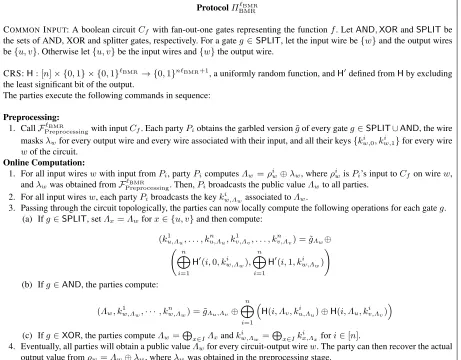
Garbled circuits with short keys. We next revisit the multi-party garbled circuits technique by Beaver, Micali and Rogaway, known as BMR, that extends the classic Yao garbling [Yao86] to an arbitrary number of parties, where essentially all the parties jointly garble using one set of keys each. This method was recently improved in a sequence of works [LPSY15,LSS16,BLO16,HSS20], where the two latter works further support the free-XOR property.
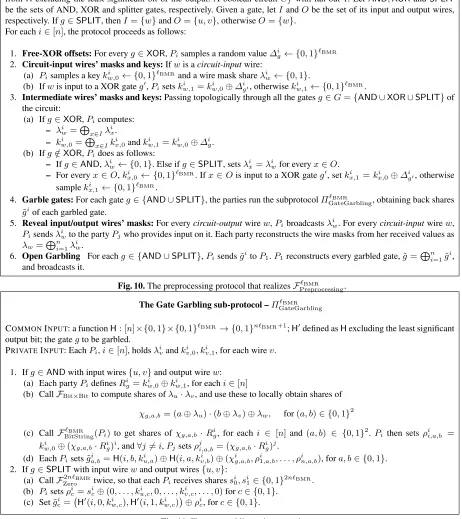
Our garbling method uses an expansion function H: [n]× {0,1} × {0,1}` → {0,1}n`+1, where`is
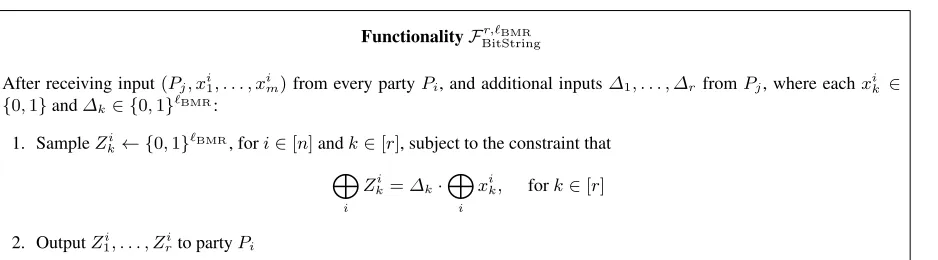
the length of each parties’ keys used as wire labels in the garbled circuit. To garble a gate, the hash values of the input wire keyskiu,bandkv,bi are XORed overiand used to mask the output wire keys.
Specifically, for an AND gateg with input wiresu, v and output wirew, the 4garbled rowsg˜a,b, for
each(a, b)∈ {0,1}2, are computed as:
˜
ga,b= n
M
i=1
H(i, b, kiu,a)⊕H(i, a, kiv,b)
!
⊕(c, kw,c1 , . . . , knw,c).
Security then relies on theDRSDassumption, which implies that the sum ofhhash values on short keys is pseudorandom, which suffices to construct a secure garbling method withhhonest parties.
Using this assumption instead of a PRF (as in recent works) comes with difficulties, as we can no longer garble gates with arbitrary fan-out, or use the free-XOR technique, without degrading theDRSDparameters. To allow for arbitrary fan-out circuits with our protocol we usesplitter gates, which take as input one wire w and provide two outputs wires u, v, representing the same wire value. Splitter gates were previously introduced as a fix for an error in the original BMR paper in [TX03]. We stress that transforming a general circuit description into a circuit where XOR and AND gates are fan-out-1 requires adding at most a single splitter gate per AND or XOR gate.
2 Preliminaries
We denote the security parameter byκ. We say that a functionµ:N→Nisnegligibleif for every positive
polynomial p(·) and all sufficiently large κ it holds that µ(κ) < p(κ)1 . The function µ is noticeable (or non-negligible) if there exists a positive polynomialp(·) such that for all sufficiently largeκit holds that µ(κ) ≥ p(κ)1 . We use the abbreviation PPT to denote probabilistic polynomial-time. We further denote by a ← Athe uniform sampling ofafrom a setA, and by[d]the set of elements {1, . . . , d}. We often view bit-strings in{0,1}kas vectors in
Fk2, depending on the context, and denote exclusive-or by “⊕” or “+”. If
a, b∈F2thena·bdenotes multiplication (or AND), and ifc∈Fκ
2 thena·c∈Fκ2 denotes the product ofa
with every component ofc.
We first specify the definition of computational indistinguishability.
Definition 2.1 LetX = {X(a, κ)}a∈{0,1}∗,κ∈
N andY = {Y(a, κ)}a∈{0,1}∗,κ∈N be two distribution en-sembles. We say that X andY are computationally indistinguishable, denoted X ≈c Y, if for every PPT
machineDand everya∈ {0,1}∗, there exists a negligible functionneglsuch that:
Pr [D(X(a, κ), a,1κ) = 1]−Pr [D(Y(a, κ), a,1κ) = 1]
<negl(κ).
2.1 Security and Communication Models
We prove security of our protocols in the universal composability (UC) framework [Can01]. See AppendixA for a summary of this. We assume all parties are connected via secure, authenticated point-to-point channels, which is the default method of communication in our protocols. The adversary model we consider is a static, honest-but-curious adversary who corrupts a subsetA⊂[n]of parties at the beginning of the protocol. We denote byA¯the subset of honest parties, and defineh=|A¯|=n−t.
2.2 Random Zero-Sharing
FunctionalityFr
Zero(P) On receiving(zero)from all parties inP={P1, . . . , Pn}:
1. Sample random sharess2, . . . ,sn← {0,1}rand lets1=s2⊕ · · · ⊕sn
2. Sendsito partyPi
Fig. 1.Random zero sharing functionality.
Our protocols require the parties to generate random additive sharings of zero, as in theFZero
function-ality in Figure1. This can be done efficiently using a PRFF, with interactiononlyduring a setup phase, as in [AFL+16]. We do this by asking each partyPi to send a random PRF keyki,j to every other partyPj.
Next,Pi defines its share byLj6=i(Fki,j(τ)⊕Fkj,i(τ))whereτ is an index that identifies the generated
share. It is simple to verify that all the shares XOR to zero since each PRF value is used exactly twice. More-over, privacy holds in the presence of any subset ofn−2 corrupted parties because the respective values Fkl,l0 andFkl0,l of honest partiesPlandPl0 are pseudorandom, which implies that their zero shares are also
pseudorandom. Finally, the communication complexity of the setup phase amounts to sendingO(n2)PRF
2.3 IKNP OT Extension
Here we shortly recall the passively secure OT extension protocol presented by Ishai, Kilian, Nissim and Pe-trank in 2003 [IKNP03], including some optimations by Asharov, Lindell, Schneider and Zohner [ALSZ13]. This protocol allows to generater=poly(κ)oblivious transfers fromκoblivious transfers using only cheap symmetric cryptographic primitives. At a high level, the protocol can be divided into three phases. In the first of these, called the seed OT phase, the sender,PA, and the receiver, PB, acting with their roles
re-versed, performκ OTs on random strings of length κ. Then, they locally expand these strings through a pseudorandom generator, so that PB obtains (ti0,ti1) ∈ {0,1}r, i ∈ [κ], and PAobtains (ti∆i, ∆), where
∆ = (∆1, . . . ∆κ) ∈ {0,1}κ is the choice vector used byPB as input in the OTs. In the second step,PA
introduces a correlation by sending the values
ui=t0i ⊕t11⊕x,
wherex= (x1, . . . , xr)are the receiver’srchoice bits. In this way the senderPAcan compute
qi = ti∆i ⊕∆i·ui
=ti0⊕∆i·x=ti⊕∆·x,
and can define the matrixQ ∈ {0,1}κ×rhaving the vectorsqias row. Similarly,P
Bcan define the matrix
T ∈ {0,1}κ×rwith rowsti
0. By taking the columns of these two matrices,PAandPBrespectively obtain
qj,tj ∈ {0,1}κ, j∈[r]such that:
tj⊕qj =∆·xj.
Finally, the last step permits to obtainrOTs on random strings, by breaking the correlation∆. To do this, the sender computesH(qj)andH(qj⊕∆)and the receiver computesH(tj), whereHis a correlation robust
hash function.
Note that this protocol only requires interaction to generate the seed OTs and during the second phase when the receiver sends the valuesui. This interaction in the second phase is most costly, since the receiver
must communicateκbits for each of therOTs to be produced.
3 Syndrome Decoding Problem
We now describe the Regular Syndrome Decoding (RSD) problem and some of its properties.
Definition 3.1 A vector e ∈ Fm2 is (m, h)-regular ife = (e1k · · · keh) where eachei ∈ {0,1}m/h has Hamming weight one. We denote byRm,hthe set of all the(m, h)-regular vectors inFm2 .
Definition 3.2 (Regular Syndrome Decoding (RSD)) Letr, h, ` ∈ Nwithm = h·2`,H ← Fr2×m and
e←Rm,h. Given(H,He), theRSDr,h,`problem is to recoverewith noticeable probability.
The decisional version of the problem, given below, is to distinguish the syndromeHefrom uniform.
Hash function formulation. The DRSD problem can be equivalently described as distinguishing from uniformLh
i=1H(i, ki)whereH: [h]× {0,1}`→ {0,1}ris a random hash function, and eachki ← {0,1}`.
With this formulation, it is easier to see how theDRSDproblem arises when using our protocols with short keys, since this appears when summing up a hash function applied tohhonest parties’ secret keys.
To see the equivalence, we can define a matrixH ∈ F2r×h·2`, where for each i ∈ {0, . . . , h−1}and k∈[2`], columni·2`+kofHcontainsH(i, k). Then, multiplyingHwith a random(m, h)-regular vector eis equivalent to taking the sum ofHoverhrandom inputs, as above.
Statistical hardness of DRSD. We next observe that for certain parameters where the output size ofHis sufficiently smaller than the min-entropy of the error vectore, the distribution in the decisional problem is
statistically close to uniform.
Lemma 3.1 If ` = 1 andh ≥ r+sthenDRSDr,h,`is statistically hard, with distinguishing probability 2−s.
Proof. Suppose`= 1andh ≥r+s, som = 2h. For a vectore = (e1k · · · keh) ∈ Rm,h, we can write
each of the weight-1 vectorsei ∈ {0,1}2 as(e0i,1−e
0
i). AnRSD sample H,y = Hetherefore defines
a system ofrlinear equations in thehvariables{e0i}i, and it can be shown that this simplifies to the form y=H0e0+c, wheree0 = (e01, . . . , e0h), by defining thej-th column ofH0∈Fr2×hto be the sum of columns 2j−1and2j fromH, andcto be the sum of all even-indexed columns inH. Note thatH0 is uniformly random becauseHis, and it is easy to show (e.g. [Pie12, Lemma 1]) that the probability thatH0 ←Fr×h
2 is
not full rank is no more than2−swhenh≥r+s. Assuming thatH0has full rank andh≥r,y=H0e0+c
must be uniformly random becausee0is.
For the general case of`-bit keys, we use the following form of the leftover hash lemma.
Lemma 3.2 (Leftover Hash Lemma [ILL89]) LetH←F2r×mande←χ, whereχis a distribution over
Fm2 with min-entropy at leastk. Ifr≤k−2sthen
∆SD((H,He),(H,u))≤2−s
whereu←Fr2and∆SDis the statistical distance.
Note that ife ← Rm,hthen we haveH∞(e) =h`. Applying Lemma3.2withk =h`, we obtain the following.
Corollary 3.1. Ifh≥(r+ 2s)/`thenDRSDr,h,`is statistically hard, with distinguishing probability2−s.
Search-to-decision reduction. Forallparameter choices ofDRSD, there is a simple reduction to the search version of the regular syndrome decoding problem with the same parameters.
Lemma 3.3 Any efficient distinguisher for theDRSDr,h,`problem can be used to efficiently solveRSDr,h,`.
The proof (inspired by a similar result for LPN [AIK09]) is a simplified version of previous reductions for syndrome decoding.
Theorem 3.4 ([GL89]) Letf be a one-way function. Then, given(r, f(x))for uniformly randomr andx, the inner producthx, rioverF2is unpredictable.
Proof. (of Lemma3.3) SupposeAdistinguishes between(H,He)and(H, Ur)with noticeable advantage δ. We construct an adversary A0 that breaks the Goldreich-Levin hardcore bit of f(e) = (H,He) by guessing the inner producthe,sifor some vectors∈Fm2 . On input(H,y=He,s), algorithmA0proceeds
as follows:
1. Samplet← {0,1}r
2. ComputeH0 =H−t·s> 3. RunAon input(H0,y)
4. Output the same asA
First notice that because H is uniformly random, H0 is also. Secondly, y = He = (H0 +t·s>)e = H0e+t· hs,ei. So, ifhs,ei= 0then the input toAis a correct sample(H0,H0e), whereas ifhs,ei = 1
then the input is uniformly random. Therefore, it holds that:
Pr[A0(H,He,r) =he,ri] = Pr[A0(H,He,r) = 0|he,ri= 0]·Pr[he,ri= 0]+
Pr[A0(H,He,r) = 1|he,ri= 1]·Pr[he,ri= 1]
= 1
2 ·(Pr[A(H
0
,H0e) = 0] + (1−Pr[A(H0, Ur) = 0]))
≥ 1 2 +
δ
2 .
Multi-Secret RSD. We now consider a variant of DRSD with multiple sets of secrets, where the matrixH
is fixed for each sample. We then reduce this to the standard DRSD problem with the same parameters, with a security loss of the number of secrets.
Definition 3.5 (Multi-Secret DRSD) LetH ← Fr2×mande1, . . . ,eq ← Rm,h(as in Definition3.2). The
q-DRSDr,h,` problem is to distinguish between a tuple(H,He1, . . . ,Heq) and(H, Urq) with noticeable advantage.
Lemma 3.4 q-DRSDr,h,`is reducible toDRSDr,h,`, where the reduction loses a tightness factor ofq.
Proof. The proof is based on a standard hybrid argument with a sequence ofq + 1hybrid distributions, where each pair of neighbouring hybrids is indistinguishable based onDRSD.
The first hybrid,H0, outputs(H, u1, . . . , uq), whereH←Fr2×mandui← {0,1}r, which is exactly the
uni-form distribution used inq-DRSD. In hybridHi, fori= 1, . . . , q, we sample regular secretse1, . . . ,eiand
output(H,He1, . . . ,Hei, ui+1, . . . , uq). Note thatHq is the same as the real distribution in theq-DRSD
problem. Any adversary Awho distinguishes between Hi andHi+1 can be used to break DRSDr,h,`, as
follows. The distinguisherDreceives aDRSDchallenge(H,y), then samplese1, . . . ,eifrom the error
dis-tribution and random stringsui+2, . . . , uq← {0,1}r. It then outputsA(H,He1, . . . ,Hei,y, ui+2, . . . , uq).
The advantage ofDagainst theDRSDproblem is identical to that ofA. A standard argument then implies that any adversary who distinguishesH0 andHq with advantageδcan solveDRSDr,h,` with advantage at
Extended Double-Key RSD. In our final variant of RSD — used in the security proof of our BMR-style online phase — we consider multiple sets of secrets, and also give the adversary two challenges for each secret which captures the double use of each key in the garbling procedure. This means we cannot preserve the RSD parameters, and must reduce to2-DRSD2r,h,`. We also make a conceptual change, and specify the
problem using a random hash functionHwith small domain (which can be modelled as a random oracle, or a random lookup table given as a common random string) instead of matrices and vectors. We switch to this notation in order to capture the computation made by the honest parties when garbling a gate.
Definition 3.6 (Extended Double-Key DRSD) The extended double-key decisional-RSD problem states that, for every fixed subsetS ⊂[n]of sizeh, it holds that
H,M
i∈S
H(i,0, ki),
M
i∈S
H(i,0, ki0),M
i∈S
H(i,1, ki),
M
i∈S
H(i,1, ki0)
!
c
≈ (H, U4r),
whereH: [n]× {0,1} × {0,1}`→ {0,1}ris a randomly sampled function, andk
i, k0i ← {0,1}`fori∈S.
Lemma 3.5 The extended double-key decisional-RSD problem with parameters(r, h, `) is reducible to 2-DRSD(2r, h, `).
Proof. Suppose there exists a setS⊂[n]for which an adversaryAdistinguishes the above two distributions with noticeable advantage. We useAto construct a distinguisherD for the2-DRSD(2r, h, `)problem.D
receives a challenge(H,y0,y1), whereH∈F2r2 ×m,m =h·2`andy0,y1 ∈F2r2 . WriteH=
H0
H1
and yj =
zj
z0j
. Define the hash functionH: [n]× {0,1} × {0,1}` → {0,1}r so thatH(s
i, b, k)is equal to
column2`i+k(viewingkalso as an integer in[2`]) of the matrixHb, for eachsi ∈Sandb∈ {0,1}. For
i∈[n]\S, let the output ofH(i,·,·)be uniformly random. The distinguisher then runsAwith input
H,z0,z00,z1,z01
,
and outputs the same asA. Notice that if theDRSD challenge is random then the input toA is random, whereas if the challenge is computed asyj =Hej for some regular errorej andj ∈ {0,1}, then we have
zj =H0ej andz0j =H1ej, and by the definition ofH, these values are equal to the sum of hash function
outputs under some secret keys corresponding toej. It follows that the distinguishing advantage ofDis the
same as that ofA.
4 GMW-Style MPC with Short Keys
In this section we design a protocol for generating multiplication triples over F2 using short secret keys,
with reduced communication complexity as the number of honest parties increases. More concretely, we first design a leaky protocol for secret-shared two-party bit multiplication, based on correlated OT and OT extension techniques with short keys. This protocol is not fully secure and we precisely define the leakage, which is obtained by the receiver. We next show how to use the leaky protocol to produce multiplication triples, removing the leakage by rerandomizing the parties’ shares with shares of zero, and using theDRSD
4.1 Leaky Two-Party Secret-Shared Multiplication
FunctionalityFr,`
∆-ROT After receiving∆∈ {0,1}`
fromPSand(x1, . . . , xr)∈ {0,1}rfromPR, do the following:
1. Sampleqi← {0,1}`
, fori∈[r], and letti=qi⊕xi·∆.
2. OutputqitoPSandtitoPR, fori∈[r].
Fig. 2.Functionality for oblivious transfer on random, correlated strings.
We first present our protocol for two-party secret-shared bit multiplication. We modify the IKNP pro-tocol for OT extension to use short keys, where by ‘IKNP’ we refer to the optimized variant by Asharov et al. [ALSZ13], which we summarized in Section2.3. With short keys we cannot hope for computational security based on standard symmetric primitives, because an adversary can search every possible key in polynomial time. Our goal, therefore, is to define the preciseleakagethat occurs when using short keys, in order to remove this leakage at a later stage.
OT extension and correlated OT. Recall that the main observation of the IKNP protocol for extending oblivious transfer [IKNP03] is thatcorrelated OT is symmetric, so thatκcorrelated OTs onr-bit strings can be locally converted intor correlated OTs onκ-bit strings. Secondly, aκ-bit correlated OT can be used to obtain an OT on chosen strings with computational security. The first stage of this process is abstracted away by the functionalityF∆-ROTin Figure2, and is implemented by the first two phases of IKNP as described in Section2.3.
Using IKNP to multiply an input bitxkfrom the sender,PA, with an input bitykfromPB, the receiver,
PBsendsykas its choice bit toF∆-ROTand learnstk =qk⊕yk·∆. The senderPAobtainsqk, and then
sends
dk =H(qk)⊕H(qk⊕∆)⊕xk,
whereHis a 1-bit output hash function. This allows the parties to compute an additive sharing ofxk·ykas
follows:PAdefines the share H(qk), andPBcomputesH(tk)⊕yk·dk. This can be repeated many times
with the same∆to perform a large batch ofpoly(κ)secret-shared multiplications, because the randomness in∆serves to computationally mask eachxwith the hash values (under a suitable correlation robustness assumption forH). The downside of this is that for∆∈ {0,1}κ, the communication cost isO(κ)bits per
two-party bit multiplication, to perform the correlated OTs.
Variant with short keys. We adapt this protocol to use short keys by performing the correlated OTs on `-bit strings, instead ofκ-bit, for some small key length`=O(logκ)(we could have`as small as 1). This allowsF∆-ROTto be implemented with onlyO(`)bits of communication per OT instead ofO(κ).
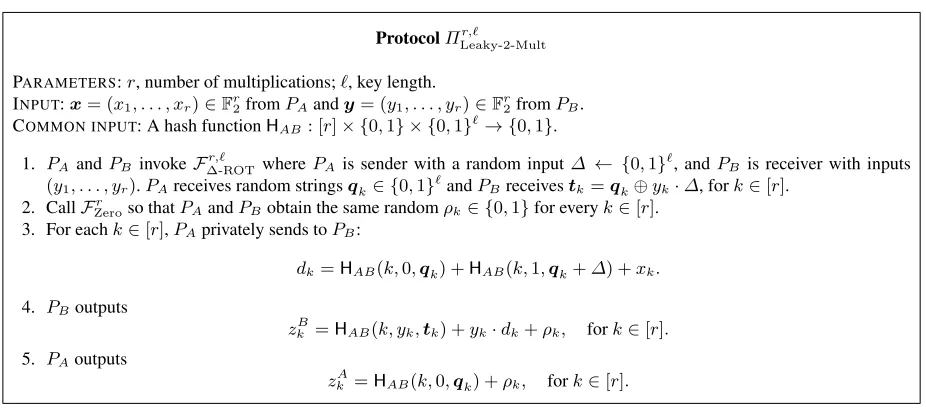
Our protocol, shown in Figure4, performs a batch ofr multiplications at once. First the parties create r correlated OTs on`-bit strings usingF∆-ROT. Next, the parties hash the output strings of the correlated
OTs, andPAsends over the correction valuesdk, which are used byPB to convert the random OTs into a
secret-shared bit multiplication. Finally, we require the parties to add a random value (fromFZero, shown in
Note that if ` ∈ O(logκ) then the hash functionHAB has a polynomial-sized domain, so can be
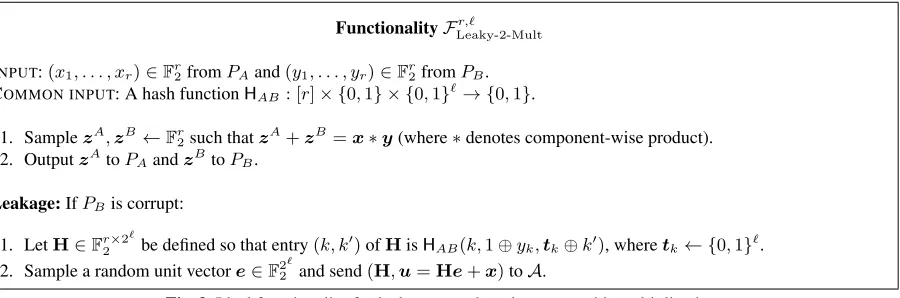
de-scribed as a lookup table provided as a common input to the protocol by both parties. At this stage we do not make any assumptions aboutHAB; this means that the leakage in the protocol will depend on the hash function, so its description is also passed to the functionalityFLeaky-2-Mult(Figure3). We requireHAB to
take as additional input an indexk∈[r]and a bit in{0,1}, to provide independence between different uses, and our later protocols require the function to be different in protocol instances between different pairs of parties (we use the notationHABto emphasize this).
FunctionalityFr,`
Leaky-2-Mult INPUT:(x1, . . . , xr)∈Fr2fromPAand(y1, . . . , yr)∈Fr2fromPB.
COMMON INPUT: A hash functionHAB: [r]× {0,1} × {0,1}`→ {0,1}.
1. SamplezA,zB ←Fr2such thatzA+zB =x∗y(where∗denotes component-wise product). 2. OutputzA
toPAandzBtoPB.
Leakage:IfPBis corrupt:
1. LetH∈Fr×2
`
2 be defined so that entry(k, k 0
)ofHisHAB(k,1⊕yk,tk⊕k0), wheretk← {0,1}`.
2. Sample a random unit vectore∈F2
`
2 and send(H,u=He+x)toA.
Fig. 3.Ideal functionality for leaky secret-shared two-party bit multiplication.
Leakage. We now analyse the exact security of the protocol in Figure4when using short keys, and explain how this is specified in the functionalityFLeaky-2-Mult (Figure3). Since a random share of zero is added to the outputs, note that the output distribution is uniformly random. Also, like IKNP, the protocol isperfectly secureagainst a corruptPA(or sender), so we only need to be concerned with leakage to a corruptPBwho
also sees the intermediate values of the protocol.
The leakage is different for eachk, depending on whetheryk= 0oryk= 1, so we consider the two cases
separately. Within each case, there are two potential sources of leakage: firstly, the corruptPB’s knowledge
oftkandρk may cause leakage (whereρkis a random share of zero), since these values are used to define
PA’s output. Secondly, thedkvalues seen byPB, which equal
dk =HAB(k, yk,tk)⊕HAB(k,1⊕yk,tk⊕∆)⊕xk, (1)
may leak information onPA’s inputsxk.
Case 1(yk = 1). In this case there is only leakage from the valuestk andρk, which are used to define
PA’s output. SincezkA=HAB(k,0,tk⊕∆)⊕ρk, all ofPA’s outputs (and hence, also inputs) whereyk = 1
effectively have only`bits of min-entropy in the view ofPB, corresponding to the random choice of ∆.
In this casePB’s output iszkB = zAk ⊕xk = HAB(k,0,tk⊕∆)⊕ρk⊕xk. To ensure thatPB’s view is
simulable the functionality needs to sample a random string∆← {0,1}`and leakH
AB(k,0,tk⊕∆)⊕xk
to a corruptPB.
Concerning thedkvalues, notice that whenyk= 1PBcan computeHAB(k,1,tk)and use (1) to recover HAB(k,0,qk) +xk, which equalszAk +ρk+xk. However, this is not a problem, because in this case we
Case 2(yk = 0). Here thedk values seen by PB causes leakage on PA’s inputs, because ∆ is short.
Looking at (1),dkleaks information onxk because∆← {0,1}` is the only unknown in the equation, and
is fixed for everyk. Similarly to the previous case, this means that all ofPA’s inputs whereyk = 0 have
only`bits of min-entropy in the view of an adversary who corruptsPB. We can again handle this leakage,
by definingFLeaky-2-Multto leakHAB(k,1,tk⊕∆) +xkto a corruptPB.
Note that there is no leakage from thetkvalues whenyk= 0, because thentk=qk, so these messages
are independent of∆and the inputs ofPA.
In the functionalityFLeaky-2-Mult, we actually modify the above slightly so that the leakage is defined in
terms of linear algebra, instead of the hash functionHAB, to simplify the translation to theDRSDproblem
later on. Therefore,FLeaky-2-Mult defines a matrixH∈ F2r×2`, which contains the2` values{HAB(k,1⊕
yk,tk⊕∆)}∆∈{0,1}`in rowk, where eachtkis uniformly random. GivenH, the leakage from the protocol
can then be described by sampling a random unit vectore∈F2 `
2 (which corresponds to∆∈ {0,1}`in the
protocol) and leakingu=He+xto a corruptPB.
ProtocolΠLeaky-2-Multr,`
PARAMETERS:r, number of multiplications;`, key length.
INPUT:x= (x1, . . . , xr)∈Fr2fromPAandy= (y1, . . . , yr)∈Fr2fromPB.
COMMON INPUT: A hash functionHAB: [r]× {0,1} × {0,1}`→ {0,1}.
1. PA andPB invokeF∆-ROTr,` wherePAis sender with a random input∆ ← {0,1}`, andPB is receiver with inputs
(y1, . . . , yr).PAreceives random stringsqk∈ {0,1} `
andPBreceivestk=qk⊕yk·∆, fork∈[r].
2. CallFr
Zeroso thatPAandPBobtain the same randomρk∈ {0,1}for everyk∈[r].
3. For eachk∈[r],PAprivately sends toPB:
dk=HAB(k,0,qk) +HAB(k,1,qk+∆) +xk.
4. PBoutputs
zBk =HAB(k, yk,tk) +yk·dk+ρk, fork∈[r].
5. PAoutputs
zkA=HAB(k,0,qk) +ρk, fork∈[r].
Fig. 4.Leaky secret-shared two-party bit multiplication protocol.
We remark that this leakage reveals a lot of information aboutPA’s inputx, and in particular, if a corrupt
PBknows something about the distribution ofxthen it might leverage this to learn∆and thus all ofx. This
illustrates the challenge of using leaky multiplication to build a secure MPC protocol, which we overcome in the next section.
Theorem 4.1 ProtocolΠLeaky-2-Multr,` securely implements the functionalityFLeaky-2-Multr,` with perfect secu-rity in the(F∆-ROT,FZero)-hybrid model in the presence of static honest-but-curious adversaries.
Proof. The main challenge in the proof consists of showing that the leakage toPBin the functionality can
be translated directly to the leakage introduced in the protocol in the view ofPB. More formally, for the two
cases of a corruptPA, and a corruptPB, we define a simulator who obtains the corrupted party’s inputs and
No corruptions. Here, no simulation is necessary because all communication is over private channels, so we just need to show that the outputs of an honest execution are distributed identically to the functionality. By inspection, the protocol is correct. Observe that the outputs ofPAare uniformly random, becauseρkis
uniformly random. SincePB’s outputs are fixed by the inputs andPA’s outputs, we are done.
Corrupt PA. This is the simpler of the remaining two cases. The simulator SA receives PA’s inputs
x1, . . . , xr ∈ F2, as well as the outputs z1A, . . . , zrA fromFLeaky-2-Mult. It completes the view of PA by
sampling theq1, . . . , qr ← {0,1}` PAreceives fromF∆-ROT, and then sendsρk =zkA−HAB(k,0, qk)to
simulatePA’s outputs fromFZero.
It is easy to see that the views in the two executions are identically distributed, since no messages are sent toPAduring the protocol, and the definition ofρkin the simulation ensures thatρkis uniformly random
(becausezkAis) and also consistent withPA’s output and the hash function, as in the protocol.
CorruptPB. We define a simulatorSB, who receives the inputsy1, . . . , yr ∈ {0,1}, and then obtains the
valuesz1B, . . . , zBr,H,u= (u1, . . . , ur)from the functionality.
LetSBsample valuest1, . . . , tr∈ {0,1}`at random, subject to the constraint that for everyk∈[r]and
k0 ∈ {0,1}`,H
AB(k,1⊕yk, tk⊕k0)is equal to entry(k, k0)ofH(viewingk0 also as an integer in[2`]).
Note that because of the wayHis defined inFLeaky-2-Mult, such atkis guaranteed to exist and can be found
by searching all22` =poly(κ)possibilities ofk0 andtk. This also ensures it will be identically distributed
to thetksampled by the functionality.SBsends these valuestkas the outputs ofF∆-ROTtoPB.
For allk∈[r],SBthen emulates the output ofFZerotoPBas follows:
1. Ifyk = 0, sendρk=zkB+HAB(k,0, tk).
2. Ifyk = 1, sendρk=zkB+uk.
Finally, fork∈[r],SBsendsdk=uk+HAB(k, yk, tk)toPB. This completes the simulation ofPB’s view.
Regarding indistinguishability, first note that the tk values are identically distributed as a uniformly
random value in both executions, since in the real world tk = qk ⊕yk ·∆ and qk ← {0,1}`. Now
considering the case whenyk = 0, we have:
zBk +HAB(k,0, tk) +ρk= 0,
from the definition ofρk. Since in both worldszkB, tkandρkare all uniformly random, subject to the above,
this means that these values are identically distributed in both worlds. Also, it is easy to see that the simulated dkvalues are computed exactly as in the protocol, because of the wayFLeaky-2-Multcomputesuk.
Whenyk= 1, we have:
zkB+HAB(k,1, tk) +dk+ρk= 0 ⇐⇒(ρk+uk) +HAB(k,1, tk) +ρk =dk
⇐⇒HAB(k,0, tk⊕∆˜) +HAB(k,1, tk) +xk=dk,
where∆˜∈[2`]denotes the position of the 1 inesampled byFLeaky-2-Mult to computeu, so is identically distributed to∆∈ {0,1}`in the real protocol. Therefore, the last equation above holds, which implies that
Communication complexity. The cost of computingrsecret-shared products is that of`random, correlated OTs onr-bit strings, and a furtherr bits of communication. Using OT extension [IKNP03,ALSZ13] with a correlation-robust hash function to implement the correlated OTs, the amortized cost is`(r+κ)bits for computational securityκ. This gives a total cost of`(r+κ) +rbits.
4.2 MPC for Binary Circuits From Leaky OT
We now show how to use the leaky OT protocol to compute multiplication triples overF2, using a
GMW-style protocol [GMW87,Gol04] optimized for the case of at leasthhonest parties. This can then be used to obtain a general MPC protocol for binary circuits using Beaver’s method [Bea92].
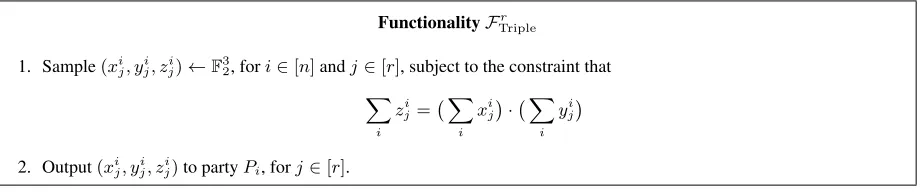
Triple generation. We implement the triple generation functionality overF2, shown in Figure5. Recall
that to create a triple using the GMW method, first each party locally samples sharesxi, yi←F2. Next, the
parties compute shares of the product based on the fact that:
( n
X
i=1
xi)·( n
X
i=1
yi) = n
X
i=1
xiyi+ n
X
i=1
X
j6=i
xiyj.
wherexi denotesPi’s share ofx=Pixi.
Since each party can computexiyion its own, in order to obtain additive shares ofz=xyit suffices for the parties to obtain additive shares ofxiyj for every pairi6=j. This can be done using oblivious transfer betweenPi andPj, since a 1-out-of-2 OT implies two-party secret-shared bit multiplication. To improve
efficiency, we actually realize a slight variation of this functionality where two (possibly overlapping) subsets
P(h),P(1) such that P(h) has at least h honest parties andP(1) has at least one honest party, choose the respective shares ofxandy.
FunctionalityFr
Triple
1. Sample(xij, yij, zji)←F32, fori∈[n]andj∈[r], subject to the constraint that
X
i
zji=
X
i
xij
· X
i
yji
2. Output(xi
j, yij, zji)to partyPi, forj∈[r].
Fig. 5.Multiplication triple generation functionality.
If we plug in our leaky two-party batch multiplication protocol to GMW, this naive approach fails to give a secure protocol, because the leakage inFLeaky-2-Mult allows a corruptPBto guessPA’s inputs with
probability 2−`. When obtaining shares of the pairwise products,PA does a secret-shared multiplication
using the same input shareswith every other party, which introduces further leakage on PA’s shares for
every corrupt party, increasing the success probability further. If the number of corrupted parties is not too small then this gives the adversary a significant chance of successfully guessing the shares ofevery honest party, completely breaking security.
To avoid this issue, we requirePAtorandomizethe shares used as input toFLeaky-2-Mult, in such a way
that we still preserve correctness of the protocol. To do this, the parties will useFZeroto generate random zero sharessi,j ∈
F2 (held byPi), satisfyingPisi,j = 0for allj ∈[n], and thenPi andPj will multiply
n
X
i=1 n
X
j=1
(xi+si,j)yj = n
X
j=1
yj
n
X
i=1
(xi+si,j) =xy,
so still obtain a correct triple.
Finally, to ensure that the output shares are uniformly random, fresh shares of zero will be added to each party’s share ofxy.
Note that masking eachxiinput toFLeaky-2-Multmeans that it doesn’t matter if the individual shares are
leaked to the adversary, as long as it is still hard to guess thesum of all shares. This means that we only need to be concerned with thesum of the leakagefromFLeaky-2-Mult. Recall that each individual instance leaks the input of an honest partyPimasked byHiei, whereHiis a random matrix andei∈F2
`
2 is a random unit
vector. Summing up all the leakage fromhhonest parties, we get
h
X
i=1
Hiei= (H1k · · · kHh)
e1
.. . eh
This is exactly an instance of the DRSDr,h,` problem, so is pseudorandom for an appropriate choice of
parameters.
We remark that the number of triples generated,r, affects the hardness ofDRSD. However, we can create an arbitrary number of triples without changing the assumption by repeating the protocol for a fixedr.
Reducing the number of OT channels. The above approach reduces communication of GMW by a factor κ/`, for `-bit keys, but still requires a complete network of n(n−1) OT and communication channels between the parties. We can reduce this further by again taking advantage of the fact that there are at leasth honest parties. We observe that when using our two-party secret-shared multiplication protocol to generate triples, information is only leaked on the xi shares, and not theyi shares of each triple. This means that
h−1parties can choose their shares ofy to be zero, andywill still be uniformly random to an adversary who corrupts up tot= n−h parties. This reduces the number of OT channels needed fromn(n−1)to
(t+ 1)(n−1).
When the number of parties is large enough, we can do even better using random committees. We randomly choose two committees,P(h) andP(1), such that except with negligible probability,P(h)has at leasthhonest parties andP(1)has at least one honest party. Only the parties inP(h)choose non-zero shares ofx, and parties inP(1)choose non-zero shares ofy; all other parties do not take part in any OT instances, and just output random sharings of zero. We remark that it can be useful to choose the parameterh lower thanthe actual number of honest parties, to enable a smaller committee size (at the cost of potentially larger keys). When the total number of parties,n, is large enough, this means the number of interacting parties can be independent ofn. The complete protocol, described for two fixed committees satisfying our requirements, is shown in Figure6.
Communication complexity. Recall from the analysis in Section4.1that the cost ofrmultiplications with ΠLeaky-2-Mult is that of `random, correlated OTs onr-bit strings, and a furtherr bits of communication.
Using OT extension, this gives a cost of`(r+κ) +r bits between every pair of parties inP(h)× P(1)
(ignoringFZeroand the seed OTs for OT extension, since their communication cost is independent of the number of triples). If the two committeesP(h),P(1) have sizesnh ≤ nandn1 ≤ t+ 1 then we have the
ProtocolΠTripler
The protocol runs between a set of partiesP = {P1, . . . , Pn}, containing two (possibly overlapping) subsetsP(h),P(1), such thatP(h)has at leasthhonest parties andP(1)has at least one honest party. We denotenh=|P(h)|,n1=|P(1)|.
CRS:Random hash functionsHi: [r]× {0,1} × {0,1}`→ {0,1}, fori∈[nh].
1. Each partyPi∈ P(h)samplesxik←F2, and eachPj∈ P(1)samplesykj←F2, fork∈[r].
2. Call FZero so that each Pτ ∈ P(h) ∪ P(1) obtains shares (ρτ1, . . . , ρτr) and each Pi ∈ P(h) obtains shares (si,j1 , . . . , si,j
r )j∈P(1), such thatLτ∈P
(h)∪P(1)ρ
τ k= 0and
L
i∈P(h)s
i,j k = 0.
3. Every pair(Pi, Pj) ∈ P(h)× P(1)runsFLeaky-2-Multr,` (Hi)on input{xik+s i,j
k }k∈[r]fromPiand{yjk}k∈[r]fromPj.
Fork∈[r],Pireceivesai,jk andPjreceivesbj,ik such thata i,j k +b
j,i k = (x
i k+s
i,j k )·y
j k.
4. EachPi∈ P(h)∪ P(1)computes, fork∈[r]:
zki = (x i k+s
i,i k )·y
i k+
X
j6=i
(ai,jk +bi,jk ) +ρik
where if any valuexi k, yki, a
i,j k , b
i,j k , s
i,i
k has not been defined byPi, it is set to zero.
5. Pioutputs the shares(xik, yik, zki)k∈[r].
Fig. 6.Secret-shared triple generation using leaky two-party multiplication.
Theorem 4.2 ProtocolΠTriplesecurely realizesFTripler in the(F r,`
Leaky-2-Mult,F (n+1)r
Zero )-hybrid model, based on theDRSDr,h,` assumption, wherehis the number of honest parties inP(h). The amortized communica-tion cost is≤nhn1(`+`κ/r+ 1)bits per triple, using OT extension based on a correlation-robust function. Proof. The claimed communication complexity follows from the previous analysis. Security relies on the fact thatPi ∈ P(h)’s input toFLeaky-2-Mult is always of the form xi+si,j, wheresi,j is a fresh, random
sharing of zero. This means that any leakage onPi’s input fromFLeaky-2-Multis perfectly masked bysi,j,
and we only need to consider thesumof the leakage from all honest parties inP(h).
Recall that we have two committees P(h) and P(1) of sizes nh andn1, with at least h and 1 honest
parties, respectively. LetAbe an adversary corrupting a set of partiesA. Throughout the proof we will write x1, . . . , xrto denote the components of a vectorx∈Fr2.
We construct a simulator,S, which interacts withAas follows:
1. Simulate the CRS withnhrandomly sampled functionsHi : [r]× {0,1} × {0,1}`→ {0,1}.
2. CallFTripleto receive the corrupted parties’ outputs,(xik, yik, zki)i∈A∩(P(h)∪P(1)),k∈[r].
3. For eachi ∈ P(h) ∩A, samplesi,j ← Fr
2, for j ∈ [n1], and send these toA as the shares output by FZero.
4. LetPi ∈ P(h), Pj ∈ P(1). Compute the messages that would be sent byFLeaky-2-Mult to the adversary
as follows:
(a) Pi, Pj ∈A: Using both parties’ inputs, generate their random output shares asFLeaky-2-Multwould
do and send these toA. Explicitly, the simulator samples sharesai,j,bj,ithat sum to(xi+si,j)∗yj, and the leakage(Hi,j,ui,j)onxi+si,j (just asFLeaky-2-Multwould do).
(b) Pi ∈A, Pj ∈/ A: Emulate the corruptPi’s view honestly, by samplingai,j ←Fr2.
(c) Pi ∈/ A, Pj ∈ A: Sample uniform valuesbj,i,ui,j ← Fr2, and sample Hi,j ∈ Fm
×2`
2 exactly as FLeaky-2-Multwould do, using knowledge ofHi andyj.
5. Fori∈A∩(P(h)∪ P(1)), computeρi=zi+ (xi+si,i)∗yi+P
j6=i(ai,j+b
i,j)and send this as the
ρi
kshare fromFZero.
6. Send toAthe values{ai,j}
i∈P(h)∩A,j∈P(1)∪ {bj,i,Hi,j,ui,j}i∈P(h),j∈P(1)∩Aas defined above, to
We first consider the distribution of the parties’ outputs.
Claim 4.1 The outputs of the protocol are distributed identically to outputs of the functionality.
Proof. We need to to show that, in the real protocol, {zik}i,k are uniformly random subject to P
izik =
P
ixik·
P
iyki. Firstly, the correctness constraint holds because n
X
i=1
zik= n
X
i=1
(xik+s
i,i k )·y
i k+
X
j6=i
(ai,jk +bi,jk ) +ρik = n X i=1
xik·yki + n
X
i=1
yik·si,ik +X j6=i
(ai,jk +bj,ik )
= n X i=1
xik·yki + n
X
i=1
yik·si,ik +X j6=i
yki ·(xjk+sj,ik )
=xk·yk+ n
X
i=1
yki · n
X
j=1
sj,ik
=xk·yk
where the second line above holds becauseP
iρik= 0, and the final line uses
P
js j,i k = 0.
Now, to see that (zik)i areuniformly random, subject to the above, notice that the masks (ρik) n−1 i=1 are
uniformly random in the protocol, so the same is true of(zi k)n
−1
i=1. This completes the claim.
We next consider the entire view of the environment Z, which is the joint distribution of all parties’ inputs and outputs, and the messages received by the adversary during the protocol. Using vector notation, this is:
(xi,yj,zi,zj)i∈P(h),j∈P(1),(ρi,si,j,ai,j)i∈A∩P(h),j∈P(1),(ρj,bj,i,ui,j,Hi,j)i∈P(h),j∈P(1)∩A
First note that theρτ, τ ∈ P(h)∪P(1)andsi,jshares, fori∈ P(h)∩A, j∈ P(1)\A, are uniformly random in both executions, since the environment never sees the honest parties’ shares. Secondly, recall that in the simulation,ai,jfor corruptPiand honestPj) andbj,i(for corruptPjand honestPi) are computed uniformly
at random, and this is identically distributed to the values in the protocol sampled byFLeaky-2-Mult, because the outputs of the honest party in that instance are not seen byZ. Also, notice that whenPj is corrupt S
computesHi,jexactly as in the real protocol, becauseSknowsPj’s inputyj.
This leaves the {ui,j}i∈P
(h)\A,j∈P(1)∩Avalues, which are the main challenge, because the simulation
computes these with random values, whilst the real execution uses the honestPi’s inputs, computingui,j = Hi,jei,j+xi+si,jfor a random unit vectorei,j. LetPi1, . . . , Pihbe the honest parties inP(h). Because the
si,jvalues are random shares of zero, it holds that the partial views containing the entire transcriptexcept for (ui1,j)
j∈P(1)∩Aare identically distributed. This is because forPj ∈ P(1)∩A, the maskssi2,j, . . . ,sih,jin
the protocol are random and independent of the view ofZ, which makes the correspondingui2,j, . . . ,sih,j
values distributed the same as in the simulation.
Once we includeui1,j, however, these values are no longer independent becausePn
i∈P(h)s
i,j = 0. We
therefore look at the distribution ofPh
X
i∈P(h)\A
ui,j = X
i∈P(h)\A
(xi+si,j+Hi,jei,j)
for some random, weight-1 vectorei,j. In the simulation, all of theui,j’s are uniformly random. Since Z can computeP
i∈P(h)\A(xi+si,j)with the information it already has, it follows that
distin-guishing the two executions requires distindistin-guishing
Hiei := Hi1,jkHi2,jk · · · kHih,j
ei1,j ei2,j
.. . eih,j
and the uniform distribution onrbits (givenHi).
We claim that this corresponds exactly to solving the DRSDr,h,` problem, because Hi is uniformly
distributed inFr×2 `h
2 andeiis a uniformly random, 1-regular error vector of weighth.
Lemma 4.2 Any environment distinguishing the real and ideal executions with advantageδcan be used to breakDRSDr,h,`with advantage at leastδ/t(wheret=|P(1)∩A|).
Proof. Assume w.l.o.g. that the corrupted parties inP(1) are indexedP1, . . . , Pt. We construct a sequence
of hybrid executions, HYB0, . . . ,HYBt, where hybrid HYB0 is identical to the simulation. In hybrid HYBj0, instead of the simulator samplingui,j (forj ≤j0, i ∈ P(h)\A) at random, we replace this with
the realui,j generated usingPi’s inputs as in the protocol. The final hybridHYBtis therefore identically
distributed to the real execution.
Let A be an adversary for which the environment Z distinguishes between HYBj0 and HYBj0+1
with advantage δ, for some index j0 < t. We construct a distinguisher D for DRSDr,h,` as follows. D
receives aDRSDchallengeHj0 ∈Fr×h2
`
2 ,cj 0
∈Fr
2. WriteHj0 = (Hi1,j 0
kHi2,j0k · · · kHih,j0), where each
Hik,j0 ∈ Fr×2
`
2 . NowDsimulates an execution ofΠTriplewithAasSwould, with the following differences.
– Dsamples a set of honest parties’ shares,(xi,yi,zi)i /∈Awhich, together with the corrupt parties’ shares
known toD, form correct triples.
– Instead of sampling the function Hi in the CRS at random, sample it such that for everyk ∈ [h], the
matrixHik,j0, sent later to the corruptP
j0, is equal to the challenge matrixHik,j0. (The remainder of the
CRS is sampled at random.)
– Instead of sampling the leakage termsuik,j0 (fork∈[h]) uniformly and independently, sample them at
random such thatP
i∈P(h)(ui,j
0
+xi) =cj0.
– For each j < j0, instead of samplinguik,j0 uniformly, compute them as in the real protocol using the
honest parties’ shares and shares of zero.
To conclude,Dsends all the output shares toZand outputs the same asZ. If the challenge(Hj0,cj
0
)comes from theDRSDdistribution then theuik,j0values are distributed as in
a real execution, so we are in hybridHYBj0+1. On the other hand, ifcj 0
is uniformly random then so are theuik,j0, so we are inHYB
j0. Therefore, the advantage ofDisδ, the same as that ofZ. A standard hybrid
argument then shows that there exists a distinguisher forHYB0 andHYBt, which has advantage at least
Parameters for unconditional security. Recall from Lemma 3.1 and Corollary 3.1 that if ` = 1 and h≥r+s, or ifh≥(r+ 2s)/`for any`, thenDRSDr,h,`isstatistically hard, with statistical security2−s.
This means whenhis large enough we can use 1-bit keys, and every pair of parties who communicates only needs to send2 +κ/rbits over the network.6
MPC using multiplication triples. Our protocol for multiplication triples can be used to construct a semi-honest MPC protocol for binary circuits using Beaver’s approach [Bea92]. The parties first secret-share their inputs between all other parties. Then, XOR gates can be evaluated locally on the shares, whilst an AND gate requires consuming a multiplication triple, and two openings with Beaver’s method. Each opening can be done with2(n−1)bits of communication as follows: all parties send their shares toP1, who sums the
shares together and sends the result back to every other party.
In the 1-bit key case mentioned above, using two (deterministic) committees of sizes nandt+ 1and setting, for instance,r =κimplies the following corollary. Note that the number of communication channels is(t+ 1)(n−1)and not(t+ 1)n, because in the deterministic caseP(1)is contained inP(h), sot+ 1sets of the shared cross-products can be computed locally.
Corollary 4.3 Assuming OT and a correlation-robust function, there is a semi-honest MPC protocol for binary circuits with an amortized communication complexity of no more than3(t+ 1)(n−1) + 4(n−1) bits per AND gate, if there are at leastκ+shonest parties.
Remark 4.1. We can obtain a feasibility result from OWF instead of a correlation-robust function, by us-ing standard OT instead of OT extension. This comes at the cost of replacus-ingκ with the communication complexity of the OT protocol.
4.3 Optimization with Vandermonde Matrices
In this section we show how to optimize our triple generation protocol using Vandermonde matrices. As we will see in Section6, this approach is particularly convenient when the number of honest parties is small and allows to avoid relying on the DRSD assumption.
The high level idea is to replace the random choice of hash functions used in the previous protocol with deterministically chosen functions based on Vandermonde matrices. We show that the variant of regular syndrome decoding induced by this choice is perfectly secure, so we can plug the new functions directly into protocolΠTriple(Figure6) and improve the efficiency.
We redefine the functions Hi, as follows. Let ` ≥ lognandv1, . . . , vn be distinct points in F2`. Let
r=`·h, and letV∈Fn×h
2` be the Vandermonde matrix given by
V=
1 v1 . . . v1h−1 1 v2 . . . v2h−1
..
. . .. ... ...
1vn. . . vnh−1
and letvibe thei-th row ofV.
Define the hash functionsHi: [r]× {0,1}` → {0,1}, fori= 1, . . . , n, so thatHi(j, x)outputs thej-th
bit ofx·vi ∈F2h`, where we expandx·viinto a vector inF
`×h 2 .
The following lemma implies perfect security of the variant of the RSD problem, where the(r×h2`)
matrixHcontainsHi(j, k)in entry(j, i·2`+k). 6