Flavour anomalies
Giancarlo D’Ambrosio1,
1INFN-Sezione di Napoli, Via Cintia, 80126 Napoli, Italia
Abstract. The LHC observed deviations from the Standard Model (SM) in the flavour sector: LHCb found a 4.3σdiscrepancy compared to the SM inb→sμμtransitions and CMS reported a non-zero measurement ofh→μτwith a significance of 2.4σ. Here we discuss how these deviations from the SM can be explained, focusing on two models with gaugedLμ−Lτsymmetry. The first model contains two scalar doublets and vector-like quarks while the second one employs three scalar doublets but does not require vector-like fermions. In both models, interesting correlations between b → sμμtransitions,
h→μτ, andτ→3μarise. We have also studied lepton flavor (universality) violation in rare kaon decays and the Bardeen Buras Gerard approach to describe theK± →π±l+l−
form factor.
1 Introduction
LHC is confirming fully the Standard Model. Still LHC did observe ’hints’ for new physics (NP) in the flavor sector, which are sensitive to virtual effects of new particles and can be used as guidelines towards specific NP models: h → μτ,B → K∗μ+μ−,Bs → φμ+μ−andR(K) = B → Kμ+μ−/B → Ke+e−[1] It is therefore interesting to examine if a specific NP model can explain these four anomalies simultaneously. In Refs. [5, 6], two variants of such a model were presented, which we want to review here. AlsoB→D(D∗)τνat Belle , BaBar and LHCb maybe shows 4-5σs discrepancy [1].
LHCb reported deviations from the SM predictions [2, 3] (mainly in an angular observable called
P5[4]) inB→ K∗μ+μ−[7] with a significance of 2–3σ. In addition, the measurement ofBs→φμμ disagrees with the SM predictions by about 3σ[8, 9]. This discrepancy can be explained in a model independent approach by rather large contributions to the Wilson coefficientC9 [8, 10, 11], i.e. an
operator (sγαPLb)(μγαμ), which can be achieved in models with an additional heavy neutralZgauge boson [12–16]. Furthermore, LHCb [17] recently found indications for the violation of lepton flavour universality inBmeson decays, averaging to all experiments [1]
R(K)= B→Kμ
+μ−
B→Ke+e− =0.785±0.080, (1)
which disagrees from the theoretically rather clean SM predictionRSM
K = 1.0003±0.0001 [18] by 2.6σ. A possible explanation is again a NP contributing to Cμμ9 involving muons, but not
elec-trons [19–21]. Interestingly, the value forC9 required to explainR(K) is of the same order as the
one required byB→K∗μ+μ−[22, 23]. The global fit to theb→ sμμdata presented at this conference gives a 4.3σbetter fit to data for the assumption of NP inCμμ9 only, compared to the SM fit [24].
Concerning Higgs decays, CMS measured a lepton-flavour violating (LFV) channel [25]
Br[h→μτ]=0.84−+00..3937%, (2)
which disagrees from the SM (where this decay is forbidden) by about 2.4σ. Most attempts to explain this decay rely on models with an extended Higgs sector [26–30]. One particular interesting solution employs a two-Higgs-doublet model (2HDM) with gaugedLμ−Lτ[31].
2 The models
Our models under consideration are multi-Higgs-doublet models with a gaugedU(1)Lμ−Lτ symme-try [31].1 TheL
μ−Lτsymmetry with the gauge couplinggis broken spontaneously by the vacuum expectation value (VEV) of a scalarΦwithQΦLμ−Lτ=1, leading to theZmass
mZ= √
2gΦ ≡gvΦ, (3)
and Majorana masses for the right-handed neutrinos.2
In both models at least two Higgs doublets are introduced which break the electroweak symmetry:
Ψ1 withQΨ1Lμ−Lτ = −2 andΨ2 withQ
Ψ2
Lμ−Lτ = 0. Therefore, Ψ2 gives masses to quarks and leptons whileΨ1couples only off-diagonally toτμ:
LY ⊃ −fYiδf iΨ2ei−ξτμ3Ψ1e2−QfYuf iΨ˜2ui−QfYdf iΨ2di+h.c. (4)
HereQ() is the left-handed quark (lepton) doublet,u(e) is the right-handed up quark (charged lepton) andd the right-handed down quark whileiand f label the three generations. The scalar potential is the one of aU(1)-invariant 2HDM [36] with additional couplings to the SM-singletΦ, which most importantly generate the doublet-mixing term
V(Ψ1,Ψ2,Φ) ⊃ 2λΦ2Ψ†2Ψ1→λv2ΦΨ†2Ψ1≡m23Ψ†2Ψ1,
that induces a small vacuum expectation value forΨ1[31]. We define tanβ=Ψ2/Ψ1andαis the
usual mixing angle between the neutral CP-even components ofΨ1andΨ2 (see for example [36]).
We neglect the additional mixing of the CP-even scalars with Re[Φ].
Quarks and gauge bosons have standard type-I 2HDM couplings to the scalars. The only devia-tions are in the lepton sector: while the Yukawa couplingsYiδf i ofΨ2are forced to be diagonal due
to theLμ−Lτsymmetry,ξτμgives rise to an off-diagonal entry in the lepton mass matrix:
mf i = v
√
2 ⎛
⎝yesin0 β yμsin0 β 00
0 ξτμcosβ yτsinβ
⎞
⎠. (5)
1The abelian symmetryU(1)
Lμ−Lτis an anomaly-free global symmetry within the SM [32], and also a good zeroth-order approximation for neutrino mixing with a quasi-degenerate mass spectrum, predicting a maximal atmospheric and vanishing reactor neutrino mixing angle [33]. BreakingLμ−Lτis mandatory for a realistic neutrino sector, and such a breaking can also induce charged LFV processes, such asτ→3μ[34, 35] andh→μτ[31].
1Σh
ΜΤ
2Σh
ΜΤ 1Σ h ΜΤ 2Σ h ΜΤ
mZ'g'3 TeV
5 TeV 7 TeV
0.4 0.2 0.0 0.2 0.4 0.00 0.05 0.10 0.15 cosΑΒ sin ΘR
tanΒ10yellowand tanΒ50blue
Τ 3Μfor sinΘR0.005
sinΘR0.02
sinΘR0.05
neutrino trident production
Bsmixing
mQ
15
mZ '
g' mQmZ'g'
C91Σ
C92Σ
C92Σ
0.000 0.01 0.02 0.03 0.04 1 2 3 4 5 6 7 23 dL mZ ' g' Te V
Figure 1.Left: Allowed regions in the cos(α−β)–sin(θR) plane. The blue (light blue) region corresponds to the
1σ(2σ) region of the CMS measurement ofh→μτfor tanβ=50; yellow stands for tanβ=10. The (dashed) red contours mark deviations ofh→ττby 10% compared to the SM for tanβ=50 (10). The vertical green lines illustrate the naive LHC limit|cos(α−β)| ≤0.4, horizontal lines denote the 90% C.L. limit onτ→3μviaZ exchange. Right: Allowed regions for model 1 in theΓdL
23-mZ/gplane fromb→sμ+μ−data (yellow) andBs–Bs
mixing (blue). ForBs–Bsmixing, (light) blue corresponds to (mQ=15mZ/g)mQ=mZ/g. The horizontal lines
denote the lower bounds onmZ/gfromτ→3μfor sin(θR)=0.05, 0.02, 0.005. The gray region is excluded by
neutrino trident production.
It is thisτ–μentry that leads to the LFV couplings ofhandZof interest to this letter. The lepton mass basis is obtained by simple rotations of (μR, τR) and (μL, τL) with the anglesθRandθL, respectively:
sinθR v √
2mτ
ξτμcosβ , tanθL
tanθR = mμ
mτ 1. (6)
The angleθLis automatically small and will be neglected in the following.3 A non-vanishing angle
θRnot only gives rise to the LFV decayh→μτdue to the coupling
mτ v
cos(α−β)
cos(β) sin(β)sin(θR) cos(θR)¯τPRμh≡Γ
h
τμτ¯PRμh, (7)
in the Lagrangian, but also leads to off-diagonalZcouplings to right-handed leptons
gZ
ν(μ, τ)
cos 2θR sin 2θR
sin 2θR −cos 2θR γ ν
PR
μ
τ , (8)
while the left-handed couplings are to a good approximation flavour conserving. mZ/gneeds to be
in the TeV range in order to suppressτ→ 3μif we want to explainh →μτ[31] (see Fig. 1 (left)), which gives stronger bounds than neutrino trident production [14]. In order to explain the observed anomalies in theBmeson decays, a coupling of theZto quarks is required as well, not inherently part ofLμ−Lτmodels.
3ChoosingQ
2.1 Model 1: vector-like quarks
In order to couple theZto quarks we follow Ref. [14] and generate effective couplings via heavy vector-like quarks [37] charged underLμ−Lτ. As a result, the couplings of theZto quarks are in principle free parameters and can be parametrized as:
gd¯iγμ
PLdjZμΓdLi j +d¯iγμPRdjZμΓdRi j
. (9)
In the limit of decoupled vector-like quarks with the quantum numbers of right-handed quarks, only
C9 is generated, giving a very good fit to data. The results are shown in the right plot of Fig. 1
depicting that for small values ofΓLsb andθR, b → sμ+μ− data can be explained without violating bounds fromBs–Bsmixing orτ→ 3μ. In the left plot of Fig. 2 the correlations ofb → sμ+μ−and h→μτwithτ→3μare shown, depicting that consistency withτ→3μrequires large values of tanβ (not being in conflict with any data as the decoupling limit is a type I model) and future searches for τ → 3μare promising to yield positive results. While this model predict tiny branching ratios for lepton-flavour-violatingBdecays, these branching ratios can be sizable in genericZmodels in the presence of fine tuning in theBs–Bssystem [38].
2.2 Model 2: horizontal quark charges
In order to avoid the introduction of vector-like quarks, one can assign flavour-dependent charges to baryons as well [6]. Here, the first two generations should have the same charges in order to avoid very large effects inK–K or D–Dmixing, generated otherwise unavoidably due to the breaking of the symmetry necessary to generate the measured Cabibbo angle of the CKM matrix. If we require in addition the absence of anomalies, we arrive at the following charge assignment for baryonsQ(B)= (−a,−a,2a), while leptons are still assignedLμ−Lτ. Herea ∈ Qis a free parameter of the model with important phenomenological implications. In this model, one additional Higgs doublet, which breaks the flavour symmetry in the quark sector, is required compared to the model with vector-like quarks. In case the mixing among the doublets is small, the correlations amongh→μτ,b→ sμ+μ−
andτ →3μare similar as in the model with vector-like quarks discussed in the last subsection (left plot of Fig. 2).
The low-energy phenomenology is rather similar to the one of the model with vector-like quarks (model 1), but the contributions toBs–Bs mixing are directly correlated toBd–Bd andK–Kmixing, because all flavour violation is due to CKM factors. (These constraints are evaded fora≤1.) How-ever, the implications concerning direct LHC searches are very different, as theZboson couples to quarks of the first generation and can be directly produced on-shell as a resonance inpp¯collisions. The resulting strong bounds are shown in right plot of Fig. 2, where they are compared to the allowed regions fromBs–Bsmixing andb→sμ+μ−data for different values ofa.
3 Lepton flavor (universality) violation in rare kaon decays
Τ 3Μ futureΤ 3Μ ne ut ri no tr id en t p ro duc ti o n Bs mi x in g & C9 1 Σ
1Σh ΜΤfor tanΒ25
tanΒ50
tanΒ85
0 1 2 3 4 5
0.00 0.02 0.04 0.06 0.08 0.10
mZ'g'TeV
sin
ΘR
cosΑΒ0.2
solid: a12
dashed: a13
ATLAS95 CL
C9 ΜΜ2Σ C9
ΜΜ2Σ& Bsmix
ing
0.5 1.0 1.5 2.0 2.5 3.0 3.5 0.0 0.2 0.4 0.6 0.8 1.0 1.2 1.4
mZ'TeV
g'
Figure 2. Left: Allowed regions for model 1 in themZ/g–sin(θR) plane: the horizontal stripes correspond to
h→μτ(1σ) for different tanβand cos(α−β)=0.2, (light) blue stands for (future)τ→3μlimits at 90% C.L. The gray regions are excluded by neutrino trident production orBs–Bsmixing in combination with the 1σrange
forC9. Right: Limits for model 2 onqq→Z→μμfrom ATLAS (black, allowed region down right) and the 2σ
limits onCμμ9 to accommodateb→sμμdata (allowed regions inside the red cone). Solid (dashed) lines are for
a=1/2 (1/3). Fora=1/2, the green shaded region is allowed (similar fora=1/3 using the dashed bounds).
4 Bardeen Buras Gerard approach and
K
±→
π
±l
+l
−form factor
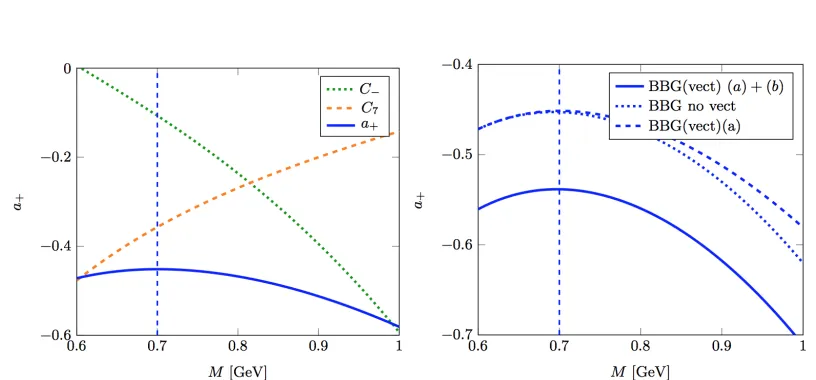
In Refs. [41, 42], the authors compute loop calculations employing a cut-offregulator instead of the dimensional regularization method. Consequently, their results exhibit a quadratic dependence on the physical cut-offM which is lost in the usual chiral perturbative calculations. This quadratic depen-dence is a crucial ingredient in the matching of the meson and quark pictures. They argue that one can obtain a parametrization of non-perturbative QCD effects by matching a low-energy Lagrangian valid up to the scale M, to the logarithmic behavior of relevant Wilson coefficients at high-energy. In this work we refer to this computational method as theBardeen-Buras-Gérard framework(BBG). Recentely Buras has advocated this determination to claim New Physics to explain the experimental value of [43]. BBG evaluateK → ππchiral loop with a dimensional cut-off(M) and match the quadratic divergences of theQi(M) weak matrix elements with the log of the short distance Wilson
coefficient as described by the equation
Heff =
i
ci(μ)Qi(μ) (10)
Figure 3. Left: In blue, the variation ofa+as a function ofM in GeV. The dotted green curve represents the contribution proportional toC−(M2) and the dashed orange curve the one proportional toC7(M2). The vertical
dashed line stands for the matching scale Right:a+as a function ofMin the three different frameworks: ‘BBG no vect.’ where vectors are not included, ‘BBG(vect)(a)’ represents the contribution coming only from diagrams with vectors coupled strongly and ‘BBG(vect) (a)+(b)’ is the case where vectors with weak couplings were included. The vertical line indicates the valueM=0.7 GeV.
5 Conclusions
for baryons predicts sizableZproduction rates testable at the next LHC run. We have also studied lepton flavor (universality) violation in rare kaon decays and the Bardeen Buras Gerard approach to describe theK±→π±l+l−form factor.
Acknowledgements
I would like to thank the organizers of the workshop QCD@work, in particular Fulvia De Fazio and Pietro Colangelo. I also acknowledge collaboration with L- Cappiello, E. Coluccio Leskow, A. Crivellin, D. Greynat, A. Nath, M. Hoferichter and L. C. Tunstall
References
[1] https://indico.cern.ch/event/549031/timetable/ Implications of LHCb measurements and future prospects, CERN 12th-14th October.
[2] U. Egede, T. Hurth, J. Matias, M. Ramon and W. Reece, JHEP 0811 (2008) 032
[arXiv:0807.2589].
[3] W. Altmannshofer, P. Ball, A. Bharucha, A. J. Buras, D. M. Straub and M. Wick, JHEP0901
(2009) 019 [arXiv:0811.1214].
[4] S. Descotes-Genon, T. Hurth, J. Matias and J. Virto, JHEP1305(2013) 137 [arXiv:1303.5794].
[5] A. Crivellin, G. D’Ambrosio and J. Heeck, Phys. Rev. Lett. 114 (2015) 151801
[arXiv:1501.00993].
[6] A. Crivellin, G. D’Ambrosio and J. Heeck, Phys. Rev. D91(2015) 075006 [arXiv:1503.03477]. [7] R. Aaijet al.[LHCb Collaboration], Phys. Rev. Lett.111(2013) 191801 [arXiv:1308.1707].
[8] R. R. Horgan, Z. Liu, S. Meinel and M. Wingate, Phys. Rev. Lett. 112 (2014) 212003
[arXiv:1310.3887].
[9] R. R. Horgan, Z. Liu, S. Meinel and M. Wingate, arXiv:1501.00367.
[10] S. Descotes-Genon, J. Matias and J. Virto, Phys. Rev. D88(2013) 074002 [arXiv:1307.5683]. [11] W. Altmannshofer and D. M. Straub, Eur. Phys. J. C73(2013) 2646 [arXiv:1308.1501]. [12] R. Gauld, F. Goertz and U. Haisch, Phys. Rev. D89(2014) 015005 [arXiv:1308.1959]. [13] A. J. Buras, F. De Fazio and J. Girrbach, JHEP1402(2014) 112 [arXiv:1311.6729].
[14] W. Altmannshofer, S. Gori, M. Pospelov and I. Yavin, Phys. Rev. D 89 (2014) 095033
[arXiv:1403.1269].
[15] C. Niehoff, P. Stangl and D. M. Straub, arXiv:1503.03865. [16] S. D. Aristizabal, F. Staub and A. Vicente, arXiv:1503.06077.
[17] R. Aaijet al.[LHCb Collaboration], Phys. Rev. Lett.113(2014) 151601 [arXiv:1406.6482]. [18] C. Bobeth, G. Hiller and G. Piranishvili, JHEP0712(2007) 040 [arXiv:0709.4174].
[19] R. Alonso, B. Grinstein and J. Martin Camalich, Phys. Rev. Lett. 113 (2014) 241802
[arXiv:1407.7044].
[20] G. Hiller and M. Schmaltz, Phys. Rev. D90(2014) 054014 [arXiv:1408.1627].
[21] D. Ghosh, M. Nardecchia and S. A. Renner, JHEP1412(2014) 131 [arXiv:1408.4097].
[22] T. Hurth, F. Mahmoudi and S. Neshatpour, JHEP1412(2014) 053 [arXiv:1410.4545].
[23] W. Altmannshofer and D. M. Straub, arXiv:1411.3161. [24] W. Altmannshofer and D. M. Straub, arXiv:1503.06199. [25] V. Khachatryanet al.[CMS Collaboration], arXiv:1502.07400.
[26] A. Dery, A. Efrati, Y. Nir, Y. Soreq and V. Susiˇc, Phys. Rev. D 90 (2014) 115022
[arXiv:1408.1371].
[29] D. Aristizabal Sierra and A. Vicente, Phys. Rev. D90(2014) 11, 115004 [arXiv:1409.7690]. [30] C. J. Lee and J. Tandean, JHEP1504(2015) 174 [arXiv:1410.6803].
[31] J. Heeck, M. Holthausen, W. Rodejohann and Y. Shimizu, Nucl. Phys. B 896 (2015) 281
[arXiv:1412.3671].
[32] X. G. He, G. C. Joshi, H. Lew and R. R. Volkas, Phys. Rev. D43(1991) 22.
[33] P. Binetruy, S. Lavignac, S. T. Petcov and P. Ramond, Nucl. Phys. B 496 (1997) 3
[hep-ph/9610481].
[34] G. Dutta, A. S. Joshipura and K. B. Vijaykumar, Phys. Rev. D50(1994) 2109 [hep-ph/9405292].
[35] J. Heeck and W. Rodejohann, Phys. Rev. D84(2011) 075007 [arXiv:1107.5238].
[36] G. C. Branco, P. M. Ferreira, L. Lavoura, M. N. Rebelo, M. Sher and J. P. Silva, Phys. Rept.516 (2012) 1 [arXiv:1106.0034].
[37] P. Langacker, Rev. Mod. Phys.81(2009) 1199 [arXiv:0801.1345].
[38] A. Crivellin, L. Hofer, J. Matias, U. Nierste, S. Pokorski and J. Rosiek, arXiv:1504.07928. [39] A. Crivellin, G. D’Ambrosio, M. Hoferichter and L. C. Tunstall, Phys. Rev. D93, no. 7, 074038
(2016) doi:10.1103/PhysRevD.93.074038 [arXiv:1601.00970 [hep-ph]].
[40] E. Coluccio Leskow, G. D’Ambrosio, D. Greynat and A. Nath, Phys. Rev. D93, no. 9, 094031 (2016) doi:10.1103/PhysRevD.93.094031 [arXiv:1603.09721 [hep-ph]].
[41] W. A. Bardeen, A. J. Buras and J. M. Gerard, Nucl. Phys. B293(1987) 787. doi:10.1016/ 0550-3213(87)90091-5; A. J. Buras, J. M. Gérard and W. A. Bardeen, "Large N Approach to Kaon Decays and Mixing 28 Years Later: ΔI = 1/2 Rule, ˆBK andΔMK", Eur. Phys. J. C74, 2871 (2014).
[42] J. M. Gerard, Acta Phys. Polon. B21(1990) 257.
[43] A. J. Buras, M. Gorbahn, S. Jager and M. Jamin, JHEP 1511, 202 (2015)
doi:10.1007/JHEP11(2015)202 [arXiv:1507.06345 [hep-ph]].