CFS Software Implementation
Gregory Landais and Nicolas Sendrier
INRIA Paris-Rocquencourt, Project-Team SECRET {gregory.landais,nicolas.sendrier}@inria.fr
Abstract. CFS is the first practical code-based signature scheme. In the present paper, we present the initial scheme and its evolutions, the attacks it had to face and the countermeasures applied. We will show that all things considered the system remains practical and we present a software implementation of the signing primitive. For eighty bits of security our implementation produces a signature in 1.3 seconds on a single core of Intel Xeon W3670 at 3.20 GHz. Moreover the computation is easy to distribute and we can take full profit of multicore processors reducing the signature time to a fraction of second in software.
Keywords: CFS, digital signature scheme, software implementation
1
Introduction
CFS [1] is a digital signature scheme based on the McEliece cryptosystem [2]. It was published in 2001 and relies on the hardness of the syndrome decoding problem and on the undistinguishability of binary Goppa code.
The practicality of the scheme is questionable because of a large public key and a long signing time. The large key size might be a problem for some appli-cations, but a storage requirement of a few megabytes on the verifier’s side is not always an issue. The second drawback is the long signing time. In fact each signature requires a large number (several hundred of thousands) of algebraic decoding attempts. The first reported signing time in software [1] was about one minute but was only meant as a proof of concept. An FPGA implementation was reported in [3] with a signing time under one second. One of the purposes of this paper is to provide a more accurate measure in software.
Since it was published, the system has been weakened in several ways. It was recently proven in [4] that the public key of CFS could be distinguished in polynomial time from a random binary matrix. This property certainly needs to be investigated further, but at this time does not seem to lead to an effective attack. More threatening is the Bleichenbacher’s attack (unpublished) which essentially reduces the cost of the best decoding attack from 2r/2to 2r/3(r= 144 in [1]) and necessitate an increase of parameters leading to a rather cumbersome scheme (gigabytes of key and minutes of signing time). Fortunately an efficient countermeasure, Parallel-CFS, was proposed in [5].
primitive. In particular we will give a precise report on the time consuming parts of the signing process. This could be an help to extend this work to coprocessor dedicated for signing. For now, our target platform is a standard PC.
We will first review the CFS scheme, its attacks and the Parallel-CFS vari-ant. This will allow us to propose some sets of secure parameters. Next we will describe the software implementation. More specifically, we will explain the var-ious algorithmic options for decoding binary Goppa and compare them. We will conclude with some timings and detailed measurements of our implementation.
2
Background
In all this paper we will consider only binary linear codes. Most of the statements are easily generalized to a larger alphabet, but no practical CFS-like signature scheme has ever been proposed so far with non binary codes.
2.1 Syndrome Decoding
We consider the following problem:
Computational Syndrome Decoding Problem: Given a matrix H ∈ {0,1}r×n, a
words∈ {0,1}r, and an integerw >0, finde∈ {0,1}nof Hamming weight≤w
such thatHeT =s.
We denote CSD(H, s, w) this problem as well as the set of its solution for a given instance. This problem is NP-hard [6]. For suitable parametersn,randw it is conjectured difficult on average which is the basis for the security of many code-based cryptosystems.
2.2 Binary Goppa Codes
Let F2m denote the finite field with 2m elements. Let n ≤2m, let the support
L= (α0, . . . , αn−1) be an ordered sequence of distinct elements ofF2m, and let
the generator g(z) ∈ F2m be a monic irreducible polynomial of degree t. The
binary Goppa code of supportLand generatorg is defined as
Γ(L, g) ={(a0, . . . , an−1)∈ {0,1}n|
n−1
X
j=0 aj
z−αj
modg(z) = 0}.
This code has lengthn≤2m dimension≥n−mtand has an algebraict-error correcting procedure. For the signature we will always take n= 2m, a smaller value would increase the signing cost. For parameters of interest the dimension will always be exactlyk=n−mt, we will denoter=mtthe codimension.
Density of Decodable Syndromes for a Goppa Code: A syndromes∈ {0,1}r is
decodable (relatively toH) with the algebraic decoder if and only if it is of the form s =eHT with e of Hamming weight t or less. There are Pt
i=0
n i
≈ nt
such syndromes. The total number of syndrome is 2rand thus the proportion of syndrome decodable with the binary Goppa code algebraic decoder is close to
n t
2r =
2m
t
2mt =
2m(2m−1)· · ·(2m−t+ 1)
t!2mt ≈
1
t!. (1)
2.3 Complete Decoding
A complete decoder for a binary linear code defined by some parity check matrix H ∈ {0,1}r×n is a procedure that will return for any syndromes∈ {0,1}r an
error patterne of minimal weight such that eHT =s. The expected weight w
of ewill be the integer just above the Gilbert-Varshamov radiusτgv, which we define as the real number1 such that τn
gv
= 2r. The threshold effect can be observed on two examples in Table 1.
In practice we will relax things a little bit and when we mention a complete decoder we mean a w-bounded decoder (with w ≥ τgv), that is a procedure ψ : {0,1}r → {0,1}n returning an error pattern matching with the input of
weight ≤ w every time there exists one. A w-bounded decoder may return an error pattern which not of minimal weight. Also, aw-bounded decoder may fail even if w ≥τgv (see Table 1 for (m, t) = (20,8) and w = 9 > τgv = 8.91), in that case we may either choose a decoding bound larger than τgv+ 1 (loosing some security) or handle somehow the decoding failure (see§5.4). In the sequel, whenever the refer to complete decoding we implicitly define a decoding bound, an integer larger thanτgv, denotedw.
(m, t) τgv w= 8 w= 9 w= 10 w= 11
(20,8) 8.91 1−2−15 0.055 2−131583 2−1010 (18,9) 10.26 1−2−331−2−18 0.93 2−2484
Table 1.Failure probability of aw-bounded decoder for a code of lengthn= 2mand codimensionr=mt
2.4 Original CFS
A CFS instance is defined by a binary Goppa codeΓ of lengthncorrecting up to terrors; of parity check matrixH; over the finite fieldF2. We will denotedecode the decoding function ofΓ. This function takes a binary syndrome as input and returns a tuple ofterror positions matching with the input syndrome or fails if
1 the mappingx7→ n x
no such error pattern exists. The matrixH is public and the procedure decode is secret. Signing a document is done like this :
1. Hash the document.
2. Suppose the hash value is a syndrome and try to decode it usingΓ. 3. Use the resulting error pattern as a signature.
Since the hash value of the document is very unlikely to be a decodable syndrome (i.e. syndrome of a word at Hamming distance tor less from a codeword), step 2 is a little more complicated. CFS comes with two workarounds for this step :
– Complete decoding [Algorithm 1] that adds a certain amount of columns of H to the syndrome until it becomes decodable (i.e.guess a few errors).
– Counter appending that alters the message with a counter and rehash it until it becomes decodable.
The two methods require t! decoding in average (a consequence of (1), see [1]), but the counter appending method includes the hash function inside the de-coding thus forcing to implement it on the target architecture, which might be an inconvenience on a dedicated coprocessor. Moreover, with this method the size of the signature is variable because the counter has a high standard vari-ation. Finally, the Parallel-CFS countermeasure (see §2.6) does not work with the counter appending method.
Algorithm 1Signing with complete decoding
functionsign(M, w) .input: messageM; integerw > t s←−h(M)
loop
(it+1, . . . , iw) R
←− {0, . . . , n−1}w−t
(i1, . . . , it)←−decode(s+Hit+1+. . .+Hiw, t)
if (i1, . . . , it)6=fail then return(i1, . . . , iw)
end if end loop end function
2.5 Attacks
There exists key distinguishing attacks on CFS [4]: it is possible to efficiently distinguish a CFS public key (a parity check matrix) from a random matrix of same size. However this does not lead, for the moment, to any efficient key recovery attack. In practice, the best known techniques for forging a signature are based on generic decoding of linear codes, that is solving the computational syndrome decoding problem (CSD).
in 1962 [7]. All practical variant derive from Stern’s algorithm [8], the most recent improvements are [9, 10]. GBA was introduced by Wagner in 2002 [11], but and order 2 variant was already proposed in [12]. Its first use for decoding came later [13].
Decoding One Out of Many (DOOM): In the signature forgery domain, an attacker can create any number of messages suiting him and be satisfied with one on them being signed. The benefits of having access to several syndromes has been mentioned by Bleichenbacher for GBA2. For ISD a proposal was made in [15] and was later generalized and analyzed in [16]. It shows that ifN target syndromes are given and if decoding anyone of them is enough, the time com-plexity is reduced by a factor almost √N compared to the situation where a single specific syndrome has to be decoded. There is a upper limit for N after which there is no gain, it depends on the type of algorithm (ISD or GBA) and on the code parameters. In practice this would mean, for 80 bits of security, multiplying the key size by 400 with a similar signing time, or multiplying the key size by 100 and the signing time by 10.
2.6 Parallel-CFS: a Countermeasure to DOOM
Parallel CFS is a countermeasure proposed by M. Finiasz in 2010 [5], aiming at cancelling the benefits of having multiple target syndromes. The idea is to produce λdifferent hash values from the document to be signed (typically two to four) and to sign (that is decode) each of them separately. The final signature will be the collection of the signatures of all those hash values, see Algorithm 2 for the description using complete decoding. This way, if the attacker forges a signature for the first hash value of one of his multiple messages, he also has to forge a signature for the remaining hash values of this specific message, thus he is back to the initial single target decoding problem. As mentioned in [5], signing appending a counter to the message is impossible in this countermeasure since it is necessary to decode several hashes of the exact same message and the counter alters the message. This countermeasure increases by a factor λ the signature time, signature size and verification time.
Algorithm 2Parallel-signing with complete decoding
functionsign mult(M, w, λ) .input: messageM; integersw > t,λ >0 for1≤i≤λdo
si←−sign((M, i), w) end for
return(si)1≤i≤λ
end function
2
In [5], Bleichenbacher’s attack is generalized for attacking several hash values. The analysis shows that for most parameters, three hash value, sometimes only two, will cancel the benefits of the attack. For ISD, it is shown in [16] that the benefit of DOOM is not as high as for GBA. There was no generalization as in [5] for several hash values, but it is not likely to change the situation and if the number of hash values is large enough to cancel DOOM-GBA it will probably also cancel DOOM-ISD.
2.7 Previous Implementations
We are not aware of any publicly available software implementation of CFS. There is one FPGA implementation, described in [3], for the original parameters n= 216,t = 9, andw= 11. It reports an average signing time of 0.86 seconds and implements the Berlekamp-Massey decoding algorithm.
3
Parameter Selection
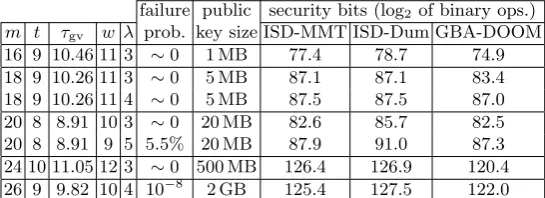
For single instances ISD is more efficient than GBA, and for multiple instances GBA-DOOM (i.e. generalized Bleichenbacher’s attack) is more efficient than ISD-DOOM. To select secure parameters will look for parameters such that we are above the security requirements for the cost of the following attacks:
– ISD-MMT [10], the best known variant of ISD, for solvingλdistinct single instances. In [10], only the asymptotic decoding exponent is given. We pro-vide in appendix§A a non asymptotic analysis which we used for Table 2. We also mention the cost of a previous variant ISD-Dum [17] which is more flexible and may have an advantage in some cases (not here though). The numbers for ISD-Dum are derived from [18].
– GBA-DOOM [5], that is the generalized Bleichenbacher’s attack, for Parallel-CFS of multiplicityλ.
failure public security bits (log2 of binary ops.)
m t τgv w λ prob. key size ISD-MMT ISD-Dum GBA-DOOM
16 9 10.46 11 3 ∼0 1 MB 77.4 78.7 74.9 18 9 10.26 11 3 ∼0 5 MB 87.1 87.1 83.4 18 9 10.26 11 4 ∼0 5 MB 87.5 87.5 87.0 20 8 8.91 10 3 ∼0 20 MB 82.6 85.7 82.5 20 8 8.91 9 5 5.5% 20 MB 87.9 91.0 87.3 24 10 11.05 12 3 ∼0 500 MB 126.4 126.9 120.4 26 9 9.82 10 4 10−8 2 GB 125.4 127.5 122.0
Table 2.Some parameter sets for Parallel-CFS using full length binary Goppa codes
undersized. We propose two main families of Goppa codes: 9-error correcting of length 218 and 8-error correcting of length 220. The latter is faster but also has a larger public key size. All proposed parameter sets achieve 80 bits of security, our main targets are those where the hash multiplicity is λ = 3. We also give some sets of parameters with higher security which were not implemented.
To be thorough, there is a very recent improvement of ISD [19]. From what we understand of this variant of ISD-MMT it is not likely to provide a significant non-asymptotic improvement when the target weight is small compared with the length as it is the case for CFS signature.
4
Algebraic Decoding of Goppa Codes
The secret is a binary Goppa code Γ(L, g) of length n = 2m of generator
g(z) ∈ F2m[z], monic irreducible of degreet, and support L = (α0, . . . , αn−1),
consisting of (all) distinct elements ofF2min a specific order. The public keyH is
a systematic parity check matrix ofΓ(L, g). We denoteLS = (β0, . . . , βr−1) the support elements corresponding to the identity part ofH. An algebraic decoder for Goppa codes takes as input a binary syndrome s= (s0, . . . , sr−1)∈ {0,1}r and returns, if it exists, an error pattern e ∈ {0,1}n of weight t such that
eHT =s. There are several algorithms (described later in this section) which all
have the same three steps:
1. Compute from sa new polynomial syndrome with coefficients inF2m.
2. Solve a key equation relating this syndrome to the error locator polynomial. 3. Extract the roots of the locator polynomial to recover the error positions.
4.1 Goppa Key Equation
The algebraic syndromeR(z) =P
0≤j<rsjfβj(z) corresponding tosis computed
as a sum of elementary syndromesfβ(z) defined for any β∈F2m as
fβ(z) =
1
z−β modg(z) = 1 g(β)
g(z)−g(β)
z−β . (2)
The corresponding key equation is
σ(z)R(z) = d
dzσ(z) modg(z),degσ≤t (3)
which has a unique solutionσ(z)∈F2m[z] up to a scalar multiplicative constant.
If there exists an error pattern e ∈ {0,1}n of weight ≤ t such that eHT = s,
then any solution to (3) is a scalar multiple of σ(z) = Q
4.2 Alternant Key Equation
A binary Goppa Γ(L, g) can also be viewed as an alternant code. We use the fact that Γ(L, g) = Γ(L, g2) when g is square-free. We still have R(z) =
P
0≤j<rsjfβj(z) but the elementary syndrome fβ(z) has degree 2t−1 instead
oft−1 and is now defined for anyβ∈F2m as
fβ(z) =
1 g(β)2
1
1−βz modz 2t=
2t−1
X
i=0 βizi
g(β)2. (4)
The corresponding key equation is
σinv(z)R(z) =ω(z) mod z2t,degω < t,degσinv≤t, (5)
which has a unique solution (σinv(z), ω(z)) ∈ F2m[z]2 up to a scalar
multi-plicative constant. If there exists an error pattern e ∈ {0,1}n of weight
ex-actly t such that eHT = s and if (σ
inv(z), ω(z)) is a solution to (5) then
σ(z) = ztσinv(z−1) = Qβ∈supp(e)(z −β) up to a scalar multiple. To remain consistent with the Goppa key equation we will speak ofσ(z) =ztσinv(z−1) as
the solution of the equation. The resolution of (5) is achieved either with the Berlekamp-Massey algorithm [21] or with the extended Euclidean algorithm.
4.3 Root Finding
The state of the art for root finding is the Berlekamp trace algorithm [22]. Its complexity is O((m+t)t2) and is advantageous compared with exhaustive techniques like Chien search or Horner’s polynomial evaluation whose complexity is linear in the length nand thus exponential inm.
5
Implementation
5.1 Finite Field Arithmetic
We need to implement extensions of the binary field F2 of degree m= 18 and m= 20. For fields of small size, the best approach is to tabulate the logarithm and the exponentiation in baseα, a primitive element ofF2m. This is efficient as
long as the table fits into the processor cache. This is not the case here and we chose to implement those fields as an extension of degree 2 ofF2m/2. We used
F220 =F210[x]/(x2+x+α),F210 =F2[x]/(x10+x9+x7+x6+ 1)
withαa primitive element ofF210 such thatα10+α9+α7+α6+ 1 = 0, and
F218=F29[x]/(x2+x+ 1),F29=F2[x]/(x9+x5+ 1).
The field F29 and F210 are small enough to be tabulated (with no cache miss
5.2 Decoding
When signing a message M, we compute a hash value s = h(M) considered as a syndrome according to the public key H. The word e of minimal weight such that s =eHT has weight w > t and thus s cannot be decoded with the algebraic decoder which is limited to t errors. If, as described in Algorithm 1, we correctly guessδ=w−terror positions we will be able to successfully apply the algebraic decoder on a modified syndrome. It was proven in [1] that this succeeds on average aftert! guesses. We describe in Algorithm 3 a variant where the syndrome is modified in polynomial form. Also, the complete root finding procedure is applied once only.
Algorithm 3Signing with binary Goppa codes
functionsign(M) .input: messageM
s←−h(M)
R0(z)←−P0≤j<rsjfβj(z) .once only, either (2) or (4)
for allB⊂Lof cardinalityδ=w−tdo
R(z)←−R0(z) +Pβ∈Bfβ(z) .syndrome adjustment, either (2) or (4) σ(z)←−solve key eq(R(z)) .key equation solving, either (3) or (5) if z2m =z modσ(z)then .split checking
A←−roots of(σ(z)) .once only
returnindices of the elements ofA∪B inL
end if end for return fail end function
Computing the Polynomial Syndrome: The first polynomial syndrome R0(z) is computed once only froms. Then, as many times as necessary,R0(z) is adjusted by computing and addingδ=w−telementary syndromesfβ(z). This
adjustment has a cost proportional to δtfield operations which is negligible in practice.
Solving the Key Equation: As mentioned above, there are various syndromes and key equations and sometimes several ways to solve them. In all case this resolution has to be done completely and produces the same locator polynomial σ(z). The cost is proportional tot2field operations with various constant.
Root Finding: The key equation always has a solutionσ(z) regardless of the existence of a suitable error pattern of weight t. The error has weightt or less if and only if the polynomial σ(z) has all its roots in the field F2m that is if
a cost proportional to mt2 field operations. This will be the dominant cost for the signature.
5.3 Discarding Degenerate Instances of Decoding
Several syndromes and key equations may be used for implementing the algebraic decoding of Goppa codes. In all cases, there is some amount of control required; at some point a coefficient is checked (leading coefficient in the extended Eu-clidean algorithm, or the discrepancy in Berlekamp-Massey Algorithm) and if it is zero the sequencing of operations if affected. Ignoring completely this test (i.e.assuming the coefficient is non zero) will provide a significant speedup in software (loops are easier to unroll) and a welcome simplicity in constrained de-vices. The counterpart is that a (small) proportion of decoding attempts produce inconsistent results and will fail. This is not a big deal in the signature context where almost all decoding attempts fail anyway. This was already remarked in [3] to simplify the control in an FPGA implementation.
5.4 How to Handle Decoding Failure
For (m, t) = (20,8) andw= 9 there is a probability of failure ofν = 5.5%. This means that some messages cannot be signed. When we use Parallel-CFS with multiplicity λ= 5, this percentage is equal to µ= 1−(1−ν)λ that is almost
25%, which is hardly acceptable. The workaround is toadd a counter:
Define a family F ={fi,0 ≤ i < 2b} of 2b one-to-one transformations
on the syndromes (for instance adding distinct predefined random con-stant vectors). Lets1, . . . , sλ denote the hash values of Parallel-CFS of
multiplicityλ. We try to decode the tuplef(s1), . . . , f(sλ) for allf ∈ F.
The verifier will also try all f ∈ F, in the same order as the signer. Optionally, theb bits indexiof the transformation can be added to the signature to speed-up the verification.
The decoding fails for allf ∈ Fwith probabilityµ2b. For instance withb= 5 in our example the probability of failure drops from 0.249 to 2−64and each time we increment b this probability is squared. The security is unchanged because we applied the same transformation on all hash values. Note that, had we allowed different transformations for the λ hash values, the attacker would have been able to apply a 2binstances ISD-DOOM for on each hash value, gaining a factor
√
2b to the attack.
5.5 Signature Size, Verification and Key Generation
6
Timings
6.1 Computation time
We measured with two decoders and the various sets of parameters the average number of algebraic decoding and the running time for producing one signature running on our target platform (a single core of an Intel Xeon W3670 at 3.20 GHz, about 400 000 signatures per parameter set were computed). The finite
(m, t, w, λ)
(18,9,11,3) (18,9,11,4) (20,8,10,3) (20,8,9,5) number of decoding 1 117 008 1 489 344 121 262 360 216
running time (BM) 14.70 s 19.61 s 1.32 s 3.75 s running time (Pat.) 15.26 s 20.34 s 1.55 s 4.26 s
Table 3.Average number of algebraic decoding and running time per signature
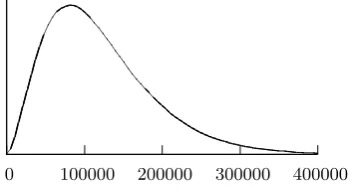
Fig. 1.Distribution of the number of decoding per signature (m, t, w, λ) = (20,8,10,3)
0 100000 200000 300000 400000
field arithmetic primitives use 75% of the total amount of CPU time, most of that (66%) for the sole multiplication. We observe in Table 3 that the number of decoding is very close (but slightly above) the expected value ofλt!. The only exception is for (m, t, w, λ) = (20,8,9,5). In that case each complete decoding has a probability of 5.5% of failure, but when it fails, the number of decoding attempts is equal to the maximum allowed. Experimentally the best tradeoff when λ= 5 is to allow only 200 000 decoding per binary syndrome (instead of 220), this raises the probability of failure to 8.4% and with a counter of 6 bits (see§5.4) we fail to sign with probability 2−95. In practice we observe that the signing cost almost doubles.
6.2 Comparing Decoders
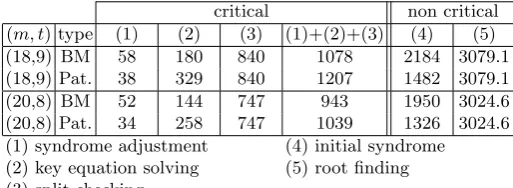
Statistics are summarized in Table 4. The “critical” steps are those called inside the loop of Algorithm 3. The “non critical” ones are outside the loop and thus are called only once per complete decoding, that isλ= 3 times per signature. A field operation is a multiplication, a squaring, a division, an inversion, or a square root. We do not count additions which are implemented with a xor. In practice, this gives an accurate measure of the complexity and allows and easy comparison of the decoders and an indication about the relative costs of the various steps. All numbers are constant for all steps except the root finding algorithm (Berlekamp trace algorithm). If we consider the non critical parts, it appears that the
syn-critical non critical (m, t) type (1) (2) (3) (1)+(2)+(3) (4) (5) (18,9) BM 58 180 840 1078 2184 3079.1 (18,9) Pat. 38 329 840 1207 1482 3079.1
(20,8) BM 52 144 747 943 1950 3024.6
(20,8) Pat. 34 258 747 1039 1326 3024.6 (1) syndrome adjustment (4) initial syndrome (2) key equation solving (5) root finding (3) split checking
Table 4.Number of field operations (excluding additions) per decoding
drome computation and the root finding algorithms are the dominant cost and thus the Patterson algorithm is more efficient than the Berlekamp-Massey algo-rithm which requires a double sized syndrome. The situation is reversed when we consider only the critical parts because the Berlekamp-Massey key equation solving is more efficient.
7
Conclusion
For a proper choice of parameters we have shown that CFS, in fact Parallel-CFS, is practical, though cumbersome to achieve a reasonable security. The fastest of our instances needs a bit more than one second of CPU time to produce a signature, which is slow but acceptable. The corresponding public key has a size of 20 megabytes, which may disqualify the scheme for some applications. Note that the public key is not needed for signing but only the secret key which consists of a pair (L, g). The generatorg has a size ofmtbits (160 or 162 bits here) and the support is a permutation of 2m elements which can be generated on the fly
from a seed. The implementation of the signing primitive we describe requires only a relatively small amount of storage3 and memory, making it suitable for massively parallel architecture (like GPUs) or “hardware-oriented” devices (like FPGAs or even smart cards).
3
References
1. Courtois, N., Finiasz, M., Sendrier, N.: How to achieve a McEliece-based digital signature scheme. In Boyd, C., ed.: Advances in Cryptology - ASIACRYPT 2001. Volume 2248 of LNCS., Springer (2001) 157–174
2. McEliece, R.: A public-key cryptosystem based on algebraic coding theory. DSN Prog. Rep., Jet Prop. Lab., California Inst. Technol., Pasadena, CA (January 1978) 114–116
3. Beuchat, J.L., Sendrier, N., Tisserand, A., Villard, G.: FPGA implementation of a recently published signature scheme. Rapport de recherche RR LIP 2004-14, ENS Lyon (2004)
4. Faug`ere, J.C., Gauthier, V., Otmani, A., Perret, L., Tillich, J.P.: A distinguisher for high rate McEliece cryptosystems. In: ITW 2011, Paraty, Brazil (October 2011) 282–286
5. Finiasz, M.: Parallel-CFS: Strengthening the CFS McEliece-based signature scheme. In Biryukov, A., Gong, G., Stinson, D., eds.: Selected Areas in Cryp-tography. Volume 6544 of LNCS., Springer (2010) 159–170
6. Berlekamp, E., McEliece, R., van Tilborg, H.: On the inherent intractability of certain coding problems. IEEE Transactions on Information Theory24(3) (May 1978)
7. Prange, E.: The use of information sets in decoding cyclic codes. IRE Transactions IT-8(1962) S5–S9
8. Stern, J.: A method for finding codewords of small weight. In Cohen, G., Wolfmann, J., eds.: Coding theory and applications. Volume 388 of LNCS., Springer (1989) 106–113
9. Bernstein, D., Lange, T., Peters, C.: Smaller decoding exponents: Ball-collision decoding. In Rogaway, P., ed.: Advances in Cryptology - CRYPTO 2011. Volume 6841 of LNCS., Springer (2011) 743–760 To appear.
10. May, A., Meurer, A., Thomae, E.: Decoding random linear codes in ˜O(20.054n).
In Lee, D., Wang, X., eds.: Advances in Cryptology - ASIACRYPT 2011. Volume 7073 of LNCS., Springer (2011)
11. Wagner, D.: A generalized birthday problem. In Yung, M., ed.: Advances in Cryptology - CRYPTO 2002. Volume 2442 of LNCS., Springer (2002) 288–303 12. Camion, P., Patarin, J.: The knapsack hash function proposed at CRYPTO ’89
can be broken. In Davies, D., ed.: Advances in Cryptology - EUROCRYPT ’91. Volume 547 of LNCS., Springer (1991) 39–53
13. Coron, J.S., Joux, A.: Cryptanalysis of a provably secure cryptographic hash func-tion. Cryptology ePrint Archive, Report 2004/013 (2004) http://eprint.iacr.org/. 14. Overbeck, R., Sendrier, N.: Code-based cryptography. In Bernstein, D., Buchmann,
J., Dahmen, E., eds.: Post-Quantum Cryptography. Springer (2009) 95–145 15. Johansson, T., J¨onsson, F.: On the complexity of some cryptographic problems
based on the general decoding problem. IEEE-IT48(10) (October 2002) 2669–2678 16. Sendrier, N.: Decoding one out of many. In Yang, B.Y., ed.: PQCrypto 2011.
Volume 7071 of LNCS., Springer (2011) 51–67
17. Dumer, I.: On minimum distance decoding of linear codes. In: Proc. 5th Joint Soviet-Swedish Int. Workshop Inform. Theory, Moscow (1991) 50–52
19. Becker, A., Joux, A., May, A., Meurer, A.: Decoding random binary linear codes in 2n/20: How 1+1=0 improves information set decoding. In: EUROCRYPT 2012.
(2012)
20. Patterson, N.: The algebraic decoding of Goppa codes. IEEE Transactions on Information Theory 21(2) (March 1975) 203–207
21. Massey, J.: Shift-register synthesis and BCH decoding. IEEE Transactions on Information Theory 15(1) (January 1969) 122–127
22. Berlekamp, E.: Algebraic Coding Theory. Aegen Park Press (1968)
A
A Non Asymptotic Analysis of ISD-MMT
We refer to the algorithm described in [10] to solve CSD(H, s, w) with H ∈ {0,1}r×n and s ∈ {0,1}r (we denote k = n−r the dimension), it uses as
parameters three integers p, `2, and `. First, a Gaussian elimination on H is performed and then three levels of lists are built and successively merged. With a certain probabilityP(p, `, `2) a solution to CSD(H, s, w) lies in the last of those lists. The whole process has to be repeated 1/P(p, `, `2) times on average to find a solution.
– There are 4 lists at the first level, each of sizeL0= (k+p/`4)/2
.
– There are 2 lists at the second level, obtained by merging the first level lists pairwise, both have sizeL1=L202−`2 on average.
– The final list at third level is obtained by merging the two second level lists and has sizeL2=L212−`+`2 =L402−`−`2 on average.
To give an expression of the success probability, we cannot use [10] which assumes a unique solution while for signature parameters we may have several4. Instead we claim (following the analysis of [18, 16]) that any particular element of the final list will provide a solution with probability≈2`ε(p, `) where
ε(p, `) =
r−` w−p
min 2r, n w
.
The min in the above expression takes into account the possibility of several solutions. In practice for the signature 2r will be smaller than n
w
. We claim that, for practical code parameters and when p and ` are near their optimal values
1. if`2is not too small the proportion of duplicates in the final list is negligible, 2. if `2 is not too large the costs for building the first level lists and for the
Gaussian eliminations are negligible.
4
Assuming the first claim is true, the probability of success is
P(p, `, `2) = 1− 1−2`ε(p, `)L2
≈L22`ε(p, `) =L042−`2ε(p, `).
Assuming the second claim is true, the cost for building the final list and checking whether it contains a solution is (crudely) lower bounded by 2L1+2L2elementary operations5. The factor 2 in front of L1 is because there are two lists at the second level and the factor 2 in front ofL2is because each element of the final list has to be constructed (an addition at least) then checked (a Hamming weight computation). Finally assuming each elementary operation costs at least`binary operations the cost of ISD-MMT is lower bounded by
WFMMT= min
p,`
2` ε(p, `)
1
2` +
1 L2
0
. (6)
Note that, interestingly, `2 do not appear in the above expression. It means that, as long as it is neither too small or too large, the choice of `2 has no impact on the complexity of ISD-MMT. In practice the proper ranges is (roughly) p/2≤`2≤log2L0. It is best to avoid the extreme values in that range and large values are better because they reduce memory requirements. Finally note that in [10] it is suggested that `2≤p−2. This is marginally inside the acceptable range but this has no consequence on the asymptotic exponent analysis.
5 here an elementary operation is an operation on a column ofH, either addition or