New Identity Based Encryption And Its Proxy
Re-encryption
Xu An Wang, Xiaoyuan Yang
Key Laboratory of Information and Network Security
Engineering University of Chinese Armed Police Force, Xi’an, 710086, P.R. China [email protected]
Abstract
Identity based encryption (IBE) has received great attention since Boneh and Franklin’s breakthrough work on bilinear group basedIBE [4]. Till now, many IBE schemes relying on bilinear groups with different properties have been proposed [5, 25, 29, 14]. However, one part of the user’s private key in all theseIBEschemes is constructed asy=f(msk), wheremskis the master key andyis an element in the underlying bilinear groupG. In this paper, we propose a new IBE: one part of the private key isy=f(msk), wheremsk is the master key and y is an element in Z∗
p. Here p is the underlying bilinear
group’s prime order. By using some novel techniques, we prove this newIBE is semantic secure under the selective identity chosen plaintext attacks (IND-sID-CPA) in the standard model. Based on this IBE scheme, we construct an IND-ID-CCA secure identity based proxy re-encryption (IBPRE) scheme which is master secret secure and efficient for the proxy compared with other IND-ID-CCA (IBPRE) schemes.
Key words: Identity based encryption, identity based proxy re-encryption, master secret secure, IND-ID-CCA secure.
1. Introduction
1In 1984, Shamir [26] introduced the concept of identity-based
cryptog-raphy to ease the certificate management in traditional public key system. A user’s public key in an IBE scheme is the identity information of the user
(e.g., email address). Hence the public key is implicit authenticated and the certificate management is simplified. However, the first practical IBEscheme [4] was only proposed 17 years after its concept was proposed. Since then, many practical IBE schemes with different properties have been proposed [5, 25, 29, 14]. However, one part of the private key in all theseIBE schemes is of the form: y=f(msk) where mskis the master key andy is an element in the underlying bilinear group G.
The concept of proxy re-encryption (PRE) is proposed by Blaze et al. [3] in 1998, which allows a semi-trusted proxy, with some information (a.k.a., the re-encryption key), to translate a ciphertext under the delegator’s public key into another ciphertext can be decrypted by the delegatee’s secret key. However, the proxy cannot access the plaintext. According to the direction of transformation, PRE schemes can be classified into bidirectional schemes and unidirectional schemes. Also according to the times the transformation can apply on the ciphertext, PRE schemes can be classified into single-hop schemes and multi-hop schemes. At NDSS’05, Ateniese et al. [1] proposed a few unidirectional PRE schemes and discussed its several potential applica-tions such as distributed secure file systems. Later, many unidirectionalPRE schemes with different properties have been proposed [17, 34, 28, 23, 10]. Due to the simpler certificate management in IBE, Green and Ateniese [13] extended PRE to the IBE setting, i.e. identity based proxy re-encryption (IBPRE). They also discussed its several interesting applications such as bridging IBE and PKE. Since then, several IBPRE schemes have been pro-posed [9, 20, 28, 22, 10], but none of them except [23, 10] can achieve master secret secure: the corrupted proxy and delegatee can not derive the delega-tor’s private key. However, IBPRE schemes in [23] are generic constructions relying on CCA-secure 2-level hierarchical ID-based (2,2) threshold cryp-tosystem, they are inefficient. IBPRE schemes in [10] rely on conditional proxy broadcast re-encryption, they are also inefficient and can only achieve secure against replayable chosen ciphertext attacks (RCCA).
1.1. Our Contribution
In this paper, we construct a new identity based encryption scheme. The main novelty of our IBE is that: one part of the private key is y = f(msk), where msk is the master key and y is an element in Z∗
p. Here p is the
IND-sID-CPAsecure in the standard model based on a related DBDH assumption in the bilinear groups.
We also construct an IBPRE scheme on this new IBE. This new IBPRE does not follow Green’s paradigm on which almost all the existing efficient IBPRE schemes are based. The main novelty in this IBPRE is that, the re-encryption key is almost independent with the delegatee’s private key. As a result, our IBPRE can achieve master secret security.
1.2. Related Work
Identity Based Encryption. Here we just recall theIBEschemes close-ly related to our work. At Crypto’01, Boneh and Franklin constructed the first practical identity based encryption based on bilinear groups [4] (BF IBE). In 2003, Sakai and Kasahara proposed a new identity based encryption with different structure based on bilinear groups (SK IBE) [25]. However, both of these work prove their security in the random oracle model. At Eurocryp-t’04, Boneh and Boyen proposed two new efficient selective identity secure IBEschemes without random oracles (BB1 IBEandBB2IBE) [5]. Later Boneh and Boyen [6], Waters [29] improved their work onIBEschemes with full secu-rity at Crypto’04 and Eurocrypt’05 (Waters’IBE). At Eurocrypt’06, Gentry proposed an efficient identity based encryption with tight security proof in the standard model but based on a strong assumption (Gentry’sIBE)[14].
All the existing IBEs can lie in three frameworks: “Full Domain Hash” framework, “ Exponent Inversion” framework and “Communicative Blind-ing” framework [7]. “Full Domain Hash” framework includes BF IBE, which is proven secure in the random oracle and support hierarchies and threshold variants. “ Exponent Inversion” framework includes SK IBE, BB2 IBE and Gentry’sIBE, which are always difficult to support extensions. “Communica-tive Blinding” framework includes BB1 IBE and Waters’ IBE, which always support extensions like hierarchy IBE, threshold IBE, fuzzy IBE, attribute based encryption and broadcast encryption.
Identity Based Proxy Re-encryption. In ACNS’07, Green and Ate-niese proposed the first identity based proxy re-encryption schemes [13]. They defined the algorithms and security models for identity based proxy re-encryption, and constructed their scheme by using a variant of the ef-ficient Dodis/Ivan key splitting approach to settings with a bilinear map. The re-encryption key in their scheme is of the form (H1(Alice)−s· H(X),
IBEBob(X)). When the proxy re-encrypt, it does some transformations and
to recover X and use this X to recover the original message. In ISC’07, Chu and Tzeng proposed the first IND-CCA2 secure proxy re-encryption in the s-tandard model based on Waters’ IBE [9]. They follow the paradigm proposed in [13] (We denote it as Green’s paradigm). Unfortunately Shao et al. found their scheme can not achieve IND-CCA2 secure and they fixed this flaw by proposing an improved scheme [24]. However, both of these schemes are not efficient due to the structure of Waters’ IBE and Green’s paradigm. In Pair-ing’07, Matsuo proposed four types of proxy re-encryption: IBE to IBE, CBE to IBE, IBE to CBE and CBE to CBE. They constructed a hybrid proxy re-encryption scheme from CBE to IBE and a proxy re-re-encryption scheme from IBE to IBE. But recently it was shown their proxy re-encryption scheme from IBE to IBE has some flaws [31]. In Inscrypt’08, Tang et al. proposed the new concept of inter-domain identity based proxy re-encryption [28]. They con-cern on constructing proxy re-encryption between different domains in identi-ty based setting. They follow Green’s paradigm but based on Boneh-Frankin IBE. Their scheme can only achieve IND-sID-CPA secure. Later, Ibraimi et al. construct a type and identity based proxy re-encryption, which aimed at combing type and identity properties in one proxy re-encryption system [16]. Recently Lai et al. [18] gave new constructions on IBPRE based on identity-based mediated encryption. Luo et al. [19] also gave a new generic IBPRE construction based on IBE. Wang et al. proposed the first multi-use CCA-secure unidirectional IBPRE scheme [30].
1.3. Organization
In Section 2, we give some preliminaries we will use later. In Section 3, we construct our new IBE scheme and prove its IND-sID-CPA security. In Section 4, we construct our newIBPRE, prove it to beIND-ID-CCAsecure and master secret secure. In Section 5, we give our comparison results. Finally, we concludes our paper in the last Section.
2. Preliminaries
2.1. Bilinear Groups
Let G be an algorithm called a group generator that takes as input a security parameterλand outputs a tuple (G, GT, e) whereGandGT are two
• (Bilinear) ∀u, v ∈G,∀a, b∈Z, e(ua, vb) =e(u, v)ab.
• (Non-degenerate) ∃g ∈G such that e(g, g) has order p inGT.
We assume that the group action in G and GT as well as the bilinear map e are all computable in polynomial time in λ. Furthermore, we assume that the description of G and GT includes a generator of G and GT respectively.
2.2. EXDBDH Assumption
EXDBDH assumption extends the DBDH assumption in the prime order bilinear group.
Definition1. Run G to obtain (G,GT, e). Next it generatesg as generators of G. On input (g, ga, gb, gc, g(b+c)d, gd, T), for any probabilistic polynomial
time algorithm A cannot distinguish T =e(g, g)abd from a random element
in G with non-negligible probability, this is the EXDBDH assumption. We note that the assumption is a falsifiable assumption [21]. Intuitively, there is no gab, gad, gbd, hence the pairing cannot help to solve the decisional
problem.
2.3. Definition and Security Notion for IBE 2.3.1. Definition
AnIBE scheme consists of the following algorithms.
1. Setup(1k). On input a security parameter, outputs both the master
public parametersparamswhich are distributed to users, and the master key msk which is kept private.
2. KeyGen(msk, params, ID). On input an identity ID ∈ {0,1}∗ and the master secret keymsk, outputs a decryption keyskIDcorresponding
to that identity.
3. Encrypt(ID,params,m). On input a set of public parameters, an iden-tity ID ∈ {0,1}∗ and a plaintextm ∈ M, outputsC
ID, the encryption
of m under the specified identity.
4. Decrypt(skID, params, CID). Decrypts the ciphertext CID using the
2.3.2. Security Notion.
We recall theIND-sID-CPAsecurity in [5]. It is defined using the following game:
1. Init: The adversary outputs an identity ID∗ where it wishes to be challenged.
2. Setup: The challenger runs the Setupalgorithm. It gives the adversary the resulting system parametersparams. It keeps the master key to itself. 3. Phase1: The adversary issues q1· · ·qm where qi is one of private key
query IDi whereIDi 6=ID∗. The challenger responds by running
algo-rithm KeyGento generate the private keydi corresponding to the public
key IDi. It sends di to the adversary. These queries maybe asked
adap-tively, that is, each query qi may depend on the replies toq1,· · · , qi−1.
4. Challenge: Once the adversary decides that Phase1 is over it output-s two equal length plaintextoutput-s M0, M1 ∈ M on which it wishes to be
challenged. The challenger picks a random bit b ∈ {0,1} and sets the challenge ciphertext to C = Encryption(params,ID∗,Mb). It sends C as
the challenge to the adversary.
5. Phase2: The adversary issues additional queries qm+1· · ·qn where qi
is one of private key queries IDi where IDi 6= ID∗. The challenger
responds as in Phase1. These queries maybe asked adaptively as in Phase1.
6. Guess: Finally, the adversary outputs a guess b0 ∈ {0,1}. The adver-sary wins if b =b0.
We refer to such an adversary A as an IND-sID-CPA adversary. We define the advantage of the adversary A in attacking the scheme E as Adv,Aa =| P r[b =b0]−1
2 |, The probability is over the random bits used by the challenger
and the adversary. If this probability is negligible, then we say scheme E is IND-sID-CPA secure.
2.4. Definition for IBPRE 2.4.1. Definition
An identity based (single-hop) proxy re-encryption scheme consists of the algorithms (Setup, KeyGen, Encrypt, Decrypt, ReKeygen, Reen-crypt):
2. KeyGen(params, msk, ID). On input an identity ID ∈ {0,1}∗ and the master secret keymsk, outputs a decryption keyskIDcorresponding
to that identity.
3. Encrypt(params, ID, m). On input a set of public parameters, an identity ID∈ {0,1}∗ and a plaintext m ∈ M, outputs the second level ciphertext CID, which can be re-encrypted by the proxy.
4. ReKeygen(params, skID1, ID2). On input secret key skID1, and
i-dentities ID2 ∈ {0,1}∗, the delegator non-interactively generates the
re-encryption key rkID1→ID2 and outputs it.
5. Reencrypt(params, rkID1→ID2, CID1). On input a second level
ci-phertext CID1 under identity ID1, and a re-encryption key rkID1→ID2,
outputs a first level re-encrypted ciphertext CID2 which can not be
re-encrypted.
6. Decrypt2(params, skID, CID). On input a second level ciphertextCID
under identity ID with secret key skID, decrypts the ciphertext CID,
and outputs m or ⊥.
7. Decrypt1(params, skID, CID). On input a first level re-encrypted
ci-phertext CID under identity ID with secret key skID, decrypts the
re-encrypted ciphertext CID, and outputsm or ⊥.
Correctness: Intuitively, an IBPRE is correct if the Decrypt algorithm al-ways outputs the expected decryption of a properly generated ciphertext. Slightly more formally, let cID1 ← Encrypt(params, ID1, m) be a properly
generated ciphertext, Then ∀m ∈ M,∀ID1, ID2 ∈ {0,1}∗, where skID1 =
KeyGen(msk, ID1), skID2 =KeyGen(msk, ID2),rkID1→ID2 ←ReKeygen
(params, skID1, ID1, ID2), the following propositions hold: • Decrypt(params, skID1, cID1)= m
• Decrypt(params, skID2, Reencrypt(params, rkID1→ID2, cID1))=m
2.5. Security Notion for IBPRE
2.5.1. IND-ID-CCA Security for the Second Level Ciphertext.
IND-ID-CCA Security for the second level ciphertext is defined according to the following game.
1. Setup. Run Setup(1k) to get (params, msk), and give paramsto A. 2. Find phase. A makes the following queries. At the conclusion of this
phase A will select ID∗ ∈ {0,1}∗ and (m
(a) For A’s queries to extract oracleOextractwith (extract, ID), return skID =KeyGen(params, msk, ID) to A.
(b) For A’s queries to re-encryption key extract oracle Orkextract with (rkextract, ID1, ID2), whereID1 6=ID2, returnrkID1→ID2=ReKeygen
(params,KeyGen(params,msk,ID1),ID2) to A.
(c) ForA’s queries to re-encrypt oracleOreencrypt with (reencrypt, ID1, ID2, C), derive a re-encryption keyrkID1→ID2 =ReKeygen(params,
KeyGen(params,msk,ID1),ID2), and return C0=Reencrypt(params,
rkID1→ID2, ID1, ID2, C) to A.
(d) For A’s queries to the first level ciphertext decrypt oracle O1decrypt
with (decrypt, ID, C) where C is a first level ciphertext, return
m=Decrypt1(params,KeyGen(params,msk,ID),C) to A.
Note thatA is not permitted to chooseID∗ such that trivial decryption is possible using keys extracted during this phase (e.g. , by using extract-ed re-encryption keys to translate from ID∗ to some identity for which
A holds a decryption key). Also note that the second level ciphertext decrypt oracle O2decrypt is no use here, for any second level ciphertext
can be first re-encrypted and then be queried to the O1decrypt to get the
decryption result.
3. Choice and Challenge. When A presents (choice, ID∗, m0, m1), choose i←R {0,1}, computeC∗= Encrypt(params,ID∗,mi) and giveC∗ toA.
4. Guess stage. A continues to make queries as in the find stage, with the following restrictions. LetC = (C∗, ID∗). For allrkgiven toA, letC0 be the set of all possible values derived via calls to Reencrypt oracle, e.g. on successful execution of re-encrypt query (reencrypt, ID∗, ID0, C∗), let C0 be the result and add the pair (C0, ID0) to the set C0. We call
C ∪ C0) is the Derivative of (C∗, ID∗).
(a) A is not permitted to issue any query of the form (decrypt, ID, C) to decrypt oracle O1decrypt orO2decrypt where (C, ID)∈(C ∩ C0).
(b) A is not permitted to issue any queries (extract, ID) to extract o-racle Oextract or (rkextract, ID1, ID2) to re-encryption key extract
oracleOrkextract that would permit trivial decryption of any cipher-text in (C, C0).
(c) Ais not permitted to issue any query of the form (reencrypt, ID1, ID2, C)
to re-encrypt oracleOreencryptwhereApossesses the keys to trivially decrypt ciphertexts underID2 and (C, ID1)∈(C ∩ C0).
The outcome of the game is determined as follows: If i0 =i then A wins the game. Let Adv=|P r(i0 =i)−1/2|. If for all probabilistic polynomial time algorithms A, Adv ≤v(k), we say that the IBPRE scheme S is IND-ID-CCA secure for the second level ciphertext.
2.5.2. IND-ID-CCA Security for the First Level Ciphertext.
IND-ID-CCA Security for the first level ciphertext is defined according to the following game.
1. Setup. Run Setup(1k) to get (params, msk), and give paramsto A.
2. Find phase. A makes the following queries. At the conclusion of this phase A will select (ID?, ID∗)∈ {0,1}∗ and (m
0, m1)∈ M2.
(a) For A’s queries to extract oracleOextractwith (extract, ID), return skID =KeyGen(params, msk, ID) to A.
(b) For A’s queries to re-encryption key extract oracle Orkextract with
(rkextract, ID1, ID2), whereID1 6=ID2, returnrkID1→ID2=ReKeygen
(params,KeyGen(params,msk,ID1),ID2) to A.
(c) For A’s queries to the first level ciphertext decrypt oracle O1decrypt
with (decrypt, ID, C), returnm =Decrypt1(params,KeyGen(params, msk,ID),C) to A.
Note here that Ais permitted to get all the extracted re-encryption keys includingID∗ to some identity for whichAholds a decryption key. Also note here that the re-encrypt oracle and second level ciphertext decrypt oracle are useless, since the A knows all the re-encryption key, he can do all the re-encryption and transform the second level ciphertext to the first level ciphertext.
3. Choice and Challenge. WhenApresents (choice, ID?, ID∗, m
0, m1), choose i←R {0,1}, computeC?= Encrypt(params,ID∗,mi) andC∗=Reencrypt
(params, rkID∗→ID?, ID?, ID∗, C?) giveC? to A.
4. Guess stage. A continues to make queries as in the find stage, with the following restrictions.
(a) Ais not permitted to issue any query of the form (decrypt, ID∗, C∗) to decrypt oracle O1decrypt or (decrypt, ID?, C?) to O2decrypt. Note
here that C? maybe can be derived from C∗.
(b) Ais not permitted to issue any queries (extract, ID?) or (extract, ID∗) to extract oracle Oextract.
The outcome of the game is determined as follows: If i0 =i then A wins the game. Let Adv=|P r(i0 =i)−1/2|. If for all probabilistic polynomial time algorithms A, Adv ≤v(k), we say that the IBPRE scheme S is IND-ID-CCA secure for the first level ciphertext.
Remark1. In this security notion, we give two target identities (ID∗, ID?) for our re-encryption not randomizing the second level ciphertext. From the the re-encrypted first level ciphertext, anyone can trivially derive its second level ciphertext.
2.5.3. Master Secret Security.
We extend Libert and Vergnaud’s definition on master secret security of PRE[17], to IBPRE. This notion demands that no coalition of dishonest delegatees be able to pool their re-encryption keys in order to expose the pri-vate key of their common delegator. More formally, the following probability should be negligible as a function of the security parameter λ2,
P r[skID? ←Oextract(ID?), skID
x ←Oextract(IDx)},
{RID?→ID
x ←Orkextract(ID
?, ID
x)},{RIDx→ID? ←Orkextract(IDx, ID
?)}, γ ← A(ID?,{IDx, skIDx},{RID?→IDx},{RIDx→ID?}) :γ =skID?]
3. New Identity Based Encryption
3.1. Our Construction
1. Setup(1k). Run G(1n) to obtain (
G,GT, e). Next it generates g as
generators of bilinear group of G with order p. For now, we assume public keys (ID) are elements in Z∗
p. We also assume messages to be
encrypted are elements in GT. Select random t1, t2, t3 ∈ Zp∗, let g2 = gt1, g
3 =gt3, h=gt2. Pick a random α∈ Zp∗, set g1 =gα, that is, params = (g, g1, g2, g3, h, p,G,GT, e), msk = (α, t1, t2, t3)
2. KeyGen(msk,params,ID). Given msk = (α, t1, t2, t3) and ID with params, the PKG picks random x, y, n∈ Z∗
p and sets dID = (d1, d2, d3, d4) = (
α+x αID+t2
+y modp, gx(gID1 h)y, g3x(gID1 h)−n, g3ygn)
2Notations: (ID?,sk
ID?) denotes the target user’s identity and private key and (IDx,
3. Encrypt(ID,params,M). To encrypt a message M ∈ GT under the public key ID∈ Z∗
p, pick a random r ∈ Zp∗ and compute CID = (C1, C2, C3, C4) = (gr,(g2g3)r,(g1IDh)
r
, M e(g1, g2)r)
4. Decrypt(skID,params,CID). Given ciphertextCID = (C1, C2, C3, C4)
and the secret key dID = (d1, d2, d3) with params, compute
M = C4e(C2, d2)
e(g2, C3d1)e(C1, d3)e(C3, d4)
Correctness:
M0 = C4e(C2, d2) e(g2, C
d1
3 )e(C1, d3)e(C3, d4)
= M e(g1, g2)
re((g
2g3)r, gx(gID1 h)
y)
e(g2,((g1IDh)r) ( α+x
αID+t2+y))e(gr, gt3x(gID
1 h)−n)e((g1IDh)r, gt3ygn)
= M e(g1, g2)
re((g
2g3)r, gx(gID1 h)
y)
e(g2,((g1IDh)r)y)e(g2, gxr)e(g2, g1r)e(g
r
3, gx(g
ID
1 h)y)
= M e(g1, g2)
re(g
2,(gx(g1IDh)
y)r)
e(g2,((g1IDh)r)y)e(g2, gxr)e(g2, gr1)
= M e(g1, g2)
re(g
2,((g1IDh)
y)r)
e(g2,((g1IDh)r)y)e(g2, gr1)
=M e(g1, g2)
r
e(g2, gr1)
=M
3.2. Security Analysis
Theorem 1. Suppose the EXDBDH assumption holds in (G,GT, e), then our proposed IBE isIND-sID-CPA secure.
Proof. Suppose A can attack our scheme, we construct an algorithm B
solves the EXDBDH problem in (G,GT, e). On input (g, ga, gb, gc, g(b+c)d, gd, T),
algorithm B’s goal is to output 1 if T = e(g, g)abd and 0 otherwise. Let g1 = ga, g2 = gb, g3 = gc, that is, t1 = a, t2 = b, t3 = c. Algorithm B works
by interacting with A in a selective identity game as follows:
1. Initialization. The selective identity game begins with A first out-putting an identity ID∗ that it intends to attack.
2. Setup. To generate the system’s parameters, algorithmBpicksα0 ∈ Z∗
p
at random and defines h = g−1ID∗gα0 ∈
G. It gives A the parameters params = (g, g1, g2, g3, h). Note that the corresponding master key,
3. Phase 1. A issues up to private key query on ID. B returns
dsim1 = 1
(ID−ID∗) +ymodp=
a+x
aID−aID∗+α0 +ymodp = a+x
aID+t2
+ymodp dsim2 = (g)( α
0
ID−ID∗)(ga)y(ID−ID ∗)
(g)y =gx(ga(ID−ID∗)g)y =gx(g1IDh)y
dsim3 = (gc)( α
0
ID−ID∗)((ga)ID−ID ∗
gα0)−n =gcx(g1IDh)−n=g3x(g1IDh)−n
dsim4 = (gc)ygn=g3ygn
where x = ID−α0ID∗ modp and y, n randomly chosen from Zp∗. We can
verify (dsim
1 ,· · · , dsim4 ) is a valid private key for ID.
4. Challenge. WhenA decides that Phase 1 is over, it outputs two mes-sages M0, M1 ∈G. AlgorithmB picks a random bitb and responds with
the ciphertext C = (gd, g(b+c)d,(gα0)d, M
b·T). Hence if T = e(g, g)abd,
then C is a valid encryption ofMb underID∗. Otherwise,C is
indepen-dent of b in the adversary’s view.
5. Phase 2. Aissues private key query onIDias he does inPhase 1except IDi =ID∗.
6. Guess. Finally, A outputs a guess b0 ∈ {0,1}. Algorithm B concludes its own game by outputting a guess as follows. Ifb =b0, thenBoutputs 1 meaning T =e(g, g)abd. Otherwise it outputs 0 meaning T 6=e(g, g)abd.
When T =e(g, g)abd thenA’s advantage for breaking the scheme is the same
as B’s advantage for solving EXDBDH problem.
4. New Identity Based Proxy Re-encryption
4.1. Our Construction
1. Setup(1k). Run G(1n) to obtain (G,GT, e) with G. Next it generates
g as generators of G. It chooses a one time signature scheme S and an IND-CCA2symmetric encryptionSE. It also chooses three hash functions
G : {0,1}∗ → Z∗
p3, H1 : S → G where S is the one time signature
scheme’s public key svk’s space, H2 :GT → K where K is the SE’s key
space. We also assume messages to be encrypted are elements in GT.
3Gmaps the identity toZ∗
Select randomα, t1, t2, t3 and compute (g1, g2, g3, h) as the same as those
in our IBE scheme, select random s, s0 ∈ Zp and compute A = gs, that
is
params = (g, g1, g2, g3, h, A, p,G,GT, e, H, H1, H2, G,SE,S), msk = (α, s, s0, t1, t2, t3)
2. KeyGen(msk,params,ID). Given msk = (α, t1, t2, t3) and ID with params, the PKG picks random x, y, x0, y0, N, n, n0, z ∈ Z∗
p, computes uID =sG(ID) and outputs the private key skID associated withID skID = (dAID, dBID, dCID)
dAID = (d1, d2, d3, d4, d5, d6)
= ( α+x
αID+t2
+ymodp, gx(gID1 h)y, g3x(gID1 h)−N, g3ygN, Aygn, Ax(g1IDh)−n)
dBID = (d01, d20, d03) = ( t2+x 0
αID+t2
+y0 modp, Ay0gn0, Ax0(gID1 h)−n0gs0)
dCID = (d7, d8) = (g2α(g ID 1 h)
uIDgzG(ID), gzG(ID)gs0G(ID))
3. Encrypt(ID,params,M). To encrypt a message M ∈ GT under the public keyID∈ Z∗
p, pick a randomr∈ Z
∗
p, a one time signature instance
with public/private keys (svk, ssk), compute
CID = (C1, C2, C3, C4, C5, C6, C7)
= (gr,(g2g3)r,(gID1 h) r,
SE.Enc(H2(e(g1, g2)r), M), H1(svk)r, svk, σ)
where σ =S.sig(ssk, C1, C2, C3, C4, C5, C6).
the re-encryption key rkID→ID0 as following rkID→ID0 = (rk1, rk2, rk3, rk4)
rk1 =
1
k3
(d1·ID0 +d01) mod p
= 1
k3
((αID
0+xID0+t
2+x0) αID+t2
+yID0+y0) mod p
= (αID 0 +t
2+k1) k3(αID+t2)
+k2 modp rk2 = Ak3·G(ID
0)
=gk3·s·G(ID0) =gk3uID0
rk3 = (dID 0
5 d
0
2) G(ID0)
=g(s·(yID0+y0)+(nID0+n0))·G(ID0)
= gs·(yID0+y0)·G(ID0)g(nID0+n0)G(ID0) =gk2k3uID0g(nID0+n0)G(ID0)
rk4 = (dID 0
6 d
0
3)
G(ID0) = g
s·(xID0+x0)·G(ID0)
gs0G(ID0)
(gID 1 h)(nID
0+n0)G(ID0)
where
k1 =xID0+x0, k2 =
yID0+y0 k3
5. Reencrypt(rkID→ID0,params,CID,ID0). Given ciphertextCID = (C1, C2, C3, C4, C5, C6, C7), first check CID’s validity:
S.Verify(C6, C7) =Yes, e(g, C5) =e(C1, H1(C6))
if these conditions are not satisfied, then return ⊥, else compute
d
CID0 = (C10, C20, C30, C40, C50, C60, C70)ID0 = (C1, C2, C3, C4, e(C3rk1, rk2), rk3, rk4)
6. Deccrypt2(skID,params,CID). Given ciphertextCID = (C1, C2, C3, C4, C5, C6, C7) and the secret key skID = (dIDA , dBID, dCID) where dAID =
(d1, d2, d3) withparams, first check CID’s validity:
S.Verify(C6, C7) =Yes, e(g, C5) =e(C1, H1(C6))
if these conditions can not be satisfied, then return ⊥, else compute
K =H2(
e(g2, C3d1)e(C1, d3)e(C3, d4) e(C2, d2)
), M =SE.Dec(K, C4) (1)
7. Deccrypt1(skID,params,C[ID). Given the re-encrypted ciphertextCdID=
(C10, C20, C30, C40, C50, C60, C70)ID with dIDC = (d7, d8) with params, decrypt
the re-encrypted ciphertext as
K =H2(
e(C30, C60)e(C10, C70)e(C10, d7) C0
5e(C20, d8)
), M =SE.Dec(K, C30)
and finally check M’s validity by using SE’s IND-CCA2 property.
Correctness: Assume the re-encrypted ciphertext isCdID = (C10, C20, C30, C40, C50, C60,
C70)ID, which results from re-encrypting fromIDx toID by usingrkIDx→ID.
We can verify the correctness of Deccrypt1(skID,params,[CID) as following
T = e(C 0
3, C60)e(C10, C70)e(C10, d7)
C50e(C20, d8)
=e(C 0
3, rk3)e(C10, rk4)e(C10, d7)
C50e(C20, d8)
=
e((gIDx1 h)r, guIDk2k3g(nID+n 0)G(ID)
)e(gr, gk1uIDgs0G(ID0)
(g1IDxh)(nID+n
0)G(ID))e(g
r, gα
2(gID1 h)uIDgzG(ID))
e(gk3uID,(gIDx
1 h)
r(αID+t2+k1
k3(αIDx+t2)+k2))e(gr,(gzgs0
)G(ID))
= e((g
IDx
1 h)r, guIDk2k3g(nID+n 0)G(ID)
)e(gr, gk1uID)e(gr, gs0G(ID))e(gr, gα
2(g1IDh)uIDgzG(ID))
e(gr,(gIDx
1 h)(nID+n 0)G(ID)
)e(gk3uID,(gIDx
1 h)
r(αID+t2+k1
k3(αIDx+t2)+k2)
)e(gr, gzG(ID))e(gr, gs0G(ID)
)
= e((g
IDx
1 h)
r, guIDk2k3)e(gr, gk1uID)e(gα
2(g
ID
1 h)
uID, gr)e(gzG(ID), gr)
e(gk3uID,(gIDx
1 h)k2r)e(gk3uID,(g1IDh)
r
k3)e(gk3uID, g
k1r
k3)e(gr, gzG(ID))
=e(gα
2, g
r)
K = H2(T), M=SE.Dec(K, C30)
4.2. Security Analysis
Theorem 2. Suppose the EXDBDH assumption holds in (G,GT, e), SE is
IND-CCA2 secure and S is strongly unforgeable, then our IBPRE scheme is
IND-sID-CCA2 secure for the second level ciphertext.
Proof. SupposeA can attack our scheme, we construct an algorithmB (or
simulator B) solves the EXDBDH problem in (G,GT, e).
Before describing B, we first define an event FOT S and bound its
proba-bility to occur. Let C∗ = (C1∗, C2∗, C3∗, C4∗, C5∗, svk∗, σ∗) denote the challenge ciphertext given to A in the game. Let FOT S be the event that, A issues a
decryption query for a re-encryption query C∗ = (C1, C2, C3, C4, C5, svk∗, σ)
where (C1, C2, C3, C4, C5) = (C1∗, C2∗, C3∗, C4∗, C5∗) butσ 6=σ∗andS.Verify(σ, svk∗,(C1, C2, C3, C4, C5)) = Yes. In the “find” stage, A has simply no
denotes the maximal probability (which by assumption does not exceed 1/p) that any one-time verification key svk is output by S. In the “guess” stage
FOT S clearly gives rise to an algorithm breaking the strong unforgeability of the one-time signature. Therefore, the probabilityP r[FOT S]≤ qpO+AdvOT S4
must be negligible by assumption.
On input (g, ga, gb, gc, g(b+c)d, gd, T), algorithm B’s goal is to output 1 if T = e(g, g)abd and 0 otherwise. Let g
1 = ga, g2 = gb, g3 = gc, that is, t1 = a, t2 = b, t3 = c. It chooses a one time signature scheme S and an
IND-CCA2 symmetric encryption SE. It also chooses H, H1, H2, G as in the
scheme. Bworks by interacting withAin a selective identity game as follows: 1. Initialization.The selective identity game begins withAfirst outputting
an identity ID∗ that it intends to attack.
2. Setup. To generate the system’s parameters, algorithm B picks α0 ∈ Z∗
p at random and defines h = g
−ID∗
1 gα
0
∈ G. It also picks random
w, r, s0 ∈ Z∗
p, defines s = r−bw and A = gs = gr
−bw = gr
gw
2 . It gives A
the parameters params = (g, g1, g2, g3, h, A, H, H1, H2, G,SE,S). Note
that the corresponding master key, which is unknown to B, isa. 3. Phase 1.
(a) A issues private key query on ID to Oextract. B returns
dsim1 = 1
(ID−ID∗)+ymodp=
a+x
aID−aID∗+α0 +ymodp = a+x
aID+t2
+ymodp dsim2 = (g)( α
0
ID−ID∗)(ga)y(ID−ID ∗)
(g)y =gx(ga(ID−ID∗)g)y =gx(gID1 h)y
dsim3 = (gc)( α
0
ID−ID∗)((ga)ID−ID ∗
gα0)−N =gcx(g1IDh)−N =g3x(gID1 h)−N
dsim4 = (gc)ygN =g3ygN dsim5 = Aygn, dsim6 =A α
0
ID−ID∗gα 0
)−n((ga)ID−ID∗gα0)−n =Ax(gID1 h)−n
d01sim = −ID ∗
(ID−ID∗)+y 0
modp= a(−ID
∗) +α0 +aID+x0
aID+α0−aID∗ +y 0
modp d02sim = Ay0gn0, d03sim =A(−ID
∗
)α0 ID−ID∗−α
0
((ga)ID−ID∗gα0)−n0gs0 =Ax0(gID1 h)−n0gs0
4AdvOT S denotes the probability of breaking strong unforgeability of the one-time
dsim7 = (gb)−α0wG(ID)((ga)(ID−ID∗)gα0)rG(ID)gz0G(ID)
= g−2α0wG(ID)(g1(ID−ID∗)gα0)rG(ID)gz0G(ID)
= ga2(ID−ID∗)wG(ID)(g1(ID−ID∗)gα0)(r−bw)G(ID)gz0G(ID)
= ga2(g1(ID−ID∗)gα0)(r−bw)G(ID)ga(ID−ID∗)wG(ID)−a+z0G(ID)
= ga2(g1IDh)sG(ID)ga(ID−ID∗)wG(ID)−a+z0G(ID) =g2a(g1IDh)sG(ID)gzG(ID) dsim8 = (ga)((ID−ID∗)wG(ID)−1)gz0G(ID)gs0G(ID)
= ga(ID−ID∗)wG(ID)−a+z0G(ID)gs0G(ID) =gzG(ID)gs0G(ID)
wherex= ID−α0ID∗ modp, x0 =
(−ID∗)α0
ID−ID∗ −α0 modp, y, y0, N, n, n0, z0
randomly chosen from Z∗
p, and z = a(ID −ID
∗)w − a G(ID) +z
0
holds. We can verify (dsim
1 , dsim2 ,· · · , dsim8 ) is a valid private key for ID. We call this simulation as “Normal Simulation”.
(b) Aissues rekey generation queries on(ID, ID0)to re-encryption key extract oracleOrkextract.
i. ID6=ID∗, in this case,ID0 can be any identity. The simulator
B first simulates KeyGen(msk, params, ID) as above and gets
skID. Then it runs ReKeygen(skID, params, ID0), and returns
the result rkID→ID0 to the adversary.
ii. ID = ID∗, in this case, ID0 can not be a corrupted identity. The simulator B uses some other technique to generate the encryption key. The simulator can generate the valid re-encryption key as following
dsim1 = k
α0 +ymodpn =
a+k−a
aID∗+α0−aID∗ +ymodp
dsim2 = g
k
(ga)g
α0y =gk−a(gα0)y =gx(gID∗ 1 h)
y
dsim3 = (g
c)k gac (g
c)α0y
=gc(k−a)(gc)α0y =gt3(k−a)(gα0)t3y =gt3x(gID∗
1 h) t3y
dsim4 = Aygn, dsim5 =Ak−a(g1ID∗−ID∗gα0)−n=Ax(g1ID∗−ID∗gα0)−n
d01sim = α 0+k0
α0 +y 0
modp= a(−ID
∗) +α0 +aID∗+k0
aID∗+α0−aID∗ +y 0
modp d02sim = Ay0gn0, d03sim =AaID∗+k0gm0(g2g3)s
0
=Ax0gm0(g2g3)s 0
dsim7 = (gb)−α0wG(ID∗)((ga)(ID∗−ID∗)gα0)rG(ID
∗)
(gb)z0G(ID∗)
·(gac)((ID∗−ID∗)wG(ID∗)−1)(gc)z0G(ID∗) = g2a(g1ID∗h)sG(ID
∗)
(g2g3)−a+z 0G(ID∗)
=g2a(gID1 ∗h)sG(ID
∗)
(g2g3)zG(ID ∗)
dsim8 = (ga)((ID∗−ID∗)wG(ID∗)−1)gz0G(ID∗)=g−a+z0G(ID∗) =gzG(ID∗)
wherex=k−a, x0 =aID∗+k0, here k, k0, y, y0, n, n0, m, m0, z0
randomly chosen fromZ∗
p, andz =−G(IDa ∗)+z0 holds. After B
generates private key forID∗, it runsReKeygen(sksimID∗, params, ID0)
with sksim
ID∗, and returns the resultrkID∗→ID0 to the adversary.
We call this simulation as “Special Simulation”.
(c) Aissues re-encryption queries on (CID, ID, ID0)to re-encrypt
ora-cleOreencrypt. Bfirst runsrkID→ID0 =ReKeygen(skID, params, ID0),
then runsReencrypt(rkID→ID0, CID, ID, ID0) and returns the result
to the adversary.
(d) A issues decryption queries on (CIDd0, ID0) to the first level
cipher-text decrypt oracle O1decrypt under the only condition (CdID0, ID0)6=
Derivative(CID∗ ∗, ID∗) where Derivative defined in 2.5.1.
i. ID0 6=ID∗, B first simulates KeyGen(msk, params, ID0) as in “Normal Simulation” 3a, then runs Decrypt1(skID0,CdID0) and
returns the result to the adversary.
ii. ID0 =ID∗, B first simulates KeyGen(msk, params, ID∗) as in “Special Simulation” 3(b)ii, then runs Decrypt1(skID∗,C[ID∗)
and returns the result to the adversary.
4. Challenge. WhenA decides that Phase 1 is over, it outputs two mes-sagesM0, M1 ∈G,Bpicks a random bitb, a one time signature instance
with public/private keys (svk, ssk), and responds with the ciphertext
C∗ = (C1∗, C2∗, C3∗, C4∗, C5∗, C6∗, C7∗) = (gd, g(b+c)d,(gα0)d,SE.Enc(T, Mb), H1(svk) r
, svk, σ) whereσ=S(ssk, C1∗, C2∗, C3∗, C4∗, C5∗, C6∗). Hence ifT =e(g, g)abd,
then C∗ is a valid encryption of Mb under ID∗. Otherwise, C∗ is
inde-pendent of b in the adversary’s view.
5. Phase 2. A issues queries as he does in Phase 1 except natural con-straints.
When T = e(g, g)abd then A’s advantage is the same as B’s advantage for
solving EXDBDH problem.
Theorem 3. Suppose the EXDBDH assumption holds in (G,GT, e) and SE
is IND-CCA2 secure, then our IBPRE scheme is IND-sID-CCA2 secure for the first level ciphertext.
Proof. Following the same idea in the proof of theorem 2, we can prove this
theorem, except this time the simulator needs to simulate re-encryption key on (ID∗, ID0) where ID0 is a corrupted identity. The simulator handles this query as following: it generates the private key forID∗as in “Special Simula-tion” 3(b)ii. And runsReKeygen(sksim
ID∗, params, ID0) withskIDsim∗, returns the
result to the adversary. Now even if the adversary gets the simulated private key for ID0 as in 3a, it can not get any useful information from these keys because they are independent with sksim
ID∗, that is, (x, x0, y, y0, n0, n0, z0)ID0 for
any ID0 are independent with (k, k0, y, y0, n, n0, z0)ID∗.
We follow the way in [5] of using H(ID)5 instead of ID to achieve full security for our IBPRE scheme.
Theorem 4. In the standard model, let E be our IBPRE scheme, if it is a
(t, qs, )-selective identity secure IBPRE system (IND-sID-CCA2). Suppose E
admits N distinct identities. Then E is also a (t, qs, N )-fully secure IBPRE
(IND-ID-CCA2).
Proof. The proof is directly following the proof for the similar theorem in
[5], we omit it here due to page limitation.
Theorem 5. Suppose the EXDBDH assumption holds in (G,GT, e), SE is
IND-CCA2 secure and S is strongly unforgeable, then our IBPRE scheme can achieve master secret security.
Proof. As shown in [17],CCA2security for the first level ciphertext implies
the master secret security, thus our IBPRE scheme can achieve master secret security.
5. Comparison
In this section, we give our comparison results with otherIBPREschemes: GA07A[13], GA07B[13], M07B [20], CT07[9], SXC08[24], LZD+10[18], WCW10[30],
LHC10[19]. Here A or B denotes the first scheme and the second scheme pro-posed in the corresponding papers. First we concern about schemes’ security, then we concern about schemes’ efficiency.
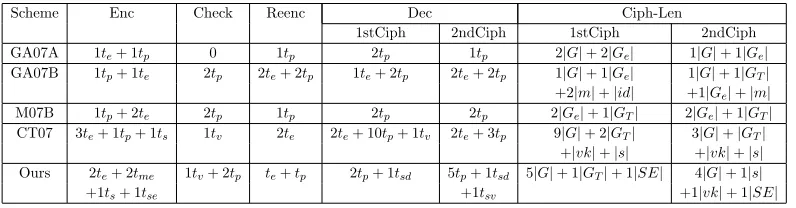
Notations: In Table 1, we denote W/O Random Oracle as with/without random oracle. In Table 2, we denote Enc as encryption, Reenc as re-encryption, Dec as decryption, Ciph as ciphertext and Ciph-Len as ciphertext length, tp,te and tme represent the computational cost of a bilinear pairing, an exponentiation and a multi-exponentiation respectively. tse, tsd and tsv
represent the computational cost of once symmetric encryption, once sym-metric decryption and once symsym-metric checking decryption results’ validity.
tsandtvrepresent the computational cost of a one-time signature signing and verification respectively. |G| and |GT| denote the bit-length of an element in groups Gand GT respectively. HereGe and GT are the prime order bilinear groups. |SE| denotes the bit length of once symmetric encryption. Finally,
|vk| and |s| denote the bit length of the one-time signature’s public key and a one-time signature respectively.
From these two tables, we can conclude that our scheme is a new result on IBPRE. Our scheme can achieve master secret secure and is based on a novel IBE while all previous efficient IBPRE schemes are based on the traditional IBE. Furthermore, our scheme seems to be a more directly construction of IBPRE for its re-encryption key is operated on the exponent instead of on the underlying group. Our scheme is particularly efficient for the proxy, compared with other IND-ID-CCA secure and master secret secure IBPRE schemes [13, 18]. Considering the proxy is always a heavy work-load party, our scheme can greatly improve the efficiency for the whole IBPRE system.
[30], LHC10 [19] schemes, for the following reasons: SXC08 [24], LZD+10
[18] schemes are based on Waters’ IBE, which make their schemes have large parameters; WCW10 [30] scheme can not achieve master secret secure and is only proved secure in the random oracle model; LHC10 [19] scheme is a generic construction. (6) In our scheme, we compute e(C10, C80)e(C10, d7) as e(C10, C80d7).
Scheme Security W/O Random Oracle Assumption Master Secret Secure Underlying IBE
GA07A IND-ID-CPA Random Oracle DBDH # BF IBE
GA07B IND-ID-CCA Random Oracle DBDH # BF IBE
M07B IND-ID-CPA Standard Model DBDH # BB1IBE
CT07 IND-ID-CPA Standard Model DBDH # Waters’ IBE
SXC08 IND-ID-CCA Standard Model DBDH # Waters’ IBE
LZD+10 IND-ID-CCA Standard Model DBDH ! Waters’ IBE
WCW10 IND-ID-CCA Random Oracle DBDH # Variant of BF IBE
LHC10 IND-ID-CPA Generic Generic ! Generic
Ours IND-ID-CCA Standard Model EXDBDH ! New IBE
Table 1: IBPRE Security Comparison
Scheme Enc Check Reenc Dec Ciph-Len
1stCiph 2ndCiph 1stCiph 2ndCiph
GA07A 1te+ 1tp 0 1tp 2tp 1tp 2|G|+ 2|Ge| 1|G|+ 1|Ge| GA07B 1tp+ 1te 2tp 2te+ 2tp 1te+ 2tp 2te+ 2tp 1|G|+ 1|Ge| 1|G|+ 1|GT| +2|m|+|id| +1|Ge|+|m| M07B 1tp+ 2te 2tp 1tp 2tp 2tp 2|Ge|+ 1|GT| 2|Ge|+ 1|GT| CT07 3te+ 1tp+ 1ts 1tv 2te 2te+ 10tp+ 1tv 2te+ 3tp 9|G|+ 2|GT| 3|G|+|GT|
+|vk|+|s| +|vk|+|s|
Ours 2te+ 2tme 1tv+ 2tp te+tp 2tp+ 1tsd 5tp+ 1tsd 5|G|+ 1|GT|+ 1|SE| 4|G|+ 1|s|
+1ts+ 1tse +1tsv +1|vk|+ 1|SE|
Table 2: IBPRE Efficiency Comparison
6. Conclusion
Acknowledgment
The authors would like to express their gratitude thanks for Prof. Liqun Chen’s many helpful comments. This work is still in progress and support-ed by the National Natural Science Foundation of China under contract no.61103230, Natural Science Foundation of Shaanxi Province under contract no.2010JM8034 and Natural Science Foundation of Engineering University of Chinese Armed Police Force.
References
[1] G. Ateniese, K. Fu, M. Green and S. Hohenberger. Improved proxy re-encryption schemes with applications to secure distributed storage. In
ACM NDSS 2005, pages 29–43, 2005.
[2] G. Ateniese, K. Fu, M. Green, and S. Hohenberger. Improved proxy re-encryption schemes with applications to secure distributed storage. In
ACM Transactions on Information and System Security, no. 1, pages 1–30. 2006.
[3] M. Blaze, G. Bleumer and M. Strauss. Divertible protocols and atomic proxy cryptography. InEUROCRYPT 1998, volume 1403 ofLNCS, pages 127–144, 1998.
[4] D. Boneh and M. Franklin. Identity based encryption from the Weil pairing. In CRYPTO 2001, volume 2139 of LNCS, pages 213–229, 2001. [5] D. Boneh and X.Boyen. Efficient selective-id secure identity based en-cryption without random oracles. In EUROCRYPT 2004, volume 3027 of LNCS, pages 223–238, 2004.
[6] D. Boneh and X.Boyen. Secure identity based encryption without rando oracles. InCRYPTO 2004, volume 3152 of LNCS, pages 443–459, 2004. [7] X. Boyen. A tapestry of identity-based encryption: practical frameworks compared, InInternational Journal of Applied Cryptography, Vol.1, No.1, pp. 3–20.
[9] C. Chu and W. Tzeng. Identity-based proxy re-encryption without ran-dom oracles. InISC 2007, volume 4779 of LNCS, pages 189–202, 2007. [10] C. Chu, J. Weng, S.S.M. Chow, J. Zhou and R.H. Deng. Conditional
proxy broadcast re-encryption. In ACISP 2009, volume 5594 of LNCS, pages 327–342, 2009.
[11] R. Deng, J. Weng, S. Liu and K. Chen. Chosen iiphertext secure proxy re-encryption without pairing. In CANS 2008, volume 5339 of LNCS, pages 1–17, 2008.
[12] Y. Dodis and A. Ivan. Proxy cryptography revisited. In Internet Society (ISOC): NDSS 2003, 2003.
[13] M. Green and G. Ateniese. Identity-based proxy re-encryption. InACNS 2007, volume 4521 of LNCS, pages 288–306, 2007.
[14] C. Gentry. Practical identity-based encryption without random oracles. In EUROCRYPT 2006, volume 4004 of LNCS, pages 445–464, 2006. [15] M. Jakobsson. On quorum controlled asymmetric proxy re-encryption.
In PKC 1999, volume 1560 of LNCS, pages 112–121, 1999.
[16] L. Ibraimi, Q. Tang, P. Hartel, and W. Jonker. A type-and-identity-based proxy re-encryption scheme and its application in healthcare. In
SDM 2008, volume 5159 of LNCS, pages 185–198, 2008.
[17] B. Libert and D. Vergnaud. Unidirectional chosen ciphertext secure proxy re-encryption. InPKC 2008, volume 4939 ofLNCS, pages 360–379, 2008. full vision available athttp://www.dice.ucl.ac.be/~libert/. [18] J. Lai, W. Zhu, R. Deng, S. Liu and W. Kou New constructions for
identity-based unidirectional proxy re-encryption. InJournal of Comput-er Science and Technology, no. 25(4), pages 793–806. 2010.
[19] S. Luo, J. Hu and Z. Chen. New construction of identity-based proxy re-encryption. Cryptology ePrint Archive, Report 2010/444, 2010. [20] T. Matsuo. Proxy re-encryption systems for identity-based encryption.
[21] M. Naor. On cryptographic assumptions and challenges. In CRYPTO 2003, volume 2729 of LNCS, pages 96–109, 2003.
[22] J. Shao and Z. Cao. CCA-secure proxy re-encryption without pairing. In PKC 2009, volume 5443 of LNCS, pages 357–376, 2009.
[23] J. Shao, Z. Cao and P. Liu. SCCR: a generic approach to simultaneously achieve CCA security and collusion-resistance in proxy re-encryption. In
Security and Communication Networks, 2009.
[24] J. Shao, D. Xing and Z. Cao. Identity-based proxy rencryption schemes with multiuse, unidirection and CCA security. Cryptology ePrint Archive:
http://eprint.iacr.org/2008/103.pdf.
[25] R. Sakai and M. Kasahara. ID based cryptosystems with pairing on elliptic curve. Cryptology ePrint Archive: http://eprint.iacr.org/ 2003/054.pdf.
[26] A. Shamir. Identity-based cryptosystems and signature Schemes. In
CRYPTO 1984, volume 196 ofLNCS, pages 47–53, 1984.
[27] Q. Tang, P. Hartel and W Jonker. Inter-domain identity-based proxy re-encryption. In INSCRYPT 2008, volume 5487 of LNCS, pages 332–347, 2008.
[28] Q. Tang. Type-based proxy re-encryption and its construction. In IN-DOCRYPT 2008, volume 5365 of LNCS, pages 130–144, 2008.
[29] B. Waters. Efficient identity-based encryption without random oracles. In EUROCRYPT 2005, volume 3494 of LNCS, pages 114–127, 2005. [30] H. Wang, Z. Cao, L. Wang. Multi-use and unidirectional identity-based
proxy re-encryption schemes. InInformation Science, No 180, pages 4042-4059, 2010.
[31] X. A. Wang and X. Yang On the insecurity of an identity based proxy re-encryption. InFundamental Informaticae, no. 98(2-3), pages 277–281. 2010.
[32] X. A. Wang, W. Zhong. A new identity based encryption scheme. In
[33] X. A. Wang, W. Zhong. A new identity based proxy re-encryption scheme. InThe International Conference on Biomedical Engineering and Computer Science (ICBECS2010), IEEE Press, 384-388, 2010.