Result Analysis of Enhanced SSO based
Multi-Factor Authentication for Web Security
Shruti Bawaskar , Prof. Mahendra Verma
Department of Computer Science & Engineering
Sushila Devi Bansal College of Technology Indore (M.P)
Abstract
—
In the domain of Network security, process of verification of user’s identity comes under the area of authentication. Traditional system applies authentication in one way or two way means which verifies the user and the provider’s information before any service exchanges was performed. Single sign on (SSO) is one of such mechanism which allows the users to get access to their services by entering their identity information only once in the system. During the last few years there are so many SSO models are suggested and applied for different types of applications and based on various signatures, cryptographic and digest approaches. But somewhere they lack in applying the access control in a granular manner.Thus, the work[17] proposed an enhanced SSO based multi-factor authentication for getting the things right according to the user and provider with fewer efforts. We have suggested and integrated earlier approach with other cryptographic protocols based on SSO using some of the additional management schemes. Along with the certificate format, its sequence, transmission information, its protection pin. Thus the complete solution will deals with increasing the protection of overall system by securing the temporary data, cookies and their logs so as to prevent fabrication, modification and eaves dropping attacks. In this work we are trying analyse the results produces by the proposed work [17]. The Results are evaluated on different factors and found satisfactory at primary stages of the research.
Keywords— Authentication , Bit Sequence Generator , MD5 , Security , Single Sign On (SSO) , Token
I. INTRODUCTION
Today's world of increasing technological requirements and users behaviour is changing very rapidly. It is quite complex to sustain the growth rate along with technology modifications. As the number of users connected to the internet is varying there usages and authentication is also suffering from several security concerns. Interfaces are complex and login functionalities are dynamically extending the functionalities. The demand is to be satisfied in such a way which is secure and load of reminding the credential should be reduced. Single Sign on (SSO) is one such solution to implement the service authentication and identity verification is less number of steps. The aim is to make them satisfied and feel secure while they are supplying the important information
available in the network. Here the users are authenticated by the distributed functionality machines in the network to hold the services and applications. The SSO system prevents the user load of entering the authentication information, like username and password, multiple times. The primary problem in a large network environment is the way to distribute the specific individual or group roles to form the organizational security policies. Later on it organize the security by resource management, measures the security mechanism and complete the requirements to analyse how those requirements exchange information’s with the network[17].
Security of information is one of the major process of getting the higher trust and reliability of users over the system and prevents the unauthorized access and activities to disrupt the normal operations. Authentication is one of such process that provides high security of information. When a user claims to have an access for the protected operations of network then the user’s identity should be checked. The process of verifying the identity is known as authentication. After this process, authorization is taking place for giving limited permission to each authorized user to access the applications inside the network. As it known, username and password is the first oldest solution for authentication, but typically that is not enough to have a secure environment. In today’s system authentication is served using three major requirements:
(i) What a user know, like password or a pin number. (ii) What a user have, like a smart card
(iii) What a user is, like biometrics.
If a user only uses a password or a pin for an authentication that is called one-factor authentication, which is not secure enough. If password used with both one of the other authentication mechanisms, than it will be two-factor authentication. In addition, to have a strong authentication mechanism, clever combinations needed to come up as a benefit for the system. First of all variety types of authentication mechanisms are presented in the following part to provide strong authentication[17].
• User authentication
the difficulty of the password based security controls and builds a communication between the user and the applications[17].
• Biometrics authentication
Biometrics serves strong authentication to the users using people’s characteristic behaviors and genetic features such as hand, fingerprint, eyes, retina, hand etc for the user authentication. Using biometric features the system is capable of differentiating one person from another by their physical attributes and provides secure authentication[17].
• Token based authentication
Token is an authentication mechanism that provides a cryptographic token to prove the user identity for the authentication server towards getting the access. It could be a physical device or logical code intended to give effective authentication to be used by only one person to get an access to the system. It has a trusted secret key between the authentication server and the applications that user wants to have an access. But this mechanism is different than a biometric device[17].
Good examples for tokens are smart card.
• Out of band
Out of band authentication is used to support two ways of communication using two ways (factor) of authentication. There is a regular flow of authentication message between the computer and the server, Using out of band means one part of it is uses other way of communication. It might be mobile communication. One part of the information is sent by the network and the other part is sent through the mobile. For instance, nowadays internet banking is popular for the customers. That security requires the user to identify him/her two times. A computer is login in to the bank over the internet. And then to verify the user it is receiving, for instance OTP on sms. That OTP is needed for to authenticate. So that user deals with two different bands. This way of communication makes it hard to hack in, because the attacker needs to hack in several communications[17].
• Certificates
There are different ways of gaining trust on humans. Those might be provided by voice, face or handwriting. This is easy for the people have known before. For the rest, it needs more techniques to trust with. Each implemented technique need to be improved personally by asking specific questions to trust the other party. It called as a “trust threshold”. It might be a unique form of paper or unique signature of trust.
One way is to have several people inside the organization, police or another third party who could be a voucher for the both parties. The second way is to apply for exchanging cryptographic keys.
Those keys are providing communication between users, like explained before in encryption types. All public keys are attached with each user identity. So that users can trust the communication by knowing with whom they are exchanging the information. However certificates are communicating and identifying users electronically. This protocol is used between different SSO components.
• PKI structure
It is challenging to believe somebody that is not known without trusted third party. PKI used as a trusted communication in ecommerce contacts made over the Internet. A PKI is designed to enable users to create, manage, store, distribute and revoke digital certificates by implementing public key cryptography. Additionally it is designed to make trusted communications between users within private or public networks. PKI provides services for identification and access control. Those are such as creating certificates with using public key, distributing certificates, signing certificates within an authenticity, adding validation date to certificates and extracting certificates which private keys are no longer validate or the supplier of the certificate is no longer allowed to have access[17].
• Network authentication
Nowadays e-businesses are compacting through the internet application systems, emailing, conferences, merging several organizations in one large network. Those countable serious communications are operating through the internet. Large numbers of users are online in the systems for their businesses. Those systems are protected by different security standards in the form of web services for the users and each mechanism has different policies and use of authorized certifications. For the identity issues SSO came in for the systems. SAML is an XML based security standard mechanism for communicating identities between different organizations. It provides authentication documentation according to web user’s authentication and authorization attributes including authentication event description for the web user between the application and the enterprise security system. The importance of the SAML is defined in four steps.
[17]
• All the key point of the SAML maintains the multiple authentication credentials like passwords in the multiple locations.
• It increases the security and decreases the identity theft by not allowing several credentials for the same user. This also decreases identity phishing inside the network by eliminating the number of times the user needs to login.
• It increases application access, so that users do not need to enter the same form of password to enter the application. All they need is to click on the application link.
II. BACKGROUND Different types of SSO
Most of the SSO products available in the market can be categorized into two types based on the architecture.
[17]
(i) Web-based or enterprise SSO
Web-based SSO can be further categorized internet facing intranet facing. Internet facing generally takes care of the SSO for the applications that interact with customers. For example customer support application, billing management etc. These applications can be knit using SSO so that customers can login only once to be able to access both the applications. While the intranet facing serves SSO for the intranet applications that internal users of an organization interact with, using a web browser. For example, an expense reporting application, travel planning etc. Multi-domain: This can be categorized into two types i.e. Intra-organization multi-domain SSO and cross-organization SSO. In first type, the SSO is made between two or more different domains in the same organization while in second one SSO made between the applications of two or more organizations.
(ii) Non Web-based or legacy SSO
Legacy SSO products use a different approach to SSO. A component called the SSO agent gets activated when a user logs into his workstation and remembers the logins and passwords of the user to different applications. It provides the credentials to the applications when the user tries to log into these applications subsequently. Thus, with one authentication session initiated by the SSO agent, legacy single sign-on enables user navigation to various applications on an intranet. Recent versions of legacy single sign-on products support smart card, PKI, and biometric authentication.
Single sign-on application
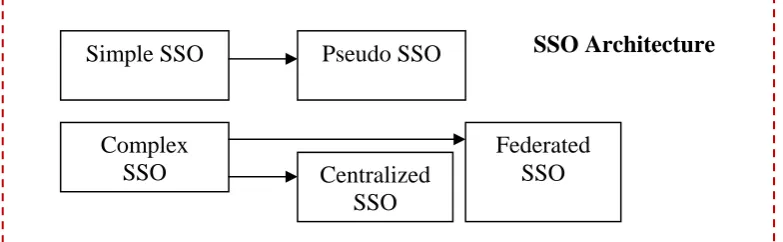
The single sign on (SSO) solutions are practically implemented in different architecture which was made according to user perspectives or operational scenarios. They are divided in to two different SSO, simple SSO and complex SSO and there further division was also shown in figure 1.
Pseudo SSO is a single authentication mechanism in which the user is having several identities but only authenticating with one credential for the first system.
For other systems user is using other identities to connect.
In Pseudo SSO, user first directed to the primary authentication which is the Pseudo mechanism.
This authentication might require a single username and a password.
Complex SSO is divided in to Centralized SSO and Federated SSO systems. In this complex environment it is possible to have more than one domain or company.
o Centralized SSO has a centralized database and a centralized third party of trust communication in one domain. In centralized systems, user has the same identity for all different systems. Token based SSO is one way to authenticate user in the centralized environment.
o Federated SSO is used in more than one domain in one environment. In this systems user has the own identity which is trusted by other systems. Microsoft Passport, the Liberty Alliance and WS-Federation protocols are used together with the security standards like SAML, Shibboleth and Kerberos to provide secure and friendly environment by sharing the user identities during the data transmissions between different domains, services and applications.
After all those explanations about different SSO architectures, standards, protocols, Federated methods and communication tools, here come to build up all those information to have a good implementation strategy for the SSO. Strategically SSO terminology is divided and showed in below blocks in Figure 2.
The blocks represent the complete implementation strategies of effective authentication using SSO. First block is representing the basic system with the entire user profiles. Sub-block is representing further categorization. The entitlements are used to determine the users activities monitoring and tracking about what they can or cannot do. Directory helps SSO to register and store the user identities. The second block is the core system of the network. All are independent and need higher level of security. And this block is in a repeat cycle to check or identify the user rights to enter the system or one system to another. That happens in the future when user entitlements are changed or need to have an entry to the other systems.
Simple SSO
Pseudo SSO
Complex
SSO
Centralized
SSO
Federated
SSO
SSO Architecture
The change is all depending on the user profile and the level of the system. Only that user profile is used and gave rights to the next system. The system authentication is done to prove the user and the authorization is done to verify if that user is authenticated or not according to the user profile. After being authenticated, user is passing through the protocols and standards to work under safe and secure conditions. Different protocols are used for the authentication in higher system levels. That is depending on how high level is intended to be accessible. And then the same cycle is processing for the authentication and authorization. Auditing is controlling and documenting user’s activities in case of attacking and faults[17].
III. LITERATURE SURVEY
During the last few years security is considered as major issues and to make it more robust against the unauthorized access authentication is the major process. Single Sign On is one of such mechanism which provides higher security. Considering this phenomenon here are some related papers studied to get better depth and analysis of existing approaches.
In the paper [8], authors suggested a new proxy signature schemes as the first public key cryptographic method for applying single sign-on in distributed networks. The work is presented in two steps: first it provides the session state management of multiple services and second is granular access control. It is an intrinsic centralized access control which provides an easy way to manage access policies and user rights revocation. The approach significantly improves communication complexity by eliminating any communication between services and identity providers during user identity and access permission verification. This is
the first approach to base single sign-on security on public key cryptography and associate such a practical application to proxy signatures.
In the paper [9] a detailed analysis of SSO enabled user accounts is performed on different websites to get the users interest and found that user’s perception of web SSO is still poorly understood. After finding the issues the paper offers a web SSO technology acceptance model with design improvements. To reduce user’s privacy concerns, it is crucial that RPs practice the principle of gradual engagement, and IdPs provide fine-grained privacy control and on-login profile switching option. In addition, future research should investigate how to enhance users’ security perception and mitigate IdP phishing attacks without relying on users’ cognitive capability.
The paper [10] specifically focused on developing the SSO for distributed environment by giving a detailed survey. The paper founds that most existing schemes cannot preserve user anonymity when possible attacks occur and those schemes are insecure. Also in existing SSO schemes have not been formally proved to satisfy credential privacy and soundness of credential based authentication. To overcome this drawback, they formalize the security model of single sign-on scheme with authenticated key exchange. Specially, the difference between soundness and credential privacy is pointed out and they define them together in one
definition. Also, they propose a provably secure single sign-on authenticatisign-on scheme, which satisfies soundness, preserves credential privacy, meets user anonymity, and supports session key exchange.
In traditional SSO application architectures, the users required to memorize and utilize a different set of credentials (e.g. username/password or tokens) for each application. However, this approach is inefficient and insecure with the exponential growth in the number of applications and services a user has to access both inside corporative environments and at the Internet. It is shown that the previous schemes are actually insecure as they fails to meet security during communication. For getting the secure authentication, digital signature with hash function is further explored.
The paper [11] also suggests a
password-authenticated key agreement scheme using smart cards. In terms of efficiency, besides the low communication costs, proposed solution builds on the efficient cryptographic primitives for smart card environment. It also gives effective results while analyzing mutual authentication, key agreement, initiator anonymity, and the functionality of password updating, DoS attack prevention and initiator traceability.
The article given in [12] proposes a Kerberos V5 protocol based single sign-on authentication model for cloud to prevent DDOS attacks. This model could benefit by filtering against unauthorized access and to reduce the burden, computation and memory usage of cloud against authentication checks for each client. It acts as a trust third party between cloud servers and clients to allow secure access to cloud services. The approach formally described as a network authentication system, initially designed for providing single sign-on to network services. Preliminary investigation is proving effective results in comparison with traditional authentication systems.
In the paper [13] single sign-on SSO mechanism is proposed which controls the authentication using Trusted Authority Center (TAC). The primary task of TAC is to automatically verify the user’s credentials details which will be only one for all applications or services. Previously introduced technique based SSO technology proved to be secure over well-designed SSO system, but fails to provide security during communication. So here emphasis is given on authentication as open problem and on to refining the already proposed SSO process. And to do this along with RSA algorithm which was used in previous SSO process, the paper is using MAC algorithm to control secured pathway for communication over distributed network.TAC i.e. Trusted Authority Center is used for sending token integrated with private and shared public key to user.
implementation of SSO mechanism in the Cloud Federation scenario using the CloudSim toolkit. The paper uses Fully Hashed Menezes-Qu-Vanstone (FHMQV) protocol for the key exchange and the Symmetric Key Encryption technique AES-128 for encrypting the identity tokens. The paper is also gives the workflow model for the proposed approach for different execution time taken in the simulation.
The paper [15] discussed some of the existing single sign-on (SSO) systems like OpenID and OAuth for authenticating web sites. They consider them as relying parties (RPs) and provides effective user authentication as a service to identity providers (IdPs) likes Google or Facebook. It also founds that in Mozilla’s Browser system, current SSO is not designed with user privacy control. Unfortunately, recently discovered attacks exploit these design flaws of BrowserID. Thus, the paper proposes first privacy-respecting SSO system for the web, called SPRESSO (for Secure Privacy- REspecting Single Sign-On). The system is easy to use, decentralized, and platform independent. It is based solely on standard HTML5 and web features and uses no browser extensions, plug-ins, or other executables. Existing SSO systems and the numerous attacks on such systems illustrate that the design of secure SSO systems is highly non-trivial. The paper also carries out a formal analysis of SPRESSO based on an expressive model of the web in order to formally prove that SPRESSO enjoys strong authentication and privacy properties.
IV. PROBLEM IDENTIFICATION
After analysing the complete usage scenarios and working of single sign on (SSO) application and implementation details along with the research works, this work identifies some f the issues which remains unsolved. Some of the authentication situation and security primitives needs to be improved in comparison with the traditional approaches[17].
Single Sign on (SSO) uses the continue access to the cookies which holds the access patterns and other details of users credential and authentication information. Thus, with traditional system cookies are not looked over and its access is not protected or encoded by which it is directly open to the normal and malicious users. Thus there must be some encryption or encoding phenomenon with traditional SSO. The integration of earlier approach with the other cryptographic protocols remain to be studied. Likewise the above issue there is an also associated problem to that regarding the cached component of the software system. It might hold the authentication information also. Thus all the access mechanism for getting the cache directly readable to user must also be controlled and protected.
After using the temporary storage for passwords, they are stored there till the next information gets stored in that buffer. This casual nature of SSO made them vulnerable against the attacker. There must be some mechanism which automatically destroys all the temporary information just after their use is over.
Log files are also not secure thus some auto erasable logs or transferrable logs to secure server just after
their use is over must be integrated with the traditional SSO.
V. RESEARCH OBJECTIVES
This work describes the risk handling and strong security primitive based SSO for complex system environment. It primarily focuses on the complete security by finding an optimal solution about usage of SSO. The goal is to make a implemented solution for improved SSO against the above mentioned issues using set of standards and protocols effectively. Futuristic results will be presented is later stages of this work by using prototype developed as a proof. Thus by this work to be completed there are some objectives on which the work is performed in some next stages of this work. These are[17]:
Analysis of information security requirements and develops a solution and test its results before and after implementation of SSO.
Develops a trusted SSO using some physical device based authentication
Integrate the protocols and standards require achieving the Robust and More secure SSO.
Analyze the critical functionalities that SSO-service would need to work proper
Proof of Concept development for proposed approach
VI. PROPOSED SOLUTION
This work proposes a novel strong authentication system using improved Single sign on (SSO). This system is having entities like: User and Authentication Server . It is having the regular exchange of security certificates between them. It will reduce the dependencies of smart cards used by traditional approaches by taking the token containing attributes and sending it to the user device. As it was a hardware device whose custody is kept with the authenticated user only, but somewhere it can be lost thus the SSO works in integration with the token over mail or some other online accounts or can be transferred as text or file. One of the reasons behind not using dedicated smart card is its availability which was not there with every user and the machines for swapping these cards require certain hardware cost. The token with such certificates are having better portability and strong cryptographic computational capabilities for implementing authentication. The token is converted to a continuous sequence of bits which is transmitted to the users devices connected through any of the network. We can also use the similar process for holding the users activity logs and cookies information which was previously stored in the computer itself. It will create the problem associated with the theft of cookies or unauthorized access. Thus the proposed work will provide two factors authentication mechanism which is more reliable that is with the use of token which is generated using MD5 algorithm and key pair which enhance security.
together MD1 and key pair is used to generate a token which contains various attributes. In Fig 2 shows the login flow of the system where the user enter his credential & upload the token which is further generated into bit sequence and then it is authenticated. The server in Fig3
verifies the user’s information and generates a token and other log based details holding files and transfer them to this token having various attributes. The authenticated
token is inserted into the system and then the credential is passed along with the auto generated digest is passed to the server. The server recalculates the digest which and matches it with newly calculated digest and if the things matched then the authentication is provided. This prevents users to remember several different usernames and passwords to have an access.
By the above component analysis the system can operates completely with integrated SSO and the electronic device holding the token. For developing this system there are different algorithms needs to be implemented which works at different layers of security control. The proposed system is capable of providing the more secure way of authentication. It were satisfying the property of authentication, authorization, provisioning, centralized identity management, cache manager, single point of control, password protection and proliferation handler etc.
EXPECTED BENEFITS
The advantages of the Proposed SSO approach include: It reduces the probability of information leaks and
third party theft with identity loss. Highly secure from unauthorized access.
Delay tolerant implementation and data filtering with applications data requirements.
Improved system performance and light weight implementation of the system.
It will hide the provider and users identity.
Proposed SSO will provide effective
interoperability across the different identity providers. It will also enable once click access and reduces the complex process of access authentication.
Data isolation and access control can be guaranteed by using access and key policies for various types of
user. Policies are used here to define finer grained access control.
Information value is sustained and security is provided according their value.
It is fast responsive mechanism will reduces the access time.
It prevents the phishing and fabrication, replay modification attacks.
Reduces the load and burdensome of password remembrance of multiple accounts.
The new key combination approach is developed to further increasing security through key policy using attribute based encryption. Multiple attributes of user is combined together to generate a new key in this.
VII. RESULT ANALYSIS
the approach can work while comparing with their competitors. At the evaluation point of view the approach seems to satisfy all the constraints of data isolation, single sign on (SSO) and user access control. If the system provides effective access control but let’s open the trapdoors for the malicious user then the confidentiality of the system can be loosed. It has a risk associated with the outsourced environment. The most prominent approach is to control the access and offers new types of authentication using single sign on (SSO) based on token generation
authentication approaches. Different type of users has different type of permissions to access the information and functionalities in the application. Because of that reason, the system has full security for its data and functionality.
As far as the results are concerned there are so many variations have to be identified and compared with their previous values to have better options. With this work some of the security goals have met and we found new solutions with their effective responses and results.
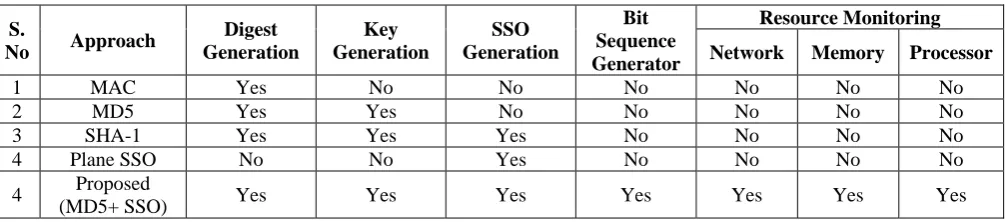
Table 1: Feature Analysis
Interpretation: From the above table 1 it is clear that the suggested approach is having strong hand on providing security to maximum extent while considering the authentication of the system.
The developed system is capable of handling the digest generation, key generation, SSO generation, bit sequence generator, and resource monitoring.
Table 2: User Registration Details
S. No User Name Password Device ID IP Address Status
1 Vijay Random 9034 172.16.154.155 Successful
2 Ram instant 6928 172.16.154.155 Successful
3 Shyam perform 2592 172.16.154.155 Successful
4 Rajesh smily 6081 172.16.154.155 Successful
The table 2 shows the basic entries need to be performed for measuring the robustness of security service offered by the
system. Here we take the example for different user combination who were used to verify the approach and passed their statics in the next tables.
Table 3: Comparative Analysis
S.
No Approach User ID
Digest Generation Key Generation SSO Generation
Size (Bytes)
Time (Mili. Sec)
Size (Bytes)
Time (Mili. Sec)
Size (Bytes)
Time (Mili. Sec)
1 Proposed 9162 64 42230 64 65369 394 41480
2 Proposed 9163 64 34760 64 39231 394 43404
3 Proposed 9164 64 13982 64 15719 394 24904
4 Proposed 9165 64 74526 64 29906 394 34084
From the above table a comparison had made between the traditional security approach which serve authentication unitary analysis for security serving efficiency. It covers the details captured for two different cases of traditional and proposed approach. The comparison had made between the size and time requirements for digest generation, key generation and SSO generation. We apply the above
combination for different user sets and their authentication primitives. Finally we found by comparing the above results that the proposed method outperforms the traditional one in several directions.
S.
No Approach
Digest Generation
Key Generation
SSO Generation
Bit Sequence Generator
Resource Monitoring
Network Memory Processor
1 MAC Yes No No No No No No
2 MD5 Yes Yes No No No No No
3 SHA-1 Yes Yes Yes No No No No
4 Plane SSO No No Yes No No No No
4 Proposed
Table 4: Resource Constrains Analysis
S. No
User
ID Application
Authentication Type
Processor Pool (%)
Disk Usage (Bits Per Sec)
Memory Pool (% / GB Per Sec)
Network Usage (KB/Sec) Read Write Physical Virtual Sent Receive
1 9162 App-1 SSO 18.23 94.56 104.3 32.85 28.83 0.0 0.0
2 9163 App-2 SSO 19.04 83.24 86.41 32.76 29.60 0.0 0.0
3 9164 App-1 SSO 23.55 79.39 97.85 30.06 22.33 0.0 0.0
4 9165 App-2 SSO 15.26 98.21 106.6 31.42 27.56 0.0 0.0
This table covers the performance analysis of proposed approach while serving its security goals. We try to found the resource requirements for different types of operational scenarios. Again here we compare the performance attributes of previous SSO with our suggested SSO. Again as resource performance monitoring we are measuring the disk usages, memory pool and network usages. After analyzing the above table with its observed values, it is proved that the newly suggested approach is serving its goals in well defined and accurate boundaries.
VIII. CONCLUSION
Information security is one of the real process of getting the higher trust and reliability of clients over the system and keeps the unauthorized access and activities to disturb the ordinary operations. Authentication is one of such process that gives high security of data. At the point when a client cases to have an access for the protected operations of network then the client's identity ought to be checked. The process of checking the identity is known as authentication.
After this process, approval is occurring for giving limited permission to each approved client to access the applications inside the network. As it known, username and password is the principal most seasoned solution for authentication, however ordinarily that is insufficient to have a secure environment. At the primary levels of evaluation results of the approach is fulfilling all the preliminary security
limitations related with authentication and also satisfying the performance parameters.
IX.FUTURE SCOPE
The work[17] proposed an enhanced SSO based multi-factor authentication for getting the things right according to the user and provider with fewer efforts.
Through our empirical research and investigation, we found that web users could perform SSO correctly once being taught, but many of them may not want to share their privacy and security for usability gains. To reduce users’ privacy concerns, it is crucial that web service providers practice the principle of gradual engagement, provide fine-grained privacy control and on-login profile switching option. In addition, future research should investigate how to enhance users’ security perception and mitigate phishing attacks without relying on users’ cognitive capability.
REFERENCES
[1] Michael Fleming Grubb and Rob Carter"Single Sign-On and the
System Administrator"published in the Proceedings of the Twelfth Systems Administration Conference (LISA ’98) Boston, Massachusetts, December 6-11, 1998
[2] Lawrence O’Gorman"Comparing Passwords, Tokens, and
Biometrics for User Authentication "Proceedings of the IEEE, Vol. 91, No. 12, Dec. 2003, pp. 2019-2040 2003 IEEE
[3] Ravikanth Ponnapalli"Secure implementation of Enterprise single
sign-on product in an organization" paper is from the SANS Institute Reading Room site.
[4] Si Xiong, Stockholm, Sweden"Web Single Sign-On System For
WRL Company"
[5] "Best Practices for Integrating Kerberos into Your Application"
MIT Kerberos Consortium. Ver. July 23, 2008
[6] "A More Secure Front Door: SSO and Strong Authentication"
report by Improvita.
[7] Khalid Bashir And Saman Asif"Important Considerations For
Single Sign-On Solution"In International Journal Of Multidisciplinary Sciences And Engineering, Vol. 1, No. 1, September 2010
[8] Bernardo Machado David, Anderson C. A. Nascimento, Rafael
Tonicelli "A Framework for Secure Single Sign-On"
[9] Kirstie Hawkey, Konstantin Beznosov, University Of British
Columbia" Investigating User’s Perspective Of Web Single Sign-On:Conceptual Gaps, Alternative Design And Acceptance Model" in ACM 2012
[10] Arul Princy "A Survey on Single Sign-On Mechanism for Multiple
Service Authentications" IJCSMC, Vol. 2, Issue. 12, December 2013
[11] Prashant Kumar Gajar, Arnab Ghosh And Shashikant Rai "Bring
Your Own Device (Byod): Security Risks And Mitigating Strategies "Volume 4, No. 4, April 2013 Journal Of Global Research In Computer Science
[12] C. Ramakrishnan, S. Dhanabal" Security Analysis of a Single
Sign-On Mechanism For Distributed Computer Networks ",IOSR Journal of Computer Engineering (IOSR-JCE) e-ISSN: 2278-0661, p- ISSN: 2278-8727Volume 16, Issue 3, Ver. III (May-Jun. 2014)
[13] Yaser Fuad Al-Dubai & Dr. Khamitkar S. D"Kerberos: Secure
Single Sign-on Authentication Protocol Framework for Cloud Access Control"Global Journal of Computer Science and Technology: B Cloud and Distributed Volume 14 Issue 1 Version 1.0 Year 2014
[14] Madhavi A. Indalkar ,Ram Joshi "Efficient and Secure Single Sign
on Mechanism for Distributed Network "International Journal of Computer Applications (0975 – 8887) Volume 99– No.8, August 2014
[15] Manoj V. Thomas, Anand Dhole, K. Chandrasekaran "Single
Sign-On in Cloud Federation using CloudSim" I. J. Computer Network and Information Security, 2015
[16] Daniel Fett,Ralf Küster,Guido Schmitz "SPRESSO: A Secure,
Privacy-Respecting Single Sign-On System for the Web" in ACM 2015
[17] Shruti Bawaskar "Enhanced SSO based Multi-Factor