Experimenting with Shuffle Block Cipher and SMT
Solvers
Martin Stanek
Department of Computer Science Comenius University [email protected]
Abstract
We experiment with the block cipher proposed by Hoang, Morris, and Rogaway [3], even though the cipher is insecure [8]. The cipher is based on swap-or-not shuffle, and we call it the Shuffle Block Cipher. We show how the cipher can be translated into SMT-LIB v2 format, suitable for automated solving by SMT solvers. We compare performance of various SMT solvers on the encryption and known plaintext attack problems.
Keywords:Shuffle, Cipher, Cryptanalysis, SMT solver.
1
Introduction
The swap-or-not shuffle [3] is a method of converting a pseudorandom function into a pseudoran-dom permutation. The shuffle can be used for small-pseudoran-domain and format-preserving encryptions [3, 5]. A construction of “standard” block cipher using this method was also proposed in [3]. We call this block cipher the Shuffle Block Cipher. Probably the most interesting feature of the cipher is its simplicity. The cipher iterates a large number of rounds, each consisting of single swap-or-not operation. However, the instantiation of the round functions proposed by the authors of the Shuffle Block Cipher in [3] is insecure, as pointed out by Vaudenay in CRYPTO 2012 Rump Session [8] (and independently by Gilbert). Nevertheless, we experiment with automated cryptanalysis of the Shuffle Block Cipher in this paper, using SMT solvers.
Our contribution can be summarized as follows:
– We show how the Shuffle Block Cipher can be translated into SMT-LIB v2 format, suitable for automated solving by SMT solvers.
– We use two problems – simple encryption of a plaintext and known plaintext attack – for comparison of four SMT solvers’ performance (MathSAT5, Sonolar, Yices, and Z3). The best (performance-wise) SMT solver for these problems is Sonolar.
– We experiment with automated solving of KPA (known plaintext attack) problems with Sonolar. We try various combination of the parameters such as block length, round count, and the number of plaintext-ciphertext pairs. Most combinations are artificially small. Solving instances with larger values of the parameters with moderately large number of plaintext-ciphertext pairs seems unsolvable efficiently by the SMT solver.
Section 5 describes the results of simple cryptanalysis for various combination of parameters. Certainly, cryptanalysis from [8] is the easiest way of attacking the Shuffle Block Cipher.
2
Preliminaries
2.1 The Shuffle Block Cipher
The Shuffle Block Cipher (further denoted as the SBC) is a block cipher with variable number of rounds and variable block length. We use the original notation from [3] in the description of the SBC. Letnbe the block length andr be the number of rounds (both parameters are positive integers). The SBC uses a keyKLthat specifies 2r subkeysK1, . . . ,Kr,L1, . . . ,Lr ∈ {0,1}n. We assume that these subkeys are randomly and uniformly chosen. LetX ∈ {0,1}nbe an input block. Let⊕be a bitwise xor operator. An inner product of twon-bit vectors is denoted bysymbol, i.e.X Y =X1Y1⊕. . .⊕XnYn forX = (X1, . . . ,Xn)andY = (Y1, . . . ,Yn). The SBC encryption is shown on Figure 1. The decryption takes the subkeys in reverse order.
EK L(X):
fori←1 tor do
X0←Ki ⊕X ˆ
X ←max(X,X0)
ifLiXˆ =1 thenX ←X0 returnX
Figure 1: The SBC encryption algorithm
Remark. The inner productLi Xˆ was proposed in [3] as an instantiation of a random round functionFi : {0,1}n → {0,1}. In this instantiation the function is specified by vectorLi, i.e.
Fi(Xˆ)=Li Xˆ.
The SBC uses a swap-or-not technique to construct pseudo-random permutation. Theoretical analysis shows that for general swap-or-not network, approximatelyr =6nrounds are necessary for a good bound on CCA-security. However, the authors state [3]:
It is incorrect to think that the theoretical analysis suggests a value liker =6n; for one thing, there is an enormous gap between computing a random round function
Fi(Xˆ)and an inner productLi Xˆ.
The authors did not provide an explicit suggestion onr values. On the other hand, the SBC was proved to be insecure very soon – Vaudenay in CRYPTO 2012 Rump Session [8] (and independently Gilbert) pointed out that the round function is linear.
2.2 SMT Solvers
some cases by translating them to SAT problems and subsequently using a SAT solver, in other cases by employing specialized solvers for particular theory. SMT solvers are used in practice for software and hardware verification, type inference, static program analysis, test-case generation, scheduling and other applications [2]. Applications of SMT solvers for software security can be found in [7]. Even though there are some applications of SMT solvers for cryptanalysis, e.g. see [4], a direct use of SAT solvers is much more frequent.
The theory of bit-vectors is suitable for modeling the SBC. The theory consists of fixed-sized bit vector variables, functions for extracting individual bits from a vector, functions for addition, rotation, bitwise logical operators, comparison etc.
SMT-LIB version 2 is a standard format for specifying SMT problems [1]. Many SMT solvers more or less support SMT-LIB v2 format – it allows to compare their performance in our experi-ments. Therefore we use this format for modeling the SBC, instead of using the proprietary input languages or bindings/APIs of particular SMT solvers.
Test environment. All experiments were performed on 64-bit Ubuntu 14.04.1 with i7-2600
(3.40 GHz) processor and 4 GB memory. The following SMT solvers were used (64-bit versions): MathSAT5 5.2.12, Sonolar 2014-09-02, Yices 2.2.2, and Z3 4.3.2.
3
Modeling the Cipher
The encryption function of the SBC was modeled/encoded in SMT-LIB v2. Since the source code in SMT-LIB v2 format grows linearly with the number of roundsrand for each plaintext-ciphertext pair a separate encoding (with separate set of variables) must be produced, we generate the SMT-LIB v2 model with a help of a Python script. The SBC is very simple and therefore the translation into SMT-LIB v2 is straightforward. Let us go through all parts of the encoding. In order to keep the presentation compact we use very small valuesn = 8 andr = 2 in this description. The bit-vector theory in SMT-LIB v2 contains operations/predicates that come in handy: bvxor (bitwise xor), bvand (bitwise and), bvult (unsigned less than), extract (extract bits from a bitvector), bvshl (shift left).
3.1 Variables and Constants
We declare a variable for each subkey (as a bit-vector of lengthn):
(declare-fun k1 () (_ BitVec 8)) (declare-fun k2 () (_ BitVec 8)) (declare-fun l1 () (_ BitVec 8)) (declare-fun l2 () (_ BitVec 8))
Variables for encryption function are declared similarly. Variable x0 denotes a plaintext, and variable y denotes a ciphertext. Variables xpi, xhi, xidenote the value of internal variablesX0,
ˆ
X in roundi, and variableX at the end of roundiof the encryption function, respectively. The prefix a1 (and possibly a2, a3 etc.) is used to distinguish a specific plaintext-ciphertext pair.
Depending on a task we want to solve, the values of some variables are set. In case of single encryption, all subkeys are set and the plaintext a1x0 is set as well. For example (the constants in this example are written in hexadecimal):
(assert (= k1 #xee)) (assert (= k2 #x57)) (assert (= l1 #x67)) (assert (= l2 #xba)) (assert (= a1x0 #x25))
In case of known (or chosen) plaintext attacks we set just aix0 and aiy values for all known plaintext-ciphertext pairs.
3.2 Inner Product
We use two different methods for computing the inner product of two bit-vector. Both methods start with bitwise AND of input bit-vectors and then they compute a “bitxor” operation on the result, i.e. they XOR all its bits. The first method computes the bitxor by “fold-and-xor” approach. Forn = 8: bitxor(x) = MSB(F1(F2(F4(x))))where Fi(x) = x ⊕ (x << i)and MSB returns the most significant bit of an argument. Using SMT-LIB v2 the bitxor operation looks like this:
(define-fun bitxor1 ((x (_ BitVec 8))) (_ BitVec 8) (bvxor (bvshl x #x01) x))
(define-fun bitxor2 ((x (_ BitVec 8))) (_ BitVec 8) (bvxor (bvshl x #x02) x))
(define-fun bitxor4 ((x (_ BitVec 8))) (_ BitVec 8) (bvxor (bvshl x #x04) x))
(define-fun bitxor ((x (_ BitVec 8))) (_ BitVec 1) ((_ extract 7 7) (bitxor1 (bitxor2 (bitxor4 x)))))
The second method simply extracts all bits and xors them together:
(define-fun bitxor ((x (_ BitVec 8))) (_ BitVec 1) (bvxor ((_ extract 7 7) x) (bvxor ((_ extract 6 6) x)
(bvxor ((_ extract 5 5) x) (bvxor ((_ extract 4 4) x) (bvxor ((_ extract 3 3) x) (bvxor ((_ extract 2 2) x) (bvxor ((_ extract 1 1) x) ((_ extract 0 0) x)))))))))
A direct translation to SAT by SMT solvers might theoretically use more Boolean variables for the first method than for the second one. Later, we explore the impact of these two variants on SMT solvers performance.
3.3 Encryption Function
The translation of encryption function is straightforward – we unroll the loop. We do not use the linear representation of the round function from [8]. Another useful SMT-LIB v2 operation for this translation is ite (if-then-else). Example of encryption function forr =2:
(assert (= a1xp1 (bvxor k1 a1x0)))
(assert (= a1xh1 (ite (bvult a1x0 a1xp1) a1xp1 a1x0)))
(assert (= a1x1 (ite (= (bitxor (bvand l1 a1xh1)) #b1) a1xp1 a1x0))) (assert (= a1xp2 (bvxor k2 a1x1)))
(assert (= a1xh2 (ite (bvult a1x1 a1xp2) a1xp2 a1x1)))
Even more compact representation of the encryption function is possible. Substituting some expressions, e.g. aixhjvariable into aix(j+1), or using helper functions can reduce the number of assert expressions or shorten them. However, such syntactical manipulations do not reduce the complexity of the problem for SMT solvers.
3.4 Preamble and Goals
We are interested in values of variables, not just knowing that the problem is satisfiable (we already know that), hence we want to produce a model for our input. Additionally, we use the bit-vector theory. These requirements are reflected in the preamble:
(set-option :produce-models true) (set-logic QF_BV)
According to the problem we want to solve, we set the goal for encryption (value of the ciphertext):
(check-sat)
(get-value (a1y))
and for cryptanalysis we are interested in subkeys values:
(check-sat)
(get-value (k1 k2 l1 l2))
4
Performance Comparison of SMT Solvers
SMT solvers compete, similarly to SAT solvers, in SMT-COMP competition [6] using benchmarks in various logic divisions. We compare the performance of selected SMT solvers on problems related to the SBC. The goals of this comparison are twofold – simple tests allow to validate the correctness of the SBC model in SMT-LIB v2, and they allow to select the SMT solver with the best performance for further experiments.
Counting variables. Certainly, solving an encryption problem is much easier than finding
keys in the known plaintext attack. In both cases the complexity of a problem can be measured (separately for each problem) by number of unknownn-bit variables. Simple calculation yields the following formulas (pdenotes the number of plaintext-ciphertext pairs for KPA):
number ofn-bit variables single encryption 3r+1
KPA 2r +3rp
4.1 Encryption
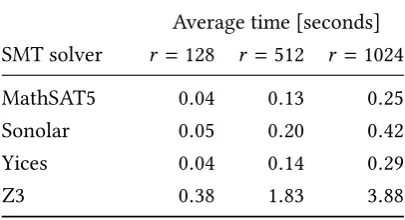
We use block lengthn=128 and three different versions of the SBC (forr ∈ {128,512,1024}) in these tests. Each result presented in Table 1 is an average of 5 distinct instances of the encryption problem.
Average time [seconds]
SMT solver r =128 r =512 r =1024
MathSAT5 0.04 0.13 0.25
Sonolar 0.05 0.20 0.42
Yices 0.04 0.14 0.29
Z3 0.38 1.83 3.88
Table 1: Performance of SMT solvers for single encryption
4.2 Known Plaintext Attack
The problem of finding keys for known plaintext-ciphertext pairs is substantially harder than simple encryption. It is unrealistic to expect a successful attack on the SBC with large number of rounds, large block length, and large number of plaintext-ciphertext pairs. For the purpose of SMT solver’s comparison, we use small valuesr ∈ {5,10,15}with the block lengthn=128. The attacks were instantiated with 10 plaintext-ciphertext pairs, where the plaintexts were generated randomly. As noted in Section 3.2 there are two possible implementations of inner product operation – fold-and-xor and extract methods. We test both variants. The results are shown in Table 2 – again, each value is an average of solving 5 different problems. Let us note that we focus on a more detailed analysis in Section 5.
Average time [seconds]
SMT solver r =5 r =10 r =15
fold extract fold extract fold extract
MathSAT5 1.99 1.59 40.20 23.98 52.64 54.32
Sonolar 0.77 0.76 3.21 3.57 6.52 6.18 Yices 0.21 0.25 9.48 8.65 17.76 19.92
Z3 1.55 1.43 4.11 3.93 20.75 12.53
Table 2: Performance of SMT solvers for KPA
Clearly, Sonolar achieves the best performance. Therefore we use Sonolar for further analyses in Section 5. Let us note few observations from the tests:
– Different problems of the same size can have vastly different solving time for the same SMT solver. For example, the odd-looking average value 40.20 seconds for MathSAT5 is caused by an outlier 104.99 seconds (other values are smaller than the average). The least variations in solving times for given parameters are exhibited by Sonolar.
5
Simple Cryptanalysis
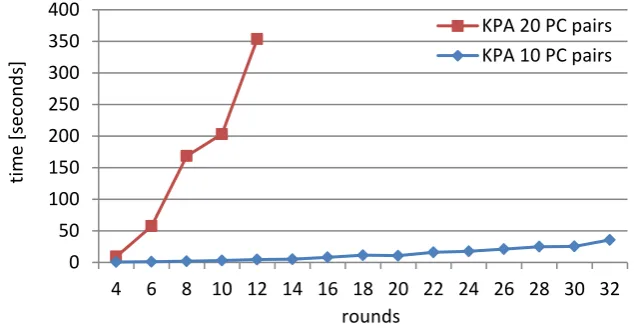
Few experiments and thoughts on the SBC security are presented in this section. All results are obtained using Sonolar SMT solver, and the extract method for the inner product implementation. First, let us show a dramatic increase of solving time when KPA deals with more plaintext-ciphertext (or “PC” for short) pairs. Figure 2 shows situation for varying number of rounds,
n=128 and 10 or 20 PC pairs (each value is obtained as an average of 10 runs).
0 50 100 150 200 250 300 350 400
4 6 8 10 12 14 16 18 20 22 24 26 28 30 32 KPA 20 PC pairs KPA 10 PC pairs
rounds
tim
e
[s
econ
d
s]
Figure 2: Comparing KPA with 10 and 20 PC pairs (n=128)
Let us note that the problem is vastly under-defined for small number of PC pairs. The SBC has key length 2rnbits, assuming independent subkeys. A single PC pair reduces the entropy of a key by at mostnbits. Moreover, a subkeyLi contributes to any encryption function by a single bit – the result of the inner product. There are many keys consistent with a reasonable set of PC pairs, i.e. the keys that transform each plaintext from the set into the corresponding ciphertext. The SMT solver simply finds some solution from the set of “consitent” keys.
Remark.We can also find an example of equivalent keys for some parameters, e.g. forn =8 andr =
2 the keys(K1,K2,L1,L2) =(0x6a,0xa5,0x62,0xad)and(K10,K
0
2,L
0
1,L
0
2)= (0xcf,0x6a,0xad,0x62), expressed as hexadecimal values, define the same permutation on{0,1}8.
Our next experiment varies the block lengthn. We set the number of roundsr = n and use 10 known PC pairs. The results in Figure 3 show a moderate increase of time needed to solve the KPA problem (the values are computed as an average of 10 instances). The situation changes dramatically (again) for 20 PC pairs: average time measured forn = 4,8,12 is 0.02 s,
0.60 s, and 234.35 s, respectively. The reason is that additional PC pairs substantially reduce the set of possible solutions for subkeys values, i.e. there is a small fraction of all subkeys that are also a valid solution for particular KPA problem. Hence the SMT solver (i.e. an underlying SAT solver) is forced to revise its guesses on unknown Boolean values more often.
0 10 20 30 40 50 60 70
4 8 12 16 20 24 28 32 36 40 44 48 52 56 60 64 KPA 10 PC pairs
block length n [bits]
time
[
se
con
d
s]
Figure 3: KPA for different block length with 10 PC pairs (r =n)
0 30 60 90 120 150 180 210 240
4 8 12 16 20 24 28 32 36 40 44 48 52 56 60 64 KPA 8 PC pairs KPA 4 PC pairs KPA 2 PC pairs KPA 1 PC pair
block length n [bits]
time
[
se
con
d
s]
Figure 4: Comparing KPA for varying number of PC pairs (r =6n)
6
Conclusion
The paper describes few experiments with the SBC. We modeled the SBC in SMT-LIB v2 and we used the SMT solver to solve small instances of the cipher in KPA scenarios. The results show that the instances with largernandr parameters cannot be solved by this cryptanalytic approach in reasonable time. The cryptanalysis using linearity of the round function [8] is clearly superior to our experiments. This illustrates the gap between a “blind” cryptanalysis (solving without any insight into the problem) and cryptanalysis that uses an identified weakness of the cipher.
Acknowledgment
I would like to thank Viet Tung Hoang for pointing out the cryptanalysis of the SBC, presented by Serge Vaudenay in the CRYPTO 2012 Rump Session (and independently found by Henry Gilbert). The author also acknowledges support by VEGA 1/0259/13.
References
[2] De Moura L., Bjørner N.: Satisfiability Modulo Theories: Introduction and Applications, Communications of the ACM, Vol. 54, No. 9, ACM, 2011, pp. 69–77.
[3] Hoang V.T, Morris B., Rogaway P.: An Enciphering Scheme Based on a Card Shuffle, Advances in Cryptology – CRYPTO 2012, Lecture Notes in Computer Science Volume 7417, Springer, 2012, pp. 1–13.
[4] Jovanovic P., Neves S., Aumasson J.P.: Analysis of NORX, Cryptology ePrint Archive, Report 2014/317, 2014. http://eprint.iacr.org/2014/317
[5] Morris B., Rogaway P.: Sometimes-Recurse Shuffle, Advances in Cryptology – EUROCRYPT 2014, Lecture Notes in Computer Science Volume 8441, Springer, 2014, pp. 311–326.
[6] SMT-COMP 2014, Cok D., Deharbe D., Weber T. (Organizers), http://www.smtcomp.org/
[7] Vanegue J., Heelan S., Rolles R.: SMT Solvers in Software Security, Presented as part of the 6th USENIX Workshop on Offensive Technologies, WOOT’12, USENIX, 2012.
https://www.usenix.org/system/files/conference/woot12/woot12-final26.pdf